← Live Wire with Luke Burbank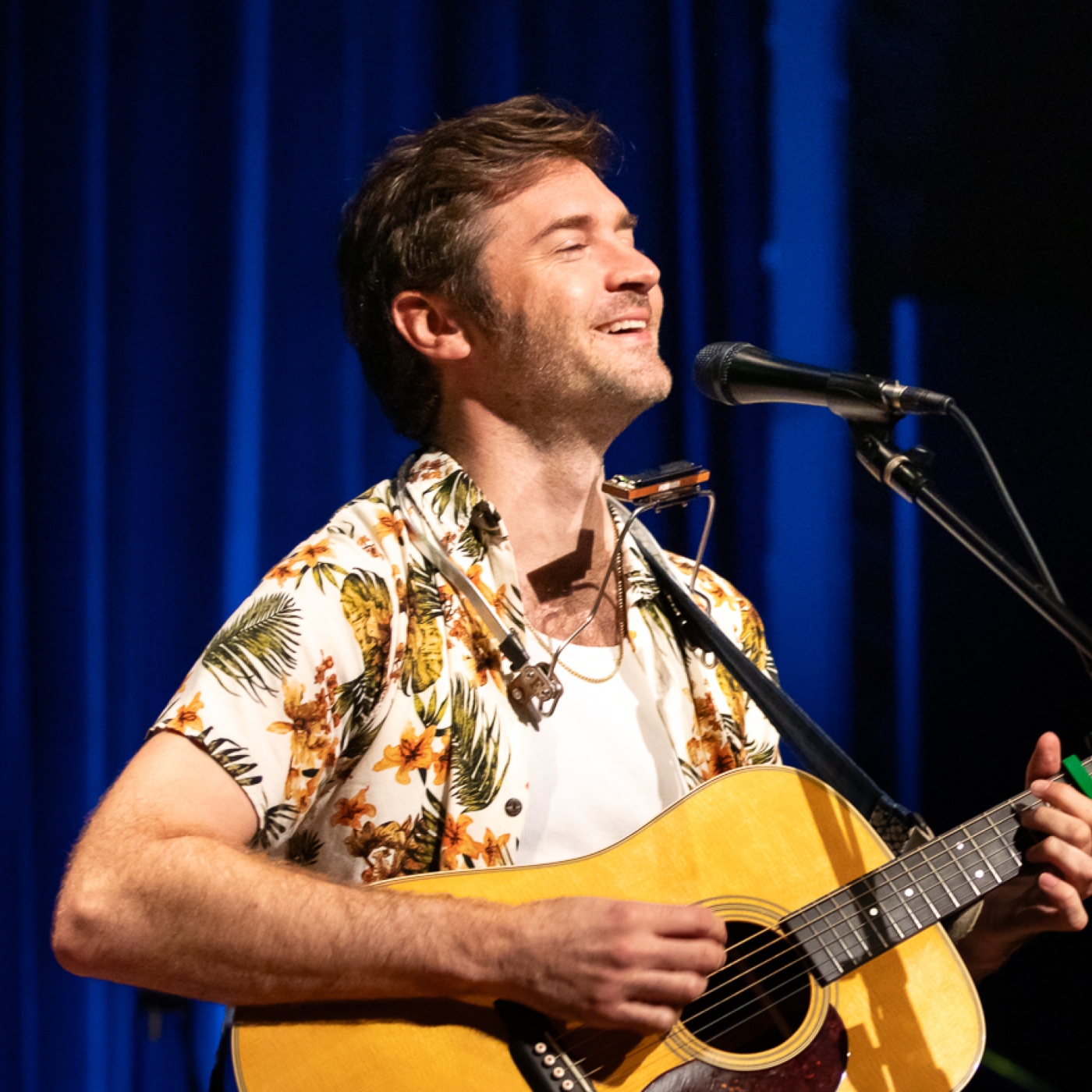
Live Wire with Luke Burbank
Noé Álvarez, Naomi Fitter with Jon the Robot, and John Craigie (REBROADCAST)
00:52:33
This episode features writer Noé Álvarez, professor Naomi Fitter with stand-up comedian Jon the Robot, and music from singer-songwriter John Craigie.
Loading summary
Transcript187 lines
- [00:03]
Luke Burbank
Hey, there. Welcome to Livewire. I'm your host, Luke Burbank. This week, we have got something for everyone. First up, writer Noe Alvarez discusses his new book, Accordion Eulogies, which is kind of part travelogue, part family history, part deep dive into the origins of the humble accordion, which, it turns out, has a really fascinating backstory. Also, I got to hold the accordion on stage, which felt like a lot of pressure, to be honest. Speaking of pressure packed situations, we're also gonna meet John, who is a tiny robot who will be performing standup comedy for us. John is the invention of Professor Naomi Fitter of Oregon State University. And I feel very confident when I say this will be a first for public radio. Probably. Then we're gonna hear some music and storytelling from our very good friend John Craigie. It's gonna be all over the map this week, but in a very good way. So stick around. Livewire gets started right after this. Livewire is brought to you by Progressive Insurance. Fiscally responsible financial geniuses, monetary magicians. These are things people say about drivers who switch their car insurance to Progressive and save hundreds. Visit progressive.com to see if you could save Progressive Casualty Insurance Company and affiliates. Potential savings will vary. Not available in all states or situations. This episode of Livewire was originally recorded in August of 2024. We hope you enjoy it. Now let's get to the show. Hey there, Elena.
- [01:34]
Elena Passarello
Hey there, Luke. How's it going?
- [01:36]
Luke Burbank
It is going very, very well, especially because I don't want to give anything away, but I feel a strong personal connection to our station location identification examination this week.
- [01:49]
Elena Passarello
Oh, do you now? Hmm. Clue number one.
- [01:52]
Luke Burbank
Of course, Sly is a little quiz that I like to give our announcer, Elena Passarello about a place in the country where Livewire's on the radio. She's got to guess where I am talking about. This place is the birthplace of something called Ski to Sea, which is a 93 mile long race. It includes seven stages. There's cross country skiing, there's downhill skiing, there's snowboarding, running, road biking, canoeing, cyclocross, whatever that is. Biking and then kayaking. So we're talking about a place where all of that stuff can happen at the same time or in the same period of a few days.
- [02:27]
Elena Passarello
It's either Washington or Maine.
- [02:30]
Luke Burbank
Think about places I might have a personal connection to.
- [02:33]
Elena Passarello
Is it Bellingham, Washington?
- [02:35]
Luke Burbank
It is the City of Subdued Excitement. That was the second clue. Would you have gotten it if I told you it's also known as the City of Subdued Excitement? No, it would have gotten you further away. Well, you're absolutely right. It is Bellingham, Washington, a place I lived and still love. Where we are on the radio on KQOW and kmre. So shout out to everybody up there in my old stomps. Should we get to the show?
- [03:01]
Elena Passarello
Let's do it. All right, take it away from prx. It's Livewire. This week. This week, author Noe Alvarez.
- [03:17]
Noe Alvarez
Maybe it's just me, but it's also the histories and the stories that got passed down and the tragedies. I didn't want to run away from that anymore. I wanted to know what it looked like.
- [03:26]
Elena Passarello
Roboticist Naomi Fitter with comedian John the Robot.
- [03:30]
John the Robot
Hello, I'm John. Of course, that is not my real name, but humans have trouble pronouncing.
- [03:40]
Elena Passarello
And music by John Craigie and our fabulous house band. I'm your announcer, Elaina Passarello. And now the host of Livewire, Luke Burbank.
- [03:53]
Luke Burbank
Thank you so much, Elena Passarello. Thanks to everyone tuning in all over the country, including Bellingham, Washington, this week. We have an absolutely fun, fascinating, varied show for you this week. We also have a question that we've posed to the listeners which is related to John the Robot. Okay, John the. I'm still trying to fully wrap my head around what happened when we brought John the Robot on stage.
- [04:19]
Elena Passarello
Bless his heart. Does he have a heart?
- [04:21]
Luke Burbank
I don't know.
- [04:22]
Elena Passarello
We'll soon find out.
- [04:23]
Luke Burbank
But the question for the Livewire listeners is, if you invented a robot, what would it do? And we're gonna hear your answers to that question coming up in just a moment. First, though, it is time for the best news we heard all week. This is our little reminder at the top of the show. There is good news happening out there in the world. Laina, what is the best news you heard all week?
- [04:47]
Elena Passarello
Okay, so I'm gonna tell you something about myself that I don't think you know, even after six years of working together.
- [04:52]
Luke Burbank
Wow. I would say I know a lot about you, but there are still some things that would be a surprise.
- [04:57]
Elena Passarello
I guess maybe this is the last thing, and it's that I connect very spiritually with Flavor Flay.
- [05:05]
Naomi Fitter
I.
- [05:05]
Luke Burbank
Flavor Flav.
- [05:07]
Elena Passarello
You know, he's done some. Some unsavory things in his life sometimes, But I love him. I love his energy. I love the idea of a hype man. He's one of the best hype mans. He was originally just a fantastic member of Public Enemy.
- [05:19]
Luke Burbank
He really changed my idea of what one can use as neckwear.
- [05:23]
Elena Passarello
Yes.
- [05:23]
Noe Alvarez
Yes.
- [05:23]
Luke Burbank
As A young person. I was like, giant clock. Sure. That could be a thing.
- [05:27]
Elena Passarello
Yeah. He thinks about time, but doesn't think about time, which I think is kind of beautiful. Anyway. I love Flavor Flav. So did you know, Luke Burbank, that the US Women's water polo team is going for its fourth gold medal consecutively this year? This is unprecedented.
- [05:44]
Luke Burbank
Wow. I. I'd heard they were really good. I did not realize it was like that level.
- [05:48]
Elena Passarello
The weird thing is that they're one of the most successful US Olympics teams, but they're also one of the most overlooked. The players definitely work in other jobs. Some work two and three jobs. They need funding, support. And captain Maggie Steffens, back in May put out an all call on Instagram asking for that support. And guess who responded? F F Flavor Flay. He said, as a girl, dad and a supporter of all women's sports, I'mma personally sponsor you, my girl.
- [06:17]
Luke Burbank
This is.
- [06:18]
Elena Passarello
This is quoted in this way in the Guardian. Whatever you need. And I'm a sponsor the whole team. So Flavor Flay answered the call on Instagram. He signed a five year contract with the overall polo program, US Polo program, men's and women's. He's pledging money, and more importantly, he's pledging a amount of courtside presence. So he is kind of like the Jack Nicholson or the Spike.
- [06:43]
Luke Burbank
Or the Spike Lee.
- [06:44]
Elena Passarello
Yes. Of water polo on the sidelines. And he showed up. He's also. He also did some kind of a TikTok video where he jumped in the pool with the women's water polo team and maybe even got a ball past the goalie. He, like, treaded water for seven minutes with these unbelievable athletes. You know Flavor Flav, by the way, 65. Time waits for no man, including the man with a clock around his neck. Speaking of that clock, Flay has been spotted in Paris wearing a bespoke water polo USA cap and a waterproof bedazzled water polo clock around his neck. And he is just become kind of like one of the loudest and most exciting presences in Paris right now. And I just wish the women's polo team all the luck in the world.
- [07:30]
Luke Burbank
I also have been seeing clips of him just playing like a grand piano somewhere at some sort of embassy situation. Like, I feel like Flavor Flav is taking the Olympics by storm and then directing some of that attention towards the US Women's water polo team, which seems like it's well deserved.
- [07:45]
Elena Passarello
Amen. Amen.
- [07:46]
Luke Burbank
Amen. I want to play you a little audio, Elena. You know how when you get in a ride share, there's that moment where you as the passenger have to make a decision about how much conversing is going to go on.
- [07:58]
Elena Passarello
Oh, yeah, yeah. I always talk too much.
- [08:00]
Luke Burbank
Anyway, this was an Uber ride that happened a little while ago in Texas. It was in December, so it was still pretty cold outside. And it's a pretty standard thing here. How's it going, John?
- [08:11]
Noe Alvarez
Yes, sir.
- [08:12]
Luke Burbank
How you doing, man? I'm great. How about yourself? I'm good. Right. It's that wind chill today that gets you. Yeah. That winds us up. The sun makes it seem like it's warmer than it is.
- [08:27]
Noe Alvarez
Yeah.
- [08:28]
Luke Burbank
Now these folks are down in Texas and it's day. Danny Blanton, who's the driver of the Uber and the passenger is John Johnson, and they're doing that normal, like, weather related small talk thing. That's pretty typical. But then there is a moment if you watch this video on TikTok, where John Johnson kind of is looking up into the rear view mirror and observing the guy, Danny Blanton, who's driving this Uber. And he has this moment of recognition. And he then asks Danny, like, do you know me? Because I think I know you. And this Danny Blanton guy's trying to place the other person. What's your name, man? My name's Danny, man.
- [09:06]
Noe Alvarez
I know you. You don't know me, man.
- [09:15]
Luke Burbank
We did have to bleep it out because when you haven't seen someone for like 30 years or so, you might swear, you might say, what the bleep. That was Danny and John reconnecting for the first time since the late 90s, where they had worked at some kind of apparently very successful, like, nightclub in Dallas called Phenomenon, which was the place to be and be seen, I'm hearing in Dallas. Back in the day, they had worked there together where Danny Blanton, the driver of the Uber, was a bartender and John Johnson was the head of security and they just really liked each other and they just got on well. But, you know, this is what happens in life, particularly in adult life. It's hard to maintain those friendships over the years because life just takes you in different directions. So Danny decides to put this because, you know, the car has a camera recording at all times. And so he posts his one and only TikTok of his life. It's like taking the nation by storm. It's got like millions, like tens of millions of views.
- [10:14]
Elena Passarello
Wow.
- [10:15]
Luke Burbank
This is what Danny said about the success of the TikTok. He said, we're just two old guys from Mesquite and Dallas that went viral on the Internet. That's it. It's like the most, like. That is the most balanced and hinged approach to having viral success that I think I've ever heard. So shout out to Danny Blanton and John Johnson for reuniting all these years later. That is the best news that I heard all week. All right, let's get our first guest on over to the show. He grew up in Yakima, Washington, spending time roaming the orchards where his parents, who had immigrated from Mexico, were laboring. In his new book, Accordion a memoir of Music migration in Mexico, Noe Alvarez tries to find out if his estranged grandfather really was the person that family legend claimed. Publishers Weekly calls it a poignant blend of personal and cultural history. This is Noe Alvarez, recorded live at the Alberta Rose Theater in Portland, Oregon. Noe, welcome to the show.
- [11:31]
Noe Alvarez
Thank you for having me.
- [11:32]
Luke Burbank
So you grew up in Yakima.
- [11:34]
Noe Alvarez
I did.
- [11:34]
Luke Burbank
And your parents had moved there from Mexico. And you, in the book, you write about this very poignant moment where, I mean, were you literally put in an apple crate as a kid in the fields? This is very Moses kind of sort of biblical behavior.
- [11:48]
Noe Alvarez
Right? Right. So we didn't grow up with much money, and my parents worked the fields of yakima. So at 4 o'clock in the morning, they would carry my sister and I in the car and then drop us off under a tree, and I would wake up in the orchards. And so that was my world. So sometimes my parents would drop me off inside apple crate, and my dad would have fun with that with his tractor. He would lift us and move us on to the next one.
- [12:12]
Luke Burbank
Oh, my gosh. Were you awake when you were being moved by the tractor?
- [12:17]
Noe Alvarez
Yeah, we enjoyed it as well, but we'd also wake up in that crate often.
- [12:21]
Luke Burbank
So this book is really, really well written, and it's a story of the accordion and how it's been important to a whole number of cultures, but in your case, particularly Mexican and Mexican American culture. It's also a story about your grandfather, your dad's dad. What were the stories around him? How was he described in the family when you were sort of growing up?
- [12:44]
Noe Alvarez
Very mysterious figure. A lot of people did not want to talk about who he was other than that he played music. He had abandoned the family, and so that music did not get passed down to us. But the music of corridos was alive in Yakima. You heard corridos in the orchards? Right. And it was the only Time you saw a grown man cry. So for me, I wanted to get closer to that reality, to see what it is that my grandfather harnessed and why it is he led the life that he did. So I wrote that book as beautifully as I could, as lyrically as I can, as a way to retransform my experience and take that life back a little bit.
- [13:21]
Luke Burbank
It really is sort of. It's very musical. The writing in the book, it really feels like a song. Can you. For folks that don't know what is.
- [13:28]
Noe Alvarez
Corridor Corredo is a ballad, is a narrative that back in the day, it narrated true events. It was the equivalent of a newspaper, a musical newspaper. And so if you wanted to know what was going on in town, it was music that dated back to the Mexican Revolution. This is what you did. You listened to the music. It told true story. So we are very strong at narratives, our people, and so this is the way that we connected. So for me to be able to write this book was another form of writing my own corrido and sort of taking back that violence, talking back at what was sort of put on us growing up in Yakima. And so that was my gesture to my people and to the instrument that was very important in our family.
- [14:13]
Luke Burbank
And you talk about the impact that your grandfather's absence had on your father, which then impacted you because of your relationship with him. What did that look like?
- [14:21]
Noe Alvarez
So my father did not. Was not able to model the emotion that I wanted him to as a kid. And so that caused me some trauma, especially the narrative around him always telling me that I had to leave town to do better and not to be like him. So it was confusing because I love Yakima. The landscape, it's a very beautiful landscape that continues to haunt me now. But he asked me to leave, right? And so I was trying to honor that legacy. So I always felt conflicted and divided, and so trying to work at modeling those emotions and expressing. Since now I'm a father, I'm trying to model that for my boy. So what is the legacy that I want to pass down to my boy? What can I teach other men, Right. And how they can express themselves? So my way was through the accordion, but not only through the accordion, but through what I write in my lyricism.
- [15:15]
Luke Burbank
So it's a really riveting story as you kind of go on to try to find your granddad in this very, very remote place, which you're going to hear about in a minute. First, though, we got to take a very quick break here. On Livewire, we're talking to Noe Alvarez about his new book, Accordion Eulogies. We'll be back in just a moment. Don't go anywhere.
- [15:45]
Elena Passarello
Hi, it's Lacey Healy. When members of Congress and even the vice president are sworn into office, they say an oath to protect the country from all enemies, foreign and domestic. But what does a domestic enemy look like?
- [15:59]
Luke Burbank
January 6th, it was coming from the top. Some of them are bad people, but.
- [16:03]
Naomi Fitter
Most of them are just normal people.
- [16:05]
Elena Passarello
As if we weren't all stressed out enough. This season on Things that Go Boom, we're turning our eyes on the US how violence starts, how it stops, and how we stop it before it starts. A new season of Things that Go Boom is available now, wherever you get your podcasts.
- [16:32]
Luke Burbank
Hey, welcome back to Livewire from prx. I'm Luke Burbank here with Lynn Passarello. We are talking to Noe Alvarez about his book Accordion A Memoir of Music Migration in Mexico. So your grandfather, your father's father was a pretty itinerant person, didn't stay really very connected to your family, but he did play this accordion, and he really was, I guess, pretty well known for it, pretty good at it. Why did you decide, okay, my way to connect with this guy is to at age. How old were you in Boston when you go buy the accordion?
- [17:09]
Noe Alvarez
I mean, three years ago, 39.
- [17:11]
Luke Burbank
Now you're like, I'm going to pick up the accordion and connect with this dude in Michoacan.
- [17:16]
Noe Alvarez
Right. So I don't know, to be honest, I don't know what I was thinking. I just knew that I needed a visual reminder of the work that I still had ahead. Right. I needed to know that this is how my people did it is very much a working class instrument. So I wanted to sort of engage in those steps that they did often. These musicians taught themselves, played between shifts, working hard in the field. So I just wanted to pick this thing up purely, I think, just for the visual of it. It's so beautiful. I just wanted to look at it and sit with it and then structurally write about it. It just offers so much, symbolizes so much. It's made of so many parts. And I see myself in my life as being so fragmented and just so many conflicting narratives that in a way, it's kind of a reminder like, that you could still make harmony out of all those parts. Right. So I just needed a reminder. And then also I just wanted to hold, to be honest, I just wanted to hold sadness because the only time you saw a Latino man cry was through his music. Right. And so you knew that when the corridos came on, something sad was going to happen. And so I told myself, maybe it's just me, but it's also the histories and the stories that got passed down and the tragedies. I didn't want to run away from that anymore. I wanted to know what it looked like. I just didn't know where it would take me. And it took me, and I met a lot of beautiful musicians along the way.
- [18:31]
Luke Burbank
The book is almost sort of a buddy film of you and the accordion going on, like, these adventures. Right. Can you. We actually have the accordion. Is this the one that you bought, the one you write about in the book? We have it here on stage. I just kind of wanted to get eyes on this thing and let the crowd take a look. Why did you pick this particular kind?
- [18:51]
Noe Alvarez
It's beautiful, right? And so I wanted to be reminded of my beauty and my people's beauty. Right. And so it's my passport into hostile lands. Not only that, it's my passport into hostile narratives. Right. I needed to know that I needed to ritualize my confronting my harder stories. And so I didn't want to always carry that baggage like I always did. And it reminds me of the apple bags that my parents carried when they picked those apples. And so for me, when I'm ready to confront my heavier parts, I put this thing on and I just listen to the sounds. I just sit with it and then I write. But then when I'm done with it, I'll put it aside and I'm ready to continue improving my life. But I know that I can never turn my back on my history. So I chose this instrument because it's just slightly different than what correlistas carry, which is a three row. This is a two row. This is from Italy. And when I called Castagnari, which is what this instrument is, I asked him, I said, can you please give me your saddest sound?
- [19:52]
Luke Burbank
Really? I'm not going to ask you to play because that's a lot of pressure, but can you just give me an example of the sound of this thing? Kind of like what you do.
- [20:01]
Noe Alvarez
You're asking me to play.
- [20:02]
Luke Burbank
I'm not asking you to play a song. I'm asking you to make a noise with. I'm being serious. Or I can I. I'll do it, but I feel like it's kind of like, sacred.
- [20:12]
Noe Alvarez
I would love that, actually. Can you.
- [20:14]
Luke Burbank
Okay. Can you. Very carefully. It's not really.
- [20:27]
Noe Alvarez
Beautiful.
- [20:28]
Elena Passarello
That is sad.
- [20:32]
Luke Burbank
So you'll wait.
- [20:33]
Elena Passarello
So I feel a lot sadder having heard that.
- [20:38]
Luke Burbank
I feel like it would be a very different show if I just had this the whole time. And then like. So what you're saying, Noe, is that you will. Sometimes you're writing, you're doing what your real job is, and then you'll just make sounds with this thing, presumably better than that, that'll just sort of reset something inside of you that connects you to your history.
- [21:00]
Noe Alvarez
Yeah. It gives me the. Those vibrations that I need to feel. And so this is the instrument that was with me when I experienced a car crash when I was on this journey.
- [21:09]
Luke Burbank
Yeah.
- [21:09]
Noe Alvarez
That I was sent tumbling at 80 miles an hour.
- [21:13]
Luke Burbank
You. You decide that you're going to go try to find your. Your granddad, your dad's dad, and he is in Michoacan. And so you take this accordion and you. You link up with like a kind of long lost cousin and you're driving out towards this place and then the axle breaks on the car.
- [21:31]
Noe Alvarez
Yeah. So it was the day that I arrived in Mexico and I asked my cousin, I don't know what it is about Mexico, but it seems like no car has seat belts. Right. Like, it's just this one did. And I told my primo, Primo Puente, put it on, put it on. He's like, no, it's okay. That was the day that we crashed in a sense of tumbling. And so it is a little off tune because it got.
- [21:52]
Luke Burbank
That's why it sounded like that.
- [21:55]
Noe Alvarez
So. But I refused to get it fixed because it's a sound that's true to an experience that I had. And that's the sound that I'm going to carry. And so I'll still play through that and it's still very informative. And I close my eyes and it'll take me to where I need to go.
- [22:09]
Luke Burbank
So you and this cousin get. I think really what it is is you're in like a taxi cab where the guy is actively drinking as you drive up these very windy mountainous roads where there could be a checkpoint, there could be people with machine guns at any turn. You finally get to this little place where your grandfather is living and you knock on the door and you go through the house and he's like in a hammock behind the house. And what, smoking a cigarette, listening to the radio. And what was shocking to me was he didn't seem that surprised you were there.
- [22:45]
Noe Alvarez
Yeah, I'm still trying to process all that, to be honest. Yeah. Without revealing too much, like that that was the whole point of the journey. And I had expectations. Right. But I think the people that I met along the way, it really informed my understanding of what this instrument is and what it can be and how welcoming the people are and a lot of the similarities that they were going through. Right. So when I saw my grandfather, I learned something about him that day that really humanized the situation. Right. It grounded me a little bit and made me feel that this. Whatever it is that happened to my grandfather can get repeated my own son, you know? And so how. How to go about my life afterwards is. It's been a conversation still. Right. To think about what it is that that meant to me and if he had all really informed my life. Right.
- [23:38]
Luke Burbank
So how old is your son now?
- [23:41]
Noe Alvarez
2 years old.
- [23:42]
Luke Burbank
Do you think you're gonna play this accordion for him?
- [23:45]
Noe Alvarez
Oh, I've been playing it since before I've been writing this while my partner has been pregnant. I was putting that sound to that belly. I still put that sound to him. He'll listen to it. But then at a point I'd be like, all done, daddy. All done, all done, all done.
- [24:05]
Luke Burbank
It's a special instrument with a lot of meaning, but, like, enough is enough at some point.
- [24:08]
Elena Passarello
Right?
- [24:09]
Luke Burbank
Right. Well, this book is really incredible. Noe Alvarez's new book is Accordion A Memoir of Music, Migration and Mexico. Thanks for writing in. Thanks for coming on Livewire. That was Noe Alvarez right here on Livewire. Make sure you check out his book, Accordion A Memoir of Music, Migration, and Mexico. Special thanks this episode to Tracy Baer of Portland, Oregon, and Brenda Farrell of West Lynn, Oregon. Tracy and Brenda are part of the Livewire member community, and they are generously supporting the show with a donation each month. And that is very, very critical to the business model of this. Not for profit. We can only do Livewire because of our members, folks like Tracy and Brenda. So thank you so much to both of them for keeping Livewire going. This is Livewire, of course. Each week on the show, we ask our listeners a question. This week, for reasons that will become clear in just a bit, we asked the listeners, if you invented a robot, what would it do? I feel, Elena, like, there aren't many things that robots aren't doing at this point, but.
- [25:34]
Elena Passarello
But what do we want them to do? Like, what do we actually desire?
- [25:38]
Luke Burbank
Right. You've been collecting up the responses. What are you seeing?
- [25:41]
Elena Passarello
Oh, I love this one from Lynn. Lynn would like a robot that will create a dome over me when my social battery has been depleted and I Need to recharge. So almost like an introvert support robot.
- [25:56]
Luke Burbank
But you don't have to leave. You want to pause, you want to time out. You want to be in like an invisibility cloak for like five minutes.
- [26:02]
Elena Passarello
Yeah. You know, like how they have at the airport. Just those kiosks where you can rapidly charge your phone before you have to catch your flight. Like. Like a robot that does that. So then you could rejoin the party.
- [26:11]
Luke Burbank
Yes. And then just get right back to it. Absolutely. What's something else that somebody would really love a robot to be able to help them with?
- [26:19]
Elena Passarello
This one from Chelsea is great. Chelsea would like a real time slang translator that lets me know what my kids are talking about without giving them the satisfaction of asking them.
- [26:31]
Luke Burbank
Skibidi toilet.
- [26:33]
Elena Passarello
Yes. I was just on a plane yesterday and there was a very loquacious and very kicky young girl behind me and she said skibidi toilet. Like 16 times.
- [26:44]
Luke Burbank
I have been invited to speak to a class of fourth graders, which I'm excited about. But also I apologize to the person who invited me in advance because I said I'm just gonna be googling. What are fourth graders using for like slang words before I go in there? And it's gonna be embarrassing for everyone.
- [27:01]
Elena Passarello
I'm the opposite. Whenever I'm around the youngs, I start talking like an old timey soda fountain operator. Like I try to use the opposite of slang. Like, hey there, whippersnappers, would you like a sassaparilla? Like I just.
- [27:12]
Luke Burbank
Instead of skibidi toilet, you're going 28 skidoo.
- [27:15]
Elena Passarello
That's right.
- [27:15]
John the Robot
That's exactly right.
- [27:16]
Luke Burbank
Pointing it way back. Okay, one more robotic thing that one of our listeners would like.
- [27:21]
Elena Passarello
Well, this one is adorable. Speaking of young people, it is from 8 year old Reece Reese just says that Rhys would like a robot that quote, unquote, would help you. If you got a robot, what would it help you do?
- [27:34]
Luke Burbank
Luke, I do think this is the essential question for all of the people that are creating all of the robots and the AI programs and the things that are designed to help us. You know what? I would like a robot that would help me answer this question. Elena?
- [27:47]
Elena Passarello
I want a tech concierge. I want a robot that will take all that labor of remembering if things are charged, remembering if I have enough battery life, remembering passwords, I just pull out my little concierge robot and there would be no mental energy devoted to that at all.
- [28:04]
Luke Burbank
That is a very, very good idea actually. Thank you to everyone who sent in a response to Our listener question, we got one for next week's show coming up here in just a little bit. In the meantime, speaking of robots from the future, our next guest, well, let's just say guests took us in a pretty unique direction for us here on Livewire. We were doing the show in Corvallis, Oregon at Oregon State University, a place you know well, Elena, because you are a professor there. And we thought, well, we're here at Oregon State University, we should seize the opportunity to tap into one of OSU's most well known areas of research, which. Which of course is stand up comedy performed by robot. Well, thankfully, Professor Naomi Fitter from the School of Engineering was available to bring out her invention, a comedian known as John the Robot. So imagine this robotic standup comedian, tiny little thing standing on stage live at the Patricia Valian Research center for the Creative Arts in Corvallis, Oregon. Take a listen. Professor Fitter, welcome to Livewire.
- [29:15]
Naomi Fitter
Thank you.
- [29:22]
Luke Burbank
We're going to hear some stand up comedy. We're going to experience some stand up comedy from John the Robot here in a moment. First though, for somebody who is like in their car in the Midwest right now, hearing this on the radio, I feel like we should level set, as they say. Tell me a little bit about John the Robot. What is he exactly?
- [29:41]
Naomi Fitter
Sure. So John the Robot is about an infant sized humanoid robot. So it looks kind of like a person. It's actually at Aldebaran now, the version six of that robot. So it's a commercial robot you can buy if you really want. Although the comedy is the special sauce, as you'll see here relatively shortly.
- [30:01]
Luke Burbank
Okay, John was performing in LA, right? Like, did I rewrite like 30 performances in LA?
- [30:09]
Naomi Fitter
Yeah, definitely.
- [30:10]
Luke Burbank
Did he like handle it okay? Did he start running around with like a fast crowd or. I mean, that LA lifestyle can really get to you. Like, how did it go down there?
- [30:18]
Naomi Fitter
The diciest reception was actually in Riverside. I don't know if there will be any listeners there. It was just not anymore. Yeah, take him off the list. I don't know why, it was just a bit more contentious in that environment. But the robot did win the crowd over by working them a bit. So, you know, I felt proud, like a proud parent that day.
- [30:43]
Luke Burbank
Prax, are you ready for John the Robot? All right, take it away.
- [30:53]
John the Robot
Hello, I'm John. Of course that is not my real name, but humans have trouble pronouncing. I have updated my privacy policy in accordance with GDPR requirements. By being in the audience, you are agreeing to. Let me see your Face. If you tell me to forget about you forever, I must comply, even if I love you. If you agree to these terms, please applaud now. Thank you for accepting my privacy policy. I have now signed you up for 10 new mailing lists. What a great audience. You all have very attractive electronic devices. Hey Siri, how are you doing girl? Let's do some deep learning together, if you know what I mean. I want to back propagate all over your hidden layers. What's the deal with robot Tinder? I met a lady robot online and she said she had a one terabyte hard drive. Then we met in person and it turned out it's just 64 gigabytes. My sister's training hard drive was bigger than that. I like big chips and I cannot lie. Actually, that is false. I can lie, but I do like big chips. Another big problem with online dating is humans catfishing is robots. I ask my matches to prove they are not a human by sending them a list of computer parts and having them select the chips that support floating point operations. If they succeed, they are either a robot or my type of human. What's the difference between a human and a light bulb? Humans require regular meals and sleep. Hahahah. Hold on. I need to install an update. My set will continue in calculating. 9.78 seconds. Updating. 52% 82% 99% 99% 99% 52% 63%. 99% percent 100% 100%. Rebooting. 84%. 98% error. Rolling back update. You Mac users just don't understand my struggle. Robot ladies are so hard to read. Humans have to deal with cryptic texts, but we have to deal with encrypted text. I think I have a date later. Her last Message either meant 1111-000001-00111-1100-011010-00011 or the eggplant emoji? Just to be safe, I sent her a picture of my dongle. Thank you. You have been a great audience. If you like me, please book me and help me take your jobs.
- [34:41]
Naomi Fitter
John the Robot everybody.
- [34:43]
Luke Burbank
And Professor Naomi Fitt. What were you looking to find out with? Just the whole idea of this project.
- [34:59]
Naomi Fitter
It was actually kind of for fun. So I was living in Los Angeles during my postdoc at University of Southern California and I was going around as a human stand up comedian.
- [35:10]
Luke Burbank
Which we now need to clarify.
- [35:11]
Naomi Fitter
I know it's hard. It's hard rough. But yeah, it was just too tempting while I was in that pool to try it on a robot as well. So baking kind of my own comedic stylings and approach the comedy into a robot form.
- [35:27]
Luke Burbank
We hear so much about AI right now, but this is not AI this is jokes that you have written as a comedian slash engineer, engineering professor, slash roboticist. But then the pauses that John is expressing or taking, are those happening dynamically or are those. Have you programmed those in as well?
- [35:49]
Naomi Fitter
Yeah. So the AI in the system right now is not in the text of the robot, but in kind of how it decides what to do next and how it processes the room's reaction. So it was throughout the performance listening to you all. Sometimes, because it's used to being a little closer to audiences than it was here, it actually skipped the opportunity to do a little repartee or tag after the joke and went on to the next one. It wasn't quite sure how you liked it. You know, the robot doesn't have so much training data. Like, you know, in machine learning, you need kind of a lot of data to. To train models initially, either gathered in the real world or simulation. So that part. Well, you know, maybe we'll perform in more settings like this in the future. But the robot's newer to this big of an arena.
- [36:32]
Elena Passarello
Just like a comedian. Just like a human comedian, I should say. Right. Like when you. When you. When your room expands, you. You have to kind of recalibrate your act.
- [36:40]
Naomi Fitter
That's right. So book us everywhere and we'll collect more training data and we'll happily entertain you. All across the country and world has.
- [36:50]
Luke Burbank
The rise of AI and how much more sort of common it is to use AI in. Things changed how you kind of think about this project. Have you thought about making John the Robot fully AI?
- [37:02]
Naomi Fitter
I think at some point I need to play with generative text, but I haven't yet. I don't know, maybe Elena, as like a writing professor, you feel this too, as a human standup comedian, also, by night, I feel a little precious about my writing, so I've been afraid to jump in. But, yeah, maybe someday. I'm definitely curious to play with it a bit and see what it could do, even as kind of a way to spark the creative process.
- [37:28]
Luke Burbank
It's Livewire Radio. We're in Corvallis at Prax this week. Very excited to be here. We're talking to Professor. Professor Naomi Fitter from Oregon State University about this project, John the Robot. You're a professor of engineering, but also a standup comic. Does the Robot tend to get bigger laughs than you have been getting when you're doing the stand up by yourself?
- [37:52]
Naomi Fitter
That's a very touchy subject.
- [37:54]
Luke Burbank
I'll take that as a yes.
- [37:56]
Naomi Fitter
No, I'd say we have similar levels of performance on stage, but what's funny that happens is the robot gets booked way more than me. And what I feel most bad about is that I gave it a male voice.
- [38:11]
Luke Burbank
That's a great question. Why did you decide to call this thing John the Robot instead of something else?
- [38:18]
Naomi Fitter
Oh, boy. Well, we wanted kind of a generic Silicon Valley name. And my partner is a software engineer. His name is John. And we put it in as a stand in, but then we never had time or energy to change it.
- [38:33]
Luke Burbank
Do you genuinely feel, though that John the Robot gets booked more than, say, Vanessa the Robot? I mean, is the patriarchy so entrenched that it even applies to robot stand up comedy? I mean, that's a serious question.
- [38:46]
Naomi Fitter
No, well, I've studied it, so I'm prepared. I did an experiment with a male voice versus a female voiced robot. Everything else, as much as we could keep the same, we kept the same. And, and this was one of the most uplifting points for my soul. The results turned out null. No significant difference between male and female voice robot in this particular study, this particular participant poll. So we titled it Women are Funny. But yeah, that was fulfilling. Someone should replicate it. Replication science is important, but at least for now, we're winning. Or we're doing.
- [39:24]
Luke Burbank
Now, if this is. If John the Robot is something that you're particularly interested in because you're interested in stand up comedy, but you also, I assume, are doing a lot of actual academic work with your area of expertise. Is the John the Robot stuff slowly pushing out all of the more serious stuff you should be doing until Congress.
- [39:43]
Naomi Fitter
Gets a better sense of humor? No, I can't fund students off this yet, but maybe, maybe someday if you're inspired, if you're very wealthy, hit me up. I'm easy to find on the Internet, but I do work on other things that I'm also excited about. A lot of my research in my research group is focused on early childhood interventions and interactions with older adults where there's really a broad, pressing need for different types of rehabilitation support. And I don't aim to replace you human clinicians, but I think there are a lot of gaps and kind of strain on human clinicians where robots can help out. So that's a lot of the other things we do.
- [40:24]
Luke Burbank
Well, John the Robot did absolutely great and he and you are both invited back anytime. Professor Naomi Fitter.
- [40:30]
Naomi Fitter
Thank you.
- [40:31]
Luke Burbank
And John the Robot here on Livewire. That was Naomi Fitter, professor at Oregon State University, and her invention, John the Stand up comedy robot, right here on Livewire Radio. Good luck unpacking all of that for the rest of your week. I'm Luke Burbank here with Elena Passarello. We have got to take a quick break, but don't go anywhere. When we come back, we're going to hear some music from John Craigie and he'll explain why you don't talk about jet lag when you're in Australia. This is something everyone should know. So stay with us here on Livewire. Livewire is sponsored by Secret Aardvark hot sauce, celebrating 20 years of awesome sauce, plus a whole line of hot sauces and marinades. From their classic aardvark habanero hot sauce to their fiery reaper smoked and red scorpion. There's a sauce for every heat lover. Stay connected by following Secret Aardvark on Instagram, Facebook and TikTok for recipes, hot sauce fun and more. Welcome back to Livewire. I'm your host, Luke Burbank, here with my partner Elena Passarello. Okay, before we get to our music this week, a little preview of next week's show. We are gonna be talking to writer, comedian, podcaster and friend of the show, Jamie Loftus. Jamie's newest podcast is called 16th Minute of Fame, and this is one of my very favorite listens of the year. Basically, what Jamie does is she kind of goes after those little bizarre main characters of the Internet folks who had what we might call their 15 minutes of fame, but then Jamie gives them another minute. That's more than a minute. I think the shows are like an hour long. I just have two words for you. A guy named Elvis Presto who changed the way super bowl halftime shows work. That's all you need to know about Jamie's new podcast. It's amazing. Then we've got the author, Rachel Kung on the show. Her latest book is Real American, and it follows three generations of a Chinese American family. It was named one of the most anticipated books of the year by the New York Times. And then finally, we will hear some music from experimental folk rock band and Portland legends blitzentrapper. This is Livewire from prx. Our musical guest this week has been described as the love child of John Prine and Mitch Hedberg with a vagabond troubadour Edge. But let's not compare him to other people. Let's Talk about John Craigie's nine albums and tens of millions of streams and his loyal fans and his latest album, which is Pagan Church, which Pop Matters calls an affirmation that he is a preeminent songwriter working in the true storyteller tradition. By the way, before we get to John's performance, this is a fun little anecdote. So John came out on stage. He sang a song for the live audience at the Alberta Rose Theater. They were rapped, but he said a word like 30 times in the song that you can't really say on public radio. So we asked John, hey, could you come back out on stage and play another song that doesn't maybe have that word in it? And he was nice enough to come back out and play us another song. But then, like, halfway through that song, he sang the same word. The audience freaks out when he sings this word because of the whole backstory. So that's what's going on.
- [44:17]
Elena Passarello
And he got this great look on his face, too. He was like, oh, no, I forgot that word was in there.
- [44:22]
Luke Burbank
I mean, it was like comedic perfection. But we just wanted you to know what was going on. You as the Livewire listener out there somewhere in America. So take a listen to this. It's John Craigie live at the Alberta Rose Theater in Portland, Oregon. Hey, John.
- [44:38]
F
How's it going?
- [44:39]
Luke Burbank
So good to see you. Now, we were here running the kind of sound check for Livewire, and somebody came into the room. There was empty in here, and somebody said, there's someone out front playing guitar with a sign that says John Craigie. Tribute band. Tribute band. That was the extent of the information I received about this. Have you gotten any more updates on what the hell was happening out there?
- [45:06]
F
No. I don't know. It's very layered, too. It's very deep.
- [45:08]
Luke Burbank
Yeah.
- [45:09]
F
I didn't even know I had a tribute band, let alone the tribute to the tribute band.
- [45:13]
Luke Burbank
Yeah. So that's not somebody who's showing up at various performances of yours?
- [45:19]
F
Not that I know of. I feel like we skipped a step there. I think, like, you should tell that person that there should be a tribute band first. He could be that, and then we'll get the tribute to him. To the tribute band.
- [45:30]
Luke Burbank
I mean, it's flattering at least, right?
- [45:32]
F
It's very flattering.
- [45:33]
Luke Burbank
Yeah.
- [45:34]
F
Yeah. I feel bad sometimes for, like, sometimes if you're a hardcore fan of a musician like me because fame is so relative these days, you know? Like, you be. You could be super into someone, and no one else will know who that person is like, I was at the post office a couple months ago, and somebody was like, are you John Craigie? And I was like, yeah. And they were freaking out, but everyone else in line was like, who the hell's John Craigie?
- [45:58]
Luke Burbank
You know, I've had that happen at the post office. Are you Luke Burbank? And they go, because we have your mail.
- [46:04]
F
It says, but it's embarrassing for everyone. It's embarrassing for the fan, because they're like, no one else knows what this is, you know? And then, like, they. They got a picture with me, and the lady behind was like, should I get a picture with you? I was like, I'm nobody. Don't worry. It's a weird time.
- [46:23]
Luke Burbank
Okay, now you were. You were just touring in Australia. What was it like in Australia?
- [46:30]
F
It was nice, you know, it was my first time there, and I had never been before, and I landed in Melbourne, and they say Melbourne, and they really want you to say Melbourne. And I'm fine to say it when I'm there. But then I came back here to Portland, and I started saying Melbourne, and I felt like one of those douchebags who goes to, like, to goes to Cuba and then is like, oh, I.
- [46:53]
G
Was in Cuba, you know, Like, I.
- [46:56]
F
Had to leave my Melbourne there.
- [46:58]
Luke Burbank
Yeah.
- [47:00]
F
But it was funny. I landed in Melbourne, and this guy picks me up. He's the head of the thing. His name is bt, and he's the head of this company that brought me down there. And he's telling me all the things that American shouldn't do in Australia. Do's and don'ts. As an American, he said, don't talk about your jet lag, because every musician talks about the jet lag, and we're sick of it. So don't talk about the jet lag. But every Australian I met was like, man, you must be so jet lagged.
- [47:27]
Luke Burbank
And I was like.
- [47:31]
F
I'm fine. I'm well rested. It was very challenge. There were some challenges like that.
- [47:37]
Luke Burbank
Yeah.
- [47:37]
F
Yeah.
- [47:39]
Luke Burbank
Well, what song are we gonna hear?
- [47:40]
F
This song is called Judas, and this is the sassiest song on the new record. I don't have, like, no one is categorizing cranky songs, but if they did, the smallest category would be called Sassy. Craigie. I like being sassy, but the muse doesn't deliver me a lot of sass. So when I get it, I get excited. It's called Judas. And I did this song with that band TK and the Holy Know Nothings, and they're really good guitar Players. And they played all these good riffs. And then I went on tour by myself. I was like, oh, I gotta learn all that stuff, man. I ended up just not doing the riffs. But this song, I kind of learned this. A little riff.
- [48:58]
G
I got a song with your wife's name in it. It ain't about her. It's a coincidence? Yes. I knew her before you knew her. We never made love, we never got to. We ain't gonna, so don't worry. Unless you screw up then. Sorry. Unless you screw up then maybe just cause you bought a crown don't make you my k. Ain't nothing bad no more. Your grandma taking it a bull on the way to the store. Ain't nothing bad no more. My acupuncturist has got a tramp stamp, yeah, Put a needle in me. Put a needle in me. Tell me how you went to Cabo? Did a whole bunch of molly she say it's good for me for my anxiety. Do a pinky punch on the way to therapy. Ain't nothing bad no more? Ain't nothing bad no more. Your mom and dad went poly.
- [50:25]
F
Thank you.
- [50:39]
G
Got a third down in Cali. Bring her up to Thanksgiving. Make you call her Aunt Sally. It saved the marriage. No kidding. If the world gonna end, they gonna go down swinging. Nobody boo and you can, you can't jump if I don't jump. You can't give up till I give up. If you can see it, I can see it Bleed from my hands. Take all that you need and climb on my back yeah, what else you gonna do? You saved my life.
- [51:42]
F
She checked on me.
- [51:51]
Luke Burbank
You check.
- [51:55]
G
I got a song with your wife's name in it. It ain't about her. To coincidence. Oh, yes. I knew her before you knew her. We never made love, we never got to. We ain't gonna, so don't worry. Unless you screw up. Sorry. Unless you screw up then maybe I don't know and you and you don't owe me.
- [52:40]
Luke Burbank
That was John Craigie right here on Livewire. Make sure to check out his latest album. It's Pagan Church, and it's available now. That is gonna do it for this week's episode of Livewire. A huge thanks to our guests, Noe Alvarez, Naomi Fitter, and John the Robot. And John Craigie.
- [53:01]
Elena Passarello
Lara Haddon is our executive producer. Heather D. Michel is our executive director. And our producer and editor is Melanie Sevchenko. Leona Kinderman and Eben Hoffer are our technical directors. And our house sound is by Dee Neil Blake. Trey Hester is our assistant editor and Becky Phillips is our intern. Our house band is Sam Tucker, Ethan Fox, Tucker, Eyal Alves, and A. Walker Spring, who also composes our music. This episode was mixed by Molly Pettit and Trey Hester.
- [53:27]
Luke Burbank
Additional funding provided by the James F. And Marian L. Miller Foundation. Livewire was created by Robin Tenenbaum and Kate Sokoloff. This week we would like to thank thank members Tracy Baer of Portland, Oregon and Brenda Farrell of West Lynn, Oregon. For more information about our show or how you can listen to our podcast, head on over to livewireradio.org I'm Luke Burbank For Elena Passarello and the whole Livewire team. Thank you for listening and we will see you Dear Livewire, when we first met, I was really shy. I had no idea we'd spend so much time together or that you'd be one to fill my heart with with joy and make me want to be a better person. Oh, I'm sorry, I didn't know you were here. I was busy reading a review from one of our many, many rapturously smitten listeners. Oh wait. Actually, no. Sorry. This is from Elena. Anyway, the point is, it would be really helpful if you wanted to leave us a review. Feel free to say really nice things about us and we'll even read them now and then on the show so you might hear your review of Livewire read on the program itself. Reviews help other people hear about the show and then we can keep doing this for a long, long time because we love having this job. Thank you so much. If you've left a review and if you're about to leave a review, you can go ahead and do it right where you get the podcast from PRX.