← Live Wire with Luke Burbank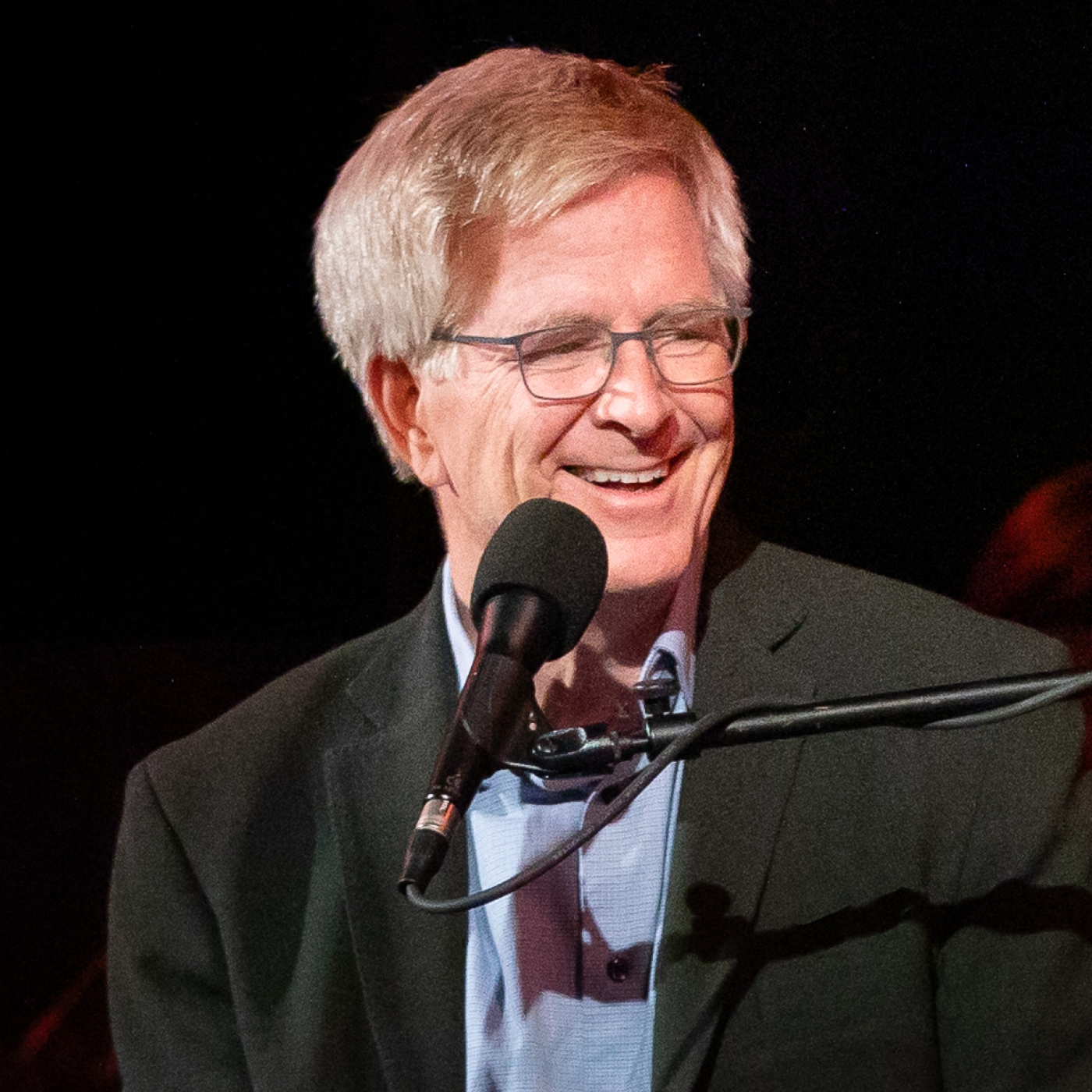
Live Wire with Luke Burbank
Rick Steves and The Lullaby Project
00:51:32
This episode features travel writer Rick Steves and music from The Lullaby Project.
Loading summary
Transcript229 lines
- [00:03]
Luke Burbank
Hey there. Welcome to Livewire. I'm your host, Luke Burbank. This week on the show, travel icon Rick Steves talks about his latest book on the Hippie Trail, which details the trip that he took when he was a part time piano teacher. That really cemented his love of travel. We're also gonna find out where in the world he hasn't been, which honestly is a pretty short list of places. Then we're gonna hear some music from the Lullaby Project and Stephanie Schneiderman. Along with members of the Oregon Symphony, they've got a piece of music written in collabor with an incarcerated mother dedicated to her daughter. It is really beautiful. You know. This week on the show we are going to be talking to our guests about some pretty life changing experiences. Look, I don't know if this episode of Livewire is going to change your life, but I can tell you it is going to make your day a little brighter. That much I can guarantee. So stick around. We've got Livewire coming your way right after this.
- [01:02]
Molly McAleer
Do you want to know what's happening on the Internet so you don't feel left out of conversation with your extremely online friends?
- [01:08]
Tiffany Scott Maddox
Then Trend Lightly might be your new favorite podcast.
- [01:12]
Molly McAleer
I'm Molly McAleer.
- [01:13]
Tiffany Scott Maddox
And I'm Tiffany Scott Maddox.
- [01:15]
Molly McAleer
We like to break down trending topics for those in the know and those who want to know but don't want to know. But want to know.
- [01:22]
Elena Passarello
I know.
- [01:23]
Tiffany Scott Maddox
What have we talked about lately?
- [01:25]
Molly McAleer
Mu dang Luigi Azealia Banks Beef with Matty Healy.
- [01:30]
Tiffany Scott Maddox
Yes, Exploring public beef so that you can be on the right side of history is a staple.
- [01:35]
Molly McAleer
Same with deep diving, long reads and holding space for new lingo. Niche drama, TV and movie RECs with.
- [01:43]
Tiffany Scott Maddox
A sprinkle of geopolitics. But like in a girly way, Trend.
- [01:48]
Molly McAleer
Lightly is available anywhere you listen to podcasts.
- [01:55]
Elena Passarello
Livewire is brought to you by Progressive Insurance.
- [01:58]
Luke Burbank
Do you ever find yourself playing the budgeting game? Well, with the name your price tool from Progressive, you can find options that fit your budget and potentially lower your bills. Try it@progressive.com progressive casualty insurance company and affiliates price and coverage match limited by state law. Not available in all states.
- [02:18]
N/A
This show is supported by Odoo. When you buy business software from lots of vendors, the costs add up and it gets complicated and confusing. Odoo solves this. It's a single company that sells a suite of enterprise apps that handles everything from accounting to inventory to sales. Odoo is all connected on a single platform in a simple and affordable way. You can save money without missing out on the features you need. Check out odoo at o D O o dot com. That's o d o o dot com from prx.
- [02:50]
Rick Steves
It's Live Wire. This week, travel writer Rick Steves.
- [03:02]
N/A
I work with 100 people up in Edmonds, and our mission is to equip and inspire Americans to venture beyond Orlando.
- [03:13]
Rick Steves
With music from the Lullaby Project.
- [03:16]
Tiffany Scott Maddox
They see their parent in a powerful place, and then I think it becomes like their anthem.
- [03:23]
Rick Steves
And our fabulous house band. I'm your announcer, Elena Passarello. And now the host of Livewire, Luke Burbank.
- [03:37]
Elena Passarello
We have got a jam packed edition of Livewire for you this week. Regular listeners to the show probably know a couple of things, and that is we do read the news. And we do usually have to give ourselves an eye bath after doing that because it's brutal. But also what they know is that we have found that there are at least each week, Alaina, two good news stories that happen in the world. Sometimes it's exactly two.
- [04:02]
Rick Steves
Yes.
- [04:03]
Elena Passarello
And we search for those and we bring them to you in a little segment we like to call the best news we heard all week. All right, Elena Passeros, what is the best news you heard all week?
- [04:17]
Rick Steves
I worked really hard on this. I felt like you needed me to come up with something real good for you, Burbank.
- [04:21]
Elena Passarello
I did. I did. I'm having a week.
- [04:23]
Rick Steves
Let's start with a question. Did you go to your college graduation?
- [04:28]
Elena Passarello
No, I did not.
- [04:29]
Rick Steves
Okay. So do you know who the commencement speaker was?
- [04:32]
Elena Passarello
No, but I know the guy from the Tim Allen Show. The Tool Time guy?
- [04:37]
Rick Steves
Yeah, the other guy. The guy with the beard guy.
- [04:40]
Elena Passarello
The other guy. I think he might have been the speaker.
- [04:43]
Rick Steves
That's good. I like that. That's pretty good.
- [04:46]
Elena Passarello
Yeah.
- [04:46]
N/A
Well.
- [04:46]
Rick Steves
Well, the University of Maryland does have you beat.
- [04:49]
Elena Passarello
Okay.
- [04:49]
Rick Steves
They have just announced who their 2025 commencement speaker is going to be. And do you know who it is?
- [04:55]
Elena Passarello
I don't.
- [04:56]
Rick Steves
It is. I'll give you a hint. He's green. And it's not easy being him.
- [05:03]
Elena Passarello
Kermit the Frog.
- [05:05]
Rick Steves
Kermit the mother trucking frog is delivering the commencement address at the University of Maryland, who I believe are the Terrapins.
- [05:16]
Elena Passarello
Uh huh.
- [05:16]
Luke Burbank
Sure do.
- [05:16]
Rick Steves
Which is a form of. It's another kind of. No, they're reptiles. Yes, whatever. So the reason for this, other than the fact that everybody wants Kermit the Frog to deliver every address ever, is because Jim Henson graduated from the University of Maryland with a degree in home economics.
- [05:35]
Elena Passarello
Okay.
- [05:39]
Rick Steves
In 1960 and I think his legacy is very deeply felt. Apparently, Kermit the Frog gave a dean's lecture there a couple of years ago.
- [05:45]
Elena Passarello
Okay.
- [05:46]
Rick Steves
So they're just, like, inviting him back.
- [05:48]
Elena Passarello
They already had the special podium built that you could hide a puppeteer in. They were like, let's get our money's worth.
- [05:53]
Rick Steves
What the.
- [05:54]
Elena Passarello
What? Oh, yeah, I'm sorry. Nothing.
- [05:56]
Rick Steves
No, I'm just gonna ignore that comment.
- [05:59]
Elena Passarello
Yeah.
- [06:00]
Rick Steves
And when asked about why he decided to agree, Kermit the Frog, who is a real living frog, said yes. If a few encouraging words from a frog can help the class of 2025 leap into the world and make it a better place, then I'll be there. I know. Isn't that great?
- [06:18]
Elena Passarello
Right?
- [06:18]
Rick Steves
It's good. Good news, but. So it had me thinking. I think Herbin Frog is one of the best Muppets to do this job. But which Muppet would be the worst animal? Animal? I think the worst one would be Beaker.
- [06:31]
Elena Passarello
Oh, well, let's be honest. They defunded Beaker, like, two weeks ago.
- [06:37]
Rick Steves
Yeah.
- [06:38]
Elena Passarello
There's no. He's not even allowed anywhere near the campus anymore for practicing science. The best news that I heard this week, Elena, it was kind of what I needed to hear as a guy who is approaching 50, approaching middle age, or maybe I'm already there. And it involves a town in Japan called Kawara. It's about 10,000 people. And the town of Quora has this trading card mania that's going on there. All of the kids are obsessed over these trading cards. They're buying them, they're collecting them, they're trading them. They don't feature, though, like, baseball players or Pokemon or anything. They feature real middle aged guys from the town. This is a set of 47 playing cards of guys who are middle age and elderly in the town of Kawara. And the kids are going crazy for these. It was started by a woman who runs a community center there. And, you know, one of the things in Japan that's been noted is that you have, you know, a lot of folks who might be older, and you don't have a lot of younger folks. And there's a pretty wide sort of distance between those two. Two groups. And so this woman thought this would be a way to get some of the younger people thinking about some of the more senior folks in the town.
- [08:03]
Rick Steves
To collect them.
- [08:03]
Luke Burbank
Yeah.
- [08:04]
Elena Passarello
To collect them. Well, yeah. You know, and so she thought, we'll have these cards. This will just be a way for the kids to identify these different, you know, middle and older Age people. The kids, though, figured out a way to make the cards fight each other like Pokemon. So like, one of the real guys from this town is a retired fire brigade chief and he can strike opponents for 200 fire damage. There's another guy on there who's a local electrician.
- [08:36]
Luke Burbank
He also has the ability to do.
- [08:38]
Elena Passarello
Damage with his electricity.
- [08:39]
Rick Steves
Oh, nice.
- [08:41]
Elena Passarello
The kids are fighting the cards against each other. These guys are becoming celebrities. There's a guy who's named the soba master, Mr. Takeshita. He's an 81 year old soba noodle maker.
- [08:51]
Rick Steves
Yeah.
- [08:53]
Elena Passarello
There's Mr. Fuji, a 67 year old former prison guard turned community volunteer whose card is so sought after, kids are approaching him on the streets to get him to autograph the cards.
- [09:04]
Rick Steves
This is so cool.
- [09:05]
Elena Passarello
It's really heartwarming. I am and I've been through all 47 of these cards. None of them are a middle aged public radio host who can defeat the firefighter by staging a public radio pledge drive.
- [09:20]
Rick Steves
Yeah.
- [09:20]
Elena Passarello
And putting them to sleep.
- [09:22]
Rick Steves
What about like nunchucks, but it's tote bags.
- [09:25]
Elena Passarello
Something, you know, I feel like this is a good start. They need to integrate in some things from my life into it. But all in all, it's a really cute story. The participation in this community center by youth in this town has more than doubled because of these trading cards.
- [09:41]
Rick Steves
So that's fabulous.
- [09:43]
Elena Passarello
Absolutely. The middle aged and elderly folks in Japan getting their due in this town. That, my friends, is the best news I heard this week. All right, let's get our first guest out here. Since 1973, he spent a minimum of four months every year exploring Europe on a mission to learn one thing. How does the metric system work? He's still trying to solve that, but in the meantime, he's also helped hundreds of thousands of people travel to Europe in ways that are fun, affordable, and culturally broadening. Not to mention the millions of viewers to his public television shows and listeners to his radio show. Plus readers of his travel books. The latest of which is the story of his time on the so called hippie trail from Istanbul to Kathmandu in the 1970s, which launched his lifelong love of travel. Please welcome Rick Steves to Livewire. Rick, welcome to Livewire.
- [11:03]
N/A
I'm still trying to figure out how tall I am in metric.
- [11:07]
Elena Passarello
You know, you and I were chatting backstage and you were talking about the kind of celebrity that you enjoy, which is either people have no idea who you are or they are obsessed with you and your work. And I think we have encountered door number two here. @ Benaroya Hall.
- [11:26]
N/A
Whoa.
- [11:27]
Elena Passarello
Yeah. What do you think it is about your TV show and your writing and all the stuff you do that causes such a fervent response from your fans?
- [11:40]
N/A
A lot of times I think people have a great trip and they just want to thank somebody for it. I get thanked for Malta and I've never been there. You know, somebody comes up out of the blue, I've never seen them before, and they go, we had the greatest time in Malta. Thank you so much. So what am I supposed to tell them? I just say, you're welcome.
- [12:04]
Elena Passarello
I really enjoyed this book of yours on the hippie trail. I was also reading it while traveling. Not in the manner that you do in the book, which is pretty Spartan, but it was just such a fun book to be traveling with and reading and thinking about travel. I'm curious if you could take me back to when you wrote this. Although I guess at the time you didn't realize you were writing a book. You were not a famous TV host. You were a recent college grad piano teacher who was going from. It was Istanbul, the Kathmandu. What were you doing on this trip?
- [12:34]
N/A
Well, first of all, this is my newest book, but it's also my oldest book. I wrote it when I was one third the age I am now. I was 23 and I had been to Europe several times and I just wanted something more. And I whispered into my friend's ear, go east, young man. And we both got together, me and my travel buddy Gene, and we headed east from Istanbul to Kathmandu. And that was the. That was the ultimate road trip. Back then in the 60s and 70s, the Beatles were hanging out with the Maharashtri yogi, you know, and it was just like the ultimate trip. And I wrote this thing for myself. As you said, I was just a piano teacher. I had no idea I was going to be a travel writer. And I diligently wrote a 60,000 word journal filling up an empty book that's just like that. A hardbound 200 page book with beautiful penmanship. I cannot read my writing now, but for some reason then I thought that this.
- [13:28]
Elena Passarello
You had a graphic designer transcribe your actual, you know, chicken scratch and make it. This is your handwriting.
- [13:34]
N/A
That's my handwriting. Yeah, but Luke, that book was when I wrote it. And then, you know, you get home and you get onto other stuff. And I basically, I may have read four or five pages of it in 40 years. And then during COVID I got a chance to do some things I didn't have time to normally and reading that journal was like, it was like an anthropological dig into a 23 year old version of myself that I had mostly forgotten about. And it was so cool to be able to look at that and see it as this coming of age trip as kind of the compost pile of experiences from where I would grow out of as a travel teacher.
- [14:11]
Elena Passarello
Because it was, you know, a lot of time on buses and a lot of kind of, you know, overnight situations in places that were pretty spartan. Did you have moments on that trip where you thought, maybe I've bitten off more than I can chew or maybe I'm not really cut out for this sort of life?
- [14:26]
N/A
Well, it was a long, long, long road. And when you leave Istanbul heading east in 1978, there's no Internet. You know, you've got some traveler's checks in your money belt, no parents to bail you out. It occurred to me when I headed east from Istanbul that there's not a soul between here and Seattle that even knows I exist. And I didn't know anybody between there and Seattle. And we were going that way and there was no information back then. Now we have too much information almost. But back then it was tough to get information. So, you know, we didn't know where we were going to be tonight or anything like that. We are naive, relatively wealthy American, easy targets for all the con artists along the way. And on the hippie trail, it was said everybody knew there was two kinds of travelers. Those who knew they had worms and those who didn't know they had worms. And we kept going deeper and deeper behind the dark side of the moon, basically. And we kept thinking, in one way it was like a fantasy, and in the other way it was just miserable. And we thought, it's not too late to turn around and go back to Santorini, where all the kids were having a great time at the youth hostel. And we got farther and farther away. And we kept thinking in four days of hard travel, we could be back in the Greek isles. But we kept going. And then we finally got to Afghanistan and we realized, this is why we're here. It really got magic. We reached the point of no return and then we crossed into India. And it was one of the great high five moments of my life just to cross that border and do high five with my buddy. And then we went to the end of the hippie rainbow, Kathmandu. And you got to read the book to know what's happened to Katmandu.
- [16:05]
Elena Passarello
Legally, we can't even talk about it on public radio. In fact, legally, we have to take a break. This is Livewire from prx. We're at Benaroya hall in Seattle this week talking to Rick Steves about his book on the Hippie Trail, Istanbul to Kathmandu, and the making of a Travel Writer. Quick break and then we'll be back with much more Livewire in just a moment.
- [16:42]
Deborah Treisman
Hi, I'm Deborah Treisman, fiction editor of the New Yorker and host of the New Yorker Fiction Podcast. On the podcast, I ask a great contemporary writer to select a favorite story from the magazine's almost hundred year archive to read and discuss. Together, we delve into the story, exploring its themes, its style, and what makes fiction work. You can listen to authors like Ottessa Moshfegh talk about why we write story or attaching a story or creating a story.
- [17:11]
Tiffany Scott Maddox
Is this inclination that we all have to stop spinning.
- [17:18]
Deborah Treisman
And you can hear writers like George Saunders discuss the nature of storytelling on the first read.
- [17:23]
N/A
You accept these things as descriptions and they make you see the scene. But every line is a chance to inflect the reader's mind.
- [17:31]
Deborah Treisman
You'll discover new favorite authors and read old favorites in new ways. Episodes of the New Yorker Fiction Podcast are released on the 1st of every month. Listen and follow wherever you get your podcasts.
- [17:59]
Elena Passarello
Hey, welcome back to Livewire from prx. We are in Seattle at the Nordstrom Recital hall at Benaroya, and we're talking to Rick Steves about his latest book on the hippie Trail. One of my favorite things about this book are the photographs that you took. I mean, they're just so vivid and I mean, they just depict these places that many of us maybe will never go to. But also you had to ration your photographs. Was ten photographs a day, that was the amount of film you could carry?
- [18:35]
N/A
Well, it's hard to even conceptualize that now. I mean, younger people don't realize that there was a day when it was an actual physical thing. You have 36 frames in a canister of film and you're on the road and you've got a dozen canisters and that's 20% of your luggage. You know, it's a, it's a headache to carry that around. And you figure out we got about 10 or 12 shots a day, and if you're overshooting it, you're going to run out. So you have to be careful. And then you don't know if it's going to turn out until you get home.
- [19:01]
Elena Passarello
Yeah.
- [19:02]
N/A
So you bring it home and you send it down. There's only one address I remember in my whole world from the 1970s. And that was Page Mill Road, Palo Alto, where we sent our Kodak film, you know, and. And then, you know, it came back and either it was a celebration or a sad day because all of your memories are dark. Or in this case, they turned out just great. But, yeah, that was the last year you could do the hippie trail, because the next year the Shah was overthrown and Khomeini came in and turned Iran into a theocracy. And the next year, the Soviet Union invaded Afghanistan and turned that into war zone. And I happened to have this weird condition where I wrote everything down in this journal so diligently. And I happen to have filmed it. And I'm no great photographer, but I put a lot of effort into it. I had a wonderful Pentax K1000 and the photos are just beautiful. And then to put it all together, discovered it during COVID when I had some time to read it and it made sense to write the book. It's quite a surprise because I didn't even know it was part of me. And now it is.
- [20:07]
Elena Passarello
What about the sort of current state of photography while traveling? Because you do so much traveling and you're in so many places where there's gotta be throngs of people with their camera phones and things like, how does that impact? And is there an etiquette piece of that that you would like to encourage people around just phone usage as a camera?
- [20:25]
N/A
Well, any travel teacher, any tour guide, anybody that really cares about being in the moment in their travels understands what a problem it is for all of us to be so focused on our screens. And everything can translate, it can measure, it can identify, it can photograph, it can tell you your altitude, everything. And as a tour guide, I really find that this is a problem for people trying to have those magic moments. That's what we have when we're on the road is magic moments. And what I do as a tour guide, for example, recently I was in Portugal with a group.
- [20:56]
Elena Passarello
You slap the phone out of their hand.
- [20:58]
N/A
No, but if everybody's. You got a great musical entertainment for your dinner, and everybody's crawling over everybody, just taking photographs, and I just say, wait a minute, we're going to all take photographs on one song, and then you're going to put your cameras away. And out of respect to the musicians and so that you can really appreciate this, we're going to be in the moment. So we have to ask travelers be in the moment more. And that means no screen.
- [21:20]
Elena Passarello
Can we be in the Moment. Can we be in the moment in places where they know that we are in fact from America? Because that seems dicey right now. What's your advice to folks that are looking. They're excited to be traveling abroad, but they're also operating under the weight of our, let's just say, reputation.
- [21:46]
N/A
Well, I was just in Istanbul a week ago and Rome two or three weeks ago, and I was tuned into that because this is understandable concern. It is. You know, I always say the mark of a good traveler is how many people do you meet, not how much do you check off of your bucket list. And those people experiences really carbonate the trip. And we Americans need to make a point to travel in a way where we're accessible. We should assume we're interesting. And in the last.
- [22:15]
Elena Passarello
I mean, my whole career is built on that.
- [22:20]
N/A
Well, we just got more interesting on the road because of what's been happening in our country.
- [22:23]
Elena Passarello
Well, okay, I see.
- [22:24]
N/A
And I would say there's a lot of people are worried. Do I want to go to Europe? Everybody's going to be mad at us. Well, they're not mad at us. They may be mad at our government. And that's happened before. It comes and goes, you know, but it's great when we travel because they get to better understand us and we get to better understand them. I always think if everybody had to travel before they could vote, we would not be in this jam right now.
- [22:57]
Elena Passarello
We only have eight more minutes with Rick. Please. We can't waste it with this ballyhoo. You know, something I was struck by in this book on the hippie trail, and you sort of alluded to it earlier, was that you and your travel partner were very far beyond the bounds of Western society and of kind of.
- [23:17]
Luke Burbank
A part of the world where you.
- [23:18]
Elena Passarello
Could easily pick up a phone and call for help. And you're going through these places that became very sort of politically chaotic in the years after. And yet I get the sense that you didn't feel unsafe. And you and I were talking this week off air and you talked about the difference between saying bon voyage to people and saying safe travels.
- [23:38]
N/A
Don't we miss the days when you said bon voyage? I mean, that was a positive thing. And now they say, have a safe trip. And it just reminds me, as a society, we. We are riddled with fear. I never really thought much about Franklin Delano Roosevelt saying, the only thing we have to fear is fear itself. But he was pretty wise, because fear, that's what makes us susceptible of people who want to Capitalize on our fear and do bad things with our society. And I find that fear is for people who don't get out very much. And the flip side of fear is understanding. And we gain understanding when we travel. And I just feel like it's so important that we get away from our home and look at it from a distance. We learn more about ourselves and our home and our country when we leave it and look at it from afar. I love the idea that Mohammed said, don't tell me how educated you are, Tell me how much you've traveled. And me as a travel teacher, the whole idea is to not avoid culture shock, but to embrace it, to see it as a constructive thing. The growing pains of a broadening perspective. And if we're also afraid that we just barricade ourselves behind walls, we'll never get to know the other 96% of humanity. So the irony is people want to be safe by building walls and staying home. And I think that's the best prescription for being not safe in the future. We need to.
- [25:13]
Elena Passarello
30 more seconds. We lost people. When I've been telling folks that I'm going to get a chance to interview you, something that has come up is people said, oh, how's his health? I know that you had been through cancer. How is your health right now?
- [25:27]
N/A
I am very thankful. Last July or something, I was diagnosed with prostate cancer. I was typical guy my age that, you know, pretty together and always trying to be healthy and just stupid about my family's cancer history. But I checked my blood PSA through the ceiling, had my prostate removed, and it's a very powerful personal and emotional and spiritual experience to go through that. And got my blood test and I am cancer free. So I'm very thankful.
- [26:00]
Elena Passarello
Excellent. That one you're allowed to clap for. Okay, well, what I was. I don't want to be sort of corny, but I'm wondering if going through that has impacted what your experience is with travel. To be somewhere on the other side of this diagnosis and to look at something and to think, boy, if stuff had gone differently, I might not be in the position to do this. Has it in any way reinvigorated your relationship with. With seeing the world?
- [26:34]
N/A
You know, there's certain things that do make things twinkle or make things come into focus or saturate the colors, you know, and I'm kind of looking for that when I'm making a TV show. What makes things twinkle? And when you've had this brush with cancer or when you've gone through a pandemic or any number of things. All of a sudden you realize how fragile and beautiful the environment is. And all of a sudden you realize how important good governance is and you realize the importance of community and how community does not happen with people doing more than their share to contribute to it. And we can't have a win lose approach to problems going forward. We need a win win approach to problems because we're all in this together.
- [27:17]
Elena Passarello
Yeah, I was going to ask you, you probably get asked this a lot, but I was going to ask you if there's somewhere in the world that you haven't been that you want to. But I now know you haven't been to Malta and I'm wondering, did something happen? Are you on bad terms with the government there? Why, why have you not been to Malta yet?
- [27:42]
N/A
There's, there are so many places I have not been and people think that all I do is travel, but all I do is work on my books that cover Europe. So, you know, my favorite places would be Sri Lanka or India or Indonesia or Japan. I love traveling there. But for the last 20 or 30 years I've just been focused on Europe. It's an exciting responsibility to have books covering these places and thousands of people saying, what are we going to do for dinner tonight? Where are we going to take the kids down to the beach or all that. So I just love that responsibility. So if somebody gave me a luxurious, all expenses paid 10 day trip to Fiji or a safari or something that I'd love to do, my first thought would be 10 days. I really need those 10 days to update my Sicily book, you know, so I'm not complaining about it. I just love my work. I found my niche and it's very gratifying to be able to help Americans travel. I work with 100 people up in Edmonds and our mission is to equip and inspire Americans to venture beyond Orlando.
- [28:51]
Elena Passarello
Well, there goes our Orlando station. That was.
- [28:57]
N/A
I lost Orlando a long time ago with my show.
- [29:01]
Elena Passarello
This is Livewire Radio, formerly on in Orlando but still on in a lot of places. We're talking to Rick Steves about his new book on the Hippie Trail. Now, Rick, you of course have guided millions of folks through Europe over the years. But as this latest book kind of shows, you were not always the savvy traveler, which got us wondering if you were ever guilty of some of the classic tourist blunders or faux pas. That means blunder in French. So we wanted to ask you about some travel transgressions to see if you have maybe committed them. This is a little exercise we're calling Rick Steves.
- [29:38]
Luke Burbank
Never have I ever.
- [29:50]
Elena Passarello
Very contemplative game we're about to play. Okay, Rick, we're wondering if you've done any of the following. Have you ever bought souvenirs for someone once you were already home?
- [30:07]
N/A
No.
- [30:09]
Elena Passarello
What is your souvenir sort of policy? Because you're. You travel so much that if it became the expectation with people in your life that you were going to bring something home, I mean, that would be its whole own probably responsibility. Right.
- [30:22]
N/A
I bought most of the souvenirs you can buy after the first five or six trips. And that was 30 trips ago. So now I just. The thought of a souvenir, a physical souvenir makes almost no sense to me. But photographs and memories. Writing a journal is like netting butterflies. And you just catch all these butterflies and you write them down, these little magic moments that you'll forever enjoy. But souvenirs? Yeah, I used to bring home. After I finished all the tacky, normal things that you'd buy, I started to bring home taxidermy stuffed animals from different places. And it never went over well with girls that I was dating. So I. And I. So they're deep in a box somewhere in all my taxidermy. Yeah, but I don't. I just don't do souvenirs. But when you read the hippie trail book, I was fixated on souvenirs and bargaining. You know, bargaining is fun.
- [31:23]
Elena Passarello
Getting these like fantastic outfits that you were like negotiating on for days on end and stuff. Right. All right, Rick Steves, have you ever peed in a bottle while in Transit?
- [31:34]
N/A
That's page 47 in this book. I wonder if it is. Yeah, that's the country. It was on the way to Iran. Yeah.
- [31:45]
Elena Passarello
So that's a yes.
- [31:47]
N/A
I could write a whole essay about peeing in places other than toilets.
- [31:51]
Elena Passarello
Yeah.
- [31:53]
N/A
I'll tell you one thing. On the airplane in India back then, and I had forgotten about this until I actually read the journal. But I went to the old prop propeller plane and I went back to the toilet and I was just mesmerized by. You could see the farmland right through the toilet. And I was just. I couldn't stop looking at. Through the toilet at the monsoon soaked farmland. And then I thought, and now I'm going to fertilize.
- [32:28]
Elena Passarello
Hi. The producers and I were debating backstage whether not to ask if you had ever been in the Mile High Club. But I think that's more upsetting. Have you ever. Rick Steves pretended not to understand a language, to avoid getting in trouble with the authorities.
- [32:52]
N/A
Many, many times. That's 101 for. That's a move for slumming around Europe in the old days. Yeah, you would, you would buy a ticket halfway to your destination and you would accidentally miss the stop and the conductor would say, you're supposed to. You don't. You're. You're supposed to get off back there. And you would just not know and you'd be traumatized. And then ultimately he would kick you off in the city that you wanted to be in.
- [33:23]
Elena Passarello
All right, Rick Steves, have you ever hopped a train? As in, like, climbed into sort of. I don't know if we use this term anymore, but let's just say ridden the rails hobo style?
- [33:34]
N/A
I've never done it hobo style, but I've done it cheap student style, which is just get on a train with an expired rail pass or something like.
- [33:43]
Elena Passarello
That and just kind of try to keep.
- [33:44]
N/A
Well, when you're on a train, and I haven't done this for a few years, but there's conductors that are coming this way. There's one here and one here, and they're coming like this, and you're trying to be right in the middle for.
- [33:55]
Elena Passarello
The radio listeners, his hands are getting closer and closer together.
- [33:59]
N/A
And you're hoping that to get to your next stop before I see you run out of space. And that's thrilling, you know.
- [34:06]
Elena Passarello
Yeah, I've been on a train before. This was just on the east coast of the US but where they didn't come by and, and check my ticket. And I was so disappointed I had paid. I felt like, what was that for? But.
- [34:21]
N/A
But Europe has evolved to the point now where they don't hardly check for public transit in a lot of countries. And everybody pays. They've got. It's government subsidized. And Germans have these passes where for a few bucks you can go anywhere in the whole country by train or by bus or by trolley. And it's a beautiful thing to be able to. It's like swinging from vine to vine, I always think, you know, around Germany.
- [34:45]
Elena Passarello
All right, last question. Rick Steves from Never have I ever. Have you ever eaten at a McDonald's in a foreign country, even though there was something local available right next door?
- [34:56]
N/A
I've eaten at a McDonald's, I will admit, because when I was on a real tight budget, it was located where you'd get a great view for the cost of a Coca Cola. And you're sitting right next to these fancy.
- [35:07]
Elena Passarello
That's not eating if you just got a Coca Cola.
- [35:09]
N/A
Yeah. There's McDonald's on the champs Elysees in France, which has beautiful wicker chairs. And they don't have golden arches, they have subdued white arches, you know, and that's thing. And then as a tour guide, I have camped out in the very back of a McDonald's assuming none of my travelers on the tour bus would come back there because I told them not to go there.
- [35:34]
Elena Passarello
Rick Steves hiding in plain sight. I love it. The book is on the Hippie Trail. He's Rick Steves. Thank you so much for coming on Livewire.
- [35:53]
Luke Burbank
That was Rick Steves right here on Livewire. His latest book on the hippie trail is available to read right now. Hey, special thanks this week to Stephanie Ko of Brooklyn, New York and Rachel Murphy of Portland, Oregon. Stephanie and Rachel are both part of the Livewire member community and are generously supporting our show with a donation each month. And we are so grateful for that support because it's the only way we can do the show. So thanks so much, Stephanie and Rachel. This is Livewire. I'm Luke Burbank here with Elaina Passarello. Of course. Each week on the show, we like to ask the Livewire audience a question. And this week we were inspired by Rick Steves many adventures around the world. So what did we ask the audience? Alayna?
- [36:47]
Rick Steves
Oh, this is gonna be so good. We asked them to tell us the most unexpected thing that has happened while they were traveling.
- [36:54]
Luke Burbank
All right, let's get into it. We actually recorded real audience members at a recent edition of Livewire. Here is what they said. This person wanted to remain anonymous. Elena. Which usually means it's gonna be good. Generally a good story.
- [37:07]
Rick Steves
I bought all this sugar in Mexico when we were running around Mexico on this bus and the Federales got on and I just kind of freaked out and said, I'm American and it's sugar.
- [37:20]
Luke Burbank
How much sugar do you need to buy while in Mexico?
- [37:23]
Rick Steves
Yeah. Are we doing some baking when we get back to the Airbnb?
- [37:27]
Luke Burbank
I mean, you're kind of asking to get hassled.
- [37:29]
Rick Steves
Yeah.
- [37:30]
Luke Burbank
Carrying around a white powder.
- [37:31]
Rick Steves
Methinks the lady doth protest too much.
- [37:33]
Elena Passarello
Yeah, exactly.
- [37:34]
Luke Burbank
All right, here's what Dan said happened to him once when traveling, and it.
- [37:37]
Elena Passarello
Was a big surprise.
- [37:38]
J
We're in the Czech Republic and we're on a like a four hour bus. And about one hour in, I had to use the bathroom badly. And the guy was like an old Soviet type. Wouldn't Stop the bus. And so we, like, three hours later, we got to a stop that actually had, like, a visitor center maybe, and there was a restroom, and I bolted to the restroom, and I just made it. So now every once in a while, we'll say to each other, oh, I had a Czech Republic moment.
- [38:12]
Rick Steves
Yes, the poor Czech Republic.
- [38:17]
Luke Burbank
I don't know how that person. Three and a half hours, he said, I don't know how in the world he was able to hold it for that long. What I think is illuminating about that is the number one reason to be in a relationship really is so you have inside jokes like that, you know. Yeah, just like a shorthand when you said, I'm having a Czech Republic moment, the other person knows exactly what's going on for you.
- [38:36]
Rick Steves
Yes. Yeah. That and charades. Like, nobody is better at charades than somebody that you've been with for 17 years.
- [38:42]
Luke Burbank
Exactly. All right, here's what Matty had happened to them when they were traveling, and it was, well, let's just say, surprising.
- [38:50]
Elena Passarello
When I was in France a couple years ago, we were in a little garden maze, hedge maze, and we came around the corner, and there was a person of the evening entertaining somebody around the corner. And that was an unexpected thing to find at the Louvre.
- [39:10]
Rick Steves
At the Louvre. Okay. A little love at the Louvre.
- [39:14]
Elena Passarello
Yeah, exactly.
- [39:15]
Luke Burbank
It's high class.
- [39:17]
Rick Steves
That's true. That's the.
- [39:18]
Luke Burbank
I think I'm going to forever use the term person of the evening going forward.
- [39:22]
Rick Steves
Yes, I liked the euphemisms very, very delicately handled by Matty there.
- [39:28]
Elena Passarello
Exactly.
- [39:29]
Luke Burbank
So those are some unexpected travel stories from our listeners. Thank you to everyone who was brave enough to respond to our question. Our musical guests this week are part of a special collaboration between the Oregon Symphony and the nonprofit organization Path Home. And here's what they do. It's so cool.
- [39:45]
Elena Passarello
Alaina.
- [39:46]
Luke Burbank
They bring together professional singer songwriters with parents who are experiencing homelessness. And through the collaboration, the participants work with symphony musicians to create personal lullabies for their children. Stephanie Schneiderman of the Lullaby Project joined us on stage at the Patricia Research center for the Arts in Beaverton, Oregon, to talk about the project. Take a listen. Welcome to Livewire.
- [40:12]
Tiffany Scott Maddox
Hello. Thank you.
- [40:15]
Elena Passarello
This is such an amazing project. Can you tell me kind of how it came to Portland and sort of what the response was?
- [40:22]
Tiffany Scott Maddox
Absolutely. It started at Carnegie Hall's Wiles Music Institute, and they have about 60 partners internationally. So Oregon Symphony brought it to Portland about seven years ago, and they partner with Path Home Family Shelter. And now, as a new addition, Family Preservation, which connects us with incarcerated moms.
- [40:48]
Elena Passarello
What's the process like? Where does the idea start? Just take me through how one of these songs kind of comes to be.
- [40:54]
Tiffany Scott Maddox
Absolutely. So the main purpose behind Lullaby Project, I kind of think is two things. One is to amplify the parent child bond. And you know, music is the most natural way to bond with your kid. And the second thing is to empower the parent in a situation that's probably feeling powerless. And so one of the first things we do is we, you know, they get to make every choice along the way. A lot of times I've done this over the years. Now, seven years I've been part of Laloway Project since its inception with Organ Symphony. And so I've written many songs with many parents, mostly moms, a couple dads. And I'll always ask them, so how do you wanna start? Like, what feels most comfortable to you? Do you wanna write a letter to your kids? Do you want to write down some thoughts? Or do you wanna just talk? And I'll write it all down. And most of the time that's what they choose. And so for the first 20 minutes, it's this really nice connection where they're sharing their story, their hardships, their love for their kids, stories about their kids, stories about their own upbringing. And I just like scribble as fast as I possibly can and then I'll ref back to them. And you know, when I recently did this with a wonderful mom that I had the honor of working with named Lacey in at Coffee Creek, a lot of the things that she said, they were so. It was already so poetic because she naturally. And naturally I think that happens. And so when she was first talking about her son, she has two kids, she was talking about her son and she said, you know, his breath is my breath and his smile is my smile. And every tear we cry together, I was like, just keep going. That's so good. And when I reflected it back to her at the end, I said, is there anything that's missing? Like, is there any message here that you want to add on? And she said, I want my kids to know their power. And we put that in there. That's one of the lyrics. We'll teach you to know your power. And it was an emotional moment where she said, if I knew my power, my potential, my life would be different. And so it's just such an honor to be in the position of like taking the medium of songwriting and recording and being a musician for all these years, all these decades, and then Using it to have somebody else, like, voice from their sense of melody. And a lot of times we'll find melody just through speech. Our natural rhythm. Our natural, you know, melody is comprised of two things. It's comprised of rhythm, and it's comprised of pitch. And so we just follow the natural melody and that becomes the song. And so I think it's like helping a family create a family heirloom.
- [43:54]
Elena Passarello
What's it like when the song is then performed for the parent and if the children are old enough to kind of understand what's going on, like, that moment of the song being presented? I mean, there can't be a dry eye in the house, right?
- [44:05]
Tiffany Scott Maddox
It's just mind blowing and always really emotional. And oftentimes there will be some moms that want to sing it on their own, meaning that they want to record it with the symphony, you know, backing them up. And it's really just kind of elevates the whole experience for them. And so their kids feel, like, swept up in this exciting opportunity, and they see their parent in a powerful place, and then I think it becomes like their anthem. I mean, I don't think that's an overstatement. It's really cool.
- [44:41]
Luke Burbank
That was Stephanie Schneiderman with the Lullaby Project here on Livewire, recorded live at the Patricia Research center for the Arts in Beaverton, Oregon. We are going to take a very short break, but do not go anywhere. When we come back, Stephanie and the Lullaby Project will perform a beautiful piece of music that they wrote in collaboration with an incarcerated mother. Stick around. More Livewire coming up. Welcome back to Livewire from prx. I'm living Luke Burbank here with Elana Passarello. Okay, it is that time again in the show where we like to play a little station location identification examination.
- [45:26]
Elena Passarello
If you are unfamiliar, this is where.
- [45:28]
Luke Burbank
I quiz Elena, our announcer, on a place in America where Livewire is on the radio. She has to guess where that place might be based on these clues. Elena, are you ready?
- [45:38]
Rick Steves
Yes, ready, but not confident, because I feel like the hamlets have been getting smaller and smaller recently.
- [45:44]
Luke Burbank
So I believe your suspicions are correct. We are. We're getting to some fairly out of the way places, including this place. It's known as a resort waterfront community on the north shore of Little Traverse Bay. It's also home to the deepest freshwater harbor in the Great Lakes.
- [46:03]
Rick Steves
Well, I would first say that it was Traverse City, but that doesn't sound right because it'd be too easy. So it's got to be one of the other little towns up there.
- [46:11]
Luke Burbank
Yes, it is. If you actually guess the name of this place, I will be quite surprised, but it is. You're right. It appears to be on the water. How about this? A notable part about this town's history is that there was some hardcore clubbing that was going on during the prohibition era. There was a place there called Club Manitow, which was an infamous Midwest summer resort, nightclub, casino that existed from 1929 to 1952. It was a speakeasy. It was a casino. It was well known in the area as a place that you could get alcohol back in the day. Does that narrow it down for you?
- [46:44]
Rick Steves
Yes, I've narrowed it down to two places. Do I get credit if it's one of the two?
- [46:50]
Luke Burbank
Hugely.
- [46:51]
Rick Steves
Okay. It's either Petoskey, Michigan, or Harbor Springs, Michigan.
- [46:54]
Luke Burbank
It's Harbor Springs, Michigan, Elena, where we're on W H B P fm. How do you know from Harbor Springs, Michigan?
- [47:04]
Rick Steves
Used to vacation in Petoskey. I just couldn't remember which one was north of the other.
- [47:10]
Luke Burbank
Every time I could not be more amazed with your skills, Elena Passarella.
- [47:13]
Rick Steves
I've just lived too many places. I think.
- [47:15]
Luke Burbank
That is absolutely incredible. Shout out to everybody tuning in in Harbor Springs, Michigan. Okay, before we get to this performance by the Lullaby Project, a little preview of what we are doing on the show. Next week we are going to be talking to New Yorker writer and Pulitzer Prize winner Kathryn Schultz about her incredible book. It's called Lost and Found and it kind of gives the timeline of her father's death at the same time that she was meeting and falling in love with her now wife. Also, we're going to talk to high school football coach, mentor and former Oregon Duck player Keenan Lowe, who's going to tell us about the time that he actually disarmed a student at a school.
- [47:51]
Elena Passarello
With a gun using a hug.
- [47:53]
Luke Burbank
It is a really moving, incredible story. Plus, we're going to hear a song from one of our very favorite at Livewire, John Craigie. That's all next week on the show. Do tune in for that. All right before the break, we were talking to Stephanie Schneiderman of the Lullaby Project, which is an organization that collaborates with parents, some of whom are incarcerated, some who are experiencing homelessness to compose lullabies for their children. So let's get back to that. Now let's hear this song from Stephanie Schneiderman and the Lullaby Project. This is with members of the Oregon Symphony, recorded live at the Patricia Research center for the Arts in Beaverton, Oregon.
- [48:27]
Elena Passarello
Take a listen now. The song that we're gonna hear. Can you tell me the backstory on that?
- [48:35]
Tiffany Scott Maddox
So I shared a little bit. It's called Connected, and it was written with Lacey.
- [48:42]
Elena Passarello
Okay. This woman that's incarcerated currently.
- [48:44]
Tiffany Scott Maddox
Yeah. So you hear those lyrics, you'll hear. Your breath is my breath, your smile is my smile.
- [48:49]
Elena Passarello
This is the Lullaby Project and Stephanie Schneiderman here on Livewire.
- [49:39]
N/A
Your breath is my breath, your smile is my smile and every tear we cry together we're always connected we're always.
- [49:59]
Tiffany Scott Maddox
One.
- [50:03]
N/A
No matter where you are I know don't I just pray you learn what love is no matter and how far I just pray you know where home is mom and dad will love you till the end of time.
- [50:36]
Tiffany Scott Maddox
Against.
- [50:37]
N/A
All odds you came to this world we will teach you to know your power we're always connected we're always one no matter where you are I just pray you learn what love is wherever and how far I just pray you know where home is mom and dad will love love you till the end now no matter where you are I just pray you learn what love is no matter and how far I just pray you know where home is.
- [51:50]
God will.
- [51:52]
Love you till the end of Ma and I will love you till the end of time. Thank you.
- [52:37]
Luke Burbank
That was the Lullaby Project right here on Livewire, featuring artist Stephanie Schneiderman and members of the Oregon Symphony, including Peter Fargola and Inez Voglar Belzic on violin, Amanda Grimm on viola, Kevin Kunkel on cello, Jason Schooler on bass, and Zach Galatis on the flute. You can learn more about the Lullaby Project right here in Portland by going to orsymphony.org lullabyproject all right, that's going to do it for this week's episode of Livewire. A huge thanks to our guests Rick Steves, Stephanie Schneiderman, and the Lullaby Project. Also, special thanks this episode to our friends Hallie and Rick Seidel.
- [53:20]
Rick Steves
Woohoo, Halle. Laura Haddon is our executive producer, Heather D. Michelle is our executive director, and our producer and editor is Melanie Sevchenko. Our technical director is Eben Hoffer. Hazik bin Ahmad Farid is our assistant editor, and our house sound is by Dee Neal Blake. Ashley park is our production fellow.
- [53:37]
Luke Burbank
Valentine Keck is our operator, operations manager Andrea Castro Martinez is our marketing associate, and Ezra Veenstra runs our front of house. Our house band is Sam Pinkerton, Ethan Fox, Tucker, Eyal Alves, and A. Walker Spring, who also composes our music. This episode was mixed by Eben Hoffer and Hazik bin Ahmad Farid.
- [53:54]
Rick Steves
Additional funding provided by the James F. And Marian L. Miller Foundation. Livewire was created by Robin Tenenbaum and Kate Sokoloff. This week we'd like to thank members Stephanie Kuo of Brooklyn, New York and Rachel Murphy of Portland, Oregon.
- [54:06]
Luke Burbank
For more information about our show or how you can listen to our podcast, head on over to livewireradio.org I'm Luke Burbank fer Elena Passarello and the whole Livewire team thank you for listening and we will see you next week.
- [54:29]
Elena Passarello
Wouldn't it be amazing to have a.
- [54:31]
Luke Burbank
Piping hot episode of Livewire delivered right.
- [54:34]
Elena Passarello
To your heart and ears each week? Well, guess what?
- [54:38]
Luke Burbank
That can happen when you subscribe to the Livewire podcast feed, and you'll get.
- [54:43]
Elena Passarello
The joy of surprising conversation every week. So go ahead and do it.
- [54:47]
Luke Burbank
It's super easy.
- [54:48]
Elena Passarello
You click on the button at the top of your podcast app and bam.
- [54:51]
Luke Burbank
You are Livewire subscribed.
- [54:53]
Elena Passarello
And if you're still, you know, feeling the love, if you're enjoying the show, hey, maybe you could hook us up and leave us a quick review that'll.
- [55:01]
Luke Burbank
Help more people find out about Livewire.
- [55:03]
Elena Passarello
And thank you.
- [55:10]
Rick Steves
From PRX.