← Live Wire with Luke Burbank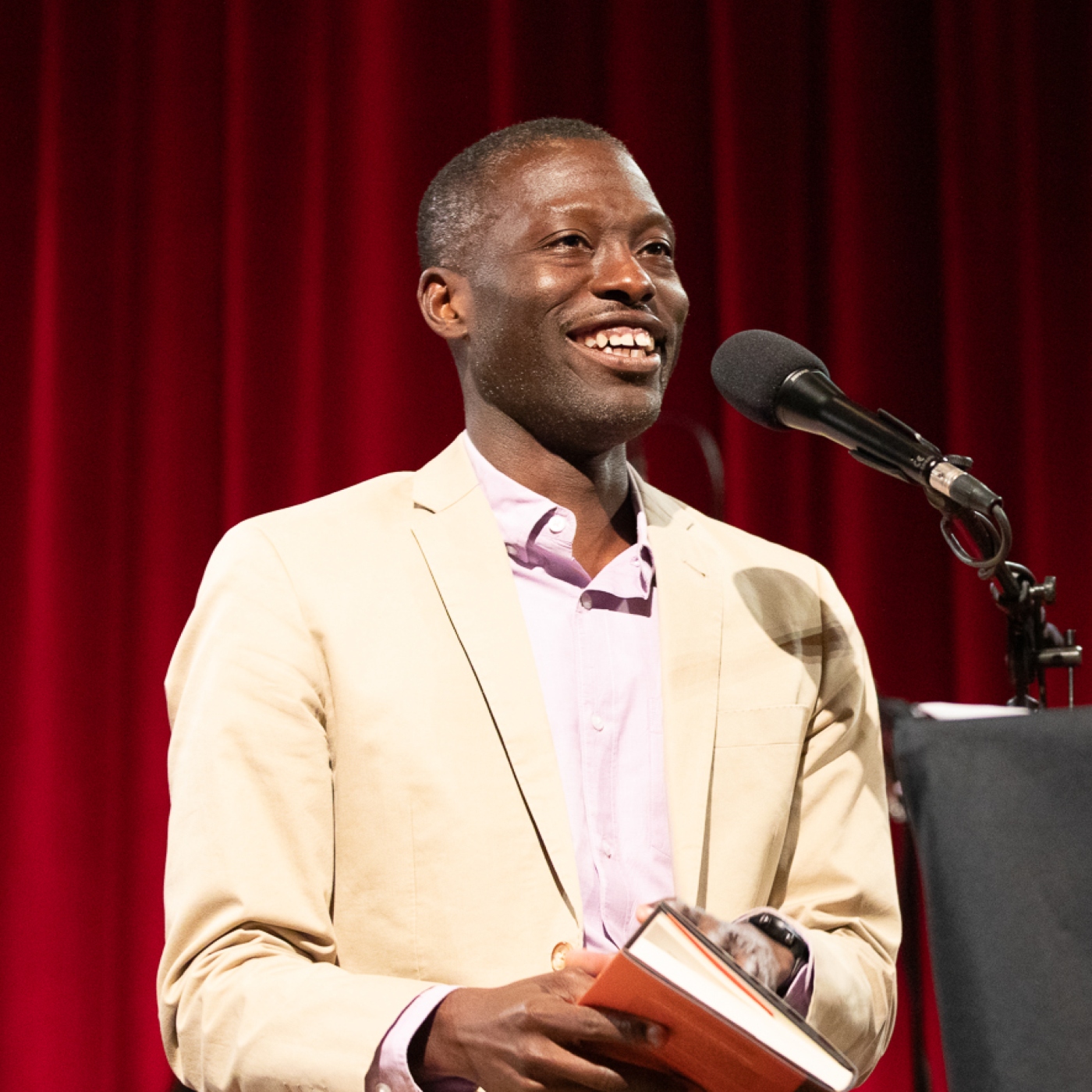
Live Wire with Luke Burbank
Roger Reeves, Sean Jordan, and Erin Rae (REBROADCAST)
00:52:28
This episode features poet and essayist Roger Reeves, stand-up comedian Sean Jordan, and music from singer-songwriter Erin Rae.
Loading summary
Transcript122 lines
- [00:03]
Luke Burbank
Hey there. Welcome to Livewire. I'm your host, Luke Burbank. This week on the show, award winning poet and author Roger Reeves talks to us about his most recent work, Dark Fugitive Essays. In it, Roger talks about some really tough stuff, but also explores the idea of finding peace and joy through stillness, which is always a challenge for me. Then hit podcaster and comedian Shawn Jordan is gonna swing by his hometown of Portland, Oregon to perform some stand up for us. Pace Magazine says Sean is both genuine and genuinely hilarious, which is like exactly the vibe that we try to go for here on Livewire. And then finally, we've got singer songwriter Aaron Ray, whose newest album, Lighten up details a lifetime of learning, self acceptance and self care. I choose to accept the fact that this is going to be an amazing episode of Livewire. So stick around. It all gets started right after this.
- [01:01]
Sponsor Voice
This is a message from sponsor Intuit. TurboTax Taxes was waiting to get your money back, which turned into worrying about getting your money back. Now Taxes is matching with a TurboTax expert who can do your taxes today and help you get up to a $4,000 refund advance loan fast. Get an expert now on TurboTax.com only available with TurboTax Live Full Service Refund has $0 loan fees and 0% APR refund advance loans may be issued by First Century Bank NA or Web Bank Term Supplies. Subject to credit approval. This message is brought to you by Apple Card. Apple Card is everything a credit card should be. It's easy to manage, built to be secure, and gives users up to 3% daily cash back on every purchase. The best part about Apple Card is applying is quick and easy. Apply in the Wallet app on iPhone and see your credit limit offer in minutes. Subject to credit approval. Apple Card by Goldman Sachs Bank USA Salt Lake City Branch Member FDIC terms.
- [02:03]
Luke Burbank
And more@applecard.com this episode of Livewire was originally recorded in October of 2024. We hope you enjoy it. Now let's get to the show.
- [02:16]
Elena Passarello
From prx. It's Live Fire.
- [02:26]
Luke Burbank
This week.
- [02:27]
Elena Passarello
Writer Roger Reeves.
- [02:29]
Roger Reeves
We delay our joy until we experience the freedom that we're looking for. And I've come kind of the place where, not that we're gonna stop fighting for it, but what would happen if, like, it doesn't get any better?
- [02:40]
Elena Passarello
Podcaster and comedian Shawn Jordan having a baby absolutely blows.
- [02:46]
Shawn Jordan
Everybody always. Immediately they're like, oh, when are you gonna have the second kid? And you're like, I don't like this one yet.
- [02:52]
Elena Passarello
So with music from Erin Ray and Our fabulous house band. I'm your announcer, Elena Passarello. And now the host of Livewire, Luke Burbank.
- [03:07]
Luke Burbank
Hey, thank you so much, Elaina Passarello. Thanks to everyone tuning in from all over the country. We have a spectacular show in store for you this week. Lots to get to first though, we gotta start things with the best news we heard all week. This right here is our little reminder at the tippy top of the show that there's good news happening out there in the world. Alaina, what is the best news you heard all week?
- [03:33]
Elena Passarello
Oh, I love this news. And this comes from Arizona, specifically Navajo Nation, where the Dina people are the largest Native American tribe, both in terms of land and in population in the country. And there's a 34 year old Dina woman in Arizona who is making a huge difference in that community and she's using horses to do it. Ally Redhorse Young grew up in the Navajo Nation, where 75% of the roads are unpaved, according to the Guardian. And a lot of the smaller communities in the nation are so remotely spread out that voting or accessing state services can require like an hour or more of driving. Just imagine having to go travel for an hour just to vote. So back in 2020, when access was even further restricted during COVID Allie Redhorse Young founded Ride to the Polls in order to raise awareness and provide access and ensure that the community was fully represented in that year's census. Cause you gotta be counted in the census in order to get federal support. And that went over extremely well. A lot of visibility. So there's doing it again this year in 2024. Ride to the Polls has a series of events. There's trail rides. For some reason, there was a skateboarding competition, which I'm assuming the horses didn't participate in that part of it.
- [04:54]
Luke Burbank
I hope not for them.
- [04:56]
Elena Passarello
There was a bull riding contest, there's concerts, tons of events to encourage indigenous voter registration and indigenous access to the 2024 ballot. This is making a huge difference. And the indigenous vote is making a huge difference in Arizona politics. And Ali Redhorse Young says that it makes a big difference in indigenous communities as well. She says we need to protect our tribal sovereignty and with that, protect our sacred sites, our languages and our traditions. They've registered hundreds of new voters in the past couple months. And in mid October, I love this, they had an offshoot event called Walked to the Polls where a whole bunch of people, including Mark Ruffalo, who's a friend of that community.
- [05:42]
Luke Burbank
The Hulk.
- [05:43]
Elena Passarello
Yeah, the Hulk. And a Bunch of members of Navajo Nation walked for three miles to cast early voting ballots. But everything is going to culminate on election day when over 100 riders are going to take their horses to vote in Arizona via a trail ride. So super cool idea. Very interesting way to empower young people and to bring attention to this really important issue in the American political system.
- [06:11]
Luke Burbank
Whatever you've got to do to get to the polls right, Planes, trains, automobiles, horses. Mark Ruffalo, Whatever it takes. The best news that I heard this week also involves animals. Elena? Well, it involves a human who sounds exactly like a bunch of different animals. You are a bird enthusiast. You've written extensively about birds. You've written books that feature birds prominently. And I think maybe a future fan of your work would be 10 year old Samuel Henderson of Oklahoma City, Oklahoma. Now, last May there was a talent show at Samuel's school and Samuel wanted to show off his cool trick that he can do, which is basically bird impressions, but like hyper realistic bird impressions. And his mom, Lori said that she was like a little bit nervous because Sam is on the autism spectrum. And you know, school age kids, you never know how they're gonna react to something, particularly your son sharing his like favorite passion. But it went really well. Like, I've watched the video of Samuel up there. He's got, the audio is a little dodgy, so I'll spare you that, but I'll kind of describe what happened. He's standing up on stage. He asks all of his classmates to hold their applause until the end of his performance.
- [07:29]
Roger Reeves
Cool.
- [07:30]
Elena Passarello
Very nice.
- [07:30]
Luke Burbank
He has a box with various stuffed versions of birds to represent the calls that he's doing. And then he sort of pulls them out, does the bird call. And you can just tell the kids are like freaking out. They are so into this. Laurie says that it took them 30 minutes to get out of the auditorium because so many kids were coming up to Samuel to high five him and ask him how he did it. Like this has completely sort of enshrined him as like a superstar at this school in Oklahoma City. And now he's becoming a superstar, of course. Elena on TikTok. This is Samuel responding to fan mail, doing various bird calls. Here's just a sample.
- [08:12]
Elena Passarello
Today I'm doing some of my fans requests. So first one is the American Kestrel. Next one is the Common Loon. Next one is the Gray Catbird. Next one is Bob White.
- [08:54]
Roger Reeves
Hang on, sorry.
- [08:59]
Luke Burbank
So there you go. Just a little sampling of Samuel, right? I mean, he's really got a knack for this, apparently, his parents, that he has really experienced his world kind of in an auditory way. He's always been able to reproduce sounds that he hears in the world. He's so good. You probably know about this because, again, you're a bird person, but there's an app called Merlin that you can use to try to identify bird calls. He can fool the Merlin app with his impressions.
- [09:27]
Elena Passarello
Oh, my gosh. I have to meet this guy.
- [09:29]
Luke Burbank
Right? He's also been invited to the Cornell Lab of Ornithology, which is, like, kind of the place for this stuff. It's, you know, the Harvard Law of bird stuff.
- [09:38]
Roger Reeves
Yes.
- [09:39]
Luke Burbank
And now they've invited Samuel there. So best news that I heard this week, Samuel Henderson and his amazing bird calling ability. All right, let's get to the show. Our first guest is the author of two poetry collections, King Me and Best Barbarian. He's also the recipient of a National Endowment for the Arts fellowship, a Whiting Award, a Pushcart Prize, lots of other awards. He teaches English and creative writing at the University of Texas at Austin. And according to Kirkus, his latest book, which is Dark Fugitive Essays, is a cerebral essay collection brimming with insight and vision. Roger Reeves joined us on stage at the Alberta Rose Theater in Portland, Oregon. Take a listen. Welcome to the show. It's so nice to have you here on our home turf. The last time that we had you on the program, it was in Austin, Texas.
- [10:54]
Roger Reeves
My home turf.
- [10:54]
Luke Burbank
Your home turf. And it was a weird show. We were at a public radio conference, and we were trying to impress the public radio bosses, so we just did the show. We did livewire in a hotel room and just tried to get people in from the hallway to watch. And, Roger, you were there, and you were incredible. But I'm glad you can see what it looks like when we really do the show.
- [11:14]
Roger Reeves
Yeah. This is kind of amazing because I just was like, oh, they must always do it in a hotel room. It's very intimate.
- [11:21]
Luke Burbank
That's right. This book is a really incredible piece of writing. And I'm curious. It's your first book of nonfiction. You've been doing poetry previously, mostly. How did this book come about for you?
- [11:34]
Roger Reeves
It's really funny. The. The book came about in a weird sort of fashion, which is I. I have a PhD. I have to. Have to admit. Confess. I have a PhD.
- [11:44]
Luke Burbank
Listen, this is a public radio show. You're amongst friends.
- [11:48]
Roger Reeves
Okay.
- [11:48]
Elena Passarello
Yeah, yeah. They're like, just one.
- [11:50]
Roger Reeves
Yeah. It's true, it's true. It's true.
- [11:53]
Luke Burbank
For the record, none of them are using them, but they have them.
- [11:58]
Roger Reeves
And so I've always written essays, but they were always, you know, scholarly essays, academic essays, which is fine. I think there's a place for that. And so I love poetry. I loved writing poems. But then as I was sort of publishing poetry, I noticed that the engagement with poetry and its sort of not its difficulty, but its nuance wasn't always. I wasn't seeing the public intellectual work. When I think of, like, the public intellectual work of someone like Lionel Trilling or James Baldwin or Grove Vidal, right? They were engaging poetry. They were engaging civil rights. They were engaged. They saw, like, the world through all of these means. And I. And I didn't feel as if there was sort of an abundance of that. And so I just started. It was actually a friend and I took, like, a pact. We were like, how about we, you know, we're always gonna write poems, but what if we just, like, wrote two essays a year just, you know, around things that we're interested in? And I realized at that moment, I was like, oh, I can write these however I want, right? It doesn't have to be written in the way that I was sort of raised through my education. And so. But the essay that really let me know I was in the book is actually the second essay in the book where I'm visiting a plantation in Charleston, South Carolina, called the McLeod Plantation, and I was asked to give a poetry reading. Yes, all of those reactions are all.
- [13:27]
Luke Burbank
Those PhDs at work. That is the proper response.
- [13:30]
Roger Reeves
But this was one of these plantations that wasn't trying to do it sort of Gone by the wind style. It was very much like, here was the truth of what it was to be enslaved in. And I remember getting a tour of the plantation that day. And there is a song to it, but there was the narrative I thought was more effective. And that's when I was like, oh, let me write this. Right? And first I tried to write it as a film. I know that's weird. And then I was like, it's not a film. It's actually an essay.
- [14:01]
Luke Burbank
Well, as a person who read that essay and appreciated the clarity with which it was written, because I could follow along. And you went into it saying, I don't want to be overwhelmed by this, and I don't want to cry from this. And you start seeing these things that are so hard to take. There's such horrors that are still there, the evidence of them. And eventually, you know, you weren't able to sort of keep that plan together. But I Wonder why did you, why did you go into that not wanting to cry when it seems like a place where that would be a very natural reaction.
- [14:29]
Roger Reeves
It's so interesting. One of the difficult things that I think I'm always grappling with is there's a way in which sometimes when our emotions become the center of an experience, we actually miss the experience. And so particularly when we're trying to grapple with history, right? We are moved by history. However, history has its legacies that we're often living. And so one of the things that I think is required sometimes is not to not be vulnerable to one's feelings. Please do that, especially men. But one of the things I think is important to do is not to center our emotions such that we think when we've cried about the, like, horrible historic thing, that's the end of the work, right? That's actually just the beginning, right. The end of the work is to think about how that thing is manifesting in our lives and then what are we going to do, right? So I wanted to make sure, because I'm a crier, I'm a poet, I cry. I cry like I cry over anything. And I just wanted to make sure I was seeing, right? So there's a fingerprint. There was a child's fingerprint in one of the bricks. I wanted to really see that. I wanted to really think about, what does this mean that the only remembrance of this child is a fingerprint in the brick? You know, we have to sit with that.
- [16:04]
Luke Burbank
You're listening to Livewire from prx. I'm Luke Burbank here with Elena Passarello. We are talking to the author and poet Roger Reeves about his essay collection Dark Fugitive Essays, which Roger is going to read from when we return after this very short break. Don't go anywhere. Special thanks to our sponsor, Up Up Books, a Portland bookshop specializing in diverse authors, local writers and independent presses. They're located across from Revolution hall in the Buckman neighborhood and they offer a space for book clubs, workshops and events. Check out their website and grab a book@upupbooks.com welcome back to Livewire. I'm your host, Luke Burbank, here with Elena Passarello. We are listening to a conversation we recorded with award winning poet Roger Reeves talking about his book Dark Fugitive Essays. Let's get back into that conversation recorded live at the Alberta Rose Theatre in Portland, Oregon. You talk about a photograph that you have in your house, I believe.
- [17:28]
Roger Reeves
Yes.
- [17:28]
Luke Burbank
At the top of the stairs. And it's a photograph of a Young black child and you call him our angel of history. Why did you kind of start the book with this photograph?
- [17:37]
Roger Reeves
Okay, so my brother in law is a photographer, used to be a photographer in Phoenix, Arizona. And he's a beautiful photographer. And he was in Arizona when Obama was just sort of teasing if he were going to be the president. So it was like some of his first rallies. And I had seen this picture. His name is Julio Jimenez. Amazing photographer. Julio had lost his job as a lot of newspaper men and photographers lost their jobs when the sort of newspaper industry collapsed. And so he came back to Texas and he had this photo and I just loved this photo. It was just, it's a beautiful photo of this boy with the shadow cutting across his face. And he's looking, you can tell he's looking deeply into like Obama, right? He's looking into his face. And I just, I just thought of that moment as like, if we think about that boy, he's probably six in 2006. I was writing this book in 2020 or sort of thinking about it more as a book in 2020. I'm thinking, oh, that boy watched Obama get elected. He watched Michael Brown being killed. He watched Trayvon Martin, he watched Trump be elect. He watched our nation become what it was, right? And then we have the uprisings in 2020. And I thought, oh, that's who, that's who the angel of history is right now, right? That's the person who was like actually bearing witness to the change. Right. And to the, to sort of where we are now.
- [19:10]
Luke Burbank
It is a phenomenal picture and it's right at the beginning of the book. I can't stop looking at it and kind of going on that journey that you're going on with him. Could you read a little bit from the book?
- [19:20]
Roger Reeves
Sure. I'm going to read from the second essay, which is called A Little Brown Liquor. So there's this idea that I kind of grew up with a little bit where like certain types of liquor will make you mean. Yeah. And so like brown liquor, you know, white liquor, you know, the clear liquor, we call it white liquor. Do things. And so this poem's all about like sort of being drunk on thinking about like black linguistic practices. So little known fact was I was a youth minister. I grew up in a Pentecostal church. And so like, yeah. Oh, wow. People are like, oh, Lord, did we.
- [20:01]
Luke Burbank
Just start having church?
- [20:03]
Roger Reeves
And so I love this term. Dearly beloved. Right. So each section of the essay starts, Dearly beloved. Dearly beloved. Black life is a constant improvisation on what it means to be human, which is to say dirty in the parlance of outcasts. In skew it on the barbie. A changing of the rules from old school to new school and back, back again. A simultaneity bad and bougie, being in time and out of time, yet being on time. In other words, timeless but hella present. As a practitioner of this sort of living, I'm constantly astounded at the discourse black folks have created to transmit, signify and inhabit the hoodoo, heteroglossia and hauntings of our improvisational and luxuriant lives. We've created a sonic landscape in which we can ironize, cry and celebrate black life in the space of one line of verse, Louis Armstrong's what Did I Do to be so black and blue? For instance, in Armstrong singing you can hear both a smile and a wince of pain and simultaneously a little laugh as the term blue in the chorus takes on a plethora of meaning. It's a shifting blue, a blue of both midnight in the river that calls you a little too close. A blue that Langston Hughes writes about in Suicide's Note when he declares the face of the river asks for a kiss. Armstrong's blue is the blue of loneliness and a blue of dawn, of possibility, a blue of Jimmy Rushing when he declares he's going to Chicago and sorry but I can't take you. There's nothing in Chicago that a monkey woman can do. While it might seem rushing is singing this song forlornly to a lover. It's a devious sort of tongue in cheek confession in which leaving his lover offers the possibility of new territory, new horizons, the avant garde. Yet and still in Russian singing we hear some ambiguity, a tinge of sadness. Black life needs and creates the linguistic and epistemological flexibility that can articulate and allow these simultaneities. Getting up to be getting down, Riding dirty as a way of riding clean with an ounce in the sock on D's and vogues, the paint job candy coated or suicide wrist red. We've created a discourse that accommodates the irony of once being property, the irony of objects that can and do resist, objects that speak, moan and make love, all while dancing to outcasts or Ernette Coleman or. Or Sister Rosetta Tharp, or that sister from around the way who sings only when she gets a little brown liquor in her a red solo cup in one hand, a lit and burning down cigarette in the other.
- [23:01]
Luke Burbank
That's Roger Reeves reading from Dark Days, Fugitive Essays. You write in this book, that freedom is how you come to art, and it's what makes you stay. But I'm curious, how do you find that freedom in a country that has been pretty much set up to not make people like you, free man?
- [23:19]
Roger Reeves
You know, that's a. You know, that is the question of black art. That is what the black artist is constantly sort of thinking about. Right? And some people would say that's how African American came to be, literature came to be. I think how I'm thinking about it is. So there's this. There's this idea, right, that generally what we do is we kind of delay our happiness, right? We delay our joy until we experience the freedom that we're looking for. And I've come kind of the place where, like, what happens if, like, not that we're gonna stop fighting for it, but what would happen if, like, it doesn't get any better for black folks? What happens if it doesn't get any better for queer folk, for trans folk? Are we going delay our joy? And so I'm beginning to think about how one might be able to inhabit joy in the middle of what feels like catastrophe, right in the middle of what might feel like disaster. I think about 2020 going out to protest and watching people dance in the middle of protest. Right. I think we have to do this. I also think about these moments of rallies and like, I think about, like, before the civil rights movement, right?
- [24:32]
Luke Burbank
Before.
- [24:32]
Roger Reeves
During the civil rights movement, before they would march in Birmingham or in Selma, the night before, they would get together and sing, right? And it would. That singing would help to buoy up their spirits when the police and the water cannons were coming. So what I've been thinking about is, like, the way I think about art is it's a place to be beautiful. It's a place to make my beauty and my joy.
- [24:50]
Luke Burbank
Now, because if you try to wait for everything to be solved, you may miss the chance to have your joy.
- [24:56]
Roger Reeves
Correct. Right. Because there's no. There's. Who's to say there's. There's not always a rainbow at the end.
- [25:03]
Elena Passarello
What does that look like in the writing space? Like, we see it on the page once. Once all is said and done. It's so evident on a sentence by sentence level. But when you're in your bathrobe or however you. However you make your writing.
- [25:15]
Luke Burbank
Yeah.
- [25:15]
Roger Reeves
Early in the morning, what is it?
- [25:17]
Elena Passarello
How do you keep that present while you're actually trying to argue these big things?
- [25:22]
Roger Reeves
You know what I try to do? I just try to listen. I listen for the next word, I allow myself to be surprised. I allow for digressions. That's the poet in me, right? Like, one of the things that I think is really beautiful. And I live by this adage. It's Robert Frost. It's a good adage, though. He used to say, no tears for the writer, no tears for the reader. No surprise for the writer, no surprise for the reader. So what I'm. So whatever I'm feeling while I'm making it is what you're going to feel and what you're going to know, right? So one of the things that I'm always interested in is when I'm there, finding ways. So we're in this moment right now where everybody has a hot take, has a critique. But one of the things we don't know how to do is talk about the complexity of beauty. And I want to always sort of think about the difficulty of beauty. And I want it rather than being like, oh, this is bad, or this is terrible, or this could be. Sometimes I want to be like, look how amazing this is. And shouldn't we replicate this amazingness? Right? So what I'm trying to do is just be in the place of, like, celebration, right? Like celebration as a rigorous form of engagement.
- [26:25]
Luke Burbank
This book covers such a wide range of things. Music, art, military. Juntas, Chile. It's got so much in it. I'm curious. Who did you write it for? Who are you hoping finds this book? And what do you want their experience to be?
- [26:40]
Roger Reeves
That's a great question. I wrote it for you. But I also was thinking about my daughter, who is eight now. When I started writing the book, she was probably about two or three. And what I was thinking about is I'm writing it for her and I'm writing it for me. I'm writing the essays that I wish existed when I was having some of these difficult moments around beauty, around what to do with U.S. policy. And it's used in South America and in the Middle East. I'm really thinking about sort of putting another brick in a house. And I'm just contributing a brick, right? Each of these books are bricks in the house of liberation. And that's the way I think about it. So to me, when I was thinking about the book, I was like, oh, write. You know, your first audience is yourself, right? I think it's okay for writers to first write to themselves, because we need that thing. Because if you write something, you need. I always say this. If I write something I need, I will write something someone else needs as well. Yeah, it's kind of impossible to write something you need and not.
- [27:43]
Luke Burbank
Yeah. You get to the universal through the personal. Right.
- [27:45]
Roger Reeves
Correct. Through the very specific through the very particular.
- [27:48]
Luke Burbank
Yeah. Well, I'll tell you, this brick is holding up its corner of the house. So thanks for writing.
- [27:52]
Roger Reeves
Thank you for having me.
- [27:53]
Luke Burbank
Roger Reeves, everyone, right here on Livewire. That was author and poet Roger Reeves right here on Livewire. His latest book, Dark Fugitive Essays, is available right now. Hey, special thanks this episode to Laura Canape of Portland, Oregon, and Nancy Weil of Arch Cape, Oregon. Nancy and Laura are part of the Livewire member community and they are generously supporting the show with a donation each month. And we are eternally thankful for that because it is what allows us to keep doing this show that you know and love as Livewire So big thanks to Laura and Nancy for keeping it going. Sometimes checking your email, let's be honest, can be a little stressful. But we want to change that over here at Livewire. We want to make checking your email more joyful with our weekly newsletter, which is only good news. That's all we do over here at the Livewire newsletter. We got sneak peeks and deep dives on upcoming events, details on where you can join us live, new episode drops, and even more than that, getting this drop of joy. It's super easy, too. You head over to livewireradio.org and you click keep in touch. It takes like 30 seconds, 25 if you're speedy. So help us help you have a little more fun in your inbox with the latest from the Livewire newsletter. This is Livewire, of course. Each week we like to ask our listeners a question based on our upcoming guest Shawn Jordan's comedy special, which is about parenting. We wanted to ask the Livewire listeners a question relevant to that. Alaina, what did we ask, folks?
- [29:54]
Elena Passarello
We wanted to know what has been the most surprising, funniest slash weirdest parenting challenge that you've ever encountered.
- [30:01]
Luke Burbank
And I'll tell you what, as now the parent of a 30 year old, they just change over time. They don't go away.
- [30:07]
Elena Passarello
Your 30 year old kid is still saying interesting and challenging things to you.
- [30:11]
Luke Burbank
No, now I just see on Instagram that she's in Los Angeles and had no idea this was happening. That's the grown adult version of this kind of stuff. Anyway, Alaina, you have been collecting up the responses from our listeners. What are they saying?
- [30:23]
Elena Passarello
It's always good when we ask the listeners to talk about their kids. Always just a gold mine. You get things like this One from Chelsea, who remembered how hard it was to convince my kids that the word plaid is not pronounced. Played. It took me years.
- [30:42]
Luke Burbank
Chelsea says, honestly, I'm with the kids on this whoever, and I know you're. You know, you teach English, Elena, so maybe this, you know, is near and dear to your heart, but if you really go through the pronunciation of most of our words, it makes no sense.
- [30:57]
Elena Passarello
Yeah, no, because you got braid and stayed. But then you also have paid P A, Y, E D. So who knows?
- [31:04]
Luke Burbank
How do we expect our children to trust us when some of the first things we teach them is that we've been lying to them about visually about how these words should be said?
- [31:12]
Elena Passarello
That's right.
- [31:13]
Luke Burbank
All right, what's something else weird that happened to one of our parent listeners?
- [31:18]
Elena Passarello
Uh, this one is from Laura. Laura says my kid likes to rank people by the amount that she loves them, and I guess that's fine, but I've been trying to teach her not to share people's rankings with them or update them whenever the ranking changes, for that matter, which is often.
- [31:36]
Luke Burbank
I have a feeling I know what Laura this is. We might be part of the problem because we've been elevating the child in question to, like, superstar status, featuring them on various episodes of Livewire.
- [31:47]
Elena Passarello
And I bet our ranking is really good.
- [31:49]
Luke Burbank
Don't tell me if I'm not in the top five, please. Okay, one last weird parenting moment that someone wanted to tell us about.
- [31:55]
Elena Passarello
This one is from Sam. The hardest parenting challenge that Sam has encountered is supporting your child's interests while being honest about the fact that the video game Minecraft is so all caps. Freaking all caps. Boring. It's true. When you have a kid, right, sometimes you have to engage with the same piece of media again and again and again and again. Like Barney for forever.
- [32:20]
Luke Burbank
Yeah, Cocomelon.
- [32:21]
Elena Passarello
What's Cocomelon? Is that.
- [32:23]
Luke Burbank
Oh, boy. That's the right answer, by the way, Elena, that you don't. It's just some of that inane content that, for some reason, seems to really work for kids, but most of the parents I know, it's the bane of their existence. And, yeah, Minecraft as well. Like, that's one that never clicked for me. I knew it was a thing, though, because I was at a Fourth of July parade, and all of the kids were carrying around these pixelated, like, swords from the little kind of, like, vendors. And I was like, what is that? And my friend who has young kids said Minecraft. I was like, oh, all right. Thanks to everyone who responded to our Audience question this week. We appreciate you. Hopefully your children will forgive you in the meantime. This is Livewire from prx. Our next guest is a comedian and also podcaster who co hosts the wildly popular show All Fantasy Everything with friend of Livewire, Ian Carmel. He's been named Portland's funniest person. He made his national TV debut on the Late Late show with James Corden. And this year he released his first full length stand up special called Girl dad, which details the sometimes hilarious and often unexpected process of becoming a father. Shawn Jordan joined us at the Alberta Rose Theater in his hometown of Portland, Oregon. Take a listen.
- [33:41]
Shawn Jordan
Hey. Hey. Thanks for having me. I have a three year old daughter. Having a three year old is fantastic. Having a baby absolutely blows. It's probably the stupidest thing anyone could do. And so, yeah, it's just nice to be out performing. I love any chance I can be away from my kid. It's great. Nobody's honest, nobody says that, but it's not that fun. You know what I'm talking about? Everybody always, immediately they're like, oh, when are you gonna have the second kid? And you're like, I don't like this one yet, so be a big old never from your boy. I felt extremely inadequate the whole time. Just the whole process was so scary. Like going in for the delivery process, it was such a, I don't know, so scary because I didn't know, you know, I didn't know if I could help at all. I just feel so, as a guy, I just feel so dumb all the time, you know, I was walking in the hospital, my wife is doing magic with her body. She's radiant, she's just perfect. And I just look like this all the time, you know. Pretty good joke for an audio medium, I get it. But I look like what you think I look like listeners. Kind of a schlub. And so I walked in when we were going to go for delivery, I walked up to the nurse and I was like, hey, can I help at all? Like, is there anything I could do that would be of assistance? I didn't want to get in there and like help, you know, for real. But I was just like, can I be of any assistance? And she said, yeah, actually, when labor starts, we found that if the partner tells some jokes. She really said that. She said that if a partner tells some jokes, that kind of helps things out. I'd never seen a labor before, so when she said that I thought, well, awesome. This can't be that tricky. So I was all excited for labor to start, I was going through jokes that I really was. I was going through jokes, I was going to try. And then I saw her first contraction. I saw labor start right in front of my eyes. I saw her first contraction. I thought to myself, what a silly suggestion that was. Shame on you. Recommend I tell a joke during that. It wasn't funny. It didn't look funny. And a lot of it looked like the craziest thing you could go through. And a lot of guys, they're real quick to hop in and be like, well, it's just like breaking your femur, bro. It's like a big guy thing they say. And I just can't. I can't go on that walk with you. It didn't look like that. I've broken my legs a whole bunch. Not my femur, but my tibia and fibula seven times, so I think that equals a femur. And skateboarding. I don't have gambling debt or anything.
- [36:30]
Luke Burbank
But.
- [36:36]
Shawn Jordan
I broke my legs a whole bunch. Didn't look like that. There's no real comparison. It looked like. The only thing I could compare it to is if you took every bad thing that's ever happened to me. Like every breakup, every flat tire, every ice cream headache, every time I've talked to a cop, every time I've been hit in the face and just like, balled it up to the size of like a watermelon and then shove that in my butt. Really, really in there, like. Cause the baby's not kind of, you know, flush. It's like flush. No crowning or anything. And you made me keep it for about 10 months. Said nine, but it's 10. And then on a day that's pretty inconvenient for me, you were just like, all right, come on down to the hospital and shove that out in front of a bunch of strangers. I don't think a joke would help me through that. Yeah, she's three right now. Having a three year old's fantastic. She thinks everything I do is dope. She thinks it's cool. I have long arms that ain't gonna last forever. She can't reach something across the table. I'm like, that's all right, let Superman get it. And I just slide it to her. We bought her Christmas presents right in front of her, you fool. We got this Barbie. It was a Barbie kitchenette. It was a big one for her room. And her eyes, it looked like her eyes were like dinner plates where she was looking at it. She's like, who's that for? And I'M like, you dumb, Dumb. It's for you. What are you doing? It costs $9 at the Goodwill. You better enjoy it. Yeah. She's three. So we're potty training. Figured it'd be rude not to, so we're doing that. A little trickier than I thought. I thought animals should just figure it out. I thought it was a little more intuitive. They don't. They don't know what they're doing. She just poops her pants, and it's just. It's wild. Toomey. The last time she pooped her pants, she came out and told me what she did. And the way that she explained it, she was so articulate when she explained it. I was like, why'd you do it then? It was insane. She just said it just like. I'm talking now, not with, like, the pronounced Ls, but, you know, she kind of got there. She had a big. She came out, she was wearing tights, and she had a big lump in the bottom. You know what I'm talking about? She did. And I knew what it was. I'm not being. You know, I wasn't mad or anything, but I knew what time it was when she came out. But she came out and I saw this big lump of poop in her tights, and she stopped. She looks at me, she's like, dad, dad. And she's like, I pooped my pants. And kind of shrugged her shoulders a little bit, which. That's empathy. That's an adult emotion. Why'd you do it? So she's like, I kind of pooped my pants. I think we should probably go in the bathroom and clean it up. I'm like, yeah, we should. We're going to. But why'd you do it? Then I just imagine her standing in her room thinking, man, I really ought to poop. I could just do it in my pants. I'll just go tell dad and he'll handle it. I'm not going to waste all those extra steps to the toilet. So my wife, she found a video online of a medical professional that's just explaining how to potty train. And this medical professional hops on. It's a video. And they say when you're potty training, you're supposed to refer. Use the technical terms when referring to a kid's genitals. You're not supposed to use slang. Which I wasn't going to. I'm not a godless pig. Anyway, remember, I said technical. So this woman, she says, you need to use the technical terms when referring to the genitals. Technical terms like penis, vagina, and butthole. The technical terms. Penis is technical. Vagina is extremely technical. I don't know if that last one is technical. I think you might want to run it up the flagpole a little bit. Has anyone ever heard a doctor call it a butthole? It's a pretty funny word. But, like, in the room, I just. I don't think they're doing that. It's called an anus. I'm not a doctor. Far from it. I went to two years of college, didn't graduate. No plan on graduating. That's why I had a daughter, so she could finish what I started. Neither here nor there. That being said, I don't think it's technically called your butthole. I'm going to have to get my prostate checked sooner than later. I'm 43. It's coming up. And if the doctor calls it that, I don't think they get to check. I just. I don't see a world where a doctor. Where a doctor, an actual doctor, comes into the room and dips their fingers in the little jelly. And then they look at me, and I'm pretty vulnerable. I imagine at that point, there's a few people in here that I can definitely tell have had it done. And it's. I mean, I'm not scared, but, like, I'll be vulnerable. I'll be facing the wrong way in a gown, which is never flattering. And if the doctor comes in, dips their fingers in the jelly, and looks at me and says, okay, I'm going to check your prostate to do that, I'm going to gently, gently insert these two fingers into your butthole. They said I could say this.
- [42:15]
Luke Burbank
I asked.
- [42:18]
Shawn Jordan
It's the funniest email I've sent in a while. If they say that, I'm gonna turn around and say, no, you're not. You are the funniest fake doctor I've ever met. I'm gonna get out of here and find a real doctor, have them gently insert their fingers into my anus, and on that note, I'm gonna get out of here. Thank you so much. My name is Shawn Jordan. I appreciate it.
- [42:49]
Luke Burbank
That's Shawn Jordan, everyone, right here on Livewire. This is Livewire. I'm Luke Burbank here with Elena Passarello. We have to take a very quick break, but don't go anywhere. When we come back, we're going to hear some music from Pickathon featuring singer songwriter Aaron Ray. Stay with us. Welcome back to Livewire from prx I'm Luke Burbank here with Elena Passarello. All right, it's that time in the show where we like to play a little station location identification examination. This is where I quiz our esteemed announcer Elena about a place in the US where LiveWire is on the radio. She's gotta guess the place I am talking about. We recorded this live at the Alberta Rose Theater in Portland, Oregon, where the stakes could not have been higher. Right, Elena?
- [43:53]
Elena Passarello
That's right. I felt the pressure. It was gripping on me like a vice.
- [43:58]
Luke Burbank
And you performed beautifully as always. Let's take a listen to that. Hey, Elena.
- [44:03]
Elena Passarello
Hey, Luke.
- [44:04]
Luke Burbank
Are you ready to play another round of station location identification examination? I think so. That's not the most confident voice I've heard you use, but all right. You're actually incredibly good at this, so. And I think you're gonna. I don't want to jinx it, but I think you're gonna do well with this one. Okay. All right. I did not know this, but the Venus Fly trap is native to a wetlands that's within a 60 mile radius of this place and nowhere else in the world.
- [44:32]
Elena Passarello
What?
- [44:33]
Luke Burbank
Yeah.
- [44:34]
Elena Passarello
Oh, well, it's got to be somewhere boggy and smoggy and swampy.
- [44:40]
Luke Burbank
Ish.
- [44:41]
Elena Passarello
Little salty. Maybe a little coastal.
- [44:43]
Luke Burbank
Yes, yes, definitely coastal. How about this? It's known as Hollywood east due to its role as a filming location for several popular television series and movies including Blue Velvet, Weekend at Bernie's. I know what you did last summer. Scream. One Tree Hill, Dawson's Creek.
- [45:01]
Elena Passarello
Oh, okay. I do believe it's Wilmington, North Carolina.
- [45:04]
Luke Burbank
I believe you're exactly right. Wilmington, North Carolina, where we are on whqrfm. All right, big shout out to the folks tuning in from Wilmington, North Carolina. All right, before we get to our musical guests this week, a little preview of what we are doing on the show. Next week we're gonna be talking to Ira Madison the about his new collection of essays. It's pure innocent fun. It's kind of a mix of memoir and cultural criticism where Ira reflects back on like the pop culture that shaped his career as a writer and also what it was like for him growing up as a black gay man in Milwaukee. And then we'll hear some musical comedy from Ricky Lindholm. Ricky is an Emmy nominated actress, comedian and musician. You may know her as one half of Garfunkel and Oates. Now she's set to release her first solo album. It's called no Worries if not. And we're gonna hear, well, a song that kind of takes a real twist on the scandalous relationship in the Sound of Music. Yes, the Sound of Music like you've never considered it before. From the perspective of the Baroness. It's gonna be a really fun show. Make sure you tune in next week. This is Livewire from prx. Our musical guest this week earned a nomination for emerging act of the year at the 2019Americana Music Awards, as well as spots performing the Newport Folk Festival, the Grand ole Opry, and 2024's Pickathon Music Festival, where Livewire set up shop. Now, if you are not familiar, Pickathon is a four day experiential music festival that brings talent from all around the world to an idyllic farm in Happy Valley, Oregon. So take a listen to this. It starts off with a conversation with Aaron Ray. We recorded this at the Lucky Barn from this year's Pickathon Music Festival. Thank you. Hello, Aaron Ray fans. Hello, Lucky Barn. I read on the Internet that you were not particularly interested in music, or at least it wasn't something you saw yourself going into. And then you got a guitar as a gift when you were 18. Is that true or is that like many things on the Internet, not true?
- [47:18]
Aaron Ray
It is true. I didn't. Well, music has always been a part of my life. My parents played together, so I grew up hearing them sing together. Yeah, I was like, I went to a semester of college and I was going to be a therapist, which could also happen one day.
- [47:32]
Luke Burbank
But you could be doing that in its own way. Yes. Now, two records ago, it was called Putting on Airs.
- [47:41]
Roger Reeves
Yes.
- [47:41]
Luke Burbank
And this one's called Lighten Up. Yes. Those. Those must be a related conversation.
- [47:46]
Aaron Ray
I guess the through line is just personal experience and lighten up. I guess after putting on airs, you know, broaches a lot of subject, a lot of mental illness. Talked about being afraid to be gay in the south. Growing up with bad mind. And so with lighten up, I was like, maybe I'll have a little fun this time. Even though I had a lot of fun on both records. But.
- [48:10]
Luke Burbank
All right, without further ado, all the way from Nashville, Tennessee, Erin Ray.
- [48:16]
Aaron Ray
Thank you for being here.
- [48:34]
G
Came here cause I said I would Ain't been honest my words no good Guilt tie in my neck I shouldn't have done you wrong it was another case of if only a man so quick I'll go crazy for a fantasy man Put off being true I knew it all along you came to me sweet honey Someone who cares I was putting on a. I was honey, where did you heard first break they tell me that'll take you to the same mistake over and over once more to get your attention if you pry, don't drive you out of town and you don't wanna keep your head down well, I guess you better stand up straight set your intention Came to me, sweet honey Someone who cares I was putting on airs you came to me, sweet honey Someone who cares I was putting on airs I was.
- [50:14]
Roger Reeves
Right.
- [50:52]
G
I never did learn to like myself Been chasing down anyone whom I could help Learn more than with charm Come out stealing no, it never really even matters but eventually your record catches up with you See you from across the ring know what you're dealing Came to me, sweet honey Some honey cares I was putting on airs you came to me, sweet honey Someone who cares I was putting on air I was, I was.
- [52:13]
Aaron Ray
Shawn Thompson's weird ears on the electric guitar.
- [52:18]
Luke Burbank
That was Erin Ray right here on Livewire performing the title track from her critically acclaimed album, Puttin on Airs. By the way, that performance was recorded at the Lucky Barn as part of this year's Pickathon 2024 music festival. If you want to learn more about Pickathon, head on over to pickathon.com or follow them on Instagram Pickathon. All right, that's gonna do it for this week's episode of Livewire. A huge thanks to our guests Roger Reeves, Shawn Jordan and Erin Ray.
- [52:51]
Elena Passarello
Laura Haddon is our executive producer, Heather D. Michel is our executive director, and our producer and editor is Melanie Savchenko. Eben Hoffer is our technical director, and our house sound is by E. Neal Blake. Our production fellow is Ashley Park. Valentine Keck is our operations manager. Our house manager is Ezra Veenstra, and Andrea Castro Martinez is our intern.
- [53:12]
Luke Burbank
Our house band is Sam Tucker, Sam Pinkerton, Ethan Fox, Tucker, Zach Pony Domer, Eyal, Al Alves and Awaker Spring, who also composes our music. This episode was mixed by Eben Hoffer. Special thanks to Chris Bright, Jason Powers and all the good folks over at Pickathon.
- [53:32]
Elena Passarello
Additional funding provided by the Regional Arts and Culture Council. Livewire was created by Robin Tenenbaum and Kate Sokoloff. This week, we'd like to thank our members Laura Canape of Portland, Oregon, and Nancy Weil of Arch Cape, Oregon.
- [53:44]
Luke Burbank
For more information about our show or how you can listen to our podcast, visit Livewire Radio. I'm Luke Burbank. For Elena Passarello and the whole Livewire team, thank you for listening and we will see you next week. Wouldn't it be amazing to have a piping hot episode of Livewire delivered right to your heart and ears each week. Well, guess what? That can happen when you subscribe to the Livewire podcast feed. And you'll get the joy of surprising conversation every week. So go ahead and do it. It's super easy. You click on the button at the top of your podcast app and bam. You are Livewire subscribed. And if you're still, you know, feeling the love, if you're enjoying the show, hey, maybe you could hook us up and leave us a quick review that'll help more people find out about Livewire. And thank.
- [54:42]
Elena Passarello
You.
- [54:45]
Roger Reeves
From prx.