← Live Wire with Luke Burbank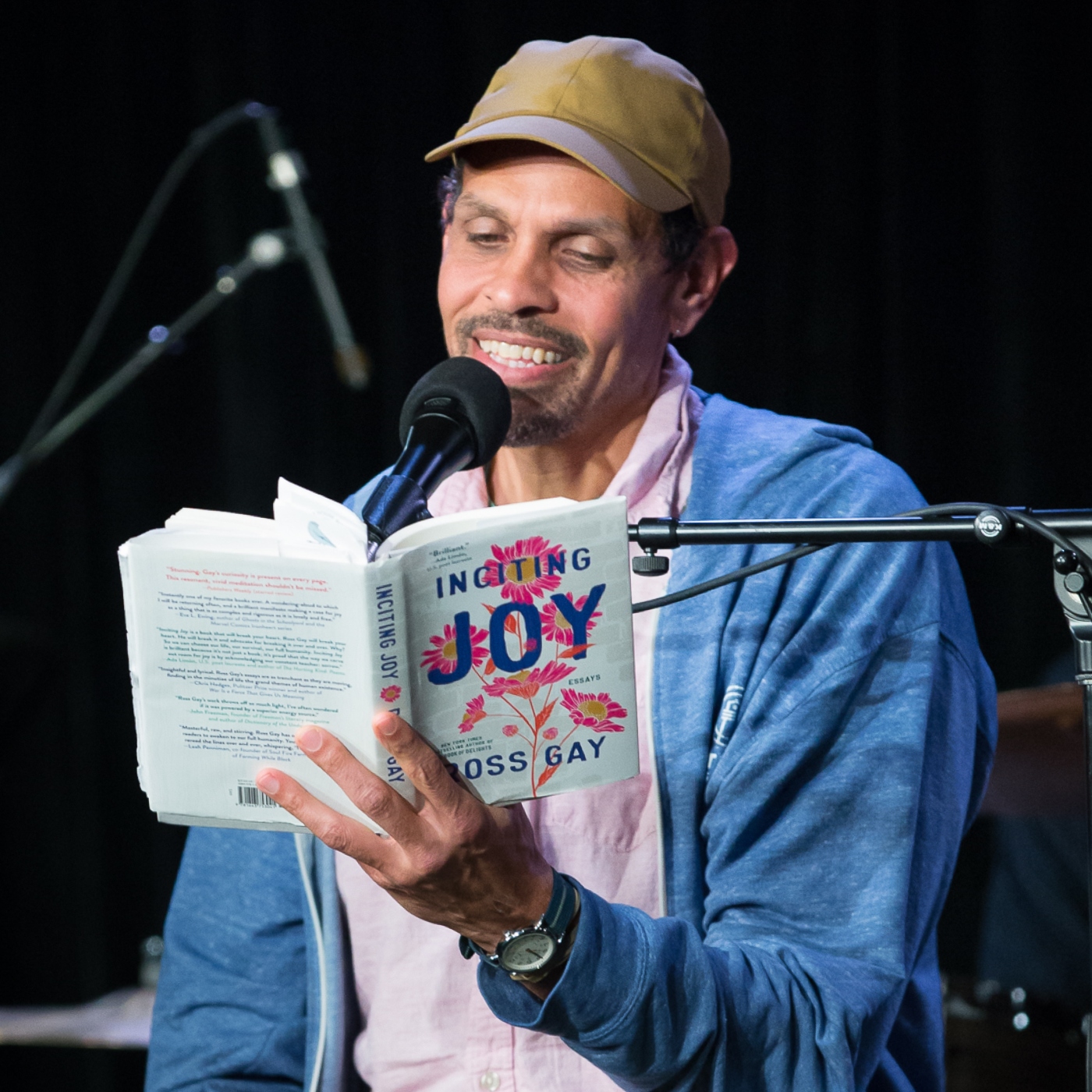
Live Wire with Luke Burbank
Ross Gay, Lane Regan, and Baroque Betty with Mood Area 52 (REBROADCAST)
00:51:57
This episode features poet and essayist Ross Gay, writer and Michelin Star chef Lane Regan, and music from Baroque Betty with Mood Area 52.
Loading summary
Transcript139 lines
- [00:03]
Luke Burbank
Hey, there. Welcome to Livewire. I'm your host, Luke Burbank. This week on the show, we are talking about joy, which we can all use more of in our lives. Always. We're here to talk about writer and poet Ross Gay and his book Inciting Joy, which he's gonna read from. Then we're gonna bond over stories of childhood skateboarding, which is gonna be joyful. Then we are gonna catch up with Michelin star chef and writer Lane Regan on why they love cooking and but they don't love being a chef. And they're going to talk about their book A Forager's Guide. Plus, we'll finally get to the bottom of the rumor that Lane once sold homemade ranch dressing at a Chicago farmer's market, which they deny, but I'm not sure. All that plus music from Baroque Betty in Mood Area 52. Our mood, joyful that you're sticking around for Livewire, which gets started right after this. Hey, y'.
- [01:01]
Ross Gay
All.
- [01:01]
Sam Sanders
Each week on the Sam Sanders show, we ask big questions and offer hot takes about the pop culture we're obsessed with. Like, should we be allowed to talk at the movie theater? Are stadium concerts boring now? Is it time to stop making bingeable tv? Join me and a bunch of comics and journalists and celebrities as we make sense of the zeitgeist, or at least make fun of it. The Sam Sanders Show. Wherever you get your podcast and on YouTube.
- [01:30]
Odoo
This show is supported by Odoo. When you buy business software from lots of vendors, the costs add up and it gets complicated and confusing. Odoo solves this. It's a single company that sells a suite of enterprise apps that handles everything from accounting to inventory to sales. Odoo is all connected on a single platform in a simple and affordable way. You can save money without missing out on the features you need. Check out odoo-o o.com. that's O-O-O.com.
- [02:00]
Luke Burbank
This episode of Livewire was originally recorded in March of 2023. We hope you enjoy it. Now let's get to the show.
- [02:09]
Elena Passarello
From prx, it's Livewire.
- [02:20]
Lane Regan
This week, poet and essayist Ross Gay.
- [02:23]
Ross Gay
The sort of notion of privilege, like, oh, you're privileged because you have a place to garden, or you're privileged because you have breathable air, is evidence actually of disprivilege. You know, it's evidence of brutality.
- [02:35]
Lane Regan
And chef and writer Lane Regan.
- [02:38]
Elena Passarello
Chefs are storming through kitchens and they're mad at their employees and they're, you know, like, ah, this thing needs to Be this way. It's like, what's the point?
- [02:46]
Lane Regan
With music from Baroque Betty, with Mood, Area 52 and our fabulous house band, I'm your announcer, Elena Passarello. And now the host of Livewire, Luke Burbank.
- [03:00]
Luke Burbank
Thank you so much, Elaina Passarello. Thanks to everybody for tuning in from all over the United States. We've got a wonderful show in store for you this week. Of course, we asked the Livewire listeners a question. We asked them to describe their perfect world weekend. And one of the people that we're interviewing this week, Lane Regan, runs this place in the woods of Michigan. It's called the Milkweed Inn. And it's pretty much the most perfect woodsy weekend that you could ever imagine. So we're going to hear our listener responses to that question coming up, what does their perfect weekend look like? First, though, we got to kick things off with the best news we heard all week. This is our little reminder at the top of the show that there is good news happening out there in the world. World. Elena, what's the best news you heard all week?
- [03:49]
Lane Regan
Well, I have some Waffle House best news. This is a Waffle House in Little Rock, Arkansas, where the Hunter family shows up for breakfast at least once every weekend. And they always request to sit in the section of a server there named devonte Gardner. Devonte knows everybody's order, including eight year old Kazen. Kazen gets a high five every time he comes in. And then devonte knows that he wants hash browns with cheese, which in Waffle House parlance is covered. Anyway, one day Kazin was in that Waffle House with his grandfather and he heard Mr. Gardner asking around on leads on a very cheap car because it turns out he lives far away now from the Waffle House and has to walk several miles.
- [04:35]
Luke Burbank
This was Mr. Gardner, their typical server there at the Waffle House.
- [04:38]
Odoo
Yeah.
- [04:38]
Lane Regan
Devonte Gardner. Yeah. The apartment where he lived with his family, with his wife and two daughters was uninhabitable because of a black mold problem. They had to move to a motel and he was walking several miles from that motel to the Waffle House to go to work and make everybody smile like he normally does. So 8 year old Kazin goes home and tells his mom, his mom and her husband actually had a black mold issue that made them have to leave a place where they used to live. So she totally empathized and so she told Kazin it would be okay if they started a Go Fund Me. So Kazin starts the GoFundMe asking for $5,000 to get Mr. Devonte Gardner a new car. But then a local news station picks it up, and now $50,000 has been raised for this amazing Waffle House server.
- [05:29]
Luke Burbank
Wow. So I guess he's got a Tesla now.
- [05:31]
Lane Regan
Yeah, Well, I think he's gonna get a car plus a year's rent. It's gonna take a little pressure off, and that's awesome. The gratitude in this story is just so amazing. It's the thing that makes me feel the best. Devonte Gardner says, I am thankful job that I enjoy, but it's really hard to save enough to improve my family's stations. But we are slowly working our way back. I love working at Waffle House because I have the opportunity to make people feel good every day. And when Kazen was asked about his act of generosity, he said, sometimes people just need a little help, which is very cute and totally true.
- [06:04]
Luke Burbank
Good lesson to learn as a young kid. Absolutely. Speaking of food, the best news I saw this week involves pizza, where the sport of pizza acrobatics, also known sometimes as pizza freestyle, or for those not very much in the know, pizza tossing is finally getting its due. A great profile in the Washington Post of a guy named Tony Geminani, who has been competing in pizza acrobatics for, like, almost 35 years now. He started off when he was 17. He was working at his brother's pizzeria in Castro Valley, California, and he just noticed that he could kind of, like, do cool stuff with the pizza dough. Like, he could throw it, like, a little higher. You know how like, the sort of movie version of somebody making pizzas, like.
- [06:51]
Lane Regan
Cocktail, but for pizza.
- [06:52]
Luke Burbank
Right? Exactly. Well, he was just, like, really good at it, and he was throwing it higher and higher. And so then he started just kind of, like, seeing what the limits of what he could actually do was, and he got really good at it. Part of how he got good was he would sew these kind of, like, circular things that were, like, a pizza dough and then practice with them all day long when he wasn't at the pizzeria. And he got super good at it to the point where he's won, like, something like. Well, he's won a total of 13 World Championships in various parts of the pizza competitive space. Elena. Okay, so he's got seven of them are for pizza acrobatics. He's also won several Guinness world records, including largest pizza baseball spun in two minutes, by the way, that was 33.2 inches if you're scoring at home. Now, the reason that I found this so fascinating is because, do you know, I've actually watched the, like, world championships of this happening in Las Vegas. I attended something called the International Pizza Expo and conference once in Las Vegas, and I saw him there doing this. It is incredible. They're like, on a stage. There's like pyrotechnics, there's loud music. They're spinning the pies. It's like everybody actually very physical and takes a lot of practice and physicality. Anyway, Tony is now kind of transitioning into being sort of the elder states person of the pizza acrobatics world. But what's cool is he's now, because he's like, on YouTube and all these videos are out, he's getting young people into it, including women and other people who maybe, you know, wouldn't have traditionally been included in the pizzeria pizza acrobatics world. So I can just say, having seen Tony in person, the guy is amazing, and I'm glad he's finally getting his due. Pizza acrobatics being treated as the sport that it is. Alaina, sport of the future. That's right. Right there with pickleball, the most delicious sport that I know about. That's the best news that I heard all week. All right, let's get our first guest on over to the show. He's a New York Times best selling author of the Book of Delights. He's also got four books of poetry out. The Boston Globe calls his latest book Inciting Joy a raucous affair with dancing. Fabulous covers of all your favorite songs, tons of food, a backyard full of folks and all their sorrows too. Book Riot calls it essentially reading. This is our friend Ross Gay, recorded at Town hall in Seattle. Take a listen. Ross, welcome back to the show.
- [09:36]
Ross Gay
Thanks. Good to be here.
- [09:37]
Luke Burbank
It's really nice to see you. The last time I think that we talked to you, we were talking about your previous book, the Book of Delights, where you really kind of did a practice of finding something to be delighted about every single day and writing about it. And now you've got this book, Inciting Joy. Did your previous book kind of feed naturally into this latest book?
- [09:59]
Ross Gay
You know, probably because it did, as did the book before it. Catalog of unabashed gratitude. Partly because people would be, you know, I'd have conversations with people about Joy on account of those two books, which I was thinking about somewhat, but I wasn't thinking about it as a sort of long and maybe like lifelong sort of inquiry, you know. But after having enough conversations, it for sure felt like, oh, I could talk about this and think about this for a long time.
- [10:26]
Lane Regan
Did you have something that you wanted to do with this book, which is about joy? That didn't maybe happen with the previous book, which was about delight or the one before, which was about gratitude?
- [10:36]
Ross Gay
I think one thing I wanted to, like, spin out. I wanted to write longer pieces, you know, that was one thing for sure. I also felt like there's a couple impulses for writing the book. I mean, many. But one of them is that in some of those conversations, people would say things like, but how can you write about joy at a time like this? And my sort of immediate response, sort of in my head anyway, is like, that's a stupid question. But I get it. I get it.
- [11:09]
Luke Burbank
The noted joyful person Ross Gay has checked in. Yeah, great. Yeah.
- [11:15]
Ross Gay
But I get it. And then so, you know, so then I had to write this introduction where I sort of raised the question. I articulate that in a different way.
- [11:24]
Luke Burbank
Actually. I was wondering, could you read from the book a little bit, actually, that part, Because I found it to be a really interesting interrogation of this idea that I think you say something like, it's a sort of a dangerous fantasy. You write to think that joy means without pain. And I was wondering if you kind of read the part of the book that sort of fleshes that idea out a little bit.
- [11:46]
Ross Gay
But what happens if joy is not separate from pain? What if joy and pain are fundamentally tangled up with one another? Or even more to the point, what if joy is not only entangled with pain or suffering or sorrow, but is also what emerges from how we care for each other through those things? What if joy, instead of refuge or relief from heartbreak, is what effloresces from us as we help each other carry our heartbreaks? Which is to say, what if joy needs sorrow? Or what Zadie Smith, in her essay Joy calls the intolerable for its existence? If it sounds like I'm advocating for sorrow, nope. Besides, sorrow, unlike joy, apparently doesn't need an advocate given as, to quote the visionary blind man Pazzo in Samuel Beckett's play Waiting for Godot were born, quote, astride a grave, that is we and everyone and everything we love will one day, maybe today die. I think sorrow's gonna be just fine. Like Gwendolyn Brooks says about death, one of sorrow's chauffeurs. It's, quote, just down the street, his most obliging neighbor can meet you at any moment. End quote. Or as the Jackson 5 sing, not in the voice of sorrow, but Kinda. I'll be there. But what I am advocating, and adamantly so, is that rather than quarantining ourselves or running from sorrow, rather than warring with sorrow, we lay down our swords and invite sorrow in. I'm suggesting we make Sorrow some tea from the lemon balm in the garden. We let sorrow wash up and take some of our clothes. We give sorrow our dad's slippers that we've hung onto for 15 years for just this occasion. And we drape our murdered buddy's scarf, still smelling of nag champa, over sorrow's shoulders to warm them up some. We wedge some wood in the fire. As we're refilling their tea, we notice sorrow is drinking from a mug given to us by someone we've hurt.
- [13:51]
Luke Burbank
That's Ross Gay reading from Inciting Joy. This is Livewire from prx. We are talking to writer and poet Ross Gay about his new book, Inciting Joy. When we get back, we're going to talk to Ross about something that he and I were both very obsessed with as kids and that would be skateboarding. So stick around for that. Back with more Livewire in just a moment.
- [14:28]
Deborah Treisman
Hi, I'm Deborah Treisman, fiction editor of the New Yorker and host of the New Yorker Fiction Podcast. On the podcast, I ask a great contemporary writer to select a favorite story from the magazine's almost hundred year archive to read and discuss. Together we delve into the story, exploring its themes, its style, and what makes fiction work. You can listen to authors like Ottessa Moshfegh talk about why we write story or attaching a story or creating a story.
- [14:57]
Elena Passarello
Is this inclination that we all have to stop spinning.
- [15:04]
Deborah Treisman
And you can hear writers like George Saunders discuss the nature of storytelling on the first read.
- [15:09]
Ross Gay
You accept these things as descriptions and.
- [15:11]
Luke Burbank
They make you see the scene. But every line is a chance to inflect the reader's mind.
- [15:17]
Deborah Treisman
You'll discover new favorite authors and read old favorites in new ways. Episodes of the New Yorker Fiction Podcast are released on the 1st of every month. Listen and follow wherever you get your podcasts.
- [15:47]
Luke Burbank
All right, welcome back to livewire. Coming to you this week from Town hall, we're talking to Ross Gay about his incredible latest book, Inciting Joy. One of the things that you write about in this book is this question of privilege, because to say gardening, which is something that you love, incites joy for you naturally raises the question, what about people who don't have access to a garden? Or what about people who don't have access to the things that can incite Joy for us. And you talk about it in a really interesting way. Can you kind of explain that?
- [16:21]
Ross Gay
Yeah, I sort of been thinking a lot about this. The term privilege is almost sort of. I mean, there's many things. One thing is that just saying privilege almost feels. It seems like some people think to say that is an action, you know, and that ultimately what? Privilege. This sort of notion of privilege. Like, oh, you're privileged because you have a place to garden, or you're privileged because you have breathable air, or you're privileged because you can drink the water that comes out of your tap, or you're privileged because you're not getting beat up by a cop. Or you're privileged because on and on and on and on, which obscures the fact that to have all of those things happen to you is evidence actually of disprivilege. It's evidence of a brutality. And furthermore, it's evidence of a brutality that is action. So privilege is a way, you know, to say privilege often is a way to actually obscure this thing. Privilege just sort of almost makes it natural, you know, it's just privilege. That's just the way it is. I'm privileged. Bummer. When in fact, it's like, no, you know, the reason there's lead in the water is because people let there be lead in the water.
- [17:28]
Luke Burbank
Right.
- [17:28]
Lane Regan
That's not a privilege.
- [17:29]
Ross Gay
No, it's not a privilege. It's not a privilege not to be poisoned.
- [17:33]
Lane Regan
Right.
- [17:33]
Ross Gay
You know.
- [17:34]
Luke Burbank
Right.
- [17:34]
Ross Gay
It's a disprivilege to be poisoned.
- [17:36]
Luke Burbank
I believe you describe it as violence in the book. In other words, the people who are not having the privilege of a garden, it's in a way to not have access to, like, again, breathable air, drinkable water. That's the violence. Right. Everyone should be able to have a garden and drink the water.
- [17:52]
Ross Gay
Yeah, yeah. If you want to have a garden or you want to be able to get into a garden, you should be able to get into a garden. If you want to have a. Be able to have, I say in the book, like a relationship with a tree. You know, you want to be able to, like, smell flowers. You want to be able to harvest. You want to be able to, you know, pitch in to do all of this sort of processes that. That affords one, you know, the gifts that that sort of, you know, gives you. That. That just ought to be life. The absence of that or. Or the withholding of that, because it's a withholding is. Is brutality.
- [18:22]
Luke Burbank
You write about two things in this book that were the complete kind of cornerstones of my life as a kid, which were pickup basketball and skateboarding, which is part of why I enjoyed this book so much. I was wondering if you could read a little bit from the chapter. It's share your bucket. It's the fifth incitement, and it's about skateboarding. Could you read from that? Because you brought up something that I had never really thought about, but it was totally my lived experience with me and my buddies and swapping stuff on our boards and, oh, you got those new OJs and the kind of communal nature of being into skateboarding.
- [18:57]
Ross Gay
Yes. Share your bucket. Skateboarding. The fifth incitement, perhaps somewhat telling, is that when Stephanie and I were counseled by our couples therapists to spend some time imagining a safe place before entering a difficult conversation, I didn't choose a mountain stream or a forest or a glade or a meadow or a beach. I chose, along with a basketball court, a curb at the IGA at Pine Watson Shopping center in Langhorne, Pennsylvania, where one weekend night after hours, my buddy Jay and I, when we were in our late teens, dragged one of the shopping carts to the curb, tipped it over, then pushing on our skateboards beneath the flickering lights beneath the plaza's overhang, toward the cart at the end of the curb in one sometimes seamless motion we would get our feet right, bend just a touch and ollie over the cart into the dark. Or, tired of that, we rail slid the cart or tried to ollie it long ways. Maybe we stood the cart up on its wheels and tried going over it that way. All of these attempts. I'm noticing this now from some light into dark, which is a nice metaphysical metaphor for our inquiry into joy. Skating on a John Lucero hand me down, given to me by my friend Mike with rat bones wheels Jay gave me earlier that day, inside of which are some very smooth bearings that Adam gave to him, ollieing into the mystery. The metaphysical metaphor being that submission to mystery is a possible source of joy. Noted also, of course, is that I am skating with a beloved pal, Ali' ing into the dark under the watchful gaze of someone doing the same. That seems relevant too. We are studying each other, beholding each other, flying into the dark. It is to that feeling which, if I were to locate it is in my chest, and it is the feeling of groundlessness that I go before a tough chat. Footnote worth noting, too, how often we fall skating, though also worth noting, you see how I wrote it a few sentences ago, is that skateboarding, at least between the mid-80s and mid-90s was one of the many places the gift economy was in radical action, by which I mean in practice. It was just the case that whatever you had extra and skateboarding with its many components, decks, wheels, bearings, trucks, bushings, riser pads, rails, rip grip bolts, et cetera, made for extra you pass along. Most of us had a bucket of some sort where when someone needed something we dug around to find it. I never once heard anyone express it as an ethics, sharing, redistribution, commonwealthing. Though if you tried to keep your extra to yourself, if you spoke to no one of your bucket and then it got out you had one and gleaming like gold in that extra Independent truck. Independent's a brand name. A truck is the thing that holds the wheels on was the kingpin. The kingpin's the thing that holds a truck together. One of us needed to skate that day. The reaction would be an ethical one. Yo, that's up man. Also worth noting is that skateboarding's re emergence, at least in the US is almost perfectly concurrent with a new Gilded Age. A grotesque accumulation and celebration of wealth deregulation, the dismantling of the welfare state, mass incarceration, NAFTA, taking the solar panels off the roof of the White House, privatization of everything, further enclosure of the commons, and the unabashed unapologetic mongering sanctification of hoarding the horde. It is probably for this reason the aforementioned ethics. I'm saying that if you were ever inclined to go down a YouTube rabbit hole watching Mark Gonzalez, the Sun Ra of skateboarding, or possibly even the Dizzy Gillespie of skateboarding, the Andy Kaufman of skateboarding, you would find that in fully one third of his abundant footage from when he was a skinny California kid in the mid-80s all the way to his preference, present day, full figured middle aged technical goofballery he is encountering, negotiating with, cajoling, resisting or running from the so called law owners or cops, bought and rented. Usually because he is skating somewhere he should not be, which is most everywhere. Probably because there's a perfect rail or a sweet bit of transition to a gap or a set of stairs calling him. Dude's been at it for decades. He's made it. He's a grown ass man. Why doesn't he just buy his own skate park? He should know better, but he never learns. One reason Gans is among the trillion beating hearts of skateboarding and in this he is in no way singular or the best. Gans is just one of a trillion apostles of the form is because he usufructs the Skateable World, which includes benches, picnic tables, walls, handrails, flights of steps, curves, fire hydrants, ledges, parking lots, sidewalks, driveways, loading docks, loading ramps, bus stops, parking garages, schoolyards, drainage ditches, streets, alleys, walls. That is the built environment, whether new or in disrepair. In other words, the only limitation to what might be skated or made public or commoned or shared is the imagination.
- [24:09]
Luke Burbank
That's Ross Gay. Greeting from Inciting Joy here on livewire. As a. As a. As a kid who grew up really, really wanting my parents to dedicate our entire backyard in Seattle to a half pipe, which never happened, it would have been the entirety of the backyard. I was so jealous of people who had either like, a ramp or access to a skate park or whatever. But you write in this book that you're kind of glad that you didn't grow up where there were skate parks everywhere.
- [24:47]
Ross Gay
Yeah. And it's funny. So many things. It's funny to get to an age where I'm like, oh, man, I'm so glad we didn't have that then, you know, and among them, I talk about water. You know, I mean, we had water, but we didn't have bottled water. And it was amazing. And we, you know, we didn't have cell phones. It was amazing. We could get lost and be alone. It was incredible. Oh, my God, children, you don't know what you're missing. But the other thing. Yeah, like that. That sort of experience of, like, walking around the world as I still do. I'm 48 years old, and like, every once in a while I'll skateboard, I'll putter around. But I always walk around and I look at the city, the built environment. I'm like, ooh, you could skate that. You know, there's. Oh, that's to be skated, you know, again and again. In which the way that I think of it, it is kind of like you're being trained to sort of witness or being trained to sort of observe how everything is something else, you know, so you're being trained in metaphor in a way, you know, which to me feels like a profound sort of actually survival skill, you know. Oh, you could use this for that, you know.
- [25:49]
Luke Burbank
That's Ross Gay here on liveware, everyone. The new book is Inciting Joy. Ross, thank you so much. That was Ross Gay right here on livewire, recorded at Town hall in Seattle. His latest book, Inciting Joy, is available now. Livewire is brought to you by Powell's Books, a Portland institution since 1971. Powell's offers a Selection of new and used books in stores and online@powell's.com. hey. Special thanks this week to Miriam Furley of Portland, Oregon, and Michael Smith of Everett, Washington. Miriam and Michael are part of the Livewire member community and are generously supporting the show with a donation each month. They're in the league of extraordinary listeners, y', all, and that support is really big because it's how we're able to keep doing Livewire. So thanks to Miriam and Michael for keeping the show going. This is Livewire. As we do each week, we asked the Livewire listeners a question. We wanted to know what their perfect weekend might be like. Laina has been collecting up those answers. What are you seeing?
- [27:19]
Lane Regan
Well, I read these a little too quickly, and when I saw Dee's, I got really excited because, well, D actually wrote a catan tournament, which I believe is some kind of board game.
- [27:31]
Luke Burbank
Okay. Like Settlers of Catan. I believe that's a. Like, a board game that's very involved that people get really into.
- [27:38]
Lane Regan
Yeah, yeah. So that is what D would include in D's perfect weekend, but I misread it as a caftan tournament, which I would totally attend and win New York.
- [27:50]
Luke Burbank
You know, I started earlier in the show talking about the, you know, pizza acrobatics championship. I would say Caftan. Settlers of Caftan would be an only slightly more niche sport, and you would be the reigning world champion. I don't know anyone who owns more caftans than you.
- [28:05]
Lane Regan
I bought three caftans the week of my 40th birthday. Like, I was just trying to, like, manifest my golden girls future.
- [28:12]
Luke Burbank
It's working. Absolutely. Thank you. What's another perfect weekend for one of our listeners?
- [28:17]
Lane Regan
Here's a blast from the past from Heather. Heather's perfect weekend. GTL Baby gym, Tan and laundry.
- [28:25]
Luke Burbank
Whoa.
- [28:25]
Lane Regan
Are you familiar with the GTL sect?
- [28:28]
Luke Burbank
Oh, I very much am. You know, that would be a Jersey Shore reference, I believe. Right. That was how they used to do.
- [28:35]
Lane Regan
I wonder if they ever opened, like, you know, how they have, like, a Kentaco Hut, Like a Pizza Hut, Kentucky Fried Chicken, Taco Bell. Somebody should have made a place where you could do your laundry, get tan, and work out all in the same fused space.
- [28:49]
Luke Burbank
I mean, there would be a convenience to that, certainly. Okay, one more before we move on.
- [28:54]
Lane Regan
I love Aaron's perfect weekend, which is watching a true crime documentary on Friday and then being too afraid to leave my house for the rest of the weekend.
- [29:05]
Luke Burbank
Yes, I have definitely experienced that myself.
- [29:08]
Lane Regan
Anytime anyone says that I light up a room, I'M always terrified that I'm going to be on the next Forensic Files, because that is really.
- [29:14]
Luke Burbank
Watch out. Yeah. All right. Thank you to everyone who sent in their response to our question this week. We've got one for next week's show, which we will reveal in just a few moments. Our next guest's life started on a small farm in Indiana before they made their way to Chicago, where they ended up running their own Michelin starred restaurant. Now, these days you can find them in the very remote woods of Michigan where they run the Milkweed Inn, which is an amazing weekend experience that I've got to be honest with you, and I speak from experience. It's very hard to get a reservation for. Their latest book is the incredible Fieldwork A Forager's Guide. Take a listen to this conversation with Lane Regan, who at the time that we talked to them, went by Elena Regan. This is Livewire. Hi, Elena.
- [30:09]
Elena Passarello
Hey.
- [30:09]
Luke Burbank
Welcome to the show.
- [30:11]
Elena Passarello
Thanks for having me.
- [30:13]
Luke Burbank
You write in this book that you had like an awakening in 1984, which would have made you like five years old.
- [30:23]
Elena Passarello
Yeah. I mean, yes.
- [30:24]
Luke Burbank
Around there.
- [30:25]
Lane Regan
Ish.
- [30:26]
Luke Burbank
Yeah, 1984, when what happened? You went foraging with your family and something like, clicked?
- [30:33]
Elena Passarello
I think I was already doing that prior to 1984, but I think what that was like when me as the writer here now could actually think about, well, when was it that I could remember, like enough to kind of channel these stories and be able to talk about them and write about them. And so I focus on that year, 1984, because that's when I could really pull that information. Thanks.
- [31:02]
Luke Burbank
Sure. By the way, backstage you were like, very proud. You're like, I have my reading glasses with me. Yeah.
- [31:08]
Elena Passarello
But then I didn't bring the little cleaner. So wait.
- [31:15]
Luke Burbank
Why don't you go ahead and get, get your readers ready.
- [31:18]
Elena Passarello
I know you're gonna ask me to read some. I should have did this when I was just back there farting around. I should add this tongue. That's the chef part of me talking. Like, why the hell did you not have your readers ready?
- [31:37]
Luke Burbank
Well, speaking of being a chef, you didn't go to culinary school, Right. But you write in this book about you growing up in a family of people that could cook. Do you feel like cooking is hereditary, is something you can inherit?
- [31:49]
Elena Passarello
Well, I don't know if it's hereditary or able to inherit, but I think that there is something to intuition. And if you grow up maybe in an environment where surrounded by people who are cooking or foraging in that sort of way, that maybe some of that could get implanted into you. And I'm currently learning about recipes that my family has that almost. I feel like I learned through osmosis, through my mom or somehow through, like, my DNA, like, or my ancestors, like, I talk about in this book, whispering to me. And of course, like, sure. Maybe that's just multiple personalities or something. I feel like there is some sort of channeling that's going on.
- [32:37]
Luke Burbank
I want to make sure that I have your kind of journey with food. Correct. So from the book, as a teenager, you were bussing tables at an Italian restaurant, and then you make your way into the kitchen, and you end up working at Alenia, which is, like, one of the greatest restaurants in the world. In Chicago.
- [32:55]
Elena Passarello
Yeah. I mean, not anymore.
- [32:57]
Luke Burbank
Right. You. Well, okay. When you were there. Wow. Shots fired. I think. I don't think we're on in Chicago. So say whatever you want. And then you.
- [33:09]
Ross Gay
You.
- [33:09]
Luke Burbank
You walked away from millennia to make your own ranch dressing and sell it at a farmer's market. And then it's. And then eventually start your own restaurant, which won a Michelin star every single year that you were running it. And then you more or less gave that restaurant to some of your employees.
- [33:31]
Elena Passarello
Yeah.
- [33:31]
Luke Burbank
And then went to the woods of Michigan.
- [33:33]
Elena Passarello
Yeah. I mean, for the most part, that's the gist. You got the ranch dressing.
- [33:43]
Luke Burbank
I mean, that never happened.
- [33:45]
Elena Passarello
Okay. So there is a part in my other book, Burn the Place, where if at this Italian restaurant, if you take this bread that's, like, from Toronto and, you know, the Toronto bakeries, and you put it in the oven, and then you dip it in, like, the craft dressing that probably came in a vat, and then you put, like, I don't know, some sort of manufactured parmesan cheese on it. I mean, it's fantastic. So it's like you can have an epiphany having ranch dressing. And I think that was a little bit in my last book I had.
- [34:18]
Luke Burbank
Read somewhere I'd read.
- [34:19]
Elena Passarello
I think I made pierogies at the farmer's market at the ranch somewhere.
- [34:25]
Luke Burbank
We've got to get someone to take down an article where it talks about you making homemade ranch dressing.
- [34:29]
Elena Passarello
Because, I mean, I've made homemade ranching.
- [34:32]
Luke Burbank
I just loved that for your bio so much. I guess I wanted it to be true. Now, by the way, we're talking to Elena Regan about her book Field A Forager's Memoir here on Livewire Radio. One of the things that you said in the book is that you really like cooking, but you don't like being a chef.
- [34:50]
Elena Passarello
Well, I mean, okay, here's the thing. There's essentially, I'm in the business of entertainment. Right. In a way that as a chef and having a restaurant, I'm performing. And I don't want to get into all the moral dilemmas that I have with that, not only, like, environmentally, but also just physically, mentally, whatever. We don't have time for that in this 15 minutes.
- [35:15]
Luke Burbank
What? I can't. I appreciate you producing the show on the fly. Good looking out.
- [35:23]
Elena Passarello
I think that as chefs, sometimes people are taking themselves too seriously, and they're causing a whole lot of other, like, young people who are interested in food and interested in creation, artistically or whatever, a lot of strife. I think that everything's getting taken too seriously. Has been for a long time. It's not brain surgery. It's entertainment. So I love actually being a chef, and I love entertaining people, and I love cooking for others. But I think some of that pressure and some of those ideas around it where chefs are storming through kitchens and they're mad, and they're mad at their employees, and they're, you know, like, ah, this thing needs to be this way is just so. It's like, what's the point? You know? So, yeah.
- [36:17]
Luke Burbank
So now, if I understand it right, if you yell at an employee, it's your wife.
- [36:21]
Elena Passarello
Yes, absolutely. She pisses me off.
- [36:26]
Luke Burbank
Because you and your wife now run the Milkweed Inn in the Upper Peninsula of Michigan, which is a sort of phenomenon unto itself, because it's this incredibly beautiful location with what sounds like an amazing time for a very, very small number of people. During the summer months, you pick them up at the truck stop.
- [36:45]
Elena Passarello
Yeah. And the reason why I wanted to do that was to kind of go back to my roots, because when I started out, I was like, okay, long story short, I don't want to do all this working through kitchens with all these tyrannical chefs. I'm going to do my own thing. So pierogi's at the farmer's market. Not ranch dressing.
- [37:04]
Luke Burbank
All right, but agree to disagree. I'm hearing different things.
- [37:12]
Elena Passarello
I mean, the inspiration comes from somewhere. I'm gonna make some ranch dressing.
- [37:18]
Luke Burbank
Please do pierogi someday.
- [37:20]
Elena Passarello
But anyways, so I have this little underground thing at my house where I serve 10 people on Fridays and 10 people on Saturdays.
- [37:30]
Luke Burbank
And this is when you're living in Chicago.
- [37:31]
Elena Passarello
Right. And then it forms into a restaurant, which my goal. And then eventually I'm like, I don't want a restaurant anymore. I don't want to have employees. I don't want to do this whole thing, but it was so much more sustainable just doing it small, being able to actually go out and forage myself or grow the things myself. I mean, it's a lot of hard work and it's just so much of a headache in a different way than it is of doing books or payroll or all those things. But at least I know that at Milkweed, to get through one service, I'm not using like 500 gallons of water a day or I don't have the electricity going on all day. And some of the natural resources that we use in just one day in this entertainment business is a lot in just one restaurant in one city that serves 25 people. I have these dilemmas. Like when I was at the airport this morning, I was thinking, like, what if just one airport in this country, like just. Just didn't have any meat anymore, you know, like just. Just one. I'm sure it pissed a lot of people off.
- [38:34]
Luke Burbank
That wouldn't go over well at the Buffalo Wild Wings, right?
- [38:38]
Elena Passarello
But just like, you know what I mean? So like I'm sitting here getting at the airport, getting ready to come here, and I'm just like, well, why am I having these thoughts? But at the same time it's good thoughts and this is frustrating and I'm like, I just need to go back to bed. But, you know, that's whole thing anyways, you'll read in this book, if you do get my book, that there's a lot of things that keep me up at night. So you won't be surprised about that.
- [39:07]
Luke Burbank
Actually, can we hear a little bit from the book Fieldwork? Because it is a forager's memoir and you do talk a lot about all of these amazing things that you forage, particularly mushrooms. So could you read a little bit about that?
- [39:20]
Elena Passarello
Yeah. This is from chapter 15 called Ephemeral Sexual Organization. It's not that sexy. All right, so we're going to kind of start in a couple paragraphs in Mushrooms are sexy. Some are multi gendered, others are male and some are female. Some reproduce together and some are asexual, able to reproduce on their own. Mushrooms are more like animals than plants. But I don't know exactly how. I'm not a mycologist, I'm not a botanist or an anthropologist. I'm just a person who prefers mushrooms to people and trees to tall buildings. A person who spends many hours alone thinking too much about what I'm thinking. I do study some of what I write about. I have tried to understand how mushrooms reproduced, and the best explanation I've heard was told to me by my friend Rebecca, who is a mycologist. The fruiting body is the ephemeral sexual organ of the mushroom. The rest of the organism resides underground as mycelium, the part that we see just fruits to fulfill a reproductive function. She told me this, and I wondered if this was why mushrooms tasted so good. In any case, mushrooms are fascinating. People hunt them, dream about them, fall in love with them. Some people even have festivals to celebrate different seasons and species of them. And out of the many wildly beautiful organisms in the forest, mushrooms will more often than not stop you in your tracks for a closer look. On August 17, 1979, sometime in the late morning, I fruited. Okay, so I shouldn't have put my actual birth date in there. Not because I'm afraid of how old you guys know that I am, because it's not that old. So I'm sorry. I apologize to anybody older than me in the audience, but just don't go looking for my mom's maiden name and things like that, okay?
- [41:32]
Luke Burbank
Okay.
- [41:35]
Elena Passarello
Okay. So on August 1, 1979, sometime in the late morning, I fruited. I was swaddled against Mom's chest. By the time dad got to the hospital, he was dusty from Grandpa's farm. He'd been out on the tractor in Grandpa's field, sculpting a new patch of land for next season's corn, when he got the call that mom was in labor. He had two sheepshead mushrooms bundled in paper napkins. He stood in the hospital room's doorway, the mushroom swaddled against his chest. He stepped into the room, and with his free arm he reached out for me. Mom turned, shielding me from his reach. She told him to wash himself off first. He set down the mushrooms on the tray table at her bedside. After he washed up, he held me for a couple of minutes. Passing me back to mom, he said. Found two sheep, said, and nodded to where he had set them. Come real early this year. Been some good rain, though, he said, scratching his cheek. I never found him this early before. Mom didn't respond right away. She was exhausted but awake enough to tell him to move the mushrooms from her tray table. The sun rose over the window. A distant church bell confirmed it was noon. The window was open, and a fan churned where it was propped against the screen. A couple of bees pulled by the fan bumped against the screen. The air of the room 3e was warm and thick and smelled a fresh baby and starched hospital sheets. Dad sat in a chair beside the bed in Mom's arm. I was £7 and a few ounces against her breast. My sisters would arrive soon but were late as well. Dad asked what was taking them so long. Mom didn't answer, figuring whatever it was, they were up to no good. Dad pressed the shiny pads of his calloused palms together and hung his hands down between his knees like he was praying to the floor.
- [43:37]
Luke Burbank
Elena Regan reading from her book Fieldwork here on Livewire. That was Lane Regan recorded in front of a live audience at the Alberta Rose Theater in Portland, Oregon. Lane's book A Forager's Guide is available right now. This is Livewire radio from prx. We've got to take a quick break, but don't go anywhere. When we come back, we are going to hear some delightful music from singer songwriter Baroque Bedi, accompanied by by Mood Area 52. Sounds mysterious. Stick around, find out what we're talking about here on Livewire. Welcome back to Livewire from prx. I'm Luke Burbank here with Elena Passarello. All right, are you ready to play a little station location identification examination?
- [44:39]
Lane Regan
I sure am.
- [44:40]
Luke Burbank
This is where I quiz Elena about a place in the country where Livewire's on the radio. She's gotta try to guess where I'm talking about this. I'm just gonna manage everyone's expectations. Let's just say it is a wonderful but slightly boutique location in America. Okay? Okay. So don't put too much pressure on yourself. All right? Okay. This city gets its name from the Choctaw language. It's derived from the word meaning red rock. And speaking of rock, rock legend Little Richard lived here at the time of his passing. This is where Little Richard was living.
- [45:16]
Lane Regan
I know he's from Georgia originally, but.
- [45:20]
Luke Burbank
I'll give you a hint. It's not in the state of Georgia. Which leaves you 49 other possibilities. This city's Cascade Hollow distillery is located along America's whiskey trail. And George Dickel whiskey is produced in this place.
- [45:37]
Lane Regan
Oh, I do believe you're talking about Chullahoma, Tennessee.
- [45:40]
Luke Burbank
Oh, my gosh.
- [45:41]
Lane Regan
You have me a George Dickel man, the whiskey you're.
- [45:45]
Luke Burbank
I don't think I'd ever seen the name. Tullahoma, Tennessee. That's where we're on WTML radio. My goodness. That is really impressive. All right, shout out to everyone tuning in in Tullahoma, Tennessee on WTML. This is LiveWire. Okay, before we get to our musical guest this week, a little preview of next week's show. We are going to be joined by chef and author Kenji Lopez, alt. He's a James Beard Award winner, he's co host of the podcast the Recipe, and he's an all around food savant. Okay, I've been out eating teriyaki with Kenji. The guy is amazing. He's gonna talk to us, by the way, about teriyaki, also about his sobriety and very importantly about the proper way to cut an onion. Then we have got music critic legend Ann Powers. You might know her as an NPR music critic. She's also the author of several books on music, including her latest which is titled on the Path of Joni Mitchell, which explores the life and career, career and influences of Joni Mitchell. And then speaking of music, we'll have some music from alternative folk singer songwriter Kutumu, who here's a fun fact, was also a member of the Yale Whiffin Poofs, which is the world's oldest acapella group. So make sure you tune in next week for the show. Sometimes checking your email, let's be honest, can be a little stressful, but we want to change that over here at Livewire. We want to make checking your email more joyful with our weekly newsletter, which is only good news. That's all we do over here at the Livewire newsletter. We got sneak peeks and deep dives on upcoming events, details on where you can join us live, new episode drops, and even more than that, getting this drop of joy. It's super easy, too. You head over to livewireradio.org and you click keep in touch. It takes like 30 seconds, 25 if you're speedy. So help us help you have a little more fun in your inbox with the latest from the Livewire newsletter. This is LIVEWIRE from prx. Our musical guest this week hails from Eugene, Oregon, and has built a dedicated following of both fans and musicians, including Woody Platt from the Steep Canyon Rangers, who describes her sound as striking and spectacular. Take a listen to this. It's Baroque Betty accompanied by Mood Area 52, recorded live at the Holt center in Eugene, Oregon. What song are we going to hear?
- [48:30]
Elena Passarello
This is the title track to my album.
- [48:33]
Luke Burbank
It's called Sobering Up.
- [48:56]
H
I would drive worlds to you. Fire and brimstone on an engine spring broken too. Just praying I'll get there Just to hold the last thread of us wrapped around my little finger. I've always been good at hanging on in a catastrophe. You've always been good at professing your apathy on this carousel rusted and sputtering ring out But I'm dreaming I was always dreaming like a bulletproof fool like the obvious could be true I'm still dreaming Please don't wake me from dreaming I'm just running confused and I'm sobering up the longer I look at you Well I would walk worlds to you Broken glass and eggshells by a busted hotel room with the house keeping knocking just to borrow some time that I hadn't already been stolen I've always been good at pretending you love me you've always been good at making me crazy enough to think that you've always been walking the line But I'm dreaming I was always dreaming like a bulletproof like the obvious could be true and I'm still dreaming Please don't wake me from dreaming I'm just running on fus and I'm sobering up the longer I look.
- [51:24]
Elena Passarello
At you.
- [51:46]
H
Cause I'm dreaming I was always dreaming Like a bulletproof like the obvious could envy true and I'm still dreaming Please don't wake me from dreaming I'm just running out of fus.
- [52:16]
Luke Burbank
And.
- [52:16]
H
I'm sobering out the longer I look.
- [52:20]
Elena Passarello
At you.
- [52:33]
Luke Burbank
That was Baroque Betty accompanied by Mood Area 52 right here on Livewire. Her album Sobering up is available now. All right, that's gonna do it for this episode of the show. A huge thanks to our guests Ross Gay, Lane, Regan and Baroque Betty, along with Moody Area 52.
- [52:56]
Lane Regan
Laura Haddon is our executive producer. Heather D. Michel is our executive director. Our producer and editor is Melanie Sevchenko. Our assistant editor is Trey Hester. Our marketing manager is Paige Thomas. Our production fellow is Tanvi Kumar, and Yasmin Medyan is our intern. Our house band is Ethan Fox, Tucker, Sam Tucker, Eyal, Al Alves and A. Walker Spring, who also composes our music. Molly Pettit is our technical director, and our house sound is by D. Neal Blake.
- [53:21]
Luke Burbank
Additional funding provided by the James F. And Marian L. Miller Foundation. Livewire was created by Robin Tenenbaum and Kate Sokoloff. This week we'd like to thank members Miriam Furley of Portland, Oregon, and Michael Smith of Everett, Washington. For more information about our show or how you can listen to our podcast, head on over to livewireradio.org I'm Luke Burbank for Elena Passarello and the whole Livewire crew. Thank you for listening and we will see you next week. Hey, if you appreciate the work that Livewire is doing to amplify riveting and unexpected voices to a national audience and I gotta tell you, it's a big audience these days. Please, please, please consider offering some monthly support by becoming a member of our League of Extraordinary Listeners. Here's how it works. Membership starts at just five bucks a month and there are great perks at every level, including a special shout out on the broadcast. Impress your friends by being shouted out on Livewire. It means the world world to us and really does make it possible for us to do the show. So please, if you can help, support us by visiting livewireradio.org memberships.
- [54:54]
Lane Regan
From PRX.