
Podcast
Look at the Book
Hosted by Desiring God · EN
Look at the Book is John Piper's ongoing series of 8-12 minute videos to help you learn to read the Bible for yourself.
57episodes
Episodes
Newest firstAll episodes

1 Corinthians 1:18–25, Part 2: God’s Wisdom Prevents the Knowledge of God by Wisdom
TodayTap to summarizeIn wisdom, God hides his plan of salvation from the self-proclaimed wise of this age. In grace, he reveals the power of the cross to those he calls.
Transcribe →
1 Corinthians 1:18–25, Part 1: Don’t Change the Gospel to Please the Proud
3d agoTap to summarizeWhat makes Paul so unwilling to add eloquence to the word of the cross? The apparent folly of the cross proves its actual power to those who are saved.
Transcribe →
1 Corinthians 1:13–17, Part 4: Does Divine Inspiration of Scripture Mean Divine Dictation?
1w agoTap to summarizePaul was taught by the Holy Spirit — but does that mean God told him exactly what to write? God preserved his truth through Paul’s personality.
Transcribe →
1 Corinthians 1:13–17, Part 3: Shameful Cross vs. Proud Eloquence
1w agoTap to summarizeAs Paul discipled the Corinthian church, he never intended to be their celebrity pastor. He aimed at something far greater: preaching a powerful cross.
Transcribe →
1 Corinthians 1:13–17, Part 2: Why God Kept Paul from Baptizing
2w agoTap to summarizeWhen Paul looked back on his work of establishing the Corinthian church, he thanked God for keeping him from baptizing too many believers. Why?
Transcribe →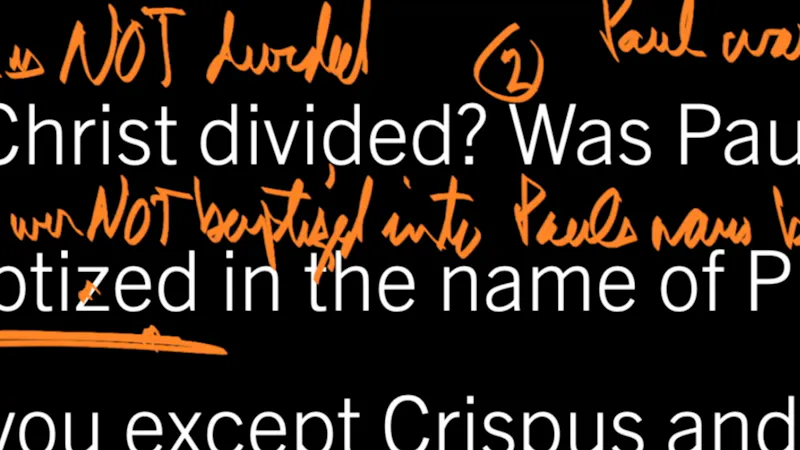
1 Corinthians 1:13–17, Part 1: Antidote to Disharmony: Christ’s Unity, Christ’s Death, Christ’s Name
2w agoTap to summarizeIn the face of church factions, Paul exhorts members of Christ’s body to focus on the unique work Jesus has done through his death and resurrection.
Transcribe →
The Miracle Alternative to Factions in the Church: 1 Corinthians 1:10–12
3w agoTap to summarizeThe Corinthian believers tried to split into fan clubs, but they never belonged to their favorite teachers. In Christ, their teachers belonged to them.
Transcribe →
God Will See to It That We Arrive Guiltless at Christ’s Coming: 1 Corinthians 1:4–9, Part 6
3w agoTap to summarizeHow can we know that God will keep us until the end? Because his faithfulness links his call to our final glorification with unbreakable power.
Transcribe →
How Can Our Waiting for the Coming of Jesus Be Sure? 1 Corinthians 1:4–9, Part 5
4w agoTap to summarizeIn this age, the Christian life is a waiting life. But we wait full of confidence that Christ will return and bring us into our eternal home.
Transcribe →
How Rich Are Christians? 1 Corinthians 1:4–9, Part 4
Jul 18Tap to summarizeHow do the Corinthian church’s riches in word and knowledge serve to confirm the testimony of Christ? Their beautiful speech shows a beautiful Savior.
Transcribe →