Podcast
Making Noise Podcast
Hosted by Adam Kennaugh · EN
COVID-19 really threw a wrench in our world, literally! All of our lives have changed and we have been trying to figure out ways to maintain our sanity, maintain our relationships, and on top of that keep making music and try to make a career out of it. The old rules for carving out a career in classical music are no longer feasible or lucrative. We have to be creative not only artistically, but business savvy as well. So how the hell do you do that?! No really, how?!
If you’re feeling the weight of uncertainty and misdirection, whether, in your personal or professional life, you will find solace in knowing that your peers and colleagues are not the avatars you see on Facebook, Instagram, or any other social media platform. They are real people too. With real troubles and challenges. We are all trying to figure out how to keep a level head and earn a living as musicians. So let’s talk about it.
Join me as I interview friends and colleagues in search of a career in classical music.
10episodes
Episodes
Newest firstAll episodes

Ep 29 - Danielle Kuntz
May 10, 202200:55:20Tap to summarize“For harp, textbooks all talk about the range, they talk about the pedals, they talk about glissandos and some extended techniques. Most of the unplayable music I get has nothing to do with any of that.”As a new music harpist, Danielle Kuntz is dedicated to bringing new music to life. Danielle believes that the longevity of the classical music industry relies on living composers. She has focused her career on connecting these composers with new audiences by commissioning them and performing their music. Danielle also works to make the harp a more accessible instrument for composers through lectures, workshops, and individual instruction. She is also the harpist and Marketing Director of the Midwest-based new music ensemble The_____Experiment. Danielle holds degrees from the University of North Texas and is currently based in Ann Arbor, Michigan.Danielle and I have gotten to know each other quite well in the last few months. We have had several lengthy conversations. almost entirely through video calls, including this one on the podcast. One thing I have learned about Danielle is that she is very excited about connecting new music with pretty much anyone; whether that is through collaborating with a composer on a new piece or coaching them through writing for the harp, performing music, and interacting with audiences, even her social media presence is incredibly inviting. Be sure to follow her for great tips on writing for the harp! We talk a lot about what it means for Danielle to create and promote new music, as well as the virtual workshop she founded called Toolbox Sessions, which is a series of presentations by collaborative performers on how to effectively write for their instruments - which takes place May 19-21, 2022. We also talk about expanding the accessibility of new music to wider audiences, and so much more on episode 29 of the Making Noise Podcast.I hope you enjoy it! —-Follow Danielle's work: daniellekuntz.com Follow her on the socials: IG/FB @daniellekuntzharp and Twitter @daniellekharpToolbox Sessions website: Toolboxessions.comFollow the Toolbox socials: IG/Twitter @toolboxsessions and FB @composertoolboxsessions —-Watch the podcast on YouTubeListen to the podcast on Spotify, Apple Podcasts, Stitcher, iHeartradio, and my website where you can listen to music, purchase scores, and learn how to commission a new piece for your ensemble.
Transcribe →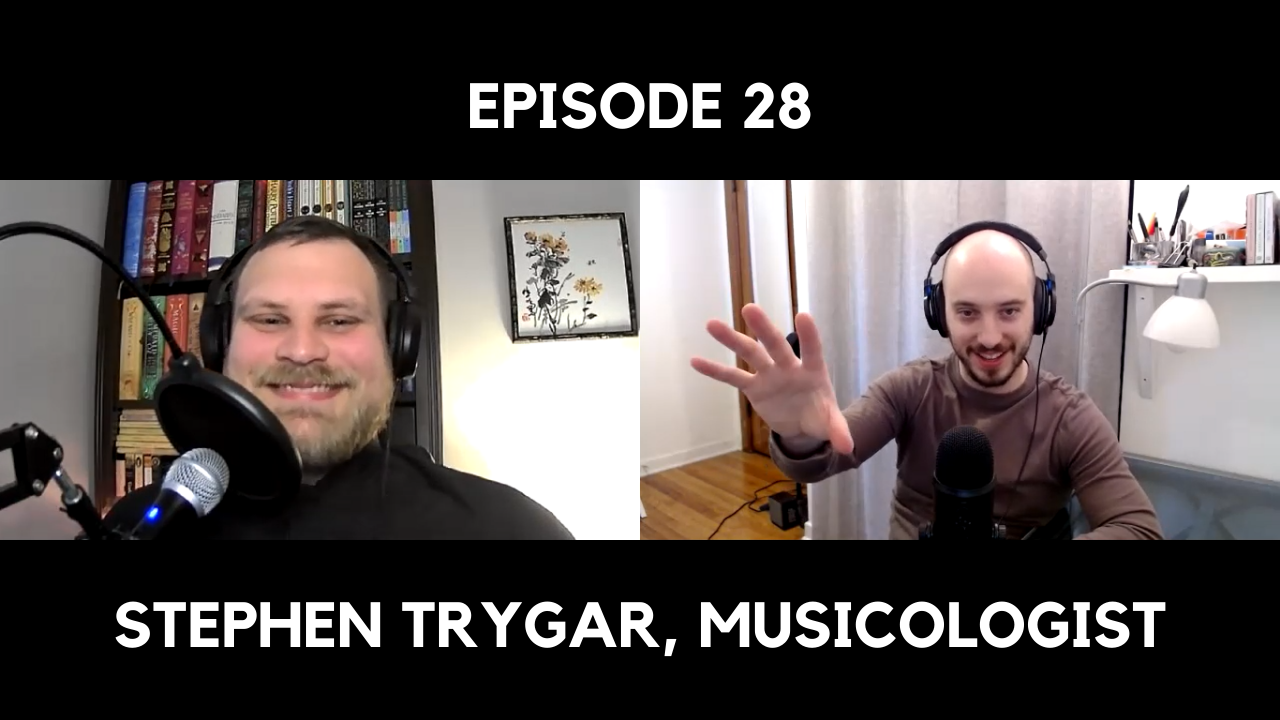
Ep 28 - Stephen Trygar
Mar 1, 202202:44:57Tap to summarize“...I wrote that script, I recorded it, and I was like, ‘this is what I’m going to do. This is how I’m going to promote my career. This is how I’m going to further my career and this is how I’m going to do it the way I want to do it.”Stephen Trygar is a historical musicologist, podcaster, writer, producer, and voice actor engaged in revitalizing the music of the past and making it more accessible for modern audiences. His journey to understanding the music of our past has led him to being an advocate for new music, creating podcasts that explores the musical world and sheds light on the world’s cultures: The Composer Chronicles and Cultured, But… Not Really. Stephen’s approach to writing follows a similar path, aiming to uncover hidden parts of our musical world that has been lost to history or swept under the rug.Recently I was a guest on Stephen’s podcast, The Composer Chronicles. The conversation was so enjoyable that we kept it going for another hour and a half even after we stopped recording. To me, it felt like we had a great rapport. The dynamic was strong and we both genuinely enjoyed each other’s company. That is why I am so excited to have Stephen on the podcast. He was at odds with the typical career trajectory of a musicologist: becoming a professor. So he created his own path. His perspective and approach to musicology is the perfect example of what it looks like to forge a career in classical music. We talk a lot about what the role of musicologist is today, as well as his podcast, how bread helped shape our language, the issues with censorship, Tchaikovsky and the phenomenal biography written by his brother, our frustration with operas being performed in the language it wasn’t written in, and so much more on episode 28 of the Making Noise Podcast.I hope you enjoy it! —-Follow Stephen's work: alexandrianmedia.org Follow him on the socials: @stephenjtrygarListen to our conversation on The Composer ChroniclesThe Life and Letters of Peter Ilych Tchaikovsky by Modeste TchaikovskyAmazonFree eBook—-Watch the podcast on YouTubeListen to the podcast on Spotify, Apple Podcasts, Stitcher, iHeartradio, and my website where you can listen to music, purchase scores, and learn how to commission a new piece for your ensemble.
Transcribe →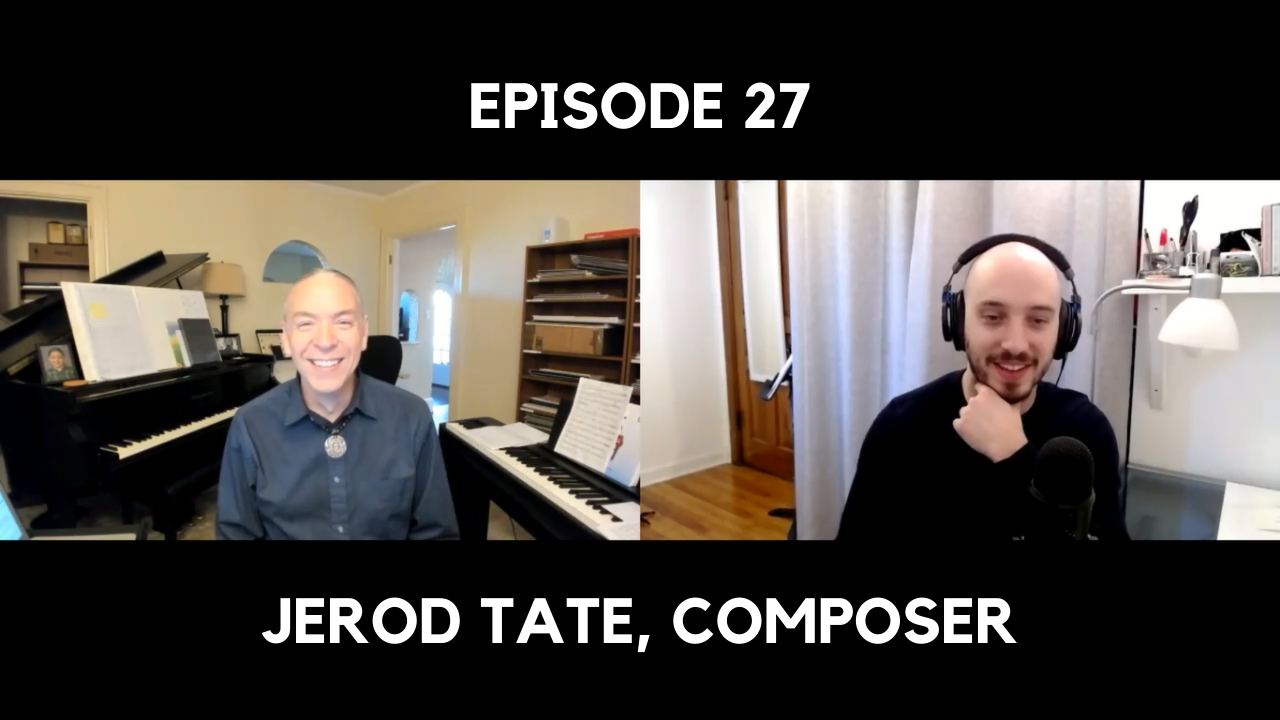
Ep 27 - Jerod Tate
Feb 15, 202201:21:41Tap to summarize"We've got 8 billion people in the world. Which means there is 8 billion ways to be a person. And everybody that is alive is literally their own universe; their own beautiful universe of experience and perspective, with an incredibly colorful story." Jerod Impichchaachaaha’ Tate, is a classical composer, citizen of the Chickasaw Nation in Oklahoma and is dedicated to the development of American Indian classical composition. His Washington Post review states that “Tate is rare as an American Indian composer of classical music. Rarer still is his ability to effectively infuse classical music with American Indian nationalism.”Tate is Guest Composer/Conductor/Pianist for San Francisco Symphony Currents program Thunder Song: American Indian Musical Cultures and was recently Guest Composer for Metropolitan Museum of Art’s Balcony Bar program Home with ETHEL and Friends, featuring his commissioned work Pisachi (Reveal) for String Quartet.Recent commissions include Shell Shaker: A Chickasaw Opera for Mount Holyoke Symphony Orchestra, Ghost of the White Deer, Concerto for Bassoon and Orchestra for Dallas Symphony Orchestra, Hózhó (Navajo Strong) and Ithánali (I Know) for White Snake Opera Company. His music was recently featured on the HBO series Westworld.Jerod is the type of person who has a deep and intimate understanding of the craft and the business of being a musician. It felt as though every other sentence was a masterclass on becoming the person you know you can be. He exuberates absolute positivity with an optimistic perspective toward progress. This perspective is constant throughout our conversation, peppered inside of fascinating stories about his mother, a choreographer who commissioned Jerod’s first piece; his father, a judge in tribal and American law; as well as advice on finding your superpowers as an individual, accepting the ups and downs of being a composer, the language of the Chickasaw tribe, and so much more on episode 27 of the Making Noise Podcast. I hope you enjoy it!—-Follow Jerod's work: jerodtate.com Check out his YouTube channel: youtube.com/c/JerodTateVideos Follow him on the socials: Facebook: facebook.com/jerodtate Instagram/Twitter: @Jerodtate —-Watch the podcast on YouTubeListen to the podcast on Spotify, Apple Podcasts, Stitcher, iHeartradio, and my website where you can listen to music, purchase scores, and learn how to commission a new piece for your ensemble.
Transcribe →
Ep 26 - Seth Boustead
Jan 25, 202201:38:08Tap to summarize"Part of it is always the same: we want to package this up in an interesting way and bring people in who are hearing this music for the first time, or say, 'Wow, I didn't know there were so many composers out there. That's amazing!'"Seth Boustead is a composer, broadcaster, writer, concert producer, in-demand speaker, and visionary with the goal of revolutionizing how and where classical music is performed and how it is perceived by the general public. As the founder and Executive Director of Access Contemporary Music, Seth has created unique programs like Songs About Buildings and Moods, the Sound of Silent Film Festival, the Thirsty Ears Festival, a chain of storefront music schools, and dozens of concerts in New York, Chicago, Milwaukee and Mexico City. Seth is the host and creator of the award-winning podcast Relevant Tones and the Concept Lab series in Manhattan. More at sethboustead.com I have been wanting to have Seth on the podcast for some time now. As a composer, pianist, and founder of Access Contemporary Music, he has established and created so many outlets and opportunities for new music in Chicago and NYC. I personally got to experience the Thirsty Ears Festival, which on one of the nights had a scaled-down version of the Sound of Silent Film Festival. The experience was so incredibly inviting, which felt more like a backyard family bbq than a performance in a concert hall. He is currently running a Concept Lab in NYC, which is a series that solely features works in progress, allowing deep collaboration between performers and composers. We talk about all of this, as well as mission statements, making a press kit, universal basic income, and so much more in episode 26 of the Making Noise Podcast. I hope you enjoy it!——-Follow Seth's work: sethboustead.comAccess Contemporary Music: www.acmusic.orgRelevant Tones Podcast: www.relevanttones.com——-Watch the podcast on YouTubeListen to the podcast on Spotify, Apple Podcasts, Stitcher, iHeartradio, and my website where you can listen to music, purchase scores, and learn how to commission a new piece for your ensemble.
Transcribe →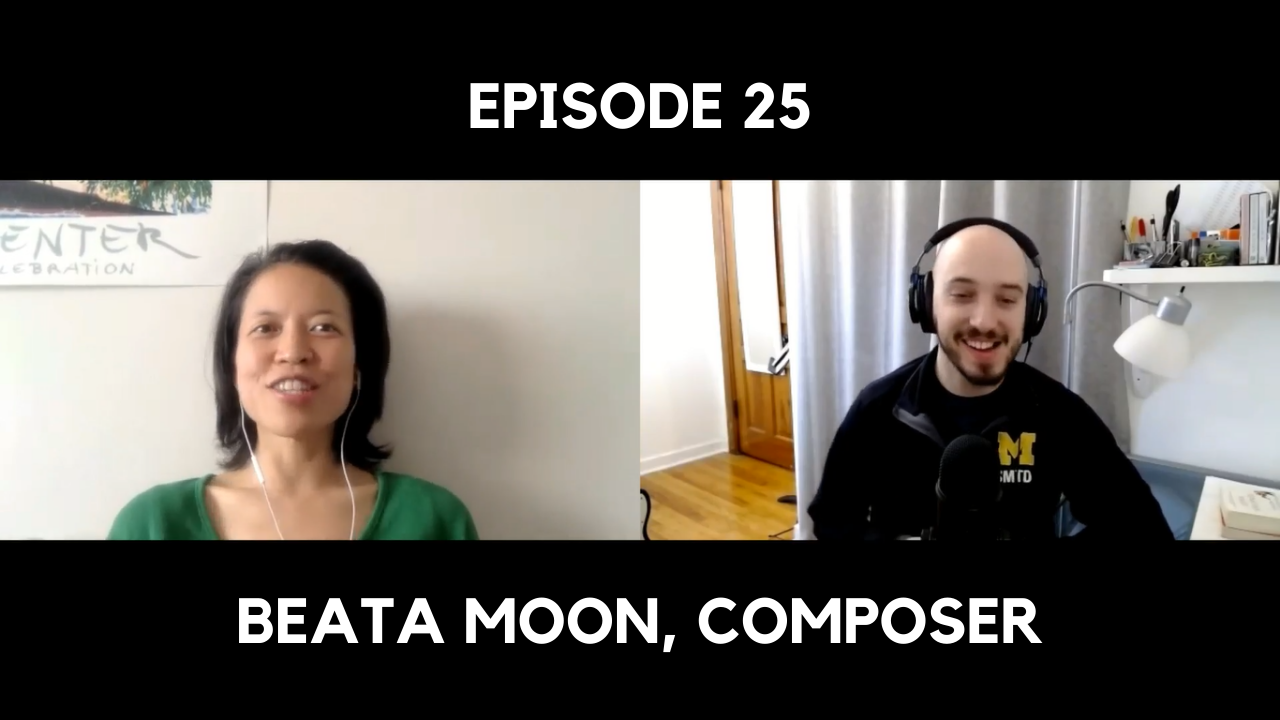
Ep 25 - Beata Moon
Jan 10, 202201:01:22Tap to summarize"One of the messages that I hope will come out of our talk is that people try to have more of an open mind, not make assumptions and be kind to one another."Through her various roles as a teaching artist, performer, composer and activist, Beata Moon has been able to fulfill her wish to work with people of all ages and backgrounds. A graduate of the Juilliard school, Moon's extensive experience as a teaching artist for Carnegie Hall, Lincoln Center Education and the New York Philharmonic includes facilitating workshops about social-emotional learning for teachers and administrators and designing curriculum tailored for students of diverse backgrounds and abilities. She has facilitated conversations about race and restorative justice and believes in the power of music and the arts to heal and work towards social change. She recently became certified as a Climate Reality Leader trained by former US Vice President Al Gore and The Climate Reality Project. http://www.beatamoon.comThe headline in NPR was titled "For a musician in New York City, not being fully vaccinated comes at a cost". After reading the article, I was very concerned. Here is someone who really wanted to be fully vaccinated - yet experienced adverse effects - and is now being called an anti-vaxxer with the potential to lose work. She has done so much for the community as a composer, performer, teacher, and advocate, yet when blinders are on, people only hear the word "unvaccinated" and cast her aside. The very community she has helped to foster is in some ways pushing her out. The inability to communicate openly and honestly about things we disagree on has been concerning me for several years now. I immediately reached out to Beata Moon to see if she would have this conversation on my podcast. Given how charged this topic is, we hope that anyone who listens is able to walk away from this conversation feeling informed and a little more welcoming to those with different perspectives or beliefs. It is such an honor to have Beata Moon on episode 25 of the Making Noise Podcast. I hope you enjoy it!—————-Follow Beata's work: http://beatamoon.com/ Center for Humane Technology www.humanetech.comZdoggMD www.youtube.com/c/ZDoggMD/videos Dr. Vinay Prasad www.youtube.com/channel/UCUibd0E2kdF9N9e-EmIbUew/videos Dr. John Campbell www.youtube.com/c/Campbellteaching/videos To help with identifying feelings www.hoffmaninstitute.org/wp-content/uploads/2021/05/feelingssensations.pdf Box Breathing: https://health.clevelandclinic.org Jane Goodall https://shop.janegoodall.org The Righteous Mind: Why Good People are Divided by Politics and Religion by Jonathan Haidt www.amazon.com/Righteous-Mind-Divided-Politics-Religion/dp/0307455777—————-Watch the podcast on YouTubeListen to the podcast on Spotify, Apple Podcasts, Stitcher, iHeartradio, and my website where you can listen to music, purchase scores, and learn how to commission a new piece for your ensemble.
Transcribe →
Ep 24 - Erin Rogers
Nov 29, 202101:12:59Tap to summarize“It was 2003, and I came to NYC with Greg Cornelius who is a saxophonist and composer at Bowling Green. And he and I were driving in his Dodge Caravan and I think we were listening to Music for 18 Musicians, and it was raining, and I remember seeing the city lights of New York, and just being overwhelmed with this idea that I need to be here.” Erin Rogers is a saxophonist and composer based in New York City. She is co-artistic director and core member of thingNY, Popebama, New Thread Quartet and Hypercube. Her music has been performed at the Prototype, Ecstatic, and MATA Festivals (NYC), Celebrity Series (Boston), Edmonton Fringe Festival, the Hamburg Elbphilharmonie, Centro Nacional de las Artes (Mexico City), and NYmusikk Bergen (Norway). Rogers is a member of LA super-group WildUp, and performs with the International Contemporary Ensemble, Talea, and Wet Ink. She is a D’Addario Woodwinds Performing Artist and Chamber Music Society of Lincoln Center Teaching Artist. Rogers can be heard on New Focus Recordings, New World Records, Edition Wandelweiser, Gold Bolus, Love Records, INNOVA, New Amsterdam, and Relative Pitch labels. www.erinmrogers.comI have known Erin for a few years now. Specifically, before leaving New Jersey and heading to Bowling Green, OH to start my graduate work, I saw her saxophone quartet, New Thread Quartet, perform at a church in Jersey City, NJ. After the performance, I introduced myself. We ended up on the topic of me going to grad school and it turned out she is a BGSU alum! What little I knew about Bowling Green, and here I am in NJ meeting someone who went through the program and is doing such awesome work! I’ve been a fan ever since. Erin is so incredibly hard-working, juggling a varied and wide-ranging freelancing career as a composer and performer in NYC. Recently, she released a solo album titled 2,000 miles, which you can purchase on Bandcamp. Our discussion center almost entirely on the making of 2,000 miles, topics like her improvisational/compositional process, the recording process, traveling from NYC to her hometown in Alberta, Canada, the artistic solutions that grew out of being quarantined, and so much more on episode 24 of the Making Noise Podcast. I hope you enjoy it!—-Follow Erin’s Work: www.erinmrogers.com Erin’s album on Bandcamp: 2,000 Miles Check out some awesome up-coming performances of Erin’s (NYC):Dec 2 - Marilyn Shrude 75th Birthday Celebration // New Thread Quartet, Lost Dog, Momenta QuartetDec 11 - Works by Popebama + Rick BurkhardtDec 15 - Hypercube: Works by New York Women ComposersDec 17 - Kathy Supové premieres Constancy // Bargemusic: Here & Now Winter Festival Day 2—-Watch the podcast on YouTubeListen to the podcast on Spotify, Apple Podcasts, Stitcher, iHeartradio, and my website where you can listen to music, purchase scores, and learn how to commission a new piece for your ensemble.
Transcribe →Ep 23 - Garrett Hope
Oct 12, 202102:17:11Tap to summarize“You know I’m a Seth Godin fan. When he talks about education he says one of the problems right now is we’ve been teachings students how to get the right answer. And that is the wrong way to do it. We want people who can ask the right questions. So what does that mean for music?”Dr. Garrett Hope’s purpose is to use his God-given creativity and communication skills to entertain and enlighten, draw people together for a common cause, and to coach others to see new opportunities. An award-winning composer of film and concert music, Garrett engages with performers and audiences to tell stories and create life-changing experiences. He loves working with educational ensembles, and especially values his work with students. As a coach and public speaker, Garrett empowers people to see new opportunities and take courageous action. He does this by helping them identify and break through the beliefs that they hold about themselves that are preventing them from achieving their potential. He helps creatives build networks and make strategic business decisions so they can make a living doing what they love. Garrett holds degrees from the University of Nebraska–Lincoln, the University of Northern Colorado, and Colorado Christian University. He is a native of Colorado, but currently lives in Nebraska with his wife and daughter.For more information visit www.garretthope.com. This day, October 12, 2021, marks the year anniversary of the podcast! It brings me such joy that this occasion can be celebrated with a guest who has had such an impact on me. Garrett Hope’s work on his podcast, The Portfolio Composer Podcast, helped me realize I need to do more than create music in order to start earning a living as a composer. It is the reason why this podcast exists. I have devoured so many hours of episodes and continuously learn so much from him and the people he talks to, several of which I have had on here! As you can see, I’m completely honored to have this conversation with Garrett. We talk about many topics, including woodworking as a hobby through the quarantine, the upcoming online Garrett is starting called the Ultimate Music Business Summit (more info below), parenting and allowing children to have unsupervised free play, the value, and overall wider community reach of outsourcing, and so much more on episode 23 of the Making Noise Podcast. I hope you enjoy it!Follow Garrett’s Work: www.garretthope.com Listen to The Portfolio Composer Podcastwww.theportfoliocomposer.com/category/podcast-episodes Sign up for the Ultimate Music Business Summitwww.musicsummit.bizUMBS’ Mission:Please join us at the second annual Ultimate Music Business Summit, which will be held January 6-8, 2022! This is a virtual summit where musicians (from across the globe) can gather and learn about entrepreneurial ideas. The goal of this summit is to ignite curiosity and offer valuable information from an array of experts. The entrepreneurial-minded musician who attends the summit will leave with new, creative ideas that will not only inspire them but will give them the necessary tools to utilize in our ever-changing musical world. The desire to connect, educate, learn, and grow together is UMBS’s hope and mission. Please visit our website at musicsummit.biz for more information! Thanks!Prices of Tickets:Basic Ticket: $17Basic Ticket Super Early Bird (purchased before Oct. 31): $7Basic Ticket Early Bird (purchased before Nov. 30): $14VIP (access to all video recordings): $137Super Early Bird (purchased before Oct. 31): $67Early Bird (purchased before Nov. 30): $97—-Watch the podcast on YouTubehttps://www.youtube.com/playlist?list=PLBaiw-p9pO12oAGlV1BUkPNk6K-62igrJListen to the podcast on Spotify, Apple Podcasts, Stitcher, iHeartradio, and my website where you can listen to music, purchase scores, and learn how to commission a new piece for your ensemble.
Transcribe →Ep 22 - Alex Shapiro
Sep 6, 202102:33:15Tap to summarize“Those of us that have these very complicated internal lives as artists, we’re so lucky; because we carry our world with us all of the time.”I’ve always been really interested in Alex and everything she does. After listening to her on several podcasts and following her music, I’ve learned so much from her about the business side of composing, connecting with other musicians, and more personal things as well such as stepping away from composing and finding pleasure in daily life. She understands the importance of pursuing our need as artists to create, while at the same time finding the balance of a healthy and joyous life - Alex likes to kayak, take photos of wildlife, go camping, and do many other outdoor activities. She explains the importance of connecting with others and being authentic with your work, while advocating the need to be properly compensated for that work. She also goes into detail about her process and several projects she has worked on; one of the riskiest moments in her career; emotional highs, and lows; getting mileage out of your work, and so much more on episode 22 of the Making Noise Podcast. I hope you enjoy it!—-Follow Alex’s Work: www.alexshapiro.orgA helpful link for our colleagues looking to expand the scope of their programming is this onehttps://www.alexshapiro.org/ProgrammingResources.htmlFollow her socialsFACEBOOK https://www.facebook.com/alexshapiroINSTAGRAM @alex_shapiro_composerTWITTER @alex_shapiro—- Watch the podcast on YouTubehttps://www.youtube.com/playlist?list=PLBaiw-p9pO12oAGlV1BUkPNk6K-62igrJListen to the podcast on Spotify, Apple Podcasts, Stitcher, iHeartradio, and my website where you can listen to music, purchase scores, and learn how to commission a new piece for your ensemble.
Transcribe →Ep 21 - Alan Belkin
Aug 30, 202101:08:50Tap to summarize“The point is obviously not the colonoscopy, the point is what we remember. And music is all about memory. When you write music, if you don’t appeal to the person's memory at all, it’s not going to have much of an impact.”I was very excited after receiving an email from Alan that he would be happy to join me on the podcast. His work as a composition instructor - through the articles and books he has produced - has really impacted the way I understand how music is experienced. These concepts are all explained in his book titled Music Composition: Craft and Art (linked below), where he lays out various principles that are style-neutral and designed to enhance the emotional impact of your music: what features of an opening invokes curiosity in the listener; how do you maintain interest in a way that makes sense to the character of the piece; what degree of novelty vs. invariance is an appropriate balance, etc. We talk quite a bit about many of these concepts in this episode, as well as realizing how music is perceived by learning about psychology, Alan’s experience studying with Elliott Carter, his YouTube channel - where you will find videos about these topics, I would highly recommend subscribing to! - and so much more on episode 21 of the Making Noise Podcast. I hope you enjoy it!—-Follow Alan’s Work: www.alanbelkinmusic.com Subscribe to his YouTube Channel www.youtube.com/channel/UCUQ0TcIbY_VEk_KC406pRpg Purchase his book, Music Composition: Craft and Art, on Amazon www.amazon.com/Musical-Composition-Craft-Alan-Belkin/dp/0300218990/ref=sr_1_3?dchild=1&keywords=music+composition+craft+and+art&qid=1630336515&sr=8-3 —-Watch the podcast on YouTubeListen to the podcast on Spotify, Apple Podcasts, Stitcher, iHeartradio, and my website - www.adamkennaugh.com - where you can listen to music, purchase scores, and learn how to commission a new piece for your ensemble.
Transcribe →Ep 20 - Doug Bielmeier
Aug 2, 202101:40:05Tap to summarize“Here’s the suffering: I just made the statement ‘I really appreciate music when people are being honest.’ And then we bring in ‘voice’ into that. Now, when someone puts pen to paper if they’re concerned about being honest and being true to their voice, I feel like that is a recipe to not write anything at all.” Boston based, Doug Bielmeier creates commercial and experimental music tailored for boutique audiences and media described as an extension of Xenakis’s early tape pieces (American Record Guide, 2018) and “drone work meant to shake you out of your shell of complacency (Midwest Record).” Bielmeier has been featured on over 10 Album including Plague Tape (Boston Hassel, 2021) and Monophonic (SEAMUS, 2020) and his recent releases Ambient Works (Albany Records, 2021) Beast of Bodmin Moor (2019), and Betty and the Sensory World (Ravello, 2017). Performed and broadcasted internationally: over 100K listeners at Somafm.com. Performed by the Unheard-of Ensemble and Hypercube Ensemble. Doug is exceptional at seeing different ways in which something can be understood; for example, he finds ways to reframe negative self-talk into something more constructive. This ability to search for different perspectives is certainly consistent with The Process, a podcast where he talks to composers about their process for creating music. Although we set out to have a thorough conversation about his podcast, which we eventually did, our conversation took many twists and turns: like writing honest music vs. writing to your voice, a technique Doug like to use which he calls “windowing,” silly social media trends, living in Bowling Green, different accents throughout the United States, and so much more on episode 20 of The Making Noise Podcast. We had planned for a 45-minute conversation and ended up talking for 1 hour and 40 minutes. That alone I think is an indicator of how much we enjoyed the conversation. I hope you enjoy it! ----- Follow Doug's Work www.dougbielmeier.com/ Facebook: www.facebook.com/doug.bielmeier.5/ Instagram and Twitter: @dougbielmeier Doug's YouTube Channel www.youtube.com/channel/UC3Mi8HeVda77D3vFg4sQgYA The Process Podcast: https://theprocessmusic.podbean.com/ ---- Watch the podcast on YouTube: https://youtube.com/playlist?list=PLBaiw-p9pO12oAGlV1BUkPNk6K-62igrJFollow the podcast Spotify: https://open.spotify.com/show/0THZ9JPnPTk7S0A9hbFm3B Apple Podcasts: https://podcasts.apple.com/us/podcast/making-noise-podcast/id1540191908 Stitcher: https://www.stitcher.com/show/making-noise-podcast iHeartRadio: https://www.iheart.com/podcast/269-making-noise-podcast-76217791/ Visit my website where you can listen to music, purchase scores, and find out how to commission a new piece for your ensemble https://www.adamkennaugh.com/
Transcribe →