← Making Space with Hoda Kotb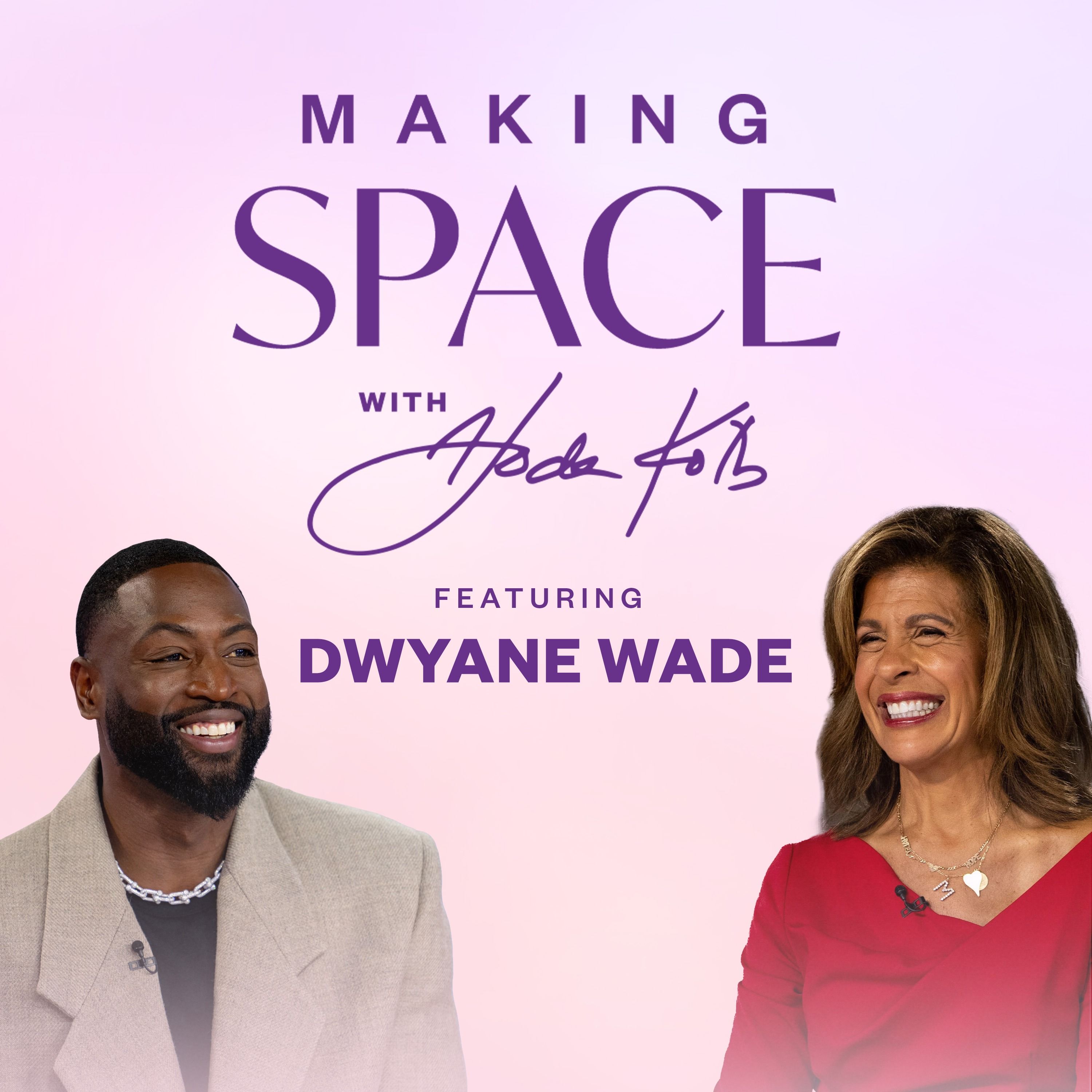
Making Space with Hoda Kotb
Dwyane Wade on Retiring from Basketball and Relying on His Village (April 2025)
00:37:47
Dwyane Wade is one of the greatest NBA players of all time. The thirteen-time all-star player won three championships during his time in the league. In the six years since his retirement, he's focused on his family and philanthropy, working with the Wade Family Foundation to support communities in need. Wade opened up to Hoda on how he fell in love with basketball, his decision to retire, and his battle with cancer.
Loading summary
Transcript231 lines
- [00:01]
A
America's best network just got bigger.
- [00:04]
B
Switch to T Mobile today and get built in benefits the other guys leave out.
- [00:08]
A
Plus our 5 year price guarantee and now T Mobile is available in US Cellular stores.
- [00:17]
B
Best Mobile Network based on analysis by Oogle of speed test intelligence data 2H 2025 bigger network the combination of T Mobile's and US cellular network footprints will enhance the T Mobile Network's coverage price guarantee on talk, text and data exclusions like taxes and fees apply. See t mobile.com for details.
- [00:31]
A
Are you looking for mental health care that truly listens? At Wellness Bound Mental Health, we believe your journey to wellness is a partnership. We specialize in medication management for anxiety, depression, bipolar disorder and more. We have new patient appointments available. Call or text by 412-955172 Wellness Bound Mental Health Working together to achieve Wellness. What does it take to reach the top? To hold the single most important trophy in the game high above your head? My guest today can tell you all about that. NBA legend Dwyane Wade was a 13 time All Star and three time champion. After 16 seasons in the league, Dwayne was inducted into the Basketball hall of Fame, receiving a statue in his honor outside the Miami arena he called home for the majority of his career. But as Dwayne will tell you himself, basketball was only the beginning. D. Wade is so much more than the sport. In fact, he's 6 foot 4 inches of pure goodness. He is a father and advocate and husband. Married to actress Gabrielle Union, Duane is half of one of Hollywood's most stylish couples. Since retiring from the league six years ago, Dwayne's been running a production company, now hosting a weekly digital show on the Y Network. He's also a commentator and operates multiple businesses, partnering on everything from wine to sneakers. Then there's his philanthropy. The Wade Family foundation supports marginalized communities in need. This is a man committed to sharing what he has earned. And recently, after a very public career, Duane revealed a very private battle with cancer. A year and a half since his initial diagnosis, Duane is ready to speak, hoping his platform will help other people. The Duane you'll meet today is healthy, healed and full of life. This guy's the real deal. Engaging, thoughtful and a class act. I can't wait for you to hear more. I'm Hoda Kotb. Welcome to my podcast, Making Space. Duane, I'm so happy. You know what I was thinking as I was getting ready to sit down with you?
- [03:02]
B
Tell me.
- [03:02]
A
I thought Dwyane Wade could have had one chapter in his Life. And it would have been a beautiful book. It could have been the basketball chapter and you would have ended your life. At your eulogy, they would have said, wasn't he the best player, the best teammate, the most competitive? But you didn't choose to have that kind of life. You chose to have a multi chaptered life. Did you design your life or did it just keep kind of revealing itself to you?
- [03:30]
B
First of all, thank you for saying that. When I was a kid, I just wanted to be a basketball player. I didn't even know what else really existed, you know, I didn't know what else was really an option for me, but I knew sports was an option. Right. That's what was kind of positioned to us, you know, in the inner city. It was like, here go this ball. It's football, there's basketball, there's baseball. And you know, once you start getting exposure, once you start getting exposure to people, you start getting exposure to life. You start seeing the other things that are possible. And so once I got to college, it changed everything for me. Yeah, you know, I started being able to meet people from different walks of life, you know, get a chance. I've always been curious and so I always ask questions to people and always seeing that, okay, like, I play a sport and people think it's great, but like, I think that's great. Yeah, you know, like, what do you got going on? Like, I think broadcasting is great. Like, and so for me, I was just like, if I ever get the opportunity, if any doors ever open for me because of, you know, growing up and seeing the way that my family was when I was little, not a lot of opportunities were knocking at the door. Not a lot of opportunities was presented.
- [04:28]
A
I think what's interesting about you is you said you grew up and you liked basketball, but you actually didn't like it initially. In the very beginning, your dad was like, you're playing basketball. But you didn't want that.
- [04:38]
B
No, I didn't want to know. I mean, I actually love football.
- [04:41]
A
Did you?
- [04:41]
B
That was actually my first love.
- [04:43]
A
Yeah.
- [04:43]
B
I don't know what about it, but, you know, I was just sitting down watching a game. Yeah, it's different when you sit down and watch a football game. There's only a few of them. And so I was a Chicago Bears fan and I was like, oh, I'm gonna be a wide receiver. I'm be a football player when I go do it.
- [04:56]
A
But your dad insisted. A lot of kids resist what their dads insist. Your dad's like, play basketball. You're like, no, thank you, but nah.
- [05:03]
B
No. My dad was militant. He's from the milit. Like, my dad was 6, 2.
- [05:08]
A
Yeah.
- [05:08]
B
I wanted to be like my father. Like, as a kid, I'm looking up at this guy who got these big broad shoulders, this beautiful body. Like, you know, he's really statuesque in his movements, and he played all the sports, and so my dad would take me along with him. So I did want to be like my father, but he played all the different sports, and so basketball wasn't the one that he was the best at. And so it wasn't the one that I was kind of, you know, gravitating towards until, you know, he kind of made sure he forced us to play a little bit.
- [05:35]
A
How'd you fall in love with the game? What was it?
- [05:37]
B
Chicago Bulls.
- [05:38]
A
Oh, that's it.
- [05:39]
B
Michael Jordan.
- [05:40]
A
Yeah. You just saw him and said, yep.
- [05:42]
B
I was like, oh, that's who I want to be. Like, now move over, dad. Like, move out the way, pops. Yeah, yeah. Once I saw Michael Jordan and just his grace, you know, his. He defied, like, just the way he stayed in the air. It was just graceful and winning. Like, once the Bulls won a championship in 91, I felt like a winner. Being a kid in Chicago, they gave my family and I something to celebrate, and we didn't have a lot to celebrate at that time. And when the Chicago boys won that first championship, I was like, now that's what I want to. That's the feeling. That's what I want to do for the rest of my life.
- [06:18]
A
Okay. Now, seeing something like that, because a lot of us grew up seeing like, oh, I want to be Barbara Walters or I want to be whatever. But the road from being a kid, seeing someone you admire and actually becoming that is a long one. I mean, why did you think you could? Like, who said you could?
- [06:36]
B
Everybody said I couldn't.
- [06:37]
A
Could not.
- [06:38]
B
I knew that they was like, well, you know, you should think about doing something else.
- [06:41]
A
Who said you couldn't?
- [06:42]
B
Well, just. It's just the talk, you know, it's all the day. They said it.
- [06:46]
A
They said it.
- [06:46]
B
You know, whenever you go and you listen, whether you go to camps or you hear someone speak and it's not wrong because, you know, I know a lot of kids that got a lot of hoop dreams. And I look like that's going to be tough.
- [06:57]
A
Yeah.
- [06:57]
B
Not saying that you cannot do it, but I look at it and be
- [06:59]
A
like, that's it's going to be tough.
- [07:00]
B
You know, now that I know yeah. Like, there's only a few slots to get to the NBA. It's only a few greats in the games. And so, like, if I tell somebody, yeah, I'm gonna have a statue, and I'm gonna go down as one of the greatest to do this and that, they're gonna look at me and they're gonna be like, oh, precious, kid. You're so precious.
- [07:17]
A
You know, Aren't you so glad you didn't know the odds? Because if someone had told you, Dwayne, at that stage in your life, the odds of you making it just based on life. And like you said, a couple of slots is 100,000 to 1.
- [07:33]
B
Yeah.
- [07:33]
A
Could have been that. But because you didn't know the odds, you didn't know what you were up against. You just played.
- [07:38]
B
I did not know what I was up against. I mean, first of all, when I first started playing the game, even though I fell in love with it watching Chicago Boys, I didn't know nothing. It wasn't about money. I didn't know what kind of money they were making. I just knew that I. You know, me and my brothers would run to the TV because it was a. We just loved it. And we would play it. I go right in my backyard. We will play it all day long. So for me, it was just the only thing that I really loved. Like, you know, when you're a kid, you're going to school, you're going home.
- [08:03]
A
Yeah.
- [08:03]
B
And I was like, well, I don't really love school, but I love gym. I love recess. Right. And so I was like, I love this. And I just played it from the passion. I just played it from the love. Like, that's what my family and I, when we would actually get together, you know, all my uncles and everybody, big barbecues, like, we in the backyard hooping. And that's what I fell in love with. More so than, you know, obviously, what it became a job.
- [08:25]
A
How proud was your dad when you made it? Like, how proud was he to see what his.
- [08:30]
B
I can't even imagine. I can't even imagine.
- [08:32]
A
I mean, my God, he believed, though blindly, he did.
- [08:35]
B
I guess he did believe. I don't know if he thought, you know, my dad would tell you he didn't think I would be a good basketball player. Like, I wasn't good when I was young. Like, I was less than average, to say the best. Yeah. And then at some point, it all came together for me. And so. But, you know, my dad is a. He's a guy who went to the military at 19 years old. But my dad was a very good baseball player. He actually felt that he was gonna go to the major leagues. Right. And some things happened in his life that took him another direction, which he wound up going to the military because of his best friend wound up getting killed in front of him. And he just. He stopped playing baseball, and he went and did something else. And some other things happened. And so he channeled his love of sport into his son. He channeled it into me, and he took me, like, literally everywhere with him. And so I fell in love with sport. I fell in love with competition. I fell in love with camaraderie. And so I fell in love with the things around the gang, and then I fell in love with the game.
- [09:28]
A
What has basketball given you?
- [09:30]
B
Opportunity. It's given me opportunity. And I think that's the thing that we all want. We all just want an opportunity to be heard, to do the things that we want to do. And so, you know, when you're a kid and you don't feel like no one sees you and you're not being heard, your community has not been heard, your voice has been muted or whatever the case may be, you want that opportunity to show somebody that, you know what? I can be great. I can do this. I wanted to be the kid to get his family out of the ghetto or the hood or whatever we call it. I was like, I'm gonna be him. I'm gonna be the one that do that.
- [10:01]
A
You're him. And then some. I mean, you know, in the hall of Fame, like, you have all the things. I mean, and you happen to walk the beautiful fine line of being so incredibly talented beyond. And also, you seem to have, like, the most beautiful. I don't know if it's humility or just, like, you have it in perspective somehow.
- [10:23]
B
Yeah.
- [10:24]
A
Often when success comes quickly, any of us will get like, oh, I lost my way.
- [10:29]
B
You did, Definitely. Along this journey, I definitely lost my way. I had to check myself. Yeah, you got to constantly check yourself. You got to constantly look in the mirror.
- [10:37]
A
Yeah.
- [10:37]
B
You know, especially when so many people are telling you that you're everything. Yeah. You have to be the realest with yourself, because most people will not. And most people don't know you. Like, you know, you.
- [10:47]
A
Yeah.
- [10:47]
B
You know, you. You know, your insecurities. You know, the things that people see me, they see all confidence. I have a lot of insecurities. Right. I have a lot of moments that I'm not as confident. I know that you don't know that and so I think one of my strengths has always been real with myself first and foremost. And then from there, I'm able to be real with others. Or, you know, my college coach always say that. It's like, you know, you're real with you, and then that allowed you to be a leader and be able to be real with others.
- [11:12]
A
You're also a student. I feel like you're always learning, like, no matter what, just the way you are with everybody, the way you were just now. You worked with Jenna all week, and you showed up up early on the zooms. You take the notes, you're paying attention, you're watching tape. Like, you treat these opportunities like it's game day. Yeah.
- [11:32]
B
These opportunities are not just passed around. You know what I mean? Like, you thank you for allowing that seat to open up, because that seat ain't just open. And so, you know, when you're able to get opportunities, obviously outside of the game of basketball, I was thankful for that opportunity. But when doors are open, you know, I'm curious. I want to see what's behind that door, and especially if I'm able to get inside that door and be able to get in there and be able to ask questions and learn. And then, you see, once you get in there, and I think Barack said it best, is you sit at the table with some people that has all these accolades and certain positions, and they're not no smarter than you. They're not necessarily better than you. They just have the opportunity before you. And so for me, when I get a chance to get in a room, I'm like, okay, what can I learn from you? What can you learn from me? I know when I walk in a room, I'm walking in knowing something that you don't know, just like, you know, something that I don't know. And so I can provide something to you just like you can for me. It's just I need to get in that room. And so because of the game of basketball, I've been able to get in those rooms a little bit. And so I want to take full advantage.
- [12:33]
A
I love it. I love that you just show up early. What's your whole thing with showing up early?
- [12:37]
B
It's just always been like, my dad didn't play that. My dad was militant military, so you
- [12:41]
A
had to be on time.
- [12:42]
B
My whole life, like, I. My father would get up every day at 5am wow. And I would have to get up every day at 5am with him because he would make me iron his clothes before he went to work and Once I got close to that age, like 12 years old, I would have to drive him to the train station, drop him off. You had to drive back 12 years old.
- [12:58]
A
Wow.
- [12:58]
B
Because nobody, nobody else could do it. I don't know if no one else can do it. My dad saw something.
- [13:03]
A
Yeah.
- [13:04]
B
And he was putting something in me and a lot of responsibilities on me. And so I've been getting up at 5am since I was like 9 years old.
- [13:12]
A
So what do you do at 5 that's for you now that life's about you now?
- [13:16]
B
Yeah. So many different things. I think the first thing I try to do is I try to get up and work out. And the way I feel, if I don't feel good, then everything else is off. And so first and foremost, I want to get in there and I want to. I get right to the gym as soon as I wake up. And then from there I go to the sauna after I go to the gym. I'm a sauna guy.
- [13:32]
A
I love it.
- [13:32]
B
But I do a lot of things. I'm always into learning mode, so I'm meditating a lot. I'm trying to have moments of peace. I'm trying to understand that once I pick that phone up, once my family wakes up, I'm on once that happens. And so I get two, two and a half hours of just you. Just me. And like I said, I have to know me, I have to learn me, and I have to care for me. Self care is so important to everybody. If you don't care for you, no one else is gonna care for you like you do someone.
- [13:58]
A
I was talking, I interviewed Martha Beck, who's written a bunch of books on just life. And she was like, you know what I say to myself in the morning? I said to myself, hey, girl, you seem like you might need a little lemon water. I'm gonna get up and get that for you. It's like you're speaking to yourself the way you would speak to a trusted friend, the way you'd care for somebody else. But it's really for you. What do you get out of meditation? What does it give you?
- [14:21]
B
I feel like it centers me.
- [14:22]
A
Yeah.
- [14:22]
B
You know, it allows me to put my feet on the ground.
- [14:24]
A
Yeah.
- [14:25]
B
Sometimes, you know, we. I'm levitating.
- [14:27]
A
Yeah.
- [14:27]
B
You know, I'm not. I'm feeling, I'm levitating. I'm all over the place. I'm doing so many things. I have to be so many different things and so many people for different people. And sometimes I just need to let My feet fill the ground.
- [14:37]
A
Yeah, yeah, yeah.
- [14:37]
B
And when I meditate, it allows me to put that phone down, not worry about what's going on in the world, whether it's 10 minutes, 15 minutes, 20 minutes, whatever the case may be like. It allows me just to be at peace with me and allow my brain and my mind to start thinking about the things that I want to do, the things I need to do, all these things. So I just feel like it's so needed. That moment of solace is so needed.
- [15:01]
A
More with Dwyane Wade when we come back.
- [15:11]
B
This is the exclusive table with the view. This is your name on the list. This is three times points on dining with Chase Sapphire reserve and a $300 dining credit chase Sapphire Reserve. Now even more rewarding.
- [15:21]
A
Learn more@chase.com Sapphire Reserve cards issued by JPMorgan, Chase bank and a member FDIC subject to credit approval. And Doug, there's nowhere I wouldn't go to help someone customize and save on car insurance with Liberty Mutual, even if it means sitting front row at a comedy show. Hey, everyone, check out this guy and his bird. What is this, your first date?
- [15:41]
B
Oh, no.
- [15:42]
A
We help people customize and save on
- [15:43]
B
car insurance with Liberty Mutual together.
- [15:45]
A
We're married. Me to a human, him to a bird. Yeah, the bird looks out of your league. Anyways, get a'@libertymutual.com or with your local agent. Liberty, Liberty. Liberty. Liberty. Out on the road, it helps to have a partner, like the Love's Rewards app. Download Love's Rewards today to get sweet discounts and earn points on food, fuel, drinks and more. Every time you scan Love's Rewards, save and Earn at every turn. Terms apply. See website for details. I mean, you're so. You're very introspective, which I find incredible. And I feel like I'm a person who believes. Like, when your karma bank is full, like you're giving.
- [16:26]
B
Say something.
- [16:26]
A
When your Karma bank is full, abundance comes. It just works that way. I feel like, you know, some people are waiting, like, why didn't I get the promotion? Why didn't I get the job? Why didn't no one call? Why didn't we get the deal? It's like when you're in those moments, it's sort of like you think about what I've given out there. And as I look at your life, you've spent your lifetime giving things away privately. Like, who knew you were doing all this stuff? Is that part something that was ingrained in you as a young child?
- [16:54]
B
Yes, it was. We was a family who didn't have much, as I continue to say, but we still had more than certain other families and other people. And so my grandma always, you know, she always instilled that in us, that if I had shirts that I wasn't wearing, we giving these shirts away.
- [17:08]
A
Yeah.
- [17:09]
B
You know, we got pants and we got toys that we're not playing with. We're giving this away to someone else that, you know is not as fortunate as us to even have these things. And so I'm not really. I'm not tied to anything. Like, I have material things because of that. I'm not tied to anything material. Like, we can get up and go right now if that's the case. Right. My family is what's important. My loved ones, my. My village. As long as I got my village with me, we can be anywhere in the world. And so I'm really not ties to anything. And it really started at a young age with my grandma making sure that we understood the importance of what we have and understanding that everybody's not even as lucky and have the benefits that we have to have the things that we have. And so I take that. I take that, and I try to pass that down to my kids as well, to let them know how fortunate that we all are.
- [17:50]
A
I love by the way this conversation has been dominated with talk of your family. I hardly even ask about them, and yet here they come. Because that's your North Star. It's obvious and clear. Who taught you how to parent
- [18:06]
B
life lifetime. My father. And you forget this a little bit along the journey, Me and my dad had some times where we ain't even speak right. But. But my dad was an amazing father.
- [18:16]
A
How so?
- [18:17]
B
Well, just. He was there. He showed up.
- [18:19]
A
That was it.
- [18:20]
B
He showed up. I mean, you know, he instilled things in us. Like I said, he was very militant. So a lot of ways that I am, a lot of that comes from my dad. Like, make your bed, like, wash the dishes. We had. Like, we had chores. Right. We had things we had to do before we go play basketball. But also, too, it wasn't just me. You know, I have stepbrothers. My dad will have other kids from the neighborhoods. They'll spend the night at our house. And we didn't have much. And so I watched him be a parent to so many people. But outside of that, it's just been life. You know, you learn from your mistakes, you learn from others along your journey. But the most important thing for me is I've been learning from my Kids, I was a young parent and I didn't know how to do it. And so I say with Zaire, I'm like, bro, if I messed up in any way, I apologize because I was 20 years old.
- [19:04]
A
You didn't know.
- [19:04]
B
I didn't know. And so we learned together. But I learned to listen, I learned to watch, I learned to have patience because I did not know. And so I think that's, you know, those are some of the principles you need, you know, to be called a good parent.
- [19:17]
A
That's so interesting. I remember Will Smith said I was interviewing him about his book and he said, kids are perfect seeds. All you need to do is throw some water on them and give them some sunlight and get out of the way and don't try to manipulate their branches. Let them grow the way they want to grow. Because they all have their own kind of lives. The patience and the listening part. Because often we want to guide our kids.
- [19:38]
B
Yeah. And we have to do that.
- [19:39]
A
We have to do that 1,000%.
- [19:40]
B
Yes.
- [19:41]
A
So what is fatherhood taught you? Like, how has it changed you, especially now, because you're a different parent today than you were.
- [19:48]
B
Yeah.
- [19:48]
A
You know.
- [19:49]
B
Yeah. My kids be on me about that. I think, like what I like I always tell people, like, I'm in love with my kids. Right. And I feel like when I, when I see them, when I watch them, I see all the, all the best versions of myself. Right. Like, I think that's what we see in our kids, the purity. And then we see the best versions of who we are in them. And so I feel that it's my responsibility. They didn't ask to be here. It was a choice that was made. And so it's a responsibility that I have. And so I take being a parent very seriously and all my kids and different parents that I have to be because of different situations, but I take it very seriously in the moments that I have to parent and be a father. And when I can't hands on do it, I take being a model to them very seriously. And also too, when I make mistakes, I take having a conversation with them very seriously about my mistakes.
- [20:38]
A
Because you do you talk to them
- [20:39]
B
about, I'm not perfect, I will make them. And I sit and I talk to him about it.
- [20:42]
A
Are you permissive as a parent? You let things roll or do you.
- [20:45]
B
Yeah, I let things roll for a little while.
- [20:47]
A
Yeah. Yeah.
- [20:48]
B
You know, I'm not a. Stop it right away. You gotta allow for it to allow space. Allow space.
- [20:54]
A
You learned a lesson late in life. Which is often scary. Diagnoses come on a phone call or in a doctor's office. You know, I find life so weird. I was diagnosed years ago, like, probably 15 years ago. But I remember that Tuesday I was fine, and Wednesday, everything was turned upside down, and I was like, how? I'm still sitting here. How did you get the news that it was confirmed that what you had was, in fact, cancer? And what did it do to you? Like, what did those words. How did they land?
- [21:29]
B
I mean, cancer shakes you to your core. You know, my primary care, My primary doctor, you know, I got on a phone call with her, and, you know, after you do your exams and your MRIs and your blood testing and all those things, you don't want to hear from your doctor after that unless it's, hey, everything's great.
- [21:44]
A
Yeah.
- [21:44]
B
If it's not, everything's great. Now you're concerned. And so I just. I heard uncertainty in her voice when she called me, and she was like, would you come in? I'm like, not to come in? Oh, no, you can't tell me over the phone. And so I knew, and I didn't want to right away. I didn't tell anybody. I just went in without telling. Without telling anybody. I just went in. And then when I went in, I talked to her, and she was giving me some information about the mass that they saw on my kidney, but, you know, was like, but let's. We're gonna go in and get you another MRI so we can make sure. And then I was like, all right, cool. I'm still not gonna tell anybody. And so I went in to take another mri.
- [22:16]
A
Why didn't you. Why didn't you mention it?
- [22:18]
B
I. I don't know.
- [22:19]
A
You wanted to wait and see if it was something.
- [22:21]
B
I wanted to make sure that it was. It was for real. Before you start, you know, getting everybody worried and concerned, one thing I know, in my family, I'm the rock, you know, I'm the rock of the family. And so, you know, if something happened to me, everybody's like, yeah. And so I started getting concerned once the second MRI came back, and she was like, I want to send you to a specialist at a doctor friend of mine. I was like, okay, there's something there.
- [22:43]
A
Yeah, yeah, yeah. Who was the first person you told?
- [22:45]
B
My wife. Yeah, my wife. We both have the same primary care doctor. So she knew I was going in and stuff of that nature, but I just kind of, like, tried to soft land it to her, too. Like, you know, they say it might be something I'm gonna go check it out, and we'll see. But once I found out, once the doctor told me that they believed that it's a possible cancer, but they still wasn't 100% sure. But they did know that it was. That they was concerned. They was concerned with, you know, it was like, 3 centimeters. The area that it was in was a very tough area to really get to see it. And Doc was like, well, we're gonna have to go in there and we're gonna have to get it. But he made me so comfortable because he walked me through every step of how it would work. So then I came back and I told my wife. I was like, I'm gonna have to make a decision. Either I allow this to see if it grows, or I get it now. Right. That's a decision I have to make. And obviously, we made a decision as a family to make sure that the whole goal is to live a full life, to live a long, healthy life, as much as I can control it. And now that I know, I can't sit and be thinking about something that's in my kidneys.
- [23:47]
A
Did you tell your kids or.
- [23:49]
B
Eventually. Eventually we sat down. The kids. We told the kids. My way of telling them is probably, like, real, like a no look past.
- [23:56]
A
It's nothing.
- [23:57]
B
Yeah. You know, I'm a no look past guy. Right. So it was probably like, yeah, I gotta go do this thing. But it was tough because, you know, you don't want your kids to be overly concerned and worried, you know, about the.
- [24:08]
A
I thought it was interesting that when you went in for the surgery, you were only allowed to have one person take you in and who that person was, who you chose, because at that moment, you're probably at your most vulnerable. It is before. It is right before everything happens. You chose your dad.
- [24:25]
B
Chose my dad. How come he's the guy for me. Yeah, he always been. And it's crazy because I'm a mama's boy, you know, all those things. But my dad has been there. When I close my eyes and think about who's been there, you know, not since I've been married and all those things, but just in my life. But also, too. My dad shared with me when he was going through prostate cancer. And I think we got closer through that process because I started, you know, obviously concerned about him. We was all very concerned, but we started communicating more because this was something that was a part of our genes as men in our family. And so we started being able to, like, share personal things. Like, I Would call my dad after I left the hospital like, yo, I just got a prostate exam, Pops. And she. The doctor did this. And he'll laugh and say, oh, yeah, that's nothing. That's a whole nother one. She just wanted to do this. We just got close when it's prostate cancer. And from there, I just thought about actually who I wanted to see in my most vulnerable state, right? And it was my dad. You know, I wanted my wife to see me when I woke up. I wanted her to be the first person I saw. But in my most vulnerable state, when I was probably the scaredest I've ever been, I wanted my dad to be there. You know, I was like, I need my dad.
- [25:29]
A
You know, it's funny because strong guys like you and a lot of people who feel that don't like the sad eyes that you get when someone don't
- [25:37]
B
like him at all.
- [25:37]
A
No. And, you know, it's love, but it doesn't matter because you don't want to be looked at that way.
- [25:42]
B
All nothing. I'm so prideful. I'm so prideful. It sucks. Sometimes I wish I was a little
- [25:47]
A
less, you know, but how did you deal with it? Because once people knew, I'm sure they were like, you okay? You all right? You sure? You know, which makes you feel kind of, you know, sick. Even though they've gotten it out.
- [25:59]
B
I walk through the airport now, everybody be like, you know, get well. I'm like, I'm. Well, you know, it was happening in 2023.
- [26:06]
A
Yeah.
- [26:07]
B
But first of all, it's, you know, it's love. You know, people. You could tell, people care about you.
- [26:11]
A
You.
- [26:11]
B
When people even know what you're going through, whether it's, you know, personal, your family, or people that you do not know. And someone come up to you and say, you know, get better and this and that, they. They care enough.
- [26:20]
A
Right? It's love.
- [26:20]
B
It's love in that sense. So, you know, I just try to take it all the same way. And one thing I learned as an athlete is to be even. Kill.
- [26:27]
A
Yeah.
- [26:28]
B
Never be too high, Never be too low.
- [26:29]
A
Oh, that's good.
- [26:30]
B
And that's how I approach life. I try to approach life very even kill. So, you know, with my wins, we gonna celebrate. And with our losses, hey, we ain't gonna get too down. We're going to do what we got to do so we can get back to the celebration.
- [26:43]
A
More to come with Dwayne. Stay with us. Out on the road. It helps to have a partner like the love's rewards app. Download Love's Rewards today and save 10 cents on every gallon of gas and up to 25 cents on every gallon of oxygen. Autodiesel Loves rewards. Save and earn at every turn. Terms apply. Not available in all states. This is a Monday.com ad the same Monday.com helping people worldwide getting work done faster and better. The same Monday.com designed for every team and every industry. The same Monday.com with built in AI scaling your work from day one. The same Monday.com that your team will actually love using using the same Monday.com with an easy and intuitive setup. Go to Monday.com and try it for free. Yes the same Monday.com breathe in. Feel the sense of calm that comes from having up to $300 in overdraft protection with Goto Bank. Now. Did you say 300? Yes. Now back to our breathing. So if I overspend my balance, go to bank has my back up to $300.
- [27:55]
B
Yes.
- [27:56]
A
Can we breathe out now? Less worries, more zen. With over $300 in overdraft protection. Tap to open an account today. Eligible direct deposits and opt in required for overdraft protection fees. Terms and conditions apply. So when you decided it was time to leave the game of basketball, and I'm not equating this at all to what happened with me, but I just had a sensation when I. So it was my 60th birthday here on the plaza and they threw this big party.
- [28:27]
B
Yeah, I saw it.
- [28:28]
A
Oh, thanks.
- [28:29]
B
It was amazing, by the way.
- [28:31]
A
And I felt like in that moment I was on top of the wave. It was cresting. I could feel it. I was like, this is the top. It doesn't get better. This is it. Cause people often wanna repeat the thrill of what this high feels like. But someone I interviewed once described them, life is like a series of waves. Sometimes you're on a huge one, but it never does last. It's beautiful. But then you paddle back out and what's my next wave I'm catching? Am I going to catch a medium wave? Ooh, that one looks fun. I don't know what it's like, but it looks like it's going to be a crazy ride. I'll take that one. You let some pass and you catch the next one. But I knew with all of my heart on that day that was it.
- [29:13]
B
You felt it on that calm, calm.
- [29:16]
A
I was crying the whole time. Not because I was. I mean it was emotional, but because I knew and I felt it. So just I guess a way of asking, like, when and how were you sure? You know, because yeah, the moment was time to.
- [29:30]
B
I'm trying not to get teary eyed. The moment I knew once I left Miami, I went to Chicago and it was like one of the best years of my life because that was when my daughter Ziya found the confidence to come out to our family being in Chicago because of the teacher she had and also to my agent who passed away. That was his last year of life and I got a chance to spend that last year with him about being in Chicago because he couldn't travel or anything. So you know, for my personal life that, that moment was great. But I then went to Cleveland and I got a call. I was in practice and I got a call. I knew my agent was sick and I got a call to fly to Chicago to be with him so I could say, you know, my goodbyes. And when I got there, I remember the family allowed me to go in a room and just have, you know, 15, 20 minutes just by myself.
- [30:16]
A
Him.
- [30:16]
B
And he was the first person at that moment I felt the same thing you felt. I felt like he was the first person I told that I'm. I don't want to do this no more. That the love that I have for the game of basketball is not there anymore. That I'm ready to do something else. And also too, he was a big part of my journey and I was losing him too at the same time. And I just was like, I want to do something else and I'm scared, you know, I'm scared to do something else cuz this all I know.
- [30:40]
A
Yeah.
- [30:41]
B
And I told him in the room, I told him that I was going to retire. I was going to retire that year. I didn't tell anybody when I walked out of the room, but I wanted him to hear those last words from
- [30:49]
A
me that could he communicate back or
- [30:51]
B
he didn't communicate back. He was non communicative. But I know he can hear me. You know, you can see him still moving and trying. And so I said it for the first time, I finally said it to someone else and not just myself. And it wasn't that I couldn't still play basketball a little bit, it's just that I didn't have that no more. So once I said it to him, I freed myself. And then eventually I got traded back to Miami that year and I was like, okay, here go the bow.
- [31:17]
A
This is perfect.
- [31:18]
B
That's back where I started. Everything happened. This is it. And I told my team. I was like, that was it for me. My last game, it was In Philly. I started my career in Philly. My first game was in Philly. My last game was in Philly. I was like, this is it.
- [31:32]
A
Chills. Yeah.
- [31:33]
B
But someone told me along the way, they said, if you think you're ready to retire, than play one more year. And so after going through conversations with so many people and getting some confirmation about how my last year could possibly be, I decided to, you know, give the fans, give my family, and give everybody that last year so we can all prepare ourselves for the future. And so I played one more year after that. I knew I was ready to retire the year before.
- [31:55]
A
Were you glad that you played the year, or do you wish you had just retired?
- [31:58]
B
I was glad I did.
- [31:59]
A
You did? Yeah.
- [32:00]
B
I went out good. Hold up. I went out like you.
- [32:02]
A
I went out with extreme.
- [32:05]
B
Yeah, it was great. You know, I always talk about it. I was like, man, you know, you try to figure out how to land your plane once you've been playing and you've been a great player and you're not as great. You gotta land that plane at some point, or if you don't, they will land it for you, and you're not gonna like the way that they landed. And so I was like, all right, I gotta. I gotta get out of this, you know, before they land this plane for me.
- [32:22]
A
Yeah.
- [32:23]
B
And so I was able to. A smooth, smooth landing.
- [32:26]
A
Love it.
- [32:27]
B
Oh.
- [32:27]
A
Oh, I love it. Just the way you wanted it.
- [32:29]
B
Just the way I wanted it.
- [32:30]
A
All aspects of your life, I feel like, are getting full, like you're filling your cup. You went on a retreat for men, and it was a life changer for you.
- [32:38]
B
I did the retreat. It was my wellness retreat. Yes. I put the retreat on.
- [32:42]
A
Wait, what?
- [32:43]
B
Yes, yes. It was my first wellness retreat that I did.
- [32:45]
A
And what was it like, and why did you feel that that was necessary?
- [32:50]
B
Well, coming off of the kidney cancer, the scare, and we know just even wellness in general is just the conversation around, it has been, you know, more talked about. And, you know, I just. I know that we all are dealing with things, right? Like, we're all dealing with so much, and we don't have a lot of positive outlets. There's a lot of outlets out here, but a lot of positive outlets, you know, to. To gravitate towards. Well, that we know of necessarily, or, you know, because some people look at all therapy, that means I'm weak and, you know, I don't know what a life coach is like. It's a lot of confusion around what to do around wellness and so I decided to bring 30 men together. This getaway for days. We had an amazing group of individuals put together. We had different assignments and different things we were gonna do. Different conversation moments we were gonna have. And I don't know about everybody, but it's very rare to get 30 men in one place to be very vulnerable and open up.
- [33:42]
A
They opened up.
- [33:43]
B
Oh, open up. We were pouring out. And I know we shared things in that room that our wives and our parents or other significant others, whatever the case may be, our kids, they don't know because we don't. We're too. We don't open up like that. So, yeah, we called it a timeout. You know, it was to take a timeout sometimes. Sometimes it's like when the team making a run on the basketball court. Coach, run out the time out, timeout.
- [34:04]
A
Slow it down. Everything.
- [34:05]
B
Slow this down. And so it was amazing. It was what I needed. That's when I actually. I filmed my show. You know, I have a digital show as well, and I filmed it. And that's when I actually didn't think I was gonna do it, but that's when I told everybody about my kidney cancer. And I held the tape because it was on our network. And then eventually I put that out, and it was in my own words, in my own voice. But just been in that environment, in that wellness environment with those. With those group of individuals, it gave me a safe space. And a lot of times, Hoda is man, we feel that we don't have the safe space to be weak, to be vulnerable, to be whatever it is the adjective is. But I felt it in that moment, and so I shared it.
- [34:42]
A
Are you going to be doing more of those? Because it sounds like you should.
- [34:44]
B
I would love to. I'm looking for some sponsors. Anybody out there want to assist?
- [34:48]
A
Do it.
- [34:49]
B
So I live in California. We did it up in San Diego.
- [34:52]
A
Beautiful.
- [34:53]
B
So a lot of guys came in from San Diego. Some flew in. We put together an amazing group, and this was when I knew it was going to be amazing. I didn't know, like, it was. You don't know. And so I remember when we were meeting for the first dinner, we were all going to meet, and we had to all meet in the lobby. Everybody came in at different times. And as I was getting off the elevator, I heard this soundtrack of men, voices of laughter, of conversation. It was one of the most beautiful soundtracks I've ever heard. And I was just. I was walking, smiling. I was like, yeah, this is going to be a success.
- [35:22]
A
Love It. Love it. So we call this podcast Making Space, because it's all about what you do when you do have time and space. So if Dwyane Wade had a day all for himself, you had not one commitment on your calendar. Nobody needed you, nobody wanted you. You could wake up when you want, do what you want. The day was yours with a bow on it. It's Dwayne's day. What would you do with that?
- [35:46]
B
I've had a lot of those days.
- [35:47]
A
Have you? All right, tell me how you started.
- [35:49]
B
I create those days for myself, by the way.
- [35:51]
A
That's smart.
- [35:51]
B
Yes. It's called chapter of my life, and certain moments of my life is called self.
- [35:54]
A
Self.
- [35:55]
B
Yes. I really create moments for myself, and I have. The family understands that, so I have a lot of those.
- [36:00]
A
Tell me. Okay, so what do you do on a day like that? I want to hear.
- [36:02]
B
Well, it depends. I think, you know, one of the things I love to do is I love to golf.
- [36:05]
A
Okay. Love it.
- [36:06]
B
When I get to say, all right, guys, I'm golfing all day. That's. That's great for me. But I think probably the. The most fulfilled I am when I'm able to do it is if I can create something, it would be to create a day of vulnerability. Just a space, a safe space to feel vulnerable. Yeah. When you feel like you're able to dump everything. Yeah, we hold a lot.
- [36:22]
A
Yeah.
- [36:22]
B
You know, when you feel like you're able to be free and dump everything and just be vulnerable and even if you gotta go scream, if you gotta go cry.
- [36:29]
A
Yeah.
- [36:29]
B
You know what I mean? Like, these are things that we don't want to talk about because it's not, you know, you feel like you're going to be less than. No, we need that. Sometimes I got to go somewhere and scream. Just yell. Just get it out. But sometimes I need to go and shed a few. And so if I could, in my perfect. You know, on one of my perfect days, it would just be able to create an environment where I can be vulnerable by myself. Get it out, dump it, and then get ready for the next day.
- [36:53]
A
That is beautiful. And Gabrielle Union, your wife, do you guys. Couples that do well, like you guys do well is they grow together. It's not like one person's stuck because you're constantly growing. She's constantly growing. Is that kind of why it continues? The relationship continues to be so amazing and fruitful? Because some people get stuck, and they're like, you're not the guy I met. You're like, yeah, I'M better, I'm different, I've changed or.
- [37:17]
B
Yeah, well, first of all, you gotta have patience.
- [37:20]
A
Yeah.
- [37:20]
B
You know, you gotta have patience because you can't rush someone's journey. You know, you can talk to them and tell them what they should do, but you can't rush the journey. And so my wife has had to have a lot of patience with me. I've had to have a lot of patience with her. And ultimately it's because we choose to. Right. We continue to wake up every day and we choose each other. And so just, I think, just have patience with it. And, you know, we know one of the hardest things in this world to do is to be married. I think we all see the statistics. This is very tough. It's tough for me to be by myself sometimes. So to be with my wife, I'm sure I get on her nerve all the time.
- [37:52]
A
Time.
- [37:53]
B
But we choose to be together. We've been together 17 years. We've been married 10 years. And it's a choice every day. And some days you'd be like, I don't want you on my nerve. And then you come back and you'll be like, okay, I have to sit, I have to listen. I have to understand that we are in different places in life. My wife is 10 years older than me.
- [38:10]
A
Yeah. So she's in a different spot.
- [38:11]
B
She's in a different spot. I just retired from basketball. I've only been done six years. I'm just finding myself. My feet is just touching the ground.
- [38:18]
A
Yeah, you are.
- [38:18]
B
Yeah, I'm in a whole different spot. And so she's had to have patience with me as well.
- [38:22]
A
Yeah.
- [38:23]
B
And so the growth, the village, our friends. Yeah, you need good friends. You need a good village around you to help you. And we both have that individually and collectively. And so all those things is needed. And it saved us to this point where we can even talk about being in a 10 year marriage and, you know, and being, you know, Dwayne and Gab. Because without all of that deuces, it's over. Yeah, I'm sure I'm tough to be with.
- [38:47]
A
You know what? Lastly, before we go, one of my favorite pieces of video was that commercial that I saw where they were describing how you were trading jerseys during your last year. I could not contain myself as I was watching women with jerseys who've lost loved ones. I mean, but what it showed me was all of the goodness you're putting out in the world. Like the woman whose house burned down and thank you and scholarship and anyway, I just want to say, you're such a treat. You do so much good stuff that no one ever hears about. But it was nice to know through that commercial. I'm like, wow. I felt like I knew your life in 30 seconds. Like, right there. That's you. The parents did good, by the way.
- [39:32]
B
Thank you. Yeah, they did all right. They did all right. I just hold up to me is just about, you know, I leave with love, you know, and ultimately, you know, we know what temperature of the world we live in. A lot of times, it's a lot of hate out there. It's a lot of ugliness out there disguised as something else at times. But, you know, I feel like love wins always. And so, you know, when I'm no longer on this earth, when you talk about legacy, when you talk about leaving something, you know, I want to leave that behind. I want to leave the scent of love behind.
- [39:58]
A
Ooh, the scent of love.
- [39:59]
B
Yeah. The scent of love behind.
- [40:00]
A
Okay. Would you make that cologne? Because I'm. Goodbye.
- [40:02]
B
That was fire. That was. I just made that up.
- [40:06]
A
We. We coined it here. All right, Dwayne. Thank you.
- [40:09]
B
Thank you all. Appreciate you.
- [40:10]
A
Awesome. Oh, so good. Hey, guys, thank you so much for listening and for coming on this journey with me. If you like what you heard, and I hope that you do, please give Making Space a five star rating and review on Apple Podcasts and make sure you tell your friends. Follow us on Apple Podcasts, Spotify, or wherever you're listening right now. Making Space with Hoda Kotb is produced by Alison Berger and Alexa Kasimov, along with Kate Saunders. Our associate audio engineer is Juliana Masterilli. Our audio engineer is Katie Lau. Original music by John Estes. Bryson Barnes is our head of audio production. Missy Dunlop Parsons is our executive producer. Libby Least is the executive vice president of Today and Lifestyle. Want to make your home everyone's favorite summer destination? Shop Etsy for hosting essentials like handmade outdoor furniture for your backyard guests, custom drinkware for your signature cocktails, and of course, some festive seasonal decor. No matter how big the invite list is, you'll be all set for the moments that make summer special. Celebrate summer parties with original items from small shops on Etsy. Celebrate being human.