← Making Space with Hoda Kotb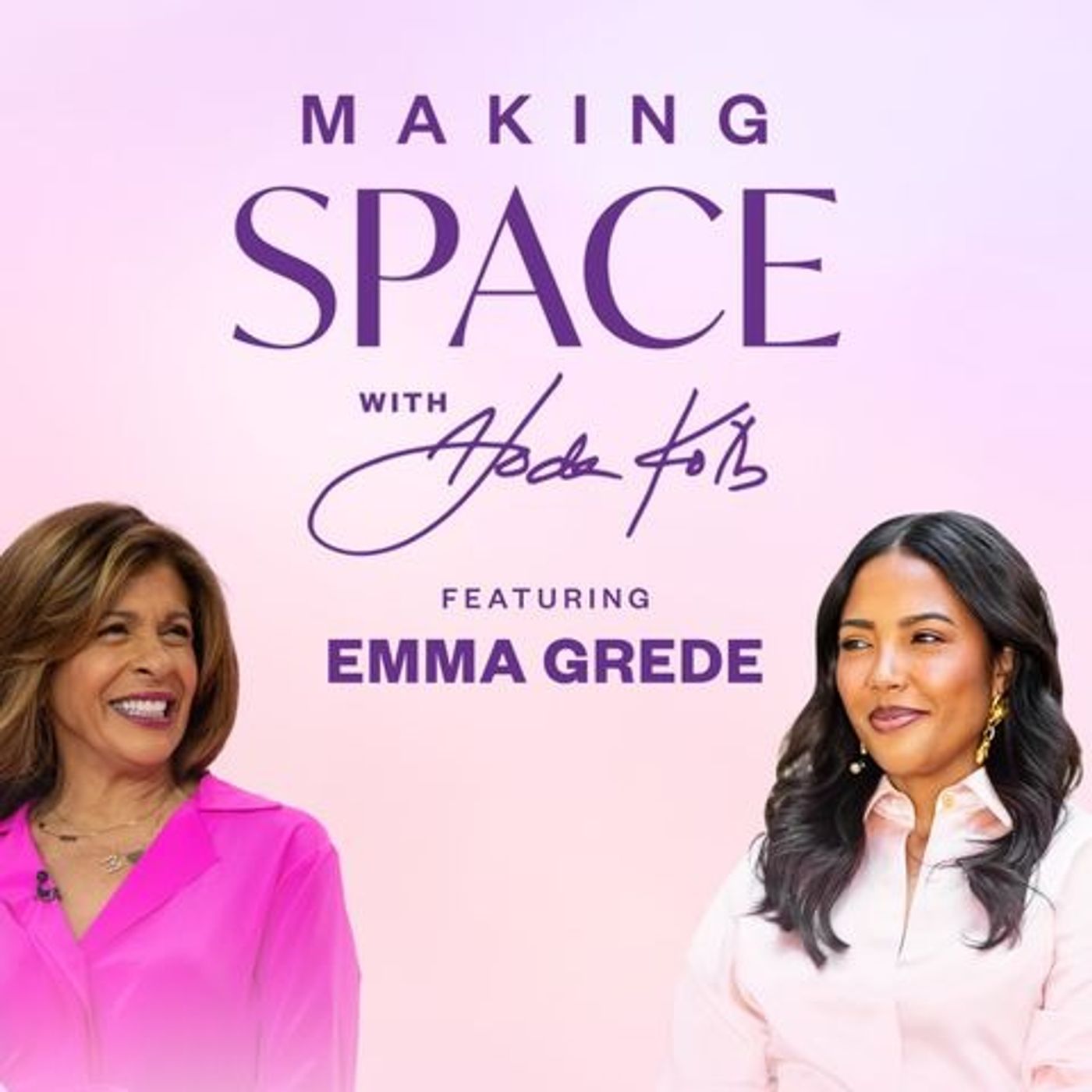
Making Space with Hoda Kotb
Entrepreneur Emma Grede On Being "Self-Made" And Building Iconic Brands (May 2025)
00:44:11
Businesswoman and entrepreneur Emma Grede has launched some of the biggest brands in fashion. Known as the powerhouse behind companies like Skims and Good American, Grede says she takes issue with the phrase "self-made". Raised by a single mom in East London, Grede worked her way up through the fashion world, but she says her partners and mentors helped get her to where she is today. She opened up to Hoda about her childhood, and balancing motherhood with her career.
Loading summary
Transcript213 lines
- [00:00]
Hoda Kotb
Amazon Health AI presents Painful Thoughts why
- [00:05]
Emma Grede
did I search the Internet for answers to my cold sore problem? Now I'm stuck down a rabbit hole filled with images of alarmingly graphic source in various stages of ooze. I can clear my search history, but I can never unsee that.
- [00:23]
Hoda Kotb
Don't go down the rabbit hole. Amazon Health AI gets you the right care fast. Healthcare just got less painful.
- [00:30]
Depop Advertiser
Your little one grew three inches overnight. Adorable. Also expensive. Sell their pint sized pieces on Depop and list them in minutes with no selling fees because somewhere a dad refuses to pay full price for the clothes his kids will outgrow tomorrow and he's ready to buy your son's entire wardrobe right now. Consider your future growth bird budget secured, Start selling on Depop where taste recognizes taste. Payment processing fees and boosting fees still apply. See website for details.
- [01:09]
Hoda Kotb
As you're listening to this podcast, whether you're in your car, making dinner or maybe you're on a walk, there's a decent chance my guest today has had a hand in something in your closet, in your kitchen, or in your drawers. I'm talking about Emma Greed. She is the mastermind, CEO and co founder of Good American, founding partner of Skims, co founder of the cleaning brand Safely, and as of right now, she's also the host of Aspire with Emma Greed, the audio and video podcast where Emma shares what she's learned building culture, defining brands. Emma's one of the most successful self made women in the world. You've seen her on Forbes, on Shark Tank, and alongside some of the most powerful names in Hollywood and the business world. And today she is right here with me. And here's what I love the most about Emma. She knows that there's more than enough to go around. She's scaled businesses and now she's scaling mentorship. So listen closely. This episode may give you the push you need to invest in yourself in the way you've always wanted to. I'm Hoda Kotb. Welcome to my podcast Making Space. All right, so Emma, first of all, I'm just happy to be sitting with you because A I adore you and b I also adore you. So two words that I always say when I look you up. Two words that I feel like are never missing from any article and that those two words are self made. When you think of yourself, is that one of the things that you say? Yep, that's one of the things I'm most proud of. I did this.
- [02:48]
Emma Grede
You know, it's so funny. I have a little bit of a problem with that term self made. Well, just because I feel like in my career there's been so many people that have been a part of it, and still now, you know, it's like I have partners and I have, like an amazing staff and an incredible team. And so the idea that anyone is self made, it's like, yeah, I started myself and yeah, I got myself to where I am, but it takes so many people. And it's like I have four kids and I have three businesses and this amazing new podcast that's just started. It takes a lot and you really have to rely on a lot of people. And I also think to be successful, you have to know how to utilize everything around you. And so, yeah, I guess, like self made in the traditional terms, but there's a lot that I want to get to. All this stuff makes sense.
- [03:35]
Hoda Kotb
I want to get to your podcast because first of all, I feel very proud of you because I've watched you kind of grow. I've watched you because you were my first TV interview. I mean, I remember being so shocked. You were sitting with us on the Today show set, and I felt like you kind of came out of nowhere because I feel like we know people in these circles. You came on the set and I remember Jenna and I, we're like, we love her, we want to be friends with her. Who is this person? So I want to take you back and I always ask this question and. And I find it very revealing for everybody I interview. Okay, close your eyes. Imagine your childhood bedroom. Look around. What kind of sheets are on the bed? What did you have on the shelves? Did you have any posters? What was around? And now open your eyes and just tell me what you see.
- [04:21]
Emma Grede
You know, it's such a happy place for me. It's a very crowded room because I shared a room with my sisters. So there were three of us in one room, bunk beds. And I had the single bed, so I was, you know, the one. And I lived in. You know, we had this little house. I grew up in East London in England. So it was like this tiny little house that was so chaotic. I'm one of four girls, single mom, and it was loud. And those walls were covered in posters, by the way. What?
- [04:49]
Hoda Kotb
Anyway, everyone got.
- [04:50]
Emma Grede
Oh, yeah. It was like a mixture of like Marky Mark. Take that, who's an English brand? Michael Jackson, like a lot of Michael Jackson. That was a crazy time. And that bedroom really was like the center of my life. That's where so much happened. So formative for me were you the
- [05:07]
Hoda Kotb
neat person or the.
- [05:08]
Emma Grede
Oh, I was the neat person.
- [05:09]
Hoda Kotb
Of course you were.
- [05:10]
Emma Grede
Yeah, the neat person. And funnily enough, the quiet one, which is really interesting when I think about myself now. I was the reserved one out of all of my sisters. The rest of them are crazy.
- [05:20]
Hoda Kotb
So, first job as a little kid?
- [05:24]
Emma Grede
Oh, I worked. Literally, I did every job in imaginable. I mean, I was a real hustler. I would sell anything I could get my hands on. I was selling fireworks in the local store before, you know, when they didn't care, when you were like 11 years old, they'd be like, we need an extra person. Over this period, I worked in a delicatessen, I did a paper route, worked in clothes shops. I mean, I've done so many jobs.
- [05:48]
Hoda Kotb
Did you work for money? Was that what you were working for?
- [05:52]
Emma Grede
Absolutely. Because I was obsessed, obsessed with fashion magazines. I washed a lot of cars as well. Now it's all coming back to me. You took me back to that bedroom and it's like I'm in plaster. But it's interesting because I work so much and for me it was always about money, but it was about the freedom that came with the money. Right. If I had a little bit of cash in my pocket, you know, my mom, she just did everything she could to keep the roof over our heads. And so any little bit of money that I had, I would give to my mom. And she would always say, you know, treat yourself. Go and buy a magazine, Buy some sweets for you and your sister, some candies. And so that was, you know, for me, it was more about the relief that came with the money.
- [06:32]
Hoda Kotb
What did your mom do for a living?
- [06:33]
Emma Grede
Oh, it's so funny. So my mom actually started in fashion. She was a window dresser. But then she really quickly had to make a switch. When my dad left, I was about five years old. And so my mom had three of us. She was 28 with three of us under five. And so we kind of got to the place where she had to transition and she ended up working in the city. She became a banker and she became quite a high powered person. She worked at Morgan Stanley for over 20 years.
- [07:00]
Hoda Kotb
Wow.
- [07:01]
Emma Grede
Worked her way up through the ranks and she was one of very, very few women at that time.
- [07:05]
Hoda Kotb
Wow. What did she teach you? What did you learn from her?
- [07:08]
Emma Grede
Everything, honestly, everything. There were so many lessons and I think so much of it came from this place of how to value yourself, how to value your contributions. You know, my mom is a very tiny, white, blonde woman and she's Got these four, you know, black kids. And she was like, listen, girls, like, life is not going to be so easy for. But let me tell you, you know, it's like, you're no better than anybody else, but nobody is better than you. And so I really was brought up with this sense of self and sense that I could do anything that I wanted to so long as I was willing to work for it. And that's still how I feel now.
- [07:45]
Hoda Kotb
Did you feel. Because, you know, I have adopted a couple of kids. They're from different places. Not every family looks like a quote unquote family just because of life. How did you handle that part of it? I mean, did that come up in life? Is that your mom? I don't. You know, people trying to put the pieces. Where's your dad?
- [08:04]
Emma Grede
Trying to put the pieces all the time. I mean, because my mom is so little and blonde and we're all bigger and we'd all have this huge curly hair. No one really understood. And people would make remarks to my mum, not understanding that she had four black kids. So there was always that, you know, I watched my mom, let's just say, be very strong when she needed to be.
- [08:24]
Hoda Kotb
Did it bother you as a kid?
- [08:26]
Emma Grede
No, you know, it never did because again, I had a real sense of where I came from and my heritage. My mom had a lot of friends. My dad's from Trinidad. Later I had a Jamaican stepfather who was my mom's boyfriend. And so I was surrounded by people that, you know, came from where my dad came from. And so there was a real sense of who I was, where we come from. And the balance of, you know, being British and Caribbean, that was kind of weaved throughout my life, my whole life.
- [08:54]
Hoda Kotb
It's so, I think, unique kids struggle when they're young. And I felt this too, when I was a little kid. I mean, I had the funny name. We were in Morgantown, West Virginia, and I was just trying, you know, when you are different, then you will yourself to be like others. And then when you get older, you're like, thank God, thank God I am this person. When do you think your mom was the most proud of you?
- [09:16]
Emma Grede
Oh, that's a good question. You know, I think she's always been quite proud of me. We have a pretty unique relationship. You know, it's like, my mom's the dad, I'm the mom, and we have three kids together. Is that how it works? That's kind of how it works. But she had to go out and work and get the money. You know, and I needed to look after the house and the home and the kids and make pack lunches and iron school shirts, and that was just the reality of our life. So we had more of a partnership together. And, you know, I think if you were to speak to my sisters, they. They really see me as someone that was very important to them in their childhood. I think my mom was proud of me as a kid because I helped so much, you know, and she needed me and I needed her, and so it was that type of partnership.
- [09:55]
Hoda Kotb
Was any of your success unexpected to her when you got.
- [09:59]
Emma Grede
No, I don't think so. You know, it's so interesting because I've always been ambitious. And when I say ambitious, I mean in everything. You know, if I was playing a game, I was playing to win. If I was gonna, you know, like, whatever I was doing, I had that type of mentality that I was going to be the best. You know, when we started, like, learning how to, like, blow dry our hair, you know, I would be like, look how brilliantly straight I can get this hair. And she'd be like, calm down. It's just a blowout. But, you know, it's like, that's just who I am.
- [10:26]
Hoda Kotb
What were you like in high school? How did.
- [10:28]
Emma Grede
A nightmare. I mean, honest. Well, the sad thing is, you know, I didn't understand that I was dyslexic until I was in my mid-20s. And so I really struggled with school. And I wanted. You know, I've been an avid reader since I was so young, and I really wanted to be a good student, but I struggled so much. And back in those days, dyslexia wasn't something that they were diagnosing. It was just like, you're a nightmare. You don't get on with the work. You don't deliver your homework on time, and you're a distraction back of the class. And I was quite happy to be at the back of the class. I was like, all right, well, you know, I'll do this other thing. And, you know, then boys came, and I was a very distracted student, let's say. And so it wasn't my finest time. I really came into myself as soon as I started to work. And so at kind of 16, 17, I dropped out of college. High school, as you would say here in the US I dropped out, and I went straight to work. And that, for me was like, that was the moment and the eye opener. Cause I was like, I understand what I'm supposed to be doing.
- [11:25]
Hoda Kotb
This is what I get.
- [11:26]
Emma Grede
I want to work in fashion. And I will do anything to get there.
- [11:30]
Hoda Kotb
How did you break the news to your mom that you were going to drop out of high school?
- [11:33]
Emma Grede
Oh, my goodness. I didn't tell her for ages how well, because, you know, I got a job. So we lived at this point, we'd moved to Essex and so I had to get a train into London every single day to go to college. And I'd stopped going to college and started a job working in a store. So I just go.
- [11:50]
Hoda Kotb
You just kept going back and forth.
- [11:51]
Emma Grede
I just kept going.
- [11:52]
Hoda Kotb
Do you remember the convo when you.
- [11:53]
Emma Grede
Oh, my God, I remember the conversation. You know, she wasn't that disappointed. She was like, as long as you're doing something, I'll be fine. You know, but she was really like. She was like, you better have a plan. And actually that was very formative for me because she said, you know, you can't be willy nilly about these things, Emily. You know, I remember that, like, you better have a plan. And so I really did start to think about how do I take what I'm doing here and will that lead to a job and where are these stepping stones? And so I started to think about how I can make my way around the fashion industry and find the job.
- [12:27]
Hoda Kotb
Did you want to be in front of the camera? Was that. No.
- [12:31]
Emma Grede
Really? No. I wanted to be a fashion designer. That's what I thought I was going to be. I loved clothes. I was obsessed with all of the fashion brands and I wanted to be a fashion designer. I just didn't have any talent. I couldn't draw, I couldn't sew. I wasn't particularly creative. And so I was like, okay, do I just want to buy these beautiful clothes and make enough money to be, you know, in those rooms? And I actually do. You know what was really interesting? I realized what I wasn't very early and I didn't really. I didn't think that I was a creative soul. I would see these brilliant people at the London College of Fashion where I dropped out, and I'd understand the emotion around fashion. And I thought, I don't have that. What I am is a great negotiator. I'm a good business person. And I knew that about myself pretty early on. And so I thought, I'm gonna find a way that I can work in, you know, really closely to brilliant, creative people. But that's not where I should be. I shouldn't be the one actually creating the things I need to be the person creating the business behind the things.
- [13:29]
Hoda Kotb
To have that kind of knowledge about your at that young of an age too is pretty cool, I think, right?
- [13:33]
Emma Grede
I just think I just leaned into what I was good at. I don't feel good when I am outside of myself. You know, it's like I knew that if you put me in a room and try to make something happen, to take something from zero to something, I could do that I could sell anything. You know, from my hustling days trying to sell shirts and things, you know, it's like I would literally be able to sell anything. But I didn't see myself as someone that was creative.
- [14:02]
Hoda Kotb
More with Emma Greed after the Break.
- [14:13]
Wayfair / eBay / Capella University Advertiser
We all love spring and spending time in our little backyard oases. Now's the perfect time to give your outdoor space a little refresh. Your patio, deck or yard should match your style and feel like an extension of your home. And for the longest time, mine felt too generic. But Wayfair helped me find good deals and create the vibe I was going for. Whether your taste is more modern, coastal, farmhouse or eclectic, they have all sorts of decor, furniture, appliances and lighting to curate a dreamy outdoor space. Wayfair is your one stop shop to make an inviting spot to enjoy your morning coffee or even host your friends for brunch. Plus, their filters and tools make it simple to narrow down what works for your style and budget. And over 20 million verified five star reviews from real customers help you make the right call. Get prepped for patio season. For Way less head to Wayfair.com right now to shop all things home. That's W-A-F-A-I-R.com Wayfair Every style, Every home
- [15:09]
Emma Grede
okay, I have to tell you, I was just looking on ebay where I go for all kinds of things I love. And there it was. That hologram trading card.
- [15:17]
Depop Advertiser
One of the rarest. The last one I needed for my set.
- [15:19]
Hoda Kotb
Shiny like the designer handbag of my dreams. One of a kind.
- [15:23]
Wayfair / eBay / Capella University Advertiser
Ebay had it and now everyone's asking.
- [15:26]
Hoda Kotb
Ooh, where'd you get your windshield wipers? Ebay has all the parts that fit my car. No more annoying, just beautiful.
- [15:34]
Wayfair / eBay / Capella University Advertiser
Millions of finds, each with a story.
- [15:37]
Emma Grede
EBay things people love.
- [15:39]
Depop Advertiser
Your little one grew three inches overnight. Adorable. Also expensive. Sell their pint sized pieces on depop and list them in minutes with no selling fees because somewhere a dad refuses to pay full price for the clothes his kids will outgrow tomorrow and he's ready to buy your son's entire wardrobe right now. Consider your future growth. Bird Budget secured. Start selling on Depop, where taste recognizes taste. Payment processing fees and boosting fees still apply. See website for details.
- [16:14]
Hoda Kotb
You're so interesting because I was just thinking, like, when you run businesses, the fact that as a young kid, you were put in an adult role and having to sort of run all of that, like, all of these bits and pieces led you to this place. So you're working in some kind of a clothing store, and you're pretending that you're in school, but there's a job and then there's a career. So when did you step from or how did you go from that first job? We've all worked at the Gap or worked at somewhere totally, but that's where we stay. So what did you do?
- [16:44]
Emma Grede
So I did a lot of work experience. And for me, it was all about trying to get closer to these fashion designers and to the industry that I love so much. So I worked in pr and I worked in a sales showroom. And then eventually I landed in this fashion show production company. So the companies that build the fashion shows, put them on, you know, invite the press, invite the buyers. And that was an incredible experience for me. Cause I really started to understand the fundamentals of the business behind the fashion shows. Like, why did they put these shows on? What are they there for? Who's going? And I met a lot of people. And so for me, it was an introduction into, okay, the buyers come from the department stores and they buy the collections. They then go off to Paris and they place their orders. The press are here, they're writing the stories, and that becomes collateral so that the buyers understand what they should buy. You know, So I really started to piece the whole thing together and understand where my place would be. And I fell into this really interesting role of brand partnership. I worked in a fashion production company. None of the designers had any money to put their shows on. And so my job was to speak to brands and see if I could create partnerships or sponsorships to do brand partnerships to back the shows, to pay for the shows. And so I just happened to be.
- [18:03]
Hoda Kotb
How did you sell it? Like, what did you give me? Give me a pitch. Cause I want to hear this.
- [18:06]
Emma Grede
It was so crazy. So you would call up at that time, it was like the mobile phone companies. And so you'd be like, hi, Nokia. You know, would you like to sponsor the Julian McDonald fashion show? And they'd be like, why on earth would we do that? So I would explain. Okay, so you're trying to reach female customers. Female customers, absolutely. Love Julia McDonald, perhaps there's a collaboration that we could do. We'll make a phone case for you. You can take that phone case and you can use it to seed to your customers. And maybe you'll do a partnership with Vogue and I can put that together. And it was like, holy moly. So we do that and then we put a contract together. And I remember the first time somebody said to me, you got a deal. Let's put paper the contract. And I went. I was like, maybe you have a contract we can work from, you know? So it really was.
- [18:48]
Hoda Kotb
So that first deal must have felt like holy moly.
- [18:52]
Emma Grede
I landed, and my first deal was a big one. And it was so interesting because I landed this deal and it took me about two years to eclipse that deal.
- [19:01]
Hoda Kotb
So you hit a home run on deal one.
- [19:03]
Emma Grede
Out the gate. Out the gate. That's so hard. And then I was like, oh, my goodness, what is happening? But it kind of kept me going. Cause I knew that there was no difference between doing something that was like a $10,000 deal and a million dollar deal. Right.
- [19:16]
Hoda Kotb
You were still doing the deal. Right.
- [19:17]
Emma Grede
It was still the same thing. It was still the same amount of work. It was still the same components.
- [19:21]
Hoda Kotb
I mean. Cause people didn't know who they were. Like, who's this girl? And sometimes when you're in a room where people either look past you, don't notice you, how did you feel? Like my voice matters in this room too. How did you get there?
- [19:34]
Emma Grede
Honestly, it was almost advantageous for me at the time because when you're, you know, you were making cold calls. I was calling brands and calling PR agencies and their representatives. Well, first you couldn't see that I was 18 years old. So that was one great thing. I wasn't sitting there in a suit, but I could. Could sound good, you know? And I used to write down all of my lines.
- [19:53]
Hoda Kotb
Oh, you did?
- [19:54]
Emma Grede
So I had all of the lines. And the great thing was I sat in front of my boss. Those were the early days of online shopping.
- [20:01]
Hoda Kotb
Yeah.
- [20:01]
Emma Grede
And everybody always used to say, what a nightmare. Your boss sits behind you, she can see your screen, she can see whatever you're doing. And I was like, no, quite the opposite. Because all the good things she would say on the phone, I would write down. And then I would use it in my own sales pitches. And she would. She was so elegant and she had the best lines. And I would just be like, oh, I'm gonna use that one. And I'd write it down. So I was literally like, in School. I was, like, being taught every day by this woman, and I just used every bit of information and, you know, and every time I would, like, alter my little script, and I'd make it a little bit tighter and a little bit better, but I was cold calling. And you'd have to phone, like, a hundred brands to get 10 meetings, and out of those 10 meetings, one would turn into a thing, and then maybe you'd get an agreement out of it. But it was a lot you. A lot of knockbacks. And I actually credit that because it made me super resilient, because I was like, this is not about me. This is just luck of the draw. And, you know, you win some, you lose some. But it gave me a very thick skin.
- [20:58]
Hoda Kotb
So after you start landing deals and you're kind of making a reputation or a name for yourself, did you stay there or did you go somewhere else quickly?
- [21:06]
Emma Grede
I did. No. I stayed in that job for five or six years, maybe a little bit too long, but I think that that happens to so many women. You get comfortable. Yes. And I was too comfortable. And I didn't have enough confidence about what it was that I knew. I thought so much was about the circumstances and the company and those people. And, you know, I didn't quite understand the strength of my own skills. And so if I could redo it, I would have left that job after three or four years. But I didn't. I stayed, and eventually I was making a lot of money for that company, and they wouldn't give me a good pay rise. So I was like, you know what? I'm going. And I left.
- [21:42]
Hoda Kotb
Wait, did you go in and say, pay me. Here's what I've done?
- [21:45]
Emma Grede
I did.
- [21:45]
Hoda Kotb
And they said no.
- [21:46]
Emma Grede
I did. And it was really clear, you know, because we would take 20% of all the deals that we did. And so I was like, here's all the money I made for you guys. And they were like, yeah.
- [21:53]
Hoda Kotb
No.
- [21:53]
Emma Grede
And I was like, oh, well, I'll take that elsewhere. Sorry, gotta go.
- [21:57]
Hoda Kotb
So you just. That's a leap there.
- [21:58]
Emma Grede
I left.
- [21:58]
Wayfair / eBay / Capella University Advertiser
Okay.
- [21:59]
Emma Grede
And it was a leap of faith, and I was scared.
- [22:00]
Hoda Kotb
Did you go with something or did you go.
- [22:02]
Emma Grede
I went with nothing with nothing. I went with little old me. You got nothing. Wow.
- [22:09]
Hoda Kotb
There are very few people who would do that.
- [22:11]
Emma Grede
Yeah. You know, I didn't have much to lose at that point. I'm 24.
- [22:14]
Hoda Kotb
Yeah.
- [22:15]
Emma Grede
I started when I was 18, so I was 24 years old. And, you know, I had rent to pay. I was living with a boyfriend. At the time, and I had rent to pay, but it's not like I had kids. And I do think there's something to be said of taking risks and how you work in your 20s and your 30s. And for me, I was very, very clear that these are the years to do the hard work. These are the years to take risk, take the risks before I have a mortgage, before I have kids. If I want to be successful, I'm gonna have to, like, make moves now.
- [22:46]
Hoda Kotb
So how'd you land a job after that?
- [22:48]
Emma Grede
So that was so interesting. I got a call from a girl that I knew from the industry, and she said, hey, there are these two magical Swedish guys, and they are setting up this incredible group of companies, and you should come over. They've just bought this PR company and this showroom, and they've got all these cool designers. And I was like, great. Like, I'll come for an interview. So I end up having three interviews. I the guy that actually becomes my husband years later. Oh. And I have an interview. My third interview is with him. And honestly, I don't really understand much of what he's saying. Like, he's using all of these really big words and elaborate terms, and I'm like, mm, mm. Yep, definitely. I can do that. I can deliver absolutely. Whatever you guys need. And I just, like, wangled my way into the job. Wow. Wow.
- [23:35]
Hoda Kotb
And you met your husband there. Bonus.
- [23:37]
Emma Grede
I did. I did. Bonus. Yes. Job security. It was great. Yeah.
- [23:42]
Hoda Kotb
So what you're most known for, if people read your bio, I mean, a lot of people, again, think you just appeared from nowhere. But how did the Kardashian piece come in?
- [23:50]
Emma Grede
The Kardashian piece came in. So I essentially started my career in this really interesting space of brand partnerships. And what happened is the world and the media landscape really shifted into the kind of celebrity culture that we have now. But if you go back, you know, 15 years ago, that really wasn't what it is. It was a very, very different cultural landscape. And so because I had all of these relationships with the brands, my business transitioned from working with designers and artists to working with celebrities. So those same brands would say, wait a minute, you can do a contract with a designer, with an artist. For us, maybe you can do a celebrity contract. And, of course, me being me was like, yeah, I can do anything. Let's have whatever you need. So we just started to transition. And then again, in the beginning, those deals were really small. But then I grew my reputation. I grew this company company. I started my own business with the Backing of these two incredible Swedish men that were my business partners. We set up a joint venture, and that was my first, you know, taste of starting a business myself from scratch.
- [24:54]
Hoda Kotb
Was it what you thought?
- [24:56]
Emma Grede
No, it wasn't. It really wasn't because it was so hard. I worked so much, and at that point, I had to go out, win the business, deliver the business, and then I would write the invoices to then bill for the business. So it was just me. And it was exhausting, and I was petrified. And I was really worried about not making any money, you know, because at that point, I remember Yen saying to me, you know, you're gonna eat what you kill. And that was one of the things I was like, yep, yep, no problem. And then the reality of that was, like, oh, maybe I haven't killed anything this month. You know, it was scary, but in a way, it was a great thing because I learned to be extremely responsible as a business owner. This was on me. This was mine to fail with. And so I created this business business. It became very successful. I was working with all of the best brands, you know, from H and M to Christian Dior, everyone in fashion right the way through. And you get a reputation. And I became the person in Europe that you would go to if you wanted to book talent.
- [25:54]
Hoda Kotb
Did you even believe what happened? I mean, I'm just thinking of you from the first deal that you landed, which was a whale, but to leaving a job, to having no job, to getting a call, to suddenly starting your own business and knocking it out of the park. Were there moments in where you are, like, not gonna make it, messing up things aren't good? Or are you just a glass half full, sort of like, I got this. I think it'll work, et cetera?
- [26:19]
Emma Grede
No, I think there were. If I'm honest, there were plenty of moments where I remember a lot of fear. That's how I felt. I was very fearful. And I think when you come from where I come from, there's always this feeling that you'll go broke, you know, and it's like, that was. And I think that's still in me today, you know, that things wouldn't work out and I would be left with nothing. And, you know, everyone that I grew up, up around Hoda had a regular job. You know, you went to work on a construction site. You went to work in some office somewhere. You. With a receptionist at the local doctors. Like, whatever it was, it was, like, very regular. You didn't go and work in fashion. Like, I didn't Know, a stylist or I didn't know what a public relations person was. You know, these were not jobs that were part of my world. And so for me, the whole thing always felt a little bit like. Like, not real.
- [27:10]
Hoda Kotb
Yeah.
- [27:10]
Emma Grede
You know, I was like, who does this stuff? Like, is this, like a dream? Like, who wears these clothes? Who's in these jobs? Like, who are these people? You know, a journalist. I was like, what's a. What is a journalist? You know? And so for me, there was just always that feeling of it could all go very quickly. And I think that when I started to understand this is my reality, and it's about how I bring myself into these situations every day, that I'm actually creating these things for myself, that nobody. Nobody's actually given me anything, but I am able to apply myself, do my best. And that that was somehow coming back to me in these reciprocal ways, that that's what I really started to believe. And I would watch Oprah every day after school like crazy, and she would talk about manifestation. And I would be like, I'm gonna do that. I'm gonna look at myself in the mirror when I'm brushing my teeth, and I'm going to, like, make this stuff happen. And so that's kind of what I did.
- [28:09]
Hoda Kotb
So in the middle of all of this, as you're. As the success is coming, you are married, and are you having children in here, where.
- [28:18]
Emma Grede
So there was a little bit of a gap. So it's like. Started my first business when I was 26. Worked at that for, you know, years and years and years. And then I didn't have my first child until I was 31. So I married at 30 with the guy, then my, you know, the guy, the husband. That all worked out. It was lovely, thank goodness. And, you know, it was a long. It was a lot of years building this company. Highs, lows, ups, downs. And I got to the point where I sold that agency. And that, for me, was a real moment, because when you get your first check, you know, for me, to have that type of security at that age was really formative. It was really like, okay, Emma, like, you're good. Rest now. You can figure out what is it that you wanted to do. And I owned 50% of that company from the beginning. And then after the investment, my shareholding had been watered down a little bit, and I was like, I need to own something. Like, I need to own it. And so that's when I started Good American. And I was hell bent on doing something that was a Little bit more creative. And that, you know, really kind of served a space that I believed was grossly underserved in the fashion business. And so I had a different point of view at that point.
- [29:32]
Hoda Kotb
So having kids and having a business, sometimes things work out conveniently, and sometimes they don't, but you make it work. Yeah. How did this puzzle fit together?
- [29:42]
Emma Grede
You know, it was an interesting one because now I have four kids, right? And thankfully, four kids didn't all come at once. And so you learn a little bit with every child. And also, I think you become a little bit more relaxed into it. Right. I remember the first kid, I was, like, running around the house, checking the temperatures. Now I'm like, all of you lot, like, get in the shower, like, 1, 2, 3, 4. And so I think that as I've really kind of found myself in my mothering, I've become way more ambitious for myself, because now, you know what you're doing it for right now. Now I have these amazing four kids. But I wouldn't say that I have slowed down or that I don't think about work in the same way. I have an amazing family. I also have an amazing career, and I value both of those things. And I think that sometimes as a mother, we have an idea that we have to say, oh, my God, my kids are the most important things in my life. My kids are super, super important. And so is what I've. And so is what I've worked this hard for. And so I think about those two things in a way that they both give me energy in different ways. They're both really important. They both need a piece of me.
- [30:51]
Hoda Kotb
I mean, what a beautiful, honest assessment of life. Because it's funny, when I left the Today show, one of the reasons was for my kids, and another one was because I want to build a business. And what's so funny is, after several months of I want bacon, I don't like it. Like, I was like, so. But my business and watching my kids watch me, they want to know, like,
- [31:16]
Emma Grede
what do you do?
- [31:17]
Hoda Kotb
What happened? Oh, did you get a thing?
- [31:18]
Emma Grede
Oh, you got a deal today? All right, like, I'll go. Let's go.
- [31:21]
Hoda Kotb
We are celebrating tonight and how wonderful
- [31:23]
Emma Grede
that they get to see that they
- [31:24]
Hoda Kotb
get to bear witness. That's such an important point when you talk about relationships. I've had some that have worked and some that haven't. How did you know? Cause in terms of a lot of times, what we see when we're growing up models, what we believe love is like. Love is this or love is that love is hard, Love is easy, love is absent, love is present. What did you model your relationship after? How did you know how to love someone?
- [31:51]
Emma Grede
What a brilliant question. You know, I have to say, I've always felt loved. You know, I didn't know my father really until my early 20s, but my mom did such an amazing job and her family, I should say, in giving all of us girls, like so much love, I had so many people around me. And still to this day, if I land in England, there are like 30 houses that I can go for dinner in. You know, it's like I can just turn up. And all of those people have got me. Like, they just got me. And so I think because of that, I had a very high standard for my expectations for love. I really wanted somebody that, that could see me and find the things that are important to me, important. And so in my relationship. And I think I'm so unbelievably lucky. I've been married now for. Oh, my God, I always forget. We've been together for 17 years. I've been married for like 11, 12. I don't know, somewhere in there. He's wonderful, but I just, I think that I have a person that supports all the parts of me that's beautiful, right? Supports the ambition, supports the bits that like, you know, because when you have four kids, there's highs and there's low lows, and it is hard. But I really have someone who comes to the table and understands what it means to be like a family, like a good, solid person. I'm lucky.
- [33:15]
Hoda Kotb
I know. I got chills on that. I got chills on the fact that your mom built this place for you. You're right. Families are big and they come in different.
- [33:23]
Emma Grede
They come in different shapes and sizes and never did. I think that my little mom wasn't enough. You know, she had to stretch herself very, very thinly for us. But she did an unbelievable job. And honestly, I never felt any lack whatsoever. Despite the fact that we were.
- [33:41]
Hoda Kotb
We were really lacking, by the way. I'm going to take that. I'm carrying that with me. That feels good. More with Emma Greed in just a moment. So again, people say, oh yeah, Emma works with the car. Are you looking for the best deal on a new home?
- [34:13]
Depop Advertiser
Discover the Dr. Horton home of the week.
- [34:15]
Hoda Kotb
With new construction homes now selling in ellensburg from the mid-3002, Dr. Horton has the right home at the best value for you, offering one and two story homes near Central Washington University.
- [34:27]
Depop Advertiser
Your new home is within reach so
- [34:29]
Hoda Kotb
what are you waiting for?
- [34:30]
Depop Advertiser
Learn more about the Dr. Horton Home of the Week. Visit drhorton.com and schedule a tour today.
- [34:36]
Hoda Kotb
Dr. Horton, America's builder and equal housing opportunity builder.
- [34:40]
Emma Grede
It's smart to always have a few financial goals and a really smart one. You can set earning cash back on what you buy every day. And with Discover, you can get this. Discover automatically matches all the cash back you've earned at the end of your first year. Seriously, all of it.
- [34:58]
Hoda Kotb
And we trust you to make smart decisions.
- [35:01]
Emma Grede
After all, you listen to this show, see terms@discover.com credit card.
- [35:06]
Hoda Kotb
Tired of overpaying with DirecTV?
- [35:09]
Emma Grede
Dish offers a reliable low price every month without surprises.
- [35:14]
Hoda Kotb
Get the TV you love and start watching live sports news and the latest movies, plus your favorite streaming apps. Oh, in one place.
- [35:22]
Emma Grede
Switch to Dish today and lock in the lowest price in satellite TV starting
- [35:27]
Hoda Kotb
at $89.99 a month with our two year price guarantee. Call 888, add dish or visit dish.com today. Kardashians, I mean, you obviously you had an incredibly successful run pre them. They just happen to be somebody that kind of catapulted you into the spotlight too.
- [35:43]
Emma Grede
Yes.
- [35:44]
Hoda Kotb
Was meeting them life changing for you or how did it change you?
- [35:48]
Emma Grede
I guess, you know, I feel so incredibly grateful. Not just for them, super incredibly grateful for them, but for the time that we have been in business. Right. I think that we have a great partnership holder because we don't speak on each other's behalf. My partnership has been one where you've got an incredible group of people that know what each other do well. And my part of everything is to come to the table and to have these businesses and do a great job in the product piece and the customer piece and to make sure that, you know, everything really works. And we did that together in a time when customers were like wild about them. Right. Like really wild about them. But we've created long lasting, brilliant businesses. And I think that they would all say, you know, we have these businesses that have customers all over the world, like everywhere. And so I think that everybody feels this immense sense of pride around what has been built. Like the brands stand on their own. And I think you can't be more proud than that.
- [36:57]
Hoda Kotb
So you're teaming up with Dolly. I saw you and Dolly Parton. I was dying. First thing, let me tell you a bit, just so you know, and I know you do know this. Dolly doesn't do things.
- [37:08]
Emma Grede
No, no, no, no.
- [37:09]
Hoda Kotb
Dolly doesn't do.
- [37:10]
Emma Grede
Let me tell you things. I know I'VE been trying.
- [37:13]
Hoda Kotb
But how did you convince her? Did you do one of your things that you do?
- [37:17]
Emma Grede
I caught her up. It's like, Dolly. Well, you know what? I have to say, Dolly has the most unbelievable team around her. And you're right, she doesn't do things. No, she does the right thing.
- [37:28]
Hoda Kotb
Yes.
- [37:28]
Emma Grede
And so it was so amazing because this is somebody who has such an iconic sense of style. And so we were very thoughtful in our approach. We were like, we're thinking this thing and really looked at, like, how Dolly has dressed over the years and what we could uniquely do. And Dolly, you know, again, she's someone that's so before her time in terms of the way she speaks, how she supports community, how she thinks about the world. And so when we spoke to her about this is what Good American is about. This is a brand that is truly there to represent all women, to make you feel like the best version of yourself. She was literally like, sign me up. It wasn't a crazy sale. Like, we were like, these are the things that we could do together. And then we worked together with her team and she has this creative director called Steve that is just like, he's like a magician.
- [38:13]
Depop Advertiser
Is he?
- [38:13]
Emma Grede
And our team sit around and we watch him sketch and we're like, wow, Steve, like, and he's so incredible. So we've really worked closely and like every rhinestone, every piece of fabric, like the ginghams, the denims, like, they have been unbelievable in, like putting this collection together. And, you know, it's a long term partnership. It's not just like a one off. And so they're in the office. We had like a party the other day. Dolly took photos with every single person on the set. We just all died.
- [38:40]
Hoda Kotb
That's so Dolly.
- [38:41]
Emma Grede
We all died and went to heaven. She sent me a guitar. Crystal encrusted sign. Wait, what?
- [38:46]
Hoda Kotb
I saw you guys in a picture. Stop it. I'm dying. I loved when you guys were hugging each other in the shot because I know you did not want to, by the way. She came to the Today show several times. And there was a woman who I work with who does our pr, named Megan. And Megan saw her and Megan grew up in South Carolina and literally says Dolly raised her just because it was, you know, her mom and Dolly and she could not walk up to her and she shuffled. Megan, who's met Beyonce and everybody shuffled up to Dolly. Dolly wrapped her arms. She said, baby, you come right here to. Megan sobbed into her chest. A grown woman in her 40s sobbing into Dolly's chest because Dolly raised her.
- [39:30]
Emma Grede
I mean, it's pretty amazing, isn't it? Yeah.
- [39:32]
Hoda Kotb
You make really good choices, too. I, like, feel like that's such an important part.
- [39:36]
Emma Grede
She's an American icon. An icon. Nobody.
- [39:39]
Hoda Kotb
Nobody like her. So now you have such great business knowledge. And I encourage anybody, if you just want to even Google Emma Greed. And look, the business nuggets you drop, whether you're on a New York Times panel with DVF or whether you're here or there speaking, they're all really important pieces of information. So when I saw you were starting a podcast, it all made sense. It's called Aspire.
- [40:01]
Emma Grede
It is.
- [40:02]
Hoda Kotb
With Emma Greed. So tell me about it. Is it business? People like, what are you doing?
- [40:07]
Emma Grede
I am so excited about it, you know, because I've spent my career ultimately building and scaling businesses, and I really wanted to figure out a way to scale mentorship. Wherever I go, I speak to people, they ask me the same questions. They're like, how did you do it? How do I start? How do I get a pay rise? How do I become a better negotiator? And I just thought to myself, this is, like, it's not just about business. This is about how you build the life of your dreams. How do we get better habits? How do we take what I feel like I learned from Oprah all those years, right. And learn to shift our mindsets and be able to do the things and live up to our full potential. And so when I thought about doing this podcast, it really was about meeting all of those people that speak to me in a way that is straightforward. Because here's the thing. There are so many podcasts out there. And when we start to think about things, this, like, extremely wide space, there's a really, really narrow point of view out there. It's mostly male in business, and it's also kind of highbrow, right? So if you own a salon in the middle of the country and it's doing really well and you'd like to open two more salons, I'm like, where does that girl go for business advice? Right?
- [41:17]
Hoda Kotb
That's good.
- [41:17]
Emma Grede
And it's not about dumbing it down. It's really about giving things a tangible and actionable. I want you to give me an hour of your time, and in return, I'm going to give you something that you can go out and use tomorrow. Whether it's about your habits or it's about your mindset or it's about that pay rise that you need to go and negotiate you know, God knows I have it. I've got plenty of stuff. They all come to me. But there's a way to do that, right? There's a way to be effective. And so with Aspire, I just want to use everything I've learned and use these incredible contacts that I've made over the years and bring that information to people.
- [41:52]
Hoda Kotb
Brilliant. So who are some of the guests you're talking about?
- [41:54]
Emma Grede
So, I mean, great.
- [41:55]
Hoda Kotb
Listen, I have such a good guest.
- [41:57]
Emma Grede
I mean, it's really, really fun. We launched with Melody Hobson, who is my business idol.
- [42:02]
Hoda Kotb
She's a home run and a lot of people don't know about her.
- [42:05]
Emma Grede
A lot of people don't know about her.
- [42:06]
Hoda Kotb
She's amazing.
- [42:07]
Emma Grede
I mean, we're talking about the former chairwoman of Starbucks. Yes. I mean, it doesn't get bigger. She is, you know, an incredible black woman who is, you know, like, she's in the finance business. You know, she has this huge private equity fund. And she is just, just, I think one of the most formidable, brilliant business women that are out there. And then you've got somebody like Gwyneth Paltrow. And I think that Gwyneth is really interesting because so many women start businesses that come from a place of their passions. So how do you take something that is your passion and turn that into a credible business and you think about something like goop, that's actually been a 16 year bill.
- [42:44]
Hoda Kotb
Oh, gosh. Crazy.
- [42:45]
Emma Grede
So I think there are the interesting learnings, but I'm trying to go deep. I'm not gonna let somebody say, you know, then I went out and raised money. I'm like, how? Where? With who? How'd you do it? What was in the propos? You know, it's like, let's go in, let's get the information. Hold up, like, come on now, you know, So I feel like that's what I want to do. I want to go deep on subjects and ask the questions that people want answered.
- [43:05]
Hoda Kotb
One of the things you said that I have passed on to people is you say that you spend 25% of your time hiring the right people.
- [43:13]
Emma Grede
It's the most important thing.
- [43:14]
Hoda Kotb
Would you just elaborate for a second on that? This is one of the nuggets you'll get on her podcast. But I love this, you know, I
- [43:19]
Emma Grede
think it's so interesting because again, and we started this show really talking about, about being self made. And I really believe that you are only as good as the people that you surround yourself with. And so being thoughtful and spending time around who's coming in to the business? What do they bring? And that takes a certain amount of understanding about who you are, what are your skills? What are you solving for? What are the gaps? Where are you not good that you need to go and find somebody who balances your skills out? And so for me, when I think about bringing people into my business, it's my. About finding those skills that I don't have and making sure that there's a representation around the table of my customer base. Right. Because you need people that can service the customers that you want. And so it's about having different ages, people from different backgrounds, and bringing everyone around the table so that you can be the best and the strongest business possible. But I have, like, a pretty crazy way of interviewing and hiring people.
- [44:19]
Hoda Kotb
Is there, like, a question that's very telling to you?
- [44:21]
Emma Grede
There's so many questions that are telling to me, but I, you know, I often ask people where they have felt most useful and where they've had most impact, because it was very telling. When somebody starts talking about where they think they're particularly good and where they've actually had impact, you start to understand what they think about themselves versus maybe what's on their resume or what. You're hiring them.
- [44:45]
Hoda Kotb
Right. You're trying to put a circle in a square.
- [44:46]
Emma Grede
Yeah, and sometimes I will bring somebody in for an interview for one position, and based off the interview, I'm like, actually, you should be here.
- [44:54]
Hoda Kotb
You're gonna do that job.
- [44:55]
Emma Grede
Yeah, because I hire for attitude over experience.
- [44:58]
Hoda Kotb
Oh, that's good.
- [44:59]
Emma Grede
Right? It's like, I want someone who wants to come in. And again, of course, Hoda, I have to do that because I had no experience.
- [45:04]
Hoda Kotb
Right.
- [45:04]
Emma Grede
I came into the business with absolutely no. No one would hire me. So it's like, you gotta come in with the hunger.
- [45:11]
Hoda Kotb
And is there any way to know if someone has potential? Like. Cause sometimes they may not have the experience, but no matter how much you drill them, not fit. Is there a way you. You're like, I don't know, but you've got that thing.
- [45:24]
Emma Grede
Yeah, I can usually sense it. It's like, listen, I really feel like the best thing you can do for career advancement. It's just a couple of words. It's like, yeah, I'll do that. Put your hand up. Do you know, I'm looking for that person, that hungry little monster, that. That's not their job. But they're like, I'll do it. I'll have a go. Like, just that level of enthusiasm says to me, oh, She's a tryer. He's somebody that's gonna, like, bring something to the party. It's not that deep. You are looking for people that just are ready to go.
- [45:53]
Hoda Kotb
That's so good, right?
- [45:54]
Emma Grede
Like, it's like, just get up and have a go. They're the people that I love.
- [45:58]
Hoda Kotb
I love this.
- [45:58]
Emma Grede
That's simple.
- [45:59]
Hoda Kotb
I love it. I love it. Okay, so this podcast is called Making Space. Because. And I always ask this question, podcast,
- [46:05]
Emma Grede
by the way, making space is so deep. So perfection.
- [46:08]
Hoda Kotb
What we need to do.
- [46:08]
Emma Grede
Damn right.
- [46:09]
Hoda Kotb
So if you had a day for Emma Greed that involved a blank schedule. Actually, your manager just came over and said, you're not gonna believe this. Tomorrow, from morning to night, you have nothing. Zero. Look at your calendar. It's all you.
- [46:22]
Emma Grede
Tell my people. Can you let somebody know this needs to happen.
- [46:26]
Hoda Kotb
This magic wand is now. So you get to wake up when your body says wake up.
- [46:30]
Emma Grede
Okay?
- [46:30]
Hoda Kotb
You get to eat, do whatever, move, exercise. Not meditate. You get to do whatever you want. It's your day. Nobody's in it unless you hand select them. How would you fill that one? One day. One single day.
- [46:43]
Emma Grede
Annoyingly, I'm gonna be up at 5 because that's just how I'm wired, right? So I'm up. I'm definitely up. I am not exercising that day. It's just not happening. But I am eating. I'm such a foodie, I can't even tell you. So I'm gonna cook a huge breakfast because one of the things that I love to do so much is cook. I just don't get the opportunity enough. So I'm gonna cook, like, a giant breakfast.
- [47:05]
Hoda Kotb
Oh, delicious.
- [47:05]
Emma Grede
I'm definitely gonna be at home with my kids and with Yens, but I would almost, like, want one of those days where. Where you, like, get in the bath, but then get back in pajamas.
- [47:14]
Hoda Kotb
That's good.
- [47:15]
Emma Grede
And you just smush. You know, everyone, like, you're allowed your iPads over there. And I've got the TV and a pile of newspapers and all the books and then just, like, food. By the way, the food you just
- [47:27]
Hoda Kotb
described, the most perfect day.
- [47:28]
Emma Grede
Isn't it like, that's it. Maybe it's raining outside. Yeah, Like London days. You know, like that. That's the vibe.
- [47:35]
Hoda Kotb
I love that vibe. By the way, great luck with your new podcast.
- [47:39]
Emma Grede
Thank you.
- [47:39]
Hoda Kotb
I think people are gonna learn a lot from them, just like they learned right here today.
- [47:42]
Emma Grede
Thank you so much, Emma. I love you.
- [47:43]
Hoda Kotb
Thank you.
- [47:43]
Emma Grede
Psych.
- [47:44]
Hoda Kotb
The best. Hey, guys, thank you so much for listening and for coming on this journey with me. If you like what you heard, and I hope that you do, please give Making Space a five star rating and review on Apple Podcasts and make sure you tell your friends. Follow us on Apple Podcasts, Spotify or wherever you're listening right now. Making Space with Hoda Kotb is produced by Allison Berger along with Kate Saunders. Our Associate Audio Engineer is Juliana Masterilli. Our audio engineers are Katie Lau and Bob Mallory. Original music by John Estes. Bryson Barnes is our Head of Audio production. Missy Dunlop Parsons is our Executive producer. Libby Least is the Executive Vice President of Today and Lifestyle.
- [48:33]
Emma Grede
There's a fire inside you you can't ignore. Stand still. Not a chance. You're a lifelong learner who's come this far.
- [48:40]
Wayfair / eBay / Capella University Advertiser
Now we're here to help you keep going further.
- [48:43]
Emma Grede
Capella University what can't you do?
- [48:46]
Wayfair / eBay / Capella University Advertiser
Visit capella.edu to learn more.