← Making Space with Hoda Kotb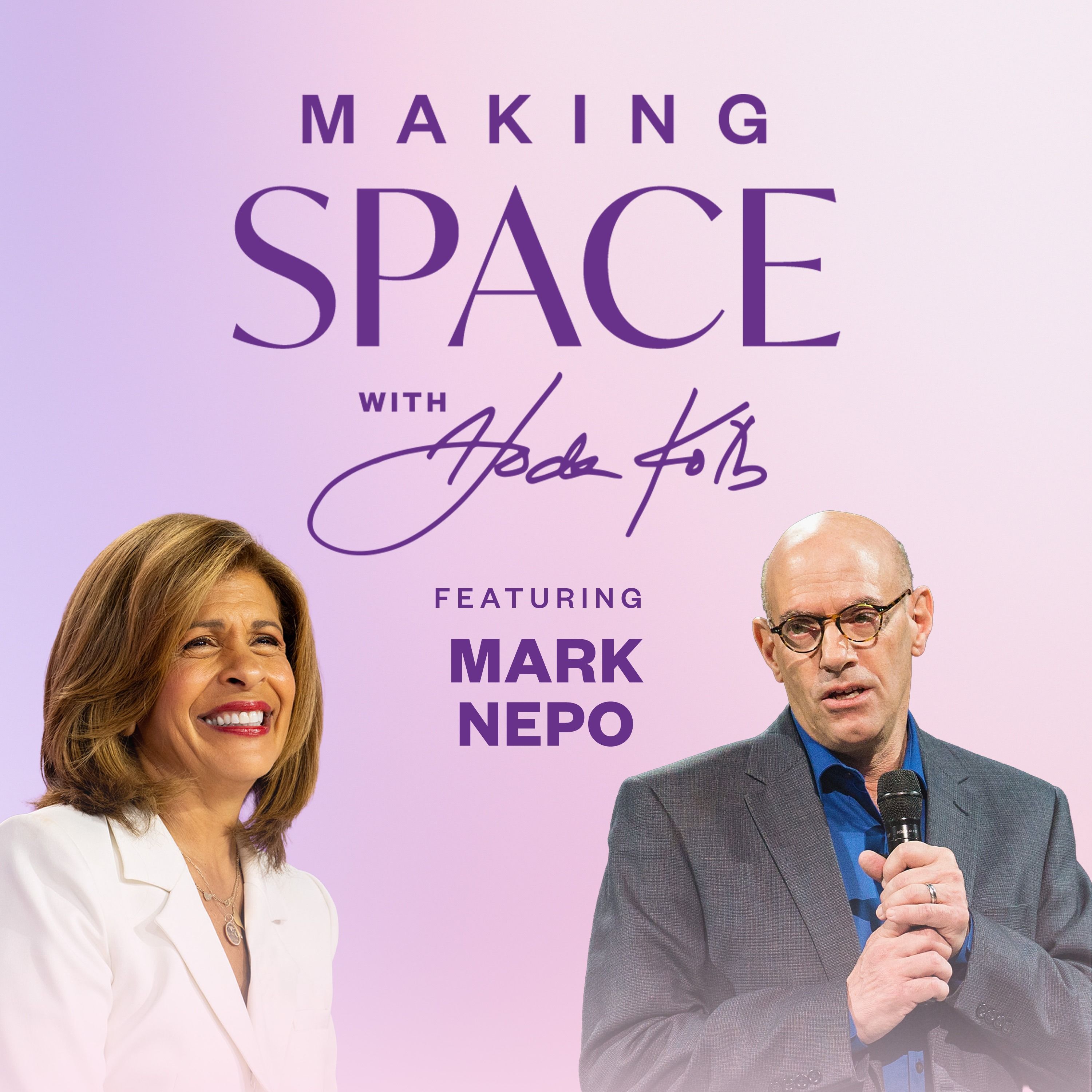
Making Space with Hoda Kotb
Mark Nepo on How the Words You Choose Shape the Life You Live
00:45:09
Most people spend their lives trying not to feel broken, but poet and spiritual philosopher Mark Nepo believes that breaking is actually where life begins. In this deeply moving conversation from Making Space, the New York Times bestselling author of The Book of Awakening sits down with Hoda Kotb to pull back the curtain on how we can stay open, even when we are hurting, overwhelmed, or just trying to get through the day. Mark reflects on the wisdom he gained from his own life threatening cancer diagnosis and a debilitating back surgery, sharing how he learned to ground himself in the present when fear threatened to take over. He and Hoda explore his newest book, The Language of the Soul, discussing why the words we choose matter in a world that often feels divided.
Loading summary
Transcript156 lines
- [00:00]
Commercial Narrator
Adobe Firefly is the all in one creative studio with AI powered image and video editing for today's creative process. Built for creators of every kind, Firefly helps you generate, edit and experiment fast because the asks aren't getting smaller, the budgets aren't getting bigger, and the timelines, oh yeah, still tight. With all the best creative AI models in one place, Firefly brings your ideas to life. Unlock a better way to make with Adobe Firefly.
- [00:31]
For my family, I'm always at my best. That's why I also want the best in my kitchen. And that means only Eggland's best eggs. They're always so fresh tasting and delicious, with 6 times more vitamin D, 10 times more vitamin E, and 25% less saturated fat than ordinary eggs. So why give your family less when they can have the best egg lands best? Better taste, better nutrition, better eggs. For added convenience, look for our hard cooked, peeled eggs.
- [00:58]
Mark Nepo
Foreign.
- [01:04]
Hoda Kotb
Most people spend their lives trying not to feel broken. And then, then there are people who believe that. That breaking is actually where life begins. Mark Nepo is one of those people. He's a poet, a spiritual philosopher, a cancer survivor, and the author of the number one New York Times bestseller, the Book of Awakening. A book that people turn to when they're searching for meaning, for comfort, or just a way to move forward. His work's all about staying open, listening to your inner life, and about finding connection, even during the hardest moment. But here's what I kept thinking about as I was getting ready for this conversation. This all sounds perfectly beautiful, but is it actually livable? What does it really mean to stay open when you're hurting or when you feel overwhelmed, or you're just trying to get through the day? And, and is there ever a time when closing off is actually the thing that saves you? Well, today we're gonna go a little deeper with Mark. Not just into his ideas, but into how they hold up in real life. I'm talking about the messy parts, the complicated parts, the parts we don't always talk about. I'm Hoda Kotb. Welcome to my podcast, Making Space. So, first of all, Mark, I'm so happy to meet you in person. I'm somebody who, like many others, have had your books, the Book of Awakening. I gifted it to everyone took credit for most of what was in it. I'm like, did you read Page so and so? But it was one of those great books. So I'm happy to be sitting with you in person.
- [02:38]
Mark Nepo
Thank you.
- [02:39]
Hoda Kotb
I wanna talk about your newest book, but before we get to That I do wanna talk. I mean, you're such a beautiful soul, a spiritual teacher, a leader. What are you finding in this moment, Mark, that people are craving? What are people needing in this season right now?
- [02:56]
Mark Nepo
Yeah. And of course, I don't have any answers, but I'll speak to it. I think, you know, as in every age, we need to be directly connected to life and each other. And, of course, things get in the way. And part of our work of needing each other is to move things out of the way. And so, you know, one. One thing, this is a little story that my grandmother, my father's mother, who was more of a mother to me than my mother, but she lived to be 94, and she was in a wing of a hospital in Brooklyn, which before there was assisted living. And I came to see her as much as I could. And I walked in and I saw her before she saw me, and she looked a little glum, and I saw her, and she perked up. I said, grandma, it's a beautiful day, like, out here. And she said, oh. Because she was Russian immigrant Jewish, she never lost that beautiful thick accent. And she said, oh, it's a gray day. Well, it wasn't a gray day. And I thought, oh, is she. She's 94. Is she not lucid? Well, she had one window, and the window was dirty. She'd been in there, like eight months. And I said, grandma, the window's dirty. I'll get it clean. Let's go into the courtyard. She looked at me. She looked at the window. And only as someone who was almost 100 years old, who crossed an ocean to be here, she said, got a dirty eye, see a dirty world. Got a dirty eye, see a dirty world. And I. I count that as immigrant wisdom. I can't tell you, Ms. Times that saved me. So all of that to say our windows.
- [04:38]
Hoda Kotb
Yeah.
- [04:39]
Mark Nepo
In our society, with our deep friendships, because of social media, the installation of technology, the being trapped in our own opinions, all of that, we got to clean our windows.
- [04:52]
Hoda Kotb
How do we. Because that's. My God, that metaphor. It's beautiful. How does one do that? You wake up in the morning and you're feeling the heaviness of all of it. So what do you do to clean it?
- [05:01]
Mark Nepo
Well, and again, I can't just speak from my experience, but let me back up and offer that in every age, great love and great suffering are the great window cleaners. Oh, you know, it's like gravity. I'm not, like, advocating suffering. I don't. You know, we don't Sign up for it. But it's like gravity. We have to deal with it. And both of those things, the wonder and the difficulties, clean the lens of our heart, our eye. And so our first challenge is to face it, to face what is ours to face to lean into life and the moment, even a difficult one, without withholding nothing back. And if I still can't do it, I gotta call you up and say, help.
- [05:48]
Hoda Kotb
Call a friend.
- [05:49]
Mark Nepo
So, you know, for me, and, you know, we were talking about a year and a half ago, I had major back surgery. And, you know, for about eight months before the surgery, I was in, like, chronic pain. And, you know, I had my cancer experience many years ago, but I'd never been in something like that. And, oh, my compassion for people and chronic pain is so off the charts now. And so, you know, even there, I had to face what was there, the fear, the pain, and get close, give my heart's attention to the nearest piece of life before me, to reach out to people around me, to be in close contact with what was not in pain and not afraid.
- [06:36]
Hoda Kotb
Oh, that's interesting.
- [06:37]
Mark Nepo
While I'm not to run from, but in with.
- [06:44]
Hoda Kotb
Okay, so you had back surgery. And I think people at home have been through. They all have their cross to bear. Whatever. It was debilitating. So you have this debilitating back surgery, and you're an active guy. You're speaking all the time. You couldn't do anything.
- [06:58]
Mark Nepo
No, I couldn't.
- [06:59]
Hoda Kotb
You were stuck. So what did you do? Like, tell me a little bit about those initial weeks. How did you get through it? Because that awakening that you're describing sounds profound and amazing. How did you get there? And how does somebody else get there?
- [07:13]
Mark Nepo
Well, I think the first thing is I couldn't. You know, suddenly I couldn't. I couldn't get into the bed. I couldn't shower. I couldn't do anything. And so the first thing was I had to accept the help of everyone kind enough to help me.
- [07:27]
Hoda Kotb
Was that hard or was that easy for you?
- [07:29]
Mark Nepo
No, it was when we're in those situations, we're broken. Of the image we want to hold for ourselves. You know, our job is really to be who we are everywhere, even below how we see ourselves. So I was just there and I said, thank you, thank you, thank you. But, you know, I had to do. I'm pretty centered, I think, and I'm go pretty slow. Boy, did I have to slow down even more. So, you know, during that time, I couldn't lift a coffee mug and a cup at the same time. And now that I'm. Well, I kind of like lifting them
- [08:06]
Hoda Kotb
one at a time, slowing it down.
- [08:09]
Mark Nepo
Now, why did it take me over 70 years to learn that? Well, apparently, I needed that lesson. You know, we're always right on time. But one thing, one other thing about that is a good example, concrete example. So before I knew what would help before I had surgery scheduled, I would struggle to get up into my study, which was on the second floor, and I would sit in my chair, and I had the fear, is this the way it's going to be now? And I had the pain. And then I said, you know, everything I've always believed in and tried to teach. And I said, what's the nearest thing to me that's not afraid and not in pain, not to run from, but to ground?
- [08:57]
Hoda Kotb
What was that? What did you.
- [08:58]
Mark Nepo
It was the floor under my feet. It was the ceiling above. And then it was the sky above the ceiling and the earth holding up our home. So this is not new, but this leads to another story that's an ancient Hindu teaching story. Anonymous. I love these. So in this story, there's a master and apprentice, always. And in this story, the master's really annoyed with the apprentice because he complained, complain, complain. So the master says, get a handful of salt, put it in a glass of water and bring it to me quietly. So he does. He says, drink. He drinks. He spits it out. The master says, what's the matter? He says, it's bitter. Get the same amount of salt, put it in your hands and follow me quietly. So he does. He leads him to a lake. He puts the salt in the lake. He says, drink. He kneels. He scoops up the water dribbles down. He says, well? He says, it's fresh. The master says, stop being a glass. Become a lake. Stop being. So that ancient story is very much tied to what I was going through or intuitively trying to do. With the chair and the pain and the floor and the ground, we cannot eliminate pain or fear, but we can right, Science it. So that means we have to enlarge our sense of things, because if we stay a glass, the pain and fear will be more acute and we'll get bitter. But if we can enlarge our sense of things, it won't eliminate it, but
- [10:37]
Hoda Kotb
it will put it in perspective.
- [10:40]
Mark Nepo
So the practice question for all of us is to personalize what relationships, experiences, and practices help us enlarge our sense of things. So when fear and pain say, hello.
- [10:56]
Hoda Kotb
Yeah. We recoil. Right?
- [10:58]
Mark Nepo
Make us a glass.
- [10:58]
Hoda Kotb
Yeah.
- [10:59]
Mark Nepo
Well, then we don't have to reinvent the wheel. We go, oh, that's right. I listen to this piece of music or I read this passage, or I go out in the woods, or I garden and even if I'm stuck, then I gotta call you up.
- [11:14]
Hoda Kotb
That's so interesting. Cause I, you know, there's always the story. And we had that like a kid twists his ankle and is in a boot before vacation or, you know, everything. You have this beautiful plan and all you can imagine is how amazing it's gonna be. And right before it happens, something goes wrong. And to right that ship, is it the same concept? Is that.
- [11:37]
Mark Nepo
Yeah, yeah. Not to right the ship, but ground.
- [11:40]
Hoda Kotb
Ground the ship.
- [11:41]
Mark Nepo
Yeah, but ground the ship. To lean into what holds us in any moment.
- [11:48]
Hoda Kotb
So when you talked about these painful pockets in your life, which is this back surgery, and you also talk about your cancer diagnosis and how that changed you completely, I would imagine just the rate of cancer. Many people listening have either been through it or know someone who has. Sure, some are changed profoundly and some maybe aren't so much. How do you become one of those who gets the benefit of the change?
- [12:19]
Mark Nepo
Well, one thing I would offer too is the change has its own timeline with every person. So it could be like a revelation for one person and it may unfold over years for another. So if we don't experience it the same way, we, you know, I think it's still happening. I think to back up, I think that. And all the traditions speak about this in different ways. Everyone is given the chance to be dropped into the depth of life. Now obviously difficult things and life threatening things throw us into that. But it's not just suffering, it's wonder, it's beauty, it's being loved unconditionally for the first time. It's surprise, it's joy. It just happened to be cancer for me. And my, I'm 75, so in my 30s, early 30s and almost 40 years now. And so, you know, I was a young poet. I was in teaching at a university. And you know, I was boy, I was hoping in a good way maybe if I worked hard enough, maybe I'd write one or two great poems. Well, all of a sudden I'm in the hospital, forget writing great poems. I needed to discover true poems to help me to tomorrow. And now I want to be the poem. The words are just a trail. And what do I mean by a poem? I don't think poem is like how words are arranged on a page. Poetry is the unexpected utterance of the Soul. You don't even have to write it down. I happen to write it down because that's how I learn. And so I've learned over time that the introspective process and the creative process are really the same thing. So back to what happens when we're thrown in these really frightening situations. We're asked to drop all of what we think are requirements. Like, I'm Jewish. I was raised Jewish. Almost dying from cancer made me a student of all paths. All my books, all my teaching challenged me to believe in everything. So I was blessed to have, you know, I had a. A devout Catholic woman bring me a rose petal in one of those soft gold purses because she believed that it had fallen from the sky in the Philippines, dropped by Mary. Well, I didn't say, well, I'm Jewish. No. I said thank you, and I put it on my bed stand. Oh, I didn't have to. There was no conversation about it.
- [14:55]
Hoda Kotb
Right. And no conflict, really. Right.
- [14:57]
Commercial Narrator
Yeah.
- [14:57]
Hoda Kotb
It's like everything comes at you that way. That's so beautiful when you talk about language. Which brings us to this book that you've written. It is called the Language of the Soul. Mark how the words you choose shape the life you live. First of all, beautiful title and subtitle.
- [15:14]
Mark Nepo
Oh, thank you.
- [15:14]
Hoda Kotb
But language really does matter, and I don't know, it seems like it's less valuable these days. Are you noticing just because of the way people are communicating and how things are going down? Like, do you think that that is something that is we're losing our way with it, or.
- [15:33]
Mark Nepo
How do you say it? Well, I do, but I think, as with everything, we're moving too fast. So, like, when a train's going by so fast and the window's blurry, you can't really say you've seen the landscape.
- [15:46]
Hoda Kotb
Yeah.
- [15:46]
Mark Nepo
And so whether. Whatever you're looking at, it could be language, it could be each other, you know, that's why when great love and great suffering stop us. I could see you at work for 10 years, but then when we're stopped, I go, oh, it's you. I had no idea. Oh, my God, it's you. So it's the same thing, you know, and language. I. This book really came out of over the years, as I teach, I'm so interested. I've always been interested in the origin of words. And because they're more whole, you know, words erode over time like pieces of nature, so they're more fragmented. So, you know, words, when we go back, they're really more Helpful. So a couple of examples. So the word academy, which we think of the word academic, it's dry, it's intellectual. Oh, no, that's not what it came from. It came from Plato in ancient Greece. And he. We think of him this. Right? He was this guy who, like we're talking, he was curious about what's going on, why are we here? And he had a group of people who wanted to talk. He didn't have a formal school. They walked. They didn't even have a classroom. He had a rich uncle who left him in olive grove. So he said, hey, we can walk there. Well, the Greek word. The ancient Greek word academy means sacred grove.
- [17:10]
Hoda Kotb
Oh, my gosh. Well, that's interesting. Right?
- [17:15]
Mark Nepo
Right.
- [17:15]
Hoda Kotb
Wow.
- [17:17]
Mark Nepo
So what we're talking about, what restores us, what helps us get through this film of isolation that helps us when we're in trouble is what's your sacred grove? What's your sacred grove? Where do you walk and find out and look into what it means to be here and discover. Discover that we're the same. Another amazing word that's really, I think, helpful today. And that's the word sacrifice. And we know sacrifice. Oh, my God. You know, and what it means and people, whether it's the healthcare workers during the pandemic or soldiers who sacrifice even their lives, and that comes out of a deeper soil. The original word sacrifice means giving up what no longer works in order to stay close to what is sacred.
- [18:12]
Hoda Kotb
That's the definition.
- [18:13]
Mark Nepo
That's the original definition.
- [18:14]
Hoda Kotb
Wow.
- [18:15]
Mark Nepo
Giving up what no longer works in order to stay close to what is sacred. So this applies very much to all the things we've been talking about. How do we stay connected when we're faced with a cancer diagnosis? You know, the things that worked yesterday may not work today. And so we have to honor them and put them down and say, what might work now? What might work now? So a quick personal example, you know, around my cancer journey. I grew up in a difficult household. I was the one sensitive child with the group of people who really like to poke and make fun. And so I quickly learned how to. I called it my catcher's mitt. I could always be hurt, but never surprised. And I would never look at my hurt till I was alone in my room. Well, fast forward that became such a reflex that when I was blessed to still be here after almost dying from cancer, I didn't survive. Not to be touched by life. I had to put down what no longer works, which took some time in order to stay closer to what is Sacred.
- [19:38]
Hoda Kotb
More with Mark Nepo after the break.
- [19:49]
Commercial Narrator
If this summer has you feeling ready to reimagine your space, Wayfair has thousands of products from furniture and decor to organization that fits your specific needs. Ready to host in your outdoor space this summer? Find everything from outdoor seating, grills, patio lighting, outdoor rugs and decor so your patio can get the makeover it deserves. Plus installation and assembly services are available for a truly seamless experience. And if you like to do your due diligence when you shop, there's over 20 million five star reviews so you can hear from real customers before you buy. Not only that, you can shop Wayfair Verified their team of product specialists vet everything by hand, testing quality of materials, functionality and features, and even how long it takes to build. Ready to upgrade your home for way less? Head to Wayfair.com to shop all things home Wayfair Every Style Every Home Wayfair Every Style. Every Home.
- [20:46]
You're great at protecting your data, but lots of places could still expose you to identity theft.
- [20:51]
Hoda Kotb
I thought it was safe.
- [20:52]
Commercial Narrator
If that happens, Lifelock gives you a US based restoration agent who will stick by your side from start to finish. Phone calls, filing documentation, preparing insurance claims. Your agent handles it all. In fact, we're so confident restoration is guaranteed. Pour your money back. Isn't it nice to have someone like that on your side? Save up to 30% your first year@lifelock.com podcast terms apply.
- [21:16]
Hoda Kotb
You've never been one to settle. Stand down or stand still. You're a lifelong learner, energized by excellence. There's a fire inside you you can't ignore. You've got competition to outrun, momentum to build on, and your own high standards to meet. Stop now. Not a chance. At Capella University, we help you catch what you're doing chasing, because you've always had the drive. Now go earn the degree. Capella University. What can't you do? Visit Capella Edu to learn more. I just want to talk a little bit about your background, if that's okay. I mean, I find it so interesting that you are such a kind of spiritual beacon, even though you know, as you preface everything like this is just me. I don't know, but it touches everybody. I would have thought, looking into your background, that you must have been raised in this place of love and nurture. So was there anything you talked about putting your mitt down, but was there anything in your childhood that would have indicated you would end up in this chair right now? Like if you looked back there?
- [22:31]
Mark Nepo
Well, I think there were a couple of things and you know, certainly both my parents have been gone now 13, 15 years and I understand them better. You know, they grew up in the Great Depression. My family were all kind of children of the Holocaust. So my father was a master woodworker. My mother was a bookkeeper and wove quilts. Both highly intelligent, both voracious readers, both very literal minded and really because focused on survival for my brother and I, they got a mystical poet for a son. You know, we didn't speak the same language. You know, I think, you know, they probably. I would ask questions and they go in the bedroom and go, what, what, what do we do with this? What's happening? Yeah, and so I understand, I understand that more now. But my father's mother, my grandmother, who I mentioned, she was the spiritual bedrock. We never talked about it, but just her presence, she was the first one when I was a little boy to speak to me soul to soul. I wasn't sure what she was saying, but I felt.
- [23:45]
Hoda Kotb
You felt it.
- [23:46]
Mark Nepo
I felt like she was saying, you are enough, just pay attention. You are enough, just pay attention. And then, you know, so I do think. And my father was an immense creative force. Now he worked with wood and I of course worked with a different medium. But there's no question that I've got so much of that force from him, that creative force.
- [24:13]
Hoda Kotb
I was reading. I mean there are so many beautiful passages you've written. This one is about your dad and I loved it so much. You talked about while he was working on his boat, which was something he loved. And you write this. Watching the boat grow through his labor is mysterious and compelling. It opens a side of my father I don't really see anywhere else. He's expansive, unguarded. Seeing my father's unconditional love of work and effort, I'm drawn to him like a magnet. I want to be in this moment with him. I want to feel what he feels. And then you write this. All of my father's greatest lessons come when he wasn't aware that I'm watching.
- [24:48]
Mark Nepo
Yeah, yeah. He never talked about it. And I remember one in particular. He built a 30 foot catch that I spent wooden boat that I spent a lot of my youth on. And then he would later, like in his 40s or so he built these half models that they were half because they'd be mounted on the wall. He would make them in great detail to actual prints from sailing ships and. And I remember eight and we had see through stairs in a small home on Long Island. And I remember on the top step, kind of, you know, seeing through the stairs, he didn't know I was watching. He was. Had tweezers, and he was placing this thread, like, rigging in this boat. And, you know, these lessons, what I felt, I didn't understand till decades later. I'd never seen anybody so immersed in something. And I felt like he was sharing with me the secret life of detail. And what I learned from that years later was it was about immersion, not excellence. And this goes back to everything else we were talking about. Where does our health lie? In holding nothing back.
- [26:03]
Hoda Kotb
Yeah.
- [26:03]
Mark Nepo
In giving our all. You know, so. And I think that in that moment, he was so immersed that he was in the moment of everyone who built a boat. Ever built a boat.
- [26:15]
Hoda Kotb
Wow.
- [26:17]
Mark Nepo
And that's what happens, you know, if you and I go back to our experience. If you're sitting with me when I'm going through cancer and we're really, really immersed together. We are in the moment of everyone who ever sat with someone in pain. And that is a resource. That's why it's important to feel what's holding us under our particular pain.
- [26:43]
Hoda Kotb
You talk about cancer, and I was trying to imagine this chapter of your life, and it seemed tough to me. But you dialed your parents number when you were sick and asked for help.
- [26:55]
Mark Nepo
Yeah.
- [26:55]
Hoda Kotb
And they did not come.
- [26:57]
Mark Nepo
Yeah. Yeah. And that. That broke a chord between us. Yeah, I. I know. I mean, I don't know because we never really talked about it, but I. I think they were afraid, and I think their fear got the better of them. Yeah. I think it kind of paralyzed them. Oh. But it was incredibly hurtful. While I was here, I was in New York City, and I had a very rare form of lymphoma. So I needed to go to Columbia Presbyterian to get it diagnosed. But my first chemo, they were brilliant, but not very good caregivers. So my first treatment was here. I wound up staying with my former wife and a dear, dear friend in a Holiday Inn. And the only medicine they gave me was oral, so I couldn't keep it down. And this was a few weeks after I had a rib removed. So, of course, I got sick over and over and over again. And this is when they were 30 miles away, we called them, and. And I just froze. And. But the more important lesson of that. Tell me that night was eventually we did go to the er, but we just kept feeling like, well, this can't go on. And it did. And. But. So I was exhausted. Two things happened. I was exhausted I was sitting on the floor with my elbows on my knees, and my former wife, in frustration and pain, blurted out, where is God? And I don't know where it came from in me. And I whispered, here, right here. And I think all my books.
- [28:40]
Hoda Kotb
Oh, I have chills.
- [28:41]
Mark Nepo
All my teaching all these years has been to try to understand what came out of me in that moment. And I realized in my exhaustion and pain, as the sun came, was coming up, as we were getting ready to go to the er, that somewhere nearby, a baby was being born. And somewhere nearby, a couple was making love for the first time. And even somewhere nearby, maybe a father and a son were speaking for the first time in years. So that taught me in that moment that to be broken is no reason to see all things as broken.
- [29:20]
Commercial Narrator
That's.
- [29:20]
Hoda Kotb
That's a very important statement.
- [29:22]
Commercial Narrator
Yeah.
- [29:22]
Hoda Kotb
Because once you see the dark side, sometimes that's all you see. Right.
- [29:27]
Mark Nepo
Well. And that's one of the things that. To be gentle with ourselves as human beings, we tend to inflate or deflate our experience and our sense of ourselves. So the important. You know, I was broken. Well, the whole world's not broken. I was in pain. The whole world's not in pain. Thank God. Thank God. Because it was that wholeness, which, you know, not. Not to run from. No, I was still there, and I still needed to go to the er. And we didn't know what. But just like the floor under my feet when I had my back later, then all of that wholeness was holding me in my moment of trial.
- [30:13]
Hoda Kotb
You and your father, you repaired later in life. And you described beautifully. I mean, it was after he had a stroke that you came back. Cause you got a call from your mom. But what was it like seeing your dad that way? And did it feel like repair? Like, were there words? But like, what happened?
- [30:32]
Mark Nepo
Well, I actually, we connected a little before his stroke. He was in his late 80s when we. I reached out to him, and we started having phone calls. And then when he turned 90, I wanted to see him. And so I did see him. And then it was about a year later that he had this stroke. And so I went to see him. And, you know, it was remarkable. I mean, you could say, well, gee, what about all those years lost? Well, that's just not how it worked out for us. But I had moments with him that were a lifetime in a moment. You know, he was. At one point, he was in the hospital. We didn't have a private room. There was sounds and blaring and everything right and all of a sudden, he was looking out the window, but from a depth that I had not seen him look at anything ever. And then he gripped my hand very tightly, and he didn't say anything that he couldn't. And I knew he was looking into eternity. And for the first time, because of what I went through, I knew that he knew that I understood.
- [31:56]
Hoda Kotb
That you understood?
- [31:57]
Commercial Narrator
Yeah.
- [31:58]
Mark Nepo
And I said, I know, Dad. I know. And then after about 20 seconds or 30 seconds, he was back into normal way I've always known him. But humbling for a poet, that the lifetime conversation in 30 seconds was without words.
- [32:16]
Hoda Kotb
You know, it's so interesting. You talked about watching your dad work on the boat without words. You talked about the most profound moments were without words. I know you write a lot of words in your books about language, but a lot of your most profound moments with your dad at least, seem to come without a word uttered.
- [32:35]
Mark Nepo
Well, and this gets to the heart of the new book because it's the words point to all that matters, and that's unseeable or untouchable. So it's not really about the words. It's what they open.
- [32:48]
Hoda Kotb
It's what they open.
- [32:49]
Mark Nepo
So in the. You know, I open the book with a saying that's attributed to Buddha, and Buddha was speaking one night after dinner with some students, and he felt they were a little too enwrapped with his words. And it was a full moon, and he stopped and he said, my words are only fingers pointing to the moon. Make sure you look at the moon. And it's in that spirit. And, you know, Joel, my publisher and St. Martin's we were. We really want this book not to be a dictionary or a glossary. So it's organized around all the kinds of things we're talking about so that the words become windows for things that matter.
- [33:32]
Hoda Kotb
Wow, that is so. That's beautiful. What did you lose the day your father passed away?
- [33:38]
Mark Nepo
What did I lose? Well, you know, it's interesting because we had been estranged for so long in my life, I didn't lose. Because I knew him in absence. I actually didn't feel. I felt more at peace, maybe because we had come together in the last few years of his life, after 17 years of absence, that I felt like I was on a dock and he went off out of view. And I felt. I've just felt ever since, like, I'm just. I kind of can go visit that dock and look for him or talk to him.
- [34:19]
Hoda Kotb
How did your mom's passing affect you?
- [34:22]
Mark Nepo
You know, my mom as you know, from my writing, we never. We never really had a close connection. And I don't. I don't. Obviously, she had her wounds, which I never really knew because she never let me get close enough to talk about them. But I've. Obviously, when I saw her, you know, she was very. A lot of anger, a lot of fear. You know, when I grew up, it really misguided me in my first understanding of love, because I, you know, I thought she was always on fire, and I thought my job was to throw water on fire. Oh, wow.
- [35:02]
Hoda Kotb
Yeah.
- [35:02]
Mark Nepo
So when I, you know, left, went to college, I thought, oh, this must. I should look for a fire to put out. Isn't that what this is? Well, of course, I learned that's not what it is. And so after a while, you know, I just had to let that be. And then, you know, when I saw her, when I had to see my father, you know, there was a lot of. In my own fear of this figure in my life. You know, I walked into this hospital room, and there's this little old lady sitting on the other side. Wow.
- [35:35]
Hoda Kotb
You're like, what's. Yeah.
- [35:37]
Mark Nepo
And everything before was true. And this is true.
- [35:40]
Hoda Kotb
Wow. Yeah. I know. This is something that I'm sure people at home are understanding.
- [35:45]
Mark Nepo
So when she. I don't think there was any tension.
- [35:48]
Hoda Kotb
Yeah.
- [35:49]
Mark Nepo
But there is one thing, Hoda, that after she died, my brother had found some photos of my mother and father before we were born. And they went on some trip driving around country in their 20s. And there was this candid picture of my mother, young, in a rented apartment in Florida. Beautiful. But the more important thing, there was a light in her eyes that I had never seen. Oh, wow. So I know now that that, of course, was part of her, too.
- [36:24]
Hoda Kotb
Yeah, she had that right.
- [36:26]
Mark Nepo
I don't know why. But this goes back to cleaning.
- [36:30]
Hoda Kotb
Yes.
- [36:31]
Mark Nepo
Our window.
- [36:32]
Hoda Kotb
Yes. Boy, that is such a beautiful statement. All right. I was thinking about. For some reason, the word control was popping into my head. Cause I feel like there are a lot of people who feel like they can try to control their destiny a little bit by getting their kids in the right schools and getting the thing and da, da, da, da. And then, you know. And then there is a point where, you know, surrender is part of the equation. We just talk to that. Because I have a feeling we have a lot of control freaks listing. I'm one, so it's actually for me, too.
- [37:02]
Mark Nepo
Well, I mean, I think the truth is. And again, we learn this through great love and great suffering is there's very little we can control. We can participate, we can cooperate, but the only thing we really can control is our presence and our absence. And I think that there really is no control. And one of the paradoxes that I discovered is that there's really nowhere to go and we're rushing around when the. You know, we discover. I. I think, you know, we get so caught up in the surface world and again, because of technology. So that's why if we don't have that grounding, we will become the current on the surface. We will become that versus using it to serve the grounding, universal spirit and connection. So, you know, I think that we wind up discovering that it's a journey from in to out, not from here to there.
- [38:11]
Hoda Kotb
You know, you talked about awe and wonder and all those beautiful things. So I was on a flight like a week and a half ago, and I sat down. The guy sat next to me, and he asked if I was at some AI conference, which is the opposite of where I'd ever be. I go, no, I don't. And he said, you know, I've had a heaviness. And I said, oh, what happened? And he said, I saw an image of a little kid in an orphanage somewhere with a protruding belly, and I just couldn't sleep. He said, I woke up, I couldn't sleep. I couldn't sleep. He goes, so I looked at the picture again. I found the photographer. I tracked the photographer down. I found the orphanage. I found how it was run. I did due diligence to make sure it was, you know, a legit place. And he said. And I sent a bunch of clothes there. And he said, this little boy's name's Freddy.
- [38:55]
Commercial Narrator
And.
- [38:55]
Hoda Kotb
And he showed me a picture of Freddie wearing this beautiful shirt. And I got tears in my eyes. I'm listening to the guy, and he says, yeah. And he said. And then I said, well, how much does it cost to feed the children? And he said, well. The guy said, well, it's $231. He goes, oh, is that per day or per week? He goes, and that's a month for all these kids. So he starts doing that. So we have this beautiful, profound airplane conversation that just goes on and on. It's so deep and beautiful. I just sigh when I feel cracked open. So I'm leaving the plane. There's a man pushing his wife in a wheelchair. They're in their 40s, and a little girl who's four. Who's their kid? Cute as can be. Anyway, I'm walking and I Don't know if she felt my cracked openness. This girl slipped her hand in my hand and just walked with me. Just walk with me. I looked at her and her dad says, she's super friendly. And I was like, lucky me. She goes, my name's Bree. I go, hi, Bri. And so we're walking, not saying much, and then we get to the. She has to take the elevator. She goes, I gotta take the elevator with my mom and dad. Will you wait for me at the bottom of the escalator? I said, yeah, I will. So I waited for her and she held my hand all the way out. And I thought to myself, what a beautiful three hours. Like, I felt cracked open on the plane. So much so that a four year old felt like, there's a hand. I'm gonna go stick mine in there.
- [40:16]
Mark Nepo
That's beautiful.
- [40:16]
Hoda Kotb
And it's just. I was thinking about looking for awe, like, and I was thinking, how do you capture that? Like, how do you do that again? Like, how do you not miss that?
- [40:26]
Mark Nepo
Well, I think. And that's such a beautiful story, but let's go back to the gentleman.
- [40:30]
Hoda Kotb
Okay.
- [40:31]
Mark Nepo
And you know, this is leaning in.
- [40:36]
Hoda Kotb
Yeah.
- [40:36]
Mark Nepo
The word trust means follow your heart.
- [40:38]
Hoda Kotb
Okay.
- [40:39]
Mark Nepo
That's another word.
- [40:40]
Hoda Kotb
Yeah, yeah.
- [40:40]
Mark Nepo
So leaning in and not just seeing the picture.
- [40:44]
Hoda Kotb
Yes.
- [40:44]
Mark Nepo
But leaning into life. And look at the sequence of things that happened. Yeah. So I think it's by following our heart, by taking the risk to be fully here, this brings up something else that's a real problem of our age, which I would talk about as screen mentality. Right. So what's happening is we are on screens so much that part of us is starting to mistake what we're seeing as reality. And even more, we're starting to have that screen mentality go with us when we're not on screen. So I can go out of the supermarket and a woman can fall, dump all of her groceries, scrape her knee, and I go, oh, that's terrible. Click. What's next? No, she's six. This is real.
- [41:43]
Hoda Kotb
Yeah. This is happening right here.
- [41:45]
Mark Nepo
I can participate.
- [41:46]
Hoda Kotb
I can.
- [41:47]
Mark Nepo
So this opens us one of my small poems, which is. And my poems are, you know, I retrieve them. I'm not channeling, I give my all, but if I'm honest, they become teachers and give me an insight I didn't know. And one of them is, which has been a teacher for years, is the mystery is that whoever shows up when we dare to give has exactly what we need hidden in their trouble.
- [42:14]
Hoda Kotb
Wait, say that again.
- [42:16]
Mark Nepo
The mystery is that Whoever shows up when we dare to give has exactly what we need Hidden in their trouble. Oh. Ah.
- [42:33]
Hoda Kotb
Oh my gosh. So we think we're helping somebody out and deep down they've got the thing.
- [42:38]
Mark Nepo
Well, how many times have I in my life gone to help someone and tripped and they said, oh, can I help you? Can I help you up?
- [42:47]
Hoda Kotb
Oh my God. Boy, that is so profound and beautiful. More ahead with Mark Nepo. Stay with us.
- [43:07]
Commercial Narrator
Carter's has your family covered for every summer. First for steps, first swim lesson or first sleepover. Our clothes help kids and parents shine, thanks to comfy design and easy dressing details. Visit Carters.com to shop the latest styles or find a Carter's store near you.
- [43:25]
Hoda Kotb
At dsw, we ask the important questions like what shoes are you going to wear? Whether you're prepping for wedding season, festival season, or just planning the ultimate vacay, the right shoes can make or break an rsvp. So own the moment. You've got big plans and we've got just the shoes at the perfect price, of course. Get ready to get ready with designer shoe Warehouse. Head to your daughter dsw store or dsw.com today and let us surprise you. Breathe in. Feel the sense of calm that comes from having up to $300 in overdraft protection with Goto bank now. Did you say $300? Yes. Now back to our breathing. So if I overspend my balance, Goto bank has my back up to $300. Yes. Can we breathe out now? Less worries, more zen. With over $300 in overdraft protection, tap to open an account today. Eligible direct deposits and opt in required for overdraft protection fees. Terms and conditions apply. When you have a busy life, like many people do, how do you make space? Or how would you recommend for yourself and for others to make space so that wonder, awe, all that cool stuff can happen.
- [44:43]
Mark Nepo
I think a challenge for all of us is to try to slow down to the pace of what is real. Of course we're speeded up, but then we don't have to stay there. So it's always course correction. So I try. I don't often at these days anymore like stop and have a separate meditation practice. But I try to integrate it so that when I'm impatient at the line at the pharmacy, slow down, slow down. If I have a big decision or if something alarms me, I try to stop and give my heart's full attention to the nearest piece of life until it becomes my teacher. Forget my agenda, forget it even wanting it to Calm me down. This exists outside of me.
- [45:37]
Hoda Kotb
So put the focus on that.
- [45:39]
Mark Nepo
Give my heart's attention, and then I'll. You know, then we'll be sped up again. Yeah, but that's why it's so important to both be living inwardly, outwardly, at the same time.
- [45:51]
Hoda Kotb
I like that. Will you just tell me what you do in the mornings and in the evenings to bookend your day?
- [45:56]
Mark Nepo
Yeah. So I'm an early morning person, and I get up and I do. Well, this is another thing I'll share, which I invite folks to create their own simple rituals. I have three. I don't do them every day, but most days. First thing I do is I open the blinds with the consciousness of letting light in. Very simple. Next thing I do is take care of something living. Our dog, Zuzu. And then the third thing is I do something for someone I love. So I make coffee for Susan before my wife, Susan, before she gets up. Now, when I do those, the way that I enter the day is always different. If some days I'm rushing and I'm late and I go, I gotta open the damn blinds, well, then it's not a ritual. It's a habit.
- [46:50]
Hoda Kotb
How do you make it a ritual, not a habit?
- [46:52]
Mark Nepo
Presence.
- [46:53]
Hoda Kotb
Presence. So you say, I'm letting light in right now.
- [46:56]
Mark Nepo
Well, and the thing is, we have this gift. If I'm in that and I'm going, oh, God, I got it. Now I got to take care of the dog. I can stop and back up and start over.
- [47:07]
Hoda Kotb
Yeah. Yeah. So how do you frame it? I get to. I get to.
- [47:11]
Mark Nepo
I just. I get to stop. Another thing that I do is, you know, I'm a list maker, and I always start with the list of the things that I want to do, I hope to do, that I need to do. But having gone through all the things I've been in my life, I have a cup of coffee, Zuzu's at my feet, and then I ask myself every day if this is my last day on Earth, what stays on the list? And then I take the list apart. And even if I called you yesterday, it might be to call you up and say, I love you. So you might say, well, then why do you make the list? Because I live in the world.
- [47:50]
Hoda Kotb
Yeah.
- [47:52]
Mark Nepo
So every day I make the list, and I take the list apart. Wow.
- [47:55]
Hoda Kotb
Wow. What about before bed, before you close your eyes?
- [47:58]
Mark Nepo
Oh, before bed, I always. I get in bed and I just think about everyone I love. And then Zuzu gets up. She doesn't stand.
- [48:10]
Hoda Kotb
She's the best Sorry. I can tell.
- [48:11]
Mark Nepo
Yeah.
- [48:12]
Hoda Kotb
Yeah.
- [48:12]
Mark Nepo
She's a yellow lab. And she'll get up and curl behind. Starts curling behind my feet. And you know that feeling when their weight is like. And so she sighs. And then I sigh and I just say, this is heaven.
- [48:25]
Hoda Kotb
Yeah. This is heaven. Easy. All right, you guys gotta get this book. It's called the Language of the Soul by Mark Nepo. The subtitle is how the Words yous Choose Shape the life you Live. Again, look up all of Mark's books. They're all amazing. The Book of Awakening is a favorite of mine. I know it's by everyone's bedside table, but it's also by mine. And it was a great Christmas gift, too. All right, Mark, thank you so much. I appreciate it.
- [48:48]
Mark Nepo
Oh, you're so welcome. Thanks for having me.
- [48:50]
Hoda Kotb
Oh, that was beautiful. This episode of Making Space is produced by Alyssa Aquino and Briana Steinhilber, along with Kate Saunders. Sound design and mix is Joe Plord. Ashley Domagola is our production manager. Sadie Bass is our supervising producer. Our head of audio production is Jessica Fenton. Ariana Davis. Santana is our executive editor. I'm Hoda Kotb, and this has been Making Space, a production of the Today Show. We'll see you next week.
- [49:24]
Commercial Narrator
Ready for the first day of school at Etsy? We're here to help kiddos feel like it's going to be the best year yet. Find back to school basics like personalized backpacks and custom outfits made to stand out, but not in an awkward picture day kind of way. Celebrate new beginnings with original back to school finds on Etsy. Celebrate being human.