← Marketecture: Get Smart. Fast.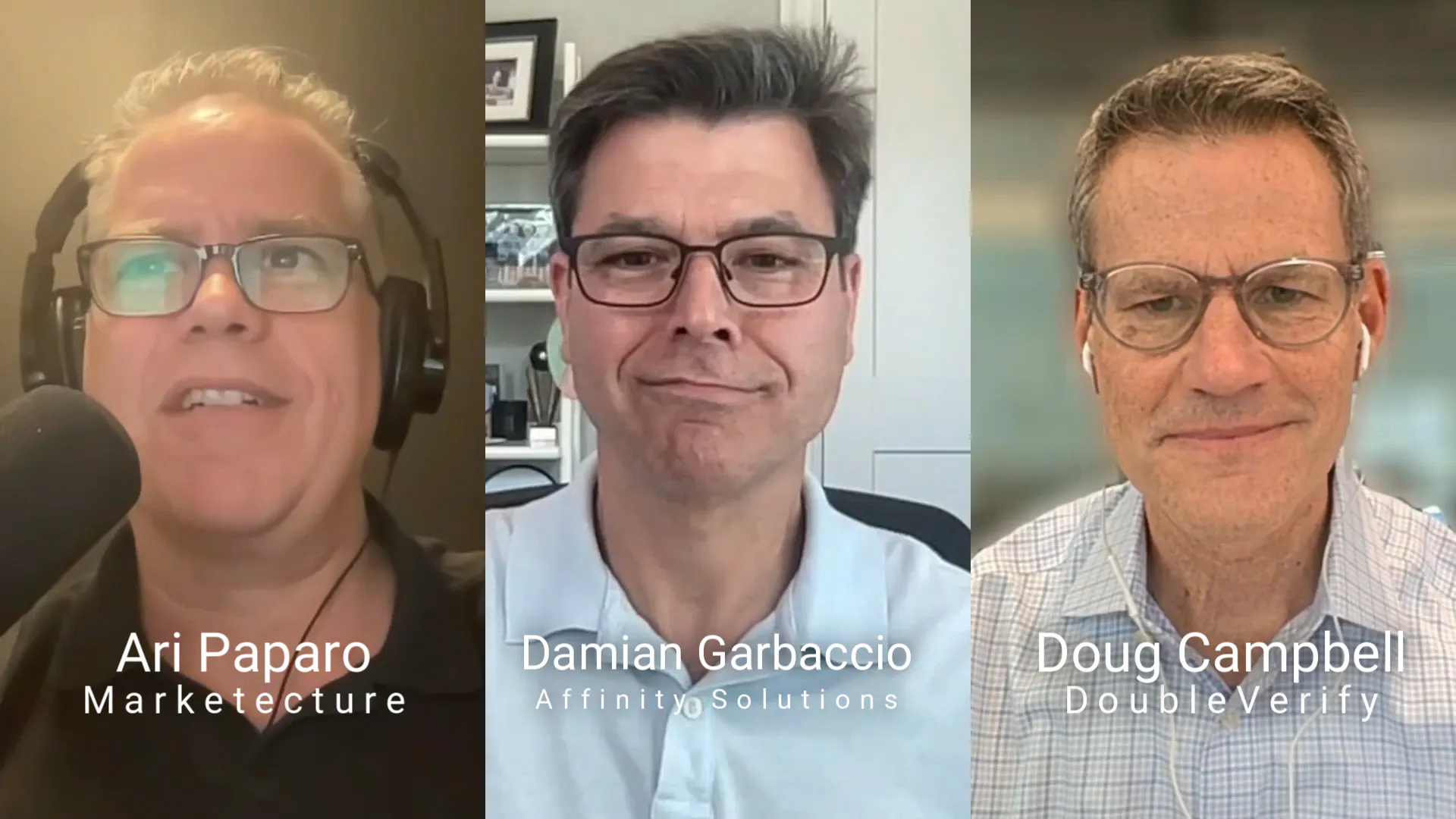
Marketecture: Get Smart. Fast.
Damian Garbaccio and Doug Campbell on Affinity's Outcomes Marketing Council
00:18:54
Loading summary
Transcript59 lines
- [00:00]
A
Foreign.
- [00:10]
B
Welcome to Market Tech, where you can get smart fast with in depth interviews of leading executives. I'm Ari Paparo. I'm here today with two guests. We have Damien Garbaccio, the Chief Commercial and Marketing Officer for Affinity Solutions. Damian, Did I, did I mangle your last name?
- [00:27]
C
No, that was perfect.
- [00:28]
B
That was good. Okay. And Doug Campbell, the Chief strategy officer for DoubleVerify. I think I got your name right, Doug. So why do we have two guests? What are we here to talk about? Well, there's a new thing in town. It's called the Affinity Solutions Outcome Marketing Council. A little bit of a mouthful. And it's described to me as a collaborative forum of marketing and advertising leaders focused on advancing accountability and media measurement. And they just came out with a report, so that's what we want to talk about. So Damian, you want to tell us what this is all.
- [00:59]
A
Yeah, well, happily, and maybe it's just a function of my age. I, I know a lot of folks in the space have been around for a little bit and, and our work at Affinity is, is really about outcome and outcome marketing and measurement. So we thought it was a really good idea rather than just sort of talk about our own companies, but get a group of individuals together, some who have been in our space for a long time and some who have been and successful and left to really bring a group together to try to help the market, try to help the ecosystem, have better marketing outcomes and what's stopping it? What do the opportunities exist? And so it's a very sort of collaborative effort to help the market.
- [01:40]
B
Right. And so what did you publish? You published a report, Measurements Tipping Point, the Optimization blueprint for Brand Growth. Do you want to go through it or Doug, or both?
- [01:52]
A
Well, I can just outline it. Doug is a one of the significant members of the Outcome Marketing Council, so I certainly. And his input was crucial here. But essentially we did a survey specifically to talk to brands and their agencies. It was like 80% brands and understand their point of view, what's working, what's not around measurement. Everyone's using outcomes and optimization and all these words that hopefully have meaning. But we kind of dug in a little and realized that there was a lot of gaps and there's a lot of ways to improve and that's our goal, is to help improve. And certainly Doug had a perspective, so I'll hand it off to him.
- [02:33]
C
Yeah, sure. I mean, you know, from my perspective, look, after all these years, it's still pretty difficult to connect ad exposure to actual purchase data and certainly very Difficult to do it in real time for both measurement and for optimization. And so we went out and we wanted to find out, you know, what, what people thought about this exact topic, what, what they're currently doing and what they will and what the, the best people, the people that are, they're kind of, you know, really trying to lead this, this space are doing. And our goal was just to bring a little bit of data and, and increase kind of the focus on. On improving that connection.
- [03:11]
B
What are the headlines? What'd you find out?
- [03:13]
C
So, a whole bunch of things. First, you want me to start?
- [03:18]
B
You can tell I'm not, I'm not used to doing these two people podcast. I'm working on it. So, Doug, why don't you start?
- [03:26]
C
Okay, sure. Look, at a very high level, the big takeaway was that 91% of marketers believe that their kind of platform reported results are overstated in some way. And so probably not that hard to believe that in a world where there's sort of a lack of transparency and some obfuscation about what's going on along all platforms, that there is still a very large portion of marketers that don't know or don't believe exactly the numbers that they get. Sure.
- [04:06]
B
And platform we're talking about the. Like you run on meta, you run on YouTube and they tell you whether it worked or not. That's what we're talking about.
- [04:13]
C
Yes, that's right. Yeah, that's right. And it's also, it's. But it's all platforms. Right. So it's not just those two.
- [04:19]
B
No, no, of course not. A platform in. No, we're not saying that they're not accurate, those platforms. We're saying that brands don't trust them. That's what we're saying. Right?
- [04:29]
C
Correct.
- [04:30]
A
Correct.
- [04:30]
B
And David, do you find this surprising or this is expected?
- [04:34]
A
Well, I think it's somewhat par for the course. You know, I was, I was joking around that 91's high. I. I want to.
- [04:41]
B
It is. That is high.
- [04:44]
A
I want to catch that 9% and see if they just click the wrong button on the survey.
- [04:48]
B
Right.
- [04:48]
A
But I, you know, one of the. Those percentages, 4 out of 5 is another example that we use before of brands sort of not using some of the optimal data that exists. I think there's. Not that we don't know this, but there's a reinforcement that there's a fundamental issue and distrust. I don't think, I don't think it comes off as it's. People are deceiving you or Being dishonest. But I think there is an inherent biasness that happens and I think folks are aware of it. It's what can you do with that and how do you adjust it and change it and how do you change the, you know, tire while you're driving the car of, of getting your brand out there? It's tough.
- [05:29]
B
Yeah. So what stood in the way of marketers, you know, adopting other measurement solutions? Because there are a lot out there. Doug, do you want to kind of talk to what you're hearing there?
- [05:41]
C
Yeah, sure. And let me start, you know, by saying, you know, obviously this is the outcomes council, so you know, we're going to talk a, about, you know, actual sales outcomes as being kind of a primary driver of what we think you should use inside of optimization in order to build those outcomes. But taking a step back, like, you know, proxy measurements and metrics are not bad either. They're very convenient, they're fast. You know, many, many marketers kind of settle for those. I think what we were trying to focus on in the surve was that, you know, it's very important that you use really strong data and really in real time optimization in order to help drive real sales outcomes. And I think, you know, ultimately that's, that's, that's sort of what we see as sort of the, the ultimate goal. And whether you're kind of a performance advertiser at sort of the bottom of the funnel or you're a brand advertiser at the top of the funnel, the ultimate goal is to get sales of some sort or be, you know, build a brand of some sort. And I think what we're trying to kind of, you know, get to is, all right, how do we find out how to do that, who's leading that and what are they doing to make that effective?
- [07:04]
B
Right. So real sales outcomes. So you would think if someone, you know, rings up the cash register, that's the, that's what you want to use as your outcome. Right. But a lot of people don't do that. They use proxy metrics of some kind. How does that end up shaking out?
- [07:22]
A
Well, you know, that's, that is literally one of the key themes of the study. And a couple of things are barriers to that happening. Some of which are just structural, infrastructural, technical ways that that data, you know, how a bill becomes a law of that data getting used in optimization and also organizational will of, of, of particular brands, agencies, platforms putting the muscle towards doing it. But in general, it's one of those things where if we say we want, and to Doug's point of an outcome, if we want a true outcome, the best proxy for a purchase is a purchase. So if you have direct credit and debit card purchase data, or like you said, the cash register POS data, and that can be used within the system we have, that is ideal. And what we've seen is the barriers that folks have called out is one, there's a speed issue. People need to prove things out right away, and it's not, as always, easy. Also, there's a, again, a piping in a structural issue that is a barrier. I think that is if you don't want to tout outcomes, then you don't have to do those things. But if you want to tout outcomes, you need to figure out a way for this to work. And I think what we saw was some of those folks or some of the respondents are very interested in that happening. I think we as an industry need to make it easier for that to happen.
- [08:51]
B
Yeah. And I think that that's where some of the distrust of platform metrics come in, because a platform will say, you sold 100 widgets, and you look at your cash register and you only sold 90. And that's a big mystery.
- [09:03]
A
Yep. Who stole those 10 widgets?
- [09:05]
C
I don't know.
- [09:07]
B
And then someone else said, you sold 90 widgets, now you're sold 180.
- [09:13]
C
The real. That's right. That's the real problem.
- [09:15]
B
And what about speed? So speed of getting the data and then speed of using it for optimization, you know, how. How big of a problem is that? Maybe, Doug, you want to jump into that?
- [09:27]
C
Yeah, sure. I mean, you know, when we, when we look at what marketers told us in the survey in order to kind of improve the ability to. To do this, you know, there were a couple of big things. It was shorten the data path. So that just means fewer steps between, you know, the data that you have, you know, at the cash register at some transaction and then back into the system itself. And today, of course, you know, we have lots of hops. You have matching hops, you have direct data hops, you have first party data, clean room hops, you have all kinds of hops. And so one of the things that the survey brought to bear was the fewer the number of hops. So the more direct a connection you can make into your optimization, the better. And then, you know, you need to use quality data. So, you know, this is another part. So not only is it the. The ability to kind of get back into the system, but it's also you have to use high quality data and high quality data can, can be first party data, can be third party data, can cost.
- [10:28]
B
Right.
- [10:29]
C
You know, a fair amount of money or it can be really difficult to put together in a way that optimization systems can use. And then the last part is you should obviously, and we believe in this very wholeheartedly, you should have a third party doing the measurement. You shouldn't have the platform itself during the measurement.
- [10:46]
B
Yeah. How much do you think is of waste or inefficiency is there based on some of these challenges? Damien, do you have some thoughts about that?
- [10:57]
A
Yeah, I think some of the survey results bear that. I think it's, there's a, there's a percentage. I don't know if it was 11 or more.
- [11:06]
C
11%. Yeah, that's right.
- [11:08]
A
What is it?
- [11:09]
C
11%?
- [11:09]
A
Yeah, 11%. So I think there's no doubt again going back to like the overall macro sentiment and, and respondent data is there's no doubt that there is waste. How much is TBD because of the, the sort of complex way that it's getting measured today and cost of, of the actual data that you' outcome data to, to use that. So but there is a, again there was some specifically on the percentage of waste but to the extent we're not sure and I don't think anyone is sure but it's again, it's not like we don't, we think people are robbing and it's not trust but there's, there's an opinion that is that the platform is potentially a bias. There's also a huge waste conundrum but no one knows really how to put their finger on it and say it's X, Y or Z. And also just to add to this, there was a lot of feedback in the survey around that it requires you to use when you're doing all these things that we're talking about like so easily that you could do or not easily but that everyone wants to. It takes a fair amount of organizational muster and change because you've been working off of a system, so to speak and reporting to your company and reporting to marketing that has existed for a while. So there's inertia, there's a, so in order to sort of take that up, even if it's better, there's going to be some disruption.
- [12:40]
B
Got it. Yeah. So let's flip it. We've been talking about all these problems and negatives. What, what are, what's the best practice in terms of using real verified purchasing Data and doing it quickly, etc. What are you seeing, Damien?
- [12:52]
A
Well, the, the fact, and this is, and by the way, there is more positive, I think out there and you know, when you get a lot of brands and agencies together for some questions, I think especially if they're anonymous, they're going to vent a little. But the, the really good news is there is a huge percentage of folks who have the willingness and the desire to do it. I think they're waiting for it to be a slightly easier, meaning that organizational change, that sort of structural change. Secondly, that they're aware that verified true set, I.e. actual credit, debit or other purchase data exists. So the fact that they're willing to do it and they know it exists out in the market, they are starting to plan for. You know, maybe we talk about outcomes years before we can actually do some of the exact outcomes we're talking about, but there is this momentum towards doing that because the assets, the variables in that equation do exist today more than they did several years ago, right?
- [13:51]
B
Yeah. I mean if you go back five years or 10 years, a lot of this stuff was science fiction. You know, like real time feeds of conversions into multiple systems. Like no one was doing any of that. So, so now looking forward, everyone's thinking AI solves all their problems. You know, it doesn't have to be accurate. The AI will figure it out. Is it, is this a garbage in, garbage out problem? Maybe? Doug, you want to start with that one?
- [14:14]
C
Yeah, I mean, look, I think, you know, look, I think models getting better is, is a good thing. So let's, let's start there. Like, I do think that that's an important part of the evolution of, of, of the systems. But it is definitely, there's no question that it's the data that makes a big difference in that, in that equation. So if you have, you know, as I said before, very solid conversion data into a system, you know, whatever model you have that will create better outcomes as we move forward for the future. There's no question about it. And that was reaffirmed as sort of you went through some of the best practices that marketers, you know, talked about in the survey.
- [14:53]
B
Yeah. And Damian, what's your perspective on this problem?
- [14:58]
A
Very similar that the AI optimization and I say that more than outcomes, the AI optimization benefit will help significantly. Meaning at least now in terms of some of the belief of the respondents and some of our industry and outcome council members is that it needs to be quality data going in. To your point, I think there is a lot of a. It doesn't matter what goes in, AI will fix it. I think there is a general starting to be belief that AI is going to feed off of that great data. But I think the, the very positive and, and beneficial at least hope is that that positive, beneficial data into AI will help optimization, not just post campaign outcomes, meaning it'll help improve while it's going, it'll be iterative and that will be hopefully a barrier to some of the structural problems. So you're not even sort of waiting months or even weeks or even days. You are optimizing in flight. So it's sort of outcomes in flight, so to speak. And that's what there's a belief that AI is going to help with. We hope to see that.
- [16:07]
B
Right. And sort of to wrap it up. Doug, what are the couple of things that you would say to CMOs who are in this 90% of kind of skepticism and have, have these questions about accuracy? What's your advice?
- [16:23]
C
Yeah, I think, you know, it's a couple of things. So first is, you know, again look at the, you know, your current practices and, and, and again, you know, third party measurement is important. Second is try to shorten the path between, you know, conversion and optimization. And kind of no matter what models you're using, how you're using AI or what platform you're using, this is an important part. And then using real deterministic data that is of high quality will help ultimately build a better model and a better outcome through the optimization. And I guess that leads me to you, Damian.
- [17:02]
A
Yeah, well of course being on the same council and of like mindedness, I agree. However, additionally I think that CMOs are increasingly given the responsibility of interacting sometimes much more with the CFO and acting often like a CFO and having commercial responsibility. So I think that is driving the need to have verified outcomes be part of your skill set and part of the output of your return on AD spend. So I think that's very important and I think there is that momentum and I think it's very much about organizational will. As I've mentioned, you really have to be sort of a proponent and sell internally as well as externally. But the last message I'll leave with, by no means is this battle lost. There is an opportunity to be great here and to be innovative. So no one's super far behind at all and there's a lot of opportunity ahead.
- [18:07]
B
Doug, you're like you fell off the side of the boat there for a second.
- [18:11]
C
Yeah, exactly. I don't know what happened.
- [18:13]
B
We'll cut that stool.
- [18:14]
C
That's fine.
- [18:16]
B
All right. I always. I always end in one question. It's a little bit awkward in this case, but, like. I'll ask Damien. So if this council was an animal, what animal would it be?
- [18:24]
A
A lion.
- [18:26]
B
All right, lion, always a good one. Lions a standby. All right. The Affinity Solutions Outcome Marketing Council. You can get its report tipping point, I assume, on the affinity website. So thank you, Damien and Doug, for coming on on the show.
- [18:40]
C
All right, thank you, thank you.