Podcast
Marketing Science Lab
Hosted by Decoding the science of digital persuasion. · EN
Welcome to the Marketing Science Lab, where data meets strategy. Join us as we dissect the latest marketing research, uncovering the science behind consumer behavior and effective campaigns. We translate complex studies into actionable insights, empowering you to make informed decisions and achieve measurable results.
www.marketingsciencelab.org
www.marketingsciencelab.org
20episodes
Episodes
Newest firstAll episodes
The Science Behind Last-Minute Holiday Shopping: Why Limited-Time Deals and Credit Cards Make Us Spend More
Dec 15, 202400:08:34Tap to summarizeSource: Kathuria, A. and Bakshi, A. (2024), "Unveiling the dynamics that shape online impulse buying behavior", Journal of Research in Interactive Marketing, https://doi.org/10.1108/JRIM-03-2024-0147With Christmas just around the corner, many of us find ourselves caught in the whirlwind of last-minute holiday shopping. But have you ever wondered why those "Limited Time Only!" deals are so hard to resist, especially when you have a credit card in hand? Recent research from the Thapar Institute sheds light on this fascinating phenomenon, revealing the psychology behind our online impulse buying behaviors.The Perfect Storm: Time Pressure and Easy PaymentThe holiday season creates what researchers call a "perfect storm" for impulse purchases. When retailers combine limited-time offers with convenient payment options, they tap into powerful psychological triggers that influence our shopping behavior.Why Limited-Time Deals Work So WellPicture this: You're browsing for a gift when you spot a "Next 2 Hours Only!" deal on that perfect item. Your heart rate increases slightly, and before you know it, you're hitting the "Buy Now" button. This reaction isn't just coincidence – it's science. The research reveals that limited-time deals trigger two crucial responses:* An immediate sense of urgency* Fear of missing out (FOMO)These psychological triggers effectively bypass our normal decision-making process, leading to more spontaneous purchases.The Credit Card EffectEver noticed how much easier it is to spend when using a credit card? The research confirms this isn't just perception. Credit cards significantly reduce what researchers call the "pain of payment," making us more likely to make impulsive purchases.The Role of Pleasure in ShoppingPerhaps the most interesting finding is how hedonic motivation – the pleasure we get from shopping – acts as a crucial bridge between marketing tactics and our buying decisions. This pleasure-seeking aspect becomes even more pronounced during the holiday season, when shopping carries additional emotional weight.What This Means for MarketersEffective Strategies:* Strategic timing of limited-time deals* Clear visibility of countdown timers* Prominent display of credit card benefits* Mobile-optimized shopping experiencesResponsible Marketing:* Implementation of spending alerts* Educational resources about financial management* Cool-off periods for large purchasesTips for Mindful Holiday ShoppingWhile these marketing tactics are powerful, understanding them can help us make more conscious shopping decisions:* Set a holiday budget before browsing* Use spending alerts on your credit cards* Take a "cooling off" period before making large purchases* Be aware of how limited-time deals affect your emotionsThe Future of Online ShoppingAs e-commerce continues to evolve, understanding these psychological triggers becomes increasingly important for both retailers and consumers. The key lies in finding the balance between effective marketing and responsible consumption.Whether you're a marketer implementing these strategies or a consumer navigating holiday deals, awareness of these psychological mechanisms can lead to better decisions. After all, the best shopping experiences happen when both retailers and customers win. Remember, while the allure of limited-time deals and the convenience of credit cards can make holiday shopping easier, understanding the science behind these marketing tactics helps us maintain control over our purchasing decisions. Happy mindful shopping! This is a public episode. If you would like to discuss this with other subscribers or get access to bonus episodes, visit www.marketingsciencelab.org
Transcribe →
Star Power vs. Search Power: The Spotify Playlist Showdown
Dec 8, 202400:09:48Tap to summarizeSource: Max J. Pachali, Hannes Datta (2024) What Drives Demand for Playlists on Spotify?. Marketing Science 0(0). https://doi.org/10.1287/mksc.2022.0273Full Show Notes: https://www.marketingsciencelab.org/p/star-power-vs-search-power-the-spotifyIn the ever-evolving landscape of music streaming, playlists have become a crucial battleground for artists, labels, and platforms alike. A groundbreaking study published in Marketing Science has revealed fascinating insights into what drives demand for playlists on Spotify, with implications that could reshape our understanding of music discovery and promotion in the digital age.The Research: Unpacking Playlist PopularityResearchers Max J. Pachali and Hannes Datta from Tilburg University set out to answer a critical question: What makes some playlists more successful than others on Spotify? Their study, which analyzed data from over 30,000 popular playlists across 66 music categories, compared two main drivers of playlist demand:* Being featured on Spotify's Search Page* Adding songs by exceptionally popular major label artists to playlistsThe findings are nothing short of revolutionary for the music industry.Key Discoveries: The Platform's Power PlayThe Featuring EffectThe study found that being featured on Spotify's Search Page increases a playlist's daily followers by a staggering 0.95% on average. To put this into perspective, for a large playlist like "Reggaeton Classic" with 1.9 million followers, being featured could result in approximately 18,050 additional followers in a single day.The Superstar EffectIn comparison, adding at least one track by a major label superstar artist increases daily followers by 0.45% on average. While still significant, this is less than half the impact of being featured on the Search Page.Implications for the Music Industry1. Platform PowerThese findings underscore Spotify's significant ability to guide user attention through its Search Page. This supports concerns that the platform can potentially favor certain content producers over others, reshaping the dynamics of music discovery.2. Value of SuperstarsWhile not as impactful as being featured, superstar artists still play an important role in attracting followers to playlists. This suggests they remain a valuable asset for major music labels, albeit with diminished influence compared to platform featuring.3. Shifting DynamicsThe research implies that Spotify holds significant power in driving playlist success, potentially even more than the major labels do through their superstar artists. This could shift the dynamics in negotiations between Spotify and the labels, impacting discussions around royalties and revenue sharing.What This Means for Marketers and Musicians* Platform Optimization: For marketers and artists, understanding and leveraging Spotify's featuring mechanisms becomes crucial. Strategies to increase the likelihood of being featured on the Search Page could yield significant returns.* Superstar Collaborations: While less impactful than platform featuring, collaborations with major label superstars still provide a notable boost to playlist followers. This remains a viable strategy for playlist growth.* Diversified Approach: The most effective strategy likely combines efforts to secure platform featuring while also incorporating popular artists. This dual approach maximizes potential for playlist growth.* Data-Driven Decision Making: The study underscores the importance of data analysis in music marketing. Understanding the specific impacts of different strategies allows for more targeted and effective promotional efforts.The Bigger Picture: Evolving Music EcosystemThis research highlights the complex ecosystem of music streaming and the various factors at play in determining what reaches listeners' ears. It's a stark reminder of how technology continues to shape the music industry and consumer behavior.As platforms like Spotify gain more influence over music discovery, we may see further shifts in how music is created, promoted, and consumed. This could lead to new opportunities for emerging artists and innovative marketing strategies, but also raises questions about fair competition and the future of artistic diversity in the streaming age. This is a public episode. If you would like to discuss this with other subscribers or get access to bonus episodes, visit www.marketingsciencelab.org
Transcribe →
When Black Friday Goes Digital: Understanding the Evolution of Shopping Behavior
Nov 30, 202400:12:36Tap to summarizeSource: Lee, J., Kim, M., & Lennon, S. J. (2024). Black Friday shopping has moved online. Has BF misbehavior followed? Journal of Global Fashion Marketing, 1–19. https://doi.org/10.1080/20932685.2024.2417301 The shift in Black Friday shopping from physical stores to digital platforms has brought new challenges and opportunities for both retailers and consumers. This research provides valuable insights into how consumer behavior has adapted to the online environment.The Digital TransformationBlack Friday shopping has undergone a dramatic transformation, with 90.6 million people choosing to shop online compared to 76.2 million shopping in stores during 2023. Online spending reached a record $9.8 billion, marking a 7.5% increase from 2022.Understanding Consumer BehaviorEmotional ResponsesThe research reveals that perceived unfairness during online shopping directly triggers negative emotions, which can lead to retaliatory behaviors[1]. These emotional responses are particularly important during high-stress shopping events like Black Friday.Retaliatory BehaviorsTwo main types of retaliatory behaviors emerge in the online environment:* Exit behavior (switching to other retailers)* Revenge behavior (actions aimed at harming the retailer's reputation)Gender DifferencesThe study found significant variations in how men and women respond to online shopping frustrations. Men tend to exhibit more extreme responses and are more prone to retaliatory behavior compared to women, who typically opt for more measured responses.Practical ApplicationsFor Retailers* Implement clear inventory updates* Provide transparent pricing* Maintain consistent communication* Offer immediate alternatives for stockouts* Develop gender-specific response strategiesFor Consumers* Recognize emotional triggers during online shopping* Consider long-term satisfaction before making retaliatory decisions* Communicate concerns directly with retailers* Have backup options ready for desired itemsFuture ImplicationsThe research suggests that as online shopping continues to grow, retailers must adapt their strategies to:* Manage perceived inequity* Handle stockout situations effectively* Develop targeted approaches for different consumer segments* Build long-term customer relationships through transparent practicesThis transformation in Black Friday shopping behavior represents a significant shift in retail dynamics, requiring both retailers and consumers to adapt to new digital realities while maintaining positive shopping experiences. This is a public episode. If you would like to discuss this with other subscribers or get access to bonus episodes, visit www.marketingsciencelab.org
Transcribe →
The Psychology of Ad Skipping: How Personality Shapes Viewer Behavior
Nov 24, 202400:09:43Tap to summarizeSource:Dharba, S., Gandhi, S., Torres, I. M., Madadi, R., & Zúñiga, M. Á. (2024). Secrets to why consumers skip ads: The moderating role of personality traits. Journal of Marketing Communications, 1–28. https://doi.org/10.1080/13527266.2024.2428946In today's digital age, online video advertising has become a cornerstone of marketing strategies. Yet, as advertisers strive to capture audience attention, they face a growing challenge: ad skipping. A recent study published in the Journal of Marketing Communications sheds light on this phenomenon, exploring the intricate relationship between personality traits and ad-skipping behavior.The Rise of Ad SkippingWith platforms like YouTube boasting nearly 2 billion monthly logged-in users, the potential reach for advertisers is immense. However, the prevalence of ad-skipping options has transformed the advertising landscape. Viewers, bombarded with content, often perceive ads as intrusive or irrelevant, leading to increased ad avoidance.The Role of PersonalityThe study introduces a fascinating perspective by examining how the Big Five personality traits - extraversion, agreeableness, conscientiousness, neuroticism, and openness to experience - influence ad perception and skipping behavior.Key Findings:* Extraversion: Individuals high in extraversion tend to perceive ads as more relevant and engaging. Their sociable nature makes them more receptive to ads as opportunities for social engagement or cognitive stimulation.* Agreeableness: Those high in agreeableness are more likely to view ads as relevant and less intrusive. Their tendency towards harmony and cooperation translates into a greater acceptance of ads that align with their values.* Conscientiousness and Neuroticism: These traits were found to intensify the negative effects of perceived irrelevance and intrusiveness on ad avoidance behaviors.Implications for MarketersUnderstanding these personality-driven responses opens new avenues for targeted advertising:* Personalization is Key: Tailoring ad content to align with different personality types can significantly reduce skipping behavior.* Content Strategy: For extraverted audiences, create ads that feel like social interactions. For agreeable viewers, focus on ads that emphasize community values and social good.* Timing and Placement: Consider the context of ad placement, especially for highly conscientious individuals who may be more sensitive to interruptions.* Softer Approaches: For audiences that skew towards neuroticism, consider less intrusive ad formats or native advertising techniques.The Future of AdvertisingAs we move forward, the ability to understand and adapt to individual personality differences will become crucial in creating effective advertising strategies. By leveraging these insights, marketers can craft more engaging, relevant, and personality-tailored campaigns that resonate with viewers on a deeper level.The study on ad skipping behavior and personality traits offers a new lens through which to view and approach online advertising. As the digital landscape continues to evolve, so too must our strategies for engaging audiences. By considering the psychological underpinnings of ad reception, marketers can create more effective, personalized, and ultimately more successful advertising campaigns. This is a public episode. If you would like to discuss this with other subscribers or get access to bonus episodes, visit www.marketingsciencelab.org
Transcribe →
The Hidden Link Between Loneliness and Clutter: Insights for the Holiday Season
Nov 17, 202400:12:43Tap to summarizeSource:Hu, B., Cole, C., & Wang, J. (2024). How loneliness affects consumers' reluctance to let go of used possessions. Psychology & Marketing, 1–15. https://doi.org/10.1002/mar.22117As the holiday season approaches, many of us find ourselves surrounded by an ever-growing collection of possessions. The global explosion in self-storage units over the last decade is a testament to our struggle with letting go. But what if there's more to our attachment to stuff than meets the eye? Recent research published in Psychology & Marketing (2024) sheds light on a surprising connection between loneliness and our reluctance to part with possessions. Let's dive into these findings and explore how they can inform our approach to decluttering and gift-giving this holiday season.The Loneliness-Clutter ConnectionThe study reveals a counterintuitive truth: lonely individuals are less willing to dispose of items they no longer use, even if these items could benefit others. This reluctance stems from a heightened attachment to material possessions, which lonely people may use as a substitute for interpersonal relationships. It's as if our belongings become silent companions, filling the void left by a lack of social connection.Key Findings:* Loneliness increases attachment to possessions, making it harder to let go.* This effect is stronger for self-purchased items than for gifts.* Lonely individuals may use possessions as a coping mechanism for lack of social connection.The Gift ParadoxInterestingly, the study found that lonely individuals are more likely to dispose of gifts compared to non-lonely people. This suggests that gifts might serve as reminders of unsatisfactory or ended relationships for those experiencing loneliness. It's a poignant reminder of the complex emotional landscape we navigate when it comes to our possessions.Practical Implications for the Holiday Season:* Mindful Decluttering: When helping someone declutter, be aware of the potential emotional attachments to items, especially if the person might be experiencing loneliness.* Social Decluttering: Consider organizing group decluttering activities. This combines the act of letting go with social interaction, potentially making it easier for lonely individuals to part with items.* Thoughtful Gift-Giving: Opt for experiential gifts or consumables. These create memories without adding to physical clutter and may be easier for the recipient to enjoy without forming strong attachments.* The "Take a Picture" Strategy: For sentimental items that are hard to part with, try photographing them before disposing. This preserves the memory without keeping the physical object.* Gratitude Practice: Incorporate gratitude exercises into your decluttering process. This can help shift focus from material possessions to intangible values and relationships.Implications for Marketers and Businesses* Empathetic Marketing: Secondhand marketplaces could create campaigns that acknowledge the emotional aspect of letting go while emphasizing the benefits of decluttering.* Trained Decluttering Services: Professional organizers could benefit from training in the psychological aspects of attachment to possessions, allowing them to provide more empathetic support.* Meaningful Donation Campaigns: Charities could highlight how donated items create new connections, appealing to people's desire for social impact.* Innovative Product Design: Home organization companies could develop products designed to help manage sentimental items more effectively.As we navigate the holiday season, understanding the link between loneliness and our attachment to possessions offers valuable insights. It allows us to approach decluttering, gift-giving, and consumption with greater empathy and mindfulness. Remember, the true value of possessions often lies in the memories and connections they represent, not in the items themselves.This holiday season, let's focus on creating meaningful connections and experiences. By being aware of the psychological factors influencing our relationship with possessions, we can make more intentional choices about what we keep, what we give, and ultimately, what truly adds value to our lives.Call to ActionAs you prepare for the holidays, take a moment to reflect on your own relationship with your possessions. Are there items you're holding onto out of loneliness rather than necessity or joy? Consider trying one of the strategies mentioned above, like organizing a decluttering party with friends or opting for experiential gifts this year. Share your experiences in the comments below – your insights could help others navigate their own decluttering journeys.Remember, sometimes letting go of possessions can mean making room for new experiences and connections. Here's to a holiday season filled with meaningful relationships, cherished memories, and just the right amount of stuff! This is a public episode. If you would like to discuss this with other subscribers or get access to bonus episodes, visit www.marketingsciencelab.org
Transcribe →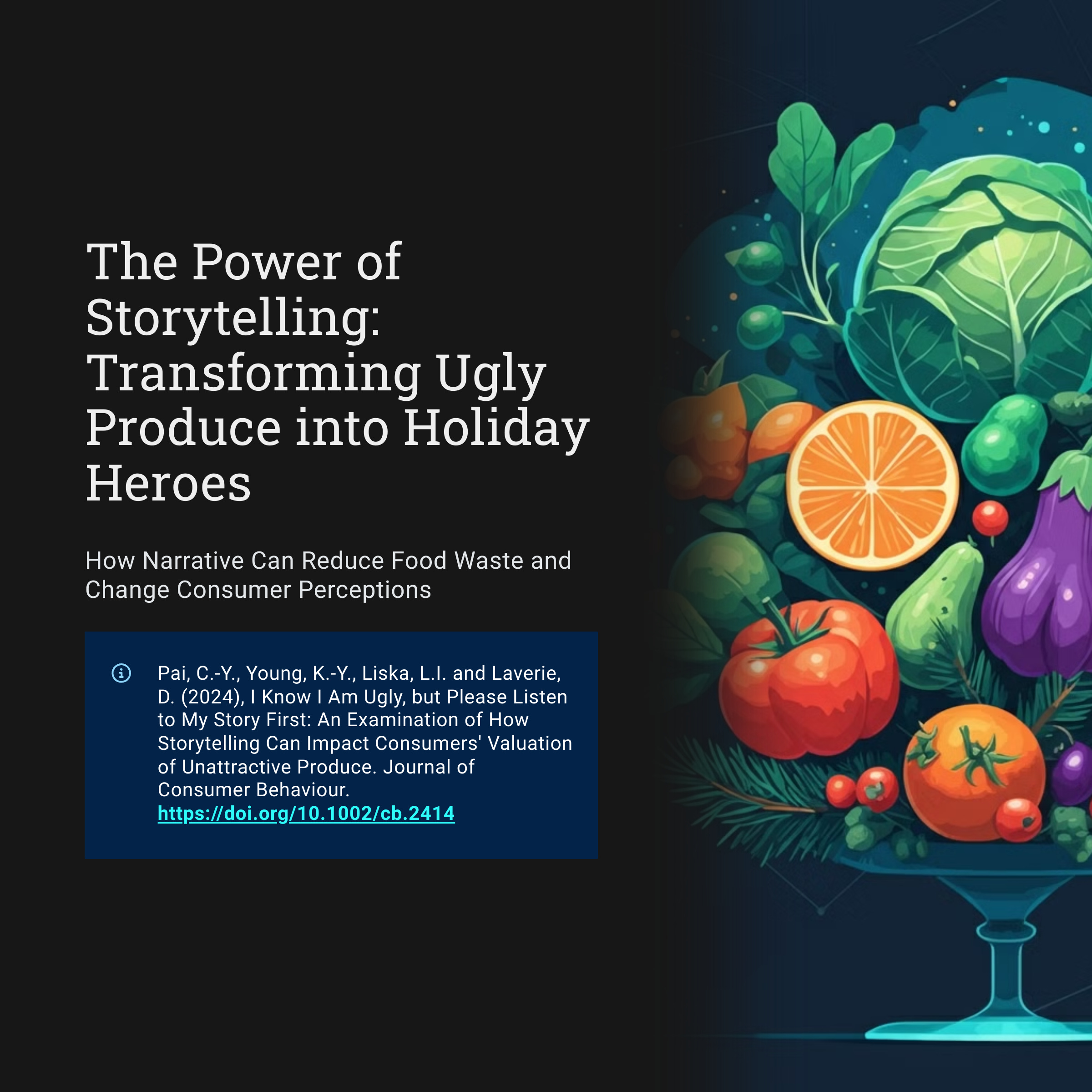
The Beauty of Ugly Produce: How Storytelling Can Reduce Food Waste This Holiday Season
Nov 10, 202400:10:26Tap to summarizeSource:Pai, C.-Y., Young, K.-Y., Liska, L.I. and Laverie, D. (2024), I Know I Am Ugly, but Please Listen to My Story First: An Examination of How Storytelling Can Impact Consumers' Valuation of Unattractive Produce. Journal of Consumer Behaviour. https://doi.org/10.1002/cb.2414| Full episode notes: https://www.marketingsciencelab.org/p/ugly-produce-storytelling-reduce-food-waste-holidaysAs we approach the holiday season, a time of abundance and celebration, it's easy to overlook a growing problem: food waste. Did you know that during the holidays, food waste in the United States increases by a staggering 25%? This shocking statistic highlights the need for innovative solutions to combat this issue. At the Marketing Science Lab, we've uncovered a fascinating approach that could help address this problem: using storytelling to change consumer perceptions of "ugly" or unattractive produce.The Ugly Truth About Food WasteBefore we dive into the solution, let's consider the scale of the problem. According to the United Nations, around 30% of global food is lost or wasted at farms, retail stores, or households. During the holidays, this issue becomes even more pronounced. Think about all those slightly bruised apples or oddly shaped potatoes that might get passed over for the picture-perfect produce in our holiday meals.The Root of the ProblemConsumers have become accustomed to seeing only aesthetically pleasing fruits and vegetables in stores, leading to cognitive biases against "ugly" produce. We tend to associate visual perfection with quality and taste, often rejecting perfectly edible food simply because it doesn't look "pretty" enough.The Power of StorytellingRecent research titled "I Know I Am Ugly, but Please Listen to My Story First: An Examination of How Storytelling Can Impact Consumers' Valuation of Unattractive Produce" by Chu-Yen Pai and colleagues (2024) offers an innovative solution to this problem. The study found that combining storytelling with marketing tactics, such as coupons, significantly increased consumers' willingness to purchase and consume unattractive produce.How Does It Work?Imagine you're at a grocery store during the holiday season, and you see a bin of misshapen apples. Instead of just a price tag, there's a small sign that tells the story of the apple orchard. It might read:"These unique apples are the result of an unusually warm fall at the Johnson Family Orchard. While they may look different, their flavor is just as sweet and crisp as their picture-perfect cousins. By choosing these apples, you're supporting local farmers and reducing food waste this holiday season."This simple story changes the narrative around these "ugly" apples. It's no longer just about appearance; it's about supporting local farmers, reducing waste, and still getting a delicious product.The Science Behind the StoryThe research showed that storytelling can enhance consumers' perceived taste of unattractive produce, which in turn increases their likelihood of purchasing it. It's about changing the narrative around these foods and appealing to consumers' values and emotions.Practical Applications for the Holiday SeasonRetailers could create themed storytelling campaigns for the holiday season. For example, they could have a "12 Days of Ugly Produce" promotion, where each day features a different unattractive fruit or vegetable with its unique story. Day one could be "Rudolph's Red-Nosed Tomatoes" for a holiday salsa, or "Frosty's Misshapen Potatoes" for the perfect mashed potatoes.Combining storytelling with other marketing tactics, like coupons, was found to be particularly effective. So retailers could offer a "buy two, get one free" deal on these featured items, making it even more appealing for consumers to try these "ugly" but delicious options.What Can You Do?As consumers, we have the power to make a difference. This holiday season, challenge yourself to seek out and purchase at least one piece of "ugly" produce each week. Not only will you be helping to reduce food waste, but you might also discover that those oddly shaped carrots make the best holiday side dish you've ever had!Share your experiences and creative uses for these items on social media using #UglyProduceBeautifulStory. You might inspire others to join the movement and make a real impact on reducing food waste this holiday season.As we celebrate the season of plenty, let's also celebrate the beauty in imperfection. By changing our perceptions and embracing "ugly" produce, we can make a significant impact on reducing food waste. Remember, every piece of produce has a story – sometimes, we just need to listen. This holiday season, let's challenge ourselves to look beyond appearances and make more sustainable choices in our food consumption.By employing storytelling techniques and being open to imperfect produce, we can all contribute to a more sustainable and less wasteful holiday season. After all, it's what's inside that counts – both in produce and in our actions towards a better world.What personally drew you to study food waste and storytelling? Was there a specific moment or experience that inspired this work?“The inspiration for this project goes back to my childhood in Taiwan. My mom would take me on what she called a “treasure hunt” at the wet market, where we’d search for odd-shaped or “ugly” fruits and vegetables. She valued these less “perfect” items, finding them more affordable and often safer, with fewer pesticides. Those experiences made a lasting impression on me, so it’s a pity to see today’s supermarkets showcasing only picture-perfect produce. Much of the imperfect produce is discarded before it reaches the shelves. This shift means we’re missing out on a valuable teaching moment, namely a chance for the next generation to understand the beauty, benefits, and value of imperfect produce firsthand.As a professor, I’ve seen the power of storytelling in engaging students, and I structure my lectures like stories to keep them connected and invested. When my co-authors and I started researching ugly produce, we found that while past studies explored many factors, they hadn’t looked at storytelling as a way to enhance consumer acceptance. We were like, why not tell consumers the stories of those ugly products? So, we designed experiments to see if storytelling could make a difference, and the results were clear. Storytelling proved to be a highly effective tool in encouraging people to embrace ugly produce.With this project, my co-authors and I are thrilled to share that marketers can utilize storytelling to reach young consumers and advocate for these so-called “ugly” fruits and veggies. It’s been incredibly meaningful to turn a personal experience into a cause that feels accessible, relatable, and genuinely impactful.”-Dr. Chu-Yen PaiAs someone who has deeply studied this topic, what personal message would you share with families about appreciating imperfect produce during the holiday season?“During the holiday season, we focus on gratitude and togetherness, and I think that spirit can extend to our food choices, too. Embracing imperfect produce is a beautiful way to appreciate the earth’s offerings. Each fruit or vegetable, regardless of its aesthetic appearance, has its own beauty and role to play, just like each of us around the holiday table. By including these in our meals, we’re not only reducing waste but also showing appreciation for the resources and effort that went into growing them. It’s a reminder that we don’t need perfect appearances to make a perfect holiday meal. It’s time to bring back the tradition of thanking and valuing each of nature’s unique offerings.”-Dr. Chu-Yen Pai This is a public episode. If you would like to discuss this with other subscribers or get access to bonus episodes, visit www.marketingsciencelab.org
Transcribe →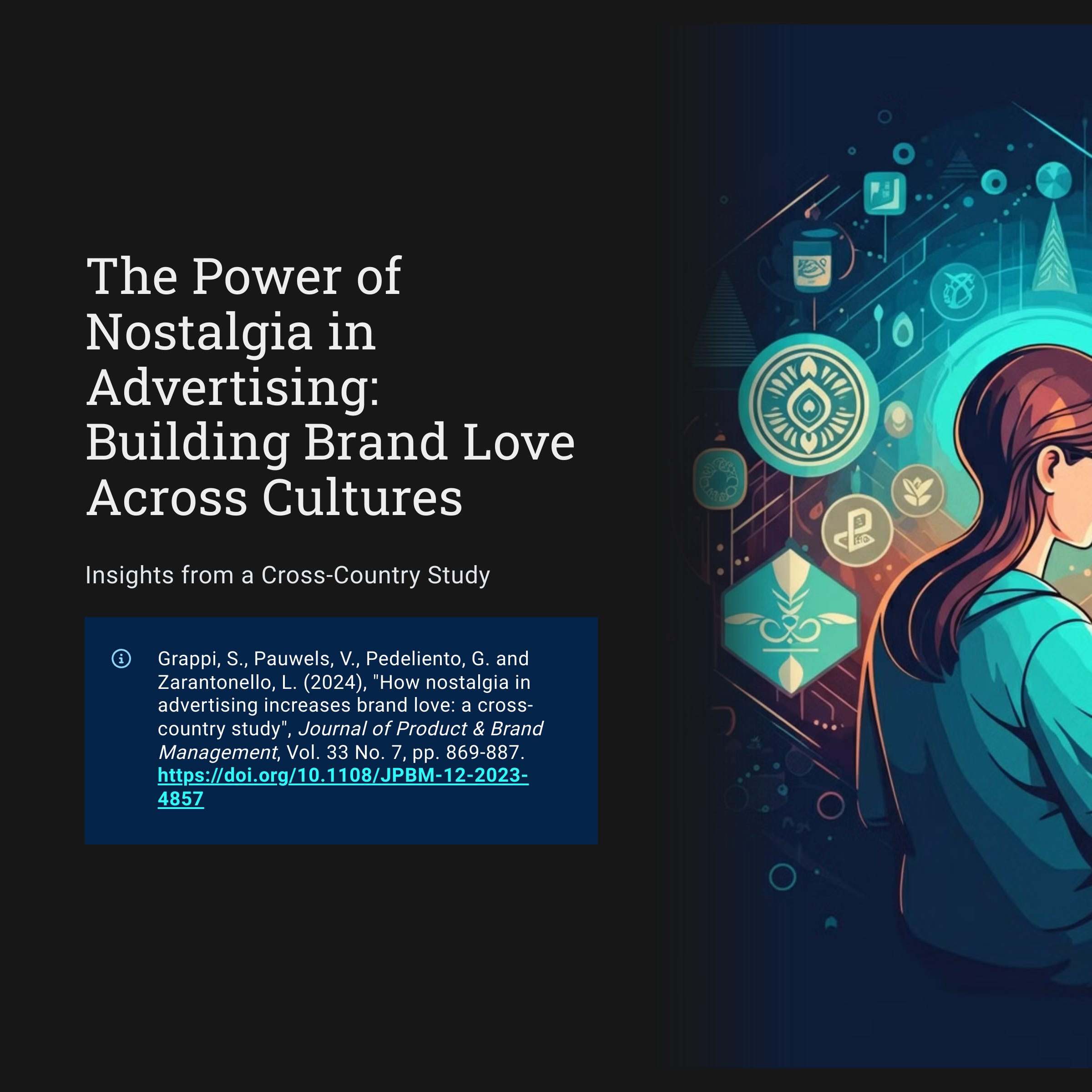
The Power of Nostalgia in Advertising: Building Brand Love Across Cultures
Nov 9, 202400:08:41Tap to summarizeSource:Grappi, S., Pauwels, V., Pedeliento, G. and Zarantonello, L. (2024), "How nostalgia in advertising increases brand love: a cross-country study", Journal of Product & Brand Management, Vol. 33 No. 7, pp. 869-887. https://doi.org/10.1108/JPBM-12-2023-4857Full show notes: https://www.marketingsciencelab.org/p/nostalgia-advertising-brand-love-cross-cultural-studyIn today's fast-paced digital world, marketers are constantly seeking innovative ways to connect with consumers on a deeper level. One strategy that has gained significant traction in recent years is nostalgic advertising. But does tugging at consumers' heartstrings with memories of the past really lead to stronger brand relationships? And does this strategy work equally well across different cultures? A recent study published in the Journal of Product & Brand Management sheds light on these questions, revealing fascinating insights into the power of nostalgia in building brand love.The Resurgence of Nostalgia in AdvertisingNostalgia in advertising isn't a new concept, but it's experiencing a significant resurgence. From Super Bowl commercials to social media campaigns, brands like Disney, Gucci, Netflix, and Coca-Cola are all tapping into the power of the past to connect with consumers. This trend has become so prominent that Advertising Week even highlighted it as one to watch.But why the sudden surge in nostalgic advertising? Researchers suggest that people tend to seek comfort in nostalgia, especially during challenging times. The recent global pandemic, for instance, has triggered an increase in emotionally charged cues in advertising, including nostalgia. By evoking fond memories of the past, brands can provide consumers with a sense of security and optimism about the future.Personal vs. Historical NostalgiaNot all nostalgic advertising is created equal. The study distinguishes between two types of nostalgia in advertising:* Personal Nostalgia: This type of advertising leverages an individual's actual past experiences.* Historical Nostalgia: This approach is associated with events that the individual did not directly experience but are part of a collective past.Both types of nostalgia imply that consumers will view the past, whether individually or collectively, as superior to the present. Advertisers can evoke these feelings using various elements such as music, jingles, and visual images.The Link Between Nostalgia and Brand LoveThe study's primary aim was to investigate whether nostalgic advertising can foster brand love - an intense emotional attachment that consumers develop for a particular brand. Brand love goes beyond simple preference or loyalty; it's characterized by passion, positive emotional connection, and even a sense of anticipated separation distress if the brand were to become unavailable.The researchers conducted a pre-test and post-test quasi-experimental study with representative samples from both a developed country (the UK) and a developing country (India). Participants were randomly exposed to ads evoking either personal nostalgia, historical nostalgia, or non-nostalgic content.Key Findings* Nostalgia Increases Brand Love: The results indicate that the use of nostalgia in advertising increases brand love in both developed and developing countries.* Cultural Differences Matter: The effectiveness of each type of nostalgia varies depending on the country:* In the UK (developed country), personal nostalgia increases brand love more than historical nostalgia.* In India (developing country), historical nostalgia was found to be more significantly related to brand love than personal nostalgia.* Cultural Context is Key: The researchers suggest that these differences might be related to cultural nuances. Developed countries like the UK tend to be more individualistic, placing greater emphasis on personal experiences. In contrast, developing countries like India often have more collectivist cultures, where shared history and heritage play a more significant role.Implications for MarketersThese findings have significant implications for marketers, especially those operating in global markets:* Consider Nostalgic Advertising: Marketers should consider using nostalgic advertising as a tool to build long-term brand value and foster brand love.* Tailor Your Approach: The type of nostalgia used should be tailored based on the target country's level of development and cultural context.* Focus on Personal Nostalgia in Developed Countries: For markets like the UK, emphasize personal nostalgia in advertising campaigns.* Emphasize Historical Nostalgia in Developing Countries: In markets like India, focus more on historical nostalgia and shared cultural experiences.* Be Culturally Sensitive: When crafting global campaigns, be mindful of cultural differences and adapt your nostalgic messaging accordingly.Nostalgia can be a powerful tool in a marketer's arsenal, but it needs to be wielded carefully and with cultural sensitivity. By understanding the nuances of how different types of nostalgia resonate in various markets, brands can create more effective, emotionally resonant campaigns that foster deep, lasting connections with consumers.As we navigate an increasingly global marketplace, the ability to tailor nostalgic messaging to different cultural contexts may well be the key to building brand love across borders. So, the next time you're crafting a campaign, remember: the past might just be your ticket to your brand's future success.Link to Quizlet: https://quizlet.com/study-guides/nostalgia-in-advertising-building-brand-love-across-cultures-1b0fa780-1660-4be8-a0ae-5d3d0608d28c?i=3i62em&x=13qt This is a public episode. If you would like to discuss this with other subscribers or get access to bonus episodes, visit www.marketingsciencelab.org
Transcribe →
The Science of Brand Recovery: Understanding and Facilitating Consumer Forgiveness
Nov 6, 202400:10:41Tap to summarizeSource:Yoruk, I., Hsu, J.-H., & Lee, Z. W. Y. (2024). Consumer forgiveness: A literature review and research agenda. Psychology & Marketing, 1–25. https://doi.org/10.1002/mar.22138In the latest episode of Marketing Science Lab, we take a deep dive into groundbreaking research on consumer forgiveness. The study, published in Psychology & Marketing in 2024, synthesizes findings from 89 articles to provide a comprehensive understanding of how brands can rebuild relationships after negative events. This research is crucial for marketers navigating an increasingly complex and transparent marketplace.Understanding the Consumer Forgiveness ProcessAt the heart of the research is a framework that views consumer forgiveness as a coping process. This process involves several key stages:* Stimulus: A negative marketing event occurs, such as a product failure, service mishap, or brand transgression.* Primary Appraisal: Consumers evaluate the severity and impact of the event, assessing the brand's responsibility. Key factors include perceived severity, intent, stability, and controllability.* Secondary Appraisal: Consumers evaluate the brand's recovery efforts and assess available resources to cope with the situation. Perceived justice (distributive, procedural, interactional) and trust repair play crucial roles here.* Coping Strategy: Based on these appraisals, consumers choose to either forgive the brand, avoid it, or seek revenge/retaliate.This framework provides marketers with a roadmap for understanding the psychological journey consumers undergo when deciding whether to forgive a brand transgression.Key Factors Influencing Consumer ForgivenessThe research highlights several critical factors that influence a consumer's likelihood to forgive:* Attribution: How consumers attribute the cause of a negative event significantly impacts their forgiveness. Events perceived as unintentional, unstable, and uncontrollable are more likely to be forgiven.* Justice Perception: Consumers are more likely to forgive when they perceive the brand's recovery efforts as fair and just. This includes distributive justice (fair compensation), procedural justice (fair processes), and interactional justice (respectful communication).* Emotional Transformation: Forgiveness involves transitioning from negative emotions to more positive or neutral states. Brands that facilitate this emotional shift are more likely to be forgiven.* Individual Differences: Factors like personality traits, cultural background, and past experiences with the brand can influence a consumer's propensity to forgive.* Relationship Strength: Generally, stronger pre-existing relationships with a brand increase the likelihood of forgiveness, but this can backfire if consumers feel a sense of betrayal.Actionable Strategies for MarketersBased on the research findings, we can extract several actionable strategies for marketers facing brand crises:* Prioritize Transparency: Be upfront about what happened and why to reduce negative attributions and increase perceived controllability.* Tailor Recovery Efforts: Consider the nature of the transgression, the strength of the pre-existing relationship, and individual consumer characteristics when crafting recovery strategies.* Address All Justice Dimensions: Ensure recovery efforts encompass distributive (fair compensation), procedural (clear resolution processes), and interactional (empathetic communication) justice.* Facilitate Emotional Transformation: Design recovery experiences that help consumers move from negative emotions to more positive states.* Leverage Brand Communities: Nurture positive sentiment within brand communities, as this can influence individual consumers' forgiveness processes.* Invest in Relationship Building: Continuously invest in building genuine connections with customers to create a buffer during negative events.* Consider Cultural Factors: Be aware of how cultural differences might impact forgiveness processes, especially for global brands.The Role of AI and Social Media in Consumer ForgivenessThe research also highlights emerging areas that marketers need to consider:* AI and Forgiveness: As more customer interactions become automated, understanding how consumers attribute blame and forgive AI-driven service failures is crucial.* Social Climate Impact: Social media firestorms and online sentiment can significantly influence individual forgiveness processes. Real-time monitoring and rapid response plans are essential.* Self-Concept Maintenance: Consider how forgiving a brand might align with a consumer's self-image or values, and how this can be leveraged in recovery strategies.By understanding these complex dynamics, marketers can develop more effective strategies for rebuilding trust and fostering long-term customer loyalty, even in the face of brand transgressions.Interactive Quizlet: https://quizlet.com/study-guides/understanding-consumer-forgiveness-in-brand-recovery-51604789-fd6d-4191-b462-2329c008108a?i=3i62em&x=13qt This is a public episode. If you would like to discuss this with other subscribers or get access to bonus episodes, visit www.marketingsciencelab.org
Transcribe →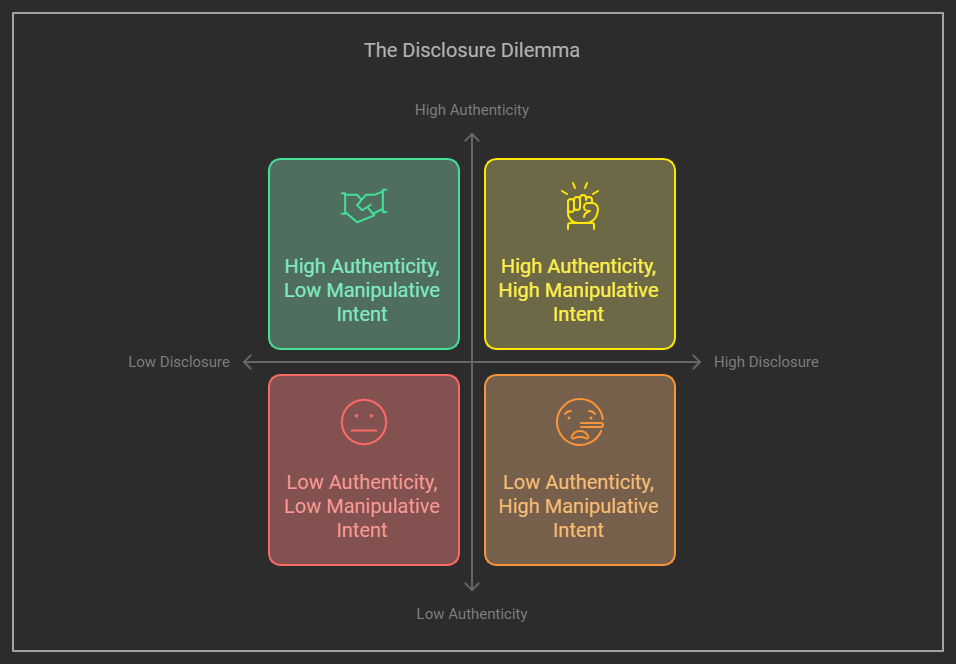
Unmasking the Paradox of Influencer Marketing Disclosures: Balancing Authenticity and Skepticism
Nov 2, 202400:06:18Tap to summarizeSource:Shen, P., Nie, X. and Tong, C. (2024), "Does disclosing commercial intention benefit brands? Mediating role of perceived manipulative intent and perceived authenticity in influencer hidden advertising", Journal of Research in Interactive Marketing, Vol. ahead-of-print No. ahead-of-print. https://doi.org/10.1108/JRIM-01-2024-0052In the latest episode of Marketing Science Lab, we delve into groundbreaking research on the hidden influences of influencer marketing disclosures. This study, published in the Journal of Research in Interactive Marketing, uncovers surprising insights that challenge conventional wisdom about transparency in sponsored content.The Authenticity-Skepticism Tightrope: Understanding Disclosure EffectsThe research reveals a fascinating paradox in influencer marketing: sponsorship disclosures simultaneously enhance perceived authenticity and trigger skepticism about manipulative intent. This dual effect creates a complex landscape for marketers to navigate.Key findings include:* Positive Impact: Disclosures can boost an influencer's perceived authenticity, positively influencing brand attitudes.* Negative Consequence: The same disclosures may increase perceptions of manipulative intent, potentially harming brand perception.* Bidirectional Relationship: Perceived authenticity and manipulative intent continuously influence each other, creating a delicate balance.Decoding Consumer Responses: The Role of Thinking StylesOur discussion highlights how individual differences in consumer thinking styles significantly moderate the effects of sponsorship disclosure:* Experiential Thinkers: These consumers focus more on the authenticity boost from disclosure, leading to more positive brand attitudes.* Rational Thinkers: They are more likely to scrutinize the motives behind disclosures, potentially developing negative brand perceptions.This distinction emphasizes the importance of tailoring influencer marketing strategies to align with the dominant thinking style of the target audience.Crafting Effective Disclosure Strategies: Balancing Transparency and EngagementBased on the research findings, we explore several actionable strategies for marketers:* Embrace Strategic Transparency: Be open about sponsorships to enhance authenticity, but carefully consider the presentation to minimize perceptions of manipulation.* Personalize Disclosure Approaches: Tailor your disclosure methods based on your audience's thinking style. For example, use more prominent disclosures for experiential thinkers and subtler integrations for rational thinkers.* Enhance Influencer Authenticity: Encourage influencers to share genuine, long-term product experiences and integrate sponsored content naturally into their overall content strategy.* Leverage Technology for Optimization: Use consumer data and AI to personalize disclosure methods and timing for different audience segments.* Focus on Trust-Building: Develop campaigns that demonstrate honesty and sincerity beyond mere disclosure, considering the overall influencer-brand relationship perception.The research underscores the complexity of modern influencer marketing. While transparency through sponsorship disclosure is crucial for ethical marketing and trust-building, its effects on consumer perceptions are nuanced and sometimes contradictory. The key for marketers is to find the right balance – embracing transparency while carefully considering how disclosures are presented and integrated into content.By understanding the interplay between perceived authenticity and manipulative intent, and how different consumers process this information, brands can craft more effective, trusted influencer partnerships. Remember, in the world of influencer marketing, it's not just about what you say, but how you say it. The goal is to create authentic connections that resonate with your audience while maintaining transparency and trust.Interactive Quizlet: https://quizlet.com/study-guides/influencer-marketing-disclosures-authenticity-vs-skepticism-e0ed2b07-4f1a-40e5-86e6-7319226916fd?i=3i62em&x=13qt This is a public episode. If you would like to discuss this with other subscribers or get access to bonus episodes, visit www.marketingsciencelab.org
Transcribe →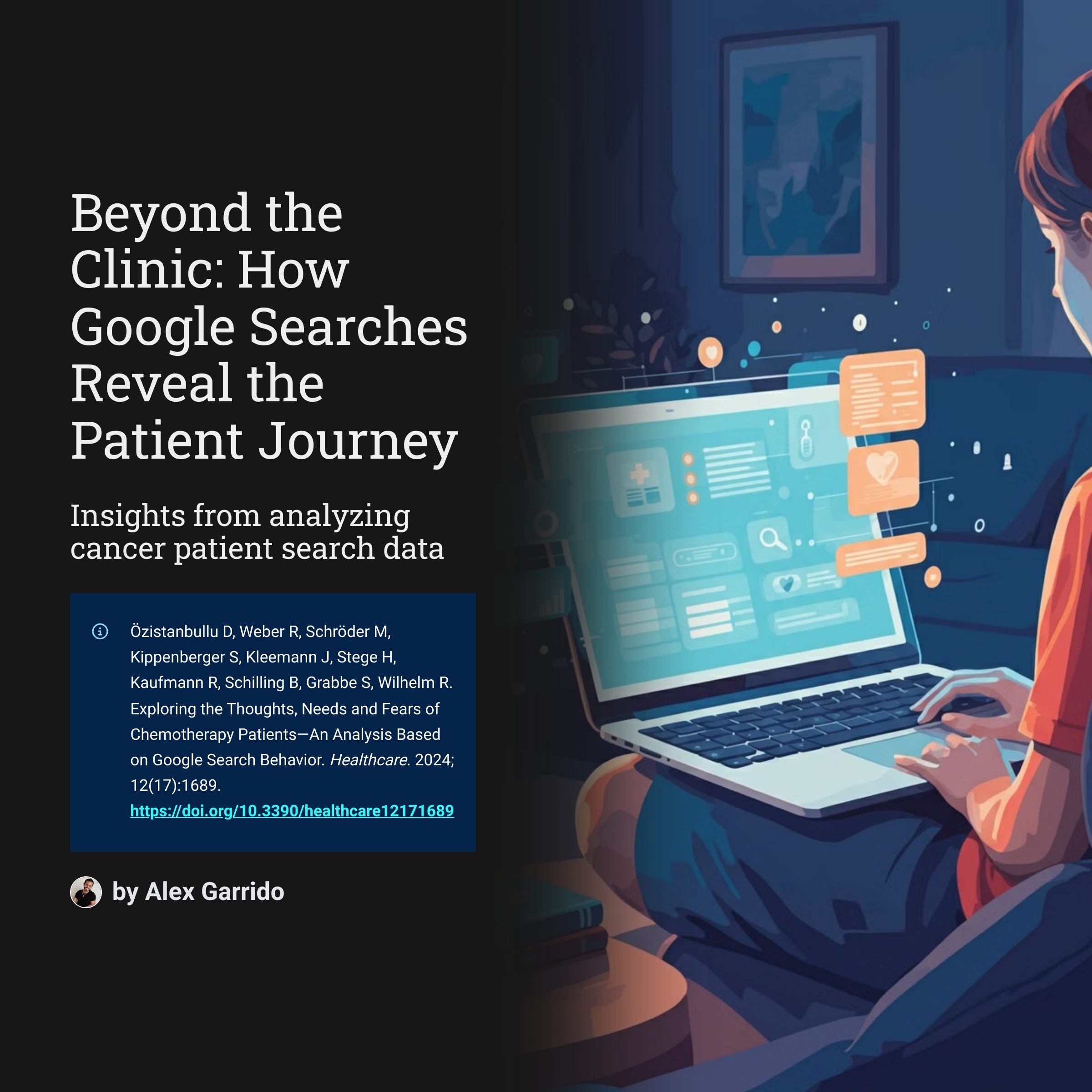
Beyond the Clinic: How Google Searches Reveal Patient Priorities in Cancer Care
Oct 26, 2024Tap to summarizeSource:Özistanbullu D, Weber R, Schröder M, Kippenberger S, Kleemann J, Stege H, Kaufmann R, Schilling B, Grabbe S, Wilhelm R. Exploring the Thoughts, Needs and Fears of Chemotherapy Patients—An Analysis Based on Google Search Behavior. Healthcare. 2024; 12(17):1689. https://doi.org/10.3390/healthcare12171689Today, we're diving into a fascinating study that sheds light on the thoughts, needs, and fears of chemotherapy patients by analyzing their Google search behavior. This research not only provides valuable insights for healthcare professionals but also offers important lessons for marketers in understanding consumer behavior and information-seeking patterns.Full Episode Notes: https://www.marketingsciencelab.org/p/beyond-the-clinic-how-google-searchesSlides: https://slides.marketingsciencelab.org/beyond-the-clinic-how-google-searches-reveal-the-patient-journeyStudy Overview* Objective: To understand the collective interests, concerns, and information-seeking behaviors of individuals affected by cancer, either as patients or caregivers, through analysis of Google search data.* Method: Analysis of Google AdWords data for chemotherapy-related search terms in Germany from September 2018 to September 2022.* Data Scope: 1,461 search terms associated with "chemotherapy," representing 1.7 to 29 million search queries.Key Findings* Consistent High Interest* Google Trends analysis showed a consistently high search interest in chemotherapy, with an average search rank of 85.9 throughout the analyzed period.* Seasonal fluctuations were observed, with lower search volumes in December and January.* Most Searched Topics* General information about chemotherapy processes* Side effects of treatment* Treatment success rates* Tumor Types* Breast cancer was the most searched tumor type (28.7% of tumor-specific searches)* Followed by lung cancer (13.6%) and colorectal cancer (11.8%)* Interestingly, prostate cancer, the most common cancer in men, had relatively low search volumes (2.3%)* Side Effects* Hair loss was by far the most searched side effect (51% of side effect-related searches)* Skin-related side effects were the second most common (9%)* Treatment Types and Terminology* High search volumes for "adjuvant chemotherapy" and "neoadjuvant chemotherapy"* Frequent searches for immunotherapy, suggesting potential confusion between chemo- and immunotherapy* Demographics and Search Behavior* Women appear to search more frequently for health-related information, particularly breast cancer* Men generally seek less health-related information onlineMarketing Implications and Actionable Insights* Content Strategy:* Develop comprehensive, easy-to-understand content addressing the most searched topics, especially treatment processes, side effects, and success rates.* Create separate content streams for different cancer types, with a particular focus on breast cancer.* SEO and SEM:* Optimize content for high-volume search terms related to chemotherapy side effects, particularly hair loss and skin-related issues.* Consider seasonal adjustments to SEO and SEM strategies, accounting for lower search volumes in December and January.* Audience Segmentation:* Develop targeted content and campaigns for women, who appear to be more active in seeking health information online.* Create strategies to engage men more effectively in health-related information seeking.* Educational Content:* Provide clear explanations of different treatment types (e.g., adjuvant, neoadjuvant, immunotherapy) to address potential confusion.* Develop content that addresses the emotional and psychological aspects of cancer treatment, not just medical information.* Product Development:* For healthcare and beauty brands, consider developing products that address the most searched side effects, particularly hair loss solutions and skincare for cancer patients.* User Experience:* Design websites and apps that make it easy for users to find information on the most searched topics, potentially using AI-driven personalization based on user behavior.* Influencer Marketing:* Collaborate with healthcare professionals and cancer survivors to create authoritative content addressing common search queries.* Social Media Strategy:* Use social platforms to disseminate easily digestible information on frequently searched topics, potentially using formats like Instagram carousels or TikTok videos.Limitations and Considerations* The study was limited to Google searches in Germany and may not be fully representative of global trends.* Search data doesn't provide context on individual motivations or experiences.* The study couldn't distinguish between searches by patients, caregivers, or healthcare professionals.This research provides valuable insights into the information-seeking behavior of individuals affected by cancer. For marketers, it highlights the importance of understanding the specific concerns and needs of target audiences, especially in sensitive areas like healthcare. By aligning content and marketing strategies with these insights, brands can provide more valuable, relevant information to their audiences and potentially improve engagement and trust.Future Research Directions* Explore how socio-economic factors affect digital health information seeking.* Investigate search behaviors in different healthcare systems and demographic groups.* Combine quantitative search analysis with qualitative methods for a more nuanced understanding of patient needs.By leveraging these insights, marketers can create more effective, empathetic, and targeted campaigns that truly resonate with their audience's needs and concerns. This is a public episode. If you would like to discuss this with other subscribers or get access to bonus episodes, visit www.marketingsciencelab.org
Transcribe →