← Marketing Beyond with Alan B. Hart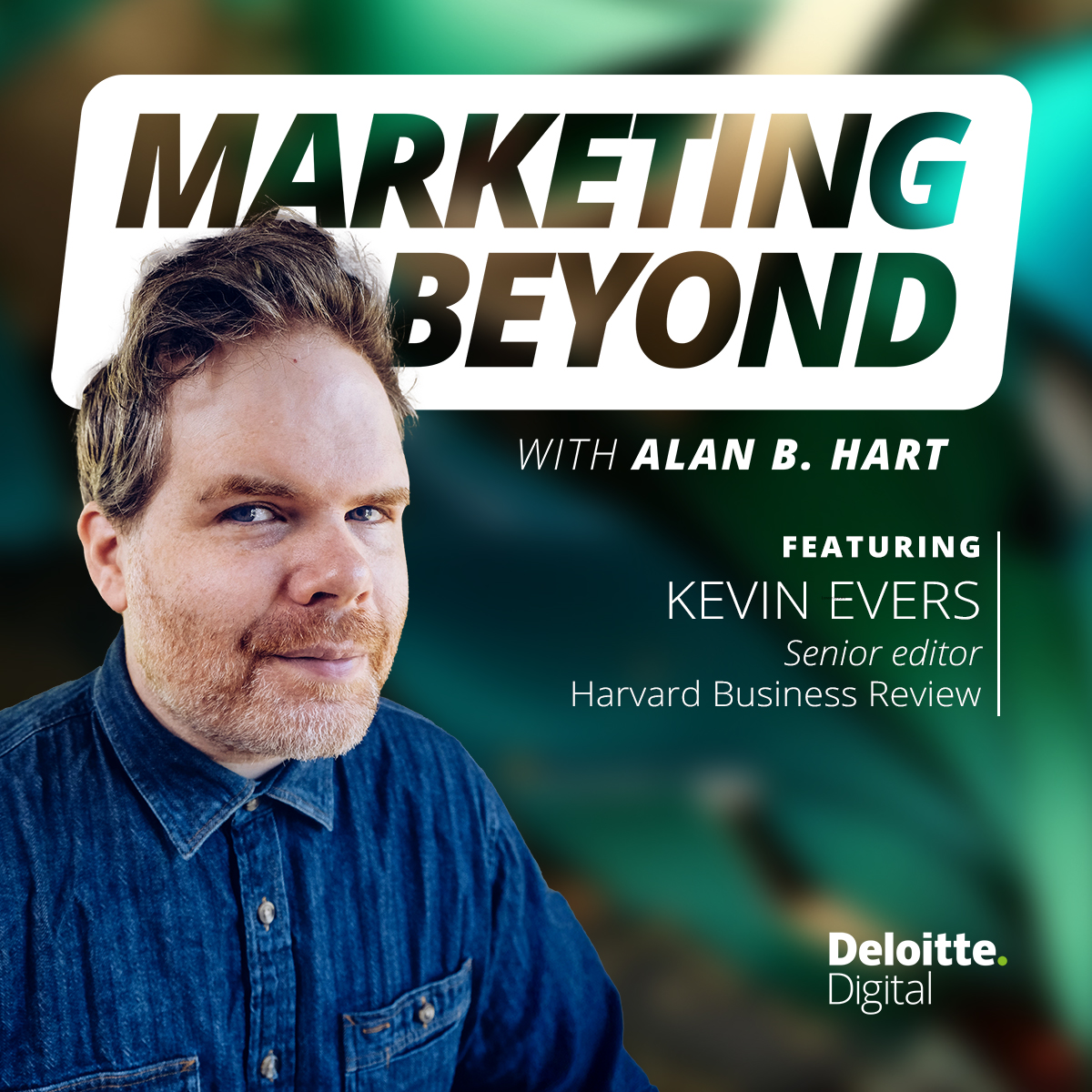
Marketing Beyond with Alan B. Hart
10: The strategic genius of Taylor Swift: Insights from Kevin Evers, senior editor at Harvard Business Review
00:38:36
What lessons can marketers learn from Taylor Swift’s massive success? In today's episode, Alan Hart talks with Kevin Evers, senior editor at Harvard Business Review and author of the book There’s Nothing Like This: The Strategic Genius of...
Loading summary
Transcript84 lines
- [00:00]
Kevin Evers
Foreign.
- [00:07]
Alan Hart
Are you ready to go beyond the basics of marketing? I'm Alan Hart and this is Marketing beyond, where we talk about the questions that spark change and share ideas that challenge the status quo. Join us as we explore the future of marketing and its endless potential.
- [00:26]
Kevin Evers
I think she really thinks like a marketer. You know, a lot of artists, they put their music out and they want the music to speak for itself, but she's not, she's not one of those artists. She really understands that communication is paramount and she builds stories around each album and then makes sure that she's directly communicating why she's making those changes. And that's a big reason why she's able to adapt and grow.
- [00:56]
Alan Hart
Hey, today on the show I've got Kevin Evers. He's a senior editor at Harvard Business Review and author of the book There's Nothing like this. The Strategic Genius of Taylor Swift came out on April 8, 2025, and it's written or published by the Harvard Business Review Press. On the show today, we talk about Taylor. It's a, it's a fun topic to talk about as a marketer. We talk about her brand, the brand building approach that she took, the famous brand first approach to everything that she does, the pivots and risk that she's taken as a brand and the lessons for us marketers and entertain the question, is she really a masterful marketer? So the answer you'll find out here shortly and the business lessons we all need to take away from her savviness running her business. That and much more with Kevin Evers. Foreign. Welcome to the show.
- [01:59]
Kevin Evers
Thanks, Alan. It's great to be here.
- [02:01]
Alan Hart
Yeah, I'm excited to have this conversation. It's going to be, I mean, normally like we're talking about business and we'll definitely talk about business, but there's so much more exciting to talk about and people to talk about. But before I give it all away, I want to talk about you as a person. And one of the things I learned about you last conversation is you, you got a late start in life talking as a kid. And for somebody that seems to be a writer, I don't know if that's a good thing or a bad thing, but just curious how that, how that affected you, how, what was that like as a kid?
- [02:35]
Kevin Evers
Yeah, I couldn't talk until I was five. I don't really remember this, this is what my, my mother tells me. So I went through extensive speech therapy before and after that. So I hope no one's judging me based on my My speaking abilities. Here I was, I was worried about. I was worried about confessing this because I'm on a podcast, so he couldn't talk until he's five. Okay, let's. Let's see. Let's see what he's got now.
- [02:58]
Alan Hart
Yeah. One of the things that made me think, as you told me this nugget, is that maybe that's why you're a great interviewer or a great writer, is that you're really, from an early age, you were just taking it all in.
- [03:12]
Kevin Evers
Yeah, that's. I guess that's all I cared about. I just. I just wanted to observe and see what was going on. I was like, you know what? I'll wait for this talking stuff, you know?
- [03:19]
Alan Hart
Yeah, yeah, no, that's awesome. That's awesome. Well, you are here and you are now a senior editor at Harvard Business Review. You've written a recent book that we'll talk about in a second. But like, what was your professional path? Where did you get your career start? How'd you end up where you are today? At hbr?
- [03:35]
Kevin Evers
I had a very unconventional path. I went to graduate school for film studies, so I thought I'd get my PhD in film or maybe I'd go into the film industry. But I ended up working at hbr and it's been great because I've really been able to use my creative abilities. Right. Being an editor is. It's not line editing. It's really helping people develop their ideas and position their ideas for maximal market impact. So, yeah, non linear path. But I'm still using a lot of the skills that I gained in school.
- [04:15]
Alan Hart
I love it. I love it. And from film to business writing and editing, you are now. It feels like in some ways you might be merging these two things together. Your latest book, there's nothing like this. The strategic genius of Taylor Swift. And I have to say, I'm sure thousands of people have thought about writing this book. I much have thought about it. I've thought about her as a marketer in general. But how did you come to the decision to write this book?
- [04:46]
Kevin Evers
Yeah, it's a great question. When I first came up with the idea, there really weren't any books about Taylor Swift. I couldn't believe it. I'm like, no one has written a book about Taylor Swift. That was before the ERAS tour. She announced the ERAS tour. And of course now there are plenty of books about Taylor Swift. But for me, it made total sense because she's a great songwriter, of course, and that's contributed mightily to her success. But you don't get this far. You don't grow your popularity to this level over two decades into your career if you're not incredibly business savvy. And I didn't approach this book any differently than I would if I was writing a book about Steve Jobs. Jeff Bezos was just third. The more I researched and the more I looked into Swift, the more and more I was impressed with the decisions that she's made throughout her career.
- [05:35]
Alan Hart
Well, and you know, I would say this is my own own opinion, I should say that. But I believe that Taylor Swift might be the greatest brand on the planet earth. And that's considering companies, causes, politicians, other celebrities. I think everyone that you can think of. How do you think about the power of her brand?
- [05:59]
Kevin Evers
It's. It's critical. Right. I think she's always known that her brand is based around intimacy and connection with her audience and curiosity. So everything she does is based on those components from the way she sings her songs. Right. The way that she conveys emotion from line to line, from word to word sometimes. And then also the experiences she builds around those songs from her concerts that are always. They tend to be theatrical in nature. They're really built around each album. And her social media impact, the way that she connects with fans, the way that she's always trying to build community and to foster curiosity in is all based on those original components of intimacy and connection.
- [06:49]
Alan Hart
Yeah, I definitely agree with that. One of the things you highlight is her fans first approach to building her following, building her brand to what it is today. What does that look like as you kind of evaluated her and what she's doing with her brand and her business?
- [07:10]
Kevin Evers
I'd say her customer obsession is her secret sauce. Right. Again, incredibly talented, a great songwriter, but talent isn't necessarily a scalable asset. But she knows that her fans are a scalable asset. So she reminds me a lot of Jeff Bezos. So Jeff Bezos had this great line in one of his shareholder letters, and I'm going to paraphrase here, but he said, our customers are delightfully dissatisfied. They may tell us that they love our products, but deep down, customers always want more. And it's our job to continually delight them. And that fits Taylor Swift to a T. She's invited fans into her living room for listening parties. That's an extreme gesture. I mean, it's something that I wouldn't do. I don't even answer the doorbell when it rings. And here she is, the most famous person in the world, inviting bussing fans into her living room. And we saw this in the ERAS tour too. She could have played a two hour show. Her fans would have walked away delighted. She could have played a greatest hit show. She had never done that before. But Instead, she plays three and a half hours. Her set list spans over 40 songs. And that had to come at a great emotional and physical toll because she's playing three nights in a row in a lot of cities. Right. But that's what she does. She sets high expectations and then she exceeds those expectations. And in most cases, she gives fans more than they maybe even deserve. And I think that's. That fan obsession is a big part of why her fans stick around for so long and why she's able to recruit new fans.
- [08:46]
Alan Hart
I love it. And one of the, I think you told me a nugget around the live streams and the fact that somehow that was being, if you will, kind of like enabling her fans to actually build followers for themselves as well. Could you expand on that a little bit?
- [09:05]
Kevin Evers
Yeah, I mean, this is something she's always done. And the, the, the Internet changed fandoms forever. Right? And it's, it's not that so much that fans want to listen to music. Of course they do. The music is really important. But they want things to do with that music. And Swift has always understood that. And you could see in the ERAS tour, right, she really encouraged fans to film the shows. And one of the biggest parts about the ERAS tour was live streams. Fans were at the concerts and they were live streaming those shows. And then fans at home were watching grainy live streams of Taylor Swift concerts. Now, she could have monetized that, right? She's a very smart business person. She would have. Of course, she saw this was going on and she could have charged for her own live streams. I mean, the eras tour grossed over $2 billion. She had enough money where she could have found a way to live stream the shows, but she didn't. She let the fans do it. And so that gave them the power, but it also allowed those videos to spread more widely. It reminded me of a technique that the Grateful Dead used back in the 60s. They allowed their fans to record shows and then fans would share those shows. And it increased the fan community, it really bonded fans, but also allowed those fans to contribute to the mythology of the band. Whereas the fans who were determining what songs were best, what versions of the songs were best. And Taylor, being the smart business person that she is, realized that she doesn't have to reap as much monetary value as she can out of every aspect of her career. But by allowing her fans to do the live streams, she created more engagement and community in the process.
- [10:53]
Alan Hart
Yeah, I mean, I think that correlation, if you will, to the Grateful Dead and the bootlegging that was going on with the recordings, I mean, magic happens in those moments too, right? Like especially with a band like Grateful Dead, that's such element of riffing on, on their existing thing, but the notion of how you talk about like bringing their community together, bonding their fans together, it's very powerful. Very powerful. And a, probably a really good example of choosing not to make money on something that actually propels your brand forward.
- [11:27]
Kevin Evers
For sure. Propels the brand. And then there, of course, there's ways that she can monetize that later on because people, people are more willing to buy merchandise and the more super fans she has, the more money that they'll spend in the long term. But she also does it in other ways in social media too. I mean, I compare it to the Grateful Dead and there's parts of her fan community and part of her strategies that remind me of the Beatles. Her understanding that she herself is just as important as her music. And she's always understood that. There's also elements of true crime communities on Reddit, just these hyper curious communities that always speculate on what's happening and what's going to come next. And that's the Taylor Swift fan community. Everything she does, what she wears, what she says, everything that she does on social media is a source of endless speculation. And she's the one that's fueling that.
- [12:19]
Alan Hart
Right. That's fascinating. Well, you know, as brand leaders, we sometimes think about brand risk as something that at least needs to be mitigated, if not avoided at all costs. But it seems like Swift has taken a different approach to risk. You know, just using the first example is country music to pop. Right. So maybe I curious, as you've studied her and what she's done over the course of her career, like how do you think she's thinking about risk?
- [12:50]
Kevin Evers
She's very protective of her brand, but there have been pretty pivotal moments in her career where she's taking calculated risks. And the biggest one was her complete move to pop music. Right. She had always had a dual strategy. After her first album, which was a pure country album, she always had one leg in country music, one leg in pop. So she'd do some country songs that she'd also have some pop songs. But when she moved directly to pop, full on pop, she was leaving country music completely behind. Right. So she had cornered both markets and she was leaving one market behind. It wasn't as if, yes, she was changing her sound, she was changing the banjos and mandolins to 80s sounding synthesizers, but it was more than the sound. So instead of having a very classic adjacency strategy, which worked very well for her for a very long time, she decided, you know, I'm going to leave behind those relationships that I develop in country music and I'm going to go with pop. Now a lot of those decisions are personal decisions for her, even though on paper they seem like bad business decisions. I think she knows that as a personal brand and as a songwriter, that's important for her to evolve her sound. And if that's the sound that she's gravitating toward, pop music, then that's really important for her growth as an artist. And because she has such great storytelling abilities and she's able to really explain her change to her fans in personal terms, her fans go along for the ride.
- [14:24]
Alan Hart
Right, right. It seems to be that notion of not only doing it like making the shift, but to your point, telling the story to your audience, to your fans about why and how this is going to be different.
- [14:39]
Kevin Evers
She did this with 1989, which was her big pop album. This was her big transformation. And at the time there was so much going on in the music industry. Streaming was becoming a very popular way to listen to music and bands and artists were trying to find so many innovative ways to catch people's attention. Right. This is when U2 partnered with Apple and everyone woke up and had a U2 album on their phone. Jay Z did something with Samsung at the time. Beyonce also, surprise, dropped an album. And instead of trying to find a new way to release music, Taylor decided to have a one on one with her fans. She hosted a live stream that was simulcast on ABC and she there is no co host. It was just Taylor, like an over caffeinated morning TV host talking to her fans and explaining why she was making this big transition to pop music. And of course that was shared widely online. People watched it. And since she had fans in the audience and she was talking directly to fans in very personal and direct terms, saying this is about personal growth for her, her fans. Even though some thought the move to pop music, they didn't like it and it was controversial, most of her fans followed along.
- [16:01]
Alan Hart
It's a pretty powerful pivot and honestly a pretty good case study for marketers thinking about moving their brand from one place to another and how potentially to bring your customers that is your audience along for the ride. Yeah.
- [16:18]
Kevin Evers
I think she really thinks like a marketer. A lot of artists, they put their music out and they want the music to speak for itself, but she's not. She's not one of those artists. She really understands that communication is paramount, and she builds stories around each album and then makes sure that she's directly communicating why she's making those changes. And that's a. That's a big reason why she's able to adapt and grow. Right? Yeah, because fans. After a while, fans get very. They have strong opinions. Very strong. Very strong opinions.
- [16:52]
Alan Hart
Right.
- [16:53]
Kevin Evers
And sometimes they don't like it when the artist change too much. Go to any online fan community when an artist makes a big pivot, and you're going to find a lot of negativity, and you will find some negativity when Swift makes these pivots. But because her storytelling is so strong, because her communication is so strong, and because she thinks like a marketer, she's able to build the right stories around those changes.
- [17:14]
Alan Hart
Well, and I was going to ask you this question, but I think you kind of already answered it. I've always looked at her from. From the outside thinking, man, she's masterful at marketing, but then also, like, wondering and scratching my head, like, really, is she? Or is the fame around her brand just such that, like, it feels like she permeates every aspect of culture? It seems to me that you think that she is. She is thinking like a marketer in.
- [17:44]
Kevin Evers
That regard, for sure. I mean, it's probably a. Both. And to be honest.
- [17:47]
Alan Hart
Yeah.
- [17:48]
Kevin Evers
Right. I mean, the more famous you are, there is cumulative advantage where it's like, the more successful you become, then success begets more success. But on the flip side of that, the more famous you are and the more eyes on. On you, the higher the risk. Right. Everything you do, everything she does is scrutinized. Right. And I think sometimes we look back, she executes so well on a lot of this stuff that it seems easy and it doesn't seem risky.
- [18:16]
Alan Hart
Mm.
- [18:16]
Kevin Evers
But I'm always trying to put myself in her shoes. Like that big move to pop music.
- [18:21]
Alan Hart
Right.
- [18:22]
Kevin Evers
If she didn't execute that album wasn't good, I mean, she would have been skewered in the media and her fans would have hated it too. So even though she gets big and even though she's extremely popular, she does take. Takes calculated risks that time. And I do think we have to give her her flowers for that, because I think the more successful you are, the harder it is to make those big moves, but she's willing to do it.
- [18:47]
Alan Hart
Yeah. Well, I think you mentioned something to me too, which is like she capitalized on certain trends, like, say, the rise of social media as social media was taking off. But today, maybe it's less of her mix in her marketing mix today than it was in the past. So it sounds like she's also refining, you know, she's always putting out great content, but she's refining, like, where that content exists in the world. Just like any marketer listening to this show, frankly. Yeah.
- [19:19]
Kevin Evers
Her social media strategy has. Has changed pretty dramatically. When she was first starting out, I mean, her rise as an artist coincided with the rise of social media. She wasn't successful because of social media. She was successful because she used those tools really well. This is back in 2006, so Facebook was still on college campuses. MySpace was the major social media platform at the time. YouTube in its infancy. It was very early on in social media. But Swift always knew that, and this is something the Beatles did too, that my. Me as a person, me as Taylor is just as important as my music. So I need to sell myself just as much as my music, and I need to sell myself as a peer, not necessarily as a star. But these days it's pretty different. She's not chronically online anymore. Right. She doesn't really go on Instagram anymore or TikTok. Right. And I think a big reason for that is she doesn't really need to. Right. She's taken a scare. She's. She's all about scarcity now. Right. The less that she's around, the more her fans engage, the more they're curious and the more they speculate. Right. So she's in a prized position right now. I'm not sure other artists could get away with that, especially new artists. You really need to be on social media directly connecting with your fans. But since Swift has been doing this for 15, 20 years and she has built that fan community and she has taught that fan community how to act, which is to be extremely curious and to speculate about everything she's doing, she's able to take a step back. Right. I think this also coincides with the rise of TikTok, because TikTok really allows fans to be co creators in a. In an artist's career. Right, Right. In the Eras tour, there's a study that showed at the peak of the eras tour, between 200 to 300 million videos reviewed a day of Taylor Swift. Right. So at the same time, she's putting out A ton of content. She's releasing a lot of albums. She was on the ERAS tour, but she could take a step back and let her fans do the work and the evangelizing for her.
- [21:43]
Alan Hart
Yeah. I mean, if I track kind of like that to like what's happened in the marketing world. Right. Like push into organic social, which she did right at the, at the right time. Yep. The rise of influencers and new channels and her ability to leverage fans as like influencers to help get her message out into the world. And the notion that you talk about like her brand is at a level at this point where she doesn't necessarily need to do the micro anymore and it needs to be kind of like reinvesting in this brand, building top of funnel mass awareness. Because she appeals to, I mean, largely everyone. I'm sure there's some haters out there, but like largely everyone is appeal, you know, she appeals to. And so like, you know, optimizing her mix for now at the stage of her being a big brand, a big global brand, and then leveraging others through these, you know, influencers of her fans and etc. It's pretty astute marketing. Not, not, not just a good marketer, like really astute marketer.
- [22:48]
Kevin Evers
Yeah. And she doesn't, every opportunity that she has or any appearance, she's always dropping some sort of hint. So she just received an award at the iHeart Music Awards and she wore a necklace and it was, it had a snake emblem on it and that's a big symbol in the Swift world that refers to her album reputation and that's one of the albums that she's planning to re record and to release. And her fans have been speculating about this for two years and she keeps dropping hints, keeps dropping hints. So every time she makes just a random appearance, all of her fans are like, oh, what does that plaid dress mean? What does that necklace mean? Everything has some kind of meaning even when it doesn't. And yeah, she's, she's a master at that. She knows that everything she does will be scrutinized. So she just drops little, little hints and then the fans go crazy online.
- [23:44]
Alan Hart
Right. Well, and I think in the last couple of seasons of the NFL, she's captivated us in an entirely new world of live sports showing, live sports viewing.
- [23:54]
Kevin Evers
So she's infiltrated the last monocultural event that we have, which is football. NFL football. Right, right. It's the only we. We live in a world of a million niches at this point, but football is the only thing that really Brings us together. And I don't think she was calc about this. I think she just wants to support her boyfriend. But.
- [24:16]
Alan Hart
Right.
- [24:17]
Kevin Evers
The. The effects have worked. Right? It's has only increased her popularity. It's brought on some haters, too, don't get me wrong.
- [24:23]
Alan Hart
But of course, of course. I mean, you can't have success without haters, so.
- [24:30]
Kevin Evers
For sure.
- [24:30]
Alan Hart
Yeah. And I. I wish Travis all the best, but she does write about a lot of breakup songs, so I'll just leave that one there.
- [24:38]
Kevin Evers
He'll be. He'll be. He'll be perfectly fine. He'll be. He'll be fine.
- [24:42]
Alan Hart
Yeah. I think he'll be death. Just fine. But I do hope the best for both of them, but it does make me. As a dad of a teenage girl. Not that she is, but we hear a lot of Taylor Swift songs. There's a lot of breakups in those songs. Travis, be careful, man. Do what. Do what you need to do. But I think one of the things we've been talking about is she's a great marketer, But I think beyond just the success that she's had in marketing and building a brand is like, her business savvy is uncanny as well. And just curious, like, I mean, you've written a whole book about her career. Like, what were some of the takeaways that you took away? And since you are both a business writer and you're writing about this cultural icon, curious what the business lessons were that you took away.
- [25:26]
Kevin Evers
The most important one, and this goes back to her early career when she was 13 or 14 years old, is a classic entrepreneurial story. She seized an opportunity that other people had ignored or didn't think existed. She was a teen girl trying to make it in country music. And 2004, 2005, 2006, when her first album came out, the consensus was, nope, we can't do this right. She wanted to write her own songs, which for a girl her age, not something that Nashville is willing to do. She wanted to write songs for an audience of her peers, teenage girls, Nashville. The consensus was that audience doesn't exist, and she wanted to put out an album as soon as possible. Most people told her she had to wait until she was 18 at least, but she persisted. Still, a lot of people in country music are like, this isn't going to work. And they were right, because the data and past experiences showed that someone like her probably wouldn't break out. At the time, 80% of hits on country radio were performed by men, and men were played four to Five times more than women on country radio. And there's no way you could be successful in 2006 in country music without having the DJs and programmers playing your songs on country radio. There's no way. And Swift persisted. She was really close to that audience. She knew that her peers liked her songs, and she ended up with finding a record label. The head of that record label believed in her vision. Of course, the rest is history. But they really ended up creating their own category. Right. They were going after an audience that everyone else had ignored. And even though they had the data to show that those country music executives were probably right, I think Swift and Scott Bruschetta, the head of her label, thought otherwise. And because of that, she broke out in country music because she was doing something that other people weren't doing.
- [27:32]
Alan Hart
It's a great way to talk about differentiation in a crowded category and pushing forward. Pushing forward to your point, like an entrepreneur would. Anyway, anyway, she is, like I said at the outset, I've admired what she's been able to accomplish from an outsider's purview and from somebody that's in the marketing world and just kind of in awe of the brand that she's built. It's pretty. Pretty amazing. Pretty amazing.
- [27:59]
Kevin Evers
So, I mean, at this point, her popularity is. Has reached absurd levels. I mean, absurd in a good way. It's right. In 2024 alone, she represented two, close to 2% of the total music market. Just her, just her albums, just her streams. And it doesn't include the box office for the ERAS tour and does include merchandise sales. So if it did, those numbers would be much higher. And the Eras tour grossed over $2 billion. That's nearly twice as much as the second place concert, which was Coldplay's Music of the Spheres. So she's not a superstar. And she's not. I don't even think she's a megastar. I don't really know what to call her because she's like, exponentially more successful and popular than even superstar artists at this point.
- [28:44]
Alan Hart
Right. It feels like it's on the order of magnitude of Galactic Star, but there's, as far as we know today, there's not life outside of Earth, but for sure.
- [28:54]
Kevin Evers
Yeah, I know, I know. If someone out there can come up with a great name for what she is right now, please tell me, because I don't know what that is.
- [29:02]
Alan Hart
I agree. Agree. Well, one of the things we do on the show is get to know you a little bit better. And, you know, we know you had A late start talking. You've definitely made up for it at this point in life. But has there been an experience of your past that defines or makes up who you are today?
- [29:20]
Kevin Evers
That's a great question. It's not a direct moment, but I had a change of heart about my own creative process. I think growing up, my creative process is very nonlinear, right. I'm not a outline and just write the thing type of person. My creative process is all over the place. If anyone wants to know what my creative process looks like, look up Dostoevsky's notebooks, right? And this is a big moment for me. When I looked at his notebooks because his notebooks look crazy. There's. He's writing on all sides of the page. Some of it's upside down. There's arrows being drawn over the place like you can't make sense of it. And I was like, I feel seen now. That's. I'm not comparing my. I'm not going to write, you know, you know, I can't write like Dostoevsky, but I'm not going to write Crime and Punishment. But I came to that realization. I was like, you know what? That's my creative process and that's the way that I need to do things. It's not a weakness, it's not a, it's not a deficiency. And the first time I realized that it, a burden was released because after that it was just trying to find ways to make that work for me and trying to find processes to allow the chaos and allow the messiness to, to be strengths.
- [30:43]
Alan Hart
Love it. What, Is there any advice you'd give your younger self if you're starting this journey all over again?
- [30:49]
Kevin Evers
I'd say it's all going to be okay. Don't be too hard on yourself. I'm sure a lot of people say that, but when we're younger, I could see this with my 8 year old daughter. She's really hard on herself. She doesn't do well on the test or she doesn't know the answer.
- [31:04]
Alan Hart
It's.
- [31:04]
Kevin Evers
It's hard for her and it's a, it's a long journey, right? It's all about what you learn, not necessarily how you do. You just keep going.
- [31:15]
Alan Hart
Yeah, no, I think it's a great, that's a great advice. And it made me think of something that's happened just in the last couple weeks with my daughter. 17, I'm at a different, different stage of this, but struggling with pre calc this year. AP Pre calc and I. She finally got a Test back this week, made an A, which is awesome.
- [31:36]
Kevin Evers
Right?
- [31:36]
Alan Hart
You know, I told her, you know, beyond just the A, I'm so proud of the fact that you've stuck with this. Right. Like, you've really grind this out. And. And that should be the thing you're most proud about at this point. So the A. The A is great icing on top.
- [31:53]
Kevin Evers
But my daughter is. She's. She loves to dance, but she's doing gymnastics this year for the first time, and she's been trying to do a cartwheel for a year and a half at this point. And she finally nailed one the other day, and it was this moment of joy for. For everyone. She's been working so hard, and she finally did it. It's like. See, it's like the hard work paid off.
- [32:18]
Alan Hart
That's awesome. It's awesome. I have to ask, what does she think about you writing about Taylor Swift? Does she know Taylor Swift at 8?
- [32:26]
Kevin Evers
She loves Taylor Swift. She's a huge Taylor Swift fan.
- [32:28]
Alan Hart
Okay, okay.
- [32:29]
Kevin Evers
It started. She's always loved adult music. When she was younger, she loved Pearl Jam. I mean, when she was like four months old. There's one.
- [32:38]
Alan Hart
You're speaking my language. Yes.
- [32:39]
Kevin Evers
It's Pearl Jam song. Wish List was a. We must have. We probably listened to that song over 2000 times because it was the. There's something about the beat of that song and Eddie Vedder's lyrics and the tone of his voice that would calm her down. And she was a crier. She cried a lot. So, yeah, we. There's one car ride. We listened to that song about six hours straight. So now. Now she's in the Taylor Swift, which is great. I took her to the Eras tour when she was six and we won again when she was eight. So, yeah, just. If there's anyone out there who has a young daughter and Taylor Swift tours again, I'd highly recommend going because you'll get major street cred with your daughter. You'll get major dad points, and it's a great place to walk into because everyone's swooning. Because you're the dad with your daughter. Yeah, it's. It's like being on a parade float. Everyone. Everyone loves it. So, yeah, my. My daughter is very excited about me writing a book about Taylor Swift.
- [33:39]
Alan Hart
I bet now that you've got extra cool points now. So. Well, curious if there's a topic either you're trying to learn more about or something you think marketers need to be learning more about today.
- [33:53]
Kevin Evers
I'm really curious about the Glut of content that's out there these days and how that impacts everyone. I mean, we always look at it from a listener perspective. It's. It's hard to. It's. It's hard to figure out, like, what we should watch, what we should listen to, because everyone else is watching different stuff or listening to different stuff. But as a book editor that's always looking for projects for trying to figure out, like, what projects break through and which ones don't. We're in like an extreme attention economy right now, and I'm really curious about how to navigate that as a creator, but also as a. Someone who puts products out into the world in the form of books.
- [34:39]
Alan Hart
Yeah, no, it's a. It's a really important point. I mean, and there's no. No good answer. If you're a brand right now, you still have to produce content, right? And in some cases the content you're talking about too, like the, the stuff that's out there that you want to somehow bring your brand closer to because it represents culture and you're trying to connect in that, in that space. It's. It's a definite challenge. And especially with all the streaming platforms on top of everything, like, just as one example, it's a lot to figure out in the coming years, for sure.
- [35:11]
Kevin Evers
I always look at on Halloween when, like when I was younger and Halloween, like you could tell what everyone was dressed as is a Marvel character. Everyone had the same touch points. But when my kids go trick or treating now and kids come to the house, I have no idea who most of the kids are because they're all watching different stuff, you know?
- [35:28]
Alan Hart
Right.
- [35:29]
Kevin Evers
Yeah.
- [35:29]
Alan Hart
Right. Yeah, it's funny. Well, are there any trends or subcultures that you follow you think other people should take notice of?
- [35:36]
Kevin Evers
Well, I mean, the biggest. The biggest subculture. I don't know if I'd call it a subculture at this point, but the Taylor Swift fandom, I'd encourage everyone to go on TikTok or go on Instagram reels and start finding some fan sites, some fan accounts, and let the algorithm do its thing. And you really need to see it to believe it. All the clowning that goes around, the true crime esque speculation that goes on is pretty extreme and fun to participate in. But there's also so much about the Phantom that's really smart. Just the lyrical analysis, the deep dives in the songs, the knowledge of Taylor is profound. So I'd encourage anyone to check out that Taylor Swift superfan sites subculture and see what it's all about Love it.
- [36:32]
Alan Hart
Love it. Last question for you. What do you think is the largest opportunity or threat facing marketers today?
- [36:38]
Kevin Evers
That's a great question. I think it goes back to the fact that there's so much content out there, right? It's like, how do you. I'm sure it's a question that every marketer asks themselves when they wake up is like, how do we, how do we stick out in this marketplace? And this is what I think about as a, as a book editor all the time. There's so many books out there, like, how do we, how do we position these books? How do we build stories around these books that really makes them stand out when there's thousands upon thousands of business books released every year.
- [37:10]
Alan Hart
That's a really important point, standing out in a crowded marketplace. Well, Kevin, thank you so much for coming on the show. Thank you for writing this book because now I can go deep dive into the business lessons related to Taylor Swift. So hope everyone that's listening to this also checks it out. But thank you for coming on the show.
- [37:29]
Kevin Evers
Thank you. It was great.
- [37:33]
Alan Hart
The views, thoughts and opinions expressed are the speaker's own and do not represent the views, thoughts and opinions of Deloitte. Material and information presented here is for general information purposes only and does not imply endorsement or opposition to any specific company, product or service. Hi, it's Alan again. Marketing beyond is a Deloitte Digital Podcast. It's created and produced by me with post production support from Sam Robertson. If you're new to Marketing beyond, please feel free to write us a review and subscribe on your favorite listening platform. I also invite you to explore the other Deloitte Digital podcast@deloittigital.com US podcast and share the show with your friends and colleagues. I love hearing from listeners. You can contact me@marketing beyondeloit.com you'll also find complete show notes and links to what's discussed in the podcast today and you can search our archives. I'm Alan Hart and this is Marketing Beyond.