← Marketing Beyond with Alan B. Hart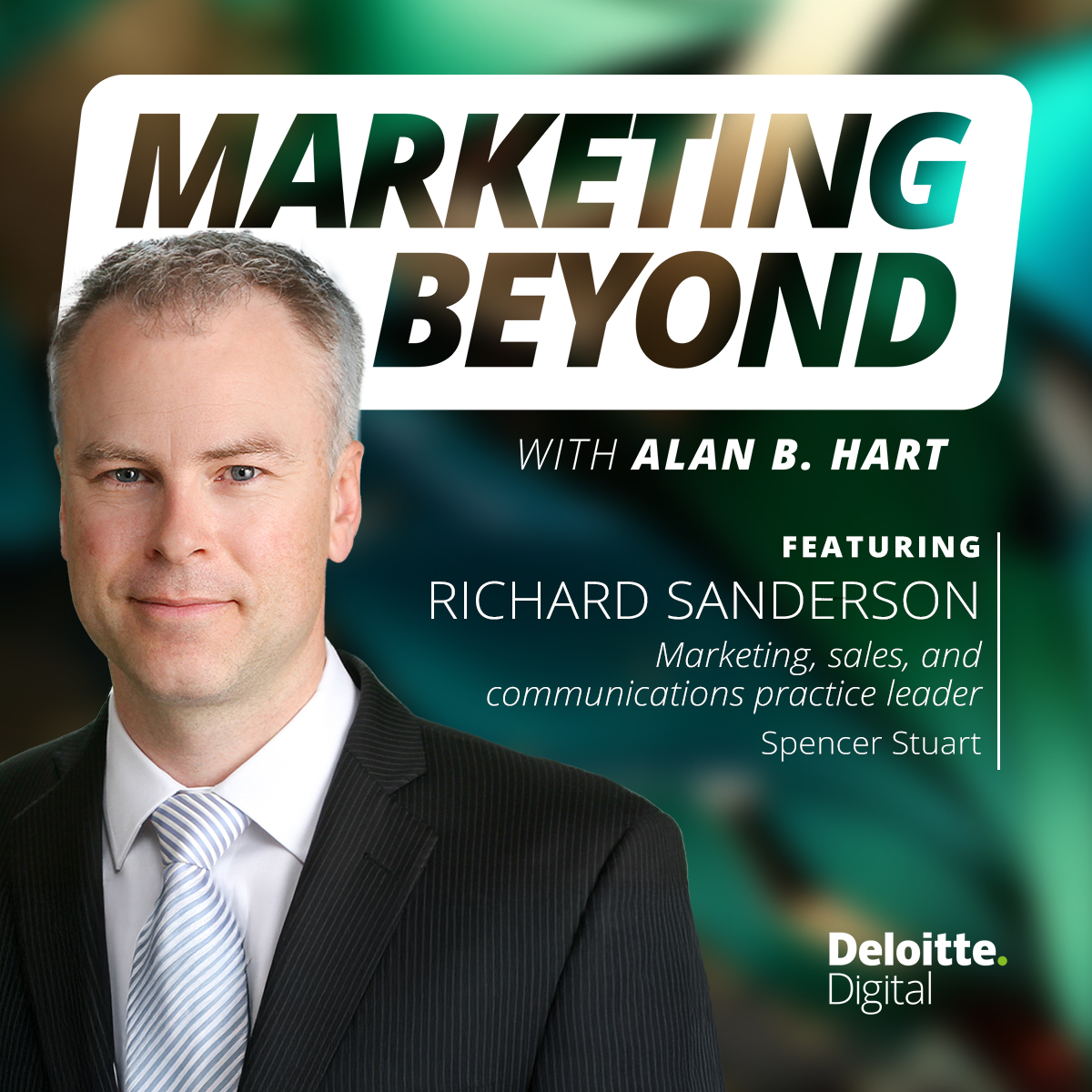
Marketing Beyond with Alan B. Hart
11: Exploring the “2025 CMO Tenure Study”: Insights from Richard Sanderson, marketing, sales, and communications practice leader at Spencer Stuart
00:42:43
What do executive recruiters look for when placing chief marketing officer (CMO) candidates? Why do CMOs have ? Richard Sanderson has spent nearly his entire career as an executive recruiter. He began as an intern at Russell Reynolds...
Loading summary
Transcript49 lines
- [00:00]
Alan Hart
Foreign Are you ready to go beyond the basics of marketing? I'm Alan Hart and this is Marketing beyond, where we talk about the questions that spark change and share ideas that challenge the status quo. Join us as we explore the future of marketing and its endless potential.
- [00:27]
Richard Sanderson
What happens to a Chief Marketing Officer when they stop being a Chief Marketing officer? What happens? Is there some CMO graveyard or something they go to or is there some place in heaven they end up. It was like it was generally curious what happens to CMOs when they exit. And the answer actually when we dug it and we've looked at now three years of cumulative data is actually really quite interesting in a positive way. What we have found is approximately 2/3 of exiting chief marketing officers are either promoted internally or, or they're going on to a similar or a bigger role at another company.
- [01:02]
Alan Hart
Today on the show I've got Richard Sanderson who leads Spencer Stewart's marketing, sales and communications officer practice in North America. He's based in Chicago. He recruits global marketing, digital growth and customer experience leaders for clients across all industries and sectors. Before joining Spencer Stewart, Richard led the marketing officers practice at Russell Reynolds. He's led a series of high profile Fortune 500 Chief Marketing Officer searches for clients seeking to transform or evolve their influence of the marketing function on their enterprise. And he's recently recruited CMOs for leading retailers, food and beverage businesses, consumer and financial services companies, technology and semiconductor businesses, along with health payers and a variety of rapidly scaling dot coms. On the show today, we're going to talk about what it's like to be an executive recruiter, what he's looking for from from cmos in that search process, how to shine and potentially fail in the process. We'll talk a lot about their 2025 CMO tenure report, what the data tells us in terms of tenure, experience levels, the titles that people are holding that are the most senior marketers in their organizations and much more. I hope you enjoy this conversation with Richard Sanderson. Well, Richard, welcome back to the show.
- [02:29]
Richard Sanderson
Thank you, Alan. Nice to be here again for the second time.
- [02:32]
Alan Hart
I know, I know it's going to be, it's going to be a good conversation. I know we're going to talk about your latest Simo tenure report, but before we get into that, I'm a dog guy and I hear you have a new addition, new puppy in the house. Got to tell me more about this.
- [02:47]
Richard Sanderson
That's right. We have a new addition to the family. A couple of months ago we got a Bernese mountain dog puppy. They are adorable but destructive. And I forgot this is actually the second time we've had a Bernese mountain dog. I just forgot how much work they are. They are way more work, I think, than having a baby. At least you can put a diaper on a baby. You can't do that with a dog. And so you have all sorts of, as you can imagine, sort of issues, little messages being left around the house you have to deal with from, from, from time to time. Plus all the teething is coming in. The teeth are sharp. I've already had two pairs of ripped pants, so. And this, it's only month two with this puppy.
- [03:28]
Alan Hart
But, but Bernese mountain dog puppy, all I can envision is just like a puff of hair. You know, like the fluffiest thing in the world.
- [03:37]
Richard Sanderson
They are very fluffy. They're very popular with kids. I. Whenever we take this puppy, we don't take them out that much, but whenever we do we just get descended on by, by people. They are I think the most adorable dog breed to, to look at. People love coming up and interacting.
- [03:53]
Alan Hart
Yeah. Well, I hope he or she doesn't continue to work its way through your work attire because you have a very important job. You're the executive, our executive recruiter at Spencer Stewart. I think you lead much of the marketing CMO job placement opportunities. So I'd love to know, how did you get into this field?
- [04:17]
Richard Sanderson
Yeah. So. Well, thank you for asking, Alan, because it's actually a slightly unusual story. I think when people think about the path to becoming an executive search consultant or headhunter as it's more colloquially known. I mean, I don't think anyone wakes up age 20 or 21 and says, Gosh, I want to be a headhunter today. That's just not the typical career path people come to this through. I think this is something that people join actually later in life. So in that sense I was actually a little bit unusual because I did originally join an executive search firm right out of undergrads. When I was 21 in the United Kingdom. I had actually done a summer internship. I had seen the posting up in the university job office. This was the days when there's still postings on these sort of index cards. I know everything's done online and through LinkedIn and everything like that, but this was the day, I'm dating myself now where jobs were literally advertised, written, published, printed and put on job boards, physical job boards. And I remember for an internship I saw that it seemed unusual, different. Maybe I'm a contrarian by nature. I want to do just something different. Didn't want to fall in the default path. And there was this. I mean, it was the company at the time. It was Russell Reynolds Associates was looking to bring on a researcher for the summer to join them. So that's how I started. I rejoined full time, worked for them for five years, both in the United Kingdom and then in the United States. And then I left. So think of that as sort of chapter one. Chapter two was driven really more by personal circumstances than anything else. I met my now wife when I transferred to Boston. For various reasons, she wanted to come to Chicago mainly to do her PhD here. And that was the moment I left. Russell Reynolds did my MBA at the University of Chicago. And then in that case, I did follow a very traditional career route out of business school. I did join a management consulting firm. At the time it was called Booz Allen Hamilton. It became Booze and Company. It split and then all the essentially the middle market strategy consulting firms really have all disappeared. You had to have scale and in their case, they were ultimately bought by PwC. I had left long before that, though. In 2010, I rejoined Russell Reynolds Associates in Chicago and then in 2018, really switched team jerseys and came over to Spencer Stewart, where I've been now for the last seven years.
- [06:37]
Alan Hart
That's awesome. That's awesome. Well, maybe not awesome for Russell Reynolds, but awesome for you, landing at Spencer Stewart. And I think in large part, I think he's still there. Greg Welch is still at the firm, but previously led many of the CMO searches.
- [06:53]
Richard Sanderson
Yeah, that's right. Greg and I are very close partners. In fact, I credit him and thank him for bringing me into this firm. And look, indeed the key reason I came, I think is because of him. I mean, I very much, very much view him, I think others do, as really the godfather of the CMO recruitment space. And he's still an incredible force and presence. And indeed, the CMO tenure study that we're going to talk about was it was his little baby. He had started this 20 or so years ago.
- [07:23]
Alan Hart
Well, you place a lot of CMOs. And before we get into the tenure report, I thought it deserves asking, as you're looking for CMOs, what are you looking for? And if there's any advice for executives on how to shine or cautionary tales of how people fail in the process that you could share.
- [07:42]
Richard Sanderson
Yeah, absolutely. Look, my observation would be each chief marketing officer role is somewhat unique and we do spend a lot of time just trying to understand what is the need. Many marketing roles have very different Focuses. Some, for example, are focused around brand or brand strategy, driving awareness, consideration. Some are more focused around product or innovation and some are more channel focused or you know, the term goes more lower funnel focused around performance, marketing, conversion, etc. So first of all, I think the point to say is we do try and get a very strong understanding of, you know, what is the need. I think the other aspect I would say around what are we looking for is we try and understand the characteristics of any particular business or industry. You know, a good example would be in the last few years there's been a particular focus from clients that are in recurring revenue or subscription businesses and the types of skills or capabilities around acquisition, retention, loyalty, customer lifetime value. That is a specific set of, of experiences or capabilities. I think the third aspect that we try and marry up is around style. And that may not be the right word. I don't mean style of individual, but, but style of company and what type of situation does it find itself in? Look, when clients come to us, there's often a very specific need. It may be because they're in a turnaround, there's a need for transformation, they could be a growth play, it could be an early stage business, it could be a mature business. And I think these sort of characteristics of where a company or a client finds itself also determines what the CMO role is going to look like. There are of course on any given search there's a set of. And if you read a position description or a job specification, they'll talk about experience and capabilities. Increasingly, Alan, I really view those as table stakes in the sense of you can actually tell a lot about an individual probably around experience and capabilities from their resume if it's well written. The point I would emphasize that it's not about is, I mean, to me at least it's not about educational credentials. I mean, when I talk to someone, whether they went to some local community college or whether they did some MBA at Harvard, I personally, I'll give you, this is a judgment call. I personally don't really put much value in that whatsoever. I certainly think by the time that we're engaging with someone, it is much more about the accomplishments in their career. It's not about educational credentials. And you know, finally I would say about this, you know, what does it take to shine or what does it take to fail or what causes failure in these processes? I mean, I've sort of come to the view over the years that it's, yes, it's your resume that gets your foot in the door for Any particular job or the opportunity. But it's the chemistry and the culture that gets you the job. And a lot of feedback we get from clients sometimes boils down to whether we like a candidate or not. And what that really is is a euphemism for fit. Now, that is highly subjective. It's also very hard, I think, sometimes to provide candidates with feedback as to why they may or may not have been successful in a process where sometimes it can come down to subjective X factors. That said, I mean, I certainly, for marketers, if there's one piece of advice I often give, it's actually around brevity. I do find many marketers like to talk. It's a great feature, I think, of marketers. They're generally very interesting, in many cases highly extroverted characters. But I do believe you have to remember what I think is the ABC of interviewing. Accuracy, brevity, clarity. You've got to keep those things in mind. I always tell when I prep. Look, if you find yourself going off on a five minute monologue, that's probably not good. If it's 10 minutes, you know you've probably bombed the interview already. I mean, you have to think very carefully. You've got 45 minutes, maybe an hour. You have to think carefully about what is the messaging you want to give. And then finally, I mean, look, I do think you can prepare for interviews. I mean, the most common form of interviewing nowadays is what's referred to as behavioral interviewing. The sense that what you've done in the past is the best predictor of what you can do in the future. Behavioral interviewing without any practice or rehearsal is actually tough because you can find yourself coming up with sometimes just tangential, incoherent answers that don't really address the question being asked. And so I do encourage people to think about examples in their career that they want to give sound bites. But focus on what was the situation, what was the obstacle you faced, what, what was the action you took, what was the result you got? And make sure you can compress that into 90 seconds, maybe two minutes, so you avoid going off on this extended monologue where you start, I think, losing the capture or the engagement of the interviewer. So there's lots in there, Alan, around how to shine or how to fail. Look, some of it is subjective, some of it is objective, but a lot of it does come down to preparation and experience.
- [13:05]
Alan Hart
Yeah, no, I love all of those nuggets. I mean, the ABCs. Accuracy, brevity, clarity, Great example. Behavioral interview practice, that it's not Something you want to go in cold with makes perfect sense as well. And the notion of chemistry, I think you said chemistry and culture is a lot of times where the decision is being made. It makes me think about, I've used this with groups that I talk to from time to time. How many people around the table actually built a spreadsheet where when they were selecting their spouse, you know, and almost I have had one hand raised in the past. So there, there's one person out there at least, but most people I know, they go, no, like why would I do that? Exactly. And that's usually how it comes down to making a hiring decision too. Like the paper, the spreadsheet gets you in the door. But the to your point, like the fit is. Is where it's at.
- [14:00]
Richard Sanderson
So.
- [14:00]
Alan Hart
So yeah, anyway. Well, let's talk about the 2025 CMO tenure report from Spencer Stewart. It looks like there's a slight increase to 4.3 years tenure in 2024. Curious, as you think about like that increase, like what factors do you think are contributing to that?
- [14:20]
Richard Sanderson
Yep. So the 4.3 years number has been somewhat steady, Alan. I mean we have seen this now hover between 4.2 to 4.5 years now. A few years now. And so the question I most often get asked is, so is 4.3 a good number or a bad number? Is that something marketers should be proud of or scared of? Which way should they go on that spectrum? I mean, I would say actually four point. There's a number of ways you can look at that. The nature of the study that we do, we use a data set where we look at every marketing leader in the Fortune 500. So it's a fairly stable set. We do it across other functional leaders. So we actually now have a. For a number of years we've had a comparison set. So it's both longitudinal over time. So we have a number of years data and it's sort of horizontal in the sense that we can look at the tenure and other characteristics of other C suite leaders. So I'd say there's two ways to break this out. When you look at just this 4.3 number of CMOs alone, there's actually a more interesting story when it's broken out by industry. And so, for example, CMOs in the healthcare industry actually have the Highest tenure at 5.3 years, followed by financial services at 4.8. Interestingly and perhaps counterintuitively, and I'm sure we'll get into this, the lowest tenure is in consumer industries at about 3.9 years. It averages out at 4.3. So that's point number one. Point number two though is when you compare this across other C Suite roles, the average tenure of any given functional C Suite leader is actually about 4.9 years. So marketing chief marketing officer, 4.3. Look, it's not wildly different from the C suite average of 4.9. And even that 4.9 is actually quite skewed by the Chief Executive officer. Just so you know, the average tenure of a chief Executive officer of a Fortune 500 company is 7.4 years. But we see many other functional leaders. Most functional leaders are in this four to five year tenure range. Yes, it is true the marketing leaders are slightly at the lower end of that spectrum. But I'm sure we'll come on to discuss. I have now been preaching for a while, low tenure is not a sign of failure. I mean, I mean, just to give you the punchline, I mean, the reality is we've seen, we've got plenty of data now. Many marketing leaders are being promoted into bigger and better roles. So in other words, short tenure is not a sense of there's a bunch of CMOs being fired. It's quite the opposite. It's a bunch of CMOs being promoted and given other opportunities. So I am at pains to sort of recast this narrative that short tenure somehow is a bad thing. It's really not. Now again, we'll get into the details, but broadly speaking, it's 4.3 years. It's somewhat steady. Yes, it's below the C Suite average, but there's actually a lot of differences when you break this out by industry.
- [17:25]
Alan Hart
One quick follow up on that is the difference between the C Suite leaders that you're talking about and the CEO. I have to believe there's something to the math there. Meaning is it, is it somewhat a factor of a CEO coming in and deciding to make some changes to his team and that's kind of the connotation, or is it the cycle of which performance of a CEO is evaluated over the performance of the C Suite staff, if you will?
- [17:59]
Richard Sanderson
Well, it's a really great question because I think the next wave of research, we haven't done it yet, but I'd love to go there. Which is what is the likelihood, authority, propensity, whatever the right, the right verbal adjective would be for there to be significant turnover in say, the first 12 months of a new CEO. In other words, is he or she in the CEO role likely to trigger changes in the C Suite? Because, you know, I think it's indoctrinated into first time or multi occasion CEOs. You've got a window probably in your first six months to reset your team. And so I do wonder whether there are some triggers of turnover related to CEO appointments, the length of time they've been in role. Look, I do think there's an interesting way, anecdotally when I have discussed this with others, the role that is actually most likely to turn right after a CEO appointment is actually the Chief Communications Officer. That role is actually, I think intuitively the closest to a CEO in terms of, I think they're often probably working very closely on writing his or her speeches, trying to, trying to decipher the strategy going through their mind. It's a very, I think the Chief Communications Officer, for example, is a very personal appointment to a CEO where they want someone probably known to them or trusted to them. And that is the role, anecdotally that I have seen that is most likely to be triggered by a CEO appointment. But I am curious to see, and I do think this is a function that you see in other roles, that you are more likely to see some turnover in other C suite roles in the six or 12 months following a CEO appointment.
- [19:30]
Alan Hart
You mentioned the fact that the CMOs that are in these roles think I've got the stat right. I think it's something like 2/3 of the CMOs are actually being promoted into more senior or bigger lateral roles, if you will. What do you think it is about CMOs or maybe these individuals, this group of individuals that they possess that make it suitable for these advancements to be taking place.
- [19:56]
Richard Sanderson
So yeah, that's a thoughtful question. Here's what I'd say. First of all, the number that we have seen when we've tracked the Fortune 500 and we tracked exits over the last three years, I mean, we were simply asking ourselves what happens to a Chief Marketing Officer when they stop being a Chief Marketing officer? What happens? Is there some CMO graveyard or something they go to or is there some place in heaven they end up. And it was like it was generally curious what happens to CMOs when they exit. And the answer actually when we dug it and we've looked at now three years of cumulative data is actually really quite interesting in a positive way. What we have found is approximately 2/3 of exiting Chief Marketing Officers are either promoted internally or they're going on to a similar or a bigger role at another company. So I think, look, first of all, this is a, it's a good news story. This is why I'm saying, you know, low tenure is not a bad feature. And also there are some differences in industry which I'll, which I'll come on to right now. I mean broadly speaking, just to give you last year's data of that it was actually 64% was the precise number for last year. Of that 64%, 23% were taking a new role within the company. In other words, they're often being promoted into some sort of general management, president, regional, other functional leadership roles. 23% keep doing a marketing role, but are. So they're probably taking a CMO role but at another company. So in other words, they're taking a lateral move and 12% of them are moving out of marketing at a new company. And this is a case where they're. Look, every year there is a small percent of CMOs that are promoted as CEO, which I think is a great news story and comes back to the point or the question I think you are asking me, which is, you know, what skills or experiences do marketing leaders have that allow them or facilitate their onward development? And this is where I will make some breakouts. By industry I mean, I think for example in consumer and particularly cpg, so consumer products industries, I mean if you look at classic companies, the marketing route up is the path into general management and P and L leadership in those businesses. I mean they are overtly designed to be the next generation of business leaders. So I don't think that we should be surprised that the tenure is lower in consumer because I think we're playing out that exact hypothesis that those marketing leaders are being plucked or identified or being developed for future onward opportunities. Why? Because fundamentally I, my, I've strongly come to believe the closer a marketing leader is to influencing revenue, just simply the more commercial and strategic impact they're going to have on their business. I mean I certainly, you know, when I'm having private conversation with marketing leaders, I always encourage them. Look, the closer you are to having influence over revenue, I think just the more, the more stable and actually more rewarding I think your role will be. We have to accept though that there are some industries where the marketing role is not necessarily structured to have direct revenue impact. And I do think we need to be honest about that. I've given an example where in consumer products I think it is. But look, if we look in say more industrial based businesses, even some healthcare businesses, look, the honest truth is marketing does not necessarily have a direct correlation to revenue generation. I think it plays a significant role in terms of revenue or sales enablement and support. But there are some industries where the marketing role is simply not as empowered or not directly impactful on the P and L or revenue as it is in other industries. So that is somewhat unique I think about the marketing role that it does play. I think different roles in different industries. That's an overt generalization Alan. I recognize that and I can give you plenty of counter examples in both. But broadly speaking I think that is a truism that we see across industries.
- [23:56]
Alan Hart
Yeah, no, I mean I would tend to agree with the generalization. I do think there are some industries I'm seeing this in financial services in particular that maybe historically was more of a communications marketing enablement type role or sales enablement type role and I'm seeing more and more strategic push into driving revenue generation.
- [24:16]
Richard Sanderson
I would agree could build upon that Alan. I mean I think the two industries to me that are most, I think have gone through the most evolution and empowerment of the role over the last five or 10 years is financial services and healthcare. I mean let's be honest, 20 years ago I think very talented marketing lead. Well first of all, definition of financial services, very broad definition covers everything from real estate, insurance, credit cards, retail, banking, investment management. I mean there's a. Financial services is a really broad definition but as you look at some of those subsegments, marketing has become very influential in those industries or categories. Let me take insurance for example. Let's be honest, you know, 20 or 30 years ago I don't think the best marketers necessarily thought of insurance as a destination for their career. Nowadays, however, I think some of the most sophisticated marketing is actually taking place in insurance. If nothing else, they have some of the largest marketing budgets out there. All of them have been driven I think incredible brand positionings, whether it's using geckos or characters, they've become long term somewhat endearing. Stories over years accompany that with disruptions in how they go to market in terms of building out direct digital channels and capabilities. I mean I think insurance is a great example of where you see some really very advanced full funnel marketing capabilities that wasn't the case 20 or 30 years ago. I think you could say the same about some aspects of healthcare healthcare provision in particular, where a while back I think marketing was predominantly a marketing communications role. Now we are beginning to see some healthcare businesses think of themselves arguably more akin to hospitality businesses. To be clear, these are my words I'm going to use now. Not from a client or from an industry but there's a sense of how, how do you put heads in beds in hospitals? Much the same way that hotels or hospitalities think about how do we optimize our assets and put heads in bed. So we are seeing some really interesting evolution of business models I think are very empowering for marketing leaders and provide new career destinations.
- [26:26]
Alan Hart
Another stat I picked up on was I think it's only 40% of Fortune 500 marketing leaders that you looked at hold the CMO title.
- [26:33]
Richard Sanderson
Yep.
- [26:34]
Alan Hart
Meaning that there's probably many that are holding either like dual functions or marketing kind of adjacent titles. How do I think about that? Like the. And the changing responsibilities.
- [26:45]
Richard Sanderson
Yeah, you should. So look, I think this is part of a broader picture that there's been an enormous evolution of marketing over the past five to 10 years. I mean, I know I have spoken and written before about just, you know, the growth, sort of almost the smorgasbord that exists of marketing and marketing adjacent titles that have grown and mushroomed, if you like, over the last few years. Chief growth officers, chief revenue officers, chief customer officers, chief experience officers. I mean they're all fundamentally, I think they have marketing at their heart. That there has been this sort of clear evolution of the role. And it has got to the point, as you've just identified, that actually half of people who are doing marketing leadership roles, less than half even have the chief marketing officer title now. So, you know, in our study for 2024, it's about 40% what we are seeing now. I'd say there's two or three other major categories. There's what I call the CMO plus roles or CMO, which is. You're right, it's often marketing and another, another responsibility area that may vary by industry. So for example, if you're in retail, it could be marketing and merchandising, for example. I think the most common one we see has been marketing and communications. That to me is actually a bit of a big deal because we have seen a fragmentation of marketing and communications. Many Fortune 500 companies now will have separate standalone marketing leaders versus communications leaders. They are now quite clear and distinct disciplines. But nonetheless, our data shows that some still have that marketing and communications or we'll see other variants, marketing and digital marketing and growth. But there is the sense of 8% have CMO plus roles. There's a second bucket which I mentioned, which is this sort of other chief role, Chief commercial chief, growth chief experience. There's this family of other type of. They are still marketing centric roles at their heart, but we see now a wave of those again. They will vary by business. And then, you know, there's actually a fairly significant number of folks that have the senior marketing leadership role in their company, but they simply, they just simply don't have the chief title in them. They may be an EVP or an SVP of marketing, Marketing and sales. For various reasons, either the role itself isn't commanding the chief title, or simply the company chooses not to use chief title. So it's still clearly the most senior marketing role in the business. But the broader point is now, as I said, only 40%. So less than half of the top marketing people actually just have the straightforward Chief Marketing Officer title. Now, that is now in the minority, not the majority. And that has changed.
- [29:25]
Alan Hart
That's interesting. Well, something around the neighborhood of 37% of Fortune 500 CEOs have some element of marketing experience.
- [29:35]
Richard Sanderson
Yes.
- [29:36]
Alan Hart
And I'm curious, like what unique perspective do you think that that adds to the CEO role?
- [29:44]
Richard Sanderson
Yeah. So the path to CEO, there's lots of ways you can go. I mean, one of the more common ones, I think the most common one we see will be someone who's been running a president, general manager of a business unit or region. They may have stepped into a Chief Operating officer role as some sort of succession step, and then into, then into CEO. It's still relatively rare to go straight from chief marketing to chief Executive officer. That said, to your point, as we have looked at all the CEOs of Fortune 500 companies, our belief is at some point in their career. Admittedly, it may have been early in their career, but at some point in their career, about 37% have held some sort of marketing leadership role or clearly have marketing experience. Why is that helpful? I mean, you're asking someone who spends their entire time with marketing. So of course, I'm going to give you a little bit of a, a biased view as to why I think it's important. But you know, ultimately, when you think around, you know, the constituents of this, of the C suite, who ultimately is the voice of the customer? Is the chief financial officer? Not really. Is the Chief Information Officer? I don't think so. Is the chief HR leader? No, I mean, really, you know, it is. The marketing leader is the true customer or consumer advocate. They're the voice of the customer. They will have spent time understanding insights, segmentation, targeting strategies. They probably understand pricing, promotion, how to incentivize action. It's the true connection. Somewhat uniquely, you could say some sales roles have this, but marketing, I think is at the center, particularly given some of the insights Driven work that really is the voice of the customer at the C suite or at the leadership table. And so I do think that experience is very helpful. I would love that number to be higher than 37%. But you know, at least at some point a full third, just over a third of CEOs have some personal, firsthand, direct understanding and leadership of marketing at some point in their career.
- [31:43]
Alan Hart
You can be biased all you want when you talk about marketing experience at the CEO level. Because I agree with you like and I think your perspective, you highlighted that like you know that marketing role is in practice should be the voice of customer, where markets are going, kind of that external looking face, maybe that and the sales function itself if you have a head of sales. But like the rest of the roles are really more operational efficiency driven, streamlining organizations, et cetera. So I 100% agree with you. This has been fascinating. I always love to get an updated view of what's going on in the, in the 10 year space with CMOs and the data that you guys provide, produce each year. It's always fascinating conversation. One of the things we like to do is get to know you even a little bit better. And one of the questions that I always like to ask, and I've actually asked you this before, so if you have the same answer, that's okay. But what experience of your past defines or makes up who you are today?
- [32:41]
Richard Sanderson
Well, I mean, I think, I mean for me I feel it's actually really added benefit to have lived and worked extensively in two different continents. And I do, I think I have found that to be helpful on a number of levels. And I have to say, and I'm actually sad it's becoming a little bit rarer in the sense of, I think it's becoming increasingly more challenging in someone's life and career to move countries, move continents. As we all know, visa processes, visa applications. My general worry is there's, if I was to put it really bluntly, there's been just a decrease in labor mobility might be the way labor geographic mobility might be the way of phrasing that correctly. And I feel very fortunate to have a good understanding of the United Kingdom of Europe, of companies, of cultures, as well as, as well as the United States. And particularly in this moment when we're recording, when we're going through a period of some tariff and trade tension. I mean I personally think being able to firsthand have that point of view, bring it to the work here, have some different senses of style, of what makes success, of how people operate in different countries, continents and cultures that, to me, I think has been immensely valuable and I wouldn't want to give that up at all. And I do think it is actually an aspect of what defines me, if nothing else. Alan most obviously, despite living in the United States for 25 years, people tell me I still have a fairly strong British accent. I've tried doing an American accent. It sounds like some terrible Texan twang gone wrong. So I'm just going to stick with the way I am. But I'm very happy with it.
- [34:20]
Alan Hart
I love the accent and yes, you still have it. Not that you need me to remind you you still do. But I was recently at a table of colleagues and I loved the fact that I literally was the only person with American accent. I had, I think three Brits, an Aussie, and honestly, I can't remember where the other one was from, but it was not from America. And so I one, wish I had a better accent first and foremost, and two, wish I had more of those experiences you talked about. Curious, if you're starting this all over again, what advice would you give your younger self?
- [34:55]
Richard Sanderson
You know, I was thinking about this because I sensed you were probably going to ask me this question. And you know, when I think about what's most valuable to me today, that perhaps I didn't appreciate 20 years ago. And if I was to give my younger self some advice, it's around the concept of time. I think as we go through our lives, in our career, we become busier and busier and our time becomes more valuable as we go through our career. Ironically, at the start of our career we may be a little bit resource poorer, but time rich. And later in life we're maybe a little bit resource richer, but time poorer. And so what I value now is the ability to have autonomy and direction over my time. And I try and use my time the way that gives me the most joy and gives me the most pleasure. I might look back at myself 20, whatever it is, 25, gosh, dare I say, almost 30 years ago now. And the advice would be value your time because that is a resource you can't get back. You will have less of it as you go through your life. Okay, I hope there's a moment I come and retire. But you know, your best to physical years, maybe psychological, emotional, your ability to do things, the spirit of adventure is greatest when you're younger. So I'd simply say to if I was to give wind the clock back, we think more carefully about what you do with your time and make the most of it because it's the resource you will most treasure later in your life and you can't get it back.
- [36:26]
Alan Hart
Yeah, I agree with that. Either something you're trying to learn more about or you think a topic that marketers need to be learning more about to today.
- [36:34]
Richard Sanderson
Well, I mean the topic that I not worry about but do try and better understand is, is just the sort of ongoing evolution of, you know, what on earth is going on with our industry. Alan, I mean I really do believe it's very hard to be a senior marketing leader these days. I mean you are expected to be everything from a brand visionary, a product marketing guru through to a data scientist, a marketing technologist, an expert on life cycle. Mark, you're expected to do everything these days. I mean it's unbelievable. It's really hard. So there's one sense of, you know, something I'm trying to keep on top of or better understand is this ongoing evolution. Where is this all going? I'm not going to say AI I'm sure everyone else on your show has said AI Alan. I'm not going to go there. I'll leave that for others. Of course. There's a lot going on there. What does that mean? We've recently published some stuff on that topic that's obviously going to be a huge feature going forward. So I don't want to, I don't want to underplay that, but I think there's other things that have made the job really hard, really difficult that aren't going to go away.
- [37:34]
Alan Hart
No, I, I agree and I appreciate someone in your position saying like the marketing role is super complex and like you mentioned everything from technology to how do I drive growth, to process to like, I mean you, you literally have to be an expert in almost every aspect of how a business runs to be a Chief Marketing Officer today.
- [37:55]
Richard Sanderson
That is right.
- [37:56]
Alan Hart
And it's constantly evolving, which is both the fun thing and the terrifying thing all at the same time. So I agree.
- [38:04]
Richard Sanderson
I mean I've, I've sometimes felt that this is, over the next five or ten years we may be at a moment for marketing leaders of evolution or extinction.
- [38:12]
Alan Hart
Yeah.
- [38:13]
Richard Sanderson
There's a point of view that the traditional marketing role may go away in the next 10 years. I, I, I'm sort of on board with that. I mean, and that's why I think we're seeing the evolution of the role around the concept of a Chief Growth officer or a Chief Experience Officer. I do think there are some and others who are more experienced will comment on this for you, Alan, but there are significant elements of the marketing portfolio that are going to be transformed and automated through AI. So where exactly are marketing leaders going to add value in the future? I mean, I do think this is a moment of thinking around evolution or I mean extinction is probably too strong a word, but I'll put it out there because I think it gets people's attention. But I do think we're going to see this, this wave of evolution we've spoken about for the last 10 years. That pace I do not believe is going to diminish. If anything, it may accelerate. And I do think we have to be considered around. What does that mean for marketing leadership in the future and how do we even frame what marketing leadership is?
- [39:08]
Alan Hart
Well, I'm one on the other side of the camp that I hope marketing titles and marketing leaders don't go away and that they're not going to be extinct. I do think, to your point, I think there is a rapid evolution of what it means to be, be a marketing leader. And whether we call them that in the future or whether it's a component of their job, I may see that point too. But we'll, we'll live to fight another day, Richard. We will and we'll have this debate going forward. So last question for you. I'll ask is what do you think is the largest opportunity or threat facing marketers today?
- [39:43]
Richard Sanderson
Oh, that isn't. Oh, that's a good question. I will bring it back, back to the point I made before, which is the biggest opportunity I strongly feel for marketers is to align themselves with growth, revenue and the CEO agenda. I think when we see or when we get calls from clients around, gosh, you know, for various reasons we need to rethink the marketing leadership role. The most common reason is some misalignment of agendas between the CEO and the cmo. So I think there is this number one, the biggest opportunity is around ensuring the agenda is aligned. But part of that is, I mean, to just get beyond that sort of corporate speak, which is, you know, how, you know, where marketers have sometimes gone sideways is they don't speak the language of the CEO or the board. I have heard a number of CEOs express frustration that, you know, when their chief marketing officers come to them during their one on one, they're talking about number of eyeballs or number of impressions that I hate to say it, Alan, I don't think CEOs really care that much about that. They want to know about revenue, they want to know about margin, they want to know about profit. Talk that language. Talk about how your work translates to tangible outcomes that impact the CEO and the board of directors. And for public companies, what does that translate to, for example, in terms of earnings per share? Talk that language. That's the biggest opportunity. Align the agenda. Talk the language of the team that you want to be around.
- [41:17]
Alan Hart
I love that. And Richard, as always, it's so much fun to have you on the show. Always a little friction where the role's going and so we'll keep playing that out over the times we come back. Have you come back on the show when you've got the latest set of data again in the future. So thank you again.
- [41:33]
Richard Sanderson
Thank you for having me, Alan. It's been a pleasure.
- [41:38]
Alan Hart
The views, thoughts and opinions expressed are the speaker's own and do not represent the views, thoughts and opinions of Deloitte. Material and information presented here is for general information purposes only and does not imply endorsement or opposition to any specific company, product or service. Hi, it's Alan again. Marketing beyond is a Deloitte Digital Podcast. It's created and produced by me with post production support from Sam Robertson. If you're new to Marketing beyond, please feel free to write us a review or and subscribe on your favorite listening platform. I also invite you to explore the other Deloitte Digital podcast@deloittigital.com US Podcast and Share the show with your friends and colleagues. I love hearing from listeners. You can contact me@marketing beyondeloit.com you'll also find complete show notes and links to what's discussed in the podcast US Today and you can search our archives. I'm Ellen Hart and this is Marketing Beyond.