← Marketing Beyond with Alan B. Hart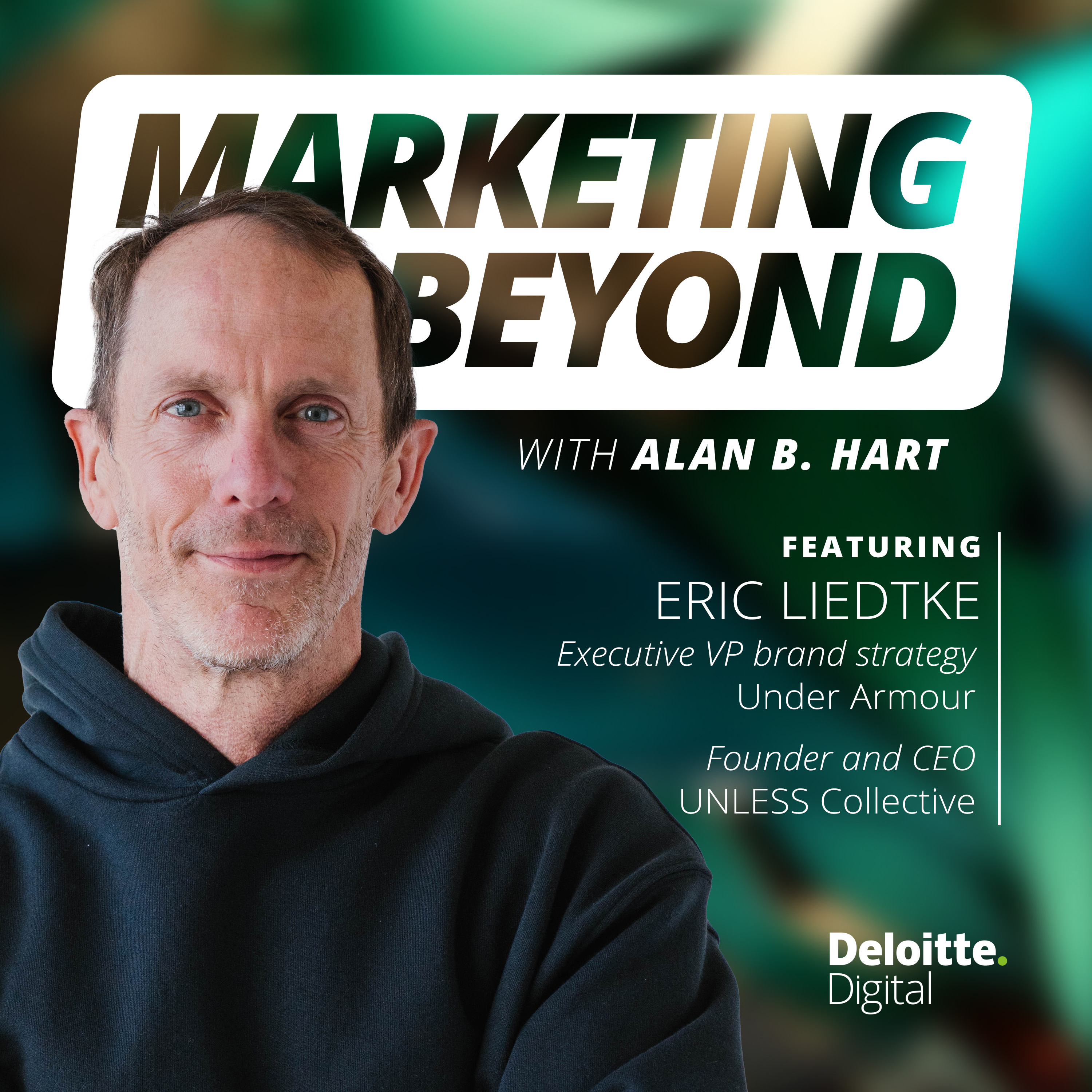
Marketing Beyond with Alan B. Hart
12: Forging a regenerative future for fashion: Insights from Eric Liedtke, executive vice president of brand strategy at Under Armour and founder and chief executive officer of UNLESS Collective
00:38:39
Can streetwear be made with zero plastic? Eric Liedtke says it can be, and he is on a mission to systematically change the fashion industry by shifting away from petroleum-based materials to plant-based materials. In 2014, Eric was...
Loading summary
Transcript58 lines
- [00:00]
Eric Litke
Foreign.
- [00:07]
Alan Hart
Are you ready to go beyond the basics of marketing? I'm Alan Hart, and this is Marketing beyond, where we talk about the questions that spark change and share ideas that challenge the status quo. Join us as we explore the future of marketing and its endless potential.
- [00:27]
Eric Litke
I'm very consistent with everyone I talk to. I'm living my life right now with a very clear principle, zero wasted hours. So if I'm not doing something for myself, for my family, for my friends, for my community, or for my world, I'm not doing it.
- [00:47]
Alan Hart
Today on the show, I've got Eric Litke. He's the founder and CEO of Unless Collective, recently acquired by Under Armour. He also serves as the president of the Under Armour brand. Unless, through Eric's leaderships, developed a regenerative creation model aimed at changing the way footwear, apparel and accessories are designed, distributed, collected and safely returned to the earth. He stepped away from his executive board position at Adidas in December of 2019 to focus on this passion for fighting plastic waste. At Adidas, he led all brands and businesses, fostering a culture of collaboration and innovation, and scaled the Adidas Ecom plus platform to reach $4 billion in 2020. Lickey's leadership drove material and process innovation, sustainability initiatives and streetwear growth, adding over $8 billion in revenue in six years. And he's initiated partnerships to combat marine pollution, including with Parley for the Oceans, and drove efforts to eliminate virgin polyester from Adidas products in 2024. Through all this experience and the conversation today, you'll hear a lot about Unless Collective, what he's trying to do to help save the oceans, as well as into Under Armour strategy and where he thinks the Under Armour brand can go. That and much more with Eric Ly. Well, Eric, welcome to the show.
- [02:17]
Eric Litke
Great to be here. Thanks for having me.
- [02:19]
Alan Hart
Yeah, I can't wait to have this conversation. I mean, we're going to get to talk about Under Armour, entrepreneurship, all. All kinds of stuff, I guess. Before we get started, though, I'd love to know, like, where did you get your career start and how did you end up? You're now like the, I guess, president of Under Armour, Is that right? And you've also got this other role.
- [02:39]
Eric Litke
Exactly. So president of the Under Armour brand, which means I, I look after all creation. So strategy, operating model, product, digital concepts and things like that. So just want to make sure we're clear. We have a. We have a CEO and I'm just, you know, I'm one of many, but my remit is making cool stuff. How did I get my start. Well, it's a long story. How far back do you want to go? But long and short of it is I was sitting in an ad agency in Detroit and I wasn't happy. I was a suit, so I wasn't the creative guy. I was more the client relations. And I just realized that I wasn't happy unless I was doing sport, having done sport, or talking about sport. So I got to work, kind of working my network, and back in the day we called it our Rolodex and finding out who we could talk to and who was in sport. And one of my best friends was working for Adidas, Adidas back in the day, in the early 90s. And he introduced me to some guys that were former Nike guys. If you're following the industry, you may know the name of Peter Moore, who designed the first Nike shoes, and Rob Strasser, who actually signed Jordan, among other things. But those two guys had broken off from Phil at Nike and started the Adidas America subsidiary. And they were hiring. And so in 94, I was like, I got to go work there. And so I. This is before cell phones, this is before email. This is like good old fashioned writing letters and picking up landlines and calling. And I was just relentless. It took me 12 months to land a job there, but I never looked back. 26 years later, you know, I basically started next to the mailroom as what they call sweeper, which is basically someone that did anything. And then I, 26 years later, I found myself at the top of the company, or 20 years later, I was the brand president of Adidas and I was in charge of all creation there as a board member. And I was living in Germany and then I had this wild idea that we could make things out of plants versus plastics. And I left. I left Adidas to kind of fix the problem of microplastics and nanoplastics, which I'm super excited to share with your listeners. And that kind of led me to being acquired by Under Armour in September of last year. So it's been a bit of a roller coaster of big to small to big, but it's been super fun.
- [04:53]
Alan Hart
That's awesome. I mean, one, I mean, just your career going back to 94, before cell phones, that's.
- [04:59]
Eric Litke
That's fun.
- [05:00]
Alan Hart
That's fun. And I mean, I remember the first.
- [05:02]
Eric Litke
I remember the first BlackBerry came out and I was like one of the first ones to have it, like carrying around a Pop Tart in your, in your pocket. It was like, I can email, I can Call people. It was like, what, what's going on here? Like, honestly, it's like, I hate to say it, but we used a lot of fax machines and Teletype machines and stuff to do so. It was like, I've. I feel like I've lived through the world changing events of digitization.
- [05:25]
Alan Hart
I still miss my BlackBerry, to be honest. Like, you know that tactile keyboard, not to mention you could skip it across the parking lot and still pick it up and use it.
- [05:34]
Eric Litke
They, Steve Jobs came in and just swept them out. Like I BlackBerry. The BlackBerry film is a good one. If you haven't seen it. It's a really good movie about like, you know, the climb and the top and the kind of like the arrogance of being on top and then boom. The humility of just dropping to the bottom with, with basically the iPhone coming in and disrupting everything.
- [05:56]
Alan Hart
Awesome. Let's talk a little bit about Unless collective.
- [05:59]
Eric Litke
Yeah.
- [06:00]
Alan Hart
You talked about, you know, long kind of storied rise at Adidas or Adidas as you will.
- [06:08]
Eric Litke
As you will. Very European.
- [06:11]
Alan Hart
But it does, but I think it's more proper. But you know, I don't know it is.
- [06:16]
Eric Litke
But you know, the, it's, it all depends where you live and how you have your background. But yeah, Adidas is the appropriate thing because this is a little fun fact. The founder of Adidas name was Adolf Dassler and so he, his nickname was Adi. So he went Adi and then his first two letters, the last name Adi Das. So that's basically the guy's name who founded the company.
- [06:37]
Alan Hart
Love it. I love it. I love it. Well, you know, from going from there to deciding to focus on plant based materials, like that's a big shift.
- [06:46]
Eric Litke
Yeah.
- [06:47]
Alan Hart
Not only like going from big company to small company, but like you're talking about a fundamental technology shift that you're going to try to take.
- [06:54]
Eric Litke
Yeah, I mean I like to build stuff and I think, I think the big wake up moment was in 2014, parley for the Ocean's founder Cyril Gooch walked in my office when I was at ADI in Germany and said, hey, would you like to save the oceans? And I was like, yeah, I think that's important because I am a sportsman and I like the water even more. I mean, if I'm doing sports in the water, I'm the happiest person on life in the world. But I was like, I kind of got a job I'm doing. I mean, I'm not going to now go be an activist. But he goes, no, no, no, you Understand, you're part of the problems. And I was like, what do you mean? And he educated me then on the role of nanoplastics and microplastic and how it was killing the krill and the phytoplanktons that are in the ocean. The phytoplanktons are responsible for every second breath we have. So once you go down that rabbit hole, it's hard to come back up and be like, oh, everything's normal again. When you realize the impact you're having as the president of a brand that's producing basically billions of products a year that are, you know, made of petroleum based synthetics and nylons and spandexes and things like that that are wonderful, brilliant, breathable, flexible, you know, wicking materials, but they never go away. They're forever materials. So I didn't realize that. And when he opened, when he pulled back that curtain, I was like, I got to deal with that now. Not only am I trying to sell more product, I got to deal with the fact that the stuff I'm selling is now actually killing the ocean and therefore eventually killing us. Because then you go deeper and you're like, oh, these nanoplastics are entering into our bodies and some of us are eating a credit card worth of plastics or drinking a credit card, or breathing a credit card worth of plastics a week. And now you find out you have a plastic spoon worth of microplastics in your brain. You find that you're more likely to die of a stroke or heart disease when you've got nanoplastics in your arteries, which most of us are accumulating at a scary rate. So you can't then turn that off. And there's only so often you can whisper yourself to sleep at night thinking you're doing good things, especially when you have children and you want them to have children. And then you start and their children and their children, the accumulation. So at a certain point I had to say, time out. I, I gotta go try and do this full time. I love my job at adi, but I had this thing in my brain that was bigger than sport. Then it was like, okay, how do I systemically change the fashion industry to get off of petroleum based feedstocks? And is there a way to change the plants and minerals? And that was when I left in 2019 and just before COVID hit and Covid hit and I raised some money and started a brand, you know, remotely on zoom calls like this being like, hey, that's a great idea. Let's, let's try to make some product out of just plants and minerals. And we got to work with a. With a hearty bunch of friends that had similar mission alignment. And it's been a blast. And that was in 2020. We founded ourselves with some seed capital and we then went on to build that up over four years and. And then Kevin Plank, the founder and CEO of Under Armour, called and said, hey, would you like to come on board? And we'd like to buy Unless. And maybe we could. You could. We could have you and Unless. And it'd be a. It'd be a nice partnership. So, yeah, I hope that explains a little bit about the genesis of why and where it ended up.
- [10:21]
Alan Hart
No, it does, it does. And like now with the, the acquisition and you've got kind of like this dual role thing going on. Like, is it bittersweet? Is it all upside in your mind? Like, how do you think about it?
- [10:33]
Eric Litke
I'm very consistent with everyone I talk to. I'm living my life right now with a very clear principle. Zero wasted hours. So if I'm not doing something for myself, for my family, for my friends, for my community or for my world, I'm not doing it. So I have a different perspective than the career climbing, aspirational person I was when I was at Adi. When I was at Adidas. I've now been fortunate enough to be successful in my career. When I was at Adidas, we had a lot of success. We grew the business 8 billion in six years and we quadrupled the bottom line and all the numbers were up to the right share price went from 50 to 300 or I was successful, I had a lot of fun and I was able to take care of my family. So when I did the startup life, I was at a different place than most startup entrepreneurs. So now going back into a big machine, I still carry that with me. So I'm like, okay, I'm here to help Under Armour be the best Under Armour can be. But I'm really here to scale the unless dream. I'm really here to scale this promise of a regenerative future for fashion. And. And can we systemically change the industry from one that's based on oil and petroleum to one that's based on plants so that we don't have harmful nanoplastics and microplastics entering our bodies at an unprecedented rate and wreaking havoc? Because I just think we're at the tip of the iceberg from what actually is happening to us from our plastic exposure. Your skin is your largest Organization and it's absorbing things, whether it be sun or materials or chemicals at a daily minute by minute base. What you put on your skin, whether it be creams or whether it be scents or whether it be clothing, is having a direct impact on what's going in your body. So we're now talking about microplastic exposure. But what about the chemical exposure? Because the other thing that people don't know is plastics require tens of thousands of chemicals to be created and to create and make those chemicals leach into your body when you sweat. So there's a whole discovery thing that I'm trying to pioneer solutions to with Under Armour because Under Armour is great because they believe in the mission, they want to help the mission. We just launched a collaboration at Milan Design Week which was fantastic and sold out. And we're selling it out right now at our, at our Baltimore store really successfully. So we're, they want to scale this idea because what better place to do it than the brand that was built on a material revolution called Stretch to now reinvent the, disrupt the industry with the next one called plants. So yeah, I'm, I'm super bullish on the, on the force multiplier that we have between the two ideas.
- [13:07]
Alan Hart
How, how technical is the solve here? Meaning you go from like performance materials. Right. Like Stretch to your point, like compression. I mean that's the, the historical genesis of Under Armour, right, Is compression.
- [13:22]
Eric Litke
Yeah.
- [13:23]
Alan Hart
And how do you start to think about how do I move that, you know, from oil based or petroleum based materials into plant based materials? And then I, I also have to believe that like sneakers are the, the other. Yeah, that you gotta figure out too, right?
- [13:41]
Eric Litke
No, so it's a great question. You clearly know your topic. So. Yeah, I think so. As a startup that's got minimal capital, you've gotta be very selective on what you choose to, to get into. We were always founded on the as can we make 100% plant based shoe? And I'm happy to say we did that with the Jet Degenerate, you know, version one. It was a work in progress. It's not perfect, but we did have to work around Stretch. There's five things that we to work around. Stretch.
- [14:09]
Alan Hart
Glues.
- [14:10]
Eric Litke
Because all glues are petroleum based foams. Poly. Most foams are polyurethane, which is a compound plastic. And then you've got dyes and ink. So those are like I call the five Horsemen. Everything else we could kind of get off the shelf. You know, I'm wearing a, I'm wearing a crewneck, right? Now it's a robust cotton. We pay attention to how you put it together from a stitch line, from a thread line, from a ribbing standpoint. You know, you can, you can solve those things with mechanical stretch, but for the most part, it's really paying attention to how you put things together. So it's, it's the little details, it's the base material. Yes. But then it's the trims and details, the prints and dyes you put on to make it harmlessly go away within industrial compost or even your backyard. So our stuff, we guarantee everything will go back and create, you know, nutrient rich soil. When you get more technical, when you get into a sock, which took us two years. We do have a sock, but it took us two years to develop with it with the leading sock operation managers at Future Stitch to really help us do that. Because it's complex to do it without nylons. It's easy to do it with nylons. It's easy to do it with, with synthetics that stretch, and those are just basically melted plastics. But to do a mechanical stretch with natural rubber latex and then you get to the shoe and the shoe's super complex to do because you gotta figure out how to cure the outsole. What's the outsole made of? Okay, you have to procure natural rubber latex. You work with a startup called Natural Fiber Welding, which is an unbelievable startup using only plant polymers out of, out of Peoria, Illinois. These guys are doing unprecedented work, but they kind of came to fruition the same time we were at Unless. So we kind of partnered, as in arms, to say maybe we could make the impossible shoe. And that's like we were saying, okay, what's the inspiration from plant based proteins to plant based polymers and, you know, let's make the impossible shoe. That was kind of a rallying cry. And we got to work and we figured it out, but it was like, how are you going to create the compounds? How are you going to put it together without glues? So we have, we went to Italy to make sure we were doing the proper stitching and making. Going back to the, you know, the infamous, you know, cobblers of Italy. They're in the details and they can really make it so really, really attention to detail about how those things come together. Since then, we've solved. There's a small company in Maine called Worthen that's making adhesives that are, that are, that are, that are biodegradable and compostable, which is great. So now we can use a Limited glue, but it's a glue nonetheless. So now we have some glue. So now there's foam developers coming out, there's a lot of great innovations going on. So I think once you start this little, you know, this little snowball on the mountaintop, it's quickly can become an avalanche. And as you find like minded people and engineers and designers and chemists trying to solve the same problem of how do we make our product go harmlessly away. So that's the brief that we have now at Under Armour. And now we enter into a company that's, you know, multi billion dollar company with a lot of capital to invest in research and development. More than a little startup that's, you know, trying to live paycheck to paycheck type thing. So the step move from being a startup trying to solve for things as I talked about, really using things off the shelf and finding other innovators giving solutions to now going inside a big parent company that's as committed to the cause, but now can tap into not only their own research and development, but working with big chemical companies to solve the problem of plastic chemistry versus plant chemistry. And I'm super excited about some of the things that we're finding out there that we can do with plant based solutions. So we're sticking to the mandate of everything needs to go away, but it's now exciting to have the capital behind us to develop new things.
- [17:45]
Alan Hart
That's super interesting. And as you think about like we've talked about, like how you make it possible to make products that can compete similarly to their predecessors, how do you think about the market itself, like the consumer, the brand, like how does that need to evolve to kind of meet, meet people where they are, but also like take them on this journey with you.
- [18:09]
Eric Litke
I, I think it's so, it's great. Thank you for that. I think one of the things that we founded the company on is that there's a, there's a real, I think my, my research at ADI and my experience with Ocean Plastic and some of the things we did there, there's a real consumer insight that they care, right? That's not a question people care. The question is they don't want to compromise their taste, right. Or the quality of the product for their values. And they don't want to compromise really too much on price. They don't, you know, we don't want to make it a luxury thing where you have to, you have to pay 2x or 3x the price point. So, so we really try to meet people at A we don't, we don't want to compromise your taste for your values or your values for your taste because you know, just to give you example, oatly milk came along and did the same thing with plant based proteins. It's like, I'm a vegan, I used to have to choke back, you know, an almond milk latte or okay, but I'm doing it for the world. But now it's like, oh, an oatly, I'll take an oat milk one because it's more delicious than dairy. So that's, and that's the level you need to have when you get into a fashion brand as well. You can't ask people to compromise those things and ultimately you have to build something that within three years with the right volumes can be at unit economics parity with what's currently offered. So we're not, you know, we. Oh, we need, we. Sorry about that. We need to make sure that we have the, the unit economics that come together and meet the consumer where they are. Because if, if it's just a luxury item, if it's just something that only the, the, the very privileged can buy, then it's not going to scale. And, and my ambition is to systemically change the entire industry from oils to plants. So we had to meet both of those. So those are the big challenges to bring the consumer along once you do that. And I would put our, our current unless offer, which is very lifestyle, very skate, very workwear meets streetwear oriented. I would put that up against anything Carhartt and Dickies are doing from a taste level standpoint, from a quality standpoint. So now can we get to the price point? Yes, but we need more volume. So now it's a question of scaling the volume. Again, here comes Under Armour. Who's going to help us scale audience, help us scale distribution. So that's where I think you get into this dynamic. So step one, get the value at the same level they're expecting, get the quality at the same level they're expecting, get the taste at the same level they're expecting, give it built on a better stack. Step two is scale the brand and get the volumes to get the unit economics on par.
- [20:39]
Alan Hart
And you just, you mentioned kind of where this fits in the, in the scan of things you've got. This is in the lifestyle category, if you will, like street wear. Skate to your point. Yeah. Is there a desire? It sounds like there is, but is there a desire to move this into the core Under Armour as well?
- [20:59]
Eric Litke
Oh hell yes. Oh hell Yes. I mean, we started where we were because of the, you know, the capitalization. As a startup, you're always under capitalized, right? And so you spend your money building the product, then you spend your money buying inventory, you spend your money on your employees, and then you're like, oh, we're out of money, but nobody knows about us. So we built this thing. How do we now tell people about it? And like, everything's pay for play now. How do we distribute it? We don't really have a salesforce and they're not just going to come to our DTC site, our E comm site, without knowing about us. So now you're like, are you going to pay thousands of dollars of, you know, a day to try to buy and have some people see us? So now the question of how you scale audience and distribution. So we go inside Under Armour and we're like, okay, now we need to solve for these five horsemen. So the brief, I'm working with the research teams, and this is the luxury of being the president of Under Armour. Also. It's like, okay, strategically, we're focused on this, we're focused on regenerative, we're focused on solving some of these big issues that we're limiting the startup world. And let's solve for Stretch, which is, to your point, is a core piece and capability of all performance product. You need stretch, you need breathability, you need some of these things. So we need to solve for that, which we don't have right now. They need to be invented. And we're in the process of trying to explore those, those opportunities. You need to solve for glues. So if you're going to make a running shoe, are you going to make a basketball shoe? You're going to make a football cleat, you got to solve for glues, you got to solve for plates, you got to solve for pbix, you got to solve for a lot of things. I think they're all solvable, but we have to go one after the other. But the idea is like, can we solve for glues? Can we solve for stretch? Can we solve for foams? Can we solve for prints? Can we solve for dies? If we can do all that, then we can systemically change the $3 trillion fashion industry that's currently based on the back of petroleum.
- [22:42]
Alan Hart
Yeah, I love it.
- [22:43]
Eric Litke
Stay tuned there. But that's the dream.
- [22:46]
Alan Hart
Well, I'm looking forward to seeing where it goes. This is your passion. You can just feel it, right? And you're driving it with Under Armour. Now, are you Also working on the core Under Armour as well or are you just focused on this?
- [23:04]
Eric Litke
Oh no, I'm deep in the machine. I don't wear the title of Under Armour brand president for jokes and giggles and that's something I take very serious. So yeah, we're working on the operating model, we're working on the strategic plan, we're working on building a compelling product and building consumer advocacy. So yeah, we're deep in the weeds of storytelling and everything else. So I spend 99% of my time on Under Armour core business and probably 1% of my time unless. But we have a general manager that does the day to day unless stuff as we build that out.
- [23:39]
Alan Hart
Gotcha. What do you feel like as a brand? Like the core? I don't know what it is. Maybe it's the secret sauce, the core equity that you're trying to play up in the market as you try to think about how do I propel the Under Armour brand itself.
- [23:52]
Eric Litke
Yeah, I think Under Armour is uniquely positioned in the space. I think the roots. I mean first of all we're founder led, which I think gives us a distinct opportunity to lean into. I think anytime you have a founder still engaged in day to day business business, you still have that heart and soul. You know, when I worked at Adidas, the founder was long in the rearview mirror. You know, I think you've got very few brands, maybe New Balance, you could argue the Davis's are still running, but very few brands are still founder led unless there are small ones coming up like you know, I'm running or what have you. So I think from an underarm standpoint, having that leadership, having that, you know, North Star is really, is really inspiring and really motivating on a regular basis. But being a brand that's in the, in the, in the Baltimore, in the heartland of the Northeast if you will. And maybe it's a, a city that's been taken some harder knocks than it deserves. But it's like, you know, it's a, it's an industrial city that is, you know, that really represents the core of Under Armour. Being a brand that is, is apparel founded primarily and grew into footwear is also a differentiator. Especially as a multi billion dollar brand that we are it, it's got, you know, I think we leaning into some of these credentials. So whether it be the founder story of Kevin and being an underdog, whether it be the hard routes of being in, I mean you're in, you're in, you're in Baltimore versus Beaverton, you're In Baltimore. You're in Baltimore versus Boston. You're in Baltimore versus Germany. There's a distinct difference of grit and muscle and hard work and scrap and humility that goes into that. And I'm here for it. I think Under Armour represents a lot of what America is and the values we hold dear. It's no, it's no coincidence that our headquarters is less than a mile and a half from the Fort McHenry where the star Spangled Banner was written. So it's like there's a. There's a lot of. There's a lot of there, there. You know, I think. I think. I think Under Armour, you know, has always been the alpha brand when it came out. And I think, you know, how we dimensionalize that into representing, you know, a few more things is fun and exciting and I'm excited to build it. I don't want to divulge too much because it's, it's. We're not. We're not fully cooked yet, but I see a lot of white space for Under Armour to occupy from its unique positioning as some of the things I just outlined.
- [26:13]
Alan Hart
We'll have to have you come back on when you can share more details.
- [26:16]
Eric Litke
Yes, let's. We're not. We're not at our best right now. Let's. Let's come back on and celebrate the turnaround, which I'm sure is going to happen, but it's going to take a couple years.
- [26:25]
Alan Hart
Yeah, yeah, I hear you. I hear you. Well, one of the things we like to do on this show is to get to know you a little bit better. So I've got a few questions. Less about Under Armour, less about unless, but and more about you. First question I love asking everyone is, has there been an experience of your past that defines or makes up who you are today?
- [26:45]
Eric Litke
Yeah, yeah, many. I mean, that's like. I mean, I. I don't think there's one inflection point that I had. I had a pretty privileged upbringing. My parents were engineers. My dad was a doctor. My mom was basically a civil servant. She was a renowned engineer, worked for NASA, helped design the first satellites that went up into space. My dad was chief of cardiology at University of Wisconsin. My mom then quit her engineering life to come and raise families and be engaged in our lives. And she's basically volunteered her entire life. So I think having role models of parents that were so service oriented and were so bigger than transaction, I mean, my dad made a decision as a doctor, and people that will know this. Well, you have to you make a decision. You can go into private practice, you can go into research. And there's two different paths and they're both intriguing for different reasons. One's probably much more desirable from a financial standpoint, private practice. One's more desirable to discover solutions to big problems. My dad went into that one, so he was a university guy that basically was trying to cure heart disease. And you don't realize the impact that has on you, but you absorb that. My mom, meanwhile, she's volunteering and founding senior citizens homes and she was the CEO and the CFO and raising money to build out not just senior citizens, but assisted living and then the whole network. And so now they've got. She basically is, you know, that has helped build up this place called Addicts Angels in Madison, Wisconsin. That's this metropolis of just how people can age gracefully is the best way I can say it. And never be shamed by putting in a home to die. You know, it's like, no, you come in when you want to have assisted meals coming in and you make a community and then, okay, then you can graduate to the next level if you need more service and the next level, yes, it is, but it's all there. So. So anyway, my long story short, I was surrounded by people that were giving. I was surrounded by people that were purpose led and not transactional led. I went the other way. I went into business. I went, I became a very, you know, transactional, you know, but, but I've come around full circle now to be very purpose led and very intentional with every decision I make. Even being with you today, it's like, is this going to help my world, my community, my friends, my family? Yeah, yeah, it helps all of the above because it helps me get the word out on less. But I believe living your life with purpose and always keeping in mind legacy is really important. And I learned it from my parents for years.
- [29:18]
Alan Hart
Right. Well, what advice would you give your younger self if you were starting this journey all over again?
- [29:23]
Eric Litke
Party less. Because living, I'll add on that, living with that kind of, you know, that kind of role modeling, it's hard. They were high achievers and I was like, I'm rebelling. I'm going over here and I'm going to drink and smoke and do what I need to do to disconnect from this world of perfection. So I did that and I came through that and I came through a lot smarter. But I would have liked to maybe stop a little earlier. But all kidding aside, I think there's one Vice. I love giving to myself and everybody I work with is don't let perfect get in the way. Better. I think sometimes we dream too much about perfect end states and even being a startup. Well, no, just every day you got to get better. Every day just take a step. Every day take a step. And if you do that, all of a sudden you look up and say, holy, look how far I came. It's like climbing a mountain, right? You don't realize that when you, when you, when you stand at the trailhead and you look up at the mountain, you're like, I don't. That's a lot. And then you, you look, you look back and oh my gosh, I come so far. Oh my gosh, I've come so far. So I think it's just really breaking journeys down into steps. And so I would, I would, I would really lean into that if I were giving that advice to myself.
- [30:37]
Alan Hart
Love it. Well, is there something. Either you're trying to learn more about yourself or you think marketers. This is a show primarily for marketers. You think marketers need to be learning more about. Could be either.
- [30:51]
Eric Litke
I think marketing in general and I'm learning this. We just hired a head of marketing, Under Armour, Tyler Rudstein, and he's probably 25 years younger than me, which, you know, I don't let him ever hear that. But, but he's bringing in a whole new playbook. And I think the marketing rules are changing systemically. Like, you know, just from a general marketing communication. I mean, it's no, it's no, it's no news to anybody that, you know, nobody's watching TV anymore. The cable cables have been cut, everything's streaming all the time. User generated content is blowing up. But it's like it's really paying attention to those trends and making sure you can capture on them. It's the real. If you want to get into the comms marketing 101, it's like I'm shocked at how fast the industry has changed and continues to change day in and day out and how you go one day from building these glorious cruise ships of these commercials that run for 30 seconds and that you've taken six months to build them. And oh my God. And you. And it's like it doesn't matter. It's like nobody's watching the super bowl commercial anymore. I'm sorry. It's like that's a bunch of boomers and Gen Xers. Like, if you want to get to today's consumers, how are you breaking that down? For TikTok, how are you doing it with user generated content? How are you doing it from almost the most unpolished version you can do? It's like, this is what, you know, like, let me hold my phone up. A selfie is the new comes. It's like, it's just from a classic trained marketer like myself. Like, that's just. I mean, no, I'm used to being in a studio with LED lights and backdrops and. No, it's like those days are kind of over. It's the unpolished, the unsanctimized, the raw. People want real. They want to feel like they're talking to a real person. It's like one of the things Tyler taught me yesterday, it's like internal is the new external. People want to know behind the scenes and they don't want to have a glorious story. They want to see the innovations in real life. They want to hear the founder story going back to my again, what Kevin brings that others don't have. They want it. It's a rich real. There's authenticity there. I think people crave that. So how do you become the more authentic, true self on a regular basis? Is the advice I give to anybody that cares to take it.
- [33:01]
Alan Hart
Yeah, no, I appreciate that. And then two more questions for you. Is there any, like, trends or subcultures that you personally follow or take notice of? I'm just sure the question is really.
- [33:15]
Eric Litke
To me, it's like, I mean, that's where you have to geek out at what you love. And there's people that love cars, there's people that love motorcycles, there's people that love computers. I love everything surf. So I'm a pretend surfer. I like to surf. I can get on a wave, I can pop up, I can ride a wave, but I'm certainly not an achieved, accomplished surfer. But there's something profound for me about being in the water. It speaks back to why I'm doing what I'm doing. About feeling, feeling the, the, the breath of the earth underneath your board. You know, there's something really spiritual about that for me. And so I just geek out on the whole surf culture, surf vibe, surf look, you know, surf origins, waves, you know, that you, you name it, anything that has to do with that kind of. It's not so, even so much about the subculture, but there is one big one there. It's, it's even about the, the natural elements that create, you know, the, the waves, you know, is it. The waves is the last, you know, when you ride A wave. It's the last breath of that wave. That wave may have traveled thousands of miles, but the end is the beginning, which is the, you know, so it's like, it's like the end is the beginning of your ride. So anyway, again, like I said, I can get very philosophical here, but it's kind of what we're doing with regenerative fashion as well. We start with the end in mind. So it's like somehow they all relate back and maybe it's a mistake, maybe it's the universe whispering, whispering to me quietly.
- [34:39]
Alan Hart
It feels like everything in your life is coming in alignment.
- [34:45]
Eric Litke
I feel very content.
- [34:47]
Alan Hart
Yeah. Well, last question I have for you. What do you think is the largest opportunity or threat facing marketers today?
- [34:54]
Eric Litke
Well, the easy answer there is AI. But how? I think the largest opportunity is absolutely how do you automate and how do you target people more effectively? I think there's. AI is doing that wonderfully. I mean, it's like, it's unbelievable what AI can do for you. From a creation standpoint, from a tool standpoint, from a targeting standpoint, from optimization standpoint to storytelling standpoint, I think that's an opportunity and a threat. I don't think AI is very authentic yet. And I think people crave authenticity. I think there's a reason why people love user generated content. They love hearing from people they trust. And you develop these relationships with people you follow through TikTok or through YouTube or different channels. I think there is a. They let you see behind the scenes so you get to know the person. Like I follow this person, Nathan Florence, which is John. John Florence, which is one of the best surfers in the world, but he does these vlogs on YouTube and I can't get enough of them. They're 15, 20 minutes long. But it's not just him riding waves, which is spectacular. It's him discovering new places, him going on tour, him and his wife Photograph photographing him, him not being able to paddle out because I can relate to that. But it's super raw and authentic. A. I could never do it because it requires a deep insight. You have to go down the rabbit hole of understanding surfing and his experience of traveling, traveling with a surf with multiple surfboards and trying to check in in an airplane and all that nightmare of them breaking boards and like, all that. But it's all. I'm there for it because it's like, it's a lived experience that you can appreciate. So I think it's how marketers tomorrow can use the tools of AI but the craft of authenticity. And so this word I used to like to use at IDAS from my friend Paul Gadia. He used to talk about the best way to craft the best way to predict the future is to craft it. So we came up with a term called future craft, which is a beautiful term about how you bring the authenticity of yesterday's atelier shops from a fashion and you blend it with the innovation of tomorrow. I think marketers need to think about the same way. How do you keep it real and personal and human and authentic while using the tools of AI tomorrow?
- [37:17]
Alan Hart
I love it. Well Eric, thank you for coming on the show. This has been fascinating.
- [37:22]
Eric Litke
I hope so. It was enjoyable for me. I always like having discussions about cool stuff and so yeah, maybe I'm not the coolest, but I like to talk about things that are interesting to me. So I appreciate your your interest and hope so. Hopefully somebody gets some value out of it.
- [37:37]
Alan Hart
The views, thoughts and opinions expressed are the speaker's own and do not represent the views, thoughts and opinions of Deloitte. Material and information presented here is for general information purposes only and does not imply endorsement or opposition to any specific company, product or service. Service Hi, it's Alan again. Marketing beyond is a Deloitte Digital Podcast. It's created and produced by me with post production support from Sam Robertson. If you're new to Marketing beyond, please feel free to write us a review and subscribe on your favorite listening platform. I also invite you to explore the other Deloitte Digital podcast@deloittigital.com US podcast podcast and share the show with your friends and colleagues. I love hearing from listeners. You can contact me at marketingbeyondeloit.com you'll also find complete show notes and links to what's discussed in the podcast today and you can search our archives. I'm Alan Hart and this is Marketing Beyond.