← Marketing Beyond with Alan B. Hart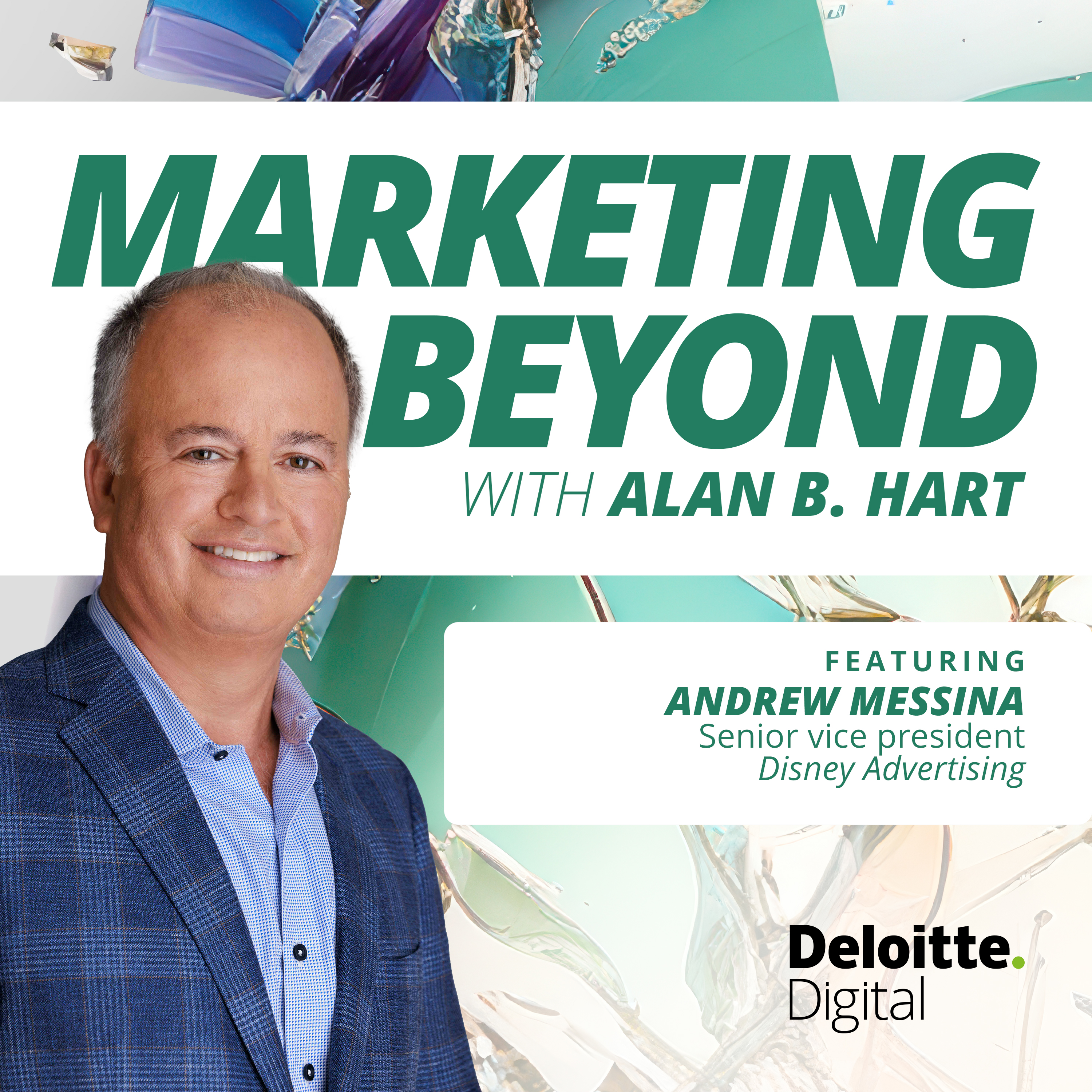
Marketing Beyond with Alan B. Hart
16: Driving audience engagement with the magic of Disney: Insights from Andrew Messina, senior vice president at Disney Advertising
00:20:11
Andrew Messina is a Senior Vice President at Disney Advertising. He began his career on the agency side before moving into daytime sales at ABC, then advancing to a primetime senior account executive role, and ultimately rising to his current...
Loading summary
Transcript47 lines
- [00:00]
A
Foreign.
- [00:07]
B
Are you ready to go beyond the basics of marketing? I'm Alan Hart, and this is Marketing beyond, where we talk about the questions that spark change and share ideas that challenge the status quo. Join us as we explore the future of marketing and its endless potential.
- [00:26]
C
Foreign the show got Andrew Messina. He's the senior vice president for Disney Advertising. The Disney advertising includes linear, programmatic, and addressable many brands that we know, Disney, Disney plus, Hulu, fx, and many more, as well as espn. On the show today, we'll talk about integrations, sponsorships and advertising and the evolution of advertising. We'll also talk about the changing landscape of advertising and the explosion of women's sports and how they're taking advantage of that opportunity. That and much more with Andrew Messina. Well, Andrew, welcome to the show.
- [01:11]
A
Thanks.
- [01:12]
C
I'd love to know how you ended up in media.
- [01:15]
A
Well, I had a not the traditional way like kids these days. I was a history major and at Tulane. And my interesting story of how I got in the business is not the traditional like it was in the past or, you know, currently with kids, you know, logging onto LinkedIn. LinkedIn. I started looking for a job in New York City, and I saw a classified ad in the New York Times, and I sent my resume into this small advertising agency and this woman responded to me after I sent it in two weeks, you know, prior. And I go, thanks for meeting me. How'd you decide to pick me as all these resumes? She goes, my boyfriend saw your resume on the kitchen table and you went to Tulane. And he went to Tulane. So I decided to interview and she gave me the job at a small agency.
- [02:06]
C
That's amazing. That's the power of networks.
- [02:09]
A
Well, it's not how it's done today.
- [02:11]
C
No.
- [02:12]
A
Which we can get into later.
- [02:13]
C
Yeah. That's awesome. What was from that very early job to now being senior vice president, Disney Advertising? What was the path? What were some of the big stops?
- [02:22]
A
So for me, when I started small agency, then I went to McCann Erickson, I worked on some big brands like Nestle and Coke. And I realized, you know, I really wanted to get into the sales side of things. So I started as a daytime planner in 1994 at ABC. So that's prior to Disney. That's, you know, that's. We were Cap City's abc. So I worked in the heyday of when, you know, daytime television had some big ratings in General Hospital, All My Children, One Life to Live, and then we had the O.J. simpson trial, which basically destroyed daytime television because all they ran was the trial, right?
- [02:56]
C
Yeah.
- [02:56]
A
And then what happened there is, you know, loyal viewers on daytime couldn't watch their show for six or eight months, so they lost interest. And the daytime ratings from then on kind of just kind of disintegrated. And then I moved into primetime because it's a natural progression of promotion. And then there was an opportunity for me to move to Los Angeles as a senior account executive. Actually selling, did that for five years during the dot com boom. Had three of my four kids, loved la, no plans to moving. I was going to be an LA person and then got promoted to VP in New York. So that changed my life a little bit. And then for the last 17 years, I've been senior vice president at Disney because we were bought by Cap City or we were bought by Disney in 1996. But in the last seven years we've had a lot of different. The media landscape has changed for up until 2017. I was just selling ABC after that. Now under our umbrella we, you know, we sell Disney Channel, abc, Freeform, espn, fx, Nat Geo, you know, all the, you know, Disney plus is massive now. Five years ago there was no advertising. So a lot, a lot has changed.
- [04:07]
C
Yeah, well, you've seen a lot. What is the scope? I mean, besides those properties you just listed off, what's the scope of the role that you have right now?
- [04:15]
A
So right now I oversee, my most recent role is I overse all the brand partnership, the client partnerships under the team. So we have an investment team that handles the agencies and I handle all the brand partnerships. So all of the clients under those major holding companies, I work with all those companies. And my primary responsibility is to develop the relationships with the senior C suite people like the CMOs, CFOs and CEOs. So I've been doing that for the last seven years across categories, across agencies. But in the last year, really more so just I'm focused across all the entire brand team. So we have an entire brand team under myself.
- [04:55]
C
Okay, well, if we just pick out sports for a minute, like how have you seen, you know, consumer, you know, brands, I guess, and integrations and advertising shape the sports landscape and the consumer engagement for sports.
- [05:12]
A
Yeah, I mean, right now, when, when you talk about Disney advertising sales, we have the best in class, you know, across all properties. We're, we're very fortunate. But when you talk about the main priorities for us, it's streaming and it's sports and live sports. Right now, if you talk about the NBA, we just renewed our rights deal with them. We have we have Monday Night football. We have 70% of the rating points in college football because we picked up the SEC network. We have all, all the college football championships. So we have a ma. Massive, massive, you know, reach in that aspect. And when you talk about sports, a lot of our major, major clients, we probably five years ago had multi year deals, which is a two, three, four, five year deal with certain clients. We probably had five to 10 of those a handful of years ago. Now we have probably upwards of 70 plus multi year deals because even though there's a lot of sports, there is not, there's, there's not a lot of real estate. So the demand on live sports now is, is better. It's been, you know, hotter than ever. And you know, I don't know if you were going to touch on women's sports, but you know, women's sports right now we've been business for 30 years, but over the last couple of years the women's sports specifically has just, has blown up. The wnba, the, the women's NCAA tournament, which we had a couple years ago with, you know, which we still have but under with Caitlin Clark. Those numbers for that, for the NCAA women's were higher than the men's.
- [06:44]
C
Yeah. Hopefully that's creating more real estate for you, for you and brands to try to figure out how to, how to make it work.
- [06:51]
A
It is. And I think we are, brands come to us because whether they're a legacy brand or a new brand, you know, they come to us because they're trying to launch a product and you know, we, we have our first Super bowl in 20 years, in 2027, which is very exciting. Last time we had it was in Detroit in 2006. Now we'll have it in LA in 2027. And you probably saw the super bowl sells out, you know, pretty quickly. If you're, if you're launching a, a major automotive brand right now, you, you know, you want to be in the super bowl, you want to be in the national championship, you want to be in the NBA Finals. So when you. We have game six tonight, Oklahoma Pacers on abc. And the demand for NBA has been, has been spectacular.
- [07:40]
C
Well, Andrew, like you've got under your remit and under Disney advertising so much variety of properties and types, opportunities to connect with consumers. If I'm a brand, how do you, how do you manage that? How do you bring that power of everything to two brands?
- [07:59]
A
Well, I mean it goes back to what I was saying earlier is, you know, we have a, as you said, the portfolio is Massive. And it allows us to reach every single audience across every single demo. And when I look at our cultural calendar from the entire year, you start in January with New Year's Rock and Eve, and then you end, you know, with college football and NFL. So throughout the year we have touch points for marketers. So there's really not a time of year that we're not really making an impact, whether it's streaming sports or entertainment.
- [08:35]
C
Love it. Awesome. Well, a lot of brands are trying to experiment with co creation with consumers. I'm curious if you've experienced or have any thoughts on how that might shift or change or augment the advertising landscape for you at Disney?
- [08:52]
A
Yeah, I mean, I think it'll evolve, but at the same time, live sports, what we're able to do on site for certain during the national championship games, whether it's an auto or a qsr, those experiences, you know, we, for instance, college game day, if you're a college football fan, you are watching college football all week long and we, we cover it. The best thing about it for us is, you know, you've got ESPN.com which covers, you know, seven days a week. And then, you know, we've got lead up on espn, you know, Thursday, Friday, Saturday, and then Saturday college game day. You would think that the ratings, because you look at linear ratings, have kind of plateaued. On college game day, they were up 16%, which is huge, you know, significant number. So that makes our sponsors a lot of, you know, very happy. And also, quite frankly, it just creates the more demand. So if we, if somebody pulls out of college game day, we are pretty much, it's pretty easy for us to replace them. So high demand.
- [09:53]
C
Well, you mentioned, you mentioned auto before, especially as getting in those big marquee moments. If you think about auto and retail, like, how do you see like the different strategies playing out? Like, is there a leaning towards one versus the other in terms of how you think about packaging the right approach for them?
- [10:11]
A
Yeah, no, I think they have their own approach. And what we do is we customize, you know, we really, they give us their brief of what they're trying to accomplish, whether they're launching a new product in a restaurant or whether they're launching a new auto or it just depends. Well, we'll customize it to their needs.
- [10:27]
C
Meet them where they are. Okay, is there any like, any standout moments for you in terms of what retail is doing or what auto is doing today?
- [10:36]
A
I mean, I think retail, the gold standard on retail is college game day built by home Depot, they've been with us for 23 years. It's their gold standard. And, you know, we build all these things. These are built by, you know, our entire. We have a sports brand solutions team which handles sports integrations. We have an entertainment brand solution that handles our entertainment like the Oscars, Country Music Awards. But we. This is, you know, my role is to work very, very closely with the CMOs and make sure that they're happy with everything. So, you know, I'm on the road a lot talking to these clients, going down to Atlanta to meet Home Depot, going to Detroit to meet the autos. So we want to make sure, because you look at Cannes right now and you see how many people are here, relationships really, really still matter. And the only way some of these things are going to get done is through making sure you're connected.
- [11:29]
C
We've been in the business for a long time, both on the agency side and on the media side. What's like maybe one big transformation you've seen over the course of your career?
- [11:39]
A
I would go back to relationship. Back when I started in the business, you had a lot of internal relationships. But we weren't out early in my career on the street when I, When I moved to LA and during the dot com boom, we. I was on the road every week in la, San Francisco, Seattle, you know, Portland, meeting with all the different clients there and developing those relationships early. Earlier on, there was, it was. I think it was more transactional. The relationships really, really matter. And I know, you know, a lot of things have been automated and we're moving, you know, fast and furious towards 75% of our inventory, you know, in automation. But at the same time, like I said, look at can. There's all these people here and they're all building relationships.
- [12:21]
C
What is it? I mean, you've been in various types of sales and general management roles, like that notion of relationships. And can you put your finger on, like, what it is that makes it so unique and special?
- [12:34]
A
Well, I mean, I think the main factor is trust. Like, you know, just like, you know, you have good friends for a long time. And when I meet young kids in this, you know, who are coming out of college, one of the things that I didn't have, you know, I got my, my first start off a coffee table, right? Okay, Now I have so many kids because I have, I have so many kids come to me, college graduates, because I have four kids and everybody's like, oh, you work at the Walt Disney Company. Can I come meet with you? And I'm Happy to meet because I want those kids, when they move up the ladder to do what I'm doing and meet with them. So I think the biggest difference right now is the relationships. I think they matter much more than they did 25 years ago.
- [13:16]
C
Well, one of the things we like to do on the show is to get to know you a little bit better. I know you got that early start in your career responding to the old ads, if you will. Has there been in a experience of your past that defines and makes up who you are today?
- [13:30]
A
Yeah, I would say I go back to LA again. Somebody gave me an opportunity. I was first of all given the opportunity, abc. But then three years into my career, I was on the prime planning side at ABC and somebody, and there was a person running the LA office. I didn't have, you know, I didn't have direct sales experience. I wasn't a salesperson yet. And he gave me the opportunity. And the opportunity, like I said, was right before the dot com boom. So I was forced to then with him go out to see all the clients and explain what we were doing at abc. And then, you know, we were meeting with these, the e trades, the eToys, you know, all those E companies and we were, we were just having fun, you know, and we were, and we were making money. So that kind, and then that kind of changed the trajectory of my career because that really got me deeper into sales and I really broadened. That's, that's how I really honed or started honing my skills from a relationship.
- [14:26]
C
Standpoint, that investment by him to you.
- [14:29]
A
And so that's the rope. That's kind of what I'm doing now with a lot of people. And I, you know, we, at Disney, we have a great mentor program. So we've, you know, I have, you know, over the years, I still have a lot, I have a lot of ex mentees, but once you have a mentee, they're your mentee for life. So I still mentor a lot of kids when they're starting work, but I also have a lot of internals and I think it's probably one of the most rewarding things because I didn't really have that mentor, but I did have people along the way in my career. Nobody does it on their own. And I even tell my own kids, when you're starting off in your 20s, that's the beginning of your story, the rest of your career. And because in your 20s, you're pretty stressed out if you're, if you don't have direction. But I Think a lot of kids now and there's a lot of pressure on these kids coming out of college. So I think if just explained them, it's easy for you to, easy for me to say, you know, don't stress out about it. But if you give them, you know, the, the advice of, all right, just keep your legs moving, keep your head down and work hard, it's not easy, but it's also not that difficult.
- [15:34]
C
I love it. Well, if you were thinking back and, and that younger self, you know, looking for that first job or after that first job, you know, where are you going to go next? What advice would you give your younger self?
- [15:47]
A
Just that I would say to myself, don't try not to stress and make sure that if you can outwork everyone and open every single door that you can. Because this has been a tough or an Interesting last 5 years for this generation because they were at home for a handful of years and quite frankly we're in the office four days a week and we're not in on Fridays, we're working from home. But I mean there was a long time that we were a year plus that we were at home five days a week. And I think, you know, that hurt the, you know, the relationship building for some of the younger generation coming out of college. So I think my advice to my kids and everybody out there is get out there and develop the relationship. You never know where your next opportunity is going to come from. And if you're not having those conversations and you're not having those in person meetings, it's not, it's not going to just, it's not going to fall in your lap.
- [16:43]
C
Was there a topic either you're trying to learn more about or you think marketers need to be learning more about today?
- [16:48]
A
Well, I mean if we're in can and you don't say I, you're in trouble. So I, I am reading Mark Britton's book There's an AI right now and I just think the more I can learn about AI, the better off I think everybody's going to be because it's, it's not going away. I think over the next three, four or five years it's going to drastically change every single business. But I think in a lot of ways it' going to change it in some good ways.
- [17:14]
C
Yeah. Are there any trends or subcultures that you're following you think other people should take notice of? Basically what I'm most interested in, like what are you curious about in the world right now?
- [17:23]
A
I mean, it goes back to the younger audience again when, when we need, we need to cultivate the younger audience. And you know, and marketers are very focused on the younger audience because you may not be wanting to buy a luxury car when you're in your 20s, but the luxury car makers and they, they want to target you because they want, once you're able to afford that, they want you to subconsciously know I want that car when I' so I think in this fragmented world, you really, really need to focus on the young kids because they are all, they have a lot of choices and there's, you know, there's not just a handful of retailers out there. There's not just a handful of consumer. There's constantly new products going out there that are. One would have thought that in the retail world there was a handful of retailers. Now we all know with the advent of you can just go online and buy what you want. There's a lot of different choices from apparel to SN sneakers or whatever, you may have it. So I think focusing on the younger audience and making sure that you're, you're attracting them and you're reaching them, that's critical for the marketers.
- [18:25]
C
Well, last question for you. What do you think is the largest opportunity or threat facing marketers today?
- [18:31]
A
I think getting completely being complacent just thinking and coming from Disney, we have a pretty good position because there's the upper funnel and there's the lower funnel. We pretty much cover in that, that entire funnel. And I think the big threat for some of these marketers is they need to make sure that they're reaching that entire funnel. So to me, they need to make sure that that's covered. Otherwise it could be an issue.
- [18:55]
C
Well, thank you for coming on the show.
- [18:57]
A
Thank you very much.
- [19:01]
B
The views, thoughts and opinions expressed are the speaker's own and do not represent the views, thoughts and opinions of Deloitte. Material and information presented here is for general information purposes only and does not imply endorsement or opposition specific company, product or service. Hi, it's Alan again. Marketing beyond is a Deloitte Digital podcast. It's created and produced by me with post production support from Sam Robertson. If you're new to Marketing beyond, please feel free to write us a review and subscribe on your favorite listening platform. I also invite you to explore the other Deloitte Digital podcast@deloittigital.com and share the show with your friends and colleagues. I love hearing from listeners. You can contact me at marketingbeyondeloitte.com you'll also find complete show notes and links to what's discussed in the podcast today, and you can search our archives. I'm Alan Hart, and this is Marketing Beyond.