← Marketing Beyond with Alan B. Hart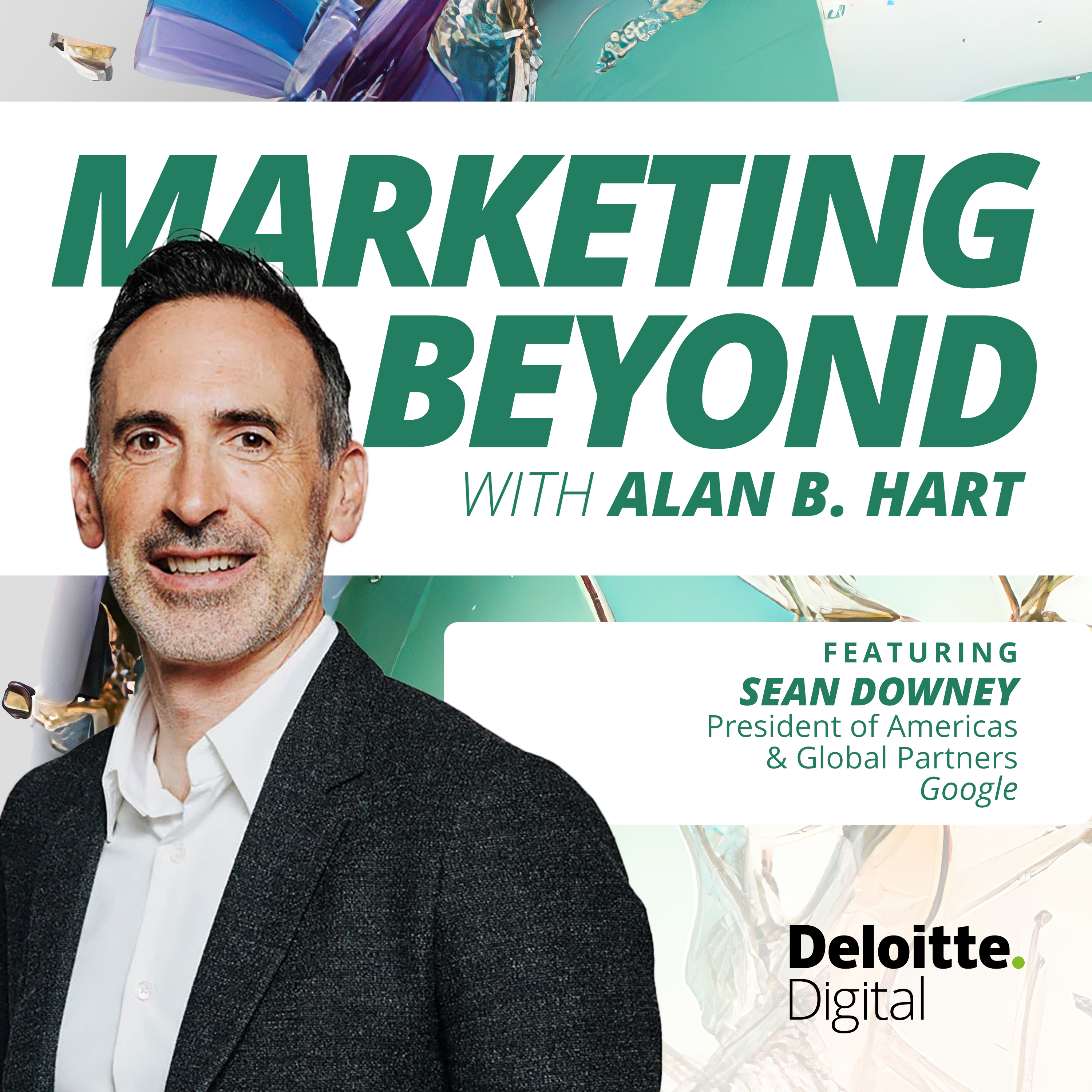
Marketing Beyond with Alan B. Hart
17: Google it: Smarter marketing with AI: Insights from Sean Downey, president of Americas & Global Partners at Google
00:33:59
Sean Downey is the president of Americas & Global Partners at Google, overseeing the company’s expansive advertising business, including Google Search and YouTube. With a background rooted in the earliest days of digital marketing startups and...
Loading summary
Transcript129 lines
- [00:00]
Alan Hart
Foreign.
- [00:07]
Are you ready to go beyond the basics of marketing? I'm Alan Hart and this is Marketing beyond, where we talk about the questions that spark change and share ideas that challenge the status quo. Join us as we explore the future of marketing and its endless potential.
- [00:26]
Foreign.
- [00:32]
The show I've got Sean Downey, president of America's and Global Partners at Google. Sean leads the advertising business for Google, which makes up roughly somewhere around 70% of the business. We talk about the evolution of marketing and advertising platforms at Google, talk about AI and automation, how that's been integrated into the Google platforms for anybody to use it that can use Google Ad platforms themselves. We talk about change management and the leadership principles that he puts in place to help his teams be more innovative and adapt to change in a growing marketplace. That and much more with Sean Downey. Well, Sean, welcome to the show.
- [01:18]
Sean Downey
It's great to be here, Alan. So, so happy to talk to you today.
- [01:21]
Alan Hart
Yeah, me too. So, before we get talking about business, I have got this interesting stat that you've been to approximately a thousand youth baseball teams.
- [01:33]
Sean Downey
Youth, that's the critical word right there. At least a thousand.
- [01:36]
Interviewer/Host or Guest Contributor
Yeah.
- [01:36]
Sean Downey
I have three sons, they all play baseball. And I have one, one that's better than the others. And so he's a fairly accomplished travel player and he travels everywhere the weekends to play baseball since he was 8. So I've been in every state, almost every hotel. I even left Cannes last year early because he had a tournament in Georgia. And I think it's important to do those things with your kids because it's a little bit life balanced, but also shows your personal range. And what I love to tell people about it is like one night I was here, I was in the Mediterranean. I was sipping rose, just having a great time, and then 24 hours later, I was on a fly fishing boat on the Chattahoochee River. So, so pretty good. Fun, fun life day.
- [02:15]
Alan Hart
I love it. I love it. I love the, the spectrum there too, that you're illustrating.
- [02:20]
Sean Downey
Everyone loves work life balance. Yes. And work life balance comes in, you know, sometimes you have more work, sometimes you have more life. But I think we should all be normal humans. Baseball teaches life lessons. It teaches failure. I'm a huge growth mindset person and it's kind of fun to see your kid go through it because he's going to be a better person. It's a, you know, keeps the personal. It keeps me grounded when I'm coming to work.
- [02:41]
Interviewer/Host or Guest Contributor
I love it.
- [02:41]
Alan Hart
Well, what was your path like? Where did you get your Start in your career. And how did you end up, you know, the President of America's and Global Partnerships at Google. Big job. How'd you get started?
- [02:52]
Sean Downey
It was unintentional to find my way to this job. When I started in the workforce, there really wasn't a Google, at least a Google that anyone knew about. I think it was still. I think it was still in the garage in Menlo Park. But I, I'd like to say there was a grand plan or that, you know, I trained to do this role. Um, I don't think I'm any smarter than a lot of people walking down the crosset here, but I was willing to take some risks in my career and I joined the digital marketplace in a schoolhouse in Chapel Hill, North Carolina, building web design websites. And I took that job because nobody else wanted it. And I thought it'd be a place I could differentiate myself and build a career because this Internet thing was new back in that time. And then I just found myself in a really fortunate place to learn that industry from the ground up. I did some startups, some that worked, some that didn't. I worked with some great companies along the way like DoubleClick and I was fortunate to get acquired by Google and then here I am in this seat. But I think that's because I took a risk of something that was ill defined and then worked really hard to master my craft and do well at it. And sometimes that works out for you. And even if you're not the smartest person in the room or the most pedigreed person, you just work hard and take risks and you're going to find yourself in that fun spot.
- [04:08]
Alan Hart
That's awesome. I love. I'm gonna pull on this thread a minute because I'm also from North Carolina and the. Your connection to North Carolina and that story was pretty cool. I grew up in North Carolina. I went to NC State and then UNC for business school.
- [04:24]
Sean Downey
So. Amazing. So I was in a schoolhouse in Jordan Lake.
- [04:28]
Interviewer/Host or Guest Contributor
Yeah, yeah.
- [04:29]
Sean Downey
Which was a really remote part of Chapel Hill where UNC is located.
- [04:33]
Interviewer/Host or Guest Contributor
Yeah.
- [04:33]
Sean Downey
Now it's highly populated. My first son, my first baseball player son was born in Raleigh.
- [04:38]
Alan Hart
Durham.
- [04:39]
Sean Downey
Yeah. So and I moved there because I went to school in Buffalo and it was really cold there. Was the opposite of Cannes.
- [04:44]
Alan Hart
Right.
- [04:45]
Sean Downey
And I wanted to go somewhere warm and work and work and find a job. And, you know, that launched my career. And it's really weird to tell people you launched your advertising career, especially in digitally in Chapel Hill, North Carolina.
- [04:56]
Interviewer/Host or Guest Contributor
Right.
- [04:57]
Sean Downey
Like, nobody does that. No, like you have to be in New York or Silicon Valley. And I'm a native New Yorker, so I ended up back in New York.
- [05:04]
Interviewer/Host or Guest Contributor
I love it. I love it.
- [05:05]
Alan Hart
Well, talking about Google's advertising business today, like, what is the scope of it? I mean, I believe if my numbers are right, it's roughly 70% of the revenue today. But tell me more about the scope.
- [05:17]
Sean Downey
Well, it's the biggest business in Google, as you know, and we drive a lot of growth for a lot of companies. I think that's our core value proposition. And as the economy does well, whether you're a small business or a big business, we get, we grow when you grow, right. And that's important for us. But really we're in the business of helping people grow their business. And we have these two amazing platforms that we focus the business on. We have this thing called Google Search and people have heard of it. It's where people go to find information, to ask questions, to get the answers that they want. It's where small businesses, whether you're in New York City or in Chapel Hill, North Carolina can connect to commerce around the world and grow their businesses. And it's an amazing place to connect people and grow. And we think we solve a lot of critical problems and growth for our partners. So that's a huge portion of our business, obviously. And then we have this amazing platform called YouTube. Up and down the quasi, you can, you can't go five feet without meeting a creator. We are celebrating our 20th anniversary for YouTube and we're celebrating that the beach today down the street, but that's another place that's had its own ecosystem, is where people go to be entertained. There's really only one YouTube and we do short form, long form audio podcasts. It's a billion hours of podcasts watched a month.
- [06:34]
Alan Hart
Right.
- [06:34]
Sean Downey
And that's a place to build a brand, to build resonance with a consumer base, to, you know, get into a community. And that has a lot of solutions that help people grow their business. And also people build careers if you're a creator. And that's really the scope of the ads business. We have incredible places where you discover you can be influenced and then it's a really critical path to purchase that drives a lot of value for advertisers, publishers, creators, and ultimately allows consumers and people, consumers are people to find what they need and get a lot more educated.
- [07:06]
Interviewer/Host or Guest Contributor
Right?
- [07:07]
Alan Hart
Well, there's a lot of evolution, if you will, in the digital marketing space. You've got consumers, you've got privacy. How is Google Kind of adapting its ad solutions to meet consumers in a more private world, but also help marketers drive marketing effectiveness.
- [07:26]
Sean Downey
Well, number one, we always start with the consumer, so thank you for asking it from that lens. Consumer privacy is the most critical thing for us. People are coming here to find something that improves their lives, whether it's personal information about something important in their life or to find a product that's going to improve their family life. And protecting their information, protecting who they are, all while delivering relevance to them is really important. So we want to build solutions that serve that purpose so that we can have a good ecosystem and for markers, we want them to be successful, so we want them to make sure that we can go into a situation where they can find the right audience that's identified and work all the way through an influence curve to get to some level of purchase or intent. And that can be done in a really privacy safe way. Like you put it from a cookie ID perspective, like there are a lot of ways to do targeting and most of them are privacy safe.
- [08:21]
Alan Hart
Right.
- [08:22]
Sean Downey
So we really focus on those things. And I think our job as like technologists and platform owners is to make sure that you can be successful in that privacy safe way. And you know, I built a lot of the programmatic businesses at DoubleClick and Google and cookies was one way and ideas was one way to do things. But technology advances and technology changes and I think what's really working and resonating right now is this constructive AI powered campaigns. They're really privacy safe. You're understanding intents, you're understanding behaviors, and then we're finding people that exhibit those. And we used to call that machine learning, we used to call that automation. That sounded really boring. The AI revolution allows you to say it's AI powered things and that's helping grow. And those are very privacy safe. Like it doesn't require individual IDs, it doesn't require us to know a lot about an individual specifically. But we can find what a brand needs.
- [09:16]
Interviewer/Host or Guest Contributor
Right.
- [09:17]
Sean Downey
Who exhibits those types of traits. And we can find people that they didn't think they wanted.
- [09:22]
Interviewer/Host or Guest Contributor
Right?
- [09:22]
Alan Hart
Right.
- [09:22]
Sean Downey
So when I talk to brands, I ask them to do three things. I say invest in first party data because no one knows more about your customer than you do. Right. So tell us about them. We don't need to know who they are, what do they like, how they behave, and then we can go find those people on our platforms and we can make sure that resonates. We're trying to get them to use some of those AI powered campaigns, because that's how they're going to find people they didn't know that they needed. A lot of brands can get caught in a trap of thinking they know exactly who their customer is, when in reality they're looking for people that they didn't know existed that are incremental to their business. And a lot of those AI powered campaigns do that. And then we want them to have really good transparency about how they get that to other sites.
- [10:05]
Alan Hart
Right.
- [10:06]
Sean Downey
And that's the crust of things that we're trying to accomplish. And when cookies were being banted about, I asked my teams, I gave them a very simple task. Prove that you don't need cookies before they go away. Right, Right. So almost all of our marketers are really well equipped to leverage their first party data to leverage AI powered campaigns. And they don't even worry about the specific technology, they just worry about the outcomes that it can drive. And we're getting a really privacy safe world because of that. And we're getting better outcomes for advertisers because of that, which is the entire point.
- [10:38]
Interviewer/Host or Guest Contributor
Right.
- [10:39]
Alan Hart
Well, you talked, you mentioned AI already, but maybe take that a step further. How is AI and automation like influencing the products that you're able to provide to brands and agencies today?
- [10:51]
Sean Downey
I mean, they're deeply embedded. Google has been an AI first company for 10 plus years.
- [10:58]
Alan Hart
Right.
- [10:58]
Sean Downey
And that's really important to remember because we've been developing the research, we've been putting them in our products for quite a long time. Like everyone loved generative AI, but you know, general machine learning AI has been in the product set for quite a long time, driving a lot of business results. And we're investing all of our new things that we develop in DeepMind in the labs into our advertising tools to benefit our customers. So when I have a lot of brands, we love to do AI labs and summits and they come to me and they always ask, how can I use AI in marketing? And my first response is, you are already doing this.
- [11:34]
Interviewer/Host or Guest Contributor
Right.
- [11:34]
Sean Downey
Because if you're using Google search, it's AI powered. If you're using YouTube, it's AI powered. So maybe you want to unpack it. What do I mean? We have a lot of our advertisers using AI powered search, which means we allow them to look for search search terms that they didn't know people were searching for. A lot of people are searching for things that you're not thinking they're searching for that are really relevant to your campaign product category.
- [11:58]
Interviewer/Host or Guest Contributor
Yeah.
- [11:59]
Sean Downey
And the whole goal as we talked about earlier is to find consumers you didn't know you needed. And if I put you in an AI powered campaign that has a broad search function, it's identifying those people in real time for you and extending your audience.
- [12:10]
Alan Hart
Right?
- [12:11]
Sean Downey
That's an AI powered format, it's built in the tool. You don't need any special skills, you just need to use the tool.
- [12:17]
Alan Hart
Right.
- [12:18]
Sean Downey
And that's a really important thing as we launch all these new things. If you walk up and down the cross set this week, you've seen V3, you've seen Imagen 4, you see these amazing creative tools, those get embedded into the tool and that enables a lot of small advertisers who don't have the resources that the large ones to make creative messaging faster, right. To have a more resonant call to action that's going to work for their and improve their results. Those things all get built into the tool equally. That happens in YouTube with AI powered campaigns that help people get through campaign functions. Because if you're on YouTube, I could be watching a 15 second video which requires a certain ad. I could watch long form, which you might have a 30 second trailer which people are so used to. I might have an audio ad, I might have shorts. Like all those things have to be identified in real time and AI is powering that for them. And equally we're giving them some creative tools that help them scale production because they have more assets that can be produced. And so you could become a really good AI driven marketer by adopting good tools that we did all the work for. You just need to go be trained and then you can focus on all the innovation and the efficiency that you can get on all the tools that make your operation better, make you more intelligent, help you scale creative outside the system. But we start by just building everything we have in the technology. And much like your cell phone, you don't worry about what's in it, you worry about what it does. So when you come to Google Ads and YouTube, you know you can do what you want and you get the outcomes you desire. And most of it's powered by AI.
- [13:47]
Alan Hart
Well, I think that's pretty interesting that you, I mean it's just embedded, right? If you use our tools, you're going to be using and getting the benefits of AI as you think about helping, you know, moving from the, say, products if you will, to like how brands and agencies adopt tools, how do you empower them to help them understand where advertising and the next generation of advertising is going? Yeah, how do you support those two?
- [14:13]
Sean Downey
We do a lot of things, so maybe we put it in a couple buckets for you first. There's got to be some education, number one, because people see themselves better in a world and a vision. If you can paint the picture where they can see themselves in it, I think that's always a something. As a communicator, you have to do really well. Paint the vision, let me see myself in it, and I will embrace it.
- [14:35]
Alan Hart
Right.
- [14:35]
Sean Downey
That starts with, what is their consumer doing? So what do you have to do well to market well. And consumers are behaving a lot differently than they were two to three years ago. I always like to tell advertisers they're predictably unpredictable because they don't have patterns. And there's no traditional purchase funnel that that you should expect. They are doing really four things. Like, if we want to be simple, they're doing four things. They're searching. We're all really well accustomed to searching for information. They're streaming. Like YouTube's the number one streaming platform in the US for two straight years running. It uploads more content in a day than every other place does have combined in a year. Place is always something relevant to watch. They're scrolling. We all love to scroll. Sometimes we're in the doom scroll on our commute. But that's a great place for inspiration to discover new things. And of course they're shopping. Now. The difference is they're doing potentially all of those things at the same time. Like if you're on YouTube, you might search for something that turns into a stream that you might be scrolling. And then of course, you saw something you wanted to buy and you purchased it. Are you streaming, Are you scrolling or are you shopping?
- [15:44]
Interviewer/Host or Guest Contributor
Right.
- [15:44]
Sean Downey
All of them. Even all of them.
- [15:46]
Alan Hart
Right.
- [15:46]
Sean Downey
So you have to get people to understand that picture. And that means you must do things differently. You can't run your campaign structure the way you've done before. You can't run your targeting the way you've done before. You can't separate your budgets the way you did before. So let me start by educating you. So we do a lot of that. Like, we try and get people to understand what's happening in this world and how you really get to discovery through inspiration to purchase. Like, I think that's a really important thing. Then we try and train them in what we think they should do foundationally. Right. So we talked about media, like, that's an easy AI case. We show them how to change that, how to adopt to it, how to create a lot of efficiency and growth out of it. Because the most important thing is it has better results. You get a lot of bump of improvement using some of these automated campaigns. On average we're seeing about 10% lift from AI powered campaigns on search and over 20% on YouTube. Like you, you get benefits. So here's what they are. Learn how to use them. Then we want them to understand the creative process. And there's all these incredible creative tools that are democratizing creation and the pace of creation, more importantly. And we try and get them to understand what's the journey that they can go on. And a lot of this exists outside my tool set, but it's powered by cloud because they're releasing all these new tools and we can talk to them about how do you generate really good insights, right? So can you use AI to make you smarter about your insights? What do I mean by that? Like, imagine a world where you could take all the campaigns that were ever successful and learn from them and then make more that look like them. Then think of a world where you could take all those campaigns and then decide which ones you were most proud of because they were work that represented your brand value and you merged. I'm proud of this. And it worked. And use AI to tell you what that brief looks like, how to build more like it, and shorten your cycle to creation so you have a faster learning curve. We teach them that. Then we teach them how to create scaled creative through partners where they can create a multitude of assets in real time. Because optimization has been limited by the ability to make things like I can't make a thousand ads because it's too expensive and it takes too long. But with AI, I can find that thing I love, that works, that resonates, and I can make thousands of them in real time. Because there's all these tools that scale that development and there's great partners doing this work in the marketplace. Then I can get into like ideation and creation and shrinking that time. And that's important because the brief time for a CMO is shrunk. Lorraine Tuhill likes to talk about this. She's my CMO at Google. She used to have six months lead time for a campaign. We release products all the time now and she has 10 days. So how do you get from brief to execution in 10 days? In the old process, right, you fail miserably. You can't do it, there's no way. But you can use tools to get there faster and you can accelerate your development, you can accelerate your Production and you can accelerate your ideation really fast. So we teach them that. Then we get into measurement and we talk about how do you model things, how do you look for the insights that you didn't know existed? And how do you think about valuing things across a funnel and on for performance? And we're helping people redeploy measurement strategies with the right data.
- [18:59]
Alan Hart
Right.
- [18:59]
Sean Downey
And that could be AI driven and those are all great. And then marketers are usually pretty happy and I remind them, oh, there's one more thing. Do you know what the one thing is?
- [19:10]
Alan Hart
I have no idea at this point.
- [19:12]
Sean Downey
It's this little thing called change management. Because humans are slow to adapt to things that feel different.
- [19:20]
Alan Hart
Right.
- [19:20]
Sean Downey
And the number one, if you do a survey, I, I've been doing surveys all week because I have all these AI labs happening on the beach down here. And I love the first question to be Matt, what's your strategy? What's your most important project? It's like talk about your greatest frustration in your journey for AI transformation. In every single table, every single day, morning and afternoon says, change management for my people.
- [19:46]
Alan Hart
Right.
- [19:46]
Sean Downey
How do you get them to learn new skills? How do you get them to accept that they might have to advance how their job works and that fear that it might take it away? Like all these things exist. So you have to have a really strong change management plan, both for your teams and for your enterprise because you have to partner differently with your cross functional partners. But that's a journey and that's the education and that's a fun one because most people love transformation and they come here to solve problems and we got plenty of solutions for them.
- [20:14]
Interviewer/Host or Guest Contributor
Right?
- [20:15]
Alan Hart
Well, you've got such a massive business already. You're managing change, new products, launching this rapid cycle, if you will, as you think about leadership principles that you use to help your teams be more adaptable, more innovative, or think about innovation and even think about those partners, agencies and brands. What principles do you lean on in terms of like fostering the right environment?
- [20:43]
Sean Downey
Yeah, well, I learned most of my principles from my father. So he was a car dealer. I sat in his office as a kid in New York and I watched how he operated and few themes came out that I realized when I was older. He had an open door policy and he painted a picture that everyone in that building, whether you were the owner, his owner was a trust fund kid and he owned a lot of dealerships to occupy himself or you with a kid that came in and washed the cars, you were valuable to the operation. And your ideas mattered.
- [21:20]
Alan Hart
Right?
- [21:20]
Sean Downey
So there was this collective vision of success for the dealership because he wanted customers to walk through the door of this little Honda dealership in Latam, New York, and feel welcome, empowered, to get what they wanted and treated well. And it was everyone's job to do it. And anyone can improve it. And I watched that happen day after day after day. So I enter a leadership position, and I want to create one vision. I want our people to be chasing the same thing with purpose. I want my people to have the same message. I want my people to understand their role is to solve customer problems and help a customer reach their vision. And they'll do whatever it takes together to get there. And that requires you to do a few things. You have a growth mindset. I don't care if you fail. I love failure. I love fabulous failure. But I want you to learn something from it and then teach that learning to someone else so it's not repeated.
- [22:17]
Alan Hart
Right.
- [22:17]
Sean Downey
I want us to ideate on solutions. Listen, that means our number one skill is curiosity. Ask what are you trying to solve for? Why are you trying to solve for that? What are your problems? And then present a solution. And all the things I have to help them do that. Understand value. Right. So be a data scientist by understanding what makes value realized for a customer and be able to showcase that to them. Be a great storyteller. Right. So people understand stories better than data or lots of long slides. Tell our story of how people should get from here to here using your tools and doing those things. And then, most importantly, don't be afraid to have a point of view. Be a challenger, and you empower all those things because you want people to be able to go to our customers, explain the value of what we have, solve their business problem, and be motivated to solve that problem first and foremost.
- [23:16]
Alan Hart
Right.
- [23:16]
Sean Downey
And that culture is known, it's celebrated, and everyone knows when they walk through the doors in my building that they contribute to something greater than them.
- [23:25]
Interviewer/Host or Guest Contributor
Right.
- [23:26]
Sean Downey
And that powers innovation, powers customer orientation, and most importantly, it empowers growth personally and professionally.
- [23:34]
Interviewer/Host or Guest Contributor
Love it.
- [23:34]
Sean Downey
So that's it.
- [23:36]
Alan Hart
I love that. Well, one of the things I like to do on the show is get to know you a little bit better. We know you've got three boys play baseball, but my favorite question to ask everyone that comes on is, is there been an experience of your past that defines or makes up who you are today?
- [23:54]
Sean Downey
Well, maybe a few. So I think you learn the most when things don't go well. I think that's the Most important part. And when companies go through tough times, everyone always maybe feels it personally. So I always like to remember that you haven't always been on top.
- [24:10]
Alan Hart
Right.
- [24:10]
Sean Downey
People. When I meet people like, oh, your life must be amazing. You're the president of Google in the Americas. You have this great job, this great family, and life's been so easy, right? And life's been easy to you and your view. Because I've learned from all the things that made you weren't so great. And I learned that you can't ever take anything for granted. Because I've been laid off. I've been in a startup world that was shut down for no reason other than it was the wrong market fit. I had been laid off because the business didn't perform well because we weren't doing the right things. So I learned in that environment in those early 2000s, that you can't take things for granted. And you must be the best at what you do every day. And you do that by learning and being open to feedback about how to make the business better. And that's been maybe at the worst times of your life. The first time I got laid off, I was newly married in Raleigh, North Carolina, with a one year old.
- [25:03]
Alan Hart
Yeah, not a good.
- [25:04]
Sean Downey
That's not comfortable.
- [25:05]
Interviewer/Host or Guest Contributor
No.
- [25:06]
Sean Downey
But then you have to figure out how to rebuild yourself and that's a really important thing. The next time is. We talked about my dad and his impact on me was when he passed away from cancer, I got to recant in my brain because I had to write the eulogy, all the lessons that he taught me. So I gave you some of them that I learned as a child, but I didn't remember them until I was maybe 43 and I was reflecting on this man's life and what he meant to me and the lessons that he taught to me. And it started to really formulate my leadership principle, my personality about how I want to show up and work. And I realized that you can't have a business Sean, and a personal Shawn. There's just Shawn. Right. So he has to show up as his authentic self. You have to treat people the way at work you treat them at home. You have to be a compromise of at work the way you are at home. You have to build relationships at work the way you do at home. And I shouldn't be any different in my house at night than I am in the office or with my customers because my job is to make people comfortable and know that they have a great environment and be welcoming. And when I learned That I went from hard charging business executive who cared about the bottom line and growth to hard charging business executive who cared about people and environment and culture and it produce growth.
- [26:27]
Alan Hart
Right.
- [26:28]
Sean Downey
And that's just going through maybe some hard reflection period when you're watching your mentor go through the tough time.
- [26:34]
Interviewer/Host or Guest Contributor
Right, Right.
- [26:34]
Sean Downey
But there's a little bit about me.
- [26:36]
Alan Hart
No, it's helpful. If you were giving yourself that young self advice, what advice would you give your younger self?
- [26:44]
Sean Downey
Don't be afraid to be honest with yourself.
- [26:46]
Alan Hart
Right.
- [26:46]
Sean Downey
I think the, the hardest thing thing is when you come through with youthful bravado. All have you think, you know, right. And everyone has another level to reach if they're open to looking at it. Like, everyone can be a better public speaker, everyone could be a better data analyst, everyone could be a better seller, Everyone could be a better engineer. But if you don't seek out your weaknesses and be open to them and accept them, you don't know what to work on. No one gets any better by working on what they're great at. Right. They get better by working on what they're not so great at. So when you recognize that and you can accept it, then you can embrace true growth and then that you'll be better.
- [27:34]
Alan Hart
Is there a topic either you're trying to learn more about or you think marketers in general need to be learning more about?
- [27:40]
Sean Downey
Right now, I think change management. Yeah, I'm gonna go back to that. It's like the number one thing I think people are trying to learn how to change a culture. And reflecting on a lot of my conversations, whether it was with CEOs this week or CMOs, a lot of it was about how do I create this culture to reduce the fear of risk taking, which is like a form of change, man. Because they see the opportunity. Like if you walk down the beach here. Yeah, it's really optimistic. Like, there's all this amazing technology, all these amazing ideas, and all these executives here want to embrace it and alter the way their company works and transform their company. And the biggest challenge they have is how do I get my team and my company to embrace this? Right. So you just can't will it. Right. You have to like, think about really good change management strategies. How do you set up different KPI structures? How do you set up different celebration or recognition structures? How do you showcase it? And then how do you psychologically and emotionally move people to a different place?
- [28:45]
Interviewer/Host or Guest Contributor
Right.
- [28:46]
Sean Downey
And that's a lot. So there's plenty of books on it, there's plenty of podcasts.
- [28:49]
Interviewer/Host or Guest Contributor
Right.
- [28:49]
Sean Downey
There's plenty of experts. There's probably a self help course if you want to find it. It's probably a YouTube podcast, actually. I'm sure you can probably find it. And I think that's a topic, like I'm a student of that. Like, I love that stuff. I think I'm noticing here a lot of people are quickly becoming students of that.
- [29:04]
Interviewer/Host or Guest Contributor
Yeah.
- [29:05]
Alan Hart
What are you curious about out in the world? Could be a trend, a subculture, something you're just into at the moment.
- [29:11]
Sean Downey
Just curious. I'm like trying to figure out the how people find resonance with things. Like what draws somebody, like the psychological effects. Because as I'm like trying to transform like this, our YouTube story to the marketplace. YouTube's actual power is its authenticity and that of the platform, it's authenticity of the creators on it who have drawn all these people, all these fans to them because of their stories, because of how authentic they are. And I'm really trying to understand like what's behind that.
- [29:50]
Alan Hart
Right.
- [29:51]
Sean Downey
Because that's the secret to like really great marketing. It's the secret to really great leadership. It's the secret to really great change management of how do you tap into that, the ethos of something or the resonance of something and get people to understand it, feel simplified about it and move them. And it's probably like some deep philosophical thing or that will probably be written, a book written about. And I'm like super interested in it. So like every time I see a crater, I see a lot of them crawling up through my beach right now. And I have. That's why I asked them like, how? What did you do? And you find it's like trial and error, like, and it's just like I'm just being myself. I'm telling my story like I'm right, you know, I'm treating these people like my family. And like you understand that everything becomes really human and you know, it's not lost to me. I work for a company that is powered in AI, but I really think humanity is its greatest strength because humans power all these things. If you can tap into that culture and what makes people resonate. Yeah, great things happen. So I'm really trying to. I'm obsessed with it. So this is my conversation with everyone. I'm trying to figure it out.
- [30:51]
Interviewer/Host or Guest Contributor
Yeah.
- [30:51]
Sean Downey
Maybe apply some of it myself.
- [30:53]
Interviewer/Host or Guest Contributor
I love it.
- [30:54]
Alan Hart
I think it's a great question. It's a great question to be pondering. And I love the notion you talk about like the humanity is what draws us together. Couldn't agree More. My last question for you. What do you think is the largest either opportunity or threat facing marketers today?
- [31:08]
Sean Downey
Well, I'm an optimist, so I don't like to work in threats. I think the, the pace of ideas.
- [31:16]
Interviewer/Host or Guest Contributor
Yeah.
- [31:16]
Sean Downey
Is the biggest opportunity. Like a lot of people ask me about efficiencies or jobs and what can be taken away with technology. And I'm always a person that believes that technology advances what you can do. And guess what, that's happened since the dawn of time.
- [31:33]
Alan Hart
Right.
- [31:33]
Sean Downey
You just even think about communication. Like we didn't communicate. We wrote on stones, we got some paper, we got a printing press, we got a radio, we got a tv, we got the Internet. Communication has always evolved and it advances what you can do and not do. And the biggest opportunity is to understand what you can do and point yourself in that vision because that's going to build long standing businesses and brands that last. And if you don't do it and someone else does, maybe to your threats.
- [32:07]
Interviewer/Host or Guest Contributor
Right.
- [32:08]
Sean Downey
You'll be left behind. Like the, the penalty for complacency is irrelevance.
- [32:13]
Alan Hart
Right.
- [32:14]
Sean Downey
And there's always the law of substitution. If you can't do something that there's a substitution for you. So it's really critical for brands to embrace the future, understand how to do it and build a plan. And that's. That has way more opportunity than downside. Because if they get it right, it, it's going to be tremendous for them. And I think a lot of them are walking out of can feeling that and recognizing that because so many of these things are real that weren't real a year ago and they see that if they get it right, it's huge.
- [32:43]
Interviewer/Host or Guest Contributor
Love it.
- [32:44]
Alan Hart
Sean, thank you for coming on the show.
- [32:45]
Sean Downey
It's my pleasure. It's great spending some time with you.
- [32:50]
Alan Hart
The views, thoughts and opinions expressed are the speaker's own and do not represent the views, thoughts and opinions of Deloitte. Material and information presented here is for general information purposes only and does not imply endorsement or opposition to any specific company, product or service. Hi, it's Alan again. Marketing beyond is a Deloitte digital podcast. It's created and produced by me with post production support from Sam Robertson. If you're new to Marketing beyond, please feel free to write us a review and subscribe on your favorite listening platform. I also invite you to explore the other Deloitte Digital podcast@deloittigital.com US Podcast and Share the show with your friends and colleagues. I love hearing from listeners. You can contact me at marketingbeyondeloit.com you'll also find complete show notes and links to what's discussed in the podcast today, and you can search our archives Lives I'm Alan Hart, and this is Marketing Beyond.