← Marketing Beyond with Alan B. Hart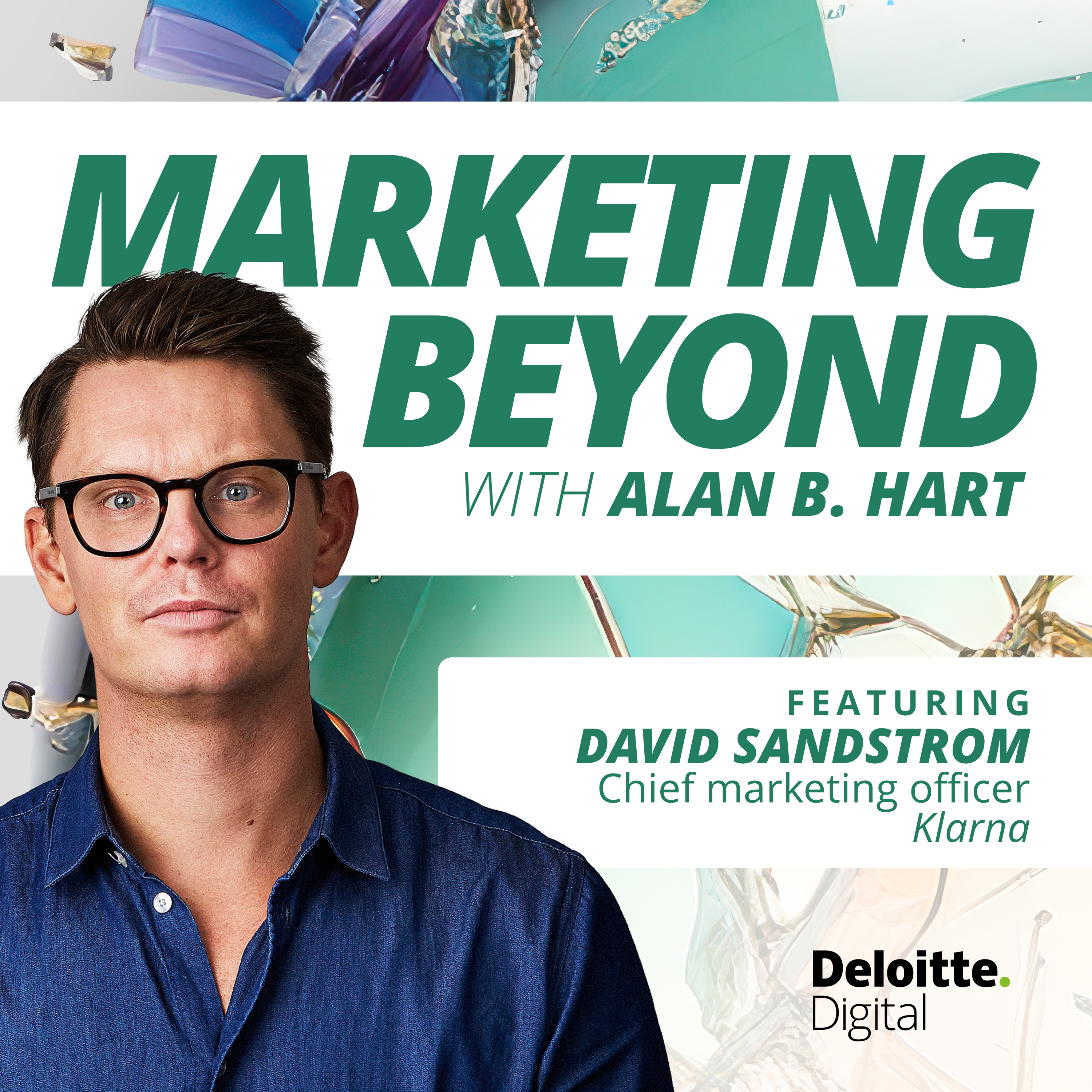
Marketing Beyond with Alan B. Hart
18: The secret to Klarna’s AI advantage: Insights from David Sandstrom, chief marketing officer at Klarna
00:20:55
In today’s episode, we continue our series as Alan and David Sandstrom, chief marketing officer at Klarna, discuss how embracing change, leveraging artificial intelligence (AI), and balancing data-driven efficiency with creativity are shaping the...
Loading summary
Transcript81 lines
- [00:00]
Alan Hart
Foreign.
- [00:07]
Are you ready to go beyond the basics of marketing? I'm Alan Hart and this is Marketing beyond, where we talk about the questions that spark change and share ideas that challenge the status quo. Join us as we explore the future of marketing and its endless potential.
- [00:27]
Foreign.
- [00:33]
Podcast Host
So today on the show, I've got David Sandstrom. He's the CMO at Klarna. He's been at Klarna for eight years as a cmo and we talk about his longevity. We also talk about Klarna's push into digital banking, their use of AI, and how it's advancing their marketing practices inside, and how he's actually driven the team to help adjust and drive that transformation. That and much more with David Sandstrom. Well, David, welcome back to the show.
- [01:07]
David Sandstrom
Thank you for having me again.
- [01:08]
Podcast Host
I know it's, it's been fun. I've been fun watching Klarna and what you guys are up to. But before we get into the business, anything new happening in your, your life?
- [01:17]
David Sandstrom
In my life, my life is actually Klarna. So there's a lot of new things going on. I mean, we're releasing a new card in the U.S. i think we announced mobile plans yesterday, or we announced the plan to release mobile plans for the couple of weeks. We have a balance live, so the ability to hold money with Klarna. We're now almost fully live with Walmart in the us which is obviously a massive thing for us. So, I mean, the list goes on and on and on. You're busy, busy, very busy, very busy.
- [01:48]
Podcast Host
Well, let's talk a little bit about your career path. Where did you get your start and how did you end up at Klarna?
- [01:54]
David Sandstrom
So I got my start within strategy, insights, consumer behavior. So I was a planner, strategist at a media company, which was a lot of fun. I've always been very intrigued by, like, human psychology, behavior, why people behave in ways they do, why they like brands, why they hate brands, why they follow influencers, why they don't. So my career start was a lot about, like, going deep into data way before AI. So I had to do it myself. Right from that I then transitioned more into creative because I wanted to get these, like, bring these strategies to life, not only chug the data, but rather, okay, when we know these things about humans, can we create something that actually influences people? Because I'm, I don't like theory too much. Like, there are a lot of good theorists out there, but like really, really living what you work with and learn and produce something. And that is how I got into advertising. I. I used to be the CEO of DDB in the Nordics for seven years, I think six years, seven years, something like that. So I spent a lot of summers here in Cannes because that was part of my job. And the last thing I did with DDB was actually start transforming Klarna. And then me and Sebastian, the CEO of Klarna, had a conversation. He said, why don't you join us and do this instead? And that's pretty much it.
- [03:15]
Podcast Host
That's the story.
- [03:16]
David Sandstrom
That's the story, yeah. And here we are, nine, eight years later.
- [03:20]
Podcast Host
I was going to say it's been a while. What do you credit the longevity?
- [03:24]
David Sandstrom
I think the constant change. It's a cheesy thing to say, but I do think it's the constant change. Every year is a new year. Every year feels like a new book in the chapter of Klarna and my career. So it is the perfect place to stay if you want a new career every year without having to go through the hassle of switching jobs.
- [03:46]
Podcast Host
Well, last time we had you on the show we talked a lot about Buy Now, Pay later. That business is still growing. Like how do you think about the growth and the. You talked about all these other things at the top of the conversation around your distribution channel. You're finding even more places to put that functionality, if you will.
- [04:06]
David Sandstrom
Yeah, I mean I personally believe, although we're doing a good job at growing it, obviously I need to believe that at least I do think like we're riding a big macro wave here, consumers, especially in the US shying away from credit. I think the macro environment that, that we're in has also led to the fact that people have started caring more about their money, more about their finances, staying on top of things. And although I do think Binopilator is to some extent frowned upon from sometimes from media, obviously incumbent banks and credit players, it is a fantastic tool. It is a utility for consumers, especially in times like these. It is an ability to spread your cost, no interest, no fees attached. And that is why we're seeing the growth. Like Buy Now, Pay later is basically credit for people who hate credit.
- [05:02]
Alan Hart
Right.
- [05:02]
Podcast Host
Well, and so you've got Buy Now, Pay later, you've got all this massive user base, you've started an advertising and brand building business for other brands. How does that come about and what's the latest developments there on that front?
- [05:17]
David Sandstrom
Yeah, I mean, what we need to do now as Klarna, Buy Now, Pay later has always been this double edged sword.
- [05:23]
Alan Hart
Right.
- [05:24]
David Sandstrom
It's Hugely popular. We're riding the macro wave, but on the other end we don't want to be positioned as a one trick pony.
- [05:31]
Alan Hart
Right.
- [05:31]
David Sandstrom
So the biggest challenge I have as the CMO at Klarna is really to try to tell the story about Klarna as being way more than this one feature.
- [05:41]
Alan Hart
Right.
- [05:42]
David Sandstrom
So we're launching the balance, which means that people like, it's like a bank account basically. People can hold money with us. We're launching our new card, which is a debit and a credit card combined. So we're doing all, all of these things. But the consumer education piece, that is really what we need to get across. Right. How do we transcend beyond buy now, pay later and.
- [06:04]
Podcast Host
Well, let's talk about the, I mean you're extending into banking features. Do you think of yourself now as a digital bank?
- [06:11]
David Sandstrom
I think we have to.
- [06:13]
Alan Hart
Right.
- [06:14]
David Sandstrom
We have probably always thought about ourselves as some sort of consumer retail everyday spending partner.
- [06:22]
Alan Hart
Right.
- [06:23]
David Sandstrom
And I do think that we've moved more and more into like very basic components. Like people want to be able to hold, save and spend money, people want to be able to access credit, people want to be able to spend that online and in store with the card. So the features and services that we're launching now really tells that story and speaks to that narrative way more of being a, I don't want to call it Neo bank, but more a global consumer retail bank.
- [06:51]
Alan Hart
Yeah.
- [06:52]
Podcast Host
What's the apprehension of a Neo bank?
- [06:54]
David Sandstrom
I have to ask. I don't know, I just don't like jargon. It's a term. I like calling things for what they are. But I think like already 10 years ago, like when we started to pivot Klarna, we had this huge conversation around like what is the world going to look like in 10 to 15 years? And then we said, well, they're probably going to be three to five global consumer retail banks based on tech AI nowadays that dominate the market because there are none.
- [07:23]
Alan Hart
Right.
- [07:23]
David Sandstrom
Most of the Global banks are B2B and the consumer banks are local. Like they're used, but they're still local. In the US there are very few if any global retail banks. And we're now seeing Revolut, Nubank, klarna and probably PayPal in that mix starting to emerge into this something. And you can call it Niobank, you can call it global consumer retail bank, whatever it is, but the place for money for consumers globally.
- [07:52]
Alan Hart
Right.
- [07:52]
Podcast Host
Well, you guys have been very public on your use of AI. I mean your CEO doing his latest report as an AI avatar, how do you think about AI and how does it work for you and your marketing organization?
- [08:07]
David Sandstrom
I mean so far or, or the journey we've been on is like it started out as a party trick, like look at these great things that you can produce and create and spit out. But you know, the, the hands had six fingers and you had three eyes and like it was strange to now starting to grow into something that is actually useful. I don't think it's yet fully production ready, but what we use it as is a fantastic support to everything we do. But I continuously iterate that we're not doing yet anything new based on AI. We're only doing the things we used to do, but way more efficient, way faster, at a way lower cost.
- [08:50]
Podcast Host
Yeah. So it's essentially partnering with the creative process.
- [08:54]
David Sandstrom
Partnering and shortcutting things that were tedious and costly.
- [08:59]
Alan Hart
Right.
- [08:59]
David Sandstrom
Just like maybe a very basic example, but if you historically wanted to shoot a 30 second film, the process just up until shoot is cumbersome.
- [09:11]
Alan Hart
Right.
- [09:12]
David Sandstrom
And costly.
- [09:13]
Alan Hart
Right.
- [09:13]
David Sandstrom
You bounce ideas back and forth but the ideas are visualized by like handwritings or stuff like that. So we use it a lot for ideation now. So almost like briefing.
- [09:23]
Alan Hart
Right.
- [09:23]
David Sandstrom
I sit personally sometimes in V3 and say hey, we should be doing something along these lines then I still need professionals and creatives to take what I have done and make it production ready. But the first 80% of almost every project is just now cut short tremendously fast.
- [09:42]
Podcast Host
You talk about it starting out as like parlor tricks or magic tricks, but like what is been the key to helping people adapt it and practice using AI?
- [09:54]
David Sandstrom
I mean, I think I get that question a lot like what are the big things that Klarna has done in order to get this like going? Because we're really at the forefront. And I think, and I talked to a lot of CMOs about this as well and I think our investment in AI culture has been more important than our investment in AI infrastructure. And we've invested heavily into that as well. But when it comes to culture, right. We've really created a culture where people lean in. I don't think Sebastian would celebrate anything publicly that isn't part of AI and people want to be celebrated publicly.
- [10:27]
Alan Hart
Right.
- [10:27]
David Sandstrom
So we measure AI use, we use it together on a daily basis. We have it as the starting point for everything. A common question is like, well have you run this through ChatGPT or whatever? Right. So the investment into AI culture and really almost forcing people to use it in the beginning, sometimes giving people Tasks that are just impossible to do. Like, if I would tell you, hey, translate this text into 15 languages, be done by Monday. Either you need a big team or you need it like there is no way of doing it without AI. So our investment into AI culture has been fantastic.
- [11:05]
Podcast Host
One of the, I think hurdles for many organizations. And I think you might have a unique perspective on this given your agency background and now like sitting CMO role. How does AI affect creativity or the creative process in your mind?
- [11:23]
David Sandstrom
I mean, I think it's now unleashed. I think it's like people talk about this replacing creativity. I'm seeing the exact opposite. Like creative people, they are going to have like, it's their time to shine now. Because creativity is going to be the difference between good and bad, right? Everyone is going to have access to these tools. It's not going to be gated behind some like massive investments. Like everyone's going to be have access and creativity will be the thing that sets things apart. Because I know firsthand the difference between prompting a good idea versus prompting a bad idea or just giving it. Like the issue with AI is that it's also trained on the average, right? On the bell curve. You get the highest point of the bell curve, right? So if you prompted to generally, if you're uncreative, if you just tell a give me a campaign, you're going to get the top of the bell curve campaign, right? And everyone's going to get that. That might fly for a couple of more months next year. Everyone's going to do that. Instagram is going to look different. TikTok is going to look different. Social channels, in my opinion, are going to be way more entertainment channels than actual social channels. So the, I mean the creativity is just going to be truly unleashed. And for creative agencies that I know well, to me a magical thing is happening. And that is the fact which has always annoyed me massively with this industry, is that you have people that call themselves creatives and they have gated the term creativity. And the only one who can be creative is creatives, right? And here in Cannes you have copywriters and art directors who are they feel that they own that term now. Everyone can be creative. There is no term creative anymore. It's just like that is gone. So everyone's there. And I do think we're gonna see a almost like battle royale for creativity. When everyone can be creative. The best creativity is gonna win. Not the ones created by Brazilian art directors.
- [13:26]
Podcast Host
I love it. All right, well, I wanna transition. There's a series of questions I ask everyone that comes on the show first one favorite question. A little bit more reflective. Has there been an experience of your past that defines or makes up who you are today?
- [13:40]
David Sandstrom
I mean, I was born in the US in Key west in the 80s and my dad played a band, so he was a hippie. And my mother is German. So I'm German by, like, that's my nationality. So the combination of a hippie, Key west musician and a very strict, by the book German, I do think that's a fantastic. That's a fantastic combination that I feel within myself quite often.
- [14:10]
Podcast Host
It makes for a great cmo, apparently.
- [14:13]
David Sandstrom
You never know.
- [14:14]
Podcast Host
Well, if you were starting this journey all over again, what advice would you give your younger self?
- [14:20]
David Sandstrom
I think try to enjoy it. I always enjoy New Year's Eve when I stand there and say, oh, this was a great. It's been a bumpy ride, but it was great. I would like to be able to celebrate more on a weekly basis. Enjoy the ride.
- [14:34]
Podcast Host
Is there a topic you think marketers need to be learning more about, or maybe something you're trying to learn more about yourself?
- [14:39]
David Sandstrom
I think you see the pendulum here in Cannes as well. Like, if you would have been in Cannes 10 years ago, it would have been all about creativity, all about ideas, all about campaigns, art direction, design. The pendulum is now swung to the other side, completely to the other side.
- [14:57]
Alan Hart
Right.
- [14:58]
David Sandstrom
I haven't seen a single agency have a spot on the beach. It's all the tech companies, all the hyperscalers, right? The conversation is about AI, data sets, programmatic targeting, segmentation, hyper efficiency. And I think that pendulum has swung slightly too far.
- [15:14]
Alan Hart
Right.
- [15:15]
David Sandstrom
I don't think we should be with the Brazilian art directors, but I also don't think that the industry can be fully dominated by data scientists. So I think we need to once again ask ourselves, like, how do you build a brand in times of AI, TikTok and UGC, which is a very hard thing to do. It was easier back when everyone was watching tv.
- [15:38]
Podcast Host
Yeah, well, are there any trends or subcultures that you're following you think other people should take notice of? I'm just mainly curious what you're curious about these days.
- [15:49]
David Sandstrom
I'm currently quite curious about, like, as I said, how do you build a brand when, like, the creators are actually building the brands and you're just part of that? So I'm quite happy that we have a strong brand because that means that we can accelerate that through creators. But if we didn't have a brand today, we can't rely on this TikTok thing to happen. But in general I'm always quite intrigued by, you know, anti trends. So as I said, like it used to be very much about creativity, now it's about data. Like what's the counterweight to that. And since we live in this currently TikTok, Twitter or Xtime where everything is very short form, very fast, I'm quite intrigued by long form video on YouTube. Again, I do think podcasts and YouTube are probably the only formats where you get some time with the viewer. A TV ad is 30 second, a TikTok is God knows about four seconds. Right. You never get any time.
- [16:54]
Alan Hart
Right.
- [16:54]
David Sandstrom
You never get any time. 10, 15 minutes on YouTube. Really going deep on a proposition on a brand on a story. Like there's something to that. That has been working well for us.
- [17:06]
Podcast Host
Yeah, that's awesome. Good plug for this format too.
- [17:09]
David Sandstrom
There you go.
- [17:10]
Podcast Host
Last question for you. What do you think is the largest opportunity or threat facing marketers today?
- [17:15]
David Sandstrom
Again, I think that the more if we go completely data driven, were asking to be replaced, like the more you behave like a robot, the more likely it is that a robot is going to replace you. That's the thing. And I think we need at least with one foot to clinge on to what brands are. And I don't want to be too fluffy. I love performance and I love growing the business. Right. But there is something magical to brands like they're like the feeling they invoke. You know, there is something there with you know, inspiration, aspiration, emotions that I fear if we don't cling onto a bit more, we're going to be replaced by data scientists which are needed in the mix.
- [18:04]
Podcast Host
They are needed, yes. Yeah. I reflect on what you're saying and I think there's this notion of talk worthiness and whether your brand can play a role. And you know, I guess one of the gatekeepers to that is how successful you are at earned media or getting people to talk about.
- [18:23]
David Sandstrom
You know, I think maybe it's a bad analogy but I do think sometimes brands can be compared to individuals and people. And if you look at it, Taylor Swift for example, she obviously has a team that coaches her. She probably is more data driven than we attribute to, but she's not 100%. Like that is not built by an algorithm.
- [18:41]
Alan Hart
Right.
- [18:41]
David Sandstrom
Like there is some fairy dust, there is heart, there is emotion. Like it's a good mix of really, really understanding your audience beyond the data set. And I think that is where brands need to be. They need to resonate both rationally, functionally, on a utility like level, but they also need to be something more that magical thing like that you used to have with a CO or whatever it is, right? And I think that the winners in the future are going to be companies that actually understand, understand that and that find a healthy mix between the data sets and just the ungraspable, unmeasurable thing. And as you said, like talkability or as I spoke about here in Cannes, brand fame is a huge business driver, right? Fame in general drives business because you just increase the probability of good things happening to you the more famous you are.
- [19:39]
Podcast Host
Well, thank you for coming on the show again. I appreciate it.
- [19:42]
David Sandstrom
Thank you for having me Again.
- [19:46]
Alan Hart
The views, thoughts and opinions expressed are the speaker's own and do not represent the views, thoughts and opinions of Deloitte. Material and information presented here is for general information purposes only and does not imply endorsement or opposition to any specific company, product or service. Hi, it's Alan again. Marketing beyond is a Deloitte Digital Podcast. It's created and produced by me with post production support from Sam Robertson. If you're new to Marketing beyond, please feel free to write us a review and subscribe on your favorite listening platform. I also invite you to explore the other Deloitte Digital podcast@deloittigital.com US Podcast and Share the show with your friends and colleagues. I love hearing from listeners. You can contact me at marketingbeyondeloitte.com you'll also find complete show notes and links to what's discussed in the podcast today, and you can search our archives. I'm Alan Hart and this is Marketing Beyond.