← Marketing Beyond with Alan B. Hart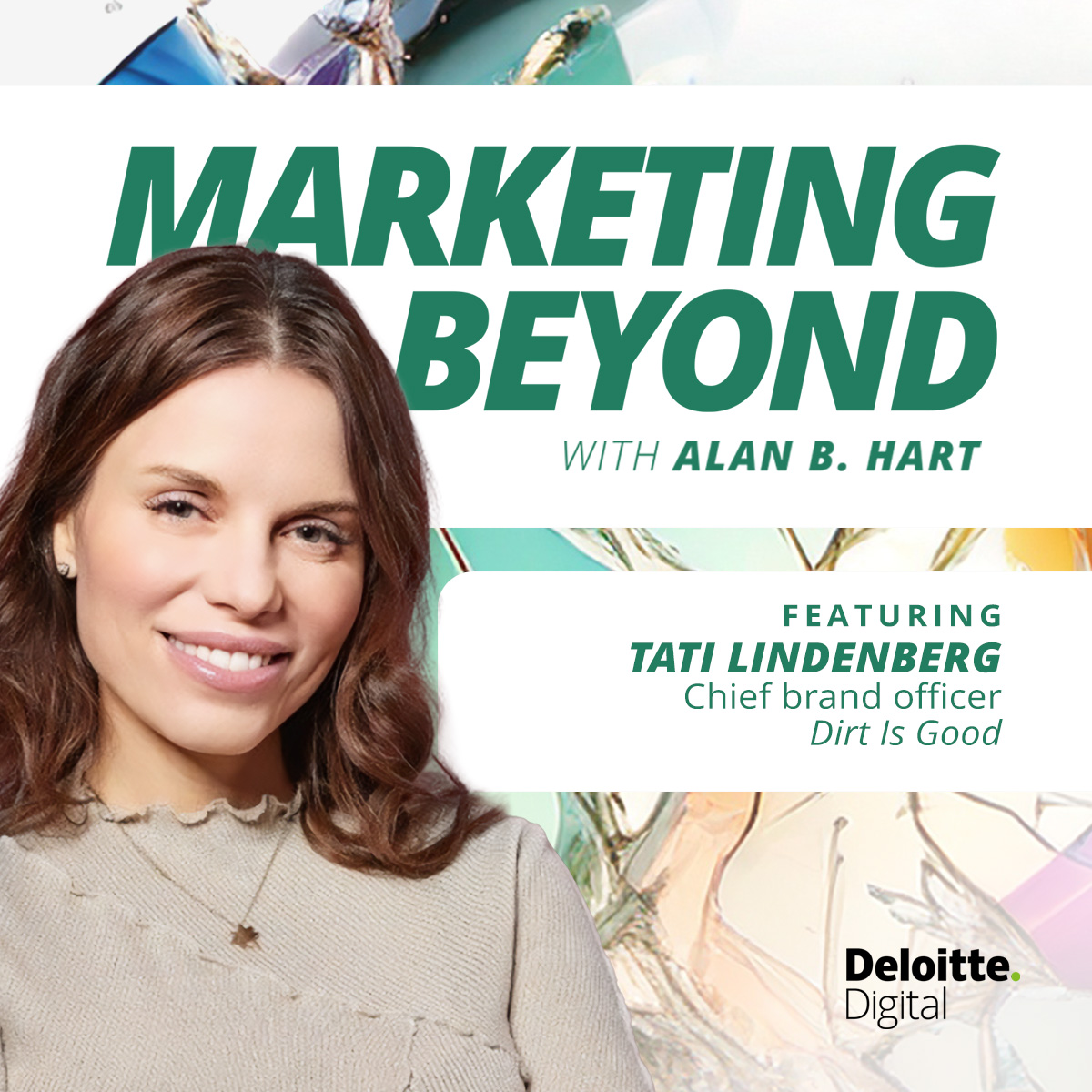
Marketing Beyond with Alan B. Hart
19: Standing out in a ‘sea of sameness’: Insights from Tati Lindenberg, chief brand officer at Dirt Is Good
00:36:15
In today’s episode, Alan wraps up our content series with Tati Lindenberg, chief brand officer at Dirt Is Good. Together, they explore global brand strategy for balancing consistency with local relevance, the origin and evolution of the Dirt Is...
Loading summary
Transcript49 lines
- [00:00]
Tati Lindenberg
Foreign.
- [00:07]
Alan Hart
Are you ready to go beyond the basics of marketing? I'm Alan Hart, and this is Marketing beyond, where we talk about the questions that spark change and share ideas that challenge the status quo. Join us as we explore the future of marketing and its endless potential.
- [00:27]
Tati Lindenberg
Foreign.
- [00:32]
Interviewer
The show I've got Tachi Lindenberg. She's the chief brand officer for Dirt Is Good, as well as the head of fabric cleaning at Unilever. Today on the show, we'll talk about her unique global brand strategy and how to balance global branding with local execution. We'll also talk about her evolution of the brand into women's sports and how sports plays a critical role in what they're trying to drive with this era of their brand. We'll also talk about the power of creativity. And she is one of the most awarded marketers across all various types of awards that I've ever had on the show. And we'll talk about what that means to her. That and much more with Tati Lindenberg. Well, Tati, welcome to the show.
- [01:22]
Tati Lindenberg
Thank you.
- [01:23]
Interviewer
Well, I know before we get into business, we're gonna have a lot of conversation about Dirt Is Good and Unilever and all the great things you're doing there. I hear started your life in a small Brazilian town. Tell me more about that.
- [01:37]
Tati Lindenberg
So I was born in Sao Paulo. I think most Brazilians nowadays work in advertising, somehow came from Sao Paulo. So I was born in Sao Paulo, but I moved to middle of Brazil when I was three and a half, nearly four. And I spent all my childhood in that small town up until I decided to go back to Sao Paulo to go to university. So it was a very different upbringing compared to the average Brazilians that you might meet, like, outside of Brazil, but a very rewarding one.
- [02:08]
Interviewer
Well, and did you go to school in Brazil or did you go.
- [02:10]
Tati Lindenberg
I went to school in Brazil, throughout university in Brazil, and then I started working a retailer in Brazil, so which was an incredible way of starting off a career, because in retailer it was kind of the equivalent of waitress, for instance, in the uk. So it was a big one, but a little bit more premium. But the advantage of working or starting your career in a retailer is that you needed to deliver fast. And whatever you do, you know that in 24 hours you'll be able to understand whether it was successful or not. So I think it really creates some sort of, like, drive and passion to get things right and also an ability to fix things fast. So that's how I started off my career. But I always wanted to live in Europe since I was. I know since I was like 11, 12. And one of the reasons why I applied for a job at Unilever is I knew that by working in a company like Unilever, I would have the chance to move to Europe or to move to another country. So I still remember that when I joined the company, my line manager at that time asked me, oh, what are your aspirations? And then I basically told her, I just want to live in Europe. That's pretty much what I want. But it worked because I was very driven and I understood the paths that I would needed to or the choices I would need to take. And two years later, I was living in the Netherlands. So it worked.
- [03:40]
Interviewer
It definitely worked. Definitely worked well. So from those early beginnings at Unilever, what were the kind of. Some of the milestones to get you where you are today? You're the Chief Brand Officer for Dirt Is Good. You're also, I think, leading the fabric cleaning business as well. So what were some of the milestones?
- [03:59]
Tati Lindenberg
I think the first big milestone was obviously moving to Europe and having the opportunity. I was quite young. I was 26. Most of my friends were backpacking at that time. So I remember moving to Europe and having the opportunity of working in a big company like Unilever. So that was the first big milestone. The second one happened when a while after living in the Netherlands, I was working a global position, and I work very close to both the India business and Latin America. And Unilever needed someone to set up a consumer insight team in India. And because I was so close to the market, I was invited to take on that job, which was, for me, the second big milestone. Accepting such a big move again, imagine that I moved to India at the time that iPhone was launched. So the best way that I could engage with my family was Skype. It was not like today. I keep saying, like, even to my son, I was like, today, life is easy. You FaceTime people whenever you want. Back in the days when I was living in India, I basically needed to go back home, turn on the laptop, and then call my mom via Skype. And that's the only way I remember. I think it was the same year that Facebook became more successful. So I couldn't. People didn't even have the habit of posting things. So it was like a long, long time ago. But that was the second big milestone also. It was, in a way, a leap of faith and accepting that I could get a bigger job. But with that, of course, came the challenges of living in Asia. I was also very Young. At that time, I was not even 30 years old. And then something happened. I was living in India, very happy about it, very. But I knew that I wanted to work in one of the big brands. And this is when I believed that Dirt is Good somehow showed up to me. There was a job in Dirt is Good in Brazil. I didn't want to go back to Brazil. It took me so much to leave. But the line manager at that time said, tati, you can get the job, but you need to come back. So I decided, okay, the job is more important than the location. I came back to Sao Paulo and I lived in Sao Paulo for a few years, which at the end worked out beautifully because I also became a mom. And it was a moment, obviously, I think, with most women to think about priorities, what I wanted out of my career, what I wanted out of my life. And when I came back from maternity leave, I told my line manager, look, again, I want to live in Europe. I know I sounded like a broken record, but I basically told these line manager, obviously not the same as ten years before that. I also didn't want to bring up my son in so Paulo. So for reasons much more related to not being the safest city in the world. And I wanted my son to have the same childhood and upbringing that I had, which was very free, very dirt as Good. And in fact, the job that I had in Sao Paulo was a Dirt as good job. So it was my first time working in the brand. I then moved to Europe, moved to the hair care business, so worked in hair care, skincare, and then I came back home and started leading, not home Sao Paulo, but home as in home care. Started leading the fabric cleaning business and Dirt Is Good. So I believe that for me, the key milestones were associated to these geographical changes, because with each of them comes, of course, change of habits, change, change of perspective, and obviously being a mom. So I think this is really what I could summarize in terms of milestones, is when both habits and perspective change.
- [07:50]
Interviewer
Well, talk to me a little bit about the scope of the fabric cleaning business, because it's pretty large and it's across many different brands under the umbrella of Dirt Is Good, but it's in many different countries as well. So maybe just speak to a little bit of that.
- [08:07]
Tati Lindenberg
So Dirt is Good is the largest laundry brand in the world. Largest in penetration. Not in turnover, but in penetration. It is. So we are in 54% of all households in the world. It's big. It's big. And we are distributed across the Globe except North America. So the business has, the brand has different names. So it could be for instance named Persuasion in the UK or OMO in Brazil, China, Vietnam or Turkey in India for instance is called Surf Excel. And what is common across of all of these brands is the fact that they are all top performance brands with a premium price which is usually 20% higher than the average of the market. So what Unilever decided to do a couple of years back is to get all of those premium laundry brands and bring them together under the Dirt is Good umbrella. So that is 65% of what I look after, the Dirt is Good group of top performance brands. But then there is all the rest and the rest are primarily value brands. So the fabric cleaning portfolio of Unilever is usually a combination of a Dirt as Good brand and a value brand that would vary from one country to the other. And they are usually brands that are more local and we keep that aspect or that approach of being more local brands. And this is what then composes the entire fabric cleaning portfolio.
- [09:38]
Interviewer
Gotcha. And so you've got those local brands, the value, more value playing brands. But with Dirt is Good and those brands that kind of cut across countries, how do you manage like the, I guess the balance between, I say a global or a multi country strategy versus like local execution, how do you think about balancing that?
- [09:58]
Tati Lindenberg
I think there is a difference between the way of managing the Dirt's good brands and the others. So Dirt is Good is a truly global brand, despite the different names. So the way that I manage is by having a very strong central team based in London. That team crafts and develops all the guardrails of the brand. So the distinctive brand assets, the anatomy of the brand as we call how the brand should look like from an esthetic point of view, since how the brand, what's the tone of voice of the branding social. And the list goes on. So the central team then develops these guardrails based on what is relevant in each country. But then the insights from specific campaigns of products usually are locally, I wouldn't say locally led, but they come from the markets. And then by understanding what the markets need and what we have as a brand, we try to find a commonality and, and of course I have incredible partners in each and every of the markets. We work with top 12 directly and with those top 12 markets we have communities, as we call the Dirt as Good community. We come together every month to make sure that we not only align the innovation plans but also the specific campaigns. And then what happens is we Divide and conquer. Some of the things we execute globally. So one example, we have a partnership with Arsenal Football, the football club, and that partnership is globally led. We manage it globally, but at the same time India has a partnership with a cricket team. They manage it locally because it's basically India for India. So we then decide very, I'd say in the best possible way what would benefit the most, the business. So that's how I run Dirt is Good with a very strong brand idea, brand essence and guardrails and then trying to make sure that we check the local nuances and distribute who is going to do what. Of course, I do have what we call do it framework. Who decides who owns all the time. And we keep having to revisit that to make sure that. Oh, but in this case, does it make sense or not? The value brands, conversely, the equity of these brands are fully locally led. So my responsibility with them is to ensure that they have the right resources, the right innovation, roadmap and investment. But they are primarily locally led from an equity point of view. So that's kind of the shift. With Dirt is Good, I look after both the brand equity and the business with the value brands much more just the business side of things. And the equity of the brand, again, the tone of voice, the design, etc. Would stay with the markets.
- [12:38]
Interviewer
I have a question about the brand itself. So you got Dirt is Good and how much does like in an execution, how much is it led with Dirt is Good as kind of like that master brand versus the product brand might be Purcell or whatever.
- [12:54]
Tati Lindenberg
It's primarily the product name, like Omo, for instance, or Persio primarily we use. Dirt is Good became many things. It started as a brand idea and it started 21 years ago. It was a very counterintuitive idea because at that time most of competitors would always focus on having clean clothes or they wouldn't tell consumers or people avoid getting dirty, but they wouldn't glorify or celebrate that they would always show like, oh, this is the type of performance that you can have. The whites would get even whiter, et cetera. So when the idea was created was really to try to provoke society to an extent to say that dirt that you were somehow avoiding is actually good, it's physically good, physiologically good and emotionally good for you. Of course, it's a metaphor for getting stuck in making things happen, going outside and living life. Which to be honest, I think it's even more important nowadays with the amount of screen time that we have than 21 years ago. But Dirt is Good was then became from a brand idea, became a signature. And in many markets it is a distinctive brand asset. So if you go to a market like my country in Brazil and I say what Omo is, people would say dirt is good or bang, which is the just do it for Nike. So in many countries, consumers recognize the signature, but we always lead the communication with Omo Pass, you skip or surf Excel. To be honest, in many countries, people don't know that the brand is a global one. They believe it's local and we let it be because we don't need it to say it is global. When beneficial, we do so. And to be fair, this is. This year was the first time that we've run a campaign which was a combination of Pursue in the UK and OMO in Brazil. And we didn't even know how to show the two brands at this point because it was like, wait a minute, do we show Dirt is good or. But they're just good in English, they're just good in Portuguese. And then we just use, of course, this technique that we would show pursuit and the brand would flip and become warm and flip and become personal. But we have never done that before. So usually is the local brand name that we lead the communication with.
- [15:13]
Interviewer
It's a very interesting brand strategy. I feel like you're charting a new course for how to potentially manage brand portfolio, if you will, in a unified way.
- [15:23]
Tati Lindenberg
True. I don't think I have much of an option. So to be fair, I think this is we, well, my team and I and the president of home care and I had multiple conversations about is it worth, for instance, combining all the brands under the same name. My life would be much easier, for instance, if I could lead Dirt as good as Dove. Dove is Dove everywhere. People recognize the brand as such. But the reality is we were not a one brand that was born in a country and then organically growing across others, rolling it out. What happened? It was a federation of brands that we then decided to bring together. So when you wait, what would be the value and the return on investment if we try? First of all, it's a lot of investment to make people realize this brand is, oh, by the way, it's now this brand. I've seen this happening and I can count successful cases, but many more failures. Exactly. So we explored that possibility, but then we realized that it's better to find a way to manage, which is what we've been doing instead of pushing the brand names across because especially nowadays we. We can see that the habits of Consumers are becoming more similar. So as long as I can have a innovation roadmap that can be quite pretty much the same across the brand name is irrelevant. We can put anything and it work well. Irrelevant for us, for consumers with everything right.
- [16:55]
Interviewer
Well, so keeping all of the various brands as well as Dirt is Good fresh, like, how do you think about that? Because you also want a level of consistency, but you've got to make sure you're still cutting through, you're still refreshing things. How do you think about the balance of the.
- [17:10]
Tati Lindenberg
That I used to say that Dirt is good is managed in eras like Taylor Swift. So what we do is each kind of like five years, we needed to shift a little bit how we express Dirt is Good one important thing. And I've been into the brand for five years, so I've. I've been working across two different areas. And what I always say is the idea of Dirt is good is sacred. I remember having a line manager who is no longer at Unilever who told me, tati, why don't you just leave the signature? Not everybody, not every consumer knows and in some markets is more or less relevant. And I remember telling him, look, the day I do it, I'm killing the brand, because that's what make the brand unique. So we will always stand for Dirt is Good. However, the way in which we, the context in which we position Dirt is Good changes. To be more specific, before I came into the brand, the expression of Dirt is good was a bit of a cheerful one. So it was all about, for instance, how kids could develop themselves and unleash their potential through painting or just going outside, just getting dirty. But it was much more the idea of dirt being good to unleash creativity. When I came in, we decided to, my team and I, because of the strategy of Unilever, at that time, we decided to talk about Dirt is a force for good. So instead of showing kids doing good for their neighbors, for instance, we would show them doing good for the planet. So I changed the context. The principle was the same. So imagine that in one advertising the era of cheerfulness. I would show a child one example, for instance, even during COVID painting a rainbow and putting up like on a window to lighten up the world. So that was the cheerfulness era, as we call Imagine that I could show that same kid that instead of painting a rainbow, that kid would be collecting plastic on the beach or planting a tree. So in both situations, the child or in some cases the adult would get dirty by doing something. The difference is in the first situation, the one benefit from getting dirty was more the individual, and the second one was a little bit more collective because it was getting dirty for the good of the planet. And then after a few years, as we call around the forest, we now place the kids onto the pitch and we started what we call our play on era associated with sport. And so in that era, imagine that again, I'm showing kids or adults getting dirty, but they're getting dirty through playing sports. So that's how I manage. Of course, the choice of each of those areas are always by design. And we do it in a way that we understand what are the trends happening out there, what is the company strategy as well, and try to combine those two things to maintain the brand fresh. So in each of those areas, we evolve a little bit the identity. So we have one dba, a distinctive brain acid called the splat. So the splat is always there, but before the splat was a little bit glowy, then the splat became more organic. Now the splat is white, but it's always the splat. So that's how I try to do keeping a few things sacred, be it the signature or the splat, but then evolve the way that we express or bring it to life.
- [20:39]
Interviewer
Yeah, I think following Taylor Swift strategy is always a winning strategy. Well, you talk about. So this latest era is sport and women and women's sports are playing a bigger and bigger role. How do you think about it fitting into what you're trying to communicate now?
- [20:57]
Tati Lindenberg
So in many levels, it's extremely important that I've been also trying to evolve the brand to be less focused on only kids and appreciating and acknowledging that families are changing and also trying to center women not only as the mom who is going to wash the kids or the clothes of their kids, but the mama who is actually a protagonist of the story and in some cases, an athlete. So from my point of view, the importance of tapping on true spirit sport is to show performance and resilience. But then tap into women's sport is also a way for me to, after so many years, start showing women not as the ones who are doing the laundry they might be doing, might not be doing, but the ones who are actually like the protagonist of our campaigns and our stories.
- [21:46]
Interviewer
Yeah, I love it. I love it. And there's so many great stories that you're pulling through that as well, just showing them the grit and the resilience. But also, this product works.
- [21:57]
Alan Hart
It gets your stuff clean.
- [21:58]
Tati Lindenberg
Precisely.
- [22:00]
Interviewer
I love it. Well, one of the things I think you might be the most awarded, varied, awarded person to sit in this chair. I think it's Cleo, Effie, Wark and Khan. And Khan. So how do you think about awards and how they fit into, like, what do they mean to you and the teams that you manage?
- [22:21]
Tati Lindenberg
Two types of awards, I would say. I think awards like Cannes, they really help to create a culture of creativity within the team. We came to Cannes the first time as Dirt is good four years back, and I remember that no one in home care would even speak about Cannes. It seemed something that only the Unilever personal care brands or foods like Hellman's, Noor Dove, Vaseline could come. And we were always like the ugly duckling, like, oh, it's laundry, we should not be there. But I remember that the first time I decided to come was a decision based on how can I make sure that my team will be more creative and how can I attract better talents in the agencies? Because let's face it, agencies want to win awards and they know that if the brand has a beautiful platform, like they're just good. And we are rewarding, rewarding creative agencies with good work, good briefs and briefs that can win awards. So it creates a very positive cycle. And I can see that because the first time we came four years ago, people would, as I said, rarely speak about Cannes nowadays, have the market saying, tati, which can campaigns you're going to have, can we join you? Can we execute here or there? So I can see that it really creates this culture of creativity and then the entire work gets better. Even the ones that we don't bring to Cannes, naturally they will get better because we have better agencies, we have better creatives and we have people paying attention. In advertising before, especially in home care, they wouldn't. So that is one type of award. And the benefits. The second one, I would say more the effectiveness awards, those are important for me and I adore them because it just proves that what we're doing is working. WARC is an award that I think is the most precious that I ever won. So, yeah, yeah, that's how I see it.
- [24:16]
Interviewer
Yeah. Warwick and Effie's are two of my favorite for that very reason. I never thought about the fact of what you described in terms of like up leveling the talent, the aspirational aspect of the people working for you for the Creativity Awards. But that makes perfect sense. So kudos.
- [24:33]
Tati Lindenberg
Thank you. Thank you.
- [24:35]
Interviewer
Well, one of the things we like to do on the show is to get to know you a little bit better. Other than we know you started early in life in Brazil and you had this massive desire to get to Europe and you're there. The question I have that I love asking everyone is like, has there been an experience of your past that defines who you are today?
- [24:56]
Tati Lindenberg
A few, but that is one that actually defines. Defines the choice I've made, as in working in advertising. I used to say that even within Unilever, but within the industry, at least the people I know, I'm one of the few people who actually wanted to study advertising. I went to university to learn communication design, media. I was. I didn't arrive in advertising by accident. And what happened is very early on, when I was living in this small town, my father used to distribute Coca Cola to the northeast of Brazil. So the city was almost like a gateway to the northeast. And as a consequence of that, it was a small town. And our house and the warehouse of Coca Cola, they were kind of like side by side. So I could during the day, just go to the warehouse. My father didn't like me doing that, but I would eventually escape. And I still remember, I don't know, I was probably 11, 12, and I still remember walking in the warehouse with those crates of, like, Coke, those beautiful, like, red ones. And I don't know, I was fascinated by Coca Cola. And then I started seeing, obviously, especially in Brazil. For me, that was so unique to see the Coca Cola heads with the bear and the Christmas heads. Because obviously, imagine that I was in Brazil. And Brazil is a warm country, but the city that I was called Gurupi, that I was living is even warmer. So it was like 35 degrees in Christmas. Celsius. 35 degrees Celsius. And I remember seeing it and thinking, which place in the world that you have, like, polar bears and it's cold over Christmas. Which I think it was both the fascination with this, like, the north hemisphere of the world, and at the same time, fascination with Coke and the brand. And what I remember, like, Coke used to. Coca Cola used to run promotions. And my father used to get all the little toys that people would buy, I don't know, five cans, and then you could exchange. And he made me also have. I have to buy them, save my pocket money and then buy 10, for instance, cans to then exchange to these mini Coca Cola bottles. I don't know if they were ever available anywhere else in the world. I was really angry because I could see them all in his office and he wouldn't give it to me no matter what. But anyways, I learned the hard way That I needed to work hard to earn anything. But that really. I know it sounds silly, but that really, in a way, defined who I am. One the fascination with advertising. And Coca Cola has always been one of the. The companies that I admire the most. Funny enough, I never applied for a job at Coca Cola because I feel that I wanted to live in this aura. You know, I prefer to never touch because I don't want to be disappointed with, like, my own perspective of Coca Cola, but at the same time, because I needed to earn all those goodies and the merch of Coca Cola, I've also understood that life doesn't come easy.
- [28:03]
Interviewer
So.
- [28:03]
Tati Lindenberg
So. And that was really defining for me at a very early stage of my life.
- [28:08]
Interviewer
So I love it. I love it. Well, if you were starting all over again, what advice would you give little Tachi?
- [28:14]
Tati Lindenberg
To take it easy? I think the. Well, the flip side of what I just said is the fact that I was always so righteous, and I was always trying to make it work and to work really hard, even sometimes when it was not required. I remember that when I started at university, because I wanted to do well. I wanted to work in a really good company. I also wanted to financially help my family. I went to two parties throughout the four years at university. And now I look back and I was like, really? I could have done more. You know, I could have enjoyed more, I could have traveled more. But I think, well, maybe if I have done that, I wouldn't be where I am. But the reality is, if I look back, I would say, just take it easy, Tati. Don't take life too serious. Now, with the age I have, I'm like, yeah, maybe it can be fine. I'll take it a bit easy. But it took me years and years, decades to reach that point.
- [29:12]
Interviewer
A few more parties now, no, I'm.
- [29:14]
Tati Lindenberg
Still not a big fan. But it's funny because once you don't do it much, you get used not to. Even here in Cannes, people say, oh, so enjoy, like, dance the night away. 10 o'. Clock. I'm always sleeping here. So anyways, no, but at least metaphorically speaking as well. I'm trying to take it more. Take it easy.
- [29:34]
Interviewer
Easy. I like it. Well, is there a topic either you're trying to learn more about, or you think marketers in general need to be learning more about today?
- [29:42]
Tati Lindenberg
Well, I'm trying to learn more about the availability of tools. What I mean by that is I used to say that we are living in the age of availability and affordability. So again, when I went to university. One of the topics that I was studying is how to take photos because obviously it was not an easy thing. You needed to learn exactly how to control the camera, etc. Nowadays, everything is available. Anyone can be a photographer, and this was before AI. Now anyone can be a copywriter, anyone can write a book. So I always, I've been trying to learn more and more about the impact of this digital world and not necessarily only the machines. Not that I'm scared, it's not the point, but it's more about how AI and all of the technologies nowadays make are so available to everyone and how they impact creativity. And I tend to believe that what is happening nowadays is what I call this sea of sameness. So there are many. One example, if you look at beauty brands nowadays compared to a decade or so ago, they now are much more similar because most people prompt the same thing, get the same output. So I'm really looking at learning more about humanity, creativity and the availability of driven by AI and associated to that. Another thing is to. I'm trying to understand in the future how brands and influencers will work together. I strongly believe in sharing authorship. A couple of years ago I told my team power to the people. Of course not my quote, but. And I love the idea that you can share author authorship, that people can actually feel that the brands also belong to them. But the reality is at one stage, when you share authorship to a given level and when everybody's doing that, I started to think what would be the esthetics of brands will be the aesthetic of TikTok or the aesthetic of the brands themselves? Because if you look at like the world of TikTok, most influencers show how they use the products in the same way. Well, there are minor differences, but then with time, well, you might have seen that when you see presentations with people showing like always small snippets of like the products being used on TikTok, I doubt you can see the difference if you don't pay a lot of attention. It could be dirt is good, it could be tide, it could be sunlight and they will all look the same because it's no longer the esthetic and the creative from the brands, but. But from the creators and the influencers. And I don't have an answer to that, but I'm trying and I'm watching this with a lot of curiosity. How are you gonna make sure that humanity, creativity, ownership of brands and the overall aesthetics in the future will all combine?
- [32:41]
Interviewer
Yeah, I love that. Are there any trends or subcultures or just things that you're genuinely curious about that you're looking at right now.
- [32:50]
Tati Lindenberg
Yeah, super fans. Because since we are at Dirt is good, we are now in the world of sport, as I said, we took the kids from the forest, moved them to the pitch. I'm now trying to learn more about the superfans culture and it could be super fans of anything because obviously the way the super fans behave is quite similar regardless if it's a sport. So for instance, Labu booze. Now I've been been reading about them and trying to understand really, because you have hardcore fans of Pop Mart or hardcore fans, for instance of Taylor Swift, hardcore fans of Arsenal. And I'm trying to really tap into what are the insights and what drives people to really enjoy like a athlete, personality, brand, whatever it is. So much so. So this is for me, one key thing I've been watching.
- [33:45]
Interviewer
Last question for you. What do you think is the either largest opportunity or threat facing marketers today.
- [33:50]
Tati Lindenberg
About the sea of sameness? I'm really concerned that everybody seems to be doing the same thing. And even when I come to Cannes, I was like, but isn't it the same thing that I've seen before? And to an extent, I appreciate that World is a ring, invention of the past. I get it. But I think we got to a point now that if you get the. Well, an example from last year when Jaguar released the concept car and everybody was horrified by that car. I was. But they needed to do that. They needed to go to that extent of like, I don't even know how I can put it, but of breakthrough or weirdness for people to talk about the long launch of a car or a brand. And what I feel is we got to that point now, which is in equal terms and opportunity, because I believe that we can be as creative as possible, but it's a threat because we needed to also. Not necessarily a threat, but a challenge that we need to keep asking ourselves. Are we modern enough? Are we culturally relevant? Are we compelling enough for consumers? So that is what I think is inequality, equal terms, both good and bad.
- [35:00]
Interviewer
Well, Tati, thank you for coming on the show.
- [35:03]
Tati Lindenberg
Thank you. Thank you so much.
- [35:07]
Alan Hart
The views, thoughts and opinions expressed are the speaker's own and do not represent the views, thoughts and opinions of Deloitte. Material and information presented here is for general information purposes only and does not imply endorsement or opposition to any specific company, product or service. Hi, it's Alan again. Marketing beyond is a Deloitte digital podcast. It's created and produced by me with post production support from Sam Robertson. If you're new to Marketing beyond, please feel free to write us a review and subscribe on your favorite listening platform. I also invite you to explore the other Deloitte Digital podcast@deloittigital.com US podcast and share the show with your friends and colleagues. I love hearing from listeners. You can contact me at marketingbeyondeloitte.com you'll also find complete show notes and links to what's discussed in the podcast today.
- [36:03]
Interviewer
And you can search our archives.
- [36:05]
Alan Hart
I'm Alan Hart, and this is Marketing Beyond.