← Marketing Beyond with Alan B. Hart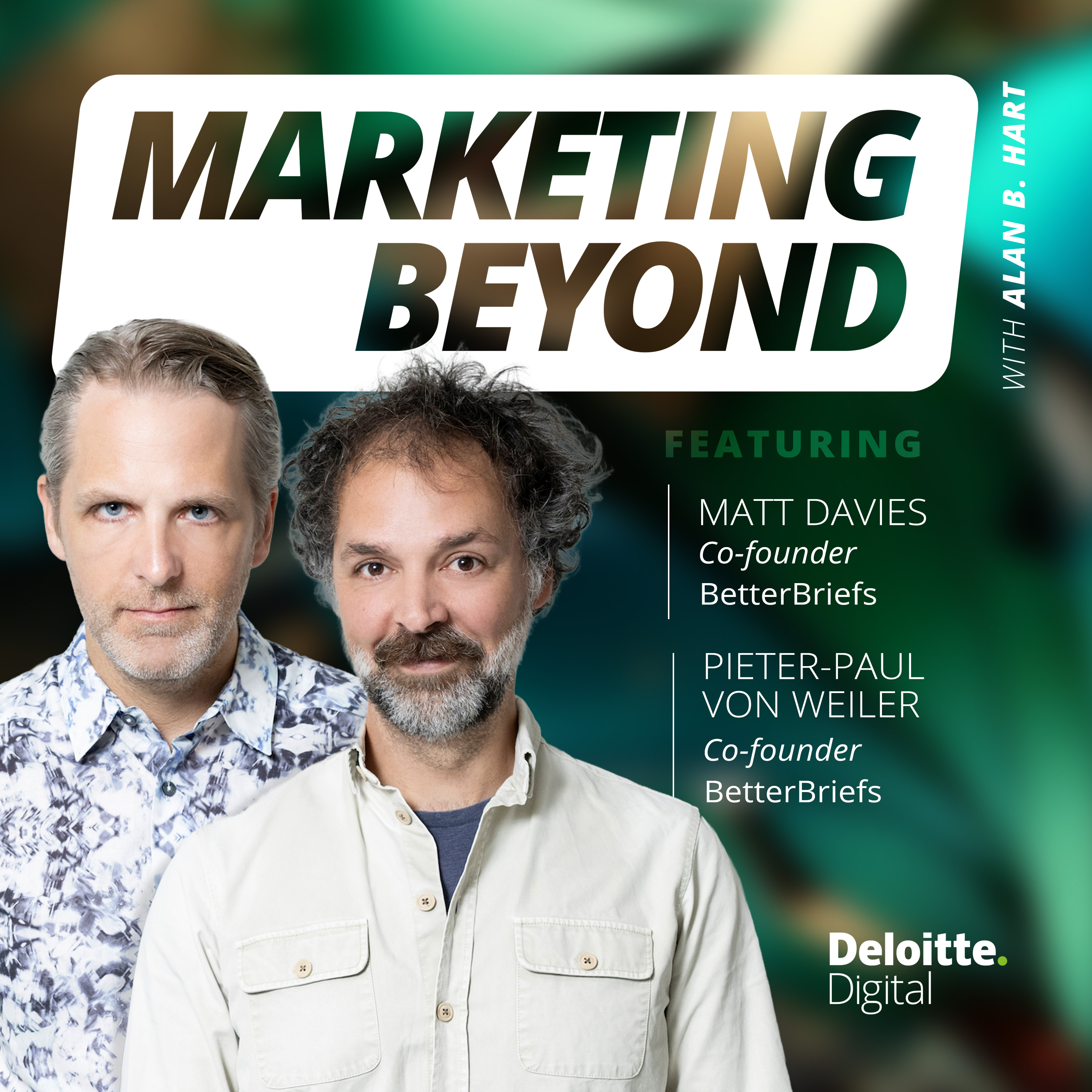
Marketing Beyond with Alan B. Hart
20: From BetterBriefs to better results: Insights from Matt Davies and Pieter-Paul von Weiler, co-founders at BetterBriefs
00:41:37
In today’s episode, Alan sits down with BetterBriefs co-founders Matt Davies and Pieter-Paul von Weiler to discuss why they think marketing briefs are the most important document in the agency-marketer relationship, how approaching briefs as...
Loading summary
Transcript63 lines
- [00:00]
A
Foreign.
- [00:07]
B
Are you ready to go beyond the basics of marketing? I'm Alan Hart and this is Marketing beyond, where we talk about the questions that spark change and share ideas that challenge the status quo. Join us as we explore the future of marketing and its endless potential.
- [00:27]
C
Foreign.
- [00:32]
B
The Show I've got Matt Davies and Peter Paul Von Weiler, two experienced former creative agency strategists with decades of experience managing thousands of briefs and ideas. And in 2021 they co founded Better Briefs after conducting the largest and only global study into marketing briefs called the Better Briefs Project, which we talk about on the show. The findings exposed a large lack of alignment between marketers and agencies when it comes to briefs and billions of dollars going to waste as a result. Today they help marketers all over the world through training, advice, knowledge sharing and with their free reports which we talk about and you can get through the links in the show notes. They want to help marketers and agencies engage in more objective discussions about briefs, brief writing and how ideas are assessed. Besides the Better Briefs Project, their latest study, the Better Ideas Project, is another one that we also discuss on the show today. Now Peter Paul von Weiler is a former creative agency strategist, having worked for creative agencies like Publicis Amsterdam, Publicis London, Saatchi and Saatchi London and later serving as the Chief Strategy Officer at AGF Partnership. Matt Davies is a former creative agency strategist, working agencies in Melbourne, Amsterdam and Shanghai. Before co founding Better Briefs, he worked with creative and design agencies like Clemenger, bbdo, Arnold Worldwide and designbridge before running his own agency. Combined, they have won over 20 FE awards, including two Grand FES and one IPA Effectiveness Award. I think that says it all. Those are about effectiveness of your ideas and your work. And I hope you enjoy this conversation with Matt Davies and Peter Paul Von Wyler. Welcome to the show. I've got Matt and Peter Paul. It's. It's not every day I interview two people, but I know you guys are business partners and you insisted on coming to the show together. I want to know why. Why are you so inseparable?
- [02:43]
A
So there's two reasons for that, Alan, and thanks for having us on the show. Reason number is that when we were leading strategy departments in agencies, we quickly discovered that when you get multiple minds, when you get multiple strategies working on briefs, you get to richer, deeper thinking quicker. And I think that's something we just naturally continued in our business. And the second reason is everything is kind of the sameish nowadays in the world of marketing and when it comes down to events and podcasts and interviews. Everybody shows up alone, so every want to drive a bit of standout. We show up together and be a bit different.
- [03:19]
B
I love it. I love it. Well, what was the path for both of you to found better briefs? What sparked it, if you will.
- [03:28]
C
Yeah. As Peter Paul mentioned, we're both former agency strategists. We applied our trade in agency land, creative agency land, brand agency land, shopper agency land, for roughly two decades each. And as strategists do, we often bemoan the quality of briefs on our desks. Peter Paul and I were sitting in a pub actually one day and I had a brief on my desk for a stock exchange listed company here in Australia. And it was wanting, to say the least. There was, it was a one line brief. There was no template associated with it. This particular company was wanting to put a lot of money and investment behind this particular activity. And it was not atypical really. We would often see briefs from our clients who were asking a lot of us and the agency. So for us as former agency strategists, we would often take it upon ourselves to train clients in areas of how to write a brief, how to communicate that brief into their agency, how to get the most out of their agency, what creative response looks like, how to assess creativity. So for us, it was a really rich, some say niche spot, but a really impactful spot in the communication process where we think we can impact what happens and how we design the work.
- [04:39]
B
I love it from the idea of why create this? You did this together. And going from kind of like other agencies to now saying, wait, we want to do something together. It's a little bit like getting married. I don't know if you think about it that way, but like, I've had partnerships in the past and I'm just curious, like, how do you guys make it work?
- [04:58]
A
Yes. I guess one thing that helps is that I'm Dutch and Matt has worked in the Netherlands. So we are bluntly honest. So issues and feedback is unfiltered. And I think that is important. It is important in a partnership and it is important in our line of business as well. There's too much ambiguity, too much politeness, too much misunderstanding that we see go wrong. That I think in our relationship everything is quite blunt. And some of the people that work for us sometimes are intimidated how we communicate with each other, that it looks a little bit like fighting sometimes, but that's kind of just us being brutally honest with each other. And that's Alan something we need more of in the world of ideas and marketing, we need more brutal honesty and that will help us get to more effective ideas.
- [05:57]
B
I appreciate that and I've had a Dutch colleague and I learned through him the Dutch succinctness and maybe like brutal truth, but it works. It works really well. And especially if you can create that language together. It does sound a little like you're fighting at times, but you're just getting your thoughts out clearly, succinctly, to the point.
- [06:21]
C
Totally. And it's always with the interest of the business at heart. I think we've been fortunate as a business where we've had people knocking on our door from day one. We started the business with a whole bunch of clients waiting to be trained on how to write creator briefs, how to assess creative ideas in a more proficient manner. So leads and getting business through the door and the financial aspect of the business, which we all know is sometimes tricky, has never really been an issue for us. The issue for us has been how we plan for the business, how we plan for growth, which is a luxurious position to be in too.
- [06:52]
B
Well, it seems like, I mean, beyond the spark of this idea, you guys have published a couple of studies, the first of which was the Better Brief project. I would love to talk maybe a little bit about that, what the findings were, et cetera, but maybe like, other than, I'm guessing it came straight out of why create this organization to begin with? Like, what were you looking to, to understand in that first project, that first study?
- [07:16]
A
Well, it kind of came the other way around, Ellen. We were kind of complaining once again why there were so many Paul briefs. And I guess we wanted to know a little bit more about it. And we quickly discovered that hardly any research had been done on this important document. When you think about a brief ride, it is a really important document, probably the most important document that exchanges hands between a brand and an agency. And we looked up the types of research and the amount of research that had been done. And a tiny study in the UK was done more than 20 years ago. It was included in some agents, agency brand relationship studies, and that was it. So it was a really important topic that was very lightly researched. And then as a strategist, you kind of, you kind of get really interested. Why is this, why is this thing that has been been haunting me my entire career so poorly researched? And I guess we just wanted to fill that knowledge gap. We wanted just to do something about it. After almost 20 years of working in the industry, I guess we, we wanted to do something about it. In our own way. And we're not researchers at all. We, we are trainers and we are strategists. But there was a passion to fill that knowledge gap, and that actually started the business, not the other way around.
- [08:40]
B
Gotcha.
- [08:40]
A
Okay.
- [08:41]
B
Well, one of the things that stuck out to me was, I think it's a stat around an estimated Hun. 1/3 of marketing budgets are wasted on these poor briefs and misdirected work. What are some of the strategies or thoughts that you help people think about now, both on the marketing side as well as the agency side to improve those results?
- [09:02]
A
Yeah, I guess there's a couple of things to start off with there. First of all, a brief is a summary of all the strategic thinking a brand has been doing. It's the end points of the strategy phase. So if your marketing strategy isn't sound, isn't clear, you're not able to write a brief. And that happens way too often, that a brief writer has to put in a poor strategy into a brief. And obviously that's not going to go anywhere. The most important section to Neil is the objective section. Agencies are screaming out for a clear picture of success. What do we need to shift in people's brain, and how will that shift in people's brain or people's heart influence behavior? And how will that behavior change deliver a commercial result? We see that go wrong way too often. And both the marketeer and the agency need to be clear on their picture of success, because otherwise you can't ideate. Because a brief is a springboard for an agency to ideate of. To start thinking from it guides and informs their behavior.
- [10:15]
C
The other thing we notice is that, is that multiple strategies often make their way into briefs. They're not as singular in their focus as they should be. So are we trying to acquire new customers? Are we trying to retain existing ones? What we have to say to those audiences who are fundamentally different will be different. So I think often we think that it's easier to do a lot and it's more efficient for our money to try and do as much as we can with a brief, when actually it's the opposite. The more focused we are with our brief, the more dedicated we are in defining that target audience in our brief and designing communications for that specific problem or opportunity. We define the better the return on the investment potential.
- [10:51]
A
And maybe the last one is treat it as a contract. Treat it as a contract as any other industry would treat contracts. Unfortunately, we're not seeing that happen. We're seeing that not enough time and Attention goes into briefs. We're seeing that they're not precise enough and there's maybe more on the marketeer side. And on the agency side, we're seeing agencies saying yes to briefs that they don't understand. So both sides have a responsibility there to take that document way more seriously.
- [11:29]
B
Well, and, you know, I think something else that stood out to me was this other stat. Around 90% of marketers admit that they changed their brief once they briefed the agency. It feels like the notion of. You just mentioned of making this a contract. I've never thought about a brief as a contract, but you're right. Like, what do you want to achieve? And then looking back to see, did the work achieve that outcome? It really is simple, but. And it's, and it's a bit of a contractual obligation that you're setting up at the outset, but I never thought about it like that.
- [12:03]
A
Well, continue to think about it like that. Continue to think how other industries treat briefs. Think about how architects are briefed. Doesn't matter if it's an interior architect or, or, or somebody who builds a building. Think about how, how your gardener is briefed, how you brief your hairdresser. Right. Those are very serious, serious documents that are, that are of huge importance. And if you change them halfway, then there's going to be massive consequences and we should treat the brief the same in our industry.
- [12:38]
C
I'm glad you brought that up, Alan. Around how briefs change. And some of it is the nature of our industry. We work in a dynamic industry and sometimes things change. Right. And if it's small things like we're updating the channel mix, we want a new format, we want a slightly new specification on the creative that we're designing, all the media that we're putting that creative end. And that's usually something that agencies can handle. When it's fundamental change, when strategy is not clear, when a brief becomes more of an internal stakeholder alignment tool versus a tool designed to brief an agency who can start work from it, then that change is really difficult to deal with. It becomes a really expensive process. We know that a poor brief kicks off a really negative chain reaction. And if that brief changes, it just resets that negative chain reaction as well. Because agencies spend far too long trying to interpret A, the first direction or B, the second direction that you're setting in your brief. We get a whole bunch of mediocre ideas back because we're uncertain in the project what the project's end goal looks like. So we spend lots of time, money, energy, Additional rounds of concepting approvals. On average, I think every round of concepting an agency is between 40 and 50 grand. So we're wasting money if our strategy is ill defined. We're not setting our agencies up for success. And yeah, it's staggering. Nine out of ten marketers admit that briefs change. We need to get better at putting final briefs into agencies and buying ourselves a bit more time up front to ensure that we're putting our best foot forward as well.
- [14:05]
A
Back to that example. So you briefed your interior architect on a mid century design and they come back with their first interpretations of how they're gonna redecorate your house in mid century design. And all of a sudden you're saying, no, sorry, I changed my mind, I want to go classical. You're going to pay for those hours that are wasted for sure. And the exact same is happening in our industry. But we're not taking it seriously, seriously enough.
- [14:35]
B
One more question about briefs before we switch gears. I've heard marketers over the course of my career say something to the effect of, well, I don't want to stifle the creativity. And so they, I think, stop themselves short of providing maybe either that critical direction or sharper point of view in terms of the strategy or the findings that they're trying to look for. What I'm hearing from you guys is you need that absolute clear direction because it actually fosters creativity. It doesn't stop, stifle it. And so like, how do you balance those two things, if you will?
- [15:09]
C
I think it's one of the most misunderstood things around creativity in the creative agency land, if you will. A lot of our clients these days, we find, don't know the inner workings of an agency. They haven't been behind the curtain, they don't know how agencies work. Creativity works well with processes and structure around it. We need that iterative process to allow the best ideas to see the light of day. And there's specific skill sets within agencies that allow that to happen. So for the idea that we just need to let creativity loose, that we need to be very free in the way that we brief. Creativity works best if we focus it. If we focus it around a specific challenge that the brand is facing, if we focus it on what success looks like, what does the end game look like for creativity? We are in the business of commercial creativity. We are not in the business of art and creating stuff for creation's sake. So what we design has to have a purpose. And it's up to the marketer to make the choices and set the direction for where the creative agency needs to find the answers. So what is the message? What is the one thing they want to say about their product or brand? What are the proof points, the reasons to believe? How is that target audience defined? So the more that we leave it open for interpretation for the agency, the more we're going to go off course.
- [16:19]
A
Yeah. And that's what you do with artists. You commission an artist and let them roam free so they can do their best work. Agencies need to be guided. They need to be guided and they need to be informed on what they need to do and how they apply their commercial creativity.
- [16:38]
B
Of the distinction there, I really do.
- [16:40]
A
And maybe one more thing on that.
- [16:42]
B
Go for it.
- [16:43]
A
So businesses invest in marketing to drive better business results. And the way that works is you make a plan, you capture it in a strategy that is translated into a brief. You give that brief to an agency to come up with ideas. It doesn't matter what type of ideas, but it's the ideas that go into the marketplace that need to deliver a positive return on investment that the business has made. So it's all connected. But in order to get to the positive return on investment, we need to set up creativity for success and we need a better process there to brief it in and manage the ideas as well. Sorry, I just wanted to close that out.
- [17:29]
B
No, I love the point and thanks for closing it. I want to talk about. So we go from brief to ideas, and your latest project is the Better Ideas Project. How does this. I mean, other than switching from briefs to ideas, what were you trying to accomplish here?
- [17:45]
C
Yeah, just to reinforce Peter Paul's point, the idea is what has the impact in the world. So a brief is an important step and an important first step in ensuring that we're getting the right response from the agency. But we also had the hunch that practices around idea assessment weren't as good or as sharp as they could be. We've experienced lots of poor practice within. Within the clients that we work with. Unfortunately, it's just an area that we just don't get trained in. We think it's something that we can all have an opinion on, creativity. So we wanted to put some objectivity around it, some findings, some stats around it, so we can have more robust conversations. Much like the Better Briefs project, it's irrefutable data. There's over a thousand people in both the samples of these reports and heavy on experience levels for marketers. So it's something that we can't refute and for us, it was an indication of where things are going wrong in that process. Because if we get that right, if we get our idea assessment right, if we manage for our biases, if we manage for organizational uncertainty during that phase. Because creative ideas can be tricky things to nurture and deal with. It's something that we wanted to really get a better understanding of.
- [18:51]
B
Well, something critical, I guess, to getting the right ideas is something you highlight, which is like 70% of creative agencies don't trust the creative judgment of the marketers that they're working with. And like, how do we think about overcoming that gap in trust? What are the tools or trades, if you will, that we can do?
- [19:10]
A
There's a lot there, Ellen, that we need to work on first. Trust is built on relationship. And a relationship is a mutual give and take. And relationships grow over time. So the first thing to do is to invest in a relationship, a mutual relationship that gets to these tricky things that are ideas and effective ideas that deliver a positive return on investment. So it's about understanding each other. Ask yourself as a marketer, do you really understand how an idea is generated? And if you don't, ask your agency, take us through. Well, Matt was talking about before, Take us, take us through how your agency comes up with ideas, showing the inner workings of your agency. So I can I, I'm better set up, I'm better equipped to set you up for success. And the same goes for agencies. I think agencies need to understand better how difficult it is to, to get ideas signed off in organizations. It's not an easy thing, especially when you're dealing with big, bold, impactful ideas. And then a couple of things need to happen. We need to work on tools, skills and process. And we can see from our findings that many organizations don't have any tools in place. They don't have any criteria in place how they will assess ideas. They haven't defined what their creative ambition is or they haven't defined what type of ideas they're looking for. Which is kind of nuts because almost every professional competition in any profession has criteria defined. But for some reason, brands haven't defined criteria for the type of ideas they're looking for. What about the sign off process? Is it in order? Is it very clear who is signing off on the idea? Everybody might have an opinion on an idea, everybody might be providing feedback on an idea, but it doesn't mean that their feedback is professional or informed. We like to say that the person who signs off on the brief is the person that signs off on the idea. And then lastly, we know that hardly anybody has trained in how to deal with ideas. Nobody's been trained in how to write briefs, and nobody's been trained how to evaluate ideas. So why do. It's easy to have an opinion on them, but nobody has been trained on them. And I would ask you, Ellen, when's the last time you, you boarded a plane with an untrained pilot, or if you needed an operation, would you allow someone who hasn't gone to medical school to operate on you? No, of course not. But in marketing, we, we, we've got this problem that we're doing all these things that we've never been trained in.
- [22:06]
B
No, it's, it's fascinating you bring this up. I mean, one of the things that is coming to mind is I used to talk to a very prominent cmo and he used to talk about this notion of an iceberg as he's going to shop these ideas around the organization. Everyone loves to comment on what marketing is and what they think marketing is, which is the tip of the iceberg. Right. It's the ad that we see, the latest creative idea that's going to go into market. He was like, but no one understands how much of the iceberg is below the water. The process, the people, the skills, the criteria, the strategy, the underlies, what everyone sees. And it sounds like what you're saying is like, to get better ideas and to understand the appreciation for, like, how an organization has to sell an idea into the organization, we need to codify some rules and maybe bring some of the stuff that's below the surface of the water to above the surface of the water so we can make better decisions. Is that, is that fair to say?
- [23:08]
C
Yeah, I think, I think you've hit the nail on the head there, Alan. I think some of the poor practice we see is that the people who sign off the brief are not the ones necessarily signing off the idea and.
- [23:18]
B
Right.
- [23:19]
C
It's also unfortunate that we are in a profession where everyone can share an opinion. Everyone has an opinion on creativity because we're exposed to ads every day. I've seen this. I like this. I know what's going to be right for our brand or not. But it shouldn't be the case. Just because you have an opinion doesn't mean that that opinion is informed, is justified. It's very hard for us to have an opinion on something more complex, like the cyber security policy of a company. And we would never, we would never offer our opinion in that area of the business as well, because it would Be ill informed. So I think people come at idea assessment with a really ill informed perspective that their opinion is valid. We should be defining everything that we do and every piece of work that we're assessing from our target audience's perspective. If someone hasn't seen the brief, doesn't know who the target audience is from that brief, not broadly who you think the audience is for your business, then we're not doing it justice, right? Too many personal opinions are going to reign, subjectivity is going to reign and we're going to get to watered down, diluted, gray, bland ideas that don't have the impact that we're looking for. We, we know that most creativity doesn't stand out. How many ads are we exposed to every day? How many of them do we notice? That is, that is the group think mentality that happens when the bottom of that iceberg rears its ugly head and derails, you know, derails projects.
- [24:36]
A
And, and when you start to look into the backstory of some of the most famous campaigns we've, we, we've seen in the last 50 years. When you, when you look back into what actually happened from a decision making perspective, most of the time there is a very limited amount or only one decision maker that buys the idea on the sports or has to fight a whole bunch of other people and say, no, I'm the decision maker. This is what we're going to do, right? That's the story behind Apple 1984. That's the story behind Sony Bulls. That's the story behind Guinness Surfer. And there's so many more of those stories where there was a very brave leading marketeer who said this is what we're doing and that's it. And they had to fight, they had to fight very hard to get it through. But now we're looking back at those, those types of ads, I think, oh, that's absolutely awesome. So it's, it's a very tricky thing. But the more people, the more people we get to decide on which idea is right for our business, the more we end up being that child in kindergarten, mixing all the pain together. And we all know what kind of color we end up with.
- [25:51]
B
Yeah, well, I really enjoyed this conversation. I mean like you were going from like better briefs to better ideas to better impact. This is a marketer's dream. And I've, I've sat on both sides of the table. Like I've been on the agency side, I've been on the marketer side evaluating and I've been in those situations. Where the brief was ill defined, I might have had some hand in that. And you get through those pitches and you know, agencies, because I've been on the agency side, they are brilliant storytellers and you can sit through a pitch of a new creative concept and you can just be completely enamored with it and then the conversation ensues. Was this what we set out to achieve and we forget to go back and look at, like, what were we trying to achieve? And sometimes we never really wrote it down, which is on us, right, as marketers and probably on our agency partners for not holding us accountable to the contract that we should have set up between each other.
- [26:50]
A
The great story also needs to be summarized in an idea and an execution of that idea that the marketeer can understand. It's all well and good to tell beautiful stories and put on a great show, but at the end of the creative presentation, the marketeer needs to be super, super clear on what the idea is and what the execution is. And there's many issues around that. Many people and agencies don't understand the difference between the two because it is relatively easy to change. An execution is very, very expensive to change an idea. Unfortunately, the industry is hungry for more and more and more ideas and they don't stand out and they're not effective. So that's why we're burning up to a third of our marketing budget.
- [27:36]
B
Yeah, yeah. No, agree, agree. Well, I want to switch gears and ask you guys a couple questions I ask everybody that comes on the show. Also, it gives me an opportunity to learn a little bit more about each of you as people and as humans. My favorite question to ask everyone. And so I'm just going to pose it to each of you individually. Maybe Matt, I'll start with you is, has there been an experience of your past that defines or makes up who you are today?
- [28:02]
C
Getting very deep, Helen. It's good. I'm going to keep it on a professional level, but I think it's, I think looking back at, I think my experience and my, and my. And my career as a strategist, it's. I think it's the diversity of experience. And what I mean by that is strategists are fortunate enough to work on lots of businesses in lots of industries, and I've also been fortunate enough to work in that format across multiple countries and continents. So it's amazing how sharp you can keep your actions and your mind when every problem you face is different. And I think that's the beauty of being in that strategic role that you can work in B2B one day you can work on automotive, the next day you can be working on consumer packaged goods the day after that. So it's always kind of getting to the heart of our clients business problems. That was always the driving force as a strategist and I think that's put us in, in good stead and me in good stead anyway for, for my career as a, as an entrepreneur and as a, as a business owner. So yeah, it's, it's, it's a, it's an interesting question. It got me thinking.
- [29:05]
B
Awesome. Peter Paul, what about you?
- [29:08]
A
Yeah, for me it was getting fired.
- [29:12]
B
That can be very impactful.
- [29:14]
A
Yeah, so I was, I was in between jobs working in London as a strategist. So this was job I took between working for publicist and work for Saatchi and Saatchis. And I was there for about four months and from one day to another I got fired and it was my own fault and it learned me a lot about listening. So I was working on a brief and I shared my first draft with my boss and he was like a true British gentleman. And after reading my brief for the first time, he said, very interesting. So I thought, oh cool, that's a good sign if he thinks it's very interesting. So I continued to refine the brief along the same strategic direction I had set out and only made a couple of tweaks to it. So the next day I shared the updated version with him and after reading it he said, I only have a few minor comments. So me as a Dutchman, I think, okay, cool. So he's just got a couple of things and we're almost there and we're good. And this continued like three or four more days like that. And on the fifth day I was asked to not come in anymore. So that was my fault. It was my fault that I wasn't listening well enough. And you listen not only with your ears, you listen with your eyes as well. And I should have listened better and understood the culture that I was working in better because when he said very interesting, the English actually mean, that's utter nonsense. When he said I only have a few minor comments, he, he means just rewrite that brief completely. And that was my fault. It took me a while to actually figure out what had happened because mid level you're, you're 10 years into your career, you think your thoughts. But I, I had to go deep to actually really, really reset myself and, and think, okay, I need to listen even better. I've, I'VE got the skills. There was just an, an incident and. Yeah, that was transforming for me, that experience.
- [31:33]
B
Yeah. Well, and I, you, you know, the cultural differences, to your point, like, I mean, we, I face that even in the US Right. The East Coast, Northeast is very different than the Midwest and California or the South. Right. You know, in the south, where I grew up, we might say, oh, that's, that's fantastic. And it's the equivalent of. That's interesting. And so, you know, the nuances are real. And, you know, anyway, it's good for you for, for owning it, but I also think there are circumstances around it probably not in your favor too. So.
- [32:13]
A
So we need a lexicon, Alan. We need the lexicon also in America, it seems, for when we're dealing with ideas. Because when you're dealing with. Ideas are really fragile things. Right. They're really hard to decide on when they first show up. They're very rough and ugly because they're never as refined as in their final polished state. And there's no room to say it's fantastic or that's interesting. We have to be clear with each other what we think and what we mean.
- [32:44]
B
Well, and I think that gets back to the lexicon, to your point, gets back to that, like, bridge of trust that needs to be built, like, so that, like, we understand each other. Like, it's hard to have trust if we don't understand each other. So. Yeah, no, I agree. I agree. Well, I want to ask you guys, each of you, like, what advice would you give to your younger self if you're starting this journey all over, maybe besides write better briefs?
- [33:06]
C
But I think for me, it's. Be a better student of the industry. Earlier, I think I went through my early career kind of trying to find my way in agency land and in this communication field. And I was fortunate enough to work at some great agencies, but there is so much available around how marketing works, how communications work that a lot of people are not aware of. And I would have, I would have pushed myself to be a better student earlier because it's. It's easy to have your head in the sand. It's easy to be indoctrinated into a particular organization's way of working, but there's stuff out there, for some reason, we. We continue to make bland work or work that doesn't stand out or work that we're not proud of, which is another finding from our research when we shouldn't have to settle for that. So, again, I learn what works. There's lots of people doing some really amazing things in, in the field of marketing science. And so how do you apply that? So I would have got across those principles earlier on, but having having known them now, I would have probably tackled early, early days of my career a bit differently as well.
- [34:10]
B
Yeah. Peter Paul, how about you?
- [34:13]
A
I would say to my younger self, my younger professional self, stop trying to outsmart everyone. Yeah, I think I made a change from trying always trying to solve everything by myself, trying to be the smartest one and always have the solution into partnership and guidance and setting other ones up for success. It doesn't, doesn't really matter who comes up with the solution. Even if you ask the right question that it evokes somebody else to come up with a solution if you provide that kind of guidance that is helpful and that's useful and get to better stuff quicker. So stop trying to outsmart everyone.
- [34:52]
B
I have one more question. I might have one more topic if it's okay if I inject the copy before we get to the last question. Matt, you piqued my interest a minute ago when you said marketing science and I should state for the record that you guys are up really early to have this conversation because you're on the other side of the world right now from where I am. So thank you for doing that. But as you think about like briefing, building strategies within briefs or on the brand side and how it relates to the creative process and getting better ideas as outcomes that drive business, like where does Curious. Just to get your couple of thoughts on where marketing science fits in and you're in the realm of the world where there's a huge marketing science institute in Australia pumping out knowledge about like what they believe they've seen from the data and what the new rules, if you will, for marketing are.
- [35:46]
A
You say rules, right? I think for us the only work, the only creative work that's worth investing is work that delivers a positive return on investment. That work that's effective. So the only thing that we really care about are the FES and the IPA Effectiveness Awards. Now for us, marketing science is this simple act of listen. Listening and applying the rules of the Ehrenberg Bass Institute. Listening and applying the rules of Byron Sharp of Nelson Field with her attention studies of Peter Field and Les Benet on how to balance building the brand with driving activation. It's listening to the studies of Adam Morgan in System one on that most of the work we're putting out there is absolutely boring as batshit. So there is so much knowledge out there on what not to do. On what type of work and how to write a good brief. But we're not applying it. There's so much creative work that's being pumped out that's utterly ignorable. So why are we not applying those basic rules? We need to stand up, right? Show up somewhere with a pair, not as an individual. Do something else. Then you're a competitor. It's so easy, but because of so many reasons. There's so much mediocre work and it's not helping our industry.
- [37:24]
B
No, I would agree with you. And I'll give you a Dutch name that I think does and has been working on this marketing science as well. So Jan Benedikt Steenkamp, or JB as he goes by UNC Professor. But I think some of his work is in line with what we see from Ehrenberg Bass. But I also think he, he has done a lot of work putting it into practice, more so than I've seen in other, other places. So as a one, as one Dutch person to another, not me, but JB to you, Peter Paul, I'll give you, give you somebody that you can reference in the future. I'll, I'll ask you my last question to both of you. You know what, as you look forward, you know you're on a show, lots of marketing listeners. What do you think are the largest opportunity or threat facing marketers as they approach tomorrow?
- [38:17]
C
For me, it's, I think purse strings are going to get tightened. Right. I think that where we might have less money to play with as a business and a brand and as a marketer, your job is to fight for that money. But you can only fight for that money if you have an understanding of the commercial impact that your marketing is going to have. So if we're just spending what we did last year, because that's all we know what to do with our budgets versus understanding and designing for what is the return that we're going to get off that marketing investment and putting together an argument for the business that suggests that we still need to be investing in brand, we still need to be investing in communications because we know that budgets the first thing slashed from the marketing teams when things get tight.
- [38:57]
B
Peter Paul, what would you add to that or maybe counter if you want?
- [39:02]
A
No, I think it's two things. For me. I would say make less ideas that work harder, take more time to write less briefs that lead to more effective ideas. The vast majority of what we put into the marketplace completely ignored. So stop doing that and just make ideas that work. And the other one is many people who write briefs have never been trained in how to write briefs. Many people who approve ideas have never been trained in how to approve ideas. I just think about that. That is such a big issue and it's yeah, the lack of skills in marketing is very concerning. So if you as a brand invest more in understanding and training and getting that right, you will win.
- [39:58]
B
Well, I just want to say thank you guys for both coming on the show. I've learned a few things. Maybe reinforce this notion of a contract is my biggest, my biggest takeaway. I've never thought of the briefing process as such, but I've learned a lot throughout this and I would encourage anybody to check out your studies. They're pretty fascinating and eye opening, to be honest. As somebody who has set in kind of both chairs the agency and the Brand Marketer chair. So thank you for coming on. Appreciate it.
- [40:25]
A
Thank you for having us.
- [40:26]
C
Thanks for having us.
- [40:29]
B
The views, thoughts and opinions expressed are the speaker's own and do not represent the views, thoughts and opinions of Deloitte. Material and information presented here is for general information purposes only and does not imply endorsement or opposition to any specific company, product or service. Hi, it's Alan again. Marketing beyond is a Deloitte Digital Podcast. It's created and produced by me with post production support from Sam Robertson. If you're new to Marketing beyond, please feel free to write us a review and subscribe on your favorite listening platform. I also invite you to explore the other Deloitte Digital podcast@deloittigital.com us and share the show with your friends and colleagues. I love hearing from listeners. You can contact me at marketingbeyondeloitte.com you'll also find complete show notes and links to what's discussed in the podcast today, and you can search our archives. I'm Alan Hart and this is Marketing Beyond.