← Marketing Beyond with Alan B. Hart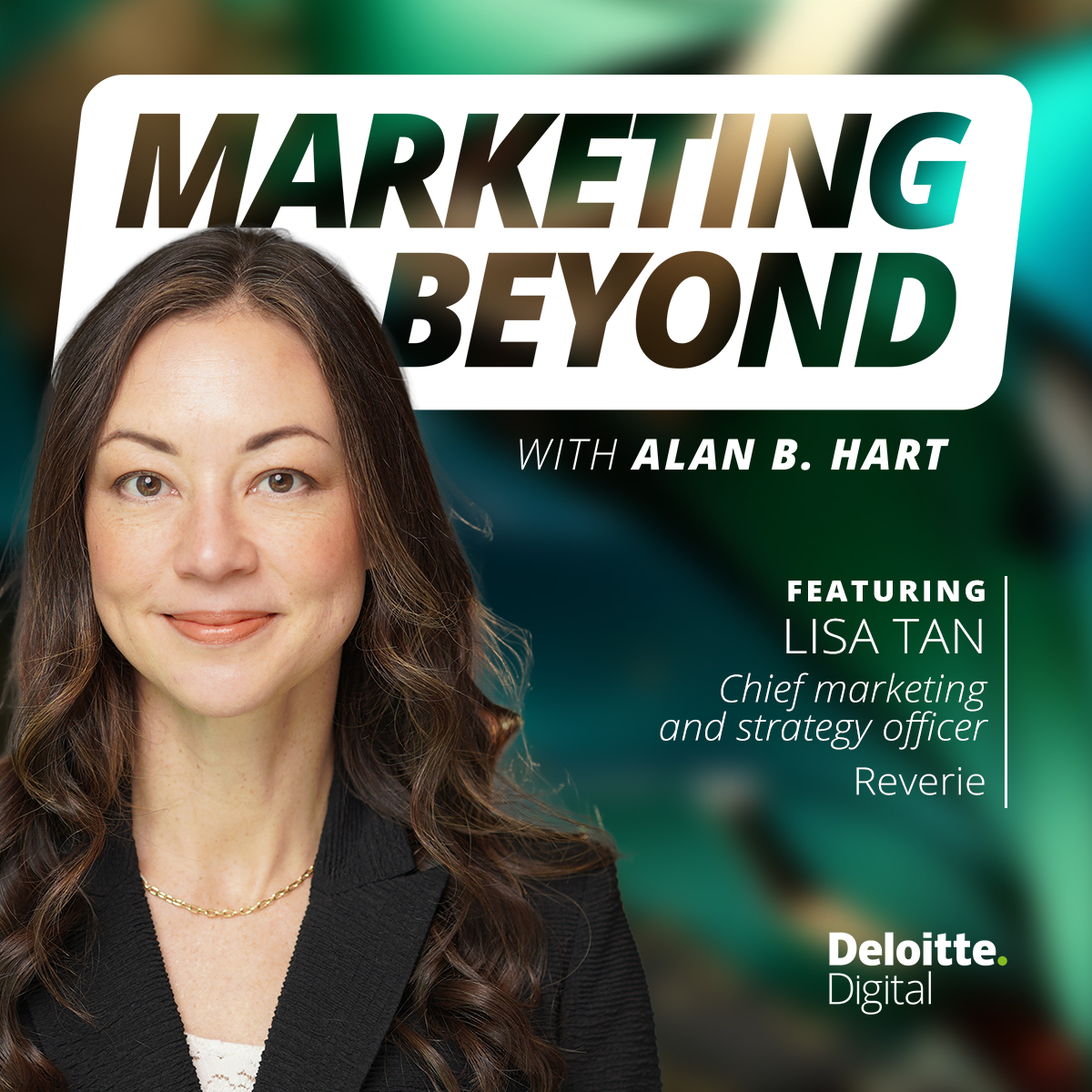
Marketing Beyond with Alan B. Hart
21: Elevating customer experience in sleep technology: Insights from Lisa Tan, chief marketing and strategy officer at Reverie
00:35:20
How can brands use innovation to stand out and improve the customer experience? Alan Hart sits down with Lisa Tan, chief marketing and strategy officer at Reverie, a sleep technology company, on a mission to improve lives through...
Loading summary
Transcript64 lines
- [00:00]
A
Foreign.
- [00:07]
B
Are you ready to go beyond the basics of marketing? I'm Alan Hart and this is Marketing beyond, where we talk about the questions that spark change and share ideas that challenge the status quo. Join us as we explore the future of marketing and its endless potential. Foreign Lisa Tan. She's the chief marketing and Strategy officer of Reverie, a sleep technology company that's on a mission to help people live better lives through the power of sleep. Lisa leads strategic initiatives and marketing and customer experience teams across their wholesale and direct consumer verticals. And she's got two decades of strategic marketing and management consulting experience. A passion of hers, which we talk about is the Reverie Innovation Summit, an annual event designed to support spark new perspectives in the sleep industry. On the show, of course, we talk about sleep and how its role in marketing and whether she's marketing products or marketing better sleep. We talk about the role of technology in marketing and how events can help power your channel, partner relationships. That and much more with Lisa Tan. Well, Lisa, welcome to the show.
- [01:26]
A
Thank you. Excited to be here, Alan?
- [01:28]
B
Yeah. I'm looking forward to talking about business and all that stuff. But before we go there, I have to know. You grew up on the edge of a canyon in New Mexico. What was that like?
- [01:38]
A
I did. I grew up in Los Alamos, New Mexico, which is a mountain town. Way up. Like, way up. The elevation is around 8,000ft above sea level. Small town, 2,000 people. It's a scientific lab town. So really interesting place to grow up, but it's beautiful. So a lot of who I am today comes from growing up surrounded by nature. And our backyard was a canyon. So whenever I felt the need to recenter or take a breath, take a moment to think, I would go out to the backyard and sit on a rock on the edge of the canyon and hear the wind blowing, see the trees moving, watch the hawks flying overhead, hunting. And it was very relaxing and grounding. And it really gave me an appreciation for nature and for how small we are in the grand scheme of things.
- [02:39]
B
Yeah, I mean, that's. That's a real gift, to be honest. Like, as you were describing the. The imagery, I was feeling an inner peace for sure.
- [02:49]
A
For sure. It's still the image that I use to center and ground myself.
- [02:53]
B
Yeah. That's awesome. That's awesome. Well, from early days in New Mexico to where you are now, you're, I believe, the chief marketing and strategy officer at Reverie.
- [03:05]
A
That's correct.
- [03:06]
B
How. How did you end up there? Where. Where did you get your business start and kind of what were some of the stops along the way? Sure.
- [03:13]
A
So I, I went to the east coast for college and then moved to New York City afterwards, which was my dream. My career path was interesting. I was originally going to do management consulting out of college. I was never exactly sure what my exact career was going to be, and management consulting felt very appealing. So I signed up for that, got a great offer coming out of college, and then the Internet bubble burst and I was actually checking my email at an Internet cafe while I was backpacking through Europe and found out that my job was deferred indefinitely. So I ended up working for a professor for six months, which is fantastic. I was a social psychology research assistant. Then I ended up moving to New York City and crashing on my aunt's couch while I looked for a job. And I ended up working in publishing and PR for three or four years. And then my indefinitely deferred offer actually came back and I was still ready for, you know, some, some rapid learning in management consulting. So I took that offer and ended up staying there for quite some time to business school, came back and had the opportunity to explore a lot of different industries and really learn about businesses at a macro level. In my, in my final years consulting, I spent a lot of time in media, really trying to figure out at the time how digitize content, how to monetize content, how to make massive digital transformations. And that gave me a taste of all things marketing. So, you know, after about, you know, that was about 12 years of work experience at that point I got married and my husband Martin is the founder of Reverie. So I said I will, you know, I don't want to continue the consulting lifestyle. I am interested in sinking my teeth into one company. Why don't I do a three to six month project for you? I'll help you figure out what your D2C division would look like and I'll help you find some marketing resources. And here I am, 12 plus years later, still at Reverie.
- [05:41]
B
I love it. I love it. Well, I guess he, he's technically the founder, but you guys are working in this together. Like where did he even come up with the idea for Reverie?
- [05:52]
A
So his background is certainly not in mattresses or bedding. He and his co founder were thinking about ideas pretty much right out of college and they had some access to foam and latex manufacturing, so they were thinking of all the different things they could do with that. Sports pads came to mind and there are a lot of things to do with foam. But in the end they said the Mattress and sleep space is really interesting and they came up with a really cool design which is still the core of our Dreamcell mattresses. It's a unique technology that really allows for full customization of the sleep surface. So they, you know, they started building that in the meantime at trade shows around the globe. Martin was intrigued by adjustable bases. They were becoming more and more popular in Europe as a lifestyle product. And so he started figuring that out, got really into the engineering of the product and ended up you building some prototypes that eventually started manufacturing for large brands like Tempur, Pedic. So that was the start of Reverie really as a sleep technology company. And really the company got its boost in the early days through doing a lot of manufacturing for large mattress brands.
- [07:18]
B
Gotcha.
- [07:19]
A
It was also an interesting time because the category itself is still not a very well known category. People, most people don't go into a furniture store seeking out an adjustable bed, but they're introduced to the category as a lifestyle product for them, which when they go shopping for a mattress. So, you know, it's been an interesting ride over the past two decades to see the evolution of the category and to see an increase in customer awareness of adjustability as something that everybody can benefit from underneath their mattress.
- [07:54]
B
Right, right. Well, so you've got, I guess, bed technology, sleep technology at the core. What does the organization look like today? You've got, it sounds like you've got mattresses, you've got adjustable bases and kind of give me the size and the scope, if you will.
- [08:12]
A
A little bit, sure. So the organization has been through many different variations over the years. As I said, in the beginning it was really focused on manufacturing adjustable bases as an OEM product. When I came on in the early 2010s, we were starting to think about how to expand and how to innovate. So, you know, at that point there were already programs with retailers selling adjustable beds under the Reverie name. And then, you know, that is has and has become our primary business. So we sell adjustable beds to, you know, top 25, top 50 furniture and mattress retailers, primarily in the U.S. although we do have some global distribution. And then we also, over the years have expanded our direct consumer presence with the adjustable base plus the mattress as a sleep system. So that is also a business unit that ebbs and flows with the economic environment. For the past 10 years, there was a huge influx of money into mattresses coming from third party investors. And that was interesting for us to participate in, although we didn't seek outside funding. So all this Effort we had put into, into advertising had to be scaled back a bit when we were competing against unlimited budgets. And you know, now we, you know, we continue to support customers who are looking for better and customizable sleep, you know, both direct to consumer and through our retail partners.
- [09:44]
B
I love it. I love it. Well, as the, as the head marketer, if you will, like, do you feel like you're, you're marketing sleep as much as your products or how do you, how do you think about like the, the, the anchor, if you will, of what you're, what you're putting out into the world.
- [10:03]
A
So what excites me when I wake up every day and go to work is our mission, which is to help people live better lives through the power of sleep. And when we think about new campaigns or when I'm thinking about what the customer ultimately will benefit from when they're using our product, it is a tool for better sleep. You know, that's. And I think over the years we, you know, we have always tried to resist the temptation or the industry standard of focusing on the promotional periods throughout the year. Our industry is very much centered around promotions, you know, big retail promotions. But it is a balance of catering to what the customer needs in the moment of a sale and helping educate them about the product and how it will impact their health overall. So we do try to anchor very much on sleep education and do that over the duration of the product life, which is long. You know, we're not a quick turn product. So figuring out how to engage with the customer pre purchase as they're considering what they need as well as post purchase over the years as they adjust to their product and then as they figure out all the cool features that, you know, the product, especially the adjustable base has to benefit their lifestyle.
- [11:31]
B
Right, right. Well, as you think about like how do you go to market? Like what does marketing look like in terms of. Because it sounds like you've got, you've still got a, a strong OEM business, but you've also got a little bit of a direct business as well. I'm just curious how the, how the market looks like.
- [11:47]
A
So when we go to market on the, on the adjustable base side, our focus is to serve our retail partners with, you know, with marketing assets that are going to benefit their explanation of the product to the customer as well as helping the customer over the, over the lifespan of the product. So that could be as simple as assets that help differentiate our product versus others. In a retail store, when you go in to purchase a mattress, there are usually 60 to 80 white rectangles on the floor that you know, that a consumer is trying to differentiate. So figuring out how to create really strong training materials that help a retail sales associate explain the product quickly and in a differentiated manner matter. Using. You know, we've really started to use a lot of 3D renderings that allow customers to see the entire bed in a virtual space, you know, either through AR or through, you know, being able to rotate and look under the bed and see all the different components in greater detail. And then a lot of content that supports product usage and sleep improvement. We, we geek out a little bit on, on sleep health. We have some really cool quizzes that we've developed with sleep advisory board members to make sure that as you think about what is going to improve the quality of your sleep, you're considering your sleep environment, your habits, and of course, the tools that you use, which would include a mattress and an adjustable base.
- [13:16]
B
Gotcha. And then in terms of, like, when you are selling direct or direct to consumer, like, how does that take shape?
- [13:25]
A
Yeah. So that's where we really spend a lot of time emphasizing sleep. And our customer, our best and easiest customers to acquire are the ones who already appreciate how sleep is. Often they are at a point in life where they, they don't wake up feeling great every morning. Maybe they wake up with back pain or they're constantly exhausted because they're trying to juggle, you know, a very rigorous profession as well as a demanding family life. Often they are a couple who has very different body types and sleep preferences and sleep needs. And that's where our, we, we, we can speak their love language when it comes to sleep products because very few couples have the same sleep needs or preferences. And if we can deliver one thing to each person on each side of the bed, we know that they're going to be happier in their nightly routines.
- [14:24]
B
I'm laughing and smiling because I'm hearing my wife in my ear, metaphorically hearing her in my ear, that we should really try one of these because you need to be a little elevated for obvious reasons. And I'm tired of hearing you.
- [14:46]
A
That is a common problem and it is easy to adjust. Pun intended.
- [14:52]
B
I like what you did there. I like what she did there. That's awesome. Well, as you think about marketing, whether it's in partnership and sales enablement through retail partners or it's direct to consumer, what role does technology or a tech stack or technology in general play as it relates to marketing for you?
- [15:11]
A
A lot. And I've found That over the past five to seven years, my role has very much been one of working closely with our, you know, with my IT partners on what our tech stack looks like and how we're going to deliver on that in a way that is relatively easy and affordable to implement, easy to train on, easy to manage data within or without. Because I think as a 20, 20 plus year old company, the legacy data that we have can become a burden as we think about our tech stack. That's definitely always a consideration, but our tech stack matters. Everything that we do has to consider the communication between our erp, our CRM and then all of the connecting technologies or softwares that plug into the CRM. We actually spend a lot of time talking to customers through our customer experience teams on the phone. So our whole VoIP setup and all of the plugins there that we have now for virtual agents and chatbots and the proper and seamless transfers from one mode of communication to another, be it chat to a live agent or virtual agent to a live agent, all these things we're working through constantly because they're evolving pretty rapidly for us right now. And then making sure that our CMS and our ESP systems plug into everything and that we're able to set up those personalized journeys and communications and touch points as we talk about staying with the customer and engaging with the customer over the lifespan of their product. Especially because often we are not actually touching the end consumer until maybe even several years into owning the product because they'll call us with a product question or a service issue and, and that's the first time that we engage with them.
- [17:03]
B
Interesting. I mean, I hadn't thought about that, but you're right, like if you're, if you're delivering it through retail partner and they take delivery of it. Yeah, it could be because, you know, hopefully beds last many years.
- [17:15]
A
Right.
- [17:16]
B
You know, do you, do you think about like registering them as customers like earlier on in the process? Like, I'm just curious how that works.
- [17:27]
A
Yes. So the ideal for us would be that a customer registers their warranty when they purchase the product.
- [17:34]
B
Gotcha.
- [17:35]
A
And, and we have a very, I mean there are two things that are very important to us in that delivery package and we, we label them very clearly. So one is the manual that has the product information on it, you know, the serial number and the product code, and then a bright fluorescent yellow sheet that says please hand this to the customer and has a QR code to register your warranty. So if we're able to get that warranty registration upfront that allows us to ensure the customer has the education they need and the resources they need to maximize use of the product.
- [18:17]
B
Yeah, awesome. Well, when you were talking about all the tech that you've got, you know, your ERP and your CRM and connecting chatbots and making sure you're seeing and your voip all like coordinate. I mean, it feels like you're not only a cmo, but maybe a, I don't want to say fly by night, but a part time moonlighting CTO as well. I don't know if you feel like.
- [18:39]
A
That, but I would never claim to be a cto and I'm thankful to have, you know, partners both internally and externally to help to help with the technical bridges. But I do think that, you know, as a cmo, of, you know, of an SMB, being able to understand, like really understand how all of the tech stack works and integrates is critical for success because it's easy to walk into a meeting and be sold on this beautifully integrated tech experience. And I have learned over the years that it is not as easy or as pretty as it sounds. And there is always coding involved. And you know, code is very much like a fingerprint. So you get too customized and you're not in a good position, you do too much off the shelf and nothing speaks to each other. There really is this balance of truly understanding what the need is and then working with the right teams to figure out how to make sure that those needs are met.
- [19:41]
B
Beautifully architected. You'd be a consultant one day.
- [19:46]
A
Consulting has definitely helped me throughout my career, so I'm very grateful for having that as as my training ground.
- [19:54]
B
I love it. I love it. When we first met at a trade show event, you mentioned the Reverie Innovation Summit and I was just like blown away by what you're doing there. And it's not your normal event, your normal kind of corporate thing. Can you share with the audience a little bit about what it is and why it matters?
- [20:14]
A
Absolutely. So this year we will be putting on our sixth Reverie Innovation Summit. And this is an intentionally small gathering where we invite our top retail partners to spend a day with us focusing on innovation. And every year the theme changes a little bit. But what is always the case is that we want to bring in speakers and programming that share amazing innovation stories that mostly have nothing to do with with the bedding or furniture industry. And the reason we do this is because it's so easy to get caught up in the day to day, especially when there are a lot of things grinding you down. You know, in our case this year, that would be constant flux of the tariff situation. And being able to step away and spend time with retail partners. Learning about the way that other companies approach problems and being inspired by people who are truly doing things differently helps us a just take a breather. So it's a bit of, hey, let's take a breather and step back. Let's have conversations about what we're hearing, what we're seeing, what we're learning today that may or may not impact how we think about our day to day when we get back to work tomorrow. And we found it's just been a really healthy way for showing that we care deeply about what we do and how we do it, and also bringing amazingly smart people together to solve problems that are inspired by things going on outside of the little world that we spend a lot of our time in.
- [22:04]
B
Oh, it's, it's, it's a lovely idea. And that you've executed like you've been. This will be your sixth year. Yes. Like, where did you get the idea to start something like this?
- [22:14]
A
Where did we get the idea? That's, that's a really good question. I think the first time we did it, we were coming up with a bunch of really cool innovations. We had an app and we had sleep tracking and all these things like 2012, 2013, 2014. And they were so cool and innovative, but they were not things that, you know, our retail buyers were necessarily ready to commit to or, or price into their product. So I think that initially sparked the idea of, well, let's get some feedback. So the first year that we did the summit, it was really more of a product showcase of all these innovations, of all these features that may or may not that were all innovative, but were they appropriate for the bed? So that's what we did the first year and got a lot of feedback. And then from there we started shifting into more, more programming and more looking even more externally. And I think that's, we've, we've, we've spent a lot of time internally doing that. So being able to share our philosophy and, and that value of pushing innovation with our partners has also been a big part of showcasing who we are as a company as well.
- [23:28]
B
Right. It does sound like, I mean, it's a way to differentiate yourself and to push the relationship with your partners into new territories. Right. To create space for both of you to figure out how, how to innovate together in the future.
- [23:42]
A
Correct. And in an industry where there, you know, There is a big focus on promotion and there is, there's a lot of commoditization. We believe it's important to continue pushing that envelope. The bedding industry is much smaller than it should be considering that everybody sleeps on a mattress every night.
- [24:01]
B
Right.
- [24:02]
A
You know, the fitness, the coffee, the, you know, fast food service, they're all much bigger than the bedding industry. And I think that that speaks to how consumers and, you know, and retailers currently value sleep products. So we always want to push the envelope and try, try to do more.
- [24:23]
B
Cool. Well, one of the things we love to do on this show is to get to know you a little bit better. We know where you started, your, your journey as a, as a little person growing up on the edge of a canyon to reflect and center yourself. And that might have something to do with my next question, which is my favorite question to ask is, has there been an experience of your past that defines and makes up who you are today?
- [24:46]
A
One experience that defines who I am. I think I spoke a little bit to just, yeah, the environment I grew up in mattered. My early start, career start, that was sort of a stop and start. And a lot of job changes over a short amount of time was a big impact on who I am today. I also think if I think back to one thing that impacted me from an early age and has continued throughout life, it would be as a child we took a lot of. I felt like I spent a lot of time in the car. Part of that was growing up in New Mexico where everything is a drive. And I was also the youngest child, so I was always tagging along to my older siblings activities. But we did do a lot of road tripping and when we went on a family vacation, it was usually fairly unscheduled and we ended up doing a lot of walking through cities, you know, wandering, wandering, wandering, wandering. I have a great appreciation for that now. Not necessarily always having everything set in stone, but being able to step back and enjoy the ride and enjoy the journey. So I, as a result, I tend to be a pretty keen observer of what's going on around me. And I will sit back and watch and learn before I speak, which often benefits me depending on the situation. But I think a lot of that time spent in cars, waiting, wandering, all of those things have really formed who I am and how I approach the world.
- [26:20]
B
What advice would you give your younger self if you're starting this journey all over again? Ooh.
- [26:25]
A
I would say when you're starting off, everybody who is has come before you knows that you don't know everything. So as a, as a newbie in, in the workplace, don't feel like you have to pretend like you know everything. Don't be afraid to ask the questions and to show your inexperience and your ignorance because you're not there to be the most knowledgeable person in the room. You're there to add value with fresh thinking and with, you know, the desire and curiosity to learn.
- [27:03]
B
Beautiful advice. Well, is there a topic either you're trying to learn more about or you think marketers in general need to be learning more about today?
- [27:11]
A
Yes, I would say, you know, obviously learning how to use AI more efficiently and effectively is a topic that all marketers need to learn about. I am spending a lot of my, my time trying to be smarter about using my brain to enable the power of AI versus rely on, you know, rely on it sort of aimlessly. I think, you know, understanding human behavior is something that has always fascinated me and ultimately is super important as a marketer. And over time and over my career, I have a very clear understanding that who I'm speaking to as a brand is not what I understand as a, as a person experiencing life. So being able to understand all the different motivations that drive people is so critical in as a marketer and as a human being and citizen of the world. So I like to read up on human behavior and on trends. I'm actually really fascinated by how trends form right now because watching my tween, my tweens, well, I have one tween and one kid that's acting like a tween. How they are ingesting information and picking up on trends is fascinating to me. And even though they don't have neither of them have direct access to, you know, social media, the way that trends are forming is, is, is fascinating. So I've been trying to understand that a little bit more as well, just to try to keep up.
- [28:49]
B
Is there any of those trends that you yourself are going down the rabbit hole, if you will?
- [28:53]
A
Well, you know, maybe it's tangential. I think it's really interesting to me to see 7, 8, 9, 10 year olds obsessed with cosmetics. I mean, really just wanting all the cosmetics. And a lot of that has to do with the packaging and a lot of that has to do with influencers that they don't even know directly, but that friends of friends have, have pulled out of the ether and are, you know, are spreading in the elementary school. But, but I think a, you know, a tangential interest for me which probably isn't so far is just, you know, trying to use food and exercise and habits as a means for longevity. So it's easy to tap into a trend like must take creatine, like, must, you know, must take magnesium before bed, which is actually a great sleep tip. You know, must eat blueberries in the morning so I have better cognitive performance. Like, it's kind of similar because there's so much information out there and a lot of it is relevant and some of it's overblown and some of it's false. And figuring out how to make sure that you're staying on track and not like, you know, diving into everything and trying out everything to your detriment is, you know, is something that I guess I ingest all the information and try to parse out what's real, try to keep my sources real, as we all do. And I think that's an important part of being a participant in a social media society today and making sure that we're helping the children and young adults in our lives work through the right processes to maintain integrity of the information.
- [30:38]
B
Yeah, it's fascinating, especially as you're talking about all those health tips and the longevity. I mean, it is a slippery slope of like, people out there trying to hack every element of their life, if you will. Yes. I was a colleague of mine who's not a colleague anymore, but like, he, you know, tracking, tracking the data and trying to figure out, like, optimize each little element, if you will. So, like, like you were mentioning, creatine is the latest thing I've heard about as well, and, or magnesium and like, monitoring his vitals to say, well, how is that improving or decrementing my sleep or my recovery for the day, et cetera. So in many ways it's really refreshing because growing up in the US I don't think we've ever really been this health conscious before, but I also think that in some cases we still have many more ways to go to adopt this more broadly and help our population become more healthy. But yeah, it's exciting. It's exciting to watch and learn. And I've got this little thing on my wrist that tracks my data every day too, I guess. Drinking the Kool Aid.
- [31:54]
A
Yes.
- [31:57]
B
Well, my last question for you. What do you think is the largest opportunity or threat facing marketers today?
- [32:03]
A
So I already mentioned AI, but I think that the biggest opportunity and threat to marketers today is AI. It's really important that we continue to use it critically. You know, it's important to remain a critical and creative thinker when using AI. And I am already so thankful for all the things I've been able to do and all the processes I've been able to expedite and all the leaning out we've been able to manage and create more with AI. But I think there's also a risk and a downside. There is an article I came across the other day. It was an MIT study that said something like 80 plus percentage of a percent of people who wrote an essay using AI couldn't remember what they wrote right after writing the essay. And that's the scary thing about relying heavily on a tool without really putting the thinking into it. So for me, as I think about what my team needs to know and understand as we build these things out is the creative brief still matters very, very much. The prompting really matters very much. And spending time to learn how to do those things effectively and to take the time to do them right is so important.
- [33:25]
B
No, I agree with you and I love the notion of, like you said earlier and when you mentioned AI originally, like using my brain, better to use AI. Right. And it does seem to be like, at least for now, we'll see what the AI does in the future. But human plus AI is the only way to drive this forward.
- [33:49]
A
Yes.
- [33:50]
B
And it to your point, you know, it does take a lot on the human to understand how to get the most from it.
- [33:59]
A
So yeah, absolutely.
- [34:01]
B
Totally agree. Well, Elisa, thank you for coming on the show. I really appreciate it.
- [34:06]
A
You bet. I enjoyed our conversation today. Alan.
- [34:11]
B
The views, thoughts and opinions expressed are the speaker's own and do not represent the views, thoughts and opinions of Deloitte. Material and information presented here is for general information purposes only and does not imply endorsement or opposition to any specific company, product or service. Hi, it's Alan again. Marketing beyond is a Deloitte Digital Podcast. It's created and produced by me with post production support from Sam Robertson. If you're new to Marketing beyond, please feel free to write us a review and subscribe on your favorite listening platform. I also invite you to explore the other Deloitte Digital podcast@deloittigital.com US podcast and share the show with your friends and colleagues. I love hearing from listeners. You can contact the me at marketing beyond deloitte.com you'll also find complete show notes and links to what's discussed in the podcast today and you can search our archives. I'm Alan Hart and this is Marketing Beyond.