← Marketing Beyond with Alan B. Hart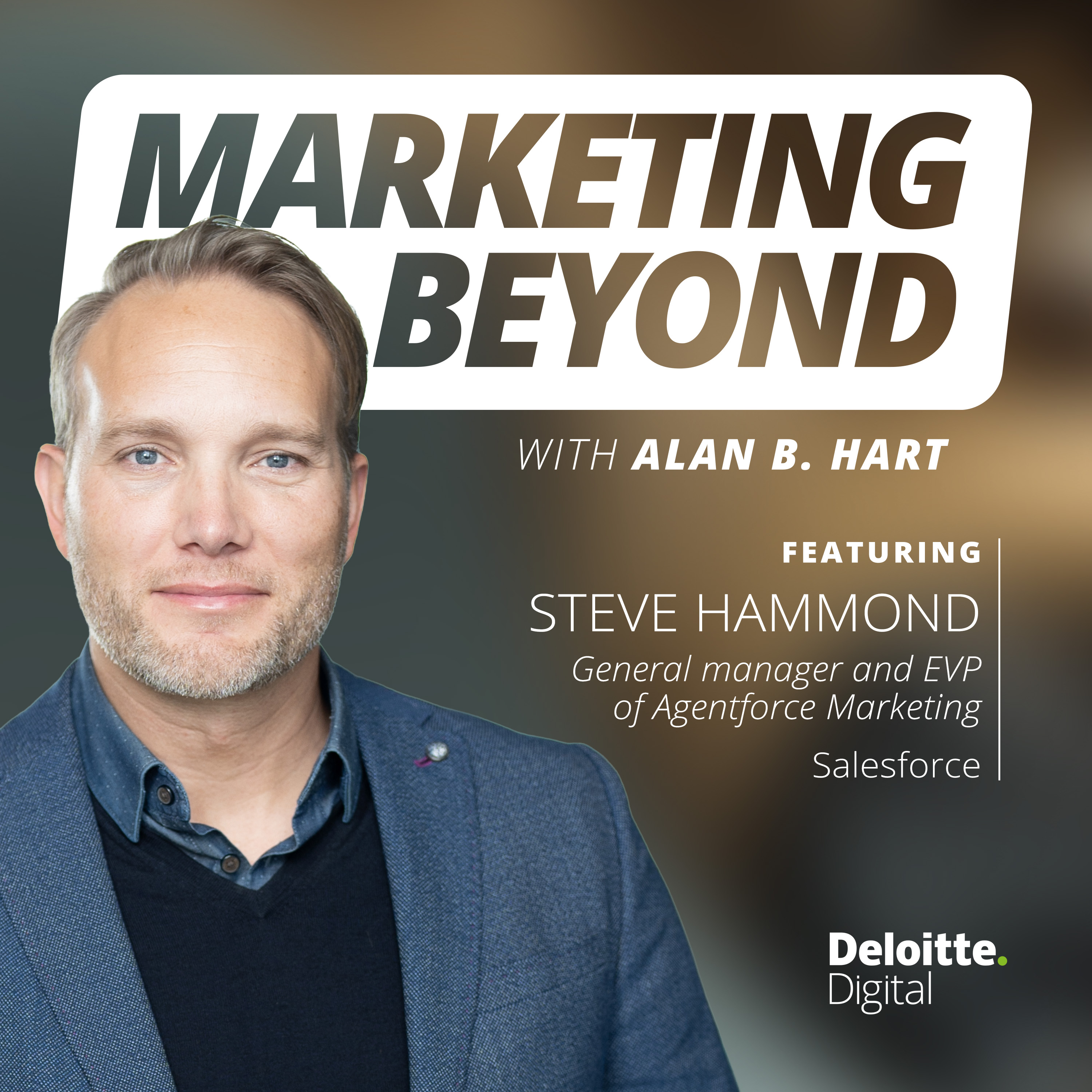
Marketing Beyond with Alan B. Hart
22: Agentic AI for hyper-personalization at scale: Insights from Steve Hammond, general manager and executive vice president of Agentforce Marketing at Salesforce
00:31:06
Loading summary
Transcript78 lines
- [00:00]
Alan Hart
On the show today, I've got Steve Hammond. He's the GM and EVP of Agent Force Marketing at Salesforce. We talk today a lot about people, how people's behaviors are changing, how that influences technology, how technology influences people's behaviors. We also talk about how Salesforce is meeting the demand for two way interactions with customers, how that's going to drive personalization into the future. That and much more with Steve Hammond.
- [00:27]
Steve Hammond
Foreign.
- [00:30]
Alan Hart
Are you ready to go beyond the basics of marketing? I'm Alan Hart and this is Marketing beyond, where I chat with the world's leading chief marketing officers and business innovators to share ideas that spark change and inspire you to challenge the status quo. Join us as we explore the future of marketing and its endless potential.
- [00:55]
Well, Steve, welcome to the show.
- [00:56]
Steve Hammond
Thank you, Alan. Appreciate it.
- [00:58]
Alan Hart
Yeah, I'm, I, I'm excited for this. I mean one, we're at Dreamforce. This is your turf and I'm a visitor. But also before we get talking about all of that business, Jaz, I want to know when you step away from all this technology, what do you do? Like, how do you disconnect? How do you recharge?
- [01:20]
Steve Hammond
Well, I think probably like most people, it is nice to step away from the things we do every day and do something different. I'm a big fan of getting out in nature. I love riding my mountain bike. Sometimes I go ride dirt bikes and other things in the mountains. I do live kind of near Park City, so it gives me a lot of access to that. I also have a farm. It's in a different state. That one's in Arkansas, but it's a great place. I get to go out and kind of ride a tractor and plow fields and other things and it's just completely different from working on technology. So I, for me it's a bit of a disconnect, but I really love it.
- [01:54]
Alan Hart
I did not expect the farm to be your answer.
- [01:57]
Steve Hammond
Yeah, yeah.
- [01:58]
Alan Hart
I mean, get your hands dirty. I get, I guess what's. There's some famous saying about like a break is as good as a vacation. Does that apply in this case?
- [02:07]
Steve Hammond
It is. It's interesting because I think I usually will get up with the sun or before the sun when I go out and work on the farm and I'm in way past the sun going down as well and I am exhausted at the end of the day. But somehow it's still a break.
- [02:19]
Alan Hart
Break.
- [02:19]
Steve Hammond
It's because it's a mental break. It's really nice. But I love technology. It's been Part of my life, at least for the last 30 years, since I've been working in the space. And I've really enjoyed keeping up with everything, but it's so nice to just walk away from it sometimes.
- [02:33]
Alan Hart
That's awesome.
- [02:34]
Steve Hammond
Yeah.
- [02:35]
Alan Hart
Well, you are now the EVP and GM of Salesforce Marketing Cloud. Although you made an announcement today. I think it's going to be called Agent Force Marketing.
- [02:46]
Steve Hammond
It's the same marketing cloud technology, but we've added Agent Force to it, which means that it allows marketers to be more effective at their jobs. They can be able to create campaigns and content for campaigns more efficiently. We have agents that assist them in doing that. It also helps assist them in doing analysis of their campaigns and audience performance. And what's really interesting is it goes beyond that, because really getting to the next generation of marketing isn't just about making marketers more efficient, which it does, but it also allows for an organization to create a conversation with their customers, which historically has been impossible at scale. Typically, we try to replicate that in person because when we're in person, we can read each other's body language and facial expressions and we can be adaptive. Right. And digital channels, it's more complicated. And now with agents, we can unlock that now at the scale of marketing, and that's one of the things we've added.
- [03:44]
Alan Hart
I love it. I love it. Well, how did you get started? Like, where did you start your career? How'd you end up at Salesforce?
- [03:52]
Steve Hammond
How far back do you want to go?
- [03:53]
Alan Hart
Go as far back as you want.
- [03:55]
Steve Hammond
You know, it's funny, I thought I was going to be a dentist for quite a while. My dad was a dentist, and I worked with him in a dental office for four years. But then he had invented this tool for boating, and we didn't live anywhere near an ocean, and it was just his hobby. And so he said, hey, would you go and figure out how to take this thing to market? And the only this was in 1997, the only way for me to get this thing to market was to put out to build a we website and to figure out how to create interactive content and video to show people how this thing worked. And then I went and went up to the top of the west coast and sold to every dealership all the way down the west coast, and then created this website and started selling online that way. And that changed my whole trajectory. I switched into design, computer design, and into computer science. And I built an agency, a small agency, and kind of got that going. And then when I finished My mba. This company called Omniture called me, and they said, hey, would you come and help us? You know, help our customers implement this web analytics technology? And it took me down the path of getting into enterprise, and then that continued, and I did some fun things there, and then Adobe bought us, and now I'm at Salesforce, so that's kind of how I got into all that.
- [05:09]
Alan Hart
That's awesome. I mean, that's a great story. Not to mention. I want to back up just one second, because your dad invented a boating tool.
- [05:17]
Steve Hammond
Yeah.
- [05:18]
Alan Hart
With no water around.
- [05:19]
Steve Hammond
Right. We all have our. We talked to us earlier. We all have this escape we need to do sometimes. His escape was sailing. And he would take us. We would go up to the San Juan Islands near Seattle, and we would charter a sailboat and we would go sail to the San Juan Islands. And this one time we were up there, it was stormy, and he was trying to tie the line to a mooring buoy that's floating in the ocean, and he couldn't do it. And we dropped the smaller dinghy thing off the back. That's what they're called, the dinghy. And we went around and we. And he had to drop the line down, and the boats were almost colliding and people were falling overboard, and. And he's like, there's got to be a better way to do this. And so he. He just went. He's very creative. He thought of this idea of basically finding a way to take your mooring line off your boat, loop it through the ring on the mooring buoy, bring it back aboard the boat. And that's why it was more. It was kind of complicated the way it worked. But it's really interesting. You look at it and think, how would this thing work? It does somehow. And so I had to create this technology to show people how it. And that's how I really got into it.
- [06:18]
Alan Hart
Right. Well, I love the entrepreneurial story and the early sales, like, beating the. Beating the doors, not on the doors.
- [06:26]
Steve Hammond
That was a. That was an experience, you know, going and showing up cold, calling these places. And you're like, hey, I've got this scene to show you. And half the time they're like, what are you talking about? I don't want to buy stuff from strangers.
- [06:36]
Alan Hart
And.
- [06:36]
Steve Hammond
But you just keep going, and you learn a lot through that.
- [06:39]
Alan Hart
All right, well, let's talk about, like, broad. A lot is changing in the. In the world and impacting organizations in various ways. Like, how do you think about just all the change that's going on right now.
- [06:53]
Steve Hammond
It's hard to keep up with. You know, I think there's just change happening everywhere. And I, I think if you go back to kind of the basis of that change, it really, I think almost all, almost all change stems from how some new technology kind of creates an opportunity for people to re engage in a different way. And we're obviously seeing that right now with agents. And I mean I'm talking generally agents here, we're talking about Gemini or if it's anthropic or meta or, you know, you name it. Basically at some point people are saying, hey look, why do I need to go out and go to a website anymore? Because I have this thing that does the research for me and gives me these interesting outcomes and I think what's happening, you know, I don't think we're going to see a landslide shift over to pure agents. People still need to have that brand experience. It still needs to be a connection between what I'm looking for and the brand or this kind of immersive experience and that I don't think that's going to go away. But I do think that the expectations are driving change because you know, you go and you think about how like, is my website good enough anymore or is my email good enough anymore or any of these other communications, are they good enough? I think no, they're not. The things that we've had, they don't meet the expectations anymore because they are for the most part a one way broadcast of an experience with a call to action where you're saying, hey, here's this thing, hey, is it interesting? Do you want to go ahead and click on this thing? And now it's up to you as a user to keep clicking through or calling or whatever it might be versus what we're starting to see now is this expectation of an agent that will do that work for me and why should I go and have to do these clicks and all these other things? I think ultimately what that means is that the interface changes. A brand can and should have its own interface that is more agentic. And I think it's really important as well. It shouldn't be a boring text based agent either. It needs to be beautiful and immersive.
- [08:48]
Alan Hart
What do you think are the key elements that brands or companies have to try to get right as they adapt to these new expectations?
- [08:58]
Steve Hammond
Well, I think some of it's organizational and it's a mindset. It's one of the most important things is you've got oftentimes A champion in a business that wants to do some of this new stuff. And then you have other people that are kind of like, well, that's too scary, or I don't like change or I would rather do it a different way. And you end up kind of sometimes having some turmoil where people don't know how to apply the change in a business. And so organizationally, what I would say one of the first things you need is you need the leadership in the business. The top level leadership needs to believe in it and they need to come to an understanding of a strategy that they can help their teams to feel comfortable with and say, this is what we're doing. Because if the top level leadership isn't behind it, then the other teams won't get behind it either and you'll have diverse ways of approaching it and it will cause problems. I think the second thing that's really important beyond kind of getting alignment in the business around a strategy, is having a really deep understanding of the customer and the data that you want to include in these agentic experiences. Because AI is only really as good as its source of information. And so it's, it's really important to have your house in order to have an understanding of your customer data and to make sure that it's not siloed and isolated and broken. And then I think beyond that it's, it's finding ways to connect those two things. It's saying, okay, we have our data, we're going to use that data to make better decisions.
- [10:24]
Alan Hart
Right.
- [10:24]
Steve Hammond
And then I need to, now I need to have the right kind of content to go with that as well. And all this is of that strategy that the executive team needs to get behind and drive.
- [10:32]
Alan Hart
Yeah, it's interesting to me, the more we talk about technology in general, the we, not just you and me, but the more you hear the people equation and the human plus technology really start to take shape. Like how do you think about like the intersection and the interwovenness between the people and the tech and what the tech needs to do for the people and what the people need to get from the tech. Does that make sense?
- [11:00]
Steve Hammond
I think so. The comparison that comes to mind for me is a developer, because this has seen such dramatic change. And I would say because I used to do some development work, I was never really an expert at it. That's why I shifted more into strategy and other things. And part of that was because a lot of developers are really focused on something like syntax in the language. You could go through and say, hey, I'M trying to accomplish this thing and they're like, oh, I would use this model and this method and here's how I would. And they have all the syntax perfect. Does that need to be done anymore? Do they need to know that level to still be as successful anymore? Because AI now has all of that at its fingertips or relative fingertips. The idea. Finger bits, finger bits, there you go. Where the AI knows all that syntax and it can help you write those functions and methods and everything else you might need for that. And so now I think what's happened in the space of developers world is that developers needs to be more strategic. They need to have a better understanding of what are they trying accomplish and why are they doing that. And so I think in the world of marketing it's very similar. When you look at marketing technology, a lot of marketing teams had to really be, you know, they had to spend a lot of time really understanding where's the data, how is the data set up, what's the data schema look like, what does this integration look like, why is it set up that way? And you had to know all these deep kind of behind the scenes elements around how your data was going to work in order to understand your customers and segmentation and all these other things. I think what's happening going forward is that we can now let AI have that understanding of the integrations and the data and help manage more those kind of repetitive things that are kind of the equivalent of going from just being a kind of a syntax based coder to a strategic coder in the world of marketing. It's kind of like, hey, I can go from having like spending like 80 to 90% of my time managing these data streams and these complicated data schemas and all these other things to the point where I can now be more strategic in things. Think about what am I trying to get out of this, how am I trying to engage people properly, what kind of a conversation and engagement am I trying to drive? And so I think what you're going to see is we still need both, we still need people who know that, but I think you'll see a lot higher percentage of people who can spend more time driving creativity and strategic and personalization. I think we're going to unlock really next level of experiences because people can be more strategic.
- [13:33]
Alan Hart
Yeah, no, it's super fascinating to your point, like how you, you're elevating the role and in some ways you're getting back from, you're getting back to the root problem. You're trying to Solve in many cases. Right. Like, it's less about the. How it has to be formatted, formatted and, and the syntax that you need, etc. And it's more about like, is this achieving the outcome that I'm looking forward to achieve?
- [13:58]
Steve Hammond
Yeah.
- [13:59]
Alan Hart
Which honestly probably puts us right where we need to be.
- [14:03]
Steve Hammond
It definitely is where people want to be. Yeah, I mean, I think we all want to be. It's how you make progress. We do what we think about.
- [14:11]
Alan Hart
Right.
- [14:12]
Steve Hammond
And if we're always just thinking about the repetitive things, that's we'll spend our time. But if we think about the outcomes like you're saying, then that's what we'll be focusing on.
- [14:21]
Alan Hart
Well, so how do we. I would love to spend a little bit of time just thinking about how does this and the concepts that we've just been talking about, how does that translate into what you're doing at Salesforce and related to the marketing solutions that you're putting out right now?
- [14:36]
Steve Hammond
We've, we've been on a journey where we've acquired some amazing technologies over the last 10 plus years. An array of technologies. And if you look at these technologies, all of them have stood out in the analyst categories of being leaders by themselves. But collectively they needed to be better, they needed to work better together. I think we're really at a really important impasse where having them work together is essential for making sure that you can have that common view of the customer and have a single decisioning engine and an ability to be able to have common channels across departments and teams. Making sure that your marketing team isn't disconnected from your service team or your sales team or your commerce team, that they all have that interconnected linkage. And, and so what we've been focusing on is for the last four years we've been effectively modernizing our marketing technology. We've been taking these kind of independent siloed applications and creating common ground across them. And it's not just been point to point integrations, it's been fundamental data sets that are now the same across all these systems. That's a giant unlock and a big, big effort and a big outcome as well. And then on top of that common foundation which we have been calling Data Cloud, which this week it got relabeled as Data360, that common foundation, it gives you the ability to have data from many different sources that describe your customer and the interaction with your customer and to operate at real time speeds which you can use for decisioning and personalization. That's critical in order for the AI to get access to and use that. And then what we've done is we've taken the best parts of these applications that we've acquired and, and we've effectively rebuilt them on top of this new data set, this new platform that we have, data 360. And that has allowed us to be able to take what were these kind of isolated data sets and operating systems for marketing and now make them interconnected between marketing, service, sales and commerce. And so from a customer's perspective, what that means is that when I engage with your brand and you're using Salesforce to connect these different systems, I don't have a separate conversation when I work with your marketing emails or your website or your programs. And when I go and I call into your call center or maybe I talk to a salesperson, they know who I am. The system makes it better for me as a customer because it's all connected now and then for the organization that's managing that, you don't have as much of this throwing over the wall situation where the other team has to try to pick it up and then you kind of lose the customer in the mix or you have inefficiencies. So what we've been building is a modernization and a connection of these technologies that if I kind of project out a few years and I was really kind of being very strategic, I would say that I would ask myself, is there such thing as a marketing cloud, a sales cloud, a service cloud, or is there something that's kind of a mixture of all of them that a company uses? And that's ultimately, you know, today's problems versus tomorrow's problem. But we've built a system that works across all those boundaries in a very fluid way. And that's what's really interesting.
- [17:55]
Alan Hart
Yeah, well, I think if you extrapolate that to, okay, if all of these blend together and maybe you get data360, maybe you've got person360 in this future state.
- [18:07]
Steve Hammond
Yeah, yeah, yeah.
- [18:09]
Alan Hart
Personalization is at scale is a whole different thing now.
- [18:14]
Steve Hammond
That's right. And we built it that way today.
- [18:18]
Alan Hart
Yeah.
- [18:18]
Steve Hammond
And so what we did is we created, for example, because we had that common view of the customer. We used to have an isolated personalization system that was exclusively to marketing. And what we said was, that's stupid, that, you know, we need to do something that's that every part of the organization can use because otherwise what ends up happening, this team creates one, that team creates one, that team creates one, and they're not connected. And so with personalization, what we've done is we've said, okay, we're going to create this engine on top of this common data set, and the engine is available to all systems to use as well. And the really great thing about it is that it's also linked into our Agent Force technology. And Agent Force is actually hyper personalization. You think about what that means is like you have the ability to be able to understand someone's intent because they're telling you that intent. And up until the latest generations of AI, there was no way for us to understand your intent, even if you told us, because maybe we couldn't understand the language you used or the. Maybe you're using slang, or maybe you're asking for something in a way we didn't understand. And you had to create all these rules in the past, but now you can run that same input through an agent that uses these LLMs that have deep understanding of language and knowledge, and then they can feed that back into our system in a way that we can understand it. And then we can use that with our personalization engine and render back to you in seconds or milliseconds an experience that was impossible even a year ago. So it's really a giant unlock in terms of kind of hyper personalization.
- [19:46]
Alan Hart
Yeah, I mean, the future is bright for personalization and better experiences.
- [19:50]
Steve Hammond
I think it absolutely is. Yeah. I mean, this is kind of the dream that we've all been chasing. And it was very elusive because for the past. I started working with personalization in 2005. I helped acquire two companies and bring them together. And it was funny because at the time when we put those technologies together, the limiting factor wasn't the ability to understand a profile or make a decision. It was how do you match that back to content and then give someone a piece of content that matched their actual interest? And you could only create so many pieces of content. But now that we have these LLMs that can literally generate words and descriptions and templates and layouts and everything on the fly. Now it's the sky's the limit. And it's just really interesting what we can do with it.
- [20:41]
Alan Hart
Well, one of the things we like to do, we know you like the mountain bike, you like to do some farming every once in a while. But my favorite question asked everyone that comes on the show is, has there been an experience of your past that defines or makes up who you are today?
- [20:58]
Steve Hammond
Well, kind of. I think I mentioned briefly the fact that I went kind of door to door selling in These products. Right. That's been a big part of my life, is kind of going out and working with a lot of different people and a lot of different cultures. I lived in different countries. I lived in Germany for a couple years. I lived in Australia for a couple years. I lived in London for about a year. I think that. And I've visited probably and spent a lot of time in about 50 different countries. I think that spending time with people around the world and living with people in different cultures has given me a deep respect for the way that people think and that I'm not always right. And it helps me to sit back and listen a little bit more. And so in the case of maybe applying that back to what I do, what I try to do is listen very carefully to what our customers want and what the market wants and think, you know, carefully about where things are going and apply that in a way that I hope we anticipate, you know, a couple of years forward of where we are so that we're ahead of the market. But yeah, I mean, I hope that my kind of international and experience with people and cultures has helped me to have a deep respect and understanding of what people are looking for and what they need, so I can apply that in a good way toward what we're building.
- [22:15]
Alan Hart
Awesome. Well, if you were looking back and you looking at young Steve when you're getting your start, what advice would you give him?
- [22:25]
Steve Hammond
I would give him the advice to focus on getting really good at something and being an expert in that thing and believing in himself to continue pushing forward in that thing and then. And delivering, delivering quality products and delivering chasing that vision and then delivering on it. I think the thing that I see most often in people is that you've got great ideas, you've got great vision, but you kind of sometimes get discouraged and give up. I would tell myself to keep going and just keep, keep delivering because I think that's been the biggest difference for my me and my life is having people support me and believe in me and help me to get to where I am. I think that's a lot of times about just continuing and pushing forward.
- [23:12]
Alan Hart
Yeah, I love that. The push forward, get it done, get.
- [23:15]
Steve Hammond
It done, Deliver, deliver. Because that's, that's the difference between having an idea and executing on something is just delivering. Awesome.
- [23:22]
Alan Hart
Well, is there a topic either you're trying to learn more about now or you think other people need to be learning more about in general?
- [23:29]
Steve Hammond
I mean, there AI is just changing so fast. I, I think for me, what's top of mind for me in AI is I want to try to figure out. We talked earlier about all these changes that are happening in customer expectations. I saw the emergence of the browsers in the late 90s and then everything that happened around that and then the bust of the dot com bubble and then we've seen a few other kind of emergence of technologies and then bursts of bubbles and then new technologies. And these are kind of patterns. And I think that the topic I'm probably most interested in right now is kind of trying to figure out how is this AI going to really play out? Because there are some amazing things happening with it. There are also a lot of like ridiculous hype situations that people are looking at too.
- [24:17]
Alan Hart
Yeah.
- [24:18]
Steve Hammond
And I think I, I really want to try to spend a lot more time with people who are in position to know and who are influencing and, and try to get a deep understanding so that I can try to be ahead of where things are going to go as well. That's my interest.
- [24:31]
Alan Hart
Again, we're back to that, like what are people going to do with this stuff?
- [24:35]
Steve Hammond
Right. That's, that's it. And that's the thing is like, like it's a kind of an interesting evolution because technology companies and technologists are going to create things, but it's how people apply that and what people do with it that really shapes where it will go. And that's a moving target.
- [24:54]
Alan Hart
Well, what else are you curious about in the world that's going on right now? Anything you're following, taking notes?
- [25:01]
Steve Hammond
Yeah, I've got kids who are in college right now. I've got two kids who are in university programs. One's a computer science major who's just about ready to graduate. I have a daughter who's doing dietetics and I have another son who's getting into his programs as well. And you know, we hear all the time what's going to happen with you know, AI and jobs, everything else. So that's what's on my mind a little bit. Like how do I make sure that I can create technologies and futures for people that, that there are opportunities that we can evolve with the AI in a really productive way. And I'm, you know, I want to do it for my kids, I want to do it for the people around me. And I, I do a lot of mentoring as well. I help mentor about 150 college age students on, on careers and, and kind of where things are going and, and life as well. And I, I just see that there, there, there's a Whole generation of people out there that are asking these questions, what is AI going to, you know, do to my job? What is it going to do to my future? And I want to be part of helping shape that in a really nice way.
- [26:02]
Alan Hart
That's awesome. I'm glad there are people like you trying to figure this out. My daughter is 18, so we've got one more year before she goes to college. But I'm already thinking like you are. She's going to get a job. Right?
- [26:13]
Steve Hammond
Right.
- [26:13]
Alan Hart
Yeah.
- [26:14]
Steve Hammond
My kids are asking themselves that question all the time. Every. Every one of these students that I'm mentoring is asking that question. How's it going to shape my future?
- [26:20]
Alan Hart
Right, right. Well, last question for you. What do you feel like is either the biggest opportunity or largest threat facing marketers today?
- [26:29]
Steve Hammond
Apathy. I think apathy works on both sides, but I think the biggest threat is not doing something right now because the world's changing around us. And I've talked to dozens of companies this week in detail about how their marketing is changing. And the stat that caught my attention just in a few conversations where they brought it up was that when they're looking at their web traffic, they're already seeing a high percentage of their web traffic coming from agents. We're talking 40% in some cases. Wow, 40%. That's high. That's saying these used to be people coming and clicking through, and now these are agents doing that. So what that's telling us is that we're seeing a higher percentage of people using agents to do the research for them. And then the agents are going out and pinging the websites and trying to gather information and pull that back. Now, it's not going to be the case everywhere, but it's going to be some percentage. It might be more like in single digits or teens and many other companies, but I think it would be a mistake for any company right now to say, I'm just going to wait and see what happens with this stuff, because it's not going to stop. No, it's going to continue, and it's going to happen faster and faster. We're going to see more and more of these agents performing actions on behalf of individuals. And what that requires is for a brand to think about how can they create a beautiful experience that is in harmony with these agents, because that's what people are looking for, they want. I mean, why do we use the agents anyways? Right. They do a lot of the work for us. Right, Right. They can go out and research a product. They can find the Best, you know, match for us based on the criteria that we give it. They do a lot of that work for us. So if I go to a company's website or if I'm, you know, sending out an email on behalf of my company to somebody, I need to make sure that that information I'm sharing is tied to an agent. And that's one of the things we delivered. It's really cool. I can now send out an email. That email isn't a dead end. Do not reply. Someone can now respond to that email. I have an agent sitting on the backside on the back end of that email that can basically be educated around the product or the offering. I've sent out the email about and someone can ask questions and I can inform them at the speed and scale of that email. I can do that for the website, I can do that for an SMS message. I can do it for a mobile application. This is possible today. I can do it. And if I'm a brand and I'm out there waiting to see how this is going to play out, it's going to be too late. I need to be doing it right now.
- [29:02]
Alan Hart
Right. No, that's great advice. And I have this fear right now that I need to end this interview and go figure out how to market to agents.
- [29:14]
Steve Hammond
It's all linked together. I mean, I think the biggest thing here is first of all, I mentioned this earlier. It's kind of getting your data in order, getting, getting a deep understanding of your customer and having a place where you can have a deep understanding of your products and your offerings and, you know, anything that you're trying to connect and then make sure that that is linkable and accessible to these agents and then, and then finding ways to deploy an agent effectively within your information you're sharing with your customer base.
- [29:41]
Alan Hart
That's awesome. Well, Steve, thank you for coming on the show.
- [29:43]
Steve Hammond
It's been my pleasure. Thank you so much, Alan. Appreciate it.
- [29:52]
Alan Hart
Hi, it's Alan again. Marketing beyond is a Deloitte digital podcast. It's created and hosted by me, Alan Hart, and produced by Sam Robertson. We have even more cutting edge marketing insights headed your way. Be sure to subscribe to our channel to stay up to date with our latest episodes. I love hearing from listeners. Share your thoughts about the episode, the topic covered or the show by commenting on this video or emailing me at@marketingbeyondeloitte.com if you're interested in more conversations with industry visionaries, we invite you to explore other Deloitte digital podcasts@deloittigital.com US podcast. There you'll find the Marketing beyond webpage with complete show notes and links to what we discussed in the episode today. I'm Alan Hart and this is Marketing Beyond. The views, thoughts and opinions expressed are the speaker's own and do not represent the views, thoughts and opinions of Deloitte. The material and information presented here is for general information purposes only and does not imply endorsement or opposition to any specific company, product or service.