← Marketing Beyond with Alan B. Hart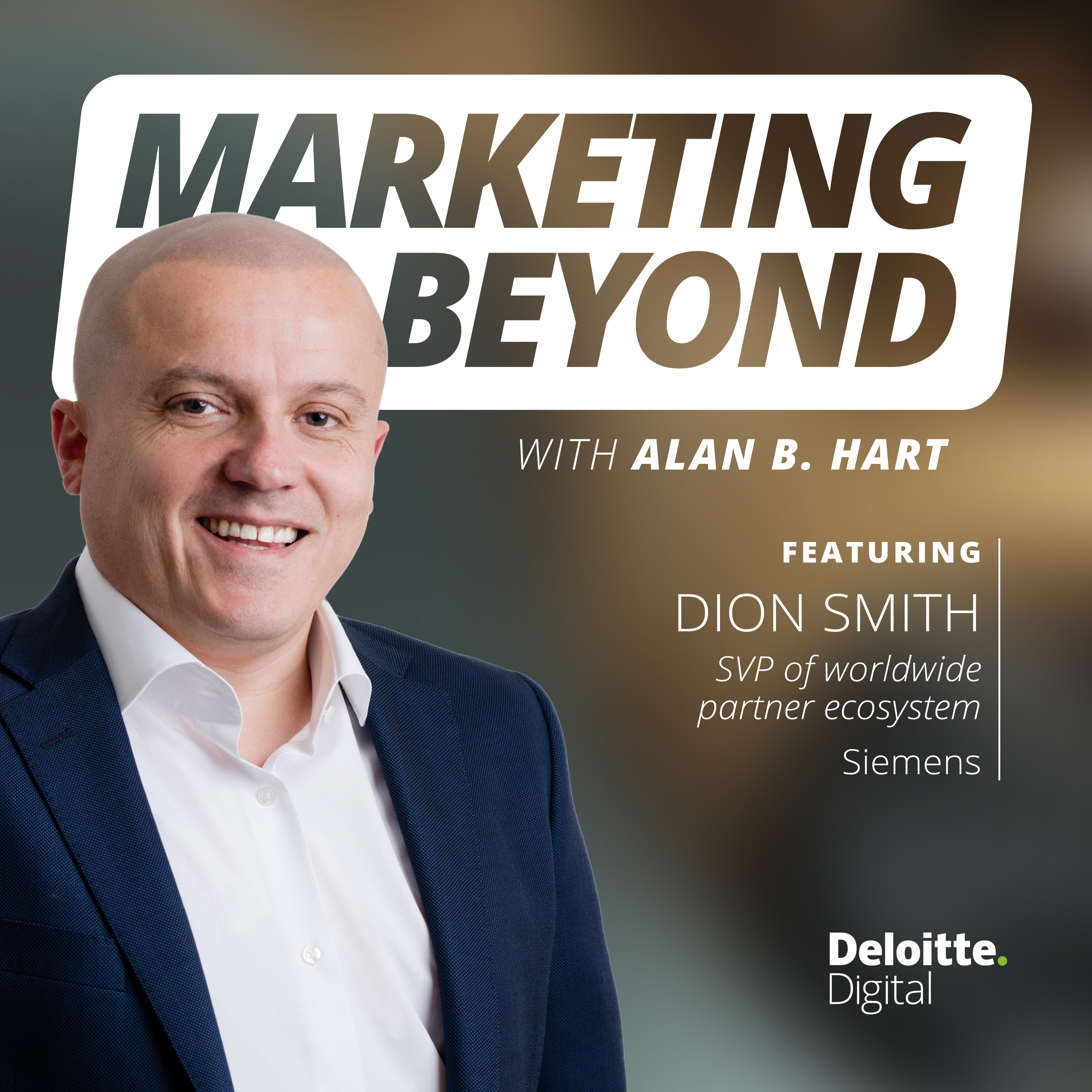
Marketing Beyond with Alan B. Hart
23: Transforming complexity into clarity through data: Insights from Dion Smith, senior vice president of worldwide partner ecosystem at Siemens
00:37:10
Loading summary
Transcript60 lines
- [00:00]
A
So today on the show, I've got Dion Smith. He's the senior Vice President for Worldwide Partner Ecosystems at Siemens. And on the show today, we talk about the massive transformation that he's driving across his partner ecosystem, going from 200 partner programs to one for a company that has been around for 175 years, a massive amount of change. And we're going to unpack that today and tell you much more about that and how AI plays a role in his life and in the life of Siemens. That and much more. With Dion Smith.
- [00:40]
B
Are you ready to go beyond the basics of marketing? I'm Alan Hart, and this is Marketing beyond, where I chat with the world's leading chief marketing officers and business innovators to share ideas that spark change and inspire you to. To challenge the status quo. Join us as we explore the future of marketing and its endless potential.
- [01:05]
A
Well, Dion, welcome to the show.
- [01:07]
C
Thank you for having me. So excited to be here today.
- [01:10]
A
Yeah, I am, too. I mean, we were having fun getting going here as we were getting set up, but one of the things I have to ask you about is this story that you mentioned to me about dying in an accident. Not just once, but I think multiple times. And coming back from that, obviously you're here today.
- [01:32]
C
Yeah, absolutely. So, yeah, it's probably about 30 years or so ago now. I was unfortunately a passenger in a car accident, and it was a pretty bad wreck. It was one that left me stuck in the vehicle for about three hours while they cut me out of the car before taking me to the hospital. But, yeah, to the point it was very surreal because that night I was obviously in a pretty bad way. They pulled my parents into the operating theater, also my brothers and my sister, in essence, to kind of say goodbye. And throughout the night, I had multiple operations and came around a couple of days later with a few bits of additional things, machinery inside me becoming, I guess, a version of the early Million Dollar Man.
- [02:19]
A
Oh, my gosh. My gosh. I mean, something like that must just reset how you think about life.
- [02:28]
C
Yeah, absolutely. I think it's been core to. To how I've operated since that time. I think, you know, when you've gone through that type of experience, you get a real appreciation for life. And clearly that happened to me very, very early on in my life. And it's probably been one of the. The fundamental drivers for me in respect of not. Not necessarily taking things serious, as serious as. As maybe others do in the moment, but being a lot more driven and practical with time because candidly, the Way that I look at it is all that time that I've had over these last 30 years was something that may not have been. So, yeah, it's really grounded me in the way that I've certainly operated after, over these last few years.
- [03:13]
A
Yeah, just thankful for modern medicine too.
- [03:16]
C
Absolutely, absolutely. Firemen, doctors. Yeah, it's incredible. Incredible.
- [03:21]
A
Well, from that, because it sounds like it was very early, maybe even before you got your start in your career. How did you get your start in your career? And you're now the senior Vice President for worldwide partner ecosystems at Siemens.
- [03:36]
C
Yeah, well, it was actually, I mean, we didn't talk about this previously, but it was actually a bit of a pivot point because prior to that I was actually a semi professional footballer. But unfortunately snapping a few things meant that I couldn't continue with that. So it was a bit of a gig change in direction. But I think that that core of being a very driven individual moved me into sales very early on in my career. So I started off within a couple of smaller organizations, within inside sales and in essence, SDR star roles, as we'd call them today, before moving into Hewlett Packard. And really my first established role was, was working at HP back in the early 90s to the point that I even had the opportunity to meet Dave Pack. I even had the opportunity to meet one of the founders, which was, which was fantastic. And since then, over these last 30 years, I've been very fortunate to work for some of the largest blue chip companies around. So Hewlett Packard, as I mentioned, Dell, Samsung, Amazon Web Services, Zoom, and now Siemens. So it's been a great journey, but also a journey that's been founded on building ecosystems. You know, either joining those companies at a time when they didn't have an indirect sales motion and building that ground up, or joining those companies at a time when the market's changed or the company's propositions have changed and you need a different type of ecosystem to address that market opportunity.
- [05:07]
A
I love it. Well, tell us a little bit about the job you have at Siemens and the scope of it and, and the Siemens that we should know today.
- [05:15]
C
Yeah, so. So it was a great journey for me. So, you know, I'd be candid. You know, in the uk, I think depending on which country you're, you're in, is, is your denotion as to what Siemens does. And for me in the uk, white goods was very big. So when I think of Siemens at the time, you know, 18 months ago when Siemens approached me, I'm thinking Ovens, fridges, freezers, microwaves. But I went on my own personal journey of discovery and saw very quickly just how diverse Siemens is as an organization. And you know, no surprises with a company that's been around for 175 years, you know, operating across digital industries and smart infrastructure. Incredibly impressive the portfolio that we have. But to your question, part of what was brought to me was that Siemens was looking at and is looking at a North Star of what we call becoming one tech company. And as part of my journey prior to joining Siemens, I tried to go on that customer journey and that partner journey as to what, what is and how is Siemens representing itself to the market. And it was clear to me there was a phenomenal opportunity to be able to help develop the ecosystem to support that North Star. So that was the catalyst for me going in and for my role. Therefore, I'm principally responsible for helping build and execute that ecosystem that will support our journey of becoming one tech company.
- [06:44]
A
Well, let's talk a little bit about that one tech mission. Like where, what does that, what does that look like? How does it come to life, if you will?
- [06:52]
C
Sure. Well, if you think, you know, the sheer diversification of Siemens, you know, we're building things from or supporting manufacturing of spaceships to trains, you know, to smart factories. The depth and scale of the portfolio of what we offer is, is as I said, extensive. But historically it's been, let's say very business unit driven. So kind of a go to market model that's been in essence a little bit siloed and hasn't harnessed the true value end to end of offering, you know, large scale solutions and outcomes. So from a one tech company perspective, our goal is to seamlessly bring this together in a way that we can actually solve far bigger problems for client outcomes. And obviously core to that is utilizing the ecosystem to be able to make and knit that together to solve for those.
- [07:48]
A
Well, in your, the, the ecosystem as you describe Siemens, and you're broadening even my understanding of it, to be honest, that you've got everything from the white goods to the infrastructure to the energy, to all of the various industries that you play. And then if you layer on top of that all the various types of partners that you're responsible for, I mean it, it goes from, you know, component OEM and partnerships at the manufacturing level all the way to the system integrators and the advisors, et cetera, that wrap around the solutions that you guys offer. That's a lot of complexity.
- [08:29]
C
It is a huge amount of Complexity. And I think again, if you think from Siemens portfolio perspective, factory automation, motion control, process automation software, digital software, digital twins, smart buildings, the reality is that over a third of the world's machines are Siemens. And the reality is that as we sit in this room right now, it's highly likely that the majority of the things, including the clothes that we're wearing and the infrastructure that's being used to record this, will have an element of Siemens somewhere within it. So to your point, when you think of partners, and I've been doing this for 30 odd years, the stereotypical partners, let's say as distributors or MSPs or resellers, systems integrators, this move into other partner types like panel builders and machine builders, and therefore, yes, the sheer diversification of that ecosystem is incredible. But, but what makes this even more exciting, and this was also the catalyst for me to, to come, let's say, from the world of IT into the world of ot, was this convergence. And now you think of this world that we're moving into, you know, agents, agentic, AI, cloud, it's a phenomenal opportunity. And to be able to then connect different partner types to complement each other in that ecosystem, to deliver those types of outcomes is what is really truly exciting.
- [09:59]
A
Well, and you're driving a huge transformation of how these partners work together in concert with the one one tech Siemens vision. How do you think about like that transformation and I'm curious, like what lessons you've learned in these?
- [10:18]
C
Yeah, a lot, A lot. It's been, it's been an incredible journey. And I think, you know, one of the, one of the first challenges was actually baselining the data of the different partner types and what they're actually doing. You know, if you think that with the scale of Siemens being, as I said earlier, 175 years old and having so, so many different lines of business, you know, what we historically had was over 200 partner programs to get around that complexity of an ecosystem. But if you're solving to become one tech company, you need to work out where you have commonalities. And the reality is, as I kind of went on the journey with the team on understanding the data or understanding the partner journey, the buying patterns, we could see a lot of commonalities in that. There was a lot of themes inside that partner ecosystem. So baselining that and getting alignment across all of the different business groups at Siemens as to, you know, what is a distributor and where do they play, panel builder, machine builder, etc. It ultimately allowed us to be able to Build a framework, a partner program framework where we could have a single program that has the mechanics and the levers to control the different types of behaviors that we need from those different partner types. And super excited that we, you know, we built, designed and built and, and launched that inside 10 months. That actually went live on the 1st of October this year.
- [11:54]
A
That's amazing. So basically going from 200 to 1.
- [11:57]
C
Yes, yes. With over 40,000 partners globally and I think currently about 170 plus countries.
- [12:05]
A
I'm surprised you're still standing.
- [12:08]
C
So, so for me, you know, going back to your earlier question, Trans transformation was, was really embedded into me from my time in hp. You know, in, in the early days in hp, you were really educated to embrace change and understand that change is good. And ever since, all of the roles that I've done across those other organizations have been transformative roles is what, is what shows the whites of my things are stable and they're working. That's not really something that motivates me. My, my focus and passion is to drive transformation. And in essence, the more complexity that there is, the bigger the smile there is on my face. And this has been a phenomenal journey so far.
- [12:49]
A
All right, well, it wouldn't be a marketing podcast if I didn't ask. One usual element of a partner program is MDF or marketing development funds. How, how does that play a role in your, in your new program?
- [13:03]
C
Critical. So, so you know, partnerships. One of the, one of the primary reasons why you use as a vendor partners is to give you depth, scale and reach. And with partners you need to be able to empower them because ultimately they're far closer to the client. They're far closer in understanding what is going on within the client. And again depending on the specialisms of the market, they also understand the markets that are much deeper way than most vendors. Most vendors do. So therefore you want to be able to empower them to be able to create awareness and create demand for you as a vendor. So for me, within our partner program that we were just talking about, one of the fundamental elements, sorry is, is marketing development funds, MDF being able to draw a clear line to partners that, you know, if they invest in capabilities and competencies in ess to have the subject matter expertise to either sell or technically support what it is that we have, we will recognize them with funds that they can then utilize for various ways. You know, maybe a case of they want to attend an event, maybe a case that they want to do an eShop, maybe a case that there's a particular campaign where they have success in a vertical or an industry. So making funds available to be able to do those types of initiatives is absolutely key. And there's a connection to that also, also with a, with another typical program element, which is deal registration. Because what you want to be able to do is to then quantify that those investments are bringing a good return to the company. So it would be foolish to continually throw in hundreds of thousands every month without assessing what is coming out. So being able to provide marketing funds for partners and also provide them assets that they can utilize to create the things that we just spoke about, but then measure it, you know, did what we did there actually generate opportunity? And using a deal registration mechanism to capture those opportunities is a really, you know, closed loop effective way to see the impact that your partners are having for you in those markets.
- [15:21]
A
That's a great, that's a great idea. You don't, I think, have in the marketing space a lot of people focused on how to make that payback and that quantification work for both parties. So it's a great highlight that what.
- [15:38]
C
You guys are doing and it's incredible the, the creativity and the insights that you also receive from your partners. Because as I said, as an organization, as a large organization, there, there are a lot of assets that we can provide. But as partners start to digest that, they will start to give you a lot of insights or feedback. They'll either use that or they're slightly tweak that. And then as a vendor, you can learn from that. So you can make your messaging even more targeted or more applicable and more valuable for those partners.
- [16:08]
A
Well, if we step back and just think about the, I mean, just the sheer complexity of the transformation you're building, the 200 to 1 to get to a singular program. If you were going to tell other leaders, they're going to step into your shoes, some advice that they could use, like how do you, what would you tell them?
- [16:32]
C
So for me, it begins with the partner journey and the customer journey. You know, what is the journey that you want your customers to go on with you? And then how does that apply when you're talking to partners? How does that apply to the journey, therefore, that the partners will need to go on with you as well? I think when you've got clarity on that customer journey, it's far easier then to start to put together the different elements to support that journey. Elements, you know, were span across infrastructure, you know, process people, you know, tooling. But that's really key, really, really key. The other, the other element is to, to really understand the data. I'm a big advocate of data. I think, you know, it was again, it was indoctrinated into me earlier on, early on in my career, but certainly for the time that I spent at AWS is one of the key leadership principles around really using data based. So understanding your data to be able to support the journey also that you want to take those customers on, I think is a critical element.
- [17:43]
B
Love it.
- [17:45]
A
Well, we love talking about business, but we also like to get to know you, Dion, and we know your story from the outset of this conversation is amazing. But I beg to ask the question I always ask everyone still, has there been another experience or an experience of your life that's kind of made you who you are today?
- [18:07]
C
Yeah, there is. And you know, it's funny because if you'd asked me the, that question, the answer that I will give you in a moment wouldn't be something that I would have talked about in earlier years and that's that I'm dyslexic. And I think, and I was undy, I was undiagnosed dyslexic. So I went through all of my schooling and early life not knowing, just in essence questioning why it was more harder for me to learn or read things in the way that my, my friends and that were as I went through school. It wasn't. And there was a real stigma associated to dyslexia. And it wasn't until later on in my life, and again fortunate to work for some very large companies that embrace diversity, that people started to talk a lot more openly around dyslexia. And once I started to also learn more around dyslexia, it started to draw some very clear lines as to why I was able to do things in a faster way in certain aspects of my, my business life and my personal life. In essence, pattern recognition. So for me, you know, with the dyslexia, it was trying to, once I knew I had dyslexia, really qualifying what, what are my superpowers? Because as you, as you now look around the world and you see how open people are in, in being able to talk about dyslexia, it's amazing to see how many people actually have dyslexia and once they define what part and what element of their superpower is with that, how they can exploit that to, to their own advantage. So, so for me, being able to be a lot more open about that, be more of an ambassador now and trans was, was a real, I think maturing moment for me in the last probably seven or so years, I would say being. Being as open as I am with that now, and I actually really embrace that because I'm very open in sharing that, you know, how that is an advantage in areas that I can help my colleagues, the. The company and in, as I said, seeing things far quicker, far clearer. And really, I think as I kind of knit that together with why I've ended up probably in this transformation space, it all kind of makes sense. Yeah, it makes sense that I love that complexity. I love being able to. The more challenging things are to be able to see. See the. See the navigation and the journey that you need to take to provide the clarity to get to. To outcomes that you're solving for.
- [20:49]
A
Well, and I. I would add on to that, I think the, you know, push through the complexity. Right. Like that just inherent. I don't want to say. I guess I'll use the word like, just dogged pursuit of it. Right. Like, because you've got to get through it seems like not knowing that you, you know, you saw, you know, words on a page differently than other people. You had to work through that.
- [21:17]
C
Yes.
- [21:18]
A
Yeah.
- [21:18]
C
Yeah.
- [21:18]
A
It's an extra layer of work ethic.
- [21:21]
C
Well, and I think this is. I think no podcast today would be not using the acronym of AI. And I think that for me, when I know what it is that I want to say, I know what I need things to look like, but the part is my ability to then put that into a format in the way that it. In the way that it is absolute clear inside my mind, but not doing that. And it's so funny because, you know, many people always replying to things that I share. I never knew, Dion, you were such a good writer. I never knew that you were so good. But that's just my ability now to utilize those tools to represent. So. So it's brilliant. I mean, it's been a. It's been a real fun journey for me these last couple of years in embracing different AI tools, which, you know, historically would have been, you know, the. The adverse superpower, but now it's. Julie, even the. The eras that needed development are becoming superpowers because of the use of AI.
- [22:19]
A
That's a great explanation. Well, if you're going to give young Dion advice, you're starting your career or this. This whole journey over again, what advice would you give your younger self?
- [22:30]
C
Yeah, it's. It's a great question. I think for me, I. Probably earlier on in my career, I maybe reacted too quickly. Without really getting a complete picture of whatever that thing was that I was working on. And I, and I think that it's super important. It goes back to what I shared earlier about data. I think it is so fundamental to get a 360 view on things prior to reacting. You know, I see it, I see it daily where I think, you know, a lot of things happen where they're, they're done on feeling or they're done on. Well, that's just the way that we've done it for 15 years. So we'll do it, we'll do it in that same way. And it's super important to be able to, to really understand the complete 360 of what it is that you're looking at before, before you set out, you know, that new strategy or that new journey. And I think also that, you know, probably has come with, with age for me as well. I think, you know, you tend to, to naturally take a further step back from things as you get older and become a bit more reflective. So for me that feedback would be, don't react Dionys, quickly take a step back, digest a bit more and then be clearer on that journey.
- [23:52]
A
Love it. Is there anything you're trying to learn more about yourself today or you think other people should be trying to learn more about?
- [24:03]
C
Yeah, it's a great. So I'm, I'm currently, as a side initiative, I'm working with INSEAD at the moment on a particular project and that, that project that I'm working on is around complexity to clarity. It really feeds back to some, some of the points that we talked about earlier. When, when you're working on global transformations, they always tend to be complex and, and it's how, and what the right way is to approach that, to get that clarity on that complexity. And you know, this is touching areas like, you know, the existing, you know, what is the existing value chain of how you're going to market? But more importantly, what, what is the future value chain actually need to look like? And then, you know, understanding those situations, the problems, you know, the implications and the needs, how are you going to execute that strategy that will keep you ahead? And it's interesting because if you look at a lot of companies right now, very large companies today, you're starting to see a theme coming through of reinvention. And I think that will be something that we're going to continue to see at pace over the next 12, 24 months. And why is that? The reality is that the world is moving at an incredibly faster click right now than it has ever been before with AI, the ability for net new entrants to come into a market that are agile and suddenly can dominate market positions overnight. For companies that have been established for a very long time, your ability to reinvent is going to become critical. So that complexity that tends to just naturally come into very large established organizations will require a continued reinvention. So for me that, that, that's a big focus for me right now.
- [26:00]
A
Yeah, well and as you describe that I'm thinking not only the, to your point about the value chain of your existing value chain where you're going in the future, the need to reinvent how you go to market, how you, how you, how your business operates. You know, there's an element of like business has to almost decouple themselves from the past to get to the future but also probably decouple the components of their business to allow partners in, to allow complementary solutions into the mix. It's a very different way of managing a large enterprise.
- [26:36]
C
Yeah, absolutely. Well and there's a great, there's a great. I'm sure many of your listeners would have watched it, but if you hadn't haven't I would encourage you to go and watch Jeff Bezos's why it's always day one. And I think the key in that it really relates to what we're talking about here which is what tends to happen as organizations continue to grow and scale is these unnecessary complexity comes in and the loss of agility comes in. I think this is where when you then start to build lower level management, middle level management, as much as you'd like to think you've got fast decision making or agility, it just tends to naturally show go slow. And this kind of concept of two way doors is many companies then fall into a place where oh no, once we've made a decision, that decision is made and we're committed. Whereas it's a bit more of a let's, let's fail fast and come back through the two way door and we can come back through and I think the follow up video is then, you know, why it's never day two. And then you understand when you watch those two videos together it kind of relates to this need to continuously reinvent and again fortunate to, to be working at Siemens, you know, a company as we spoke earlier that's been running now for over 175 years. You know, you don't get to, to stay in the world for 175 years unless you are reinventing and you think where Van Von Siemens, you know, founded the company back at the beginning that was, you know, with it, with, with the telegraph, you know, moving actually from, you know, more was the original Morse code.
- [28:16]
A
Yeah.
- [28:17]
C
To actually moving to a system that, that, that ident as those numbers were being printed. I was, I was actually in Brazil a few weeks back and I got to see one of these tele telegraph poles that was installed back in, I think it was 1897 or something in Brazil, still standing. But it's incredible. And that's what I also love about the stories of these companies. You know, the Hewlett Packard and the garage. All of these companies have phenomenal stories as to where they started. But many of them, where they started are in very, very different places to today.
- [28:51]
A
Well, you seem like a very curious person. What are you curious about in the world today? Trends or culture? Cultural things that you're following? Anything come to mind?
- [29:03]
C
So these buzzwords right now of agentic AI. So I think you're, you know, agentic AI, cloud agents, you know, operational tech. The agentic AI piece for me is really, really interesting because we have to embrace it as companies and I think there is so much opportunity out there for companies to really understand how they can utilize agentic AI within their business. I'll give you the example that I've just personally had myself over these last few months as we've been dealing with the complexity of this transformation. A part of the group that I, that I inherited, we had probably a few individuals that had phenomenal and have phenomenal subject matter expertise, but there were one of one. And being one of one and having, you know, 20 plus years of expertise in one hand is great, but is also a big exposure for you as a company now in that area. Being able for me to be able to use agentic AI, I've been able to take those areas and that knowledge and we've been able to work to insert that into an agentic AI model. And now instead of me having one person that has that expertise, I've now got 250 agents with that level of knowledge. But I freed up the individual to be able to again work on futures, to understand where and how we need to adapt to, to continue to make that agentic AI even smarter. And I think this is probably the typical taboo. Most people maybe are frightened. Well, what happens when my knowledge is passed over? What does that mean for me? This is where I think we've got to really understand and embrace the fact that what it means is we all as individuals can work on even More valuable and strategic work. So agentic AI and how we are applying that is super exciting and something that we're going to continue to evolve at scale across our new framework so that we can also interact with our partners in a, in a much more proactive and consistent way.
- [31:26]
A
That's a great example. I love that example. Last question for you. What do you think is either the largest opportunity or threat facing marketers today?
- [31:36]
C
Yeah, great question. I should ask you.
- [31:40]
A
Don't ask me.
- [31:41]
C
So, so I sound like a bit of a squeaky wheel on this, so I do apologize. But I think for me again, it is around the area of AI, but it's around driven personalization and predictive insight. And what do I mean about that? So that's really the opportunity, I should say driven personalization and predictive insight. And this is around, you know, think of again, us as individuals. I'm sure you may be the same as me. You might be having a conversation at a bar or at a restaurant and then maybe a day or maybe a couple of days later you suddenly find that your phone is guiding you to particular websites or certain pop ups are coming up and you sit there thinking, ah, they've been listening, who's been listening? And, and it kind of, you know, depending on the type of individual you are, it can either feel very uncomfortable or oh, that's, that's great. So I think the personalization and the predictive insight opportunity bit is how do we as organizations really again harness that to be able to be able to put the right things at the right time in front of client decision makers or wherever they are on that, that, that buying journey. But the, the threat then is the trust piece, right? Because back to that analogy is okay, is this intrusive or is this helping? So the ability to be able to balance that so that organizations don't overstep. The mark of trust I think will be key for marketing. So have the insight, have the intelligence, be able to utilize that from marketing to be able to target the right people at the right time, depending on where they are, but in a trustful way that you don't go too far. That people then may feel disenfranchised from your brand because they feel like you've personally overstepped a mark with them. That's the balance. That is going to be the key in the balance.
- [33:53]
A
Yeah, no, it's a very important balance you're talking about. But in the examples you gave the power of it, if you have the trust to give it access to all of your Data, I mean it can make your life better.
- [34:09]
C
It is incredible. And you know, the work that we've been doing with Deloitte around our partner framework and around agentic AI and futures, this again feeds back into the Marketing Development Fund question that you asked earlier on because we want to also ensure that we're helping our partners with our data and with their data to be able to again be clear on, well, customers that brought this, you know, also brought this in the same way that we see it as consumers, you know, from a consumerization. We've got to take that level of consumerization into the business world. And I think there's probably areas where that is happening today, but not at the scale that we could be doing that. That then means that we're providing our partners, in my case, insights that they know when to be able to approach those clients either with those upsell or cross sell opportunities or also when it comes to futures, you know, when you know what your roadmap is and the products that you're going to be bringing out in six months, nine months, 12 months, whenever you can really get ahead again with the data and the insights to be able to stage those campaigns or the communications to take those clients on that buying journey so that when you are at product launch time, they've gone on that journey, they're ready and they're in a point to be able to buy. So the whole use of that driven personalization and predictive insight I think is a huge opportunity for marketing in the future. Awesome.
- [35:44]
A
Well Dion, thank you for coming on the show.
- [35:46]
C
Thank you so much. Been an absolute pleasure sharing time with you today.
- [35:55]
B
Hi, it's Alan again. Marketing beyond is a Deloitte digital podcast. It's created and hosted by me, Alan Hart and produced by Sam Robertson. We have even more cutting edge marketing insights headed your way. Be sure to subscribe to our channel to stay up to date with our latest episodes. I love hearing from listeners. Share your thoughts about the episode, the topic covered or the show by commenting on this video or emailing me at the end@marketingbeyondeloitte.com if you're interested in more conversations with industry visionaries, we invite you to explore other Deloitte Digital podcasts@deloittigital.com US Podcast. There you'll find the Marketing beyond webpage.
- [36:38]
A
With complete show notes and links to.
- [36:40]
B
What we discussed in the episode today. I'm Alan Hart and this is Marketing Beyond. The views, thoughts and opinions expressed are the speaker's own and do not represent the views, thoughts and opinions of Deloitte. The material and information presented here is for general information purposes only and does not imply endorsement or opposition to any specific company, product or service.