← Marketing Beyond with Alan B. Hart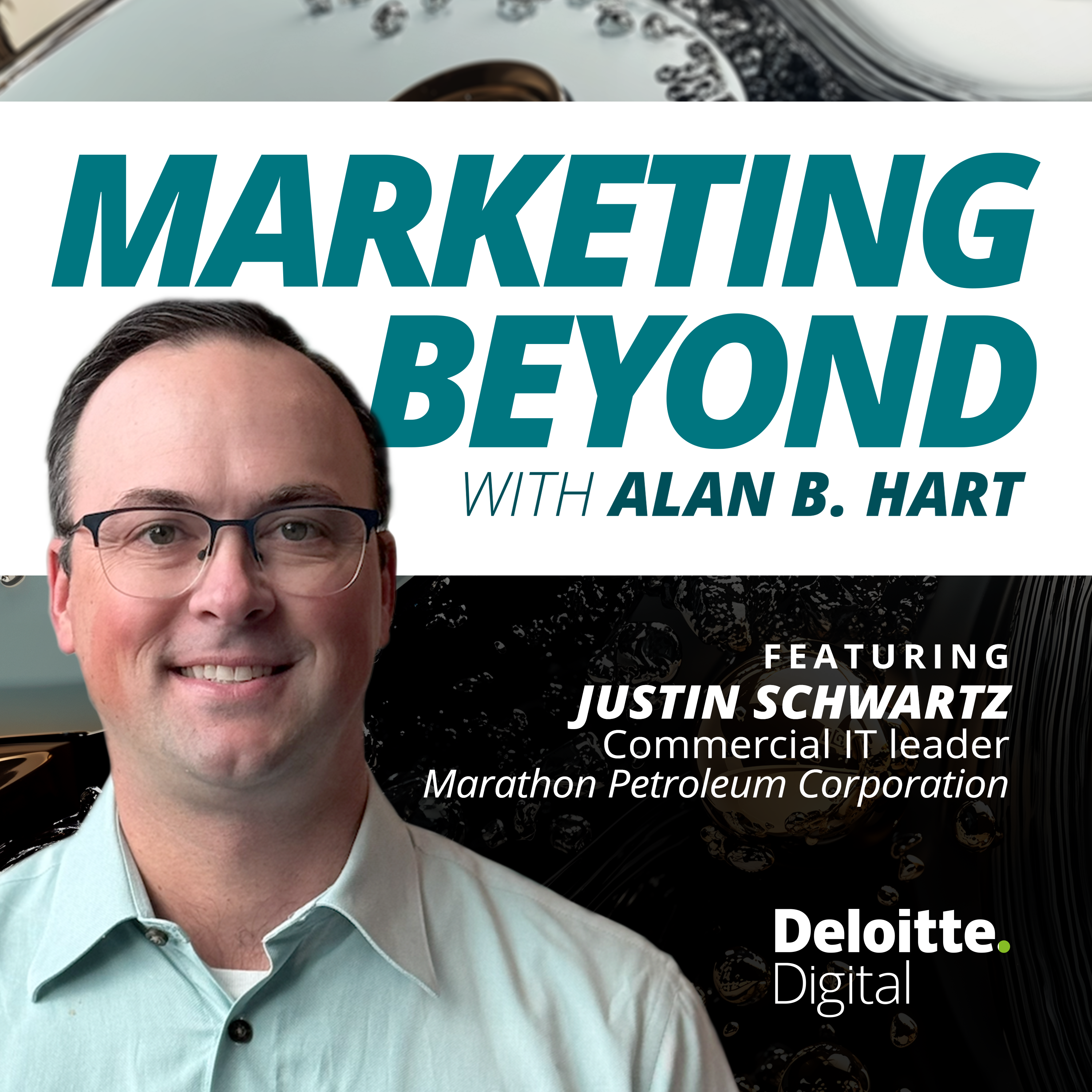
Marketing Beyond with Alan B. Hart
25: Leading people-focused tech transformations: Insights from Marathon Petroleum Corporation Commercial IT Leader, Justin Schwartz
00:20:46
Loading summary
Transcript57 lines
- [00:00]
A
Well, today on the show I've got Justin Schwartz. He's a commercial IT leader at Marathon Petroleum. And on the show today we're going to talk about transformation humans and how they change, the ways of working that help you drive that transformation and the all important, all encompassing conversation around AI and AI agents. That and much more with Justin Schwartz. Are you ready to go beyond the basics of marketing? I'm Alan Hart and this is Marketing beyond, where I chat with the world's leading chief marketing officers and business innovators to share ideas that spark change and inspire you to challenge the status quo. Join us as we explore the future of marketing and its endless potential. Justin, welcome to the show.
- [00:53]
B
Thank you, appreciate. Thanks for having me.
- [00:55]
A
Yeah. Well, let's get started. You're a dad. You have, I think, four kids under 12.
- [01:01]
B
I do.
- [01:02]
A
How do you, how do you manage that? I have one.
- [01:05]
B
Well, I, I think, you know, you said the word I, but it's really a we situation. And, and yeah, I've got a hero at home and my wife, she makes a lot of the things happen. I'm. My job is to, to not mess it up and be at the places at the times. And, and so it's a lot, but it, but it's a fun, it's a, it's a fun experience.
- [01:25]
A
Yeah. I mean with, with four. I mean I always, I always think about this like you have, me and my wife, we have one. So we can, we can tag team, right?
- [01:34]
B
Right.
- [01:34]
A
Then you get two and it's man to man defense, right? Yep. You get more than three.
- [01:39]
B
Zone.
- [01:40]
A
Yeah, zone all the time.
- [01:42]
B
Yeah, we are strictly zone. And yeah, just a lot going on. But, but yeah, it's a great, great experience. And, and it's a fun, it's a fun time.
- [01:51]
A
That's awesome. That's awesome. Well, you are the commercial IT leader at Marathon. How'd you, where'd you get your start in your career? How'd you end up at Marathon?
- [02:00]
B
Yeah, it's a, you know, I've had a ton of great opportunities. You know, coming out of school I was actually with a consulting firm and I kind of, I feel like that really set the foundation for kind of my path where I found my interests and things like that. Doing. Working for a lot of different industries at the time and then ultimately kind of fell in love with the oil and gas space and, and got hired into Marathon. And so over the years I've been working on transformation projects. M and A work. Right. Major technology deliveries and that's kind of Propelled me to, to the spot that I'm in today.
- [02:33]
A
Okay. I mean, most people will have heard Marathon, you see the gas stations on the side of the road. But, like, how do I think about Marathon in total? Like, what is it?
- [02:43]
B
Yeah.
- [02:43]
A
What is the business?
- [02:44]
B
So we're an integrated downstream oil and gas company. We have the largest refining footprint in the United states. So over 3 million barrels of capacity on a daily basis. And so, you know, huge refining company. We have a mid street midstream organization. Right. That's going to be transport logistics. Right. Of all those molecules and. And then a retail footprint that you mentioned. Right. Marathon and ARCO brands coast to coast in the United States. So it's a large organization and fuels a lot of the things that we do every day.
- [03:18]
A
Yeah, well, I, I mean, it's. In your, uh, in your bio, transformation is something that you is like, it seems to be core to who you are and the type of work that you do. Talk to me about, like, what that word transformation and like, what's the, the scope of the types of transformations you've been driving over the course of your career?
- [03:39]
B
Sure, sure. No, yeah, I think that, yeah, that is kind of the core of who I am. I think that, you know, transformation for me. Right. Really narrows in on change and, you know, whether that is taking an operation and how we do it today. How can digital uplift and change the way that we operate in order to unlock more value for the company? And so I've had experiences doing, you know, major call it, ERP transformations. We've done many different, call it modernizations around decision support, analytics and solutions like that within the commercial space. And, you know, now, you know, we're certainly on a period of transformation to understand how do we, how do we unlock more with this technology evolution that we're going through. And so we're really, really focused on those things today.
- [04:32]
A
I mean, transformation. And you described a couple of different ones, like the, you know, the big systems and then the analytics. I think of those as like, I mean, they're all big, but like, there's the big clunky ones, you know, and then there's like the more nimble, agile ones. Like as you start the transformation process, like, how do you think about doing it the right way or the best way you can.
- [04:56]
B
Yeah, actually, you know, we, we talk a lot about this because I do think that, you know, there's a challenge out there where technologists, right, really want to focus on the tech. They want to focus on, you know, what's new, what's the shiny object. Right. How can we, how can we, you know, use this hammer and find that nail? But the reality is, our viewpoint is you really have to work from what the business opportunity and the value pool really is and work your way backwards to the technologies and solutions that are ultimately going to deploy it. So when we think about transformation, I really think about what is the business problem that we're actually trying to solve here or that opportunity and then work your way backwards. That's kind of how we think about it. I think it also helps with your change adoption and the communication kind of associated with those things. And those things really matter when you're, you know, really trying to change the way you operate. You got to have the whole team kind of on board and understanding the purpose.
- [05:56]
A
Yeah. I want to come back to the change in the culture and the people part in a second, but do you. I'm just curious. You've driven a lot. Like, do you have a favorite transformation?
- [06:06]
B
You know, I think that, you know, some of the transformations that we're in right now, I mean, ultimately, you know, at Marathon, we're an integrated system. Right. And so we're trying to unlock the most value we can across our value chain. And so I'd say the kind of the transformation that we're in right now about improving decision support from all the way from our planning teams to our traders to our schedulers, and the transformation we're going on right now is probably my favorite. Right. It's such an exciting time. And, and you know, this change and how we think about unlocking that value is only being supported by more and more technology that's coming out. So this is probably my favorite time that I've had in my career.
- [06:50]
A
Yeah. I mean, as you just, just described those different users, it even gave him a more appreciation for the types of transformation you might. I mean, like, you have everything from like a retail footprint to trucks to people out in the field, you know, driving the extraction and the refinement process to traders sitting behind DES trading products. That's, that's, that's a lot.
- [07:13]
B
It's a lot. It's a lot. And I think, you know, what's with the fascinating thing is, you know, when you think about technology and how it can unlock more, it's really the connective tissue into how we operate. And so as we think about making better decisions, it's, you know, providing more high quality data. Right. Speed and reducing latency and cycle time. So ultimately those roles that you just mentioned can make the best decision Every day. And so that's, that's really what we're after and what we're focused on today.
- [07:42]
A
All right, come back to the people. Culture. Culture is a big thing. How do you foster, as you're driving these changes and transformations, how do you foster the right ways of working with people?
- [07:54]
B
Yeah, it's, you know, I think that's, that's a big, that's a big topic, I think in our, you know, industry and kind of in the world as, as things evolve, right. The culture and your, the dichotomy of that's got to change with it in order that really unlock value. And, you know, we really focus on first involvement. Right. Ensuring that, you know, whether it's a, you know, analyst, right. An independent, you know, individual contributor all the way up to kind of senior leadership is educated. We believe in, you know, really radical kind of transparency and involvement of these teams and then I think really pushing leaders to talk to their teams about being curious.
- [08:34]
A
Right.
- [08:35]
B
Asking the hard questions, you know, and, and if something doesn't make sense, you know, raise your hand and, and trying to support that kind of at every level of the organization and make it inclusive as we, as we go, go along.
- [08:48]
A
Love it. Well, maybe if you can share an example of something like you've recently done together with the business.
- [08:56]
B
Yeah. So, you know, just a, just a kind of recent example. You know, we've been, you know, we're actually out here at Dreamforce today and we've talked with a lot of different, you know, partners and things like that and, you know, partnered with a third party firm and we've deployed some agents that we're testing and, you know, that's a transformation in itself. And ultimately, you know, one of these solutions, right, is trying to uplift and augment our, you know, field personnel. You know, how do we, how do we give them better insights, reduce kind of their friction in operation and administrative activity and, and have some agents help us along the way. And so we've, we've recently deployed a few and are actively testing and kind of maturing that capability. But it's, but the fun thing about it is, you know, you're really learning, right, kind of through the process and that iterative cycle where the business is alongside you. You're working on these solutions together and then improving them kind of as you go. So it's a really, really unique situation.
- [10:02]
A
You almost can't step 10 steps here without hearing AI and agents. How are you, like, how are you approaching agents in general as a technology component?
- [10:13]
B
Yeah, I Think that, you know, you mentioned, right. It's not, it's not like a, you know, you can't get to the finish line right. Immediately. So it's a, it's certainly a journey. And, and we're absolutely on that journey. I think a lot of it is, you know, discovery.
- [10:28]
A
Right.
- [10:29]
B
We're testing a lot of things. We have a lot of different solutions that are currently being developed and currently being piloted and things like that. And, and along with that, a lot of learning comes. You know, it's not a typical kind of IT app development situation. Right. There's nuances to that. There are changes in the way we operate relative to that, roles and responsibilities and things like that. So we're really trying to move fast, but with purpose and understanding of, you know, how does this change also going to impact us and then also how's it going to impact our business users. And at the end of the day, we need to manage that change along this journey. So we're, we're moving fast, but we're also, you know, discovering a lot kind of along the way.
- [11:16]
A
So. Yeah, yeah, I mean, as I've heard people describe this move into agents and AI in general, but it'll stick to agents. You know, you've got the, the data piece is critical, right, because what is the agent going to work with? You got then the agent technology itself. But I think the thing you, you underscore in that last comment was around the how people are going to use it, how are they going to engage with it and how does that change work, you know, and what work is going forward?
- [11:48]
B
Absolutely. And I think, I think that's a question the industries, you know, across the world are asking themselves right now. And I think, you know, I think our perspective is that the first, we want to put the human at the center of this. Right. We want to ensure that the solutions and, you know, it's not the shiny object, you know, blunt force on any problem or situation. We want to make sure that it's really unlocking value and augmenting that human experience. And I do think it's going to change the way we operate. I do think it's going to, I think it's going to improve not only the experience of, you know, the business users. I also think it's going to just generally improve the employee experience. You know, I think if you think about, like in the consumer world outside of work, right, you have a much different experience typically than when you come into work and maybe you're working on legacy platforms or you're working on these huge monolithic. Right. Applications and disconnectedness and things like that. And I think this technology has the opportunity to really not only uplift the value proposition, but also the experience of work itself for employees. And I think that's something we really want to focus on as we go through this is kind of telling that story too, is, you know, whether you're a developer or you're an engineer. Right. Or you're a trader, you know, sitting on the trade floor, how is this also making your employee experience better?
- [13:17]
A
One of the things we like to do is get to know you better. We know you got four kids, a great spouse. But the question I love asking everyone that comes on the show is, is there an experience of your past that defines and makes up who you are today?
- [13:35]
B
That's a great question. There's probably. There's probably a lot of them. You know, I think that if I think about kind of my workplace experience, you know, I, you know, there's been a lot of projects and efforts and these things that I think ultimately shape kind of the leadership style that you have. But a lot of times, you know, I don't think a lot about the successes. You know, I really. I focus in on the times of challenge. Right. That we all have at points in our career. And I think in those moments, what I think defines me and hopefully defines kind of future leaders and teams that I support is, you know, when, when, when you face those kind of challenges, whether it's a, you know, a specific implementation challenge, right. We've got all kinds of problems that are going on. You know, are you resilient? Right? Can you push through that? Can you rise to the opportunity and. And band together as a team? And I think I've got some moments like that for me, in the past, and I think those have really built kind of who I am in that leadership style. I try to. Try to present.
- [14:39]
A
No, that's great. I mean, I think it's. A famous golfer recently was talking about, like, the process, right? That you got to love the process because the winds, they come. But, you know, it's not, not, not a high percentage of the time you're winning. Right. And. And the other analogy I use too, is, you know, without. Without, like, friction and force, you can't build muscle, right? So you can't get stronger.
- [15:03]
B
That's right. So if you're uncomfortable, you're learning, right? And when you're in the, in the face of adversity and those in those times of challenge, right. You know, you won't be comfortable. And you've got to. And that's also to your point. It's the process. You're building capability in order for future leadership opportunities.
- [15:20]
A
Awesome. Well, what advice would you give your younger self if you're starting this all over again?
- [15:24]
B
A lot.
- [15:26]
A
A lot.
- [15:26]
B
Change careers. No, I'm just kidding. I think what I would say, and I also think about, we talked about kids and things like that. I think about kind of their professional careers at some point. I think one of the first things I would say is really, you know, listen. Right. I think that, you know, especially for folks that are early in their careers and things, you know, high ambition, moving fast type of thing, you know, all those things will come. Right? Yeah. I think you really want to focus on listening, you know, understanding. Right. And really, and really, you know, kind of patience within that. And I think that if you allow yourself kind of that, that grace and, and having that kind of perspective, it really, I think, builds up your acumen and, and kind of all the characteristics later in your career that, that you can leverage.
- [16:18]
A
Love it. What are you, what are you trying to learn more about right now or you think other people should be learning more about?
- [16:24]
B
Oh, man. You know, I, I, I think, you know, on a, on a personal side, I think, you know, I, I'm into a little bit deeper reading than I, I've had probably earlier in my career, so reading a few more books. So I'm trying to kind of pick the pace up on that. I think every, everything around technology and leadership and, you know, I know we can't get away from the word AI, but, you know, listening and absorbing, experimenting. And I think, you know, I've got a lot of energy in that right now, and I think a lot of people do because, you know, the deeper you understand. Right. The better you can help kind of lead through transformation. So I'm pretty deep in that right now.
- [17:08]
A
Awesome.
- [17:09]
B
Yeah.
- [17:09]
A
Is there, are there any trends or subcultures that you're following or geeking out on these days?
- [17:15]
B
Yeah, I don't know about subcultures or. Yeah, I'm probably not quite in tune to that as much, but. No, I think, I think, you know, across, you know, we talked, there was a little bit of this kind of in the keynotes and stuff at the convention this week. But, you know, I think this whole idea of digital transformation and understanding really, again, the human and change element around this and thinking about, you know, how people and how their work experiences. Right. How do we, how do we message that? Right. How do we how do we help bridge the gap with this change? And obviously the organizations that kind of we're supporting. And so there's a lot of energy in that. There's a lot of conversations going on about how you talk about it and how you, how you prepare folks and the organizations that you support. And so I would say that's probably one of the, one of the biggest things that I'm kind of following right now.
- [18:16]
A
Well, last question for you. What do you think is like either the biggest threat or opportunity to these transformation and business change efforts?
- [18:25]
B
You know, I think that speed is one of the biggest elements of kind of change or sorry, impediments, right, to some of these big efforts. And I think part of that again, kind of goes back to look if call it technology evolution, right, is changing at a pace that we've never seen, right? And it's probably only going to be as slow today, right? It's the slowest it's probably ever going to be in history now, right? Tomorrow it's going to be faster. And so how do you, how do you recognize that, how can you absorb it, how can you take advantage of it and then get these efforts right really to maximize value? And I think that speed of evolution is one of the biggest issues I think that we have right now. And being able to absorb and really take advantage is, is that cycle time is just getting tighter and tighter.
- [19:20]
A
Well, Justin, thanks for coming on the show.
- [19:22]
B
Awesome. Well, thank you for having me. It was great.
- [19:31]
A
Hi, it's Alan again. Marketing beyond is a Deloitte digital podcast. It's created and hosted by me, Alan Hart, and produced by Sam Robertson. We have even more cutting edge marketing insights headed your way. Be sure to subscribe to our channel to stay up to date with our latest episodes. I love hearing from listeners. Share your thoughts about the episode, the topic covered, or the show by commenting on this video or emailing me at marketingbeyondeloitte.com if you're interested in more conversations with industry visionaries, we invite you to explore other Deloitte Digital podcasts@deloittigital.com US Podcast. There you'll find the Marketing beyond webpage with complete show notes and links to what we discussed in the episode today. I'm Alan Hart and this is Marketing Beyond. The views, thoughts and opinions expressed are the speaker's own and do not represent the views, thoughts and opinions of Deloitte. The material and information presented here is for general information purposes only and does not imply endorsement or opposition to any specific company, product or service.