← Marketing Beyond with Alan B. Hart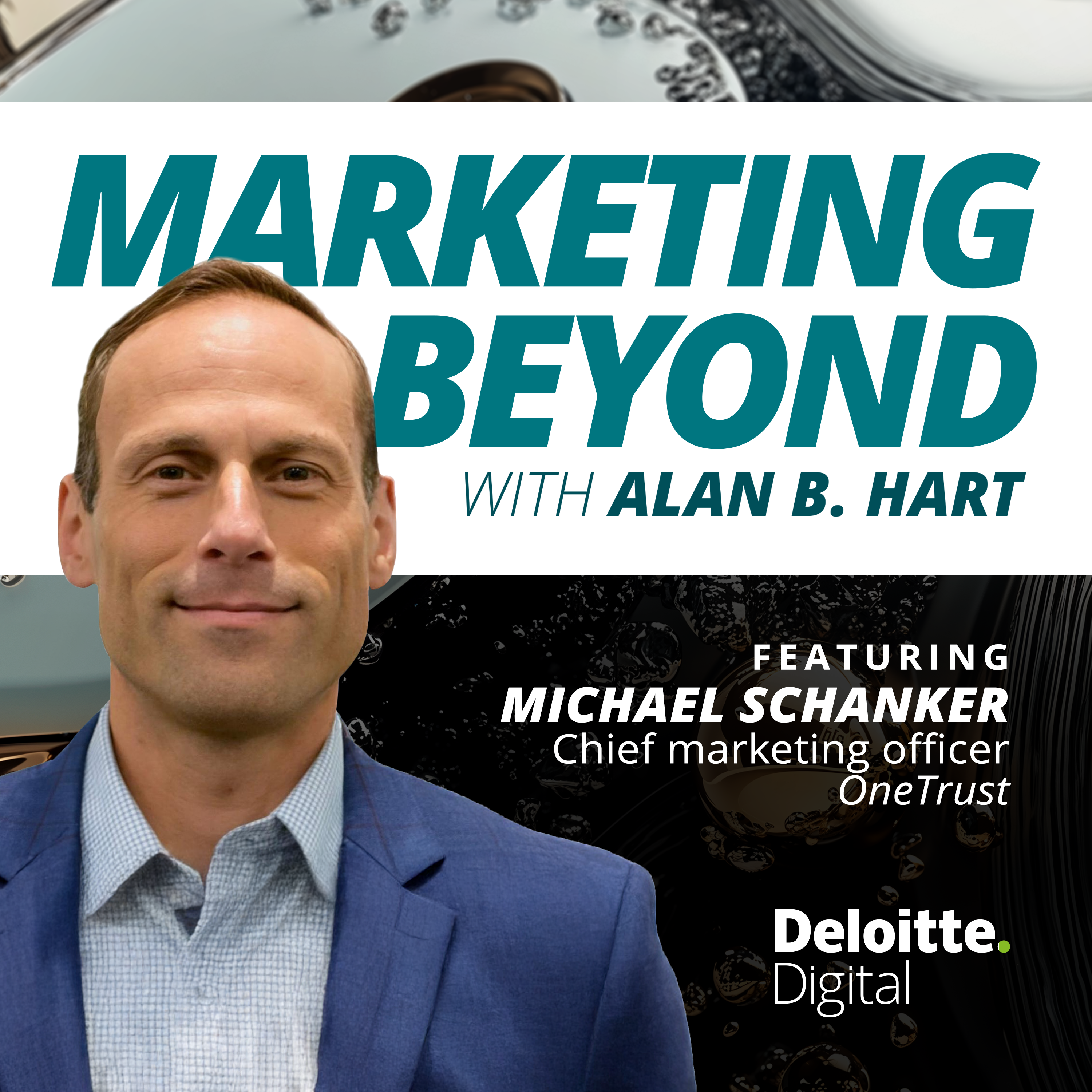
Marketing Beyond with Alan B. Hart
26: Is your governance ready for AI? Insights from OneTrust Chief Marketing Officer, Michael Schanker
00:30:38
Loading summary
Transcript75 lines
- [00:00]
A
Well, today on the show, we've got Michael Shenker. He's the CMO at OneTrust. And on the show today, we're going to talk about the introduction of AI governance and how OneTrust is building solutions and using them themselves to shape this new marketplace. That and much more with Michael Shanker.
- [00:21]
B
Are you ready to go beyond the basics of marketing? I'm Alan Hart, and this is Marketing beyond, where I chat with the world's leading chief marketing officers and business innovators, share ideas that spark change and inspire you to challenge the status quo. Join us as we explore the future of marketing and its endless potential.
- [00:46]
A
Well, Michael, welcome to the show.
- [00:48]
C
Glad to be here, Alan.
- [00:49]
A
Yeah, I'm excited to talk about OneTrust and what you guys are doing, but before we get into that, I know we were talking earlier, and you've got kids at home in a pretty interesting way that you filter information these days. So tell me about that.
- [01:05]
C
Yeah, I've got human Google alerts, so, you know, I try to keep my life as simplified as possible. There's way too much noise and information flow out there. And so what I realized is if I don't hear about it from my kids, it doesn't really matter. Right. If something happens related to the NBA or the Golden State Warriors, I will undoubtedly get a text from. From one of my sons within six, seven minutes of the thing happening. And a day before, I otherwise would have read about it. And then if something happens in pop culture or music, I'll hear about that from my daughter. Like when Travis Kelce and Taylor Swift first started dating, I was one of the first to know because she was one of the first to know. And then I'm like, if I haven't heard about it from one of them, it's probably not that important.
- [01:47]
A
Do you lease them out? I could use some help filtering information.
- [01:52]
C
They would probably be available for that. Yeah.
- [01:54]
A
Yeah. All right. All right. Well, I love that notion. I have a teenage daughter myself, so although she doesn't text me all the things that I probably should know about. So you're on top of that?
- [02:05]
B
Yeah.
- [02:05]
C
Well, no, with the teenage daughter, I have to find out about that at the dinner table. You have to have. That's got to be in person.
- [02:12]
A
Okay.
- [02:13]
C
That's a whole different podcast where we can talk about parenting.
- [02:15]
A
Different, different, different. Different episode. Yeah. Well, let's talk about your day job. Besides parenting your CMO at OneTrust, where did you get your start and how'd you end up at OneTrust?
- [02:28]
C
Where'd I get My start, well, the interesting thing, or maybe not interesting, you and the listeners can decide, but I actually started as a CPA coming out of college. I thought that's the kind of thing where you get a job and you learn business and then you figure out what you want to do next. And didn't really know that it was going to lead to marketing. And it didn't lead directly to marketing. Ended up in the consulting world and was doing large scale transformation projects, large scale technology implementations. And so I made a career transition to get on the product side of things and work in software companies. And this was so long ago that it used to take like a year for people to release a software product. So when you're in the product organization, you spend half your time writing PRDs, which are descriptions to the engineers of exactly what they should build. And then they would go off for six or nine months and start writing the code. And then you're like, what do I do now? Well, and train the salespeople to be ready when the software is ready, to be able to talk to customers and prospects about it. And I always found myself gravitating more towards that external conversation with prospects. How do you explain the difference between what they want and what you have and where's the intersection? And so nowadays that's just called product marketing, but back then it was just called outbound. And so from there just led into a series of roles at different size and different type of software companies progressing in the marketing career with a three year stint in sales. In the wake of the global financial crisis where the CEO came to me and said, Mike, you're spending half your time in, in the field with prospects and half your time doing marketing. I need 0% of your time on marketing right now, 100% on anything driving revenue so we can survive. And we did. I'm proud to say. Three years in sales, carrying a quota hit, my number and the team's number all three years. It's kind of like when a baseball player retires with a thousand batting average, albeit with not that many at bats, as any sales professionals listening would probably point out. But going back into marketing, it just made me a much better marketer because I think until you understand what it's like to sit on the other side of the table with, let's say, a CFO and explain to them why, how are you going to persuade them that the solution you have actually solves their problem? Otherwise you end up doing what I call ivory tower marketing. And that's the thing. I hate the Most. And so directly leading up to OneTrust was I was at Coupa for about five and a half years, and OneTrust reached out and the story was we have a series of products in related markets, but we need a narrative how it all fits together. And we're leaders in some current categories, but we're moving into a new category that's just emerging around AI Governance. And how do we do both at the same time? Most of my career in marketing has been creating new markets, creating new categories, and so this was an opportunity to actually have the best of both worlds. It's like, hey, already a market leader in some known categories, and let's also create a new category and then how do we stitch it all together? Thought that would be a fun challenge. And so far it has been.
- [05:50]
A
Yeah, no, that's awesome. I mean, I love the accounting background. I don't know that I've had a person on the show before that had that background. Now I've had. And it's not a bad thing. It's just like, it's just new. Like, so I've checked the box, but I've had lawyers turned marketers, I've had engineers turn marketers. Now accountants turn marketers. I like it, I like it. But. And carrying the bag, to your point, like, more often than not, especially B2B CMOs, I've found there's, there's like a accelerator for people that have done that sales role as well. I don't know if you, if you see that as well and your peers.
- [06:31]
C
Yeah, I think so. I mean, there have been some people that have worked for me that I've encouraged to do a stint in sales, even if they were going to continue in marketing. And the other thing is, especially when you come into a new organization, the whole sales team is going to be like, all right, who's this new person? Some new cmo. What are they going to do? Some brand campaign, change the logo and. And they're done. And then you tell them, well, I used to work in sales. And then their whole demeanor changes.
- [06:56]
A
Yes.
- [06:56]
C
They're like, oh, okay, you're here to help.
- [06:58]
A
Yeah.
- [06:59]
C
And I think that's. That's the most important thing. You know, we like to say that you can sum up marketing's mission in five words. Set up sales to win. And when you do that and you drive that in B2B, when you drive that really close sales, marketing alignment, that's when you start creating magic as a business.
- [07:15]
A
Gotcha. Well, so You've been at OneTrust nine months what have you, you know, what have you learned at this point? Where, where are you in the journey, if you will?
- [07:26]
C
Yeah, well, the first thing is always you meet a lot of people and you try to understand the culture, not just the nuts and bolts of the business itself. And a ton of great people at OneTrust, like most places, that's the thing you always realize you're sad to leave your friends at one company and you get to a new company like, oh, there's great people here too. Right? There's great people everywhere. I'm really passionate about the mission and wanting to help pull it together and move towards this new market opportunity. So once you figure that part out, then it's a matter of understanding. Okay, here's what I was told coming in. We've got. We've got five solutions that are related, and there's a narrative that can pull them all together. But we need to know what that narrative is. The truth is, I didn't actually know when I took the job whether there was a compelling narrative or not. I just had a suspicion that there was. Right. But I didn't have the answers yet. And so you spend your first months talking to customers, talking to analysts, talking to employees, trying to understand how does it all fit together and how does the history of OneTrust lead to the future of OneTrust? And the good news is there is a story there. We have figured it out. And so it was, you know, the role was as advertised from that standpoint.
- [08:42]
A
Right. Well, when you're thinking about, you know, moving into a new category or creating a category in some respects, how do you, like, what do you do to try to start that process, if you will, like, how do you get started?
- [08:55]
C
Yeah, well, I mean, whether you're creating a new category or you're just trying to, you know, improve the business in existing category, everything starts with the customer. Right. Who are these Personas? What do they care about? What problems do they have? Sometimes problems that they don't realize they have or they don't know how to articulate those problems. And for sure, sometimes, especially when you're doing category creation, they might be able to articulate their own pain or issue, but they don't know that there's a solution out there. And so you have to understand them well enough 360 degrees to know how would I get them to understand that a solution that we're offering actually solves a problem that they realize they have? And how high on their priority list is that problem? Because if it's a minor annoyance, it doesn't matter how compelling your solution is.
- [09:45]
A
Right.
- [09:45]
C
Like that's a bad problem to have. The good news is when it comes to, hey, how do I govern AI in my business, given all the new risks that it introduces and all the new opportunities, nobody's got that at the bottom of their list.
- [10:02]
A
No, it's pretty demand, pretty in demand right now.
- [10:05]
C
Yeah.
- [10:05]
A
So AI governance, it's a big topic, big demand. How do I think about what that starts to look like from a solution standpoint?
- [10:15]
C
Yeah. So to explain AI governance or when we talk about having AI ready governance, I think, let me take a step, step back first and talk about technology governance in general. Because some people like, well, what is, what does that mean? Right. The essence of running a business. The. It's never described this way except by people who actually manage risk day to day and their titles. But running a business is all about risk management. Right. Some people think, oh, risk, that's something you're trying to minimize or you're trying to eliminate risk. That's absolutely backwards. You're trying to figure out what is the appropriate amount of risk that we want to take on in any given thing that we're doing in the business, such that the most amount of risk to drive business performance without so much risk that we're actually putting the brand or our business performance or our employees at risk. So in that context, if you're going to govern something, you need to understand first, what are all the things that we're doing? Then you need to evaluate the risk associated with it and then you need to set up controls to try to handle that risk. So for many years people have been doing that, right? When they're working with third parties, when they're implementing their own IT in their privacy programs, especially after GDPR and CCPA came out. That's really where OneTrust got its start. In the consent and privacy world, when you think about AI, AI changes all the rules. Your governance needs to adapt accordingly. And meanwhile, AI is everywhere in organizations, Right. I'm sure Deloitte is no different than OneTrust or any other company where the board, the CEO on down is saying AI and figuring out AI is a matter of survival. Are we still going to be here as a business in five years? It's going to transform everything. And a lot of times that feels like hype. Maybe it was with like blockchain or some things, or they were just wrong by 10 years because it will be transformative. But the AI hype train, there's also a lot more grains of truth in that I think than some of the others. And so that's sort of environment in which people find themselves. Okay, I've got AI everywhere and I'm being told, don't slow the train down, right? So it's not take weeks or months, right? It's not point in time reviews. It's got to be continuous. You can't have a manual process, have people fill out questionnaires. You've got to actually ironically use AI in order to scale with AI, right? So you've got to have a agents and automation that can go look at all this information, pull it together, come back and say, hey, I filled out 98 out of 100 questions on the questionnaire. I never had to talk to a human. Can you check those? And then here's two that I couldn't find anywhere on the web.
- [12:51]
A
So you're able to automate somewhat the governance and the risk process through the use of AI to govern AI. Yeah, it's very meta.
- [13:00]
C
Yeah, it is. Well, this, this is why when we say, when we talk about AI ready governance, it's actually there's two sides to it, right? One side is how do you govern AI as a new thing that needs to be governed? But the other part of it is take every way you've been doing governance to date and throw that out the window and find a new way to do it. Being AI ready in your governance means modernizing everything you were doing and all the new stuff with AI, right? How does an agent work? How does a model work? That's a totally different paradigm where you need to think differently about what those risks look like and how you're going to try to handle them.
- [13:35]
A
Gotcha. And so as you take this solution for AI governance and you translate it into practice inside of a company, what is it? What does that look like, if you will.
- [13:47]
C
Yeah. So let me put in simple terms, right? The, the first thing that anyone wants to know that's responsible for AI governance and usually companies these days have a committee, right? And the committee needs to know what is everything that we're doing with AI, right? Because people in that room, if they all were given a piece of paper in five minutes and tried to write them all down, I promise you they would not know all the different use cases for AI that are actually happening. But it turns out if you plug into a bunch of software systems, data platforms upon which all the AI workloads are happening, you can auto discover every AI use case out there. You have these things, AI model cards that describe what is the model being used, what are the inputs? Because what really matters now is what are the inputs in what is the transformation or processing that's going on inside that LLM or other AI algorithm? And, and what is the output? And you've got risk in all three areas. Whereas before in the governance it was just like, well, what's the outcome and how do we prevent a bad outcome? And now there's, there's risk all through it.
- [14:56]
A
Well, how are you as one trust, like how are you guys starting to think about AI and for yourselves and how it, how it comes to life for yourselves?
- [15:05]
C
Yeah. So we have to be customer zero of our own software, starting with things like consent.
- [15:16]
A
Right.
- [15:16]
C
We're the market leader in consent. In the wake of GDPR and ccpa, companies realize that if the consumer has a right to privacy and they can ask us at any time, what is all the data that you have on me and possibly please get rid of it. They weren't going to solve that manually with the three lawyers that they had at the time.
- [15:31]
A
Right.
- [15:32]
C
They needed software and automation to solve those problems. So we're no different. We want to be beyond reproach when it comes to asking for consent from our customers. Do we have that information, do we have permission to use it and in what ways? Right. That's the thing that's different now is that the purpose of use of data can change and therefore what type of risk you're taking on or introducing, especially in something like an AI model, is completely different than before. So like anyone else, we need to understand all the use cases of AI. But for me, with the marketing team, we're also very focused on how do we make sure that we're leveraging AI in every way we possibly can to drive more productivity. Because we can't stand in front of other companies and tell them about how they need to govern AI and not have any of our own experiences about how you balance governing AI with moving well. And really that's where our value proposition comes in in AI ready governance is how can you move fast and govern well? Or if you're talking to a governance audience, you say govern well and move fast because they're, they're being told that they're slowing down the business and that used to be okay in the world of AI. Like it's no longer okay to slow down the business for you to be thoughtful about what sort of risks you do or don't think the business needs to take on. And yet if you move too fast.
- [16:49]
A
That'S a huge risk.
- [16:50]
C
It's A huge risk. And it goes beyond, I think, the regulatory environment, because the regulatory environment for AI right now is uncertain. You've got, you've got regulations in Europe, the EU AI act, which goes online for large companies next August. California has just passed some regulations. Colorado has done the same in the US but there's no federal preemption as of yet. But for us and for our customers, regulation was the driver when it came to privacy programs. Regulation is not the driver when it comes to the governance of AI because everybody knows what the stakes are if you get it wrong and the brand risk that you're taking on if your customers find that you're misusing their data in AI, just the level of, the level of risk goes up and the level of consequences has gone up. And so people are really focused on AI governance not because of regulators telling them that they have to, but because everybody understands what's, what's at stake for a company and for, for all of us as a society if things go wrong.
- [17:51]
A
I mean, it's a fascinating dynamic and as you describe, like fast evolving, but at the kernel of it, I guess the center of it is this notion of like good business practice and making sure that your customers know what they're signing up for. Right? Yeah. And to your point earlier about like the notice the difference between what consent used to be versus now use of data, such game changer. Right. Like you've really got to rethink how you apply these principles of good business practice with your customers information.
- [18:33]
C
Yeah, I mean, you know, we, we articulate our mission as enabling innovation through the responsible use of data and AI. Now what's interesting is two or three years from now we might just go back to saying the responsible use of data because you won't need to say AI.
- [18:48]
A
Right.
- [18:49]
C
Everyone's pointing out AI right now, especially from a marketing perspective, but it's going to be ingrained in everything and you might not need to call it out separately. Or maybe data and AI become synonymous and we just say the responsible use of AI because what else are you using data for if it's not AI driven? What other possible data use cases would you have that aren't going to be AI driven three years from now? So it'll be interesting to see which way it goes. But for now, just for the avoidance of doubt, we say the responsible use of data and AI. And to give you a sense of volume, like when it comes to consent, like OneTrust manages 400 million consent transactions a day.
- [19:25]
A
Wow.
- [19:26]
C
Everybody knows when they go to their websites they get that stuff that pops up. I always find it funny that people find it annoying. And it's like, why are they hassling me about this thing?
- [19:36]
A
Yeah, but it's important, though. Yeah, that's important. Well, I mean, it's. I think this is a very good topic to be having. And it's interesting how you guys are leading, leading this new development, this new space. One of the things, not to pivot hard, but like, one of the things we love to do is to get to know you better as well as the subjects and topics that we talk about. And my favorite question to ask everyone a little bit more reflective is, has there been an experience of your past that defines or makes up who you are today?
- [20:13]
C
What if I said no? People ever say no to that? Nope. No excuse.
- [20:18]
A
I've never had a no. No.
- [20:19]
C
All right, well, I won't be the first. No. No. The way I would think about this is my father's an engineer, my mother's an artist. Both of them taught at the high school and college level at various points in their careers. And so I think about what, what a marketer is. Right? I'm an amalgamation of those two things. Right. You have to be part engineer. And I learned how to be analytical, how to be a logical thinker from my father and then from my mother. As an artist, you really think about a broader canvas of self expression and how you can do it in, in lots of different mediums. And I think, you know, marketing is an art and a science, at least done well. And so, you know, what's the experiences that have led me to now? There's all kinds of them that nobody listening really cares about. But I think it starts with that sort of DNA and nurturing that you're given at an early age.
- [21:23]
A
Yeah. Yeah.
- [21:24]
B
No.
- [21:24]
A
Well, that was a great answer.
- [21:27]
C
I'm glad I didn't say no.
- [21:29]
A
I love it. Well, if you were starting this journey all over again, like, what advice would you give your younger Michael?
- [21:36]
C
Ah, take more pictures.
- [21:40]
A
Tell me more about that.
- [21:41]
C
Well, so think about our. Our kids have, have always been digital. They've got photographic or video evidence of like, everything that's happened in their lives. I backpacked through Europe after college, as one did back then, for about a month with a good friend. I have zero photographic evidence of that trip ever happened. And so the older I get, the more I will forget all those great things that happen. Right. But when you flip through an old photo album, it brings you back, right? You remember all those things that used to happen. And my Wife puts together these photo albums every year for our kids that capture the prior year and they look at them around the holidays and then it goes up on the shelf, but occasionally it gets pulled back out. And when I reflect on, like, what I should have done more when I was younger is like, take more pictures.
- [22:32]
A
Yeah, yeah. Celebrate those moments again, if you will. Yeah, I love that. I love that. Well, is there a topic you're trying to learn more about right now or you think marketers need to be learning more about?
- [22:44]
C
I mean, it's a, it's a boring answer, but. But AI? Yeah, for sure. You know, you think about where, where the most adoption is happening, where, where the most compelling use cases seem to be. It's, it's either, at least in, in our industry, it's either if you're a coder. Right. People can use those software tools with AI, or it's in sales and marketing use cases. And as I said before, we want to be adopting at OneTrust as many of those use cases as we can, or at least considering them. And so spending time talking to other marketers, folks like yourself, hey, what are people using? What's working, what's not? Because there's a lot of things that have been tried. I don't need to try everything myself. I can learn from others mistakes and victories as well. And so that's the area that even outside of the work context, listening to podcasts on nights and weekends, just learning about AI more broadly, I think is important. It's not just about the use cases. You need to understand the principles behind it if you want to understand how it's really going to be so transformative. And also, given our mission around the responsible use of data and AI, really thinking about what are those broader ethical questions that need to be grappled with if we're going to have conversations with our customers about this stuff, we need to be knowledgeable, we need to be credible about these things. We need to be practitioners around AI and AI governance as well. And so that's a, you know, a thing I spend a lot of time on. Because it's, you know, it's important.
- [24:22]
A
No, makes sense. Well, what are you curious about in the world today? I know you got kids and they're keeping you up to date on all things, but.
- [24:32]
C
Yeah, I mean, I'm probably curious about too many things, which is why my wife accuses me of being filled with useless knowledge. I assure her it's not useless. I just haven't found all the good places for that knowledge yet. But I think one in particular. I grew up, my brother and I watching pretty much every movie that we could. I'm a huge cinephile. And when you have kids, when I had kids, the only movies they would watch growing up came from the Marvel universe or the Star wars universe. And at the time I was like, well, this is great because I want to see those movies, but I'm a grown up, so I can bring a kid and then I have an excuse. But, but those movies are so first of all, so cgi, but not really character driven, really just action driven. That when I tried to, let's say, watch a slower paced movie with my kids, they didn't have the patience to sit there and watch one of those movies that, that maybe I remembered really loving as a kid. Now watching it as adult, I realized it was slower paced, the narrative structure was a little off and all those things. But I've been watching closely to see when that stuff will start to come back. And I think it has. Although less so in movie form and more so on streaming services and a limited series, right? If you've got eight or 10 episodes, you can really spend more time on character development and really tell a good story or multiple stories threaded together. And I think, again, not that it all comes back to being a marketer, although this is a podcast for marketers. But it's like, I think that's, that's the part of like storytelling that I think Hollywood got away from for a while and is now coming back to. Because with, with streaming, the economics can make more sense to actually take a time to just tell a good story for 90 minutes, right? Everything had to be a big movie for a while. And actually there's lots of great quote unquote, small movies, right? It's 90 minutes and it's two, three people and you're telling a story about them in a small town or whatever it is. That's, that's, that's how you can learn about the world, right? How you can learn about people and other parts of the world. Other cultures understand what's going on in other people's lives, which again, I think the, the essence of good marketing and good selling is having empathy for the person on the other side of the table. And if you can't understand their internal world and you can't put yourself in their shoes, then you're not going to be very good at your job. And so now I'm just realizing that, geez, all that time that I thought I was wasting and being told by my parents I was wasting watching tv was actually just honing my skills as a marketer. So look at that. This is like a therapy session. I appreciate it, Alan.
- [27:18]
A
I know, I love it. I love it. It's a great marketing lesson in there, especially around understanding people and empathy and, and the story that you need to architect to get people to recognize and understand and comprehend what you're doing. So, last question for you. What do you think is the largest threat or opportunity facing marketers today?
- [27:39]
C
So some people would say AI, but I actually think the biggest threat to marketers today is complacency. It's very easy to take the tactics that have worked in the past and say, okay, rinse and repeat. We're going to keep doing those things and sure, we're going to buy some new technology. Maybe it's whiz bang AI stuff, but fundamentally our approaches aren't going to change. And I think that kind of complacency is really dangerous. Because if the essence of marketing starts with understanding the Personas that you're trying to sell to and what problems they have, those people change over time. The problems they have change over time. Right. The world is dynamic. And so if you try to apply static tactics against a dynamic world, you're going to find yourself, you might start off on target and then you're 10 degrees off and 15 degrees off and 20 degrees off. So I find that constantly being willing to challenge the way we're doing things today, even when they're working, is the most important thing that I can do as a marketing leader, is get the team to think, okay, but if you had a clean sheet of paper, is this how we would do things or would we approach things differently? Technology aside, are there other things that we could do? So that's, I suppose, both a threat and an opportunity. But I, but it's, it's something that I spend a lot of time thinking about and maybe that's because I'm nine months into the job, but I think it's, I think it's important wherever you are as a marketer to not rest on your laurels and say, well, this is, this is the way we do things.
- [29:09]
A
Right?
- [29:10]
C
It's gonna, it's gotta change.
- [29:12]
A
I love it. Well, thank you, Michael, for coming on the show.
- [29:15]
C
Thanks for having me.
- [29:17]
A
Foreign.
- [29:23]
B
Hi, it's Alan again. Marketing beyond is a Deloitte digital podcast. It's created and hosted by me, Alan Hart, and produced by Sam Robertson. We have even more cutting edge marketing insights headed your way. Be sure to subscribe to our channel to stay up to date with our latest episodes. I love hearing from listeners. Share your thoughts about the episode, the topic covered, or the show by commenting on this video or emailing me@marketingbeyondeloitte.com if you're interested in more conversations with industry visionaries, we invite you to explore other Deloitte Digital podcasts@deloittigital.com US Podcast. There you'll find the Marketing beyond webpage.
- [30:06]
A
With complete show notes and links to.
- [30:08]
B
What we discussed in the episode today. I'm Alan Hart, and this is Marketing Beyond. The views, thoughts, and opinions expressed are the speaker's own and do not represent the views, thoughts, and opinions of Deloitte. The material and information presented here is for general information purposes only and does not imply endorsement or opposition to any specific company, product, or service.