← Marketing Beyond with Alan B. Hart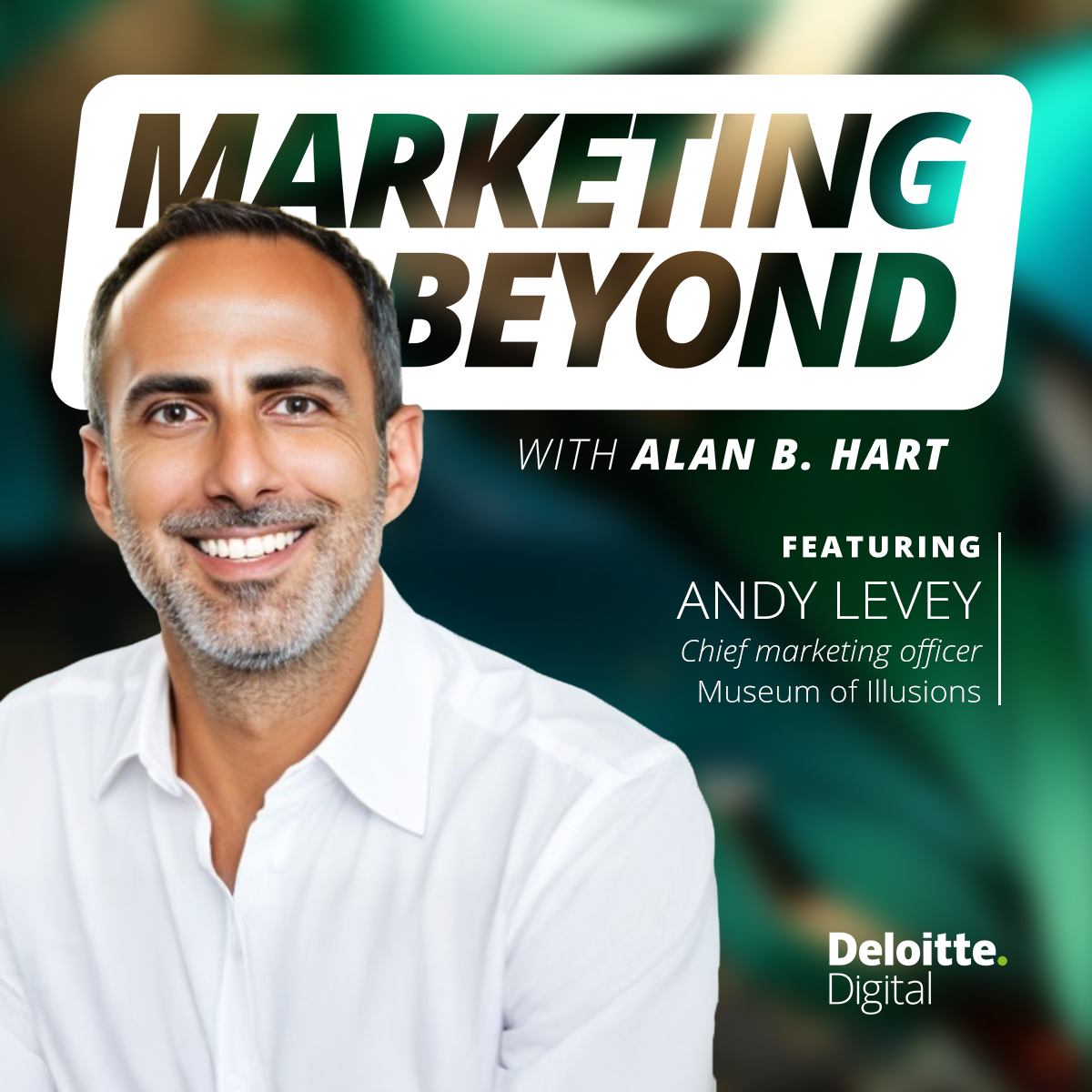
Marketing Beyond with Alan B. Hart
28: Creating Gen Z FOMO in experiential marketing: Insights from Museum of Illusions Chief Marketing Officer Andy Levey
00:42:25
Loading summary
Transcript53 lines
- [00:00]
Alan Hart
Today on the show, I've got Andy Levy. He's the CMO of Museum of Illusions. He's got over 20 years of experience shaping conversation, driving brands across entertainment, hospitality and lifestyle industries. Today, he's leading the charge for one of the world's fastest growing experiential brands, captivating global audiences with interactive perspective shifting installations that blend science, art and wonder. Before joining Museum of Illusions, he was a CMO at Play Social Media where he spearheaded the launch of Playground in Las Vegas. Before that, he was CMO at Two Bit Circus, a new entertainment company reimagining amusement park for a digital savvy generation with immersive tech and social play. Earlier in his career, he spent several impactful years with Cirque du Soleil where he led global marketing initiatives and strategic partnerships that brought the brand's legendary shows to millions across North America. Now we also talk about his background starting out as a investment banker and now until Illusions. So, so that and much more with Andy Levy.
- [01:04]
Are you ready to go beyond the basics of marketing? I'm Alan Hart and this is Marketing beyond, where I chat with the world's leading chief marketing officers and business innovators to share ideas that spark change and inspire you to challenge the status quo. Join us as we explore the future of marketing and its endless potential.
- [01:30]
Well, Andy, welcome to the show.
- [01:32]
Andy Levy
Thanks for having me, Alan.
- [01:33]
Alan Hart
Yeah, I can't wait to have this conversation. In part because investment banking, Circus and illusions, I don't think I've ever put into one sentence together and yet they all live inside of you. So like, tell me, how do those three things, you know, investment banking, circus and illusions all fit together for you?
- [01:56]
Andy Levy
It's a, it's a long and winding road, Alan, and I'm, I'm the sum of those parts today. But it was not always a clear journey. I got my background in finance and first couple of years of my career I worked in investment banking for a large mutual fund doing all sorts of analysis and things like that. And to be fully honest, I did not enjoy any minute of it, but it was, it was great. And I'll never forget, really the impetus for all of this was working on a deep analysis, running all sorts of macros to do this report. And it was like a Friday night and I had something due first thing on Monday. So I had to grind over the weekend and my brother, who's younger than me, called me because this might have been before text messaging, but called me and was like, hey, what are you up to? It's Friday. I'M working at the office. And at this time I was living in Colorado and he was going to school at UNLV in Las Vegas. And I was like, oh, what are you doing? He's like, oh, I'm going to this party with like George Clooney and Randy Gerber and all these people, you know, Cindy Crawford might be there. And I was like, this is sucks. This just is lame. This is not for me. So kind of from that moment on, I decided I wanted to change my path. In college, I went to Tulane University in New Orleans. So in college I was used to going out and partying and being very social. And so was that kind of mind shift, mind shift where I wanted to really be involved in more social facing, more consumer facing elements. And so I set up my sights to go back to school. I moved to Las Vegas, ended up going to grad school at University of Las Vegas, got my master's in hotel and restaurant management because I had no true experience in that field, and then got my MBA with specialization in marketing. And as I was doing that, I also went back to work in the field and really learned and worked in the nightlife and hospitality scene for quite a few years and just rose in the ranks. And then I turned 30 and got married. And the nightlife industry, that's kind of ancient retirement age. And so was trying to figure out what my next steps were. And I had the opportunity to go work for Cirque du Soleil in Las Vegas. And so was really at the verge of kind of the first social and digital marketing space with, with Cirque in Vegas, like in the nightclub days, we were writing like, that's how I learned to write code. We were writing like MySpace templates and, and updates and codes like that. And so at Cirque, you know, we tried to be as like, social first moving as possible, because that was just like the golden age of a brand social media, where you could kind of stumble your way through it. Worked there for three years in Vegas, got promoted and actually moved to Montreal, oversaw basically the internal agency that supported both the resident shows and the touring shows, and then advising on all sorts of other different projects. And so that took me from kind of a Vegas base to a global base. And was also in Montreal for three years, and then had the opportunity to do a Cirque style project in Dubai, which was like a startup basically, and was in Dubai for three years. And that was an amazing time. My family still wishes that we lived there. And so that was my second circus working for the Dragon Group there. And then after that moved to Los Angeles to start to work for a startup company called Two Bit Circus, which was more of a experiential digital circus, location based amusement park and was there for three years in la. And then we had the opportunity to do a couple of other projects that were larger scale. We opened one in Dallas and then we were experimenting with the hotel concept as well and that unfortunately fell through. And so after that moved into consulting with, you know, location based entertainment concepts, shows, touring, things like that. And then had the opportunity to come to Museum of Illusions about a year ago with some of my former colleagues that I've worked with in the past from Two Bit Circus and elsewhere. And it's just been amazing. It's a, it's truly cool concept. You know, I can talk a bit, you know, more about it, but you know, just kind of the best of both worlds, you know, with, you know, investment banking. Like I said, there's no emotional, you know, but what I've learned throughout my career, you know, working with nightlife, entertainment and experiential, is these are emotional products. And whether or not you think of it like that, they truly are. Because you're always going to remember, hey, I went to, I met my spouse at this nightclub or I took my kid to this Cirque show, or oh my gosh, I brought my, my daughter's group field trip group to Museum of Illusions. And so you kind of like cement these memories or tattoo these memories on your brain and just have these moments that you'll always remember. And so for something like Museum of Illusions, it was a visual concept, really cool, really different. There's an educational component, there's a Instagram and social component to it, but yeah, just an amazing opportunity to come and join them and just they're on a rapid growth trajectory. So that, that, that kind of like sums up where, where I've been, you know, and where I am today.
- [07:15]
Alan Hart
Well, I, thanks for putting all the pieces together in terms of like investment banking, moved into circus and the experiential component of the businesses you've done and now Museum of Illusions, you kind of talked about what, what brought you to Museum of Illusions, but maybe we can double click on like what it is. What, how? I've never heard of them. How do I think about going to a Museum of Illusions?
- [07:36]
Andy Levy
Yeah, I mean, I joke and you know, obviously it's one of my mandates is to make sure it's, you know, on the tip of everybody's tongue and you know, everyone knows what we are, but like, you know, I tell people and they're like, what is that place? I've never heard of it. It's just like. So, so, you know, my joke is, you know, we're one of the biggest brands that you haven't heard of. We have over 70 locations worldwide and we're, we're growing rapidly. Museum evolution started in Zagreb, Croatia about 10 years ago by two gentlemen that were really entertained by brain Games. If you remember that TV show.
- [08:08]
Alan Hart
Oh, yeah, yeah.
- [08:09]
Andy Levy
And, and so they wanted to create something where people could come and really test their brains, learn stuff and, and, and have fun. And so they grew quickly in Europe, franchised it out, grew quickly in the U.S. and then about five years ago, we, we started to realize that like, hey, we should ourselves and operate them ourselves. And so launched our first location in Charlotte. And it's grown substantially since then. And so Museum of Illusions, we, we like to say we're here to reimagine reality. But at every museum that you'll go to there, there's 60 plus interactive exhibits and illusion rooms. And so that's anything from patterns on the wall that are kind of like 3D objects that will mess with your brain to photo ops where it looks like you are smaller than someone else and they're taller than you to like our, our big marque exhibits are. We have a reverse room which is something's askew here. It looks like you're riding a train, but you're hanging upside down. Or we just opened in Salt Lake City, so we have a dirty soda bar so you can sit upside down at the bar. Other ones are building illusions. So like iconic buildings in each city and you get to climb on them and look like Spider man and hang upside down. And so it's, it's a fun concept. It's really cool. You know, obviously there's countless photo ops always, you know, kind of defying and challenging reality and, and really giving that people the hook because it is experiential wise. This is a FOMO business, right? People always want to imagine themselves going through whatever they see through someone's TikTok or Instagram. And obviously this is, you know, one of the biggest places to do so. The other thing too is where we have the name museum in our name. We are an attraction, but we're not just kind of one of those like, hey, just show up and spend 40 minutes to 90 minutes with us and leave. There's a lot of science and education that goes into everything that we do. All exhibits are backed up through Science and education. We have a partnership with stem.org where we actually have curriculum that talks about each exhibit so that can be used for field trips and things like that. So we are fun, but we're also serious about education and the environment that we provide. And obviously, as we grow and come into every community, it's really important that we come a member of the community and not just kind of like a retail shop that pops up and you ribbon cut and say, see you later. It's important for us to interact in the community.
- [10:31]
Alan Hart
Yeah. I think in our last conversation, one of your top audiences was tapping into Gen Z and Millennials. We also know, I think, from research that their experiential and experiences are kind of key to that. Those kind of large demographics.
- [10:48]
Andy Levy
Yeah.
- [10:49]
Alan Hart
How. How are you tapping into. Into that audience, if you will?
- [10:54]
Andy Levy
Yeah, I mean, this is, you know, the camera eats first. Right. The camera experiences all of this first. And so for us, making sure that every exhibit, every opportunity becomes a photo op, a video op, a gif op, a meme op for those audiences. And what we found is we work very closely with creators. We have creators that we work with in house that we have on the team that travel to location from location and start to put together little cute shorts and videos and things like that. But in every market we go to, we actually do get an outpouring of creators and influencers who want to be able to showcase this because it's visually appealing. Right. And it adds a nice aesthetic to whatever their theme or their brand is as that creator. And so we found that really working closely with content creators and influencers has driven huge awareness. We've had stuff where we'll do ticket trade or we've had stuff where we've had people come in. We've had stuff where we pay creators, and it's always funny to see where all of those land. And sometimes it's someone that you don't even talk to and haven't engaged with that ends up going viral and getting million plus views that you're like, oh, we got to reach out to that person. We want to make them a brand ambassador and bring them into the fold. And other stuff. It's funny, obviously, I'm sure as other episodes, if you talk to their CMOs and you talk to other people in the marketing industry is like, everyone's like, oh, we want it to go viral. And obviously there's no such thing as that. But the things that you think are going to work sometimes don't. And then the things you don't think about whatsoever. All of a sudden get 20 million views. You know, we have a TikTok and Instagram video that's been distributed on both platforms and between the two of them I think that has like 35 million views. And it's just people like hanging upside down, normal shot on phone, you know, not high production value and like it just clicks. Right. And so, you know, I also think it's important we have an awesome team, that one of them is a, you know, a Gen Z millennial. Like they're, they're designing the content and the marketing for that audience rather than old man me trying to do it and trying to think what's, what's hip and cool.
- [13:09]
Alan Hart
Right, Right. How you mentioned like social media influencers, creators, like what's your approach to marketing this business and as you see it, the state of marketing, if you will.
- [13:22]
Andy Levy
Yeah, I mean this is a bit different because experiential like stat and you, you see it across the board. In experiential you always see these like static images of people high fiving and smiling and it's so staged and fake and not real. And maybe I'm biased, spent a lot of time in this industry, but when I see it, I'm just like that poor marketing team or like these guys like, because that's the thing, like I said, this is a FOMO industry. You have to, we have to be video first. Everything that we do has to be video centric. And whether that's a 30 second spot, a 6, 60 second spot or just like a 7 second repeat boomerang type of thing, like you have to show it because otherwise like it's hard for people to imagine it and like just a static image just doesn't convey the WTF of our experience. Right. And so for us, we're heavy on digital as far as our investment and really our marketing spend. So heavy on digital. So obviously driving awareness through platforms like meta, Instagram, Facebook, doing hyper targeted stuff, certain markets and certain geo fences with Snapchat, driving awareness with TikTok and then catching all of that through search intent as well. But for us it's just making sure that the visuals are good, they tell the story and they give that hook for someone to be like, wait, what is that? I need to experience more? Or I saw that cool family doing that thing that needs to be us and I want to be able to use that as social currency so I can share that with my audience as well.
- [15:01]
Alan Hart
Right. Well you, you've highlighted many elements of your marketing mix. So You've got kind of like digital first, it seems, and videos. Large component of that. You're, you're on the platforms, all the different social platforms. You've got creators, you've got customers, you got people. Are user generating content around your properties, if you will.
- [15:20]
Andy Levy
Yes. Yeah.
- [15:21]
Alan Hart
How do you. I mean, I guess are there other components of the marketing mix we haven't talked about and then as you.
- [15:28]
Andy Levy
Yeah.
- [15:28]
Alan Hart
You amplify those efforts.
- [15:30]
Andy Levy
Yeah. So those are obviously the, the flashy right in front of everybody types of things. But what's really important for us too is, you know, we call it establishing the base. So whether it's a new market or existing market, the things that we have to do are we establish ourselves as a partner with whatever the tourism board or local visitor authority is because obviously they're big advocate for all activities going on in that DMA and that city. Right. And so they'll expose us to opportunities. Obviously conventions come in, you know, we're group sales is a huge component of us. So making sure that we have a partnership with them as well. Working with boots on the ground as far as local PR agency and national PR agency, making sure that we're always represented when the timing is right, when the theming is right. We're a great place to visit during special occasions, especially because we do veer a bit younger in terms of demos. So like summer was big for us because kids are out of school. Three day weekends are big for us because is, you know, we're something to do especially when the weather's warm or when it's cold and you're stuck in the house all day. Making sure we're getting in front of people, whether it's through tv, radio, things like that, with our PR agency. So that's extremely important. The other thing too is looking at what our local proximity looks like. Who are our neighbors, who can we partner with? We are a relatively simple operation in the fact that there's no food and beverage, you're just going there and experiencing the illusions. So we're the perfect opportunity to do something pre dinner or post dinner or pre event or post event. And so making sure that if there's a wine bar next to us that we're partnering with them, if there's another event going on in town, that we're the best way to warm yourself up for that event. So those have been a component. One of the big things for us as well is CRM as well, you know, and that's something we've gone in and established is really Started to do heavy duty data collection and email and SMS collection as well. So, like every new market we go into, we'll do a landing page and a contest where you can win tickets to the museum. We partner with the local hotel partner or local restaurant. We did this in a few markets and we got 10 to 15,000 emails in the span of two weeks. And then that becomes another marketing arm for us. And the fact that if we're launching a promotion or we're doing a special or things like that, we can then SMS those people, we can email those people. And then it also becomes a tool for us as we go into various markets. We can say, hey, we have a database of 100,000 people in this market. Do you want to advertise using our channels? Do you want to be a part of our newsletter? And that becomes just another either revenue generator or partnership where we can trade data and things like that. So like I said, like high level. Yeah, we're on TikTok and Instagram, but there's a huge data component and really partnership component that we work on. And then we also have an awesome group sales team as well who are going out, both closing inbound deals and hustling for outbound deals as well. Because we're a great place to have a product launch. We're a great place to have a field trip, birthday parties, things like that.
- [18:39]
Alan Hart
I love it. I mean, you've got a whole flywheel to go in there.
- [18:43]
Andy Levy
We're trying, we're trying.
- [18:46]
Alan Hart
You got the local pr. I could see that really playing a big role in launches, openings, etc. Not to say it doesn't have longer legs than that, but definitely see it there. And then you got the email data, CRM capture and the flywheel that that creates potentially with the partners you're also trying to build next door.
- [19:06]
Andy Levy
Exactly. I call it the engine. And we've got to rev the engine and it's really important. And the PR things and having a schedule and having themes and having events are extremely important as well. Because that's from my experience working in this industry. My team always tells me it's not this, but this is what I say is it's the easiest thing to launch concepts because it. And when I say easy, it's not easy any concept. It's hard to launch. Right? You've got construction, you've got permitting, you've got all that stuff. But it's easy to throw a bunch of money at this stuff and be like, hey, pr. Hey, advertising. We've got flare guns we're open. That's the easy part, right? Once you're open, that's really when it becomes harder. Like everyone forgets about you three months, six months, even a year later. So what are you doing to pop back up into those conversations? Depending on the market that you're in, you may be the only thing, or there may be four more concepts similar to yours or bigger or smaller that launch. Or a market like Vegas where the population places itself every 48 to 72 hours. How do you, how do you get ahead of that? And so it's really important for us, you know, and I have an awesome team and we're always trying to think like, how do we get ahead of these things? How do we plan? How do we, how do we plan for the holidays? What are opportunistic things that we can do? And so, you know, that's the thing is we're not a set it and forget it type of mindset where we view ourselves as always going to battle and always trying to fight for that additional ticket sale.
- [20:40]
Alan Hart
Gotcha. Gotcha. Well, you've mentioned partnerships a couple of times and brand partnerships. I'd love to talk a little bit about them and like, how they help you expand your reach. You mentioned stem.org and the curriculum that you built to try to like reinforce them, guessing like field trips and school visits and things like that.
- [20:58]
Andy Levy
I mean, partnerships are extremely important for us because it helps validate and legitimize us as a brand, or it helps validate and legitimize any other up and coming brands up there. But it's a good sync of audiences or trying to figure out how to get a different distribution channel that we haven't gotten before. With stem.org, they've been an awesome partner and they really help legitimize what we want to do because we're able to back that educational claim with actual facts, actual curriculum, actual, you know, science behind it. So we're not just your mom and pop places saying, like, hey, come and have your field trip here. And like, you don't know if it's educational or not. So, you know, that's been a big component for us, you know, for Valentine's Day and for the first two quarters, we did a partnership with Match where they did speed dating and meetups at our locations. And it was a great way, you know, interesting way to break, break the ice and just drive more people to our venues and museums that had been there before. And also gives Match another outlet rather than a bar or a restaurant. To hold your event at. There's other stuff. We've had opportunities at Comic Con and then local partners, like breweries like in Denver and Charlotte that have done Team of Illusion style beer and things like that. So it's just, how do you get. The way we view it is how do you get more distribution and more reach? And then how do you talk to another audience that you may not be able to afford to talk to, or you may not even had to think that you needed to talk to them? And then they drive in, and then like, we talked about with, like, the CRM component, then it also becomes a great distribution tool for that partner as we amplify their launch, this partnership as well. So for us, like, we've only gotten started on this, and obviously we've been successful. Like we just did in the month of July, for July 4th, we did a partnership with vet ticks.org and they provide tickets to veterans, and then we'll do another partnership with them during Veterans Day as well. So, again, trying to be a community pillar, trying to give back, trying to figure out, you know, who can reach an audience that, like I said, we may not be able to afford or they just may not be in our wheelhouse and how do we bring them in?
- [23:21]
Alan Hart
Yeah, I mean, as you talk about this, like, I'm thinking of how much, like, other marketers, frankly, could learn from how to take kind of a fixed asset, right, and make it unique and interesting to multiple types of people at various times in the year and just kind of keep it continuously, keep it fresh. Right. Like, yeah, like, you know, I work with many different types of companies, from consumer products to financial services. And frankly, there are some boring products out there. Right. Like, it's almost more about, like, how you talk about how you encase the product, and you guys have a very interesting product, I should say. But, like, how do you encase that in something that is contextually relevant at a point in time? You've been. This is kind of like a little bit of a masterclass on how you're doing that.
- [24:13]
Andy Levy
Thanks. I mean, it's tough, right? Because, like, I've done consulting before, and I've worked on boring products, and it's tough when it's a boring product. I'm not gonna lie. You know, it's tough. You, like, you can only sell so many pieces of paper. No one wants to buy paper for Valentine's Day. Like, that's. There's nothing romantic about it. Right? That's why I'm here. That's why I Continue to want to work in this industry and be the person you, you go to when you want to open up one of these concepts or places like that. Because, like, there is a science to it, there is an experience to it. I think that's the big thing is like, most of the time, like, we're pretty good here of like high fiving when things go right. But, but I think people don't understand that, like, okay, sure, like, you can market your product, you know, whether it's the paper, whether it's inexperience or things like that. But like, you have to think of those beats throughout the year. You have to think of where these overlaps and you always have to say, like, okay, how can we drive further? And I, I think there are a lot of people that just kind of either rest on their laurels or say, hey, we got a big billboard unit and Times Square. We did this thing. It's okay. So what, what's next? How can you further right. And that's, that's one of my favorite things is trying to figure out how to connect the dots and where to connect the dots, you know, and sometimes we'll shoot for the moon, but then you have other, you know, more opportunistic brands that want to say, hey, yeah, we'll, we'll take a chance on this, or this is something that we'd love to partner with. Let's see how it works. Sometimes it works, sometimes it doesn't work. But like, if you don't try, you're never going to find out.
- [25:46]
Alan Hart
Yeah, no, I love it. I love it. Well, again, I, I, I do applaud. I mean, you've got like, you know, holidays planning, you've got like partnerships, you've got data strategies. Like, you've got a lot cooking that I hadn't really thought about in terms of how it applies to the Museum of Illusions business. So it's, it's pretty interesting what you got in place. One of the, one of the things we love to do is get to know you a little bit better. We know they've got quite a varied background. Very interesting. But one of the questions I love to ask everyone that comes on the show is, has there been an experience of your past that defines or makes up who you are today?
- [26:24]
Andy Levy
Yeah, I mean, I think my, this is kind of like advice. But the experience that I have is I, I lived abroad for two years. I lived in Paris when I was 20 and 21. And it really taught me how to be way more independent than anything else in Figuring it out and realizing that my mom and dad or no one else is going to solve these problems for me. And so ever since I did that, I realized I have to solve problems on my own and I have to figure these things out. And then when I moved to Dubai, working for the startup. So working for a startup within a foreign country, it's like the exponentially more difficult. But working for a startup was amazing because you had to play every role possible and do every role possible, and you kind of figure out like how everything works. Right. And so then as you move up, like, you know, for me, moving up to the C level, like, I have a general understanding of how every facet of my marketing team works because I've had that experience rather than being someone who just either specializes in social or PR or digital and has no idea how any other area works. So I think those kind of were two inflection points. Like the living abroad really inspired me to be quite nomadic in my lifestyle. Like I said, We've moved four or five times in the past 11 years. Not planning on moving anytime soon, but I think some people, in some countries you have to join the military when you're 18 or 21. It's a requirement. So if I had my druthers, I think I would require people to go live abroad for two years when they're 18 or 20. And then I would say professionally as a marketer, I would require you, you know, after maybe three years or five years, I would require you to go work at a startup. And I think those two things combined. Listen, I'm not the end all, be all of anything, but I think those two things combined really helped drive me forward and helped me understand how to be a driver of force and how to control and how to drive revenue, drive brand forward and understand that I'm the only one who can push these things forward. And, and I can motivate my team to do it and empower my team to do it as well. And so, yeah, I mean, like I said, those two factors really helped identify and help mold who I am today.
- [29:07]
Alan Hart
Love it. I doubled down on the entrepreneurial experience. I mean, I've had my own as well. And it's great to have the title on the card, but when you're still taking the trash out, it's a humbling experience.
- [29:19]
Andy Levy
Yeah, I mean, that's just it. Like the, the startups component and then like, like I did consulting prior to Museum of Illusions, like someone's got to pay the bills. Right. And, and just because you're a consultant doesn't mean they pay the bills for you. So you got to go chase and ask and. And I think that's it. It's like, the sooner you get used to asking uncomfortable questions or asking for uncomfortable things like, like being in that weird position, like, the easier your life will be and the easier you'll. You'll be able to take on more of these challenges. And I say you won't get phased by it, but, like, even to this day, like, I still get phased by certain things where I'm just like, I thought I've seen everything, but. Okay, cool. All right, great.
- [30:03]
Alan Hart
Yeah. Well, also, what advice would you give the younger Andy?
- [30:09]
Andy Levy
I mean, the younger me, I think if I stuck in finance, I'd probably be a lot wealthier. But would I be happy and would I have lived all across the world? Probably not. I think it took me until I was in my 40s to really find my voice in terms of, like I said, like, I view myself as both a driver and someone who empowers their team. But I can also be really annoying too, because I want to get stuff done right. And I've learned that through prior bosses and mentors that I had. The reason why these people are so demanding and so successful is because they're demanding and they know what it takes to get the job done. And so for me, I wish I was like that. Probably a bit earlier in my career I was a bit like, I. More vanilla than anything else. But listen, here I am today and I'm. I'm happy where I am. But yeah, I would just expedite or accelerate the path a bit earlier. But, yeah, love it. It's good.
- [31:10]
Alan Hart
Awesome. Well, is there a topic either you're trying to learn more about or you think marketers need to be learning more about today?
- [31:16]
Andy Levy
I mean, obviously the hot button topic with everybody is AI, right? And what does it mean? Is it going to take your job? Is it going to automate? Is it going to replace your agency? Is it, is it going to make microwave you dinner? What is it going to do? I think you have to understand when it comes to that, like, for us, like, we're trying to figure out LLMs and what it means for how people are discovering us in terms of like, search versus, like chat. GPTing it. So I think it's understanding, like the context of all that in terms of automations. Like, we have a lot of good automations in place and it's just more like how, at least I think, like, it's not going to Replace people, It'll replace certain functions that you have and then you still need the people component to prompt and really understand and interpolate or interpret, you know, the data that you want. So for us it's more how do we move faster and how do we become more efficient using all these automations and things like that. Yeah, I mean I'm curious about everything naturally, but you know, honestly like what keeps me up at night job wise is just how do we continue to sell more tickets. So I'm always curious into whether it's new technology, new platforms, single things like that and what'll it do, how can we adapt it for us and how can we test it fast and you know, either fail fast or succeed fast with it.
- [32:43]
Alan Hart
Makes sense. Are there any like trends or subcultures that you've noticed out in the world? Things that make you think a little differently or.
- [32:51]
Andy Levy
I mean my kids are 9 and 12, so everything that they're telling me about Internet culture makes me feel really old because I thought I used to be with it or understanding it and there's stuff they tell me now and I was just so for me it's like really understanding the speed at which all these kind of trends and cultural things go and then also kind of filtering it like, okay, if my 9 year old is saying this, how can I, how can I market to a 9 year old or how can I market to a 12 year old to get them to convince their parents to make a purchase? Right? So in a lot of ways my kids are my lab. I say that in a very caring way. I love my kids, they're awesome. But you know, like, you know, and I think that's the other thing too because working in experiential, like I take my kids everywhere to all sorts of concepts to really understand what makes them tick and what makes them want to enjoy or value the experience. Because that, that's the thing with all this stuff, right? You may not be exposed to it, but your kids are going to be exposed to it. And then you want your kid, your kids are going to tell you like Hey D dad or hey mom, like I want to go see that place. And you're like, what is this place? Then go down the rabbit hole. So like trying to understand how the younger generation consumes what we're putting out there or consumes things and how we can adapt from that.
- [34:14]
Alan Hart
Yeah, it's super fascinating. I mean you got me thinking as my daughter's 17, so it's like Instagram is a big part of like what we look at together, right? And her, you know, giggling and laughing over on the couch, on the other end of the couch, like, what are you, what are you? Like, what's going on over there? Like, tell me, show me. And, and it's some of the funniest stuff in the world some days. And, and other times I'm like, okay, I didn't get that one.
- [34:41]
Andy Levy
Well, it's just, it's crazy, the difference in age and the algorithms. Like, yeah, yeah, my kids don't have phones yet and so they'll go on our phones to access their account and occasionally, obviously we'll, we'll check in on it. And I was just like, like, why are you getting served up this stuff? What is this? What were you even looking at to get, serve these things?
- [35:03]
Alan Hart
Right?
- [35:04]
Andy Levy
You know, and so it's like a world of difference. And even though I work in this industry, it's so weird for me to be like how far interests are so different between, you know, our age range and obviously female versus male and things like that. It's, it's crazy to me.
- [35:23]
Alan Hart
Yeah, that's wild as well. All right, well, last question for you. What do you think is the largest opportunity or threat facing marketers today?
- [35:35]
Andy Levy
Where do I start? I mean, listen, it's challenging times all around, right? You know, there's macroeconomic conditions, there's things like that, but people, for us, like, people still want to be entertained, people still want to have a good time and you know, that's what we bank on. So I think, keeping in mind, obviously, depending on what you're marketing, what type of project you are, you're there as a form of entertainment or distraction or relief for someone. And so starting to lean into that. And contextually, in the environment we're at, people need a laugh. People need to forget what's going on. Not to make it topical, but people want to relax, right? So how can you lean into that more and bring that affinity closer between yourself and the brand and that person, right? So I think obviously the biggest opportunity, probably the biggest opportunity and threat, like double edged sword is like, how do you become a part of the cultural zeitgeist? But is that good enough? Right? Like you can be part of the cultural zeitgeist, but are people actually going to buy that product or use that service? Right? And then does the advertising, does the marketing, does the social content live up to the experience or the product itself or vice versa, Right? Like you could have an excellent product and crappy marketing, right? And then you could have excellent Marketing and a crappy product. And so that's, that's the thing, like through my career, like I've been on both sides, right. And so you, you get the reviews and it's stressful and it's tough. And so I think, how do you make sure you align? Whether it's a single owned business, whether it's a large corporation, whether it's a startup, how do you make sure that the experience and the product is what the people want and you're getting those NPS scores or you're getting those great Yelp reviews or Google reviews or things like that. So really matching that up and listening to the people. Yeah, I mean, other threats to marketers, I think it's just, just, it's easy to say, hey, these are good ideas or, or, or like, yeah, this is where I was going with this. So YouTube, Instagram, they're all wonderful platforms, but you start to get people who are, are like us right now, talking heads, right? You know, who are, you know, who are experts on things. But like, you really have to make sure if you're following these people's advice that you're, you're not just following it the surface level, you're actually living and breathing it and, and doing it for your listeners. Feel free to check in with me and touch base if you want to learn about experiential. But it's one thing just to listen to the experts. It's another to kind of go down that rabbit hole and just because I say, hey, it should be like this, or someone else says, hey, you should be doing TikTok or whatever, is it a fit for what your product or your brand is, you know, and then what can you learn from it? I think that's the thing for me. Now I'm rambling, but I think that's the thing for me is like, I also look at other industries because I don't believe the experiential industry has the best marketing out there. I think there's a lot of just kind of basic stuff that's done. So I try to look at other industries to be like, okay, cool. How can we apply that to us?
- [38:54]
Alan Hart
Right?
- [38:55]
Andy Levy
This is something different or this is something unique or because we sell tickets, a lot of times we'll look at like what festivals do do or what concerts do and like, oh, that's an interesting thing. They're doing an upsell with this. Can we do that? So I think it's important and also like step outside of whatever your industry is or your role and see what inspires you?
- [39:15]
Alan Hart
Yeah, I love that. I think it's great advice. And, and it goes back to the concept you talked about in my mind as you describe this. And like the making sure it fits your business, not just adapting to like whatever's being talked about in the Internet sphere today, but it's the engine block that you talked about, like the, like getting the engine right. Right. It's not just about like being a part of culture, but is it part of culture that drives people by? Because otherwise like the engine started but didn't, it didn't get a couple cycles in. Right. Like, right. How do, how do I improve? Constantly improve the engine and like you're looking at other businesses and trying to figure out what might work for your engine. You know, testing and learning, applying it, see if it works, see if it optimizes, see if you can get a little bit more horsepower out of it or not.
- [40:03]
Andy Levy
Yeah, exactly. And, and, and that's the thing too. Sometimes you might get more horsepower, ie, exposure. But like people aren't going to buy. Is it your price? Is it a product that like people don't want or they'll, or you're like a SaaS platform that you know the public's not going to care about. So yeah, I think it's those things and really understanding what makes it tick. And like I said earlier, like, I'm a curious person and I'm always trying to figure out like what makes our business tick and what that is today might not be the same thing tomorrow. And that's something also, you know, marketers shouldn't take for granted as well is just because you're selling well today doesn't mean that three months from now you could be stressed out and like panic stricken and like what's working for you isn't working. And so just know that, that you're always, you're plugging holes in the dam on a daily basis.
- [40:52]
Alan Hart
Well, Andy, thank you for coming on the show. It's been, it's been fun to talk about your background, your career, but also take away some learnings from how you think about marketing.
- [41:02]
Andy Levy
Awesome, thanks for having me, Alan.
- [41:10]
Alan Hart
Hi, it's Alan again. Marketing beyond is a Deloitte digital podcast podcast. It's created and hosted by me, Alan Hart, and produced by Sam Robertson. We have even more cutting edge marketing insights headed your way. Be sure to subscribe to our channel to stay up to date with our latest episodes. I love hearing from listeners share your thoughts about the episode, the topic covered or the show by commenting on this video or emailing me@marketingbeyondeloitt.com if you if you're interested in more conversations with industry visionaries, we invite you to explore other Deloitte Digital podcasts@deloittedigital.com US Podcast. There you'll find the Marketing beyond webpage with complete show notes and links to what we discussed in the episode today. I'm Alan Hart, and this is Marketing Beyond. The views, thoughts and opinions expressed are the speaker's own and do not represent the views, thoughts, and opinions of Deloitte. The material and information presented here is for general information purposes only and does not imply endorsement or opposition to any specific company, product, or service.