← Marketing Beyond with Alan B. Hart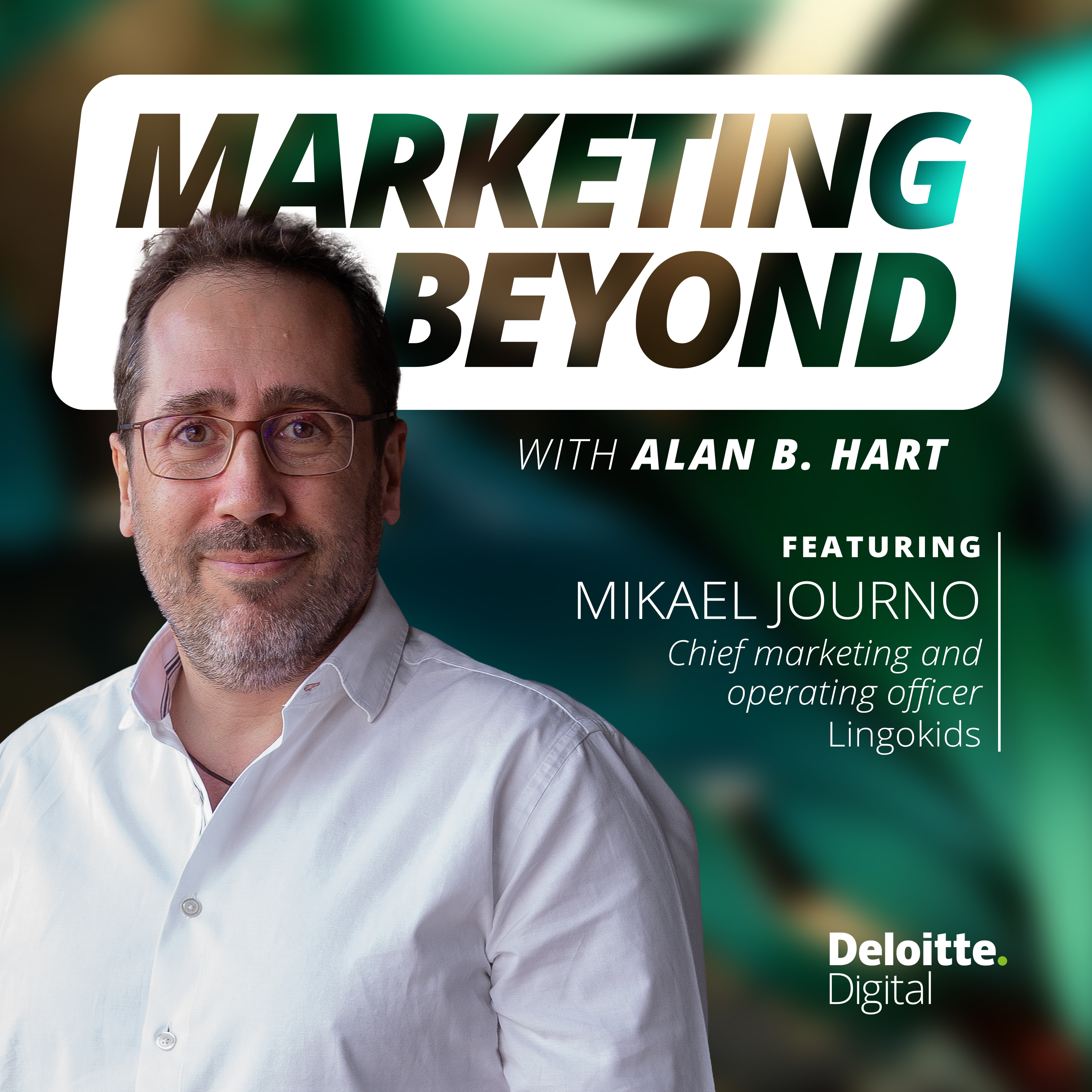
Marketing Beyond with Alan B. Hart
29: When a brand film works to shift perception: Insights from Lingokids CMO and COO Mikael Journo
00:42:06
Loading summary
Transcript73 lines
- [00:00]
Alan Hart
Today on the show, I've got Mikel Giorno. He's the chief marketing officer and actual COO at LingoKids. LingoKids is the number one interactive app for kids aged 2 to 8, with more than 165 million downloads worldwide. Mikhail holds over two decades of experience across a number of different companies. He has done CRM, marketing player, community, customer care ops, and social media, among many others. One of his standout stops along his career journey was at King, the makers of Candy Crush and. And we'll talk a little bit about that and how it influenced what he's doing today at Lingokids. Today on the show, we talk about marketing to parents. The duality of marketing, both performance and emotion and harnessing emotion, specifically parental guilt, in his new brand film for Lingokids. That and much more. With Michal Giorno.
- [00:57]
Alan Hart (Podcast Host - Marketing Beyond Intro/Outro)
Are you ready to go beyond the basics of marketing? I'm Alan Hart and this is Marketing beyond, where I chat with the world's leading chief marketing officers and business innovators to share ideas that spark change and inspire you to challenge the status quo. Join us as we explore the future of marketing and its endless potential.
- [01:23]
Alan Hart
Well, Mikhail, welcome to the show.
- [01:25]
Mikel Giorno
Thanks. Thanks for having me.
- [01:28]
Alan Hart
Yeah, I'm excited to have this conversation. I will say I have never in my life met a shark wrestler before. And how in the world did you end up wrestling a shark?
- [01:41]
Mikel Giorno
Thanks for asking. That's quite a funny story, actually. So we have. We have traditions. Like in every company, the first thing you do when you step into Lingokids is you have to share two lies and one truth. And the rest of the organization has to guess what's what. Right. So you try to find things that are a bit out there. So mine were about skydiving French wines and wrestling sharks. So obviously few people guessed it, but I actually did Breath of the Shark one time on a beach in Mexico, and it's quite original. Was a sand shark pretty, pretty safe. But still makes for a funny story. And the reaction from the crew at legokids was quite amazing. And people were just joking around and talking about that shark going back to his pals and saying, hey, today I wrestled the cmo. So that should be. Maybe your next guess is the CMO wrestling shark. That should make for funny and interesting episodes.
- [02:33]
Alan Hart
Yeah, I. I can only imagine what the shark would have to say about wrestling the cmo.
- [02:38]
Mikel Giorno
Yes.
- [02:40]
Alan Hart
All right, so from shark wrestling, do you're currently the chief marketing officer at Lingokids? Like, where did you. Where did you get your start? In your career and kind of what were some of the major stops along the way?
- [02:52]
Mikel Giorno
Yeah, so I started in the US actually so I have a. I'm French which my accent will probably like I've introduced before I have a chance to do so I studied in in France engineering. I went to the US master's there and then start my career in the US in the late 90s and so I really. Everything started for me at the very like in the middle of the first dot com bubble basically late 90s to early 2000. I was working for Sapient had nothing to do with marketing. I was helping businesses get online so traditional businesses and fresh startup basically build their website and all of their functionalities and it was very interesting already because. And that will follow me the teams were very multidisciplinary. This is when system integrators acquired like Creative Studio and so Sapient company I was working for I just acquired a company called Studio Archetype and so to bring those projects to bear we were mixing creative people and creating the visual identity and the brand of some of those companies mixed with all the tech that was behind that took me into the early 2000. I then decided to go back to France. I wanted to be a bit closer to my family for a few years. I went to Paris 2002 and I jumped into consulting and the first consulting gig I got was with a company called Diamond Cluster. It was marrying a very marketing oriented arm with a very technology oriented. I was supposed to go into the technology side of my background and I ended up in the marketing side and that's my first foray into marketing. Very quantitative marketing, very interesting projects. The very early stage I would say versus what's now more common. We were doing things around customer value management so applying the medical field approach to testing to marketing. Right. And so you need large user base. We're working with telco operators all over Europe and helping them optimize their marketing through quantitative data measurement, AB testing, modeling behaviors, responses, stimuli and that was my first foray into marketing. I then spent five years in strategy consulting at Boston Consulting Group which was probably the thing that was furthest away from marketing that I did probably. I helped two banks merge in Italy, I did some IT organization in Kuala Lumpur. I helped the French government with the strategy for tourism for the country. So it's like pretty broad part and it was all super interesting, super educational. I learned a lot but I really wanted to go back to building things like I had done at Sapien earlier and really be involved in building Businesses and helping develop businesses. I went to vistaprint in Barcelona. That's when I moved to Spain. There I took charge of strategy and analytics for the European business. On the strategy side, we did some MA and so obviously a lot of consumer insight to figure out who to go after, why the synergies. And then on an analytics side, it was all of the marketing analytics, all of the channels as well as web and product analytics. So all of the quantitative part again of the marketing. After a couple of years I looked also after the repeat business, big email, basically an email organization to drive the repeat business was a big, big chunk of our revenues, about 60% of our revenue. And so I was at Vistaprint for three years when King Kane King, maker of Candy Crush, I joined in 2013. It was just an incredible experience. It was very unique. I had been a consultant for quite some time and even at vistaprint I took over teams that had been there for a while. So you come in and you already have an existing operation. I stepped into King with a pretty blank slate on my organization and what we wanted to do on the marketing side from a team, from a system perspective, from a process perspective. But the thing that was pretty novel is the company was making a ton of money already and we had the third biggest user base in the world, 500 million users on base. So you get to do things at Hyperscale but with no legacy behind you. So from the ground, extremely exciting experience. Spent six years over there. I worked on things like CRM, live ops, cross promotion, social media, game launches, product launches, marketing strategy. It was very, very interesting. But then the company became quite stable from an organization business standpoint and I wanted to go back to building things because that's like, that's what I like to do. I joined the smallest startup in the real estate space called Host 5 for about 15 months as the GM and then finally met Lingokids. And Lingokid was a great match for me. I was really looking forward to working in the tech space. I had already invested a little bit in that space and I was helping some startup there and I found a company that was really a great fit. So I started there as the cmo. I evolved as the COO as well over the last few years and I look after the marketing, how we connect with our audience, how we scale the business, but also the business model, the pricing and all of the business performance which makes my role a mix of quantum creative and marketing and general business performance.
- [08:01]
Alan Hart
Yeah, no, that's awesome. That's awesome. I mean, such a Varied career, but all kind of building, if you will, towards this tech performance oriented marketing organization in a digital world.
- [08:15]
Mikel Giorno
And it's often serendipity where you end up being. But when you look back, there is still like you can find the common thread. Exactly.
- [08:23]
Alan Hart
Well, tell us a little bit more about the scope of lingokids. How do I think about the company, what you guys do, the size, scope, et cetera.
- [08:30]
Mikel Giorno
So LingoKids, amazing company. I've been there for the last four years. Absolutely. Love starts with a mission. We want to help parents raise amazing children. At the core, that's what it is about. And it's really true. It's like those startup stories with a founder. It started with Chris, our founder, wanting to help his niece learn English, not finding any product, building a few games and then putting them online. And that was 10 years ago. And now we have a million kids in the app every month, every weekend. Sorry, and. And we had 160 million downloads. So it's like really starting from his knees. 260 million kids, having experienced the product is quite a story. And so we have this belief that technology can be a very valuable tool to help kids learn. And we also believe strongly that for kids of that age, 2 to 8, learning through play is the way. And so our purpose is to create the product that we wish we would have had when, I mean, I have two kids, they're 10 and 12. I wish I had had lingokids when they were in the age group. And really to create this safe place that parents can feel good about, but that kids first and foremost really love and enjoy. Right. So that's really the background of what we're trying to do. We have a product that's KidSafe certified. It's at 3. It helps kids develop and learn in a very broad range of topics from math to literacy to emotional skills like empathy to practical skills like washing their hands and brushing their teeth and learning about space. We have some content with NASA on that. We have content about Dinosaur that we built with the BBC. We have like really a wide area of content. And at the core is really mine. Those two things, creating a product that kids love and really engage with and really want to be in. Because at the core, I mean, that's what we want to do. A product that kids really enjoy, but that also gives that space for parents. Right, because that's also one of the reasons they use the screen, but gives the parents the guilt free. And we'll get back to that word probably a bit later, feeling that it's a safe environment, it's educational, it's made by parents and educator. And so it's like really marrying those two things. Something kids enjoy, something parents feel good about.
- [10:54]
Alan Hart
I love it.
- [10:54]
Alan Hart (Podcast Host - Marketing Beyond Intro/Outro)
I love it.
- [10:54]
Alan Hart
Well, how you've, you've seen marketing in various con constructs throughout your career, right? And as you think about marketing as a growth driver for companies, how, how do you think about it? Like there's, you know, in the, in the modern day marketing environment today, there's a lot of conversation between brand and performance and you know, how, how those things work together, et cetera. So how do you think about it?
- [11:21]
Mikel Giorno
It's a great question. I think it's a great question because there's no easy answer to it. Marketing is a great contributor to the business in many different ways. I mean, a great company starts with a great product. If you don't have the product, there's nothing to do. Right? You need to get a product that really fits the audience. But then marketing can act as a fantastic amplifier and it works on different levels and time horizons. And that's why there's no simple answers. It helps in the short term with ads and performance that you can optimize very accurately with things like CRM where you put a stimuli out there and you understand exactly what it does and whether it's valuable and profitable. And so it helps scale the business and get a return on capital invested basically in reaching the audience very directly, very short term with the reality or the illusion of its impact in terms of measurement. But it also helps build the identity of the business. And the identity is important because the strongest brand are the brand that create the strongest emotional connection with their audience. And so the other side of it, obviously, which is very important and will remain very important is how do you create that emotional connection? What do you associate yourself with and drive beyond the direct response, drive this awareness and consideration and desire basically for the product across. And so you have to balance the two. I don't believe the era of brand and brand marketing is dead. Obviously it is true that some tools help in terms of recommendation and search engine and AI and all of that. But it's very different to be recommended something that you already have a feeling or an impression about than something you've never heard about. And that feeling and impression, it comes from the brand that you've built and the experience you've delivered with.
- [13:14]
Alan Hart
And it's, you know, I talk to so many marketers and it's this, how do I prove or how do I justify the brand Building the, driving the emotional connection. When it's so easy, relatively speaking, to measure the performance marketing.
- [13:32]
Alan Hart (Podcast Host - Marketing Beyond Intro/Outro)
Right.
- [13:33]
Alan Hart
And you've got this dual role as CMO and coo. How do you, how does the CMO side of yourself justify it to the COO side of yourself?
- [13:42]
Mikel Giorno
It's, it's a question I've been asked a few times actually, that, that question was one of the questions the board asked me before I started about how I was looking at that, at that space. And, and my answer is that not everything is measurable and the most important things might be hidden behind what can be measured. And so you have to have beliefs and you have to have things you do quantitatively. So the rule of thumb that we use when we discussed these topics four years ago was to say, okay, we'll go from the premise, we'll put 80% on measurable things, we'll know the return on that, we'll put 20% on belief. Now, the belief things doesn't mean you do things completely blind. That means you don't go down the path of trying to put an ROI behind it because it's just not going to be true, it's not going to be meaningful. And in trying to do that, you're going to limit, if you force that as a criteria, you limit what you can do. When you build the brand, the impacts are long term. They cannot be really ab tested or measured in that way. You have some leading indicators that you have to also believe would lead to performance, like brand awareness, consideration. Those things you can measure and whether you are brand building is driving those metrics is very important. But then trying to assign a specific dollar sign behind this. A bit tricky.
- [15:04]
Alan Hart
Yeah. Yeah.
- [15:05]
Mikel Giorno
And I think you just have to accept it. And I think this is where it's a philosophical view as well. How you use analytics and data. Do you think that it is a tool to make decisions or is it a tool to help make better decisions? And if you see it as a tool to help make better decisions, you're still in charge of making the decision, right?
- [15:24]
Alan Hart
Yes.
- [15:25]
Mikel Giorno
And especially with analytics, because scale matters. When you're huge, you can get very precise. When you're not, it's a lot harder. We're somewhat in between now. I mean, like we're getting to a good scale so we get some good insights, but in a lot of cases it really is the tool to help avoid making huge mistakes. Right. So you can spot the things that really don't work. But then within the realm of what works, you still have to use a Little bit of intuition, belief, understanding your audience and. Yeah, and being flexible to adjust those beliefs which the campaign that we run like shakes some of our beliefs as well. And so that was very interesting to see our, even our own thinking about what we do evolved as we do the marketing and reach users and get them to play back to us what they do and how they feel about it.
- [16:11]
Alan Hart
Well, I want to get to the campaign, but before that I have one more question. As you think about your business, you've got this great, fantastic, rich app for kids, you know, creates a great experience for them, but they're learning as they go through it, all that kind of stuff. But you've got to, you've also got to reach their parents. And I'm just curious, what is the state of marketing for brands that are trying to reach a modern day parent today?
- [16:36]
Mikel Giorno
Yes, challenging for a variety of reasons. So the biggest challenge, and I think that was also, we'll go back to it when we talk about the campaign because it's at the source of it, is that what parents say and what parents do are not exactly the same thing.
- [16:55]
The aspiration we have for what we say we would want to provide our kids with and what we actually end up doing are not exactly aligned. And so every parent aspire to put the best experiences in front of their kids. And I think you find that when you ask parents like, how do they feel about screen time? Which is like, you know, the core of our business. Three quarters of parents, 75% of parents feel guilty about screen time.
- [17:23]
So they do something that obviously is not what you'd ask them, they would want to do because they wouldn't feel guilty about it, but they have some level of guilt. 10% of them feel comfortable talking about it, 30% admit, I don't know what the true number is, but 30% admit to lying about. It's the challenge. It's like you have to reach parents but you have to figure out, okay, what is it that they're doing really looking for. And you can't quite ask them. And at the core really this goes back to what we want to deliver and this is what we think our product is so successful. And what makes it different is it, it gives what the parents are truly looking for, which is a product that their kids going to engage with and really going to have fun with. But it also gives them the thing they aspire to have, which is a product that actually helps their parents learn something, have a useful time on the device, develop themselves, you know, and so really combining like the aspirational with the nitty gritty of what you're really looking for day to day.
- [18:28]
Alan Hart
All right, well, let's talk about this brand campaign and specifically the brand film is what caught my eye to have this conversation with you. Maybe you can just tell us how this came about and kind of a. If we were to watch it, we can't watch it right now, but like, what. What would we see?
- [18:45]
Mikel Giorno
Okay, so first, where did we start from? Right again. I mean, it's brand. We believe in brand. We believe that we could perform even better in the US if people were more aware of us. And so we want to do that. And we believe that the best way to build brand is to do something that connects with the audience and drive a strong emotion. We start by going and asking parents, and we run that survey I just mentioned a few minutes before. 75% of parents feel guilty about it. They don't want to talk about it. And so we're like, okay, but this is our core business and this is where you have to figure out what level of risk you want to take. We say, no, I mean, like, this is the topic. We are the leading product in that space. We have to take the responsibility and step into that space. And so we decided to go into the realm of guilt and say, okay, well, parents felt guilty about that and is that okay? And should they? And the more you speak to psychologists and educators and you understand that almost worst is the worst problem of this is the guilt. As in the kids spend time on the device. Yes, badly spent time on device is not good. But good time and good content is okay and is actually valuable and useful. But what is not okay is when the parents feel guilty, it spoils the relationship they have with their kids. And the kid doesn't understand. You gave me that device to enjoy and then you're mad that I'm using it. That doesn't work. So you want people to use things with more purpose, more intentionality and use, you know, the right content. It's not the media. The media is fantastic. It's much better than the tv. The kids can interact, it's personalized, it can deliver a fantastic experience. You have to put the right content in it. Right? So we say, okay, we're going to take the risk and we're going to step into that space, but we want the emotion. And so we partner with this creative studio called PL with.
- [20:42]
Jesus Lada and Juan Garcia Escudero. Fantastic creatives, Award winning creatives can.
- [20:50]
And they came back with this idea to say, okay, let's do this for real. Let's put parental guilt on trial. What do you mean exactly?
- [20:58]
Alan Hart
What do you have on trial?
- [20:59]
Mikel Giorno
Yeah, they say, yeah, let's do this for real. Let's take parents. We don't tell them what they're here for. We'll recruit parents of kids two to eight, and we'll put them in a courtroom with a judge and we'll ask them questions and determine whether they are guilty or not of feeling guilty about us. Freeing time.
- [21:22]
Okay, that sounds like a good concept. So did we know we have a good concept? Well, we really liked the idea. We thought it was provocative, it was bold. We saw the risk. But every time we talked about it and, like, we did a pitch we presented to the whole company, I got emotional presenting the pitch. The creative that actually built it was like you could see the tears in his eyes. He was explaining how the thing would happen and half of the company was in tears about the end of the presentation. We have something that's going to be very emotional if we can land it.
- [21:52]
Alan Hart
Right, right.
- [21:54]
Mikel Giorno
But you don't know. You have one day to shoot. So we went to la. We found a great set for our courtroom, a great director. So the visual as well, we wanted it to be like, really, really sharp and different so you'd notice and you'd want to watch the whole thing. And we have these 11 pants that we've recruited. They think they're coming in to shoot, like an ad or something. They're not very clear. We ask them to come with their kids. So they come in on set. We separate them from the kids. They're in this back waiting room. And then one by one, we take one family, a couple, and they get into. It's a set, right? So it's in a warehouse. It's a big wooden box. You have no idea what's inside. They open the door and they find themselves in this real life courtroom. And there's this judge at the front of them saying, yeah, yeah, come in. And you see them walking in. It's like, where am I? Where is this for? We have 30 extras in the bench as, you know, like, the crowd to watch. It's like it feels too real. And they're like, okay, there's a few cameras, but still, I have no idea what they're here for. And that's actually the first question of the judge. Do you know what you're here for? No idea. And so she says, okay, well. And she talks about a screen time and how parents feel guilty about it and that we want to explore the topic. And she gets them to talk. And then you get these raw reactions and emotions from the parents, and the truth comes out about what they use the screen time for and why they feel guilty about it. You get bans to say, yeah, I do it, but I felt like a bad parent. It's like we're all crumbling there. We're like. And I'm backstage, you know, looking at the screens, and we're like. Like we're crying in the back. We're like, this is too much. And then we're like, okay. So we asked him, how do you feel? Do you feel guilty or not guilty? And, like, in the survey, parents say, yeah, I actually feel guilty. So now you've got these parents, emotionally charged, saying they're feeling guilty, they're feeling bad. In how they do as parents, they say, okay, good. But it wouldn't be a real trial if we don't hear from the defense. And so now we ask the kids to come in. In the witness box to talk about their experience. And the first question. So you've got the parents right there. Or just ask, okay, what do you feel about this? Well, I'm not so sure I'm a good parents. Let's ask the kids. And then you ask the kids, how do you feel about your parents? They're the best. They're amazing. And so you've got all these emotions flowing and all of that. And the truth is, like, most parents, the parents are there. They're doing the right things. They control the content that their kids watch. They pay attention to how much time their kids spend on the device. They're doing the right things and really using the devices and. And the content in a healthy, productive way, and yet they can't help themselves feel guilty about it.
- [24:36]
Alan Hart
Right, Right.
- [24:37]
Mikel Giorno
And that's the whole connection to the end. And to say, okay, listen, like, parents feel guilty about too many things, and we have younger kids. We want screen time to not be one of them. That's why we built this app that you can use, like, feeling safe that your kid's gonna enjoy and that you can feel good about. So that's. That's the film in a nutshell.
- [24:57]
Alan Hart
I. I mean, is to your point, like, the passion that you're talking about, like, the emotion that I felt watching the film, I went through the exact same roller coaster. It's like, you see these parents, and they're saying to this judge figure, yeah, I'm guilty. I'm guilty. I. I'm a horrible parent. And then you see the kids and this surge of positivity emotion come and because they're just like, my mom is the greatest or my dad is awesome. They're the best parents I could ever wish to hope for. You're just like. But the, the social experiment of this, I mean it worked like really well. But to your point around this guilt. Guilt is such a really tricky emotion to play up. Like, how did you have any, like, ugh, I don't know if we can get this pulled off right before you went to go do the shoot.
- [25:48]
Mikel Giorno
Many and few. So we, we knew, we loved the, we loved the concept from the get go. We connected with it. We're all parents here and like we could just feel that, oh yeah, this is gonna connect. But then the whole trick also is for us, we wanted to make sure we stayed true to what we believe. And so we didn't want to absolve, blanket, do whatever with the device and your kids and you're fine. Right?
- [26:13]
Alan Hart
Right.
- [26:13]
Mikel Giorno
So in saying that you shouldn't carry the guilt, we didn't want to say you shouldn't carry the responsibility. And so making sure that we would get the right reaction to be able to tell our story about if you're responsible and you are intentional about how you use the device and what content you use and you care about your kids, then give yourself grace. Because the guilt itself is not helping neither you or your kid. So you need to get rid of it and regain the control and the agency over what we do now. Lots of risk in there. We're stepping into a topic that we thought would backlash. We thought it would create more noise and it really didn't. Everybody connected with it respond overwhelming positive. We have like thousands of comments about people like crying, saying, this is what I needed to see today. Thank you for making me cry over my oatmeal. Just the overwhelming reaction was incredible on social media and on YouTube. And the other thing that made us feel like we did the right things. The film's been seen 25 million times on YouTube. And for those that know a bit of those metrics, we have 30% completion rate on a six minute film. And those stats are a bit unheard of. Like normally we should be like in the high teens would have been incredibly successful, but we've had like close to 8 million people watching the film until the very last frame. Right. So obviously this connected, this touched the audience in a way that was quite unique. And we felt we have the responsibility to take the risk to address the topic because Again, our mission, and it's interesting because we didn't see it like that at the beginning. Our mission is to help parents raise amazing children. We built this campaign to get known, but in the end we think that, yeah, the campaign is another tool for parents to raise amazing kids. Like, if they can let go of their guilt and give themselves grace, act with intentionality and really pay attention to what content they use. The device is fantastic and the experience is fantastic for kids. Kids are progressing faster and we know that we did study with university that proved that kids learn faster with lingokids than without. Right. So we have no qualms stepping into that space because we're very confident about what we do. It's proven, it's awarded, it's got all those things. And so we're like, okay, now we can, through the campaign and the messaging as well, contribute to helping parents raise amazing kids and have a great experience at home.
- [28:42]
Alan Hart
I love it. I love it. Well, it's been a very, very, very long time since I've seen a brand film that that connected with me that strongly. You. Not that I'm everyone, but to your point, you've. You've connected with a lot of people and so congrats on such a great creative execution of what it is and how it connects with your brand.
- [29:03]
Mikel Giorno
So thank you. I mean, it was also the bold risk for us. I mean, we're not so small company, but still, like, we're quite startup and bidgets all need to be controlled. But we decided to bet big and we decided every step of the way, if we're gonna do it, we're gonna do it as right as we can do. Like, it's like you can't cut corners on that one. So again, great creatives, Emmy winning director, Grammy winning composer for the music, and we found an incredible set. We decided to shoot in LA and to really connect with our true audience. Not do expats in Madrid, for example. For the shoot, which would have been a lot more affordable, we really wanted to get that authenticity and get the emotion out. And for me personally, I love the experience, so I'm a quant guy, but I get so emotional about that stuff. And every step was just such an incredible experience, like being on set, seeing the emotion, being able to adjust. Let's do it this way, let's do it that way. And then the cutting of the film and making sure we stay true to the emotion and yet carry the message that we think is important. And even the last weekend before we finished it, the music it's like, let's play it a little bit down here, a bit up here. Let's adjust the timing. I mean, the whole thing was like an incredible experience. And then the numbers that we got were way beyond what we expected. Our media agency, I remember we had a call with them before we launched. I was asking them, okay, so what do we expect? Like, how many people are going to view this? Right? I mean, we love the film, but, like, are we going to be able to get people to see it? Well, yeah, maybe a few hundred thousand. A million. Come on, we can do more. Like, let's do 2, 3, 4. And so then the numbers skyrocketed. We had 10 million the first week, 25 million. After a month and a half, we're like, okay, well, that worked.
- [30:56]
Alan Hart
Yes.
- [30:58]
Mikel Giorno
Couldn't be more proud. Most exceptional thing.
- [31:01]
Alan Hart
Awesome. Well, I want to. I want to switch gears because there's a series of questions I ask everyone that comes on the show and would love to ask you as well. So my first question, favorite one to ask anyone that comes on, is, has there been an experience of your past that defines or makes up who you are today?
- [31:17]
Mikel Giorno
Yeah, I think a couple, actually, that connect with each other. So as we discussed earlier, my path took me through different steps. I stepped into the quantitative marketing realm in the early 2000s in an environment that was anything but quantitative. And the impact we were able to have by measuring and by modeling behaviors was astonishing. We were taking very large established company and increasing their revenue overnight by 10%. We are taking marketing budget that actually was destroying value and flipping it around to creating values in the tens of millions. And so I left that experience thinking. I mean, it's all about quant. There's nothing else to marketing. The color of the box, the name of the product, who cares? It's all about the numbers, right? And then a few steps later in my career, I step into this company that is extremely quant. The whole business is hyper quantitative. Everything gets a B tested, every channel is measured. And yet we've hit a wall because through understanding so much about behaviors and measurement, lost complete context and contact with our audience. We don't know how they feel, we don't know what they want. We don't know, like, we completely lost the other side of marketing. And we have a brand that is extremely or business that extremely performing with a brand that is not extremely performing. And this is where for me, and that's really shaped this belief that there is enormous power in data and measurement. In quant, there is enormous risk because it hides a lot of things that are extremely important, extremely valuable in the mid to long term. There's a lot of things that data can't really touch with that same level of precision. But as human, we're very influenced by numbers. And something that has a number is more palatable, more believable than something that is like, oh, but look, the trend's okay, and they should connect to our audience better and we create this emotional connection. How much is that worth? I don't know. And so it's that balance and. Yeah, and at the end that you need to act. Facts are great, beliefs are good too, and you need to combine the two and find your path through that. That's really drives me today. And that I think should a good summary of the experience here at legokids. Between everything we do on performance and all the things we did with this campaign and many more things coming on, which I know how much I invested, that's pretty much what I know with certainty with this campaign. But we have strong belief that it would work and we have strong belief that it's been way more impactful than what it's. It's cost us to do.
- [33:58]
Alan Hart
Well, if you were starting this journey all over again, what advice would you give your younger self?
- [34:03]
Mikel Giorno
Well, don't sweat the small stuff. Like, it's pretty straightforward what you learn with age, right? That the many things that you've worried about that didn't matter, or maybe they did matter, but you had zero control over it. And so you at least personally carried a lot of anxiety at some moment in my career over things that I couldn't do anything. And at the end of the day, the story ends the same for everyone. You know, there's no mystery, there's no forever. It's like you are going to end up in the dust. And so it's important that you enjoy the journey. And there are moments in my career I wish I would have spent more time enjoying versus being anxious about, probably. And so that's probably what I. What I tell myself and what I try to tell my kids, actually.
- [34:48]
Alan Hart
Well, I'm. I'm always interested in people that come on the show. What are you trying to learn more about? Or maybe you think marketers need to be learning more about right now?
- [34:57]
Mikel Giorno
I mean, the obvious one. I'm sure you've gotten that answer a few times. Obviously, AI is a game changer in marketing and in many different aspects from a productivity standpoint, what you can deliver, what you can produce. Even like, for example, for me, with this campaign, we get a lot of stats from our channels, but it's difficult to know is it good, is it bad? So how do you run a benchmark on a six minute long format YouTube film?
- [35:24]
Alan Hart
Right, right.
- [35:26]
Mikel Giorno
Not ton of data out there. Well, I mean AI helps a lot and like was able to give us some benchmark relatively quickly, tell us whether the campaign was working well, whether it was efficient, whether it was having the impact from the metric that we had that was good or above benchmark or exceptional. And so really I did work in probably like a couple of hours of understanding my performance. That could have taken us a week of trying to do research and benchmarking and it's just one example, but creating copies and imagery and there's a ton of things that you can do today with AI and I think that's a fundamental game changer in how you produce. Doesn't tell you what you should produce though. And so that, that still leaves a lot of space for human intervention.
- [36:11]
Alan Hart
Awesome. Well, two more questions for you. Are there any like trends or subcultures that you follow you think other people should take notice of?
- [36:20]
Mikel Giorno
I'm very much into the health space right now for a variety of reasons. I look at, there's a great book from Peter Attia called Otlie that triggered a, a series of thinking and going into understanding. Also like new drugs coming out like GLP1s and how your metabolism and nutrition work. The thing that hit me the more I dive into the topic is how we have this illusion that we are in control of our own decision. We have this strong belief that, you know, yeah, we make our own decision. I'm an actor and I decide what I do.
- [36:59]
Alan Hart
Right.
- [36:59]
Mikel Giorno
We kind of understand that some things affect our mood. You know, I didn't sleep well, I'm a bit more tired, I might be grumpy.
- [37:09]
But the reality when you dive into this and these drugs are a very good example of that.
- [37:17]
Your biochemistry actually influence your brain in the decision it makes and in ways that you can't overcome or at least statistically when we look, people are actually unable to overcome and that the, the chemistry of what you ingest and the food that you take in and actually affects how you make decisions. And so I think that's fascinating. Obviously for a variety of reasons, quite important, some, maybe more important, marketing. But it's also important for marketing because it's a good reminder that people don't make decisions purely from a rational perspective. But they don't. Beyond even thinking about rational, they don't even always Realize they're making the decisions or why they're making the decisions. And again, taking us back to where we started. This is where emotions are so powerful. Right. And they drive reactions and they drive action and decisions that operate at a different level than your conscious, like rational. Okay, I've got this choice. I'm going to make this because Ayz, no, it's not how the human brain works. We're not computers, however much we tend to believe that we are. And we believe we have control of ourselves.
- [38:28]
Alan Hart
I love that sentiment and I hadn't really thought about it before. I need to spend more time studying the wellness and the GLP1s and things like that. I've heard this come up a few times, this notion of the. To your point, our bodies are influencing us more than maybe we realize and our self control is not. Is not really control in the truest sense. To your point.
- [38:50]
Mikel Giorno
Exactly. And with those drugs. Exactly that. Because like, everybody understands, okay, they make you less hungry. That I can understand the biological effect. But it's not just that they change what you're craving for. They change the food that you want to eat. That's when you think about that a little bit different. Right. It's like it takes you like, yeah, I don't want this anymore. I want that. It's like, hold on, how.
- [39:14]
Alan Hart
Right, right. It's just body chemistry at the, at the end of the day it feels like. But you know, I don't. We. Because I guess we have this big brain. We think that we can control and tell ourselves what, you know, interpret what is going on. But there's things that we still don't understand about ourselves. That's pretty interesting.
- [39:33]
Mikel Giorno
Absolutely.
- [39:33]
Alan Hart
Well, last question for you and I'll let you go. But what is the largest opportunity or threat facing marketers today in your mind?
- [39:42]
Mikel Giorno
I would look back to something we've talked about before. I think the biggest threat is the amount of data and the illusion of precision that we have in marketing. We understand attribution and incrementality and impact much, much better than we ever have. And because of that, we may be trapped into one space of the type of actions that we focus on. Right. That are the ones that actually can easily be measured. There's a ton of value, there's a ton of success that's hidden behind what cannot be measured. And I think that's where holding that line and understanding that and balancing the two sides is the biggest opportunity. But it's also, the more data is available, the more precision is available. It's the thing that's most at risk, because everybody likes the illusion of certainty.
- [40:37]
Alan Hart
Well said. Well said. Well, Mikal, thank you for coming on the show. This has been fascinating conversation was my pleasure.
- [40:45]
Mikel Giorno
Thank you very much.
- [40:51]
Alan Hart (Podcast Host - Marketing Beyond Intro/Outro)
Hi, it's Alan again. Marketing beyond is a Deloitte Digital podcast. It's created and hosted by me, Alan Hart, and produced by Sam Robertson. We have even more cutting edge marketing insights headed your way. Be sure to subscribe to our channel to stay up to date with our latest episodes. I love hearing from listeners. Share your thoughts about the episode, the topic covered, or the show by commenting on this video or emailing me@marketingbeyondeloitte.com if you're interested in more conversations with industry visionaries, we invite you to explore other Deloitte Digital podcasts@deloitte digital.com US podcast. There you'll find the Marketing beyond webpage with complete show notes and links to what we discussed in the episode today. I'm Alan Hart and this is Marketing Beyond.
- [41:48]
The views, thoughts and opinions expressed are the speaker's own and do not represent the views, thoughts and opinions of Deloitte. The material and information presented here is for general information purposes only and does not imply endorsement or opposition to any specific company, product or service.