← Marketing Beyond with Alan B. Hart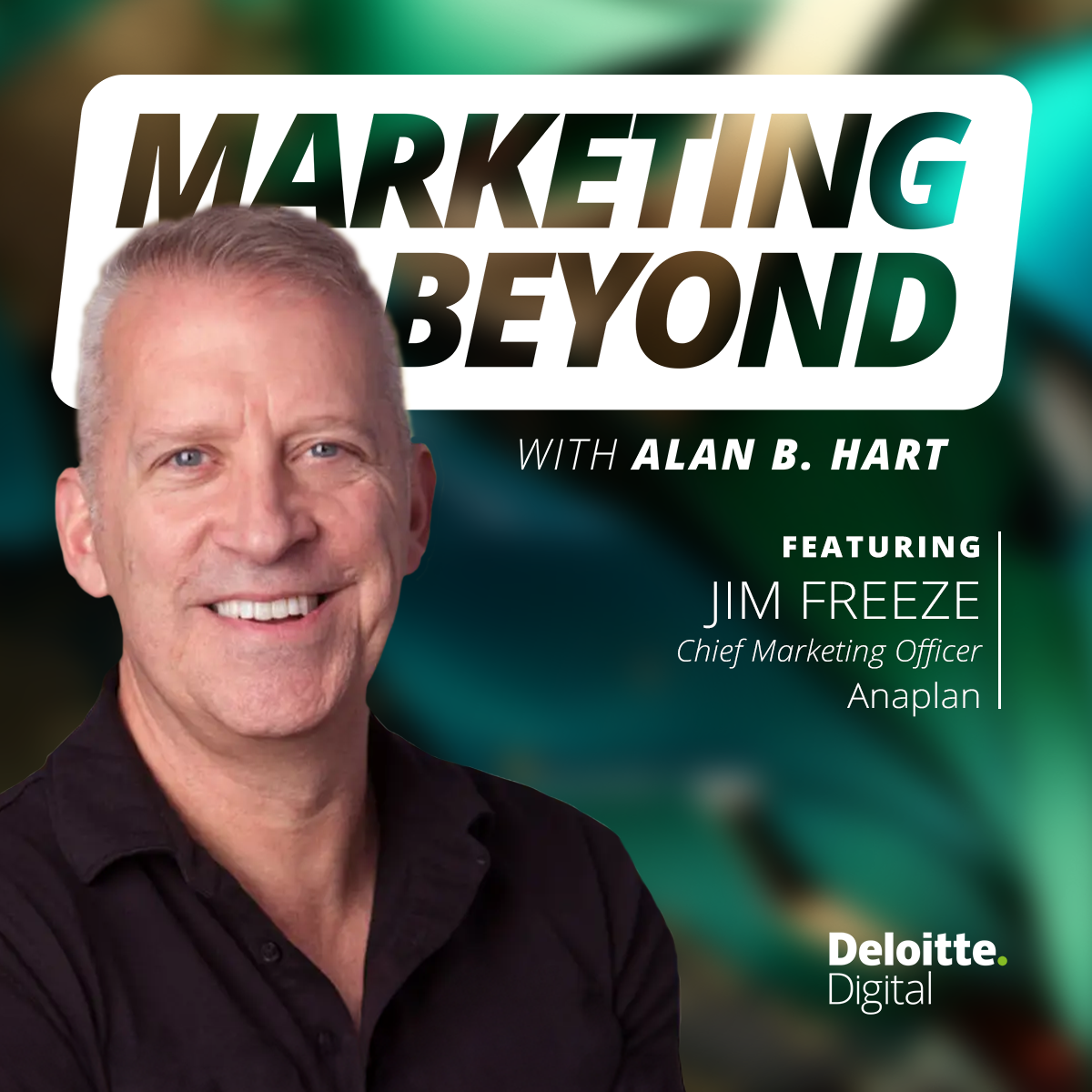
Marketing Beyond with Alan B. Hart
32: Strategies to link marketing to revenue: Insights from Anaplan CMO Jim Freeze
00:39:14
Loading summary
Transcript59 lines
- [00:01]
A
Today on the show, I've got Jim Freeze. He's the Chief Marketing Officer at Anaplan. Anaplan is a scenario planning and analysis platform designed to optimize decision making in today's complex business environment. Before joining Anaplan, Jim spent more than 25 years in revenue focused executive leadership roles for SaaS, AI security and telecom companies. On the show today, we talk about AI's impact in marketing and at Anaplan, how that's driving productivity and his forward planning decisions around hiring versus using AI. We talk about elevating the role of marketers as we use more and more AI. And what does that look like? How to build measurement that organizations will buy into and holds marketing accountable and why transparency, baselines and benchmarks are all critical in this measurement journey. That and much more with Jim Friese. Are you ready to go beyond the basics of marketing?
- [01:03]
B
I'm Alan Hart and this is Marketing beyond, where I chat with the world's leading chief marketing officers and business innovators to share ideas that spark change and inspire you to challenge the status quo. Join us as we explore the future of marketing and its endless potential.
- [01:23]
A
Foreign. Welcome to the show.
- [01:29]
C
Thank you. Thrilled to be here. Thank you for inviting me.
- [01:32]
A
Of course I am. I'm excited to get talking about all things Anna Plan and much more. But before we go there, in our prior conversation you mentioned you're a math major. You might be my first math major I've had on the show and I'm pretty sure you're only the second lawyer, which may surprise people. I have had a lawyer on before. Tell me more about like your undergrad like and the passion if you will, around math in particular.
- [01:59]
C
Yeah. Enigma wrapped in a riddle, huh? So it's interesting because I, my background and I actually think it makes perfect sense. I think it all works together quite well. But since I was young I was always very interested in numbers. I think numbers tell a story, they give you insight. And I was really good at math when I was, when I was younger. My dad was an engineer and so I, I, I guess I took after him and for me I love, I love logic and I, I tend to like kind of engaging in, in I don't want to say arguments but discussions where, you know, I try to build a case with logic and I, I think that works really well for not just algebraic equations but for written prose and, and for candidly for marketing where you're trying to, to, to build kind of a chain of logic together that, that tells a story and, and logically flows together because one thing leads to another. So in my mind it made a ton of sense. And so I, I ended up getting an undergraduate and graduate degree in mathematics from the Ohio State University. Big Buckeye fan. And then went on to law school in Columbus as well. And part of the reason I went to law school was I wasn't quite satisfied with my formal education and I thought about doing an mba, but. Well, I'm kind of learning a lot of what an MBA does on the job so I wanted to differentiate myself and I'd always had an interest in the law. So I ended up going to law school and I ended up loving it. I thought it was. It took me about a semester to figure out how the process worked. But I remember being advised by one of my professors that I would struggle in law because I had a math background. And to this day I still don't understand that concept. I actually think being able to think logically is incredibly helpful to being a lawyer. So did well in law school. Love that. And all of that has translated into me being kind of a, a very metrics driven cmo. I think data tells a story and I'm very interested in finding the right data that helps support the story I want to tell.
- [04:18]
A
Yeah, I love that. I mean from the early education to where you are now CMO at Anaplan, Where'd you get your business start and kind of what were some of the stops along the way?
- [04:31]
C
Yeah, so I, it was interesting. I originally started as a programmer right out of graduate school. So I'd finished my master's degree in mathematics and I'd done a reasonable amount of computer science as well in getting my master's degree and ended up as a programmer working for a company called CompuServe. Some people may remember that. And so the first nine to 12 months of my career I was writing in C on PCs that were serving as front end UXs to back end data on mainframe computers. And so it was a, it was a fun experience. I really enjoyed it. But ended up making a pivot to marketing for kind of a. As a result of a. What I thought was an interesting story. I don't know if you'll find it interesting, but I'll tell it. I was, was programming and we had a. On a product that was used by the largest banks in. On Wall street investment banks. And there was one of those banks that was coming in to, to visit in Columbus or Copy Surfers headquartered in Columbus and they were coming in hot. They were very angry about some things in the product and they wanted some changes and they wanted to talk to somebody on the development side. And I'd been with company about nine, 10 months. I was low man on the totem pole. And they said, Jim, you get to, you get to handle this. And it was, it was, I forget which investment bank was. But they came in and hot and over the course of an hour meeting, they asked a bunch of questions and, and I answered things and promised follow up. And for whatever the reason, I seem to have handled that situation very well. So much so that our VP of sales who was in the room went to my boss probably the next week and said, Jim did a great job. He's wasting his time in as a programmer. Get him into marketing now. And that was kind of how my marketing career was born.
- [06:32]
A
That's, that's funny. It's funny. I mean, I'm envisioning, I mean I'm envisioning like one of those lineups, you know, and it's like, who's going to take this call? And everyone takes a step back because they've been there a little bit longer and you're the lone man, you know, not sticking the step back. And they're like, you, Jim, you are the one that's going to take this call.
- [06:52]
C
And I was, I was naive enough to think, oh, no problem, this will be fun. I wouldn't characterize it as fun, but I learned a lot.
- [07:00]
A
So, yeah, I mean, those are formidable experiences though. They, they, they, they crystallize, you know, what you know about business and how it operates so well.
- [07:10]
C
And it also, yeah, and it also is, you never know what kind of a challenge is going to translate it just to just tremendous opportunity for you. And I mean, I've made a career based on what happened in that meeting. So. And you know, and, and I have to say that having a, a math background and candidly the legal background, it's really helped my career in marketing. I mean, you know, I'm a B2B marketing guy and in technology and being able to take, understand technology and understand complexity and products and being able to simplify that from a messaging and a storytelling perspective is fun. It's really hard. It's challenging. But that's part of what I like about it.
- [07:53]
A
Well, tell me about the scope of Anaplan. What kind of solutions does business build, size of business, you know, and kind of the state, if you will.
- [08:02]
C
Yeah, so Anaplan used to be a public company. It was taken private about three years ago by Thoma Bravo, which is the largest software, PE firm, private equity firm, I think on the planet. And the company, the best way to think about it is we're, we're in the planning space. Let me explain what I mean by that. Every company does planning. They do planning at the functional level and at the company level. And the reality today is the way most companies do planning is on a, maybe a quarterly or a semiannual or an annual basis using spreadsheets. And that is a, it's a very archaic and it's a very fundamentally broken process because it leads to all kinds of challenges and disconnects within companies. Things like one department having a different set of data than another department that they're planning on having one department, marketing and sales, potentially planning for the following year and having assumptions that don't match with what finance has as assumptions for the business. Very common issue. And it creates all kinds of disconnects and inefficiencies and quite frankly, bad decisions. Enter Anaplan. And Anaplan has a cloud based platform that helps address that issue. We call it a scenario planning and analysis platform. And essentially part of what makes us different is the persistence of real time unified data. You know, a unified data model that cuts across silos within the company. So everybody's working from the same source of truth. And in essence what we do is number one, we help companies activate one of their most valuable assets, which is all of their corporate data. Could be sitting in an ERP system, could be sitting in a CRM or an HCM system. We take all of that, or third party data for that matter. We allow them to activate all of that history and all of that data and turn it into something that's a forward looking predictor of the future. Allows them to take a step back and ask what if? And scenario plan. Second thing we do is we connect those siloed functions within the company. Since there's this persistent real time unified data model, companies are able to operate from that data model and connect all of their scenario plans across functions and make real time decisions as a result. Because the reality is changes are happening all the time and companies need to pivot. Planning can't be a, a quarterly or an annual process, it's a real time process. Third thing we do is we help companies accelerate time to value by having built and continuing to build out of the box best practice based applications that are based on common use cases of the Anaplan platform. Having deployed well over 2 million models that customers operate today in our infrastructure, we've seen the same FP and a use case 10,000 times. So we've been able to build applications that take what used to be perhaps a 9 to 12 month deployment that was PS heavy to 9 to 12 weeks, which is PS Lite. And then finally we have a very comprehensive artificial intelligence portfolio, predictive and prescriptive AI, generative AI and agentic that really allows companies to take advantage of the ability to not only forecast the conversational and request insights and then create workflows via what we can do from an agentic perspective. And we have some, some cutting edge agent technology that is really delivering tremendous productivity to, to our customers. Just some metrics on the business were when the company was taken private. We're about 600 million in revenue where three years ago we'll, we're well north of a billion dollars. Very profitable. Nearly half of the Fortune 50 are our customers. 2,500 customers and good growth.
- [12:03]
A
Wow.
- [12:03]
C
And headquartered in Miami.
- [12:07]
A
A great place to be.
- [12:08]
C
It is, It's a fantastic place to be.
- [12:10]
A
Yeah. Well, you mentioned AI and I mean it almost wouldn't be a marketing podcast if we didn't talk about AI and its application to marketing. So what are you seeing as a cmo? How are you thinking about AI? You've got AI embedded in your products that you're selling to the market. So how are you making use of it yourself?
- [12:30]
C
Yeah, it's a great question and I'll tell you. Our CEO tells this story and it's true. He says he doesn't talk to a CEO or an enterprise leader that isn't thinking about how they can better take advantage of AI for productivity. And we as a company are taking it very seriously. So we've got some tools in house right now that we're testing over the course of the second half of this year where we are. And I'll talk specifically about what we're doing in marketing where we have targets that we're setting for ourselves next year in terms of productivity gains we believe we can get from the use of AI internally. And so part of the edict for the company, and this is pretty consistent with a lot of companies is on a going forward basis improving productivity. And every time we want to hire somebody new, we have to ask ourselves, can we do that job or at least portions of that job with AI. So we're very serious about using AI to make us much more efficient. And one of the most obvious areas for us is in, and I'll give you some examples of how we're using it is in the content area. So we have lots of content we produce in the marketing organization, from website to, to presentations to white papers, you name it, all of the traditional B2B marketing content. There's simply no reason that we can't use AI to help transcreate that content into Japanese, into German and into French. And we're, we're doing all of that right now. And we're in the process of. A lot of what we do in terms of transcreation is done through AI. I wouldn't say that it's 100% accurate, but if you can get 80% of the way there, it saves a lot of time and it is most definitely delivering productivity to us. We're also looking at repurposing existing content. We run a bunch of events where we have customers come in and speak. And so we've recently been playing with taking transcripts and we record all those sessions, taking transcripts from those sessions and using that as an input into an AI engine to write blogs based on that presentation. So we're pretty serious about using AI on the content side to really help us improve productivity. And once again, as we're doing our planning for next year, we're taking a step back and asking can we do this job with AI? And it doesn't mean we won't be hiring. We will, but we're really focused on trying to get substantial value and productivity out of AI. So I think every marketer has to think this way. I don't know how you avoid it. And rather than avoiding it, I think marketers need to embrace AI because it has potential to be very transformative for marketing organizations in particular.
- [15:38]
A
I agree with you on the productivity side. And as you think about productivity and the trade offs you're making between hiring versus what can be done by AI or AI agents, where do you see the role of the marketer? What does the marketer role evolve into in those constructs?
- [15:57]
C
Yeah, it's a great question. And this isn't to say that AI is going to eliminate the roles. It's not, it's not going to eliminate roles. But I think with, it's the same as with, I think a lot of technology over quite frankly the last, you know, hundred years, it's, it's changed, it's not only improved productivity, but it's changed what people do. And, and it often takes more mundane tasks and volume, the tasks that, that you want to do in volume and makes those much more efficient to free up time on other things, to be much more strategic and to, to, to spend more time on Impactful marketing efforts that might be thinking about and applying the right marketing mix. Understanding and spending more time on metrics that lead to better decisions, things that help with the correct positioning, more focus on creativity. So I think all of those higher value kinds of more strategic marketing capabilities are enabled by leveraging technology, AI in particular, to deal with the volume of work that needs to happen and things that might be more mundane, albeit very important, but more mundane AI can handle that. So I think it elevates the role of the marketer to be much more strategic as opposed to being just tactical.
- [17:32]
A
Yeah, it, it, I, I tend to agree with you as well. I mean, the, the notion of taking the mundane out of the equation so that I can, you know, free myself to think above that mundane task, to think, well, is this the right next step? Is this the right, like, we've always looked at it this way. Should we look at it a different way? Because, you know, those are the human, if you will, overrides that. We're still going to need. It sounds like.
- [18:01]
C
Yeah. And, you know, if you just think about, I'm just the example I gave of taking the transcript from a, you know, from a session we did. Turning that into a blog could be really interesting, but that could be very time consuming for a human to do that. So to the extent that we can leverage AI to produce that and then take the kind of the cycles that that human would have and apply it to more impactful kinds of efforts, it makes a ton of sense.
- [18:32]
A
Yeah. Oh, definitely. All right, well, I'm going to scratch the math guy itch now. So I know you got a passion for math. You've got, you've probably got a passion for metrics. How do you, how do you translate how you demonstrate return on marketing?
- [18:47]
C
Yeah, you know, I, I don't know a marketing executive in the world who doesn't wrestle with this. Right. We, we kind of have a bad rap, don't we, as the folks who just want to spend a lot of money on advertising and, and you know, look, I, over my career, I've run into many CFOs and CEOs who, that is their perspective. And the reason they have that perspective is because, you know, I don't think marketing executives have done a great job of, of demonstrating value through the kinds of things that executives like CFOs and CEO CEOs really care about, which is draw a direct connection between this spend and how it impacts the bottom line of the business, how it helps us drive more pipeline, how it helps us improve Our win rate, you know, the ability to do that, I think is really critically important. So I think being highly disciplined and having a very algorithmic approach to it is something that I think CEOs, just based on experience, CEOs and CFOs very much relate to. And, you know, I think I, I'm. I know from experience that in order for a marketing team to kind of gain credibility, they have to establish clear, measurable, and impactful targets. And it has to be the right targets. It can't be just like, well, we generated all these MQLs at a trade show. Who cares if you can't link that directly to how it translates into Pipeline that kind of works its way through and ultimately you win and being able to directly attach it to the money that was spent on that particular show. And so there has to be demonstrable value. And I'll give you a great example of an area where we spend a fair amount of money as a marketing organization. But I think in the past, we weren't really able to do it. We didn't do a good job of saying why this was a valuable spending. And so it relates to kind of my. I've been with Anaplan almost two years now. When I first started, we run a bunch of events called Connect Events, and they're essentially, they're customer events. We have some prospects who come, but 70% of the attendees are customers. And customers come and they tell their story about how they're using Anaplan. And we also have, you know, keynotes, and we do them around the country. So we do big ones in New York, we do a big one in San Francisco, London, Tokyo, Paris, and, you know, there. Everybody in the company believes that they're impactful events or CEO. When I started saying we all believe that they're kind of impactful, we spend a lot of money on this. Is there a way for us to determine and track and say this is. This is the impact it's having on, on the business? So we took that on as a marketing organization as a way to kind of establish our credibility. And so what we did was using our own product, using Anaplan, we set up some pretty sophisticated dashboards and tracking capability to understand the impact these events were having. And so what we looked at, we certainly looked at how much new Pipeline was being created as a result of these events. But what we found was more important, since it was existing customers, was we want to be able to influence and accelerate Pipeline. So we looked at all of our customers and those who attended who had pipeline that already was in existence and those who didn't. And we did comparisons. If customers who had pipelined who attended the event, what was the velocity of the pipeline? Did it accelerate? And did our win rate improve versus those customers where there was pipeline but they didn't attend the events? And lo and behold, what we found was the velocity for customers who attended the event improved by 50%. So just really dramatically accelerated and our win rate improved by 4 percentage points. And for the size of business we are, that's absolutely huge. And so we now, as a result of being able to demonstrate the value, have expanded what we're doing around these events and increased the budget because we can, we can directly tie the events to acceleration. Deals come in faster and we win more as a result of it. And the data was there. We just hadn't pulled it together in a way that told a story.
- [23:18]
A
Right. I. I really like that example. I mean, one of the things as I listen to you talk about your approach to measurement and, you know, setting targets, et cetera, is this notion of transparency. And you highlighted, you know, this is not new for the finance organization. Right. They have pro formas, they lay out their estimates and their assumptions. And for whatever reason, I always find marketers, ha. Like, are really hesitant to put your assumptions on page. But that transparency builds trust, right? How do you think about transparency?
- [23:51]
C
No, I couldn't agree more. So when I first started, when we put our plan in place, we put out targets. And I had to be honest, I didn't know if they were the right targets or not. But I wanted to put something out there. And there was an expectation that we were going to deliver a certain amount of pipeline. And so we obviously took that on and we built a model to show how we were going to do it. And then we track that model. We provided kind of dashboards that anybody could see. And we reported out quarterly on that. And we do that now. We have a quarterly reporting cadence where we report out on a bunch of metrics that we have defined as being really important and impactful to the business. And we've gotten most of them right. Some of them we haven't gotten right. And we've admitted when we've gotten the wrong metrics and we've done some tweaking. But I think the thing that was important was we wanted to establish credibility and that we were holding ourselves accountable to hit certain targets that we believe were ones that directly tied to the objectives of the company. And where we felt that we had gotten a metric Wrong. In other words, the target was incorrect, or as it turns out, maybe it wasn't that impactful. We admitted that and we made some changes then midstream to try to get to metrics that we felt were more impactful for the business. So as an example for first year, we're in the process of rolling to account based marketing and we, we defined some ABM metrics we felt were important and we didn't get them all right. And so we talked about that, we talked about why we didn't get them right and we made adjustments for this year to make sure that they were right. And I think through that process we really did gain a lot of credibility because we were holding ourselves accountable. We were reporting on it and we were saying, hey, we did well here, we didn't do well here. And we also linked it to the performance of the company because I'm sure that marketers out there will relate to the circumstance where all the marketing metrics are great, we're knocking that out of the park, but sales is missing their targets. There's a disconnect there. Marketing can't be knocking it out of the park and sales missing its numbers. There needs to be a very tight alignment. So, you know, our compensation in part is tied to the success of our sales team because if we're not enabling the sales team to hit its numbers, then there's something wrong with what we're doing. It's not always, it's never, oh, sales just isn't doing it. It's never. There's accountability across functions. So we, we just try to be very transparent about that. And we also, I think, are really honest in terms of not only sharing the good news, but the bad news. And you know, people can deal with the truth if you can tell that if you tell them what it is, even if it's not good news.
- [26:47]
A
Right, right. No, that's very important lesson. Curious. You got started on this measurement journey very early in your days at Anaplan. As you think about other CMOs that might be listening to this conversation, any advice you have and helping them think about how to start or align their measurement framework now.
- [27:08]
C
Yes, I think, I think about two things. I think about baselines and benchmarks. Baseline. I'll give you an example of something that was important based on what our CEO asked me to do. He said we really need to elevate our brand awareness and the image of the brand. And in order to, for us as a marketing organization to execute on that, we needed to be honest about where we were, and we needed to have a baseline that we could measure our improvements off of. So we went out and did a brand equity study where we looked at brand awareness versus aided and unaided of ANAPLAN and probably about 15 different competitors. And we also tested some messaging and some other things. But it was really important to set that baseline because there's no way that we could have said, okay, here's where we're going to take the company from an awareness perspective if we don't know where we're starting. So I think baselining where you are is really important. And then the other thing I think is really important, it's proved useful to me over my career is benchmarks. It's often, you know, when you go in and you submit a marketing budget for a year, I don't think it's reasonable to assume that the cfo, the CEO, the board, your colleagues can understand if the amount is correct that you're asking for. And one of the things that is, I think, enormously helpful to that is benchmarks, because it could look like you're asking for a lot, and maybe you are, but the reality is when you look at what you're asking for as a percent of spend of revenue or a percent of spend of net new bookings, or how you're looking to allocate that OPEX spending by function, benchmarks are really useful way to say, here's how we stand up against, you know, kind of industry benchmarks for companies in our industry of a similar size. And those benchmarks do exist because it really does help frame the amount that you're asking for. So I think if you're just getting started, baselines and benchmarks really matter.
- [29:24]
A
Yeah, no, I agree. That's great advice.
- [29:27]
C
And then the other thing I would add too, is just managing expectations, you know, not over promising and being realistic about what you can accomplish when you first start. And, you know, when I started at Anaplan, I told our CEO, we're going to put these metrics in place. And I said, I guarantee you some of them are going to be wrong, but we're going to do it and we'll pivot. And he was okay with that. He said, that's fine. So managing expectations really matters as well.
- [29:56]
A
I love it. Well, one of the things we like to do on the show is get to know you even a little bit better than we already know you today. Jim, has there been an experience of your past that defines or makes up who you are today?
- [30:12]
C
Yeah, a couple things, I think. One, I've already kind of talked about, which is the experience I had as a programmer that kind of completely pivoted my career. And I'll give you another one that happened when, when I was a. A lawyer. And so I actually practiced law for a couple years. And I remember one of the last cases I worked on that just really made me decide I wanted to go back to marketing. And it was a. It was a case where I worked for a large law firm and we were representing a large company that was being sued, and we were being very effective at slowing down progress and making things move at a glacial pace. And it had an effect on me because we were doing a good job for our client. But I was like, man, I just, is this what I want to do? Is this. I want. Do I want to spend my time just preventing progress or do I really want to advance things? So it had a huge impact on me. And, and literally as a result of the work on that, that case, I decided, I just. I don't want to do this. I want to get back to. I want to get back to marketing and technology. And. And it probably was within about two months of that decision that I was back in. In marketing at a tech company.
- [31:36]
A
That's a great example. I think, I think most marketers, I don't know what it is about the function and the people that we attract to this, to this, to this area, but would probably drive themselves crazy with that, you know, with that analogy of trying to slow things down for the benefit of something else.
- [31:52]
C
Yeah, no, I think a lot of marketers have a sense of urgency and, and want to accomplish things. And so it was. Just didn't work for me. So. But, you know, that's. It's great because I learned that early, early in my, my practice of law. And it, it's great. It's. I'm glad I didn't spend a career doing that.
- [32:13]
A
Yeah, Well, I, I'm sure your law degree has proved very fruitful in other areas in marketing.
- [32:18]
C
Oh, it has. It's been. It's been incredibly valuable to me. Yeah.
- [32:22]
A
Well, what advice would you give, you know, that younger Jim, if you were being able to look back and advise him on where, where he goes forward from his early days?
- [32:33]
C
Youth is wasted on the young, isn't it?
- [32:35]
A
So, yes.
- [32:38]
C
So it's, I think, similar advice, but that I think a lot of folks would give, which is, I'm a kind of a very thoughtful and cautious person by nature, and I think through things, and that's probably led me to avoid Some risks I probably should have taken. So, you know, don't be afraid to take more risks. I would say if I was giving advice to my younger self.
- [33:04]
A
Love it. I love it. Well, are there any topics either you are trying to learn more about yourself or you think marketers need to be learning more about right now?
- [33:12]
C
Yeah, you know, AI is the obvious answer, but I'm not going to say that. I'm going to say finance. I'm often surprised by how little many marketers know about finance and how marketing investments are expensed. And once again, I'll relate it to an example at Anaplan. When I started in the previous fiscal year, the company had purchased this program and hadn't executed on it, but it was still available to us. We had another year to, to to execute on this program. So it was essentially, you know, an asset on the balance sheet and we were going to go ahead and execute on it. But we had a target to hit from a budget perspective for, for the quarter we wanted to execute and executing use using this prepaid expense wasn't going to cost us anything from a cash perspective. So there was a request saying, hey, can, can we. It's not going to cost us. It's already been paid for. And I'm like, well, it's already been paid for, but we will miss our expense target because the expense for this is going to be in the quarter. And so I'm just continually, over the course of my career, amazed by how many marketers I don't think have a good understanding of finance. And they should. And so I would say finance.
- [34:30]
A
No, I, I double down on that with you. I agree. And as you're talking about that, I was like, oh, no, don't do that because it's going to flow through the income statement.
- [34:39]
C
Exactly, exactly, exactly, exactly.
- [34:41]
A
Yeah, yeah. So awesome. Well, stepping back, like, are there any. This is kind of an odd phrased question, but what I'm looking for is like what you're curious about. Are there any trends or subcultures, anything you kind of like take notice of out in the world today?
- [34:56]
C
Yeah, the, the world of, of search, traditional, traditional SEO, it's changing and changing fast from, from traditional keyword search to AI search. And it has a huge impact on how content's being written, how you design your website. Optimization is a different animal. And I think within two, three years max, the majority of search is going to be AI search. And all the good work that you might have done around SEO and backlinks isn't going to be particularly Relevant. So the world is changing and I think if, if there's a trend I'd focus on for as a marketer, I'd focus on AI search and understanding it better.
- [35:39]
A
Yeah, well said. Well, last question for you. What do you think is the largest opportunity or threat right now facing marketers?
- [35:46]
C
Well, I think that one's easy and that's AI. And I think whether it's an opportunity or a threat is based on how you approach it and, and whether you choose to embrace it and understand it and leverage it. You know, I think AI can be our friend and can really make us more productive and a better, better marketers. But I think there are those out there who will resist it. Like is always the case with technology and in those cases I think it ends up being a big threat. So I would say embrace AI, try to figure out how to get the most out of it and apply the right AI to the right situation. But I think it's most definitely AI.
- [36:32]
A
I heard somebody recently describe it as before it was an older person like myself, but before Office existed, right before our productivity suite of slide creation tools. Whatever your slide creation tool is of choice, AI is essentially another tool, right? We've got to figure out how to embrace it, leverage it. But at some point in the future we will all just be expected that we know how to use it. So what better time to start than now, I guess?
- [37:06]
C
Yeah. The analogy I would give is when the World Wide Web came about and I think a lot of companies didn't really take it seriously and I remember that there were, there were folks who out and registered all these company names and didn't just kind of ignored it and all of a sudden it was like, oh my goodness, we got to do something about this. And it's the way people get information now. It very quickly transformed how companies interact with the public in general. So there are a thousand examples like that and AI know AI has been around for, for a long time, but it's, it's time. Is, is now.
- [37:46]
A
Yeah. Awesome. Well, Jim, thank you so much for coming on the show today. Appreciate it.
- [37:51]
C
Thank you very much. I really enjoyed the conversation.
- [37:59]
B
Hi, it's Alan again. Marketing beyond is a Deloitte digital podcast. It's created and hosted by me, Alan Hart, and produced by by Sam Robertson. We have even more cutting edge marketing insights headed your way. Be sure to subscribe to our channel to stay up to date with our latest episodes. I love hearing from listeners share your thoughts about the episode, the topic covered or the show by commenting on this video or emailing me at marketingbeyondeloitte.com if you're interested in more conversations with industry visionaries, we invite you to explore our other Deloitte Digital podcasts@deloittigital.com US Podcast. There you'll find the Marketing beyond webpage.
- [38:42]
A
With complete show notes and links to.
- [38:44]
B
What we discussed in the episode today. I'm Alan Hart, and this is Marketing Beyond. The views, thoughts and opinions expressed are the speaker's own and do not represent.
- [39:01]
A
The views, thoughts, and opinions of Deloitte.
- [39:03]
B
The material and information presented here is for general information purposes only and does not imply endorsement or opposition to any specific company, product, or service.