← Marketing Beyond with Alan B. Hart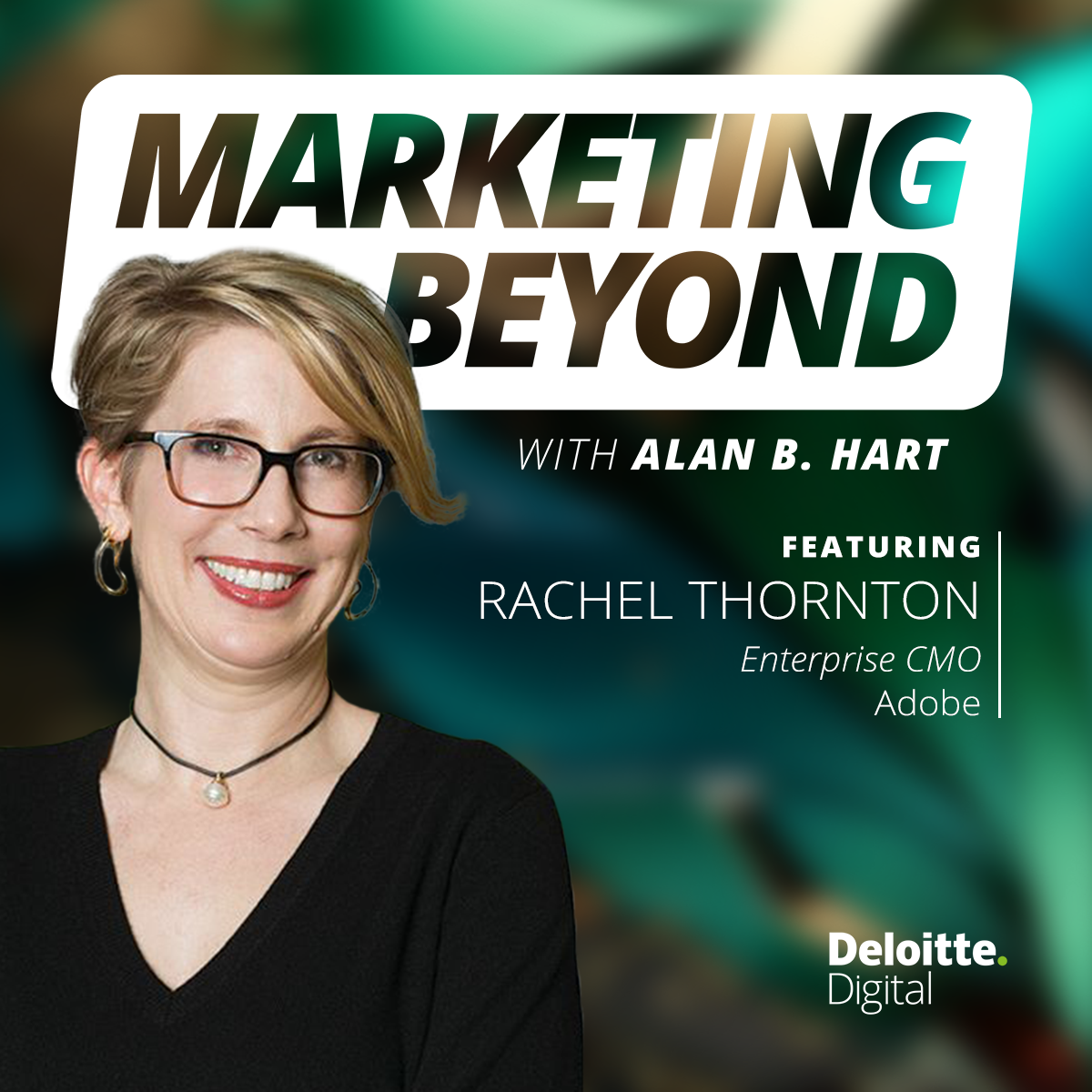
Marketing Beyond with Alan B. Hart
33: Rethink customer experience orchestration with AI: Insights from Adobe Enterprise CMO Rachel Thornton
00:20:57
Loading summary
Transcript55 lines
- [00:00]
A
Well, welcome back. Today on the show, we have Rachel Thornton. She's the Chief Marketing Officer for Adobe's enterprise business, and she's been driving strategy messaging campaigns that position Adobe as a marketing and AI platform for creating customer experiences. And so on the show today, we're going to talk about customer experience, orchestration, content, supply chain, and her own experience working with these types of solutions and capabilities. Are you ready to go beyond the basics of marketing? I'm Alan Hart, and this is Marketing beyond, where I chat with the world's leading chief marketing officers and business innovators to share ideas that spark change and inspire you to challenge the status quo. Join us as we explore the future of marketing and its endless potential. Well, Rachel, welcome to the show.
- [00:55]
B
Thank you. Thank you for having me.
- [00:57]
A
Yeah. Well, it's great to be here. And one of the things I learned about you in my research is that you are a voracious reader. I have two questions. What are you reading right now? And why is reading so important to you?
- [01:11]
B
Well, I just finished Abraham Vergesi's Covenant of Water, which is really good. Really, really good. I highly recommend it. I just, I love reading. I read lots of things, fiction, nonfiction. I just think it's a great way not only to learn, but kind of put yourself in the shoes of others, which is always great. I think it gives you a much better, much wider perspective.
- [01:31]
A
That's awesome. That's awesome. Well, and as a marketer, putting yourself that empathy of putting yourself in somebody else's perspective is an important skill to hone. Right. Well, you are the enterprise CMO for Adobe.
- [01:43]
B
Yes.
- [01:44]
A
Where do you get your start in your career? What were some of the stops along the way?
- [01:48]
B
I very first started actually at Microsoft. I was a field marketing manager. And I really love that job. And just over the years, I've always tended to gravitate towards enterprise tech. So I've been in places like Salesforce, Cisco, most recently at aws. But I just love that. I love the industry. I love the pace, I love the innovation. What I really love is working with customers, understanding what they need, and then helping them achieve their goals as it relates to their business.
- [02:15]
A
Gotcha. Gotcha. So a lot of technology companies over the course, what is it about technology that got you excited?
- [02:22]
B
I just. I love the pace of it.
- [02:25]
A
Okay.
- [02:26]
B
I love being able to work with customers and drive innovation. Working with product teams, but also working with customer teams. Teams. It's just. It's really fascinating to see this stuff come to life, you know, to sit with customers and hear what they want to do, but then have product managers, product engineers, say, we completely build that and it'll be a total game changer.
- [02:46]
A
Yeah.
- [02:46]
B
So that's what I love.
- [02:47]
A
Awesome. Well, so you are the enterprise cmo. Tell me about that role. Like, what's the scope of it?
- [02:52]
B
So, you know, as you can imagine, Adobe is an amazing company. It's an iconic brand. They're known for things, whether it's Creative Cloud, Photoshop, Illustrator, all of these amazing creative tools, but also great marketing tools. So if we think about, you know, email marketing with Adobe Marketo, Adobe Experience platform, Adobe Experience Manager, all of these great marketing products that really help you build, as a marketer, campaigns, experiences for customers. But it's really working with, you know, Fortune 100, Fortune 500, all of these really big global enterprises who I think have really unique needs, especially when you're talking about how do they think about their different customer sets, how do they build campaigns for different customers, different audience segments, and then how do they scale them? How do they take them globally?
- [03:41]
A
Yeah. Adobe in general has been in the software business for, since its creation, and you've been on this journey with customer experience, orchestration software at the enterprise level for many years as well. How is it the introduction of AI changing what you do?
- [03:59]
B
Being able to embed AI into our products has just allowed marketers to be more agile, to move faster, but also meet the demands of customers. I think lots of people talk about personalization, but what that really requires is understanding who your audience is and ideally who the individual is, like yourself, and then figuring out what's the experience you want to build for that customer and including what's the content, what are the offers, what are the campaigns. But that requires, if you get it right, a lot of content. And that need for content only continues to grow. So as we talk to CMOs and we've done some research, it's like a 5x increase in the need for content if you really want to build highly personalized journeys and experiences. And I think what AI does is allow you to do that and do that at scale. Right. So we have a product, Adobe Gen Studio, and what we're, what it helps marketers do is not only ideate and develop campaigns, create the work process, but then scale the production of those campaigns. Right. So, for example, if you think about a company that wants to build a holiday campaign, you're talking about thousands and thousands, potentially tens of thousands of assets. For example, we had 55,000 different assets for our Black Friday campaign, our Cyber Monday campaigns. Now if you go back even just a couple of years ago, building all of those would have taken weeks and weeks and months and months. And it limits your ability as a marketer to really build customized campaigns, personalized campaigns. Because like, how do you build all that? How do you produce all those? But with AI, you can absolutely do that. You can do that quickly, you can scale it, you can take multiple images, multiple messages and build them out quickly. Build out 55,000 assets instead of in months, in days, and then test them and then really personalize them to the audience, depending on what the customer responds best to.
- [05:53]
A
No, that's awesome. I want to double click a little bit on this content in particular. So one of those big boulders, if you will, under orchestration of experience is content supply chain. And an intelligent one at that, like you were describing. You think about companies that get that right. Like what does it look like when it comes together?
- [06:13]
B
When it comes together, I think the individual feels like this company, this brand understands me, understands my wants, knows how to reach me, knows when to reach me and with what offers or what experiences. We have a lot of great content supply chain gem studio customers. Earlier this week I was on a panel with a customer of ours, NFL. We're actually partners with them. We're their official creativity partner, our official customer experience and fan experience partner. And that's really exciting because you can imagine for a sports fan, especially now, you're an NFL fan, but you're a team fan, you're also a player fan. Right. So how does the NFL think about engaging all of their customers? Many of them will come to games, but many more of them will not. So it's like on the app, on social, on CTV if they're in stadium, but just building that surround experience with Adobe to provide this amazing customer experience and then all the content that goes along with it. I think that's a good example. It's, you know, when you get it right, the fan really feels engaged.
- [07:17]
A
Yeah, that's a really great example. And as you like, think about that, the back end, if you will. Right. Like the data that you have to have in place, obviously the technology stack that you're using to deploy these content and these experiences and pieces, if you will, or generate them as well. And then you've got the, the process, like this is a process re engineering of how you think this as a marketing organization as well.
- [07:42]
B
Absolutely. I think is to be successful with AI marketers, CMOs, they have to think about it not as like a bolt on. It's how they take A step back and look at do they have the right data foundation, do they have the right data architectures? Building those and then making sure that they're looking at their teams, they're looking at their processes, and then they're looking at the work streams and the technology that bring it to life. I think you have to look at those together in order to make sure you're really maximizing your investment. I'm sure it's something that Deloitte knows really well.
- [08:13]
A
Yes. I have clients going through this right now. Stepping back, I think is key.
- [08:18]
B
Yes, exactly.
- [08:19]
A
Because the way you do things has to change in some ways. The culture has to shift a little bit as well to adapt to what's possible at this point.
- [08:30]
B
And I think that's interesting and really exciting for CMOs and for marketing teams. But you really want to make sure that you're helping your teams. Like, how do you embrace it? How do you experiment with it? How do you learn with it? I was at a dinner last night talking to the CMO of the ads team over at Microsoft, and we were both talking about how do you encourage people to try things, but more importantly, how do you make sure you're giving them the right content, the right training content, the right skilling content. We're super passionate about that at Adobe. So we have Digital Academy, we have our Experience League. But all of this is in service to helping customers learn, and especially with AI, learn new skills. Get out there, experiment, try it, and really work it into your daily sort of work streams and processes.
- [09:14]
A
Yeah, well, I want to shift a little bit. So, you know, obviously the advent of LLMs and AI and customer discovery and how they find information, learn things, there's a huge implication to marketing organizations and this notion of, like, how do I. How am I discoverable in this new world? I'm just curious as a marketer, like, how are you thinking about this too?
- [09:38]
B
I think that's the other interesting thing about AI is how it's disrupted some pretty traditional marketing work streams. So having been in marketing for years and years, you can say as a marketer, you're like, hey, I know the work streams that I need to make sure I'm mainly, you know, it was for a very long time, I have to make sure my SEO is right. Right. So I have a whole work stream and process around that. But as more and more customers shift to I'm searching for information, I'm using ChatGPT or I'm using Gemini. As a marketer, you really have to think, how do I Navigate that shift from SEO to what do you want to call it? Geo or aeo. Right, but how do you navigate that shift? And a big part of it is how do you think about discoverability in something like chatgpt or Perplexity? Like, what is the content they're looking at? How do you make sure that you surface? If it's content that you control, great. But increasingly it's content that maybe your customers are talking about, your community is talking about.
- [10:31]
A
Right. It's daunting to think about, but obviously with tools and technologies like you guys are bringing forward, it makes it a little easier. I don't think it's going away. And I'm guessing then the next build is going from users typing in the questions to then agents learning what they need to learn. You know, so you're almost, you're developing content for machines today for humans to discover. Then it's going to be developing content for machines for machines. So then surface answers.
- [10:59]
B
That's been a really big topic of discussion. I think this week is like, as you think about again, how am I discoverable? Where am I driving people? Are they coming to my website? But you also have to think about now, maybe previously you were building content and experiences for your customers, people for humans. But now increasingly it has to be not just human to human, but agent to agent. Right. And so you have to think, how am I showing up here in my brand for that experience for my human customers? But then also you have agents that you want to make sure, coming to your site or reading your site that the content you have designed for them is optimized for that, you know, for agents, so that you can make sure you are showing up well. So you just have to now think of it as like, what's my human to human, what's my agent to agent content that I'm building across all of my channels.
- [11:45]
A
Gotcha. Well, you are a cmo. I've watched you and talk about your own journey of adapting how you work and you're leading your teams to use the tools and technologies capabilities. Like, what lessons have you learned? Like As a sitting CMO, that makes this helpful for other CMOs.
- [12:05]
B
Definitely the start with your customer, work backwards. Always make sure that you are like, what do your customers use? What are they looking for? What are they optimizing for? What are they trying to solve for? So starting with the customer, working backwards, but also from your team perspective, how do you help them experiment more? How do you help them, you know, lean in on new technologies and adoption of new Technologies at Adobe. I feel so lucky because as a marketer we're using all of the Adobe products. So it's like we are customer zero, we call it Adobe on Adobe. But that's hugely powerful because then I can sit with CMOs and say, this is how we've built our content supply chain. This is how we've architected our data foundation to make sure we can maximize building the right customer experience. And I think all of those lessons are hugely powerful with customers. But I also think just being curious, fostering a culture of experimentation, I just think is really critical. So that's been huge in, like I said, any role and especially now with AI.
- [13:05]
A
Well, talk about being your own marketing ambassador. I mean it doesn't get much better than that. Curious, if you talked about the football league, are there any other examples that come to mind of, of clients or people out in the universe that are starting to adapt to this new world of marketing that you look at or you go, they're getting it right. Or there's something interesting that they're doing.
- [13:28]
B
Brands that are iconic brands that are really leaning into AI and figuring out how they can use it to move faster on content creation. Coca Cola is a good example. So we worked with them on something called Project Vision is an S. And using Creative Cloud, we built AI enabled brand guidelines so that their designers anywhere in the world could create content, could, you know, create images, assets, and they were going to be always on brand because they would be guided as they were creating it on. Yes, this is working. No, not this one. But it just helped them move faster. But it also helped them make sure across their global teams they got way more consistent, way more agile, way faster.
- [14:06]
A
I love that example. Well, awesome. Well, it's been great talking about the business, but I love to also get to know you a little bit better, know you read a lot. But my favorite question to ask everyone that comes on the show is, has there been an experience of your past that defines or makes up who you are today?
- [14:21]
B
I will say that what's been, I think a great sort of like teacher. And I mean it is like an experience or like a role that I've had. I've been lucky enough to work on some pretty big customer experiences. Like I was a Dreamforce chair for a while. I we reinvent like work Adobe at all of our summits, all of our events. I actually think that the way you learn about customers, meeting them face to face, engaging with them, hearing from them, I just feel like I've been really lucky to have that and just it is so powerful because like I said, when you understand what your customers need, you can do so much more for them. And that has been one area that I've really loved. Like, I love being here and meeting with customers. I think, you know, it's funny, despite all the talk about, like, what are the things that change in customer experience and campaigns, I think that people will still want to come together and meet face to face, as you can see by the success of the folks here this week.
- [15:15]
A
Yeah, no, that's very true. That's very true. One of the you made me think of like an early experience in my career was sales and just being that front line of talking to a customer. You know what the marketing says. But how is it being actually delivered and realized? And what are they? How do they talk about it? Right. To your point. And it gets back to just good marketing. Right. Like knowing your customer internally.
- [15:40]
B
When I think about my internal customers, like, obviously sales is huge, right? I absolutely. I our success to their success. If we're doing the right thing, if we're building the right programs, then my CRO is like happy his sales team is enabled. They're being successful with customers. So yeah, helping ensuring that sales is able to connect with customers is also super critical.
- [16:04]
A
Well, if you were looking back at young Rachel, what advice would you give young Rachel as as you now are more wise at this point in your career?
- [16:15]
B
I think a couple of things. Like, it's not linear. Sometimes people think they have to have a really linear path in terms of their career and I'm not a believer in that. Like, I think it's interesting to try different things. I am a huge believer in that. Like it may on the surface see, like, oh, would that be that job doesn't really fit with where I thought I was going. But I think if you lean into it and you try it, it's going to set you up later. I look at, I look fast at all the things I've done and I'm like, yeah, each one was a really good stepping stone to a learning stone, I should say, for what I'm doing now.
- [16:46]
A
I love it. I love it. Well, what are you trying to learn more about? Could be something related to business or not.
- [16:51]
B
Well, I would definitely say, you know, how, how folks are using AI, what are they really using it for? I think that continues to be interesting. It' I'm leaning in with customers on the pilots they're building. I think if I think about being here last year versus this year, the feeling is much more optimistic about AI, how it gets used, what people are using it for, how they're implementing it. And I just think leaning into that, learning more about that, what customers are doing, is really interesting.
- [17:18]
A
It's becoming real now.
- [17:19]
B
Exactly. It's like last year I felt like people were nervous and they didn't know how to, you know, what, how does it play out? And now much more, you know, talking to customers here. It's like they've done pilots, they scaled their pilots into production, and now they're like, you know, I see where this is going to be super useful. I have the, the experience with the pilots I've done, and I'm excited to move forward.
- [17:38]
A
Yeah, no, it's awesome. Most marketers are just curious people in general. Right. And so I'm curious what you're curious about in the world today, in addition.
- [17:46]
B
To all of the technology that's going on. It's actually been really cool here to see if you think about, like, there's consumer AI, there's business or enterprise AI. I think the physical AI has been interesting. The robots, I think it's interesting to read people talk about, is it useful, is it not useful? So I'm curious to see where that goes in the coming years.
- [18:04]
A
I had a prior guest on earlier this week from Medtronic, and that actually came up. And the physical robotic AI, or physical AI and the ability, if you think about caregiving. Right. And people that maybe live alone but need help or assistance, Game changer.
- [18:23]
B
I think that's what makes this industry so fascinating. It's just all this, all this innovation that's happening, especially now.
- [18:29]
A
Well, what do you see as a marketer, like, as either the largest opportunity or potential threat that we are about to face?
- [18:36]
B
I actually think the largest opportunity, and it's something that Adobe is very passionate about. We believe that everybody is a creator at heart. And it could be whether you're creating campaigns, when you're creating ads, but whether you're creating products or a business. Right. I think harnessing human creativity, that ingenuity, that is a huge opportunity for us. And I think AI empowers that, amplifies it. That's why I'm optimistic around it, obviously, as a marketer, but I just think that is really what's exciting over the next couple years.
- [19:06]
A
I agree with you. And I like to say that creativity is the one thing that can break our measurement of how our marketing is performing and break it in a good way. Well, last question. What CES trend will change people's behavior in 2026.
- [19:19]
B
The one thing I'm excited about with CES is seeing how AI gets embedded across so many different things, whether it's consumer behavior, whether it's enterprise behavior. But also has been really interesting this year with physical AI and just some of the announcements that have come out. I think that's really cool. It'll be interesting to see where that goes.
- [19:35]
A
Awesome. Well, thank you so much for coming on the show.
- [19:38]
B
This is.
- [19:44]
A
Hi, it's Alan again. Marketing beyond is a Deloitte Digital podcast. It's created and hosted by me, Alan Hart, and produced by Sam Robertson. We have even more cutting edge marketing insights headed your way. Be sure to subscribe to our channel to stay up to date with our latest episodes. I love hearing from listeners. Share your thoughts about the episode, the topic covered, or the show by commenting on this video or emailing me at the end. MarketingBeyondeLoitte.com if you're interested in more conversations with industry visionaries, we invite you to explore other Deloitte Digital podcasts@deloittigital.com US Podcast. There you'll find the Marketing beyond webpage with complete show notes and links to what we discussed in the episode today. I'm Alan Hart and this is Marketing Beyond. The views, thoughts and opinions expressed are the speakers own and do not represent the views, thoughts and opinions of Deloitte. The material and information presented here is for general information purposes only and does not imply endorsement or opposition to any specific company, product or service.