← Marketing Beyond with Alan B. Hart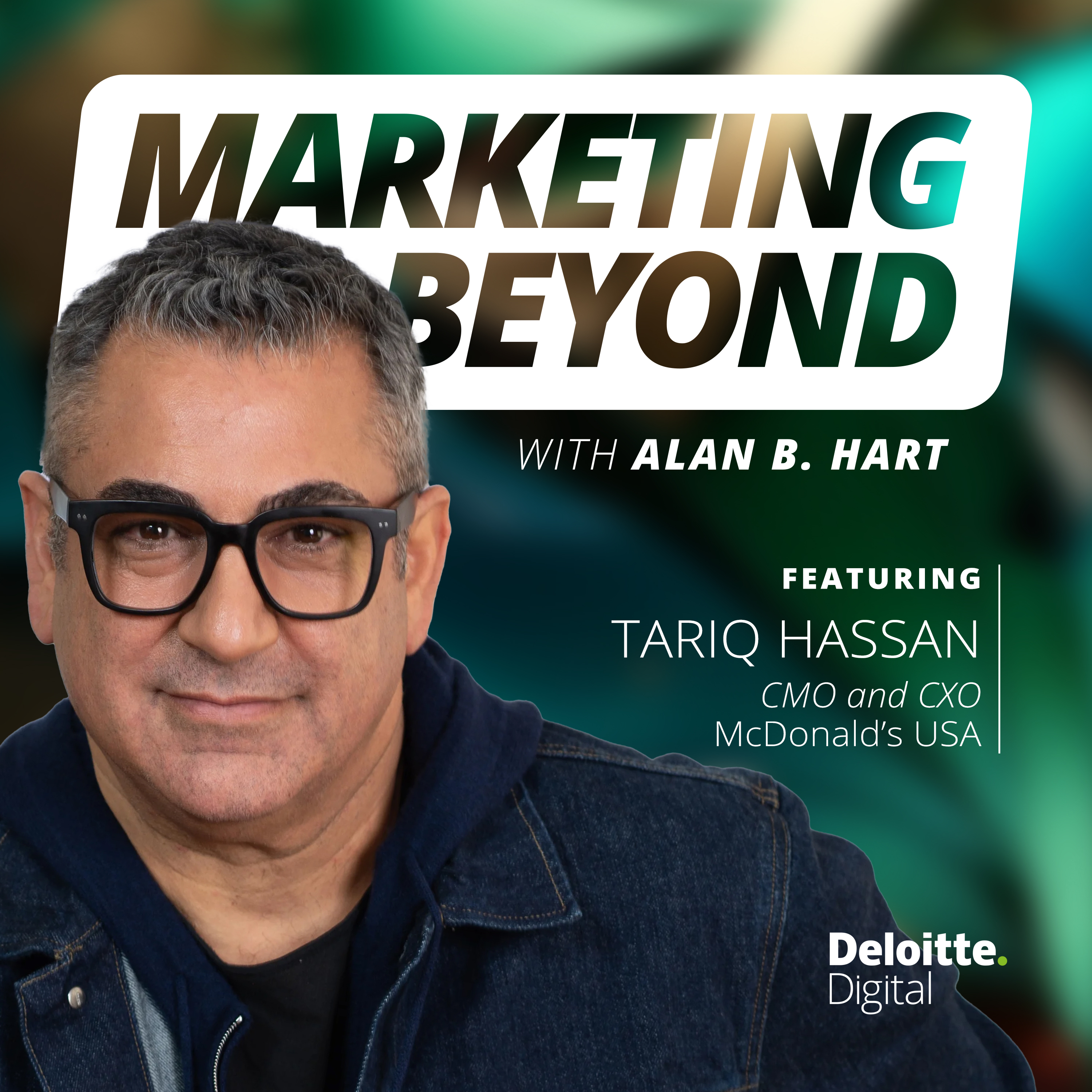
Marketing Beyond with Alan B. Hart
5: Using ‘fan truths’ to drive a fast-food renaissance: Insights from Tariq Hassan, chief marketing and CX officer at McDonald’s USA
00:38:37
Tariq Hassan is a proud girl dad, a transformational leader, and the chief marketing and customer experience (CX) officer at McDonald’s USA. Before joining McDonald’s, Tariq spent over 20 years in global marketing, communications,...
Loading summary
Transcript66 lines
- [00:00]
Tarek Hassan
Foreign.
- [00:07]
Alan Hart
Are you ready to go beyond the basics of marketing? I'm Alan Hart and this is Marketing beyond, where we talk about the questions that spark change and share ideas that challenge the status quo. Join us as we explore the future of marketing and its endless potential. Foreign the show I've got a special treat. I've got Tarek Hassan, a friend of mine. He's the Chief Marketing and Customer experience officer at McDonald's. In that role, his efforts include digital media, CRM, branded content, engagement, consumer insights, menu strategy, all to create a holistic, compelling brand experience for the customers of nearly 14,000 McDonald restaurants in the U.S. obviously, it's an iconic brand. We talk about that, how the brand is now injected into culture. And some of my favorite experiences of characters coming back, etcetera, like the Hamburglar and Grimace. You'll hear that and much more with this conversation with Tarek Hassan. Well, Tarek, welcome to the show.
- [01:25]
Tarek Hassan
Hey, Alan, it's great to see you.
- [01:27]
Alan Hart
Yeah, you too. You too. I. I can't wait to this conversation. And so before we get into the business of this, I have to ask. I am a girl, Dad. I know you are too. I think you're a year ahead of me in this college search situation. So, one, how's dad doing? And then I would love any tips you have.
- [01:47]
Tarek Hassan
Well, Alan, what I tell you is first and foremost the easy part. I love being a girl dad. And I would tell you it's a lot different than when we went to school. The process, and this is our one and only. So I have no, no reference point. And as challenging and as crazy the process is, because so much about it, like everything in our life is about business, I've chosen to sort of step back and really enjoy watching this amazing kid who's now becoming an amazing young woman discover kind of who she is through the process. And, and I've sort of decided I'm going to focus my energy on watching her have that experience in between the nerves and the what ifs and the what if not kind of moments and just really enjoy watching this amazing woman moving into the next phase of her life. And so I'll be able to tell you what this looks like in about three weeks as the rest of the decisions come in, as I say, as we wait for the acceptances that she wants to come in.
- [02:48]
Alan Hart
Right.
- [02:48]
Tarek Hassan
But either way, I know she's going to end up in a great place and move to that next phase of her life and go have the great experiences that I hope, you know, all of us had.
- [02:58]
Alan Hart
Yeah, yeah. Yeah, it's a.
- [03:01]
Tarek Hassan
So hang in there.
- [03:02]
Alan Hart
I appreciate it. I know we're just starting the visits and the tours. Applications will come next fall in our senior year, but yeah, it's. It's quite exhilarating just to be able to watch. To your point, like, you know, I don't have the stress. I'm sure that she does, going through the process and thinking about, like, life choices and things like that, but should be fun. Should be fun. So I may come calling asking for tips as we get to acceptance is where you are next year.
- [03:30]
Tarek Hassan
I wish you well and good luck, and I'm here if you need me.
- [03:33]
Alan Hart
All right. All right, well. Well, let's talk about business.
- [03:36]
Tarek Hassan
Yeah.
- [03:37]
Alan Hart
You know, you are the chief Marketing and Customer experience officer at McDonald's USA. Like, where did you get your start in your career? How'd you end up at McDonald's?
- [03:46]
Tarek Hassan
So I will tell you, my pathway to becoming a CMO is. Is anything but a straight line and in many ways not traditional. I'd tell you that the eclectic nature of it was by design, but I think it is by experiences that has brought me to this point. So I spent the first half of my career in the advertising world. I was a strategic planner in that space, which gave me tremendous opportunity to work across a variety of categories, gave me great experiences to work on a number of amazing huge brands both domestically and globally, and to have that opportunity to work as significant on global businesses. I do, which had a major impact on how we think about things. But it's also, we develop relationships. And it was through those relationships, frankly, that I made the move from the advertising world to the corporate world. And a client who had their, you know, a major, major promotion for them to get take on being the global CMO of hp asked me to follow him over to the corporate side and join him as a VP of Global Marketing for HP's of Engine Printing Group. And so the first half of my career with the advertising world, I sort of define as my customer empathy, really customer centricity and figuring out how to take business and apply it to creative expression. Moving over to hp, a lot of these things you make moves, but the context of your life and what's happening in the world around you and you make them also influence them. So I joined HP in 2008. If you think about that, Facebook was two years earlier, first iPhone was a year earlier. And I was working on at the time, things that, you know, they were calling them apps. And we wondered what we could do with these things. Right? But that was the technology and digital aspect of my career that even at the moment I didn't understand really the sort of beginning of Internet of things that I was starting to play around with and allow me to have exposure to. From there I ended up working with bank of America both on the enterprise side from strategy, insights, analytics and creative content and then eventually running marketing for the wealth business for Merrill lynch and U.S. trust. And again, the context of the time plays a major influence on the experiences I got from it. Because this is my big data chapter right at the time B of A one of every other household had a B of A product in it. The wealth business was starting to consider self directed trades. And so you were in the era of human versus the beginning of platforms and how do those work? And then to move on and move into the retail space with Petco where I was able to start to bring all of these together to work on a business that was private at the time. What started out as a consulting assignment with a former boss turned into a three and a half year, 10 year as CMO and eventually taking Petco public in what would turn out to be one of the most successful retail IPOs. And so those things ironically you think about customer centricity and creativity and really converting business into creative expression, into the data and technology world and then into big data and then applying them all to now being at McDonald's where really the challenge when I joined was all about help take the organization into a digital future and be successful in a digital economy. Think about how to build up the data to be able to do that and modernize marketing which on its face value you don't realize the steps that you've gone through until you have to start to apply them. And so that's how I got here. And again if someone all goes back to ironically I was going to law school once upon a time. So it's just how you end up where you end up, right?
- [07:17]
Alan Hart
Yeah, I mean you. The interesting thing to me, I mean it's a great career first and foremost, but also the notion that you've. What's the word? I guess gone from industry to industry. Right. Applying this kind of like customer thinking, this customer lens to whatever industry you might be in at the time, from technology to banking to now retail and now I guess restaurants if you will, quick serve restaurants. And it's interesting, I mean, I don't know if you've ever thought about it like how does this translate to the next industry or if it's just natural in terms of how you view the world and the types of problems you're trying to solve.
- [07:56]
Tarek Hassan
I think, for me, Alan, it's more of a reflection. And I do believe this. This was something that probably sparked in my agency life. I've always been much more interested in the problem than a category per se. And in many ways, I've been much more interested in the question and the next best question than, frankly, the answer per se. I just think that's my. I think my mom would even go back and tell you I was that annoying kid who just, you know, the next question. The next question, right. Tell me why. Tell me why. And so when your view is through the lens of problem solving, then for me, the next thing is about what is the next opportunity to go, you know, go challenge, go look for a problem. And then. I love transformation. I've come to realize that, you know, being a transformational leader is part of who I am and part of where my value comes from, and part of where my excitement and challenge comes from is the enjoyment of looking to the opportunity to transform things.
- [08:53]
Alan Hart
Well, McDonald's, I mean, it's. You can't get much more iconic than the McDonald's brand. When you. When you came in, like, where did you even think about starting?
- [09:03]
Tarek Hassan
Look, I came in and I had a great foundation. My predecessor, Morgan Flasley, who's now the global cmo, you know, had. Had established a lot of elements around the core business that gave me a great foundation to start from. You know, her and the leadership had already gone through a transformation of our stores. And the experience, changes that had to take place, the customers had in our stores. And I came in on the heels of us coming out of COVID and looking for ways to unlock the brand through what has now become our famous orders campaign through Travis Scott. That campaign served to do a couple of things. It woke up the marketplace to remind them what they loved about the brand and the connection with the brand. But it frankly, woke up the company to get back on its front foot and remember this amazing connection we have with customers and a reminder that nearly 90% of the country walks through our doors at least once a year. And so when I joined, the question was, how do you take this beginning and this spark and this momentum and turn it into something that you could actually maintain? And the simple way that I talked about that with my team was, you've unlocked this moment. You've connected in culture, right? You've called culture. Now culture is calling you back. What are you going to do? Because if you don't answer and keep them on the line, you get canceled as quickly as you got there. And so we set out a real true north for the business to think about. How do we leverage this cultural iconic nature that we have as a brand but haven't leveraged? And everyone was starting to talk culture. Right. Big canvas means a lot of things to a lot of people. And so we had to define what that meant for McDonald's and for us. There were four areas we focused in on. The first was we're a food company. So how do you impact the taste of culture? How do you think about the changing nature and the changing taste buds of the country and run those through? In a way they're still true to the brand. Right. Until you saw us having fun with our dipping sauces or playing around with a dolce de leche frappe. Right, right. Playing around with unique filters, but ensuring it through the familiarity of the McDonald's that they love. Second area was just going deep into our fans lives and understanding the culture of where they hang out, where they are. You know, we're talking about multicultural youth, the TikTok culture. We didn't invent the food hack, but we sure could play with one. Right. And so, and then the third one was really at the heart of something we needed, we knew we needed to do foundationally to change the business, which was start to drive the role of data. And some people might say, well, how does data play into culture? But when you're talking about a Gen Z market, who are, you know, digital natives, it's all they've ever known. Data is a currency, it's a language, it's a form of way of connecting with them. And if you do it the right way and provide value, then they, they return that value with a deeper relationship. And then lastly, we said on our scale, it's great we're participating in culture, but we're McDonald's. We're a brand where one in eight Americans has worked at a McDonald's. We need to create culture. And that became as much an external rally cry as it did an internal rally cry. Because if you're going to become a creator of culture, you also have to reflect that culture in your hallways. And it becomes a reflection of who's in the marketing organization and how are you staying connected to it. Are you thinking about the pulse that makes culture move across the country and how you associate with it? And we've just stayed on those four pills, you know, those four pillars, very consistent because we get bored of our things a lot faster than our customers do. And so just staying consistent and staying on the beat has been the magic that's allowed us to keep doing what we're doing.
- [12:29]
Alan Hart
I mean. I mean, you guys are doing it well. You're doing it well, my friend. I mean, one of the things that I noticed in the recent history of you guys is, I guess, first and foremost, I, like many kids growing up in the us had my birthday party, I think, in elementary school. I can't even remember. I was probably somewhere in, like, second or third grade at a McDonald's. I can still tell you where it is in North Carolina, but I remember, you know, the. The character element of the brand. Ronald McDonald, Grimace, Hamburglar. And they were a lot of fun to me back then, and I was so excited when I saw the Hamburglar come back. He was my favorite. Grimace was also very cool. But, like, Hamburglar in particular was one that I just really sparked to as a kid. I don't know, maybe it was the mischievous element of it, but I want to know, like, how did. Where did that come from? Like, where, How. You know, how did that manifest itself, if you will?
- [13:30]
Tarek Hassan
Look, I think for us, and I love that you're telling your birthday story, because that's articulation of an example of what we're guided by. We call them fan truths. It's truly understanding those unique moments and those connections that our fans have. Everyone's got their story. Everyone's got their birthday story. Everyone's got their first date story. Everyone's got their the championship we lost. Everyone's got the championship we won story. Right? That's the essence of the way we make decisions and the example you're bringing up of the characters. I mean, I've had a lot of people ask about our nostalgia strategy. We don't have a nostalgia strategy. What we have is we've discovered fan truths that have led us to executional ideas that have unlocked the recall and memory of things like our characters. In the case of the characters, that actually started with the adult Happy Meal. And that was where we were trading on this sort of lost childhood joy that we were starting to see inside of adults. Reactions to it came out of a simple tweet. One day you wake up and realize you had your last Happy Meal. And we thought, what was the evocative reaction to that? And why can't we give that joy back to an adult? So let's give them a Happy Meal that they recall. The collaborator we worked with is an urban fashion designer, so we worked with Cactus Plant. Flea market. And we gave the brief. They came back and said, look, we want the theme to be about friendship. Because my memory of McDonald's was hanging out at McDonald's with my friends. And the icon to our brand, Cactus Buddy, he doesn't have a friend group. We want to bring the McDonald characters back as his friend group. Now, Alan, we did this at a time when the average 17 year old, my kid included, didn't know any of these characters because we weren't marketing them to kids anymore. We weren't able to, given the changes in the industry.
- [15:14]
Alan Hart
Right.
- [15:15]
Tarek Hassan
But we created a new connection with them. And then it was the following year that we said this insight around tapping into that childhood memories and those childhood joys. You have an adult, we all need that. Right, Right. Birthdays was the obvious one. You know, you were a cool kid. You actually had a birthday party there. I got invited to a couple, but I was never cool enough to actually have mine there. And we said, okay, how do we bring that to life? And Grimace is just the embodiment of the ultimate kid.
- [15:41]
Alan Hart
Oh, yeah.
- [15:41]
Tarek Hassan
So we decided to celebrate his birthday. Now, what happened after that? We had no clue that what would take place on TikTok would. Would go the direction it did. But we do know that when you show a connection and empathy with your fans, a relatability and understanding of who they are, the odds of them reaching into your brand and using different assets and elements of your brand as expression, because we'd seen that kind of creator mindset starting to take place go way up. And so the reintroduction of the love affair of Hamburglar and of Grimace and of the characters has just been an absolute blast to those who remember them and a real, real pleasant surprise for a new generation we've introduced them to.
- [16:25]
Alan Hart
Yeah, I mean, you couldn't get a Grimace shake when they came out, so I imagine the results were great, too.
- [16:31]
Tarek Hassan
Yeah. I'll tell you a funny story. My kid was away at a summer program and thought it would be very cool to go off campus with some of her friends and go get this Grimace shake that her dad's group had, you know, her team had developed. And I got this text with a picture of the McDonald's and an upside down, you know, frown face saying they're sold out. Right. Great for culture. Not the answer you want for business. Long term, you can get away with. You don't want to run out of. You don't want to run out of burger Big Macs, but running out of a Grimace shake a couple days early is not a bad thing. It's a great sign of success.
- [17:08]
Alan Hart
Awesome. Awesome. Well, I know you talked about data and I know digital transformation is something that you've kind of marked, if you will, your time at McDonald's. Talk to me a little bit about that. What was your digital transformation journey like? How would you, how are you going about it in terms of leveraging that data and creating more personalized, engaging experiences?
- [17:29]
Tarek Hassan
Yeah, I mean that to me was the most exciting part about taking the job in the first place was to be able to take a business with roughly, you know, an average $9 check and think about how do we think about it in the same way you think about a direct to customer business and start to gain scale of first party data to get smarter, to action on that data to provide greater value to your customer, to get a better understanding of every aspect of the business, including operationally and experience. That was exciting. And we had just launched loyalty when I came in, that was part of the remit for me to come in and for how do we scale that, that capability? You know, today we end the year 2024, you know, just north of 85, you know, roughly 85 million users on that platform of which north of 45 million of them are 90 day actives. Right. And so that ability to start to understand customer behavior, to start to understand how we can engage that customer, continue to drive, you know, success of the business through that data in a way that we can actually measure in the ways that we now can, has been just an amazing journey. We knew it would be difficult because that's a, that is a transformational component for franchisees who've grown up in an amazing system that's done incredibly well for them based on a daily operating model. Right. And here come these crazy marketers that want to start to have conversations about 30, 60, 90, 120 day views of things and them along with wacky finance guys that are saying if we do this, guys, I know you're not seeing the dollar you made today, but here's what the return on it will be forex later. That's both exciting, but that comes with an accountability to help the organization understand that these are just magic tricks, right? That this is actually going to be a profitable approach to how we've done it. And that's what we're excited about. Because when I look at the scale we've been able to do, four years later, we know that customer is profitable, we know they come more often and we know at the end of the day they Spend more. Right. They're about four and a half times the value of a non digital customer. We also know there's tremendous benefits of the digital behavior that comes with that customer because I've now got a customer who's ordering for themselves, paying for themselves. And you now get to revenue, allocate resources to other parts of the restaurant to create a better experience for your customer. And so that's just the tip of it. The real value of the data and the real value of things like AI will be about the impact they have in the total restaurant operation. As the restaurant becomes smarter, as the restaurant attaches to the cloud and we start to gain a view to not only the role of the data on the customer, but the implication on the operating model for the restaurant itself, that. That's pretty exciting stuff.
- [20:06]
Alan Hart
Yeah, I mean, just the scale at which you guys operate is mind blowing. You know, you Talk about the 45 million 90 day active users, the 85 million users in total, like, I mean, that's, that's a massive business just by itself.
- [20:22]
Tarek Hassan
Itself?
- [20:23]
Alan Hart
Yeah, yeah.
- [20:23]
Tarek Hassan
Look, our delivery business is a $5 billion business by itself. When I left Petco, we were barely a $5 billion retail business. The future of that scale, you know, the goal is by 2027 that we have nearly 65 million 90 day actives. You are now entering the scale of some of the most significant customer platforms, irrespective of the QSR category.
- [20:47]
Alan Hart
Right.
- [20:47]
Tarek Hassan
And that's a really exciting opportunity to build a platform on a business that then allows you to engage your customers and provide unique value, allow that data to do really, really meaningful things for them as individuals, but ultimately for the employees as well as for the communities that you're serving.
- [21:02]
Alan Hart
Well, not to turn the conversation, but turn it a little bit, you know, your brand leader, you're, you know, a pillar, if you will, within culture because so many people have an experience with McDonald's. That also means that you're in the macro environment whether you want to be or not. And as you think about how brands respond to events, whether they're social, health related or otherwise, how. What advice would you give to brand leaders kind of faced with headwinds from time to time or shifts in the marketplace?
- [21:36]
Tarek Hassan
Look, I think there's things we've always known, but the realities of them have never been more evident as a result of digital saliency and access to your brand by our customers. So if you didn't need the reminder, you, it's there every day now that you are not in total control of the, the conversation. And so your ability both to listen, understand when to engage, and frankly importantly, understand when not to engage has never been more important, depending on the category you're in. I mean, I think one of the greatest things that ties back to, we were just talking about the power of actually having the data is critical not only in driving the business, but it's also cruel to understanding your customers. And so when I think about the challenge we went through at the end of last year with our food safety issue, yeah, that data proved to be completely invaluable for us to understand the mindset, the understanding, the nervousness and the clarity we were starting to create for customers as we explained and helped them navigate that with us.
- [22:35]
Alan Hart
Right.
- [22:36]
Tarek Hassan
And, and we were able to navigate that situation as quickly as we were because we held to our values, which goes back to the real point of what you're asking. As brand leaders, you, you, you drive clarity of your values, you're transparent with those, and then you lead with actions. And I think it sounds really simple and it should be really, really simple, but we can get in our own way sometimes on these things. And I have a tremendous appreciation for the consistency, the value of the McDonald's brand and the leadership to not waver from those values, to not waver from the character, to be unified on how we show up. And that'll help you both when things are fantastic, but it really comes to bear when you're facing a challenge for certain.
- [23:19]
Alan Hart
Right. Well, I know we were in quick communication when that was breaking, and I remember one hoping things are going to go well for you guys, but also just watching within a couple of days, weeks. I mean, it was the speed at which the brand and the company, I think, responded. And to your point, maybe it was the data component as well as how you guys track your business, etc. Etc. It was, it was, it was quite the case study, in my opinion, in terms of, like, how to do it, how to do it well, how to do it right down the center, if you will, to make sure you're addressing the challenge at hand.
- [23:57]
Tarek Hassan
So it's, I mean, the first part of it starts with a clear demonstration of the power of our amazing supply chain and our partners. Right, supply partners, and the willingness and the ability to have that kind of clarity in order to help be part of the solution, to lean in, to identify the specificity of the problem and then take the right actions and to take those actions with one focus and one focus only, transparency for protecting and doing the right things for your customers and then ensuring that those things that you're doing are in service to the communities you serve, but also those who are employed by you, your crew and your franchisees.
- [24:36]
Alan Hart
Well, not to turn this into a sad moment, but you've announced that you're leaving and you know, so we got to talk about it like, you know, in terms of, like, are there any leadership principles you'd like to leave folks as you depart McDonald's or as you think about this time you've had at McDonald's?
- [24:54]
Tarek Hassan
Yeah, look, I don't view it as a sad moment at all. So I'm thrilled you brought it up. I'm excited, like, I think that to be able to get to a place in your career where you can have the agenda defined so clearly about what to come in and add value to an organization and to work for a great leader like I did with the US President and be able to look at the that and say, like, you delivered against those things and to know yourself well enough to be able to do that work and recognize that like, I'm a transformational leader, it's what I enjoy doing. And so to be in a position where I can look at what they ask was to come in and can confidently feel good about the results that we put in and then think about the, you know, what's next and feel confident about knowing you left the organization in a better place, then that's when you can be in a position to think about the things that work for you. And then on a personal front, you know, I've been living through the last seven and a half years in a bi city professional personal life, whether that was with Petco in San Diego, in New York or now the last three and a half years, almost four years, Chicago, New York, and with my, as you put it, my one and only, getting ready to head off to college. It was a combination of really considering what I had set out to do with the organization and you don't get these windows of time back, frankly, on the personal front. And so that made the decision never easy, but one that I can feel really great about the great leadership that will remain that has a vision for what they're doing. I've never worked on an executive leadership team like the one that I did with the US team. I mean, just world class tremendous leaders, not only from a business perspective, but from a character and a human level of what we achieve together. My own team and who, you know, who's ready and they're, you know, as I said to them, the greatest opportunity for A leader is to know their leaders don't need them any longer. And that's how I feel about the capabilities of the team that I put in place. And then to know that you've got a great successor like Alyssa Buddha coffer who will take the reins. And not just that they will take care of the team and the development of what you've done, but you can feel confident that they'll accelerate it, which is what Melissa will do. That's the formula that allows you as a leader to say, okay, what's next? And I'm excited about what's next. Which, no, I'm not telling you yet. Before you ask me, I know that look, Alan.
- [27:22]
Alan Hart
Yeah, yeah, I know. I know you knew it was coming. Well, I'll watch with bated breath, but I'm excited for you.
- [27:32]
Tarek Hassan
Thank you.
- [27:33]
Alan Hart
Because I do know you've had a grueling seven plus years just with that bicity piece. Well, I'd love to ask you a series of questions I ask everyone that comes on the show. First one is kind of trying to get to know you even a little bit better. And it's my favorite question to ask frankly. Has there been an experience of your past that defines or makes up who you are today?
- [27:56]
Tarek Hassan
Yeah. You know, you and I had a chance to chat a little bit before this and I, and I was asked this question recently. It's actually not a business experience. My daughter is a 13 year cancer survivor and it's, it's not just that she's now healthy and well and she is thankfully.
- [28:14]
Alan Hart
Yeah.
- [28:15]
Tarek Hassan
But when I look back at the experience of navigating that with her, both what you learn from empathy and understanding from, you know, the whole. The reality is babies bounce and they actually are resilient and what we learn from them. Right. We constantly say out of the mouths of babes is a reason. Just a great reminder of where the choices are that we have on the things we can control, the things we can't control and the things that you can in a moment like that. This kid was just an amazing. And stays with me. Amazing reminder of how to navigate that. But it was also interesting to just to think about the way we navigated her treatment plan and the disease and understanding how to approach a problem. And I recall the oncologist looking at us and saying like, what do you guys do for a living? Because the questions you're asking and the way you're attacking this challenge and I think that has stayed with me me to understand that the reality is that in a world where we have so much data, we have so much access to information we think can give us the answer. I think back to that experience because there's that moment when you're sitting with the doctor thinking, like, all the things we're doing here, are they working? I remember saying to one of the oncologists, like, I don't understand how this is working. And he looked at me and he said, we're guessing, educated guessing guesses, but we're guessing because we're using data sets that are the closest thing to your kid, but your kid is still a unique data set. And that has held with me because I've always believed, even with data, you have to work within the intimacy of data because your kid may be the exception. Data set. And so that has influenced the way I think about attacking problems, the empathy I bring towards them, the usage of data, and the way I challenge data when I think about those kind of things. So probably not the business experience you were looking for, but it's something that has stayed very much part of and shaped how I think about things.
- [30:21]
Alan Hart
No, I think it's those personal moments that shape us even more. Even more than the business. To your point. Well, if you were starting this journey all over again, what advice would you give your younger self?
- [30:33]
Tarek Hassan
Oh, I think I probably would have told myself to a couple things. I would have told myself to start trusting my gut a lot earlier. I would have told myself to find mentors much earlier and really find those folks, that personal board of directors who were going to give you the insights. I would have told myself probably the same thing I'm telling myself still today a little bit, which is, you know, know when not to necessarily take it all too serious and actually take a step away and give yourself a moment. Which is. Which is part of what was also behind my decisioning was it's just giving yourself a minute to oscillate literally as an individual and. And refined and rebalance. I didn't do that enough throughout my career. And I probably would have told myself, take a beat every now and then, not to get overconfident, but to step back and allow yourself to soak in the moment when it's gone right. At least a beat, if you would, because Lord knows we stay on way too many beats when it doesn't go right, right, right. And again, not that I would have ever wanted to stay there, but I think there were moments I probably should have taken a moment and just, you know, breathe, you know, take a breath and remind myself what they felt Like I think they could have shortened the timing on the moments it didn't go quite as well.
- [31:58]
Alan Hart
Well, wise advice. Is there a topic that either you're trying to learn more about or you think marketers need to be learning more about right now?
- [32:06]
Tarek Hassan
Yeah. Look, I. Is any conversation you're having these day void of having the discussion around AI? No, I find it exciting. I find it exhausting and exhilarating all at the same time. The speed at which we're having to try and keep up with things, the unlocking of opportunities that come with it. But I'm also incredibly intrigued on the interrelationship between the human elements that tie to this as well. And you know, I've got my own little made up theory on some of these things around. Like for example, why, you know, why are there AI hallucinations? And I think those hallucinations are actually ironically elements of humanity showing up where assumptions are being made about data that are wrong. But, but what makes them wrong is the unpredictability of humanity. And so that's a big sort of thought, but it's something that I think a lot of us try and think about. How do we stop the tide? We're not going to. How do we leverage it? We have an all accountability responsibility, marketing, to leverage it for the good. But then how do we also ensure that we think about the continued role of humanity? Because the one thing that's constant is we've always evolved and innovated and continued to move forward. And the things that have kept us on the rails, humanity and relationships and communication and transparency and the goodness of things. Right. And in a world where that's feeling at times much harder the way the technology and the access to things that can help us make it easier. And so what's the role we all play in that?
- [33:40]
Alan Hart
Yeah, no, it makes, it makes a lot of sense. I mean this notion of the human and the machine keeps coming out when we talk about AI on the show in particular. And I think you're right. I mean the humanity, humanity's not going anywhere. How we evolve to work with the machines and the machines evolve over time, that's going to be the interesting nuggets, I think. But we're going to still coexist.
- [34:04]
Tarek Hassan
As I said, the university class I was just talking to before I came on with you, I'm excited by it, but I'd be lying if I didn't say I'm going to be enjoying the fact that I'll be able to watch a lot of this from my Retirement. But I think it is interesting and it's exciting and I think every time we come across these moments, it just leads to the most innovative, incredible opportunities. And so I'm going to choose to stay on the side of optimism and have no idea whether this notion of sort of the human in the machine is real or not. Maybe it's what I just need to believe, but I think it keeps a good reminder for us and our responsibilities as, as we play this out.
- [34:41]
Alan Hart
Well, I got two last questions for you.
- [34:42]
Tarek Hassan
Sure.
- [34:43]
Alan Hart
Are there any trends or subcultures that you follow? Anything that you're just curious about today.
- [34:49]
Tarek Hassan
That you're tracking ironically? You know, before I joined McDonald's, I was already a foodie. And I just love. Not just I love to cook, but I love food culture and I love watching what's taking place around some of the. Around some of these food trends and the extension of food into experiences. And I continue to watch those kind of things and I'm excited. And it's everything from sort of the functionality to the health and wellness aspects of things to actually us allowing ourselves to actually enjoy things and indulge things in a different way. So I'll continue to continue to watch those things. I don't think I'll ever stop the love of food, whether I'm under the arches or not. The ketchup courses through the veins for certain.
- [35:34]
Alan Hart
Yeah. I don't think I'm a foodie as well. And all I have to do is to remind myself to work out so that I can still consume the food that I want as I, as I pat the.
- [35:44]
Tarek Hassan
Well, I'm just even fascinated around, like, what's taking place in the agricultural environment, the innovation environment. The way that you're seeing, you know, things start to. There's some wacky stuff, but it's all, it's all really fascinating to me as we continue to think about how these things converge with our desire to have convenience, but yet be able to try. Try things and experience things. So I think, again, fascinating time.
- [36:05]
Alan Hart
Awesome. Well, last question for you. As a marketer, what do you feel like is the largest opportunity or threat facing us right now?
- [36:13]
Tarek Hassan
I think the opportunity and threat is what we've been talking a fair bit about. They're one in the same to me, which is how do you continue to move forward with. With the power of the access to the data and move that data around, but do it in a way that maintains trust and value for your customers? You know, you said you were fascinated about what we've been doing from the QSR industry. I would dare tell you the first indicator players you won't see in the future will be those that don't figure out how to adapt into the space, but equally will will be those who don't then also figure out how to use that data responsibly and provide value for their customers in a way that enhances the experience and puts them at the center of it. That's both the hugest opportunity. I mean, think about it. We're making decisions by the second using data on what is an average nine dollar check. That is just a wild place to be and that's exciting and I think that's true across a lot of categories. We're all going to be working our way through that, right?
- [37:14]
Alan Hart
Well, it's always a pleasure to talk to you, Tarek. Thanks for coming on the show and I wish you well and I'm going to be waiting to be able to ask you that question. What are you doing next?
- [37:24]
Tarek Hassan
Listen, we'll get together and we'll have another one of these conversations. Conversations over the next one, but I look forward to it. It's always so great to talk to you, Alan.
- [37:31]
Alan Hart
You too, you too. The views, thoughts and opinions expressed are the speaker's own and do not represent the views, thoughts and opinions of Deloitte. Material and information presented here is for general information purposes only and does not imply endorsement or opposition to any specific company, product or service. Hi, it's Alan again. Marketing beyond is a Deloitte Digital Podcast. It's created and produced by me with post production support from Sam Robertson. If you're new to Marketing beyond, please feel free to write us a review and subscribe on your favorite listening platform. I also invite you to explore the other Deloitte Digital podcast@deloittigital.com US podcast and share the show with your friends and colleagues. I love hearing from listeners. You can contact me at marketingbeyond. At deloitte. Com. You'll also find complete show notes and links to what's discussed in the podcast today and you can search our archives. I'm Alan Hart and this is Marketing Beyond.