← Marketing Beyond with Alan B. Hart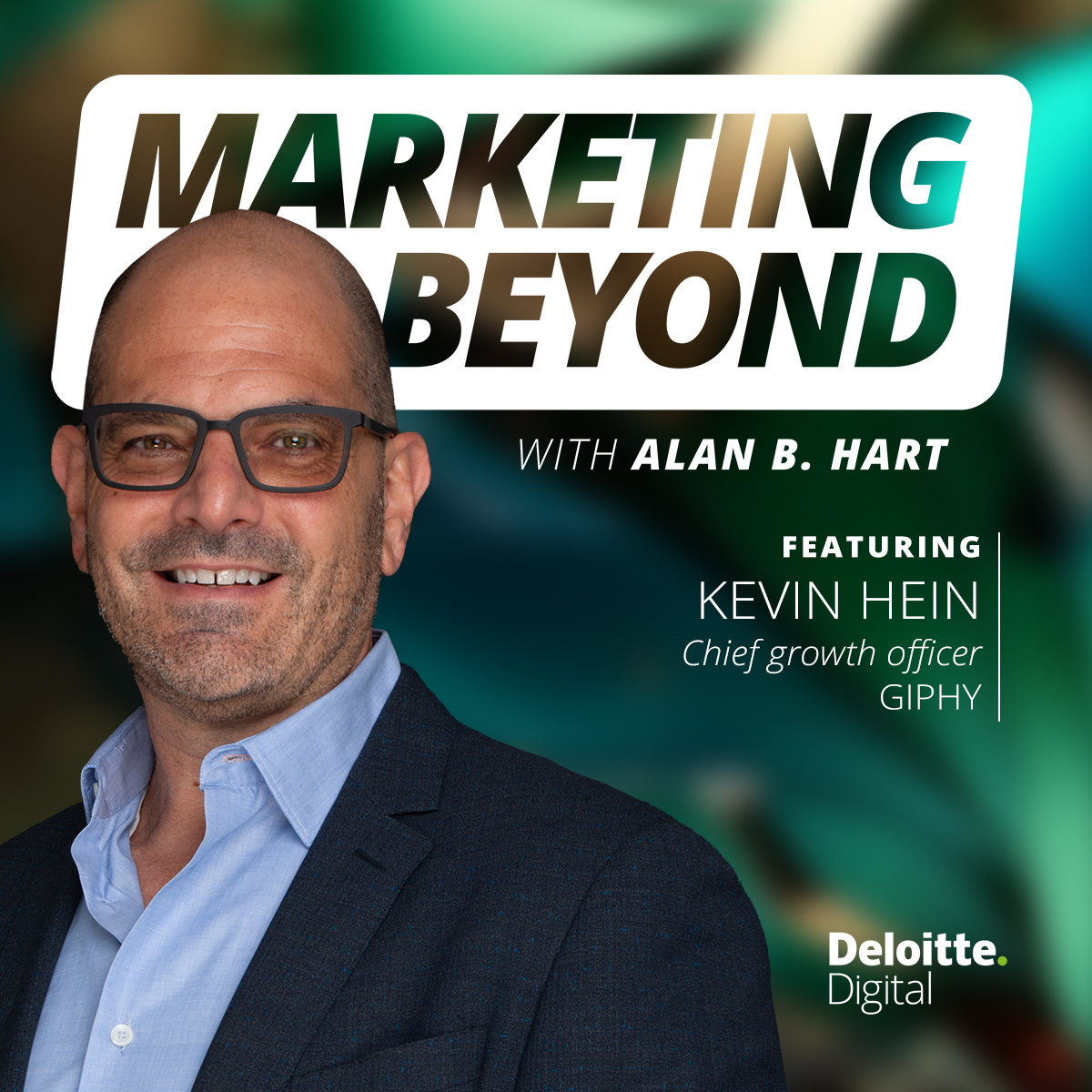
Marketing Beyond with Alan B. Hart
7: How GIFs deliver branding magic: Insights from Kevin Hein, CGO at GIPHY
00:46:06
Kevin Hein is the chief growth officer (CGO) at GIPHY. He began his print publishing career with Ziff Davis when print and tech were merging. Here, he learned the fundamentals of strategic selling while working on the PC magazine account. Kevin joined...
Loading summary
Transcript250 lines
- [00:00]
Kevin Hein
Foreign.
- [00:07]
Alan Hart
Are you ready to go beyond the basics of marketing? I'm Alan Hart, and this is Marketing beyond, where we talk about the questions that spark change and share ideas that challenge the status quo. Join us as we explore the future of marketing and its endless potential. On the show today, I've got Kevin Hein. He's the chief Growth Officer at giphy. Yes, that giphy, the tool that we use on so many screens to message our friends and colleagues. We talk about what GIPHY is today, how to think about the business. The fact that Giphy seems to be everywhere, reaches over a quarter of the world on a daily basis. And the magic of giphy, how we use it, what kind of smile it brings to our face, and how do brands work with GIPHY today to influence culture, drive business results? That and much more with Kevin Hein. Well, Kevin, welcome to the show.
- [01:20]
Kevin Hein
Thank you. Thank you for having me.
- [01:22]
Alan Hart
Yeah, I'm excited for this conversation. I mean, we'll talk a lot about giphy, but in the interim, as we try to get to know you a little bit, what is this about? Car detailing?
- [01:32]
Kevin Hein
Yeah. So it's something that has been with me my entire life. At a very young age, I was borderline obsessed with cleaning. It wanes here and there depending on the job. But what has been consistent is my love for cars and actually detailing. So in high school, I had a car detailing business that paid for my gas and insurance. And to this day, I have a garage full of car cleaning products. I haven't gone to a car wash in 20 years. I refuse to, no matter what time of the year it is. And every neighbor and friends legitimately thinks I'm out of my mind because it just. I love it. I love it. I love the final product. I love the process. It's soothing, it's therapeutic. And I understand that 99.9% of the people are saying that is the last thing I would ever want to do.
- [02:23]
Alan Hart
It does seem time consuming. But if it is your, like, meditative state, I totally get it.
- [02:29]
Kevin Hein
It is standing away and seeing a clean car that's going to get dirty in 20 seconds is just like a 20 second joy. It really is so fulfilling.
- [02:37]
Alan Hart
Okay, all right. All right. So from car detailing in high school to chief growth Officer at giphy, tell me how you got from there to here.
- [02:47]
Kevin Hein
You might think that there are no parallels there, but there are some of the best thinking that I do when I am cleaning cars, whether it's just like a wash or whether it's a full detail that could take Hours. It's that type of thinking where you're not distracted and you're really pulling all the levers. So when it comes to what we do today, those are some of my calmest moments where I think about the biggest decisions I need to make for the business, especially the ones that don't have a clear forecast to them, what you can't control. Like, those are some. I did it last week. I was cleaning. We had a 50 degree day. Got out there and I made some really good decisions for the business. So there are. That is a natural parallel that has tied through ever since my car cleaning at a very young age.
- [03:33]
Alan Hart
Yeah, I can totally get it. I don't want to clean my car, though.
- [03:37]
Kevin Hein
I understand.
- [03:39]
Alan Hart
So. But it makes perfect sense. And I guess other people. It's in the shower here you're thinking about the decision.
- [03:46]
Kevin Hein
That's right.
- [03:46]
Alan Hart
Make or whatever it is. But that's interesting. So. Well, what was the first professional gig? Maybe out of college.
- [03:54]
Kevin Hein
Yeah. So I fell into. Through friends network, print publishing at a company called Ziff Davis.
- [04:01]
Alan Hart
Oh, yeah.
- [04:02]
Kevin Hein
And at the Times, at the time, print and tech were emerging. We're sitting here in Austin and Michael Dell reared his head in the desktop computer. And I was fortunate enough to work for a brand called PC Magazine, which at the time was the.
- [04:18]
Alan Hart
The magazine.
- [04:19]
Kevin Hein
The vogue of. If I may, if Anna's listening. Sorry. The vogue of. Of tech and incredibly profitable business. And that's where I learned the fundamentals of strategic selling very early, very early stage in my career. And I still refer back to it many times. So that was my foundational training and I found success. I was the youngest outside salesperson ever traveled the east coast. And that I, I think back to that foundation many times, actually, with how I lead now in the company with real quick, there's the structure around opening market, buyer competition.
- [04:59]
Alan Hart
Right.
- [04:59]
Kevin Hein
Creating a narrative instead of leading and saying, here's my brand. It's being thoughtful about a client. And that is. I learned that from Lizif Davis when I entered this market.
- [05:11]
Alan Hart
I love it. And then when did you join Giphy?
- [05:14]
Kevin Hein
I joined Giphy a little over six months ago.
- [05:16]
Alan Hart
Oh, wow. Congrats.
- [05:18]
Kevin Hein
So thank you so much. It feels new, but at the same time, it feels already very familiar. Yeah. I created a plan with the team and we've executed on that flawlessly. So it doesn't feel like six months. It actually feels just about right on time.
- [05:33]
Alan Hart
That's good.
- [05:34]
Kevin Hein
Yeah. Thank you.
- [05:35]
Alan Hart
Yeah. Well, tell me about Giphy today. You know, I think a listener would have to be living under a rock, to not know what GIPHY is. But, like, how should we collectively think about it as a business?
- [05:48]
Kevin Hein
Yeah. So you bring up such an important point. And the roadshow that I've been on the last six months focused on clients, agencies, client direct, all across the board, our strategic partners as well. The reason why I bring that up is because when we start having conversations like this, and I'm going to do it to you right now, and you'll see it happen. So when you think of giphy, like, what do you think of? No, wrong answer here. But literally, what do you think of?
- [06:11]
Alan Hart
I think of meme wars and work or texting back and forth with my daughter, trying to get the tone right.
- [06:18]
Kevin Hein
Okay. So business and personal and trying to capitalize on intent versus reception because you might not have the right text or you want to be the cool dad.
- [06:27]
Alan Hart
Right, Exactly.
- [06:28]
Kevin Hein
Okay. So going to continue down this journey. If you don't mind, we'll stay away from the work stuff for now. So with your daughter, do you remember the last message that you sent her or the last gift you sent to her, fueled by giphy?
- [06:39]
Alan Hart
Ah, that's a good one. I don't remember the exact one, but I know it was basketball oriented.
- [06:46]
Kevin Hein
Okay. So just the fact that you're physically doing what everyone does, which is smiling, because it is an extension of our emotions and it's always a positive emotion. So sometimes these feelings and associations with GIPHY and GIFs are commoditized because we just see them as a fleeting moment of a positive emotion. But think of how powerful that is. And let's go to the corporate side.
- [07:13]
Alan Hart
Right.
- [07:13]
Kevin Hein
So it's like whatever is, it's usually around Microsoft. Right. You're working in teams. Something's going on. It's either a fun, quick conversation or somebody's getting frustrated and you kind of want to shut it down.
- [07:26]
Alan Hart
Right.
- [07:26]
Kevin Hein
And you pull that magic gif and it just Right. Sizes everybody in a very respectful, funny way. Right. So, like, those are two very powerful moments. But the point is around it that we don't think about it that much. Like, and that's our job to help people understand the thinking process of. Oh, we'll say Google might be someone's default search engine. Right.
- [07:48]
Alan Hart
Right.
- [07:49]
Kevin Hein
Giphy is by far the default search engine for, for any type of meme GIF sticker. But it's so ingrained in our behaviors.
- [07:59]
Alan Hart
Right.
- [08:00]
Kevin Hein
The thousands of messages that we send on a daily basis that you sometimes don't really connect it. But whenever I prompt somebody they know immediately. Like your words, not mine. You said the rock you have to live under if you don't know giphy. Right. So today I'm excited to get to the. The area of where we talk about how do we translate this with brand marketers for them to extend that feeling and that most importantly, that connection within messaging, it's so powerful and so underutilized.
- [08:33]
Alan Hart
And to your point, and I guess even my assessment, like, I'm using a phone to work messaging system, giphy's everywhere, it feels like. I mean, you guys have done an amazing job getting giphy in the right places for those moments where I need to ratchet up the emotion in the team meeting or I need to try to be the cool guy to my daughter or try to communicate something that I can't really communicate in words to my wife.
- [09:05]
Kevin Hein
Yeah, that's exactly right.
- [09:07]
Alan Hart
So, I mean, it seems like the proliferation, I guess, of where you are. Is the distribution job done now?
- [09:14]
Kevin Hein
Yeah. So the distribution job is never done. It's constantly evolving and we could get to that. So I wanted to thank the founders over the last decade who have done an exceptional job. They're no longer here. They've done an exceptional job building their relationships with those surfaces. And if you think about imessage meta surfaces, TikTok, Reddit just goes down the line for many, many more. It's literally represents on a daily basis. We're reaching a quarter of the world.
- [09:46]
Alan Hart
Wow.
- [09:46]
Kevin Hein
Wow. And when you think about all of the platforms, digital, analog, whichever, you think about those places where how many X people could you reach? And once you hit the B word and you're a billion plus, it becomes pretty small. And we are the only brand that could have this global reach consistently across all the surfaces that I believe is the least, I like to say, exploited, which might be the wrong adjective because it feels like very intense. But what an opportunity.
- [10:20]
Alan Hart
Yeah. Yeah. I mean, to your point, a quarter of the world is insane. Yeah. Stat. And then, you know, the notion of this, like, I'm just going to call it, like, magic of giphy.
- [10:34]
Kevin Hein
Right.
- [10:34]
Alan Hart
To help aid in that communication. Would you agree there's like something magical about being able to search for the exact thing that you're looking for to communicate the point you want to get across.
- [10:46]
Kevin Hein
Yeah. So I think the magic comes in different forms, one we discussed, which is just how it makes you feel when you're doing it. It's usually hysterical. It usually shuts down discussions in a very positive, fun way, or it amplifies discussions. But that association between joy and personal expression is so incredibly powerful, especially these days when the attention economy is right at what it's at. The second part is it's opportunity with brands to take advantage of this in a way that doesn't feel intrusive.
- [11:23]
Alan Hart
Right.
- [11:24]
Kevin Hein
Like, we talk about ad experiences, whether it's from the super bowl or a programmatic partner pushing an impression in front of somebody. We've become so muted to ad messages that even the ones that are so in your face, you're like, yeah, I kind of expected that. And the beauty and the elegance about giphy is that it's part of the conversation and it's not intrusive, it's additive. It's a natural extension of what you're talking about. Your example with your daughter.
- [11:53]
Alan Hart
Right.
- [11:54]
Kevin Hein
She probably didn't respond like, dad, that's weird. And I wasn't talking about basketball, but it was probably dead on.
- [12:00]
Alan Hart
Right.
- [12:01]
Kevin Hein
So it's just this. This magic.
- [12:03]
Alan Hart
Yeah.
- [12:03]
Kevin Hein
That literally is not anywhere else, if you think about it.
- [12:08]
Alan Hart
Right.
- [12:08]
Kevin Hein
Like, a little emoji or emoticon is not going to deliver that same message as a perfectly crafted, perfectly selected gift that is new to people.
- [12:17]
Alan Hart
Right.
- [12:18]
Kevin Hein
Like, the other part is the immediate, the immediacy, which, whether it's a live sporting event and being able to produce that in many cases instantaneously because of our content creation team, is relevancy. Right. It's all there.
- [12:34]
Alan Hart
Well, and it captures, to your point, an element of the immediacy, the cultural connection, if you will, too, because my daughter doesn't write back even. It's weird. She just texts me this creepy, you know, creepy giphy guy that, like, peers out at me and I'm like, okay, yeah, I got it. I got a creepy dad. I got you.
- [12:55]
Kevin Hein
And she send the message back.
- [12:57]
Alan Hart
Yeah, exactly, exactly. So, well, you know, there how you were talking about brands, how do brands work and engage with Giphy? Like, what does it look like?
- [13:07]
Kevin Hein
Yeah, it comes in a lot of different flavors. The one word I would want to use is collaboration. And in our world, that might sound so cliche and eye rolling because everybody wants to be a strategic partner who collaborates. Right. So what I mean about collaboration is let's talk about a Super bowl ad. You have your 32nd spot. You spend 2 million on production. You're spending 7 million on a 32nd, and then you have branding around it. But usually it exhausts a large part of your or your budget. Let's pretend that you wanted to extend that. In fact, we did this with Cerave, the campaign for 2025, which makes everyone smile too, because it's hysterical. Right. So they had their spot and then we actually created custom content off of that. So we did what we call cut down so we could take the 30 second spot and then make it into a three second GIF. Based on our insights, we know it's going to work. But what we also did is we created a unique GIF that wasn't part of the cut down and the performance, the outputs were really powerful. It extended their campaign with time and impact. And that's what you want, that long tail.
- [14:16]
Alan Hart
Right.
- [14:16]
Kevin Hein
Because if you look at the metrics of a Super bowl spot and it goes up and to the right and then the next day it's just like crickets.
- [14:23]
Alan Hart
Right.
- [14:24]
Kevin Hein
So how do you keep that, that going? This was one way that we've, we've proven and that's every super bowl advertiser should be looking at extensions on giphy and other platforms.
- [14:34]
Alan Hart
Right.
- [14:35]
Kevin Hein
But it's hard to do.
- [14:36]
Alan Hart
Yeah, yeah.
- [14:37]
Kevin Hein
No, what else, I mean, what else out there is able to get the reach and drive the impact in a conversational way?
- [14:44]
Alan Hart
There really is not something that's going to capture the moment. Like you're just describing immediacy. Yeah, yeah, exactly, exactly. And I mean, in that case, I'm guessing you guys were working with the brand and the agency in some regards. Do you also work direct with brands?
- [15:00]
Kevin Hein
Yeah. So that's one example of taking big splashy creative ideas. So another one could be a campaign that they're building right now. So for a couple of months. So that I think I've seen a couple panels where the CMOs across the board of boasts. We just want you to get in earlier.
- [15:18]
Alan Hart
Right.
- [15:19]
Kevin Hein
And every person on the other side's like, we want to get in earlier, but we usually don't. And that's no one's fault.
- [15:25]
Alan Hart
Right.
- [15:25]
Kevin Hein
When we are in early enough, we're able to work with clients directly, media agencies, and I'd like to say very closely with creative agencies. And the reason why I want to emphasize this is because on the collaboration theme, we understand that agencies have margins within their creative agencies. Like I'm talking holding companies that have sub or standalone creative agencies. We want to protect those margins. We are not going to come in to say, shift a fee here. We are not going to be blockers. We are not going to challenge creative that you're you the client hired to do a job. We work fluidly and just so in an elegant manner with them because we just want to use their momentum now where we start to add value is using our insights off of that audience of with that reach to say, hey, how about this? Or how about these words or how about this color? Or maybe we do this variation and creative agencies that might be billable for them.
- [16:25]
Alan Hart
Right.
- [16:25]
Kevin Hein
We're not trying to make them more money, but we're trying to create the most effective campaign and we can do it so quickly. The dexterity of my team is unlike anything I've seen before. A, because they love it, B because we have these insights and C, we know how to do this.
- [16:44]
Alan Hart
Right.
- [16:44]
Kevin Hein
So I'm talking about in some cases 24 hour turnarounds and we're in market. Sure. We like a little more breathing room. If we're using the third part of what I like to say. Our studios, our studios team, we have a significant studio in la. We have a mobile studio. In fact, we have it here in south by and what we're able to do is create GIF based content or short form video content right within our style and we've got the whole set up and we can do full production. So a couple weeks ago in our New York office in the Empire State Building, we have a studio there as well. We hosted big names from nascar.
- [17:26]
Alan Hart
Wow.
- [17:27]
Kevin Hein
And right now, if you look at NASCAR and giphy, you're going to see some of the biggest names creating gifts. So we scale either way, but it's a full Hollywood level production that we could do in a short period of time, multi days or something really quick that we can do an event like south by, we scale it and we're not going to hurt margins because if you're running a campaign with us, we're going to include it.
- [17:49]
Alan Hart
Right, Right.
- [17:50]
Kevin Hein
Which is unheard of now.
- [17:51]
Alan Hart
Yeah.
- [17:52]
Kevin Hein
Brands don't get it. They're like, what's the catch?
- [17:55]
Alan Hart
Exactly. I mean, I love the fact that you've got the studio horsepower, you've got it on a mobile format so you can take it where the action's happening. I mean, I'm thinking about we started with super bowl ad but like you could probably create Giphy content of the behind the scenes aspects. Right. As the. Because your talent is sitting around right. Like most of the day for that moment where they're going to do the recording. There's a lot of opportunity to leverage that.
- [18:21]
Kevin Hein
Yeah. So what's fascinating about that is we've experimented with that and majority of the time it's a hit and sometimes because you can't predict everything, it just doesn't work. It comes down to the as you know, the editing, the opportunity, who are the actual people in it? What is the focus? But yeah, we have a lot of behind the scenes and we get approvals on it. We can make that into some magic. But it's interesting of how it isn't always a guarantee.
- [18:45]
Alan Hart
Right, right.
- [18:46]
Kevin Hein
But it's a great idea. When it's done and curated properly, it screams and it does incredibly well.
- [18:52]
Alan Hart
Well, and from as I think about it, it's just that little extra for the chance for explosion of virality, if you will, or the like extending the life of anything that you're doing. I mean, it seems like a very efficient play.
- [19:08]
Kevin Hein
Yeah, it is, it is. And we want to tell more of that story.
- [19:11]
Alan Hart
Okay, awesome. Well, we talked about a lot of examples. I didn't know if there's any other examples you want to share in terms of like how giphy comes to life and brand campaigns.
- [19:23]
Kevin Hein
Yeah. Thank you. I have a recent example that I'm incredibly proud of. I am so proud of it that at times my team eye rolls because of it, because they know it's coming. It almost turns into a dad joke. But on the serious side, we've all been really impressed by this and the campaign that we just received approval for this. So I want to openly talk about it. About. It was October, about October. There was a brand under the Pepsi umbrella. Mug Root beer.
- [19:51]
Alan Hart
Yeah.
- [19:52]
Kevin Hein
Are you okay?
- [19:52]
Alan Hart
I'm familiar with it.
- [19:54]
Kevin Hein
Are you from the northeast or you've always been down here?
- [19:56]
Alan Hart
No, no, no. I, I, I, I, I travel a lot, so I've had Mug Root Beer on the road. I, I believe I know I've seen it and I've had it.
- [20:05]
Kevin Hein
So Mug as a brand under Pepsi is has established themselves as. Let's carve out like kind of a cool niche without like, you know, when you're cool, it means you're not trying.
- [20:17]
Alan Hart
Right. So the Fonzie effect, it is, it.
- [20:20]
Kevin Hein
Is the Fonzie effect and they are capitalizing that and they're doing it really well. So previously they had a contest where you, you the winner of the contest, want to stick like that whole. Right. That's the exact face. And it was incredibly successful. So they wanted to continue that momentum with us. They had a great idea to have a person who's about 6 foot 5 put on a dog mask. Yep. Put this together in your head and I'll show you some images later for everyone could search it now on giphy puts on a dog mask. We, our studio's team spent a full day with Him. And he did all these things you can imagine and not imagine. From pouring root beer mug root beer onto bacon to post, post editing around him on a rocket ship saying Happy Thanksgiving, like 60 gifts were produced from this campaign. So the one prerequisite from Pepsi was we're going to send you our sales data and what we want to see is a lift in sales. Of course they do. So when I first heard this, I see the outputs and if I show you them, you could probably imagine them in your head. These are the. If we talk marketing funnel, the highest level brand builders.
- [21:38]
Alan Hart
Right.
- [21:39]
Kevin Hein
There is nothing in it that's going to say, oh, there's a coupon for me. I'm going to go, right. Oh, I'm a 7 11. I think there was a tie in here. There is nothing. There's nothing to click to. There is no action here. But we created 60 pieces of material that were distributed throughout the world with their campaign. So our data scientists worked with the feed, which was direct aggregate sales of root beer. It's obviously anonymized. So it's nothing.
- [22:11]
Alan Hart
Privacy.
- [22:12]
Kevin Hein
And we ran a 8 geography. I don't want to geek out too much here, but we did a synthetic holdout. We did eight geographic regions. The science is strong. And after about three weeks, our data scientist comes and say, hey, we got some data. I'm like, please don't be negative. Please don't be negative. Just like 0.1%. And like anything he says, we're seeing over 4% lift.
- [22:37]
Alan Hart
Whoa.
- [22:38]
Kevin Hein
I said that? And I said, no, you're not.
- [22:40]
Alan Hart
No, there's no way.
- [22:42]
Kevin Hein
That's what I said. Nothing against giphy, nothing. It just. No. I've seen thousands of campaigns and this isn't the one that's going to have 4% lift. So he worked on it more and he said, yes. And then I said this. And there's incredible data scientists, there's incredible marketers, a crazy across the board. I'm going to use P and G as an example. Would you go to Cincinnati in front of a data scientist at P and G who's been doing this for 30 years and put this down and say, this is the data.
- [23:13]
Alan Hart
Right?
- [23:13]
Kevin Hein
And he goes, yeah, definitely. And then the campaign ran, we got more data and it is a 4% lift with a 1 1/2 times ROI.
- [23:25]
Alan Hart
Wow.
- [23:25]
Kevin Hein
And I saw this and I was a believer the second I started working here. And when I saw this, my jaw dropped.
- [23:34]
Alan Hart
Right, right.
- [23:35]
Kevin Hein
And sure, we want to replicate this in many places. And yes, it was a perfect formula. But that is astonishing.
- [23:42]
Alan Hart
Yeah.
- [23:42]
Kevin Hein
To me.
- [23:43]
Alan Hart
No, I agree. Agree. I mean, especially in, in, in categories like that, you, you know, 1% is a slam dunk.
- [23:51]
Kevin Hein
Yeah. You know. Yeah.
- [23:52]
Alan Hart
Like to get that outsized growth, I mean, you're, you're taking share. Right. Like, yeah, you're, you're taking share from the competition. And it's, it's pretty amazing.
- [24:02]
Kevin Hein
Thank you. And what validated even more when we were on with the client eight geographic markets. Three of them are ones that they do extremely well in and the other five are scattered around the country that they don't. And I wasn't sure how they're going to react. And we have 100% certainty on some of these markets. They said nothing's 100%. It's like, no, we're 100% certain of this lift. So I'm sitting here waiting for their response. Those three markets had very little lift. And they said this. We're doing well in those markets. We didn't expect to see lift. Right. So now it validates the data even more.
- [24:34]
Alan Hart
Right.
- [24:35]
Kevin Hein
So it's incredible.
- [24:37]
Alan Hart
That's crazy.
- [24:38]
Kevin Hein
I think we might be getting to this later. But when I think about this opportunity, what I'd like to see more energy from brands is around this experimentation part. Part. It doesn't have to be giphy. I hope it is. That would be wonderful. I would like to see senior leaders spending a proportionate amount of time in the areas that are that 10% experimental instead of or with.
- [25:06]
Alan Hart
Right.
- [25:06]
Kevin Hein
Junior people who are charged to find whatever that next tick tock is.
- [25:11]
Alan Hart
Right.
- [25:12]
Kevin Hein
And because we're not seeing that as much, we don't get the same type of rigor or enthusiasm with we're reaching a corner of the world every day. We bring joy. We're brand safe. We should pressure test this a lot more like with your core campaigns and it won't be a large out of pocket investment. And now across CPG and beverage, you can drive sales. Like, to me, that is utopia.
- [25:38]
Alan Hart
Yeah, no, definitely.
- [25:39]
Kevin Hein
Who wouldn't want to exploit that?
- [25:42]
Alan Hart
I can't think of anyone that would want to do that. Yeah, yeah, yeah. I mean it's, it's phenomenal. That's a, that you said it. I'll rephrase it. But it's a slam dunk. Yeah, yeah. I mean that's, that's a amazing case study. Well, I know we may pepper in Giphy here in a minute, but I'd love to switch gears a little bit and get to know you even better. Thank you. My favorite question I Ask everybody that comes on the show is, has there been an experience of your past that defines and makes up who you are today?
- [26:11]
Kevin Hein
Not a single experience, but what I've been saying a lot to myself, and thank you for asking. It's interesting to be reflective. The one phrase that keeps going on my mind is it's a chapter in the book. And what I mean is that we have these moments now, and obviously what's going on from a geopolitical perspective, whatever side you're on, the speed. It used to be cliche, things are moving so fast, and now nobody even says it anymore because it's just a constant. And it can make you feel in that moment like it's really spinning and you don't know how to get out of it.
- [26:55]
Alan Hart
Right.
- [26:56]
Kevin Hein
So I'm using this theme, and even when I'm being reflective for years back, I'm consistently saying to myself, it's just a chapter in the book.
- [27:07]
Alan Hart
Right.
- [27:08]
Kevin Hein
And it helps frame out it as a moment instead of, everything is going to happen this way.
- [27:13]
Alan Hart
Right.
- [27:13]
Kevin Hein
So it helps me step back and look at the incredible moments that are. Like. There's a saying, something like, you're never as good as you think you are, and you're never as bad as you think you are. It's like.
- [27:26]
Alan Hart
That's right. Somewhere in the middle is the truth.
- [27:29]
Kevin Hein
I think it's just Scott Galloway isn't in there somewhere that I'm stealing from incorrectly.
- [27:35]
Alan Hart
No. I love that notion of it's a chapter in the book because it does give you perspective.
- [27:41]
Kevin Hein
Sure.
- [27:41]
Alan Hart
Right. I think that's the biggest thing I would take away from that, is being able to step back and say, this is not everything. This is just the chapter that we're in.
- [27:51]
Kevin Hein
Whether it's the. The mug or whether it's somebody threw a shoulder at you while you were walking and you're still angry about it. Right. Those are the micro moments that didn't happen to me, by the way, but it's the first thing I thought of as a comparison.
- [28:05]
Alan Hart
Well, it is pretty crowded around the streets. Yeah, that's right. Well, what advice would you give your younger self if you're starting this journey all over?
- [28:13]
Kevin Hein
I'm going to stick with the comparisons because it really is what I was thinking. There are sprints that you need to win.
- [28:20]
Alan Hart
Yeah.
- [28:21]
Kevin Hein
But really the marathon is where you're going to be build those foundational skills that are going to help you in all parts of life, whether it's work or your personal life. And thinking back of whether you're Putting yourselves as you're 15, 20 or 25, whatever, whatever you're thinking back to, I had that ingrained to me. But I would look back to say I'd want to put it to practice a little bit more. The second part is, you might think, or this is what I, this is what I would say to my younger self, that I have a strong ability to size up people pretty quickly. And it's not a skill, it's more of a fight or flight protection. And I tend to be right about people. When I was younger, I wouldn't realize when I was wrong. And now when I'm not right about people, it's actually a joy because I didn't pass too much judgment on them and it's not a pat in the back for me at all. But it's like a really beautiful, humbling feeling when you're wrong about somebody because you gave them the chance and the space to see them instead of inserting your biases to somebody.
- [29:31]
Alan Hart
Right, right.
- [29:32]
Kevin Hein
So I think that is a really important message that I'm now telling my 17 year old self, who has a profitable car detailing business, by the way, enough to pay for gas and for insurance and for a movie.
- [29:45]
Alan Hart
Oh, wow. Okay. So it's kind of in the family, I guess.
- [29:48]
Kevin Hein
Yeah, that's right. That's exactly it.
- [29:51]
Alan Hart
Well, I'm just curious, you think there's something that either you're trying to learn more about or you think marketers need to be learning more about today?
- [30:00]
Kevin Hein
Yeah, and this might tail into a later topic that we might navigate to, but one of those areas is, and it is the most cliche two letters that we could say right now it's AI.
- [30:12]
Alan Hart
Right.
- [30:12]
Kevin Hein
But I want to elaborate on this because I've noticed that it's a topic that people are familiar with and have an opinion on. But I would say 90% of the people I interact with aren't experimenting with it. It's more of like a binary decision in a lot of people's minds. And I'm not being critical, it's just what I've observed, which is I, oh, I'm not gonna do that. I don't need it. It's gonna overwhelm me. And then you have people that you see across all social surfaces that are like writing code and they're defining the next AI vision and they're so in it and you don't understand a word that they're saying. I'm noticing that there aren't a lot of people in the middle and I'm Extending this to brand marketers and agency leaders across the entire chasm, most senior CMOs down to somebody who just got in the business. My point with this is I believe people need to experiment more. Just start with a model of your Choice. Could be ChatGPT and type in, I need you to help me navigate around Austin because I'm lost and just see what happens. It doesn't have to be this deeply scientific thing. And then on the other side, because I've been using ChatGPT, the paid version, not the $200 version, but I think it's $10 a month or so, and I really experiment with it. And this past week I tried to create an ebook and integrate with Canva. Are you familiar with Canva?
- [31:38]
Alan Hart
Yeah. Yeah.
- [31:39]
Kevin Hein
So it's supposed to have a natural tie in and it's something I just spent a little bit time on to experiment because I want to see if it could actually take a template from Canva and the text that we create and turn into something that was it.
- [31:50]
Alan Hart
Right, right.
- [31:51]
Kevin Hein
And just like going through that cognitively, the points of friction, the areas I was stuck or bored or frustrated and inspired, is very hard to put into words. The people who don't experiment with at all. So I see the overwhelming majority of people aren't experimenting with chat, GPT or any type of model enough. Because when the time comes when you need to be dexterous and proficient, no matter who you are.
- [32:18]
Alan Hart
Right.
- [32:19]
Kevin Hein
You're going to have a steep learning curve. So I want to see more of that. It's so much opportunity there and I think people need to experiment with more, especially when thinking about brand campaigns and just it's all. It's all tied in. So that's one area.
- [32:33]
Alan Hart
I love it. I love it. Well, are there any trends or subcultures that you follow you think other people should take notice of?
- [32:40]
Kevin Hein
Yeah. So on the subculture side, I alluded to it in the category around AI, whatever social surface you prefer. Mine happens to be for this conversation right now, aside from Giphy, of course, is TikTok. And I've been consuming TikTok content since it was musically where my daughter started using it. And I saw it was such a strong trend and then when it became TikTok. My point is the influencers, creators, the people on the edge, the people that are really driving this long tail economy of independent contributors, some of them are incredibly smart, really pushing the technology, really driving business. And these are going to be the people that are going to have the next business across all verticals.
- [33:34]
Alan Hart
Right, right.
- [33:35]
Kevin Hein
It used to be, I'm going to sell this T shirt, I'm going to integrate on TikTok shop. Now you're starting to see people do very sophisticated business. They were able to provide very sophisticated business solutions.
- [33:47]
Alan Hart
Right.
- [33:47]
Kevin Hein
Because they're grinding it out and they're doing it. And I think that's gonna be our future. My point is I don't think they're getting paid enough attention.
- [33:54]
Alan Hart
Right. No, I agree. I actually met a magician not too long ago. I don't know, I'm blanking on his first name, last name is From. He is a full fledged content creator and magician and just the power of his knowledge of how things like YouTube or other types of platforms and the algorithms are working and the way he goes about testing and optimizing content, I was, I was completely blown away and so were all the marketers in the room with me. Just the level of science.
- [34:28]
Kevin Hein
Yeah.
- [34:29]
Alan Hart
That goes into the creation process because we, we always see the output and it's hilarious, it's funny, it's shocking what, you know, all of those things wrapped up into one. But the process that he would go through to optimized content was just.
- [34:43]
Kevin Hein
I'm so glad you brought that up because I'm not going to refer to the exact brand, but it was like a really eureka moment. I saw it today. There's a stat that I'm going to misquote so poorly, but a year's time in change now is about 18 days. Okay. So whether we subscribe to that actual data point, it's something about that. But the point was the amount of iterations that this brand does and the amount of times that they change their. All their landing pages is at a very high frequency. So the point is, if you produce a product and it's working, it doesn't mean it's going to work 18 days from now. And that type of optimization, insight driven optimization is the norm now. It's not. Look, a magician's doing it.
- [35:30]
Alan Hart
Yeah, I know.
- [35:30]
Kevin Hein
But think about how many brands keep their page static.
- [35:34]
Alan Hart
Wow.
- [35:34]
Kevin Hein
And then think about how many brands when we're talking with brand leaders across the world as far as that experimental budget. Or we could play two roles. We could as like cerave. We can strongly compliment a core buy. We could be the core buy. This is the third role.
- [35:51]
Alan Hart
Right.
- [35:51]
Kevin Hein
The other one is that test and learn phase.
- [35:54]
Alan Hart
Yeah, Right.
- [35:55]
Kevin Hein
It's fun.
- [35:56]
Alan Hart
Right.
- [35:57]
Kevin Hein
We have data points that can prove it. We've got the reach. I want to see if I had a challenge to brand marketers Agency leaders. And it doesn't mean that GIPHY is always the answer by any means. But when you're thinking about a brand safe environment that could reach this many people with actions that people are doing millions and billions of times a day within messaging across all of the surfaces that everybody uses across the world.
- [36:22]
Alan Hart
Right.
- [36:23]
Kevin Hein
The experimentation in the test and learn and the iterations should be borderline fun.
- [36:29]
Alan Hart
Right.
- [36:29]
Kevin Hein
And we're not seeing enough of that. And with total respect, let's just stick on the CMO. I know you've talked to a bunch of CMOs lately. It used to be an 18 month CMO gig, now it's like 20 minutes. I completely understand why they will look at digital as an accountable, measurable way, whether it's an MMM model or whether it's your personal programmatic outputs that show the direct correlation of sales that can become a safe addictive drug.
- [36:58]
Alan Hart
Yeah.
- [36:59]
Kevin Hein
What I'd like to see more of is that experimentation side. And I think every CMO listening is now like punching the ceiling of their car saying I do all of that.
- [37:08]
Alan Hart
Right.
- [37:09]
Kevin Hein
But the board won't approve me to do that because it doesn't have the data points to support that strategy. And I think whether it's the Pepsi mug campaign or any of the fresh campaigns that delivered on the super bowl, which is a whole other discussion, you see that the brands that understand that a little bit like I was thinking back to the Bud Light campaign with the, with what's up, right?
- [37:34]
Alan Hart
Oh yeah, yeah, yeah. The classic, classic Super Bowl.
- [37:37]
Kevin Hein
And that is timeless even if you watch it now. And that wasn't too experimental, but that was like a little experimental, a little risky.
- [37:47]
Alan Hart
Yeah.
- [37:47]
Kevin Hein
But wow, what a hit. And now nothing against insurance brands. It's flow. It's an emu, it's mayhem.
- [37:57]
Alan Hart
Yeah. It's a gecko.
- [37:59]
Kevin Hein
A gecko. It's a rinse and repeat. And I think that their data shows if it isn't broken. Right. So nothing's challenged there.
- [38:08]
Alan Hart
Right, right.
- [38:09]
Kevin Hein
In highly competitive low margin business where we need change and look, that's across an entire vertical that's spending billions of dollars. And I'm sure they have every signal in the world that's showing there's no reason or no cmo, why would I change that?
- [38:26]
Alan Hart
Right.
- [38:27]
Kevin Hein
If I'm getting lifts and we don't have churn and I'm getting new people to join our insurance company, why would I move flow out? They've tried. Right. So many times. So it's. What's the answer? I don't know.
- [38:38]
Alan Hart
Right.
- [38:39]
Kevin Hein
But I'm pretty sure that's going to end. Mayhem is going to end and it's not going to be a slow draw. It's going to be like a light switch.
- [38:48]
Alan Hart
Right.
- [38:48]
Kevin Hein
And what are you substituting it with?
- [38:50]
Alan Hart
Right. Well, to your point. Yeah. If you haven't been testing, you don't know what to substitute it with.
- [38:56]
Kevin Hein
I'm sure they are, but how much time is a senior exec or a CMO spending in the test and learn phase? Right, right. Probably not a lot. And that's not their fault because they're trying to keep their job. Right, Right. So it's like that push pull, I think is a big opportunity in the industry with all brands. And if Mug can do it as a small brand. Right. Right. In they listen. Pepsi's got 15 brands that are billion dollars.
- [39:22]
Alan Hart
Right, Right.
- [39:22]
Kevin Hein
And if we're going to come back a year from now and see like Mug is going to be like played out. Right. Because they're going to be like that billion dollar brand and then they're going to have Mug that's like strawberry mug.
- [39:34]
Alan Hart
I hope so.
- [39:35]
Kevin Hein
That'd be awesome. Strawberry root beer mug.
- [39:37]
Alan Hart
Strawberry root beer mug. All right, you heard it here first. Yeah, yeah. I mean, you're right. And the. I remember it was a few years back, I was on a panel talking about marketing measurement and where things were going. And I remember making a comment which is at the heart of what you're describing, which is when everything is going great, what can I change? The creative, like the spark that is at the underlying pen of this model, which is not actually being measured in its truest sense. Right. I mean, there are now ways you can do that, but normally we're just looking. Is the chart still going up?
- [40:18]
Kevin Hein
That's right.
- [40:20]
Alan Hart
Not how do I bend the curve to a new trajectory.
- [40:24]
Kevin Hein
That's right. But think of the mindset and confidence you need to do that. Right, Right. If you're, if you're across Meta, you're across Google, maybe a little Amazon. If you're CPG and you're using programmatic, you have 90% of the market served.
- [40:38]
Alan Hart
Right.
- [40:39]
Kevin Hein
And if you're showing incremental gains and you don't have strong attrition, why would you experiment? I mean, you want to, but really why would you do it?
- [40:46]
Alan Hart
Right. There's no incentives really to do it. You just has to be you.
- [40:51]
Kevin Hein
Right? That's right. So what we welcome, because categorically from a reach perspective, from a brand knowledge perspective, meaning I know what GIPHY is. I know what it does.
- [41:05]
Alan Hart
Right.
- [41:05]
Kevin Hein
From a conversational perspective, from a brand safety perspective, it's like if you do the agency, check the box, we've got them all. It's like, but what do we do with creative? Oh, we can produce that in like 24 hours or we can take a much longer time and do a studio shoot. Right, right. So we are a very strong alternative no matter if you're a small size company or a Fortune 1 company. And we are working what is actually interesting as they do an analysis of our, of our accounts that we have active. We're attracting the Fortune 100 brands. Yeah. Of course we're going after them and they have larger budgets but across every single vertical, aside from pharma, for regulation reasons. But I think we're going to find ways for OTC brands are running to us.
- [41:52]
Alan Hart
Right, right, right.
- [41:53]
Kevin Hein
Maybe a little bit because of that friction that we're talking about. Maybe they're looking for alternatives. I like to say my sales team is really strong, consultative.
- [42:02]
Alan Hart
Yeah.
- [42:02]
Kevin Hein
But I think when we're here next year, and I hope we are, whether we're in New York or down here by south by where Giphy is, a year from now is going to be in a much different place, I'd love to say because of our efforts and our wonderful platform. But I think it's going to be because this necessary shift in the market.
- [42:18]
Alan Hart
Right.
- [42:18]
Kevin Hein
Of like you said it, the creative.
- [42:20]
Alan Hart
Yeah.
- [42:21]
Kevin Hein
But how diluted has creative become?
- [42:24]
Alan Hart
Right. Well, and it's unfortunate, you know, there's not many other places where you can insert yourself in everyone's day to day life in a way that they want you there. Right. Because they're trying to express themselves and the creative, the creative that you have out in the world is a tool for them to, to do that. And now you've married your brand to that person.
- [42:46]
Kevin Hein
Yeah.
- [42:47]
Alan Hart
Almost.
- [42:47]
Kevin Hein
Extremely, extremely. Well said. And listen, if Giphy creative was stale and old, sure then it would be just this stale old experience. But the freshness and the cultural relevancy and the timeliness, it's a perfect package for. My biggest secret is the brands that are working with us, they're like, don't tell anybody. Right. We want you to be all of ours. And like listen, there's plenty of impressions and plenty of reach, plenty of room but we, once that light bulb goes off.
- [43:18]
Alan Hart
Yeah.
- [43:19]
Kevin Hein
And I've seen it times in my career just like, oh, this is. Wait, why is this a flawlessly run ex. Why is, why is this campaign been flawlessly executed? Wait, you over delivered with organic distribution. Wait, you're not charging us for the creative. It's almost like too good to be true. I need to create a little friction, I think. Right, right, right. So they feel like we had a really negotiate there. I'm like, no, we're just, we're just awesome.
- [43:46]
Alan Hart
I love it. I love it. All right, well, I have one last question for you. As you think about the role of marketers today, what. What do you think is the largest opportunity or threat facing them?
- [43:57]
Kevin Hein
The through line of. Of what we discussed. So I believe that the opportunity is thoughtful, creative, which sounds cliche to an extent. And what I mean is that that test and learn and understanding that a little bit more time thinking about not wanting to be different, but really looking at your unique selling proposition, really looking at the essence of your brand and then being mindful of the modes. Like we're talking about personalization again, which seems to be a theme I'm hearing. But if you're mindful of the mode of the mindset of messaging, you talked about it with your daughter.
- [44:34]
Alan Hart
Right, right.
- [44:35]
Kevin Hein
You don't want to hard stern message there. It has to be the exact opposite. There's some elegance to that. So I think on the creative side there, that is the one of the largest missing opportunities. Creative plus test and learn.
- [44:49]
Alan Hart
Got it. Well, Kevin, it's been a joy to have you on. Thank you for having me. And thanks for helping me at least attempt to be a cool dad too.
- [44:59]
Kevin Hein
Yeah, thank you. It's great to be here.
- [45:01]
Alan Hart
Awesome. The views, thoughts and opinions expressed are the speaker's own and do not represent the views, thoughts and opinions of Deloitte. Material and information presented here is for general information purposes only and does not imply endorsement or opposition to any specific company, product or service. Hi, it's Alan again. Marketing beyond is a Deloitte digital podcast. It's created and produced by me with post production support from Sam Robertson. If you're new to Marketing beyond, please feel free to write us a review and subscribe on your favorite listening platform. I also invite you to explore the other Deloitte Digital podcast@deloittigital.com US Podcast and Share the show with your friends and colleagues. I love hearing from listeners. You can contact me at marketing beyond@deloitte.com youm'll also find complete show notes and links to what's discussed in the podcast today and you can search our archives. I'm Alan Hart and this is Marketing Beyond.