← Marketing Beyond with Alan B. Hart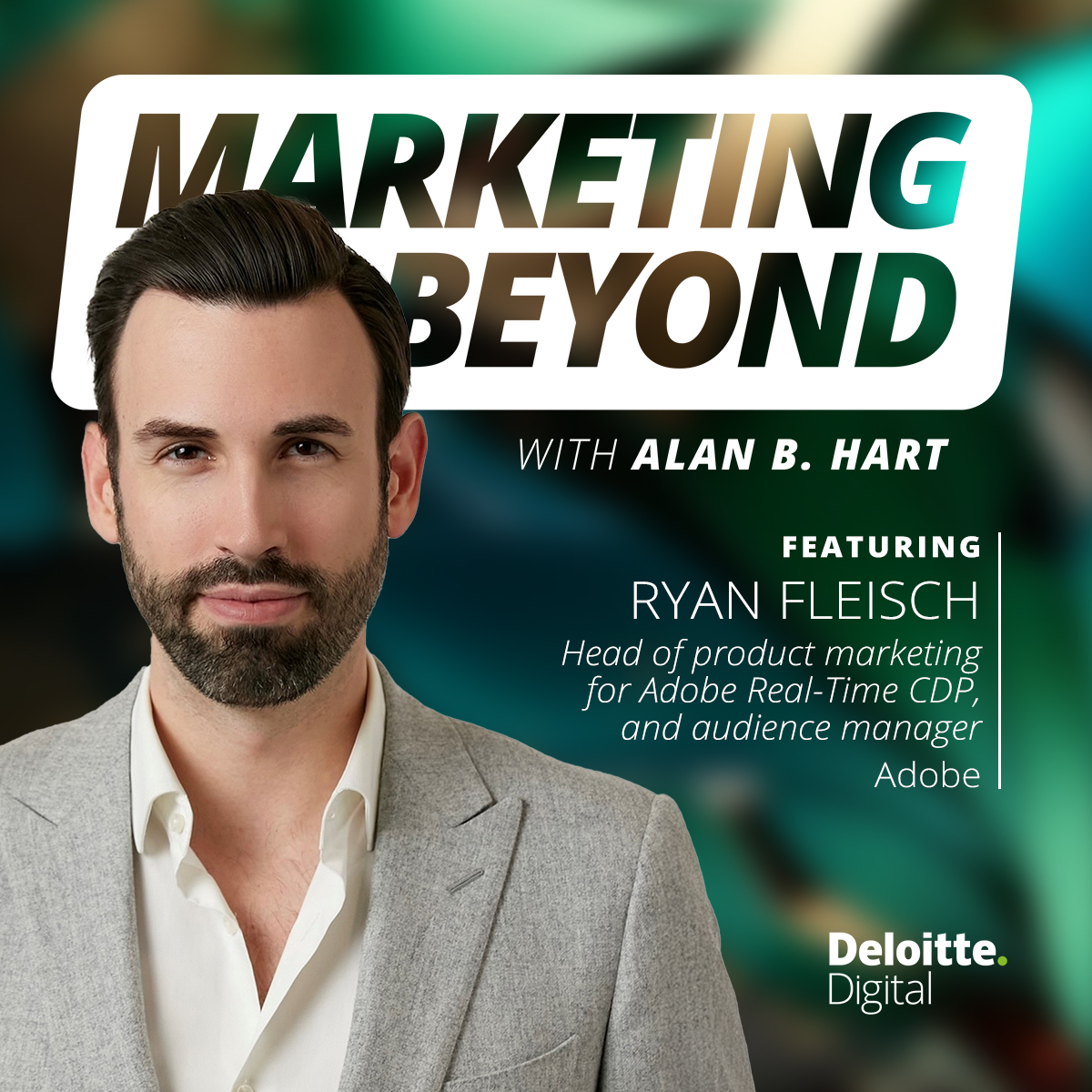
Marketing Beyond with Alan B. Hart
8: Agentic AI and the attention economy: Insights from Ryan Fleisch, head of product marketing for Adobe Real-Time CDP, and audience manager at Adobe
00:32:17
Ryan Fleisch is the head of product marketing for Adobe Real-Time Customer Data Platform (CDP), and audience manager at Adobe. He is also a recent first-time girl dad and Alan's go-to technology whisperer. Ryan has experience on both the agency and...
Loading summary
Transcript68 lines
- [00:00]
Ryan Fleisch
Foreign.
- [00:07]
Alan Hart
Are you ready to go beyond the basics of marketing? I'm Alan Hart and this is Marketing beyond, where we talk about the questions that spark change and share ideas that challenge the status quo. Join us as we explore the future of marketing and its endless potential. Today on the show I've got Ryan Fleisch. He serves as head of Product Marketing for Adobe Real Time CDP and Audience manager. His current role, coupled with his previous experience and roles in solution consulting really helped him understand the technical nuances of marketing and advertising technology as well as the big picture trends that were faced in our industry. On the show today, we talk about the attention economy, how 5,000 messages per day are influencing us and how to maintain people's attention and that overwhelming bombardment of messages and advertising. How relevance and the importance of data are linked to help make sure you can capture the right amount of attention. Talk about a new announcement that Adobe has around data collaboration tools that are really marketer first tools versus a big clunky technology that takes a lot of technical know how. And we talk about the differences between Gen AI, who we've all heard many times over and over again, versus this new agentic AI, and how that is taking us from a notion of synthesizing data and understanding to actually be acting on that data on our behalf, really allowing us to scale our impact as individuals and as departments. So I hope you enjoy this conversation with Ryan Fleisch. Well, Ryan, welcome back to the show.
- [02:05]
Ryan Fleisch
Thanks so much. Thanks for having me, Alan. Good to be here.
- [02:08]
Alan Hart
Yeah. I'm excited to have this conversation. You've had a lot going on in your life recently. Moving a new dog, a new baby. How are you adjusting? It's a lot of change.
- [02:21]
Ryan Fleisch
Just about everything's different from the last time we caught up. Exactly right. I was in Manhattan for a long time. I said I was going to do one year there and that ended up being about 13 years. But this past year my wife and I made the move out of the city. We moved to Connecticut. A week after we moved into the house, we got a little golden doodle and shortly after that had our first kid. So welcome Scarlett into the world.
- [02:46]
Alan Hart
That's awesome.
- [02:47]
Ryan Fleisch
That's awesome.
- [02:48]
Alan Hart
So a baby girl? It sounds like I did, yeah. That's awesome.
- [02:52]
Ryan Fleisch
It's been incredible. So I just got back from paternity leave a few weeks ago and just felt really blessed to have a few months to really just enjoy that time with the family.
- [03:00]
Alan Hart
That's awesome. That's awesome. A lot of change. Enjoy because it goes really fast, especially with kids.
- [03:05]
Ryan Fleisch
So I'm already realizing that.
- [03:09]
Alan Hart
The first couple of months, which you're in right now, like the sleep deprivation is real. So it might be hard to remember, but like after, you know, after you get the sleep under control, then definitely savor every little moment.
- [03:22]
Ryan Fleisch
I will, I will definitely blame the sleep deprivation if I say anything incorrect today on the podcast.
- [03:27]
Alan Hart
I love it. I love it. Let's talk about your career. Like, what was the path? You're now the head of product marketing for Adobe Real Time CDP and audience manager at Adobe. Where did you get your start? And kind of like, how, how did you end up here?
- [03:42]
Ryan Fleisch
Yeah, I always thought I wanted to go into traditional advertising, branding, that type of work. And then it wasn't till I discovered the world of digital marketing and at the time, things like paid search, when it was in its infancy, that I just really found a passion in that where for someone like me who, you know, I think has a creative bent to myself, but doesn't have a formal training in things like graphic design or copywriting, you know, I found that the digital side of marketing can still allow you to be very creative and what that strategy looks like, but still have that data driven approach of what's working and what's not and really feeling the impact that you're making. So I started doing that on the agency side and then on the brand side. And after working at both of those types of companies, the thought of going to work for a technology company that was actually powering these types of campaigns and the tools that I was working in all of the time sounded really appealing. And Adobe was doing a lot of cool stuff in that space. So I made the jump over to Adobe and originally worked in solution consulting, which I really, really enjoyed. I got to go pretty deep on the technology. I got to be talking to clients all of the time and really understanding their needs. And after a while I realized my favorite aspect of that job was how do you position the value and find the right solution for someone? And product marketing seemed like a natural progression from that. So I was able to then think about not just the deal that I was working on at the time, but the overall business of what are the opportunities that we could pursue, how do we really provide value for our clients and how do we communicate that message and that value and that story out to the market at large. So I did that on the advertising cloud now Adobe advertising for a while and then made the move into our customer data products and our CDP DMP and have just been loving it ever since. We've had a lot of new innovation lately, a lot more forthcoming and kind of seeing it go full circle between bridging the data and the content. The creative side of the equation.
- [05:54]
Alan Hart
I love it. Well, I know we'll get into maybe a couple of announcements that are underway, but before we get there, I mean, customer data and audiences. You can't really talk about audiences, I think, without talking about attention. And how do I, how do I get, maintain, keep attention? And I know, I think you've talked about this thing of as known as an attention economy. What should we be thinking about as marketers as we think about the attention economy today?
- [06:26]
Ryan Fleisch
Yeah, I think back a few years, we had the former CMO of Beats the headphones speak at an Adobe event. He said something that's really resonated with me. He's like, you know, people ask me who my competitors are and you'd think I would say other brands of headphones. He's like, but really my competitors are anybody else who's competing for attention on the places that I'm running my brand messages and my ads. And I think that's the world that a lot of brands are in now is you are in a place where studies have shown consumers only spend 400 milliseconds when an ad is put in front of them if they deem that something that's relevant to them and they want to engage with, or if they're just going to let it fly by with the other thousands of ads they might have seen that day. And I think that's high stakes when we think of us as marketers, where we've probably spent weeks, months longer, building and strategizing a campaign and a plan and an audience strategy and the content behind that. For all of it to come to this culmination of a few milliseconds and say, did we get it right or not? So that's where I think to your point. Yes. When you think of an audience strategy or a data strategy, that has to be the underpinning of is this actually going to make the most of those last milliseconds and be relevant for those folks?
- [07:47]
Alan Hart
Well, you know, getting and understanding customers, you've got to know who they are. Right. You got to know how you're transacting with them. What are the natural breaks of segments or audiences that I can start to think about marketing to, to drive up my relevancy. Right. Because relevancy, I think is correlated with attention in my mind.
- [08:11]
Ryan Fleisch
Absolutely.
- [08:13]
Alan Hart
And all of that requires first party data. And so I'M curious, now that we've kind of got first party data under our belt, where can we go from there? What's new in data collaboration with partners that I might have or thinking about third party help if you will. How are you guys at Adobe and specifically I guess around audience and CDP thinking about that?
- [08:41]
Ryan Fleisch
Yeah, there's always been a trade off scale and accuracy historically when it comes to data. I've got my first party data which is typically limited in size relative to other types, but it's probably going to be extremely accurate. I've worked directly with those prospects or customers collected it with consent, I know what they're interested in. Right. Third party data, specifically third party cookies historically have made it easy to buy just broad swaths of data, but the accuracy of those has often been in question. So it can certainly help you get that scale, but it's not going to be as pinpointed to delivering that right message as your first party data. So then after years of talking about this cookie less future, so much so that when Google announced they weren't going to deprecate cookies, my wife walked into the room, she had seen the headline and said, does this mean I have to still hear about the cookie list future for longer now? I thought this was over with.
- [09:40]
Alan Hart
Right.
- [09:41]
Ryan Fleisch
But I think, you know, even most of the studies now are saying, okay, the portion of the Internet that's going to be accessible by third party cookies is somewhere between 15 and 20% depending on what study you look at. So that's really left brands at a place where, okay, if I don't have the same scale that I did before on third party data, how do I get more extensibility out of my first party data and make sure I have the reach with that where I can use that as not just my highest value data for re engaging or building loyalty, but also as a seed for how I'm going to find more users that might look like that. That's one of the things that we've been really, really excited about and we just launched in general availability a few weeks ago, is real time CDP collaboration. So it's a product within a product, right? Our CDP at large. We've said, look, if customers are building a data strategy, you know, hundreds of the top global brands have done that with Adobe already on our cdp. Wouldn't it make sense to say, hey, there's new ways now that you can use that first party data to go work with a second party and understand in a privacy safe way more about those same users or find more Users that look like them. And this is, we've done this in a way where it doesn't require spinning up an entirely separate solution that introduces a new silo in your business and requires a lot of technical work. I think it's a very natural progression to say if you already have data sitting somewhere, let's give you new ways to use that and make that extensible.
- [11:23]
Alan Hart
It's awesome. So I mean, how does that, you know, if I think about like what does it, what does it look like you're thinking about? Like a clean room type functionality where I can connect to my partner or connect to another data source that I may not own, but I can help use it to marry with my data and make it, make it more actionable. Is that the best way to think about it?
- [11:47]
Ryan Fleisch
Great, great question. Because clean rooms have been around for quite some time. What we have realized is that when folks set up a clean room, there can be a mismatch between the resources required to set it up and the beneficiaries of that. Meaning if I'm, you know, someone who works in advertising or not, a technical marketer, right. I have, you know, some pretty straightforward objectives. If I have an audience, I want to reach them, I want to target them, I need to fill the top of my funne. But in order to do that, you know, if I set up a clean room, these are very technical systems that often require a lot of resourcing from it. And every time I want to work with another party, depending on what their tech stack looks like versus mine, I'm having to go through a whole sequence of events.
- [12:38]
Alan Hart
Right.
- [12:38]
Ryan Fleisch
If they're on one database and I'm on another, if they're already using a different clean room like the, the handshake between those can be very cumbersome. So what we wanted to do was say, well, is there a different approach we can take where we can create a layer of data collaboration that's interoperable, where the interface is very user friendly for non technical roles. I can see overlaps of audiences, I can see recommended audiences, I can get measurement back on that and I can work with parties that might have a different tech stack than me without a lot of work on a one to one fashion each time. So the interoperability is huge. And the third piece is making sure that we don't have to actually send all of one company's data somewhere else. Which is typically what happens in a clean room style setup. You're putting all of your data into someone's clean room. Instance and then the process is run from there. Our brilliant engineering team and the multiple patents they've taken to this approach now have basically constructed a way where, through what we're calling Adobe Clean Sketches, we can create a very highly accurate representation of the data without it having to move. So we're talking like 99% accuracy, where two parties can work together and understand these, these overlaps and be able to get more extensibility out of their data without having to go through all of those steps that we just went through for what setting up a clean room and working with different parties might look like in a previous version.
- [14:13]
Alan Hart
I mean, it seems like a pretty big step forward for functional users, the marketers of my life, if you will.
- [14:20]
Ryan Fleisch
And coming from an advertising background myself, it's music to my ears.
- [14:24]
Alan Hart
Yeah, exactly, exactly. Well, we've been talking about data. I mean, data, both our own first party as well as now. The extensibility you can get with partners and collaborators, it keeps growing exponentially. How do you, how do you, how do you keep up with all of that data?
- [14:43]
Ryan Fleisch
There's. There's got to be some help from technology there, because if you look at. IDC puts out a study that just looks at the. The global data sphere, as they call it, and they're saying that the amount of data in the world is going to double in size just from the years 2024 to 2026, which we're smack dab in the middle of right now. So if you think of this exponential growth on the data side, contrast that with, hey, even though STEM jobs are growing faster than many other sectors, there becomes this deluge between, can we keep up with just the amount of data and the amount of breadcrumbs that are getting strewn across more channels and more devices than ever before to make sense of actually really understanding a customer and creating the right experience for them. And so to me, that. That can only be really empowered by leveraging AI to say, can we cut through some of this noise and really help humans extract the right insights and let them still focus on what humans do best of the strategy behind this, the creativity behind this, all of those elements. Right. But be able to surface the right insights from the overwhelming amount of data that's out there right now? So that's been a really exciting focal point for Adobe as well, and that spans our creative cloud or digital experience products of how is AI really embedded? And not just AI, but generative AI and agentic AI in all of these systems in a way that can empower humans to make the most of every touch point.
- [16:17]
Alan Hart
Yeah. Well, we've been hearing about AI and particularly gen AI and marketing for quite some time. Can you help me understand the differences between gen AI and agent AI? Like how do, how does it, how do I think about it working?
- [16:33]
Ryan Fleisch
Yeah, I'm remembering, I think the last time we talked, Alan, it was. Or the last time we did this podcast, I think that was like a month after kind of the explosion around chatgpt. It just happened.
- [16:43]
Alan Hart
Exactly.
- [16:43]
Ryan Fleisch
And everybody was like, oh my God, what's this? This generative AI, it's. It's incredible how far it's come and widespread it's come since then because, you know, we, we've had generative AI in market for a while. We had AI Assistant as a big announcement in previous Adobe summits. And you can think of, you know, agentic AI now is still building upon that, but in a few really interesting ways. When you think of generative AI or AI assistant, like we build, you know, it's kind of a single pane of glass where you can interact, ask questions, get answers, find really interesting insights there. But when you take that to the next level, it's what can the AI on the other side of that pane of glass really do for you? So I think the few things that I think of as how proactive is it versus reactive with generative AI, I might ask a question and it might generate an answer in a reactive way. Where in agentic AI, it doesn't just understand my business data, it actually understands my business processes and my goals. So it could come to me proactively and say, hey, we know you're trying to hit this acquisition target. We're recognizing that there's audience segment that might be really ripe for conversion that we'd recommend targeting here, that could help you hit those goals. Would you like me to set up a campaign for that? And so that second piece then of actually going and executing on tasks versus just providing the information for you to go execute on them is kind of the other, I think vector to look at this through of how much is there a degree of freedom where an AI agent can go execute on your behalf to help you hit those business objectives, not just sift through the data. So that's where we're at now with agentic AI. And I always kind of think it makes more sense when you put it just in the lens of a maybe consumer problem that all of us have encountered. Right. Like if I were to ask a reservation app, is there a table available at this restaurant on this Time, Sure. It could give me an answer to that and that's somewhat helpful. But if I had the ability to have say, look, I need a table for my wife and I, it's our anniversary on Friday. Find a romantic restaurant that has availability between the hours of 7 and 9 and recommend a list of three places for me and I'll let you know which one I want you to go book and then go do that. Well, that's a completely different. The paradigm shift of now how AI can really help me work through a whole problem that I'm trying to solve rather than just a reactive approach on a step by step.
- [19:30]
Alan Hart
Yeah, no, that's a really good example. I mean, I think about it, my simplistic analogy is like a way to scale some aspect of myself.
- [19:40]
Ryan Fleisch
Exactly.
- [19:41]
Alan Hart
Take action on something based on the criteria I'm looking to take action around. So it's that not only knowledge synthesis that we get with Gen AI, but knowledge synthesis plus action, which is kind of cool. Very cool.
- [19:55]
Ryan Fleisch
And I think aside from just the marketers using it, it's also going back to what we were just talking about with consumers. It's not just that they're leaving behind more data than ever, it's that they're getting targeted with more ads than ever. There's studies that are saying if you live in a city like New York or large metropolitan city, you're likely getting targeted between 5 to 10,000 ads every single day. Which to put that in perspective, Alan, if you remembered all of the ads you saw, you would use over your brain's, over half of your brain's entire mental capacity in under two years. So.
- [20:33]
Alan Hart
Wow.
- [20:34]
Ryan Fleisch
Yeah, yeah, exactly. If you, if you forget, you know, a birthday or an anniversary or something to say, you got targeted with too many ads. That hasn't worked for me yet.
- [20:44]
Alan Hart
I don't think that's going to work with my wife, but might work with some other people.
- [20:48]
Ryan Fleisch
Exactly. But I mean, you know, when you think of cutting through that noise back to the attention economy and everything, having that understanding of a consumer, but again, making the most of the last milliseconds, not just with the data, the data will only take you so far. It's then about are you actually putting the right content in front of that person? And previous coworker in Adobe, just a brilliant creative named Adam Morgan. He wrote a book called Sorry Spock, Emotions Drive Business but. But he kind of put it down to a formula that if you want a lasting memory or lasting impression, it has to be some combination of an anomaly plus A memory. So you have to think of, you know, is, is there some type of match that you're drawing with the data to someone, but then can you do something that's in its own way an anomaly that stands out with the creative that you're serving them? And I think that's the piece that's been frankly under indexed for a long time. Since we've had so much data that we've just gotten so data driven that we've forgotten that, hey, all of this is really a means to an end, that it should just inform a better experience that you're putting in front of someone. It's not an excuse to build micro segments and segments of one only to then have the same web experience or the same ad or the same email be sent to them.
- [22:05]
Alan Hart
It's fascinating. Well, I mean, I guess first of all, kudos on the technology advancements you guys are making at Adobe. For folks like myself and the folks that I work with marketers every day, it's super important to make sure we're empowering the marketers of the future with the tools that they need to do their job. So kudos on the advancements you guys are making.
- [22:28]
Ryan Fleisch
Thank you.
- [22:29]
Alan Hart
One of the things I love to do on this show is get to know you, whoever we're talking to, a little bit more. And my favorite question to ask everybody that comes on the show is, has there been an experience of your past that defines or makes up who you are today?
- [22:46]
Ryan Fleisch
That's a big one. I don't know if it makes up everything about who I am today, but I guess the one that stands out is when I was graduating college, I really knew I wanted to end up in New York City. And it was the game of how do you get there and how do you make it work financially and everything. And I had a group of friends that were like, they all worked in finance, they were doing fine college, and they were like, hey, we had one room become available in this apartment. It felt like about 30 people lived there. I think it was six of us. But another one of my friends that worked in or wanted to work in marketing as well. We looked at this and we're like, well, we could make this work if we split the room. And so the next thing you know, two grown men are googling. Do they make queen over queen size bunk beds? And you know, we made it work. It was a fun experience for a year. I don't think we would have wanted to do it much longer than that. But, you know, I think back like If I hadn't have done that and just found a way to make it work to get to New York and start a career here and take an opportunity in digital marketing, I think I would have ended up in a wildly different place right now. And so I think the kind of just resilience or overcoming, you know. Yeah, it's not always going to be perfect. Every step to get somewhere. But look at the long term horizon to that of is this still taking you where you want to be? Sure, there's going to be temporary speed bumps that might get you there, but, you know, just, just overcome those and keep your eye focused on, on the long term there.
- [24:21]
Alan Hart
Yeah. Don't fear the bunk bed.
- [24:23]
Ryan Fleisch
Don't fear the bunk bed.
- [24:26]
Alan Hart
Well, I'm curious. Did you find a queen over a queen bunk bed or do you have to make something?
- [24:31]
Ryan Fleisch
No, that. That's a very funny question because we did.
- [24:35]
Alan Hart
Wow.
- [24:35]
Ryan Fleisch
Okay. And with a caveat, it was like, oh, mattresses are included. Well, this thing gets delivered and we're like, where are the mattresses? And the delivery guy points to these small little boxes that are like 4 inches by 4 inches. Like they're rolled up in that. So the mattresses were a thick sheet, basically. They were like a 1 inch thick. Okay, we'll buy different mattresses. And then we realized that there's a weight limit and we couldn't. So that was not the, that was not the most comfortable year of sleep there.
- [25:03]
Alan Hart
But, but it worked. It worked.
- [25:06]
Ryan Fleisch
I guess anything for the future of marketing, right?
- [25:11]
Alan Hart
I love it. Well, what advice would you give your younger self if you're starting this journey, Oliver? Besides mattress clarity?
- [25:20]
Ryan Fleisch
Besides, don't fear the bunk bed.
- [25:22]
Alan Hart
Right.
- [25:23]
Ryan Fleisch
I would say look, look at. And I know this is a little bit cliche, but plan out your, your goals and your objectives and look back on your success not by, you know, one year at a time, but by a much longer horizon of 5, 10 years. Because, you know, if I would have only looked at what is that one year going to look like, moving to New York versus maybe a comfort of where I already was or, you know, staying in one job and not trying something new that I thought was going to be, you know, a little bit scary at the time, but maybe even take me closer to where I wanted to be. I, I look back now of just being at Adobe alone and coming up on 11 years next month, and I think the longevity, when you look back on that, you're like, sure, there was other opportunities or paths I could have taken in that horizon, and I Look back now, I'm like, I am so happy that I kept my eye focused on the long term here. That I've had a company I believe in and that believes in me that it's been able to help me achieve my objectives and that I've been able to see so many talented people come through here and hopefully help them in a small way achieve their objectives as well. I think that's been the most rewarding piece to me. So I know it's easy when you're younger to say everything has to be now and here and instant, but just slow down, look at the long term and really keep that in focus.
- [26:46]
Alan Hart
Yeah, it's great advice. Great advice. Is there either something you're trying to learn more about yourself or a topic you think marketers need to really be learning more about today?
- [26:57]
Ryan Fleisch
I think on the marketing side, I'll get gentic AI piece, I think is absolutely critical whether you work in marketing technology and you need to learn more about the opportunities with how that can be leveraged in a platform or if you're, you know, a marketer at a brand or an agency or anywhere else. Right. Thinking about how can agentic AI, as you put it, Alan, you know, kind of be a force multiplier for yourself and help you scale. There's a huge amount of opportunity that's already here and quickly coming with that. So that would be the thing I would learn more about on the first part of your question, the personal front, I've found that in the wake of generative AI and everything, from just incredible image generation and video generation and everything else, I've actually also found myself appreciating physical art more than I ever have before. I think that's been kind of over the past year, my increase in just personal passion there of learning more about art history and new artists that are out there today that I've wanted to collect, it's taken on a whole new appreciation for me. And my dad was actually an artist as well. He worked in acrylic paints and did still lifes and just incredible work. And I've found now that while there can be amazing generation of content so quickly, when you actually start to understand the story and the piece of someone that they've poured into a painting or any other form of art from a physical standpoint, that I think it's something I've come to appreciate even more these days.
- [28:31]
Alan Hart
Yeah, that's beautiful. It may be related to art, but are there any trends or subcultures that you're following? You think other people should take notice of.
- [28:40]
Ryan Fleisch
I would say it's that I think there's been a rise in art and you're seeing a rise across all aspects of it. I think you have seen a rise, maybe more so in some of the digital trends of art like NFTs and the like. But you know, I would encourage you. Yeah. Like find some artists, it doesn't have to be, you know, painting, but writing whatever form it might be and you know, kind of step back and appreciate the work. Again, the piece of themselves that they've literally poured in to that that's, you know, couldn't be learned from just data there. So. Yeah.
- [29:16]
Alan Hart
Awesome. Well, last question for you. What do you feel like is the largest opportunity or threat facing marketers today?
- [29:24]
Ryan Fleisch
You know, I think the opportunity is, is actually pairing the content with the data. Because the abundance of data that we have, as we just talked about a few minutes ago, Alan, you know, it's. I think we've over the years taken John Wanamaker's quote too seriously of I know half my marketing or half my advertising works. I just don't know which half that we've all heard this clich a million times. But I think we've ab tested ourselves so much that we've made John Wanamaker very sad that we've said, well, okay, I can track this channel over here. So I'm going to put more dollars into it and remove them from, you know, another channel, be it television or whatever else. Right. That might be a more creatively engaging channel because, you know, in the years past, maybe I couldn't track it with the same level of data. I think now that there are a number of ways. You know, we just talked about the data collaboration aspect. There's a number of other ways where you can get that data driven approach across channels. So rethinking, what is the creative strategy that goes into these now where it doesn't just have to be something that historically we've been able to track, you know, since the exception of the channel, like paid search, still an extremely important channel. But how do I now kind of step back and say I have all this data. What is that really telling me that I should be creating across a channel like Connected Television or Programmatic Audio or whatever else that it might be?
- [30:52]
Alan Hart
Right. No. Very thought provoking. My brain is going down the rabbit hole there. Ryan, I just want to say thank you. It's always fun to talk to you. I feel like you're my technology whisperer these days. So thank you for coming on explaining stuff to me.
- [31:09]
Ryan Fleisch
Thanks so much for having me, Alan. Always a pleasure to talk.
- [31:15]
Alan Hart
The views, thoughts and opinions expressed are the speaker's own and do not represent the views, thoughts and opinions of Deloitte. Material and information presented here is for general information purposes only and does not imply endorsement or opposition to any specific company, product or service. Hi, it's Alan again. Marketing beyond is a Deloitte Digital Podcast. It's created and produced by me with post production support from Sam Robertson. If you're new to Marketing beyond, please feel free to write us a review and subscribe on your favorite listening platform. I also invite you to explore the other Deloitte Digital podcast@deloittigital.com US podcast and share the show with your friends and colleagues. I love hearing from listeners. You can contact me at marketingbeyondeloitte.com you'll also find complete show notes and links to what's discussed in the podcast today and you can search our archives. I'm Alan Hart and this is Marketing Beyond.