Loading summary
Transcript41 lines
- [00:00]
Grainger Announcer
If you're a maintenance supervisor at a manufacturing facility and your machinery isn't working right, Grainger knows you need to understand what's wrong as soon as possible. So when a conveyor motor falters, Grainger offers diagnostic tools like calibration kits and multimeters to help you identify and fix the problem. With Grainger, you can be confident you have everything you need to keep your facility running smoothly. Call 1-800-GRAINGER clickgrainger.com or just stop by. Grainger are the ones who get it done.
- [00:30]
Marketplace Sponsor Announcer
Running a business is hard enough, so why make it harder with a dozen different apps that don't talk to each other? Introducing Odoo, the only business software you'll ever need. It's an all in one, fully integrated platform that makes your work easier from CRM, accounting, inventory, E Commerce, and more. And the best part? Odoo replaces multiple expensive platforms for a fraction of the cost. This is why over thousands of businesses have made the switch. So so why not you try Odoo for free@odoo.com that's O D O O.com
- [01:02]
Sabri Benishore
who is your boss? Sometimes it's hard to tell. From Marketplace I'm Sabri Benishore, in for David Brancaccio. Who your boss is makes a huge difference in taxes, worker protections, benefits. If your boss is you because you're an independent contractor, AKA gig worker, you're on your own in a lot of ways. But if your boss is somebody else, that employer has obligations to offer benefits. Take out taxes. Workers and employers and governments often fight over this. The Labor Department has just proposed a new rule on the question. Marketplace's Nancy Marshall Genser has more the
- [01:37]
Nancy Marshall Genser
proposed Trump administration rule would make it easier for companies to classify people as gig workers. The Labor Department's wage in our division, administrator Andrew Rogers makes it sound simple.
- [01:48]
Legal Expert / Analyst
Generally, if a worker is in business
- [01:50]
Marketplace Sponsor Announcer
for him or herself and isn't dependent on an employer for work, the worker
- [01:55]
Legal Expert / Analyst
is an independent contractor.
- [01:57]
Nancy Marshall Genser
The proposed Trump administration rule puts more weight on how much control workers have and whether they face a profit or loss. That standard tends to favor employers. But there are gray areas, and the ultimate deciders here are the courts, says Richard Reibstein, a partner with the law firm Troutman Pepper Lock. He says this proposed new rule is
- [02:18]
Grainger Announcer
much ado about nothing from a legal standpoint.
- [02:22]
Nancy Marshall Genser
Reibstein says that's because anyone disagreeing with the rules goes to court. Besides, he says, the gig worker rule changes every time there's a new president. President Obama's regulations were erased by the first Trump administration, which was overridden by the Biden White House. Now the world is ping ponging back to where it was during Trump's first term.
- [02:42]
Grainger Announcer
Therefore, the courts are saying we don't need any help. That's why they've essentially disregarded these prior rules on independent contractor status.
- [02:54]
Nancy Marshall Genser
And Reibstein expects this latest Trump administration rule to also wind up in court. But first it has to be finalized, and that can only happen after a 60 day public comment period. I'm Nancy Marshall Genser for Marketplace.
- [03:07]
Sabri Benishore
A federal judge has ruled that companies that paid tariffs that were then struck down by the Supreme Court as unconstitutional a couple weeks ago are in fact entitled to refunds. The Supreme Court didn't get into that in its ruling, so that question has fallen to lower courts. To get sorted out, the government collected more than $130 billion in unconstitutional tariffs.
- [03:45]
Kaylee Wells
Lifelock how can I help? The IRS said I filed my return,
- [03:49]
LifeLock Customer
but I haven't One in four tax paying Americans has paid the price of identity fraud.
- [03:53]
Kaylee Wells
What do I do?
- [03:54]
Nancy Marshall Genser
My refund though. I'm freaking out.
- [03:56]
Kaylee Wells
Don't worry, I can fix this.
- [03:57]
LifeLock Customer
LifeLock fixes identity theft guaranteed and gets your money back with up to $3 million in coverage.
- [04:02]
Nancy Marshall Genser
I'm so relieved.
- [04:03]
Marketplace Sponsor Announcer
No problem. I'll be with you every step of the way.
- [04:06]
LifeLock Customer
One in four was a four fraud paying American. Not anymore. Save up to 40% your first year. Visit lifelock.com Special offer terms apply this
- [04:15]
Marketplace Sponsor Announcer
Marketplace podcast is supported by Fundrise. Billion dollar investors don't typically park their cash in high yield savings accounts. Instead, they often use one of the premier strategies for institutional investors, private credit. Now, the same passive income strategy is available to investors of all sizes throughout, thanks to the Fundrise Income Fund, which has more than $600 million invested and a 7.97% distribution rate. With traditional savings yields falling, it's no wonder private credit has grown to be a trillion dollar asset class. Learn more@fundrise.com marketplace. The fund's total return in 2025 was 8% and the average annual total return since inception is 7.8%. Past performance does not guarantee future results. Current Distribution rate as of 12312025 carefully consider the investment mater, including objectives, risks, charges and expenses. This and other information can be found in the Income Funds prospectus@fundrise.com Income this is a paid advertisement.
- [05:17]
Sabri Benishore
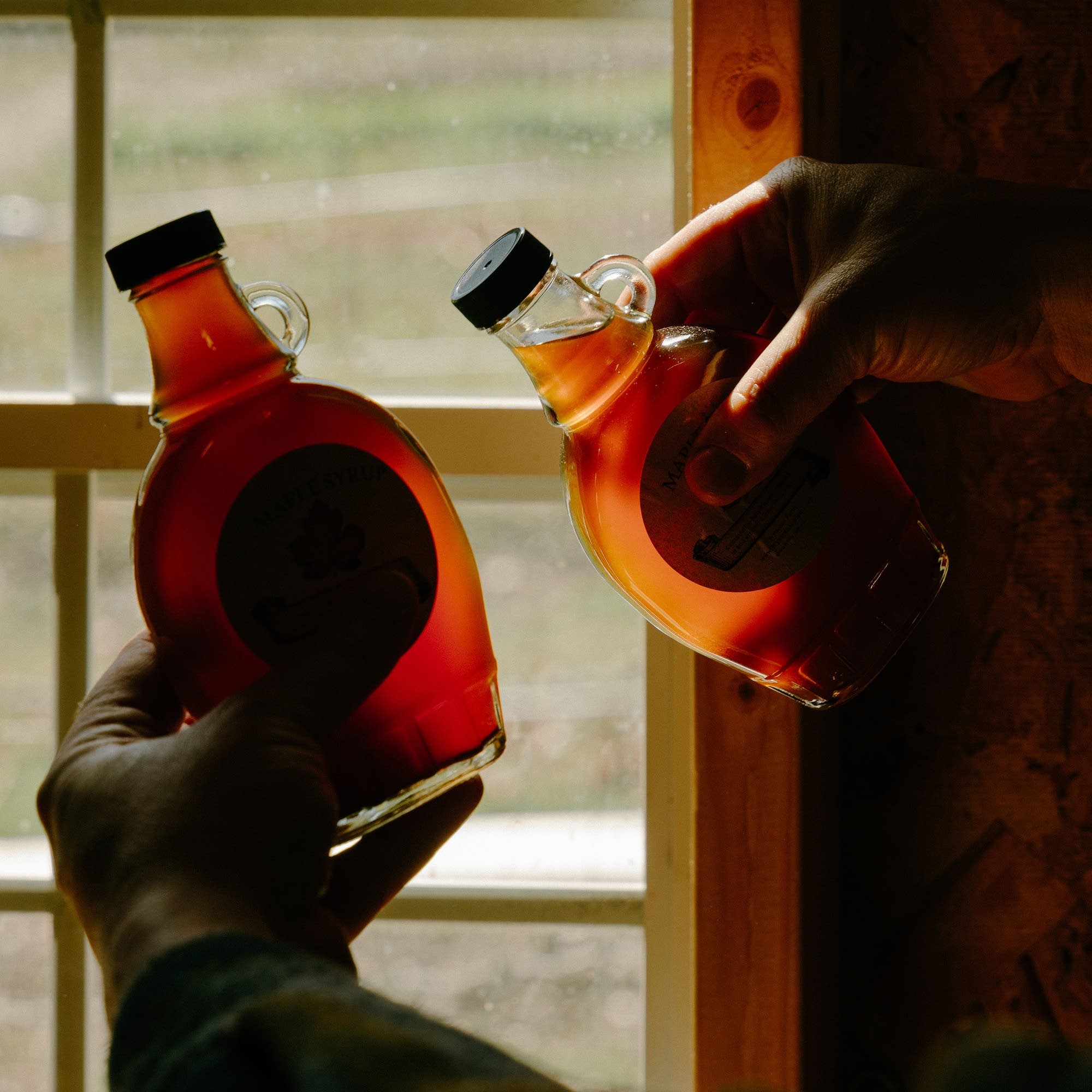
If you live in the Northeast and Midwest, you do not need me to tell you it has been a brutal winter there and you might be longing for warmer weather to Come as soon as possible. But farmers who make maple syrup are not. This merciless. Winter has been nothing but good news for them and and for future pancake breakfast needs. Marketplace's Kaylee Wells drove to a maple farm about an hour east of Cleveland to find out why.
- [05:44]
Kaylee Wells
Every winter, John Cermak and his family drill holes into 2,200 maple trees on their 45 acre farm. They hammer steel spouts into those holes and then they wait.
- [05:56]
John Cermak
So the ideal weather for us is when it freezes at night and then thaws during the day.
- [06:02]
Kaylee Wells
This last winter was Greater Cleveland's coldest in more than a decade, perfect for making maple syrup. Then the temperatures warmed a little and. A slow drip of SAP falls into a bucket or a tube. This is how maple syrup starts. This tree will produce dozens of gallons of SAP this season, which is good because it takes 40 gallons to make 1 gallon of syrup. Today, the Cermacs are boiling down giant tubs of SAP.
- [06:32]
John Cermak
I think we probably have about 7 or 8,000 gallons.
- [06:37]
Kaylee Wells
They all have day jobs, so they're just getting started as dusk arrives.
- [06:41]
John Cermak
Maple syrup is not a get rich quick scheme. It's not even a get rich slow scheme.
- [06:46]
Kaylee Wells
They'll be camped in the sugar house till roughly one in the morning, throwing logs they harvested last fall into a furnace every five minutes, reducing that SAP and into a golden syrup. For the Cermax, this mid February start is pretty normal. Adam Wild is director of Cornell University's Maple Research Forest. He says tapping season is changing.
- [07:07]
Adam Wild
The season is starting one to two weeks sooner in areas and overall I think the long term trend shows that a season is shortened by like three days at this point, which is not
- [07:17]
Kaylee Wells
great because Wild says demand for maple syrup has quadrupled in the last two decades as people look for natural foods with fewer ingred plus, whoa. There's so much more in that flavor than I ever have experienced. Taste wise, Hungry Jack pales in comparison. So far, adapting to the shorter season has meant improved storage systems, tubes, vacuum pumps, and leak sensors. The Cermacs already have all that. Eli Susakovich III teaches environmental policy at Northwestern and does a course on maple trees.
- [07:53]
Eli Susakovich III
It's not that the maple trees are stopping what they're doing, it's just they're changing the times when they do it.
- [08:00]
Kaylee Wells
He says the bigger problem is that the industry isn't changing along with the climate because of the we tap when we tap, because that's when we've always tapped mentality.
- [08:10]
Eli Susakovich III
It's the small producers that really you need to watch what they're doing. They're going to be crucial and probably lead the way in how syrup is produced.
- [08:19]
Kaylee Wells
Small producers like Jim Cermak, the patriarch at Sugarbush Creek Farm, you just always
- [08:25]
Marketplace Sponsor Announcer
have to be ready. So it doesn't really matter what the calendar date is. You know, who cares? You tap when the weather's, you know, when it gets warm and cold.
- [08:35]
Kaylee Wells
This year, the Cermak's first boil was mid February. Two years ago, an especially mild year, it was January 10th. In Middlefield, Ohio, I'm Kaylee Wells for Marketplace.
- [08:47]
Sabri Benishore
And in New York, I'm Sabri Benishore with the Marketplace Morning Report. From APM American Public Media.
- [09:00]
Legal Expert / Analyst
America's housing system is under strain. From natural disasters to the rising cost of shelter, the challenges we face and the solutions we embrace will shape how we live for the next hundred years. I'm David Brancaccio, host of the Marketplace Morning Report, and I've been working with this old house radio hour on a special podcast episode that explores how Americans are reimagining housing in this changing world. It's called Building Tomorrow. From wildfire resistant houses in California to tiny home communities in Texas to a super duper energy efficient house in the Northeast, this special blends innovation, new business models and personal stories to explore how resilience, affordability and our climate reality are redefining what home looks like. To listen, go to Marketplace Morning Report in your podcast. Apparently.