Loading summary
Transcript28 lines
- [00:00]
A
This podcast is supported by Odoo.
- [00:02]
B
Some say Odoo business management software is like fertilizer for businesses because the simple, efficient software promotes growth. Others say Odoo is like a magic beanstalk because it scales with you and is magically affordable. And some describe Odoo's programs for manufacturing, accounting, and more as building blocks for creating a custom software suite. So Odoo is fertilizer magic beanstalk building blocks for business. Odoo. Exactly what businesses need. Sign up@odoo.com that's o d o o.com.
- [00:30]
A
The McDonald's snack wrap is back. You brought it back. Ranch snack wrap, Spicy snack wrap. You broke the Internet for a snack? Snack wrap is back.
- [00:46]
B
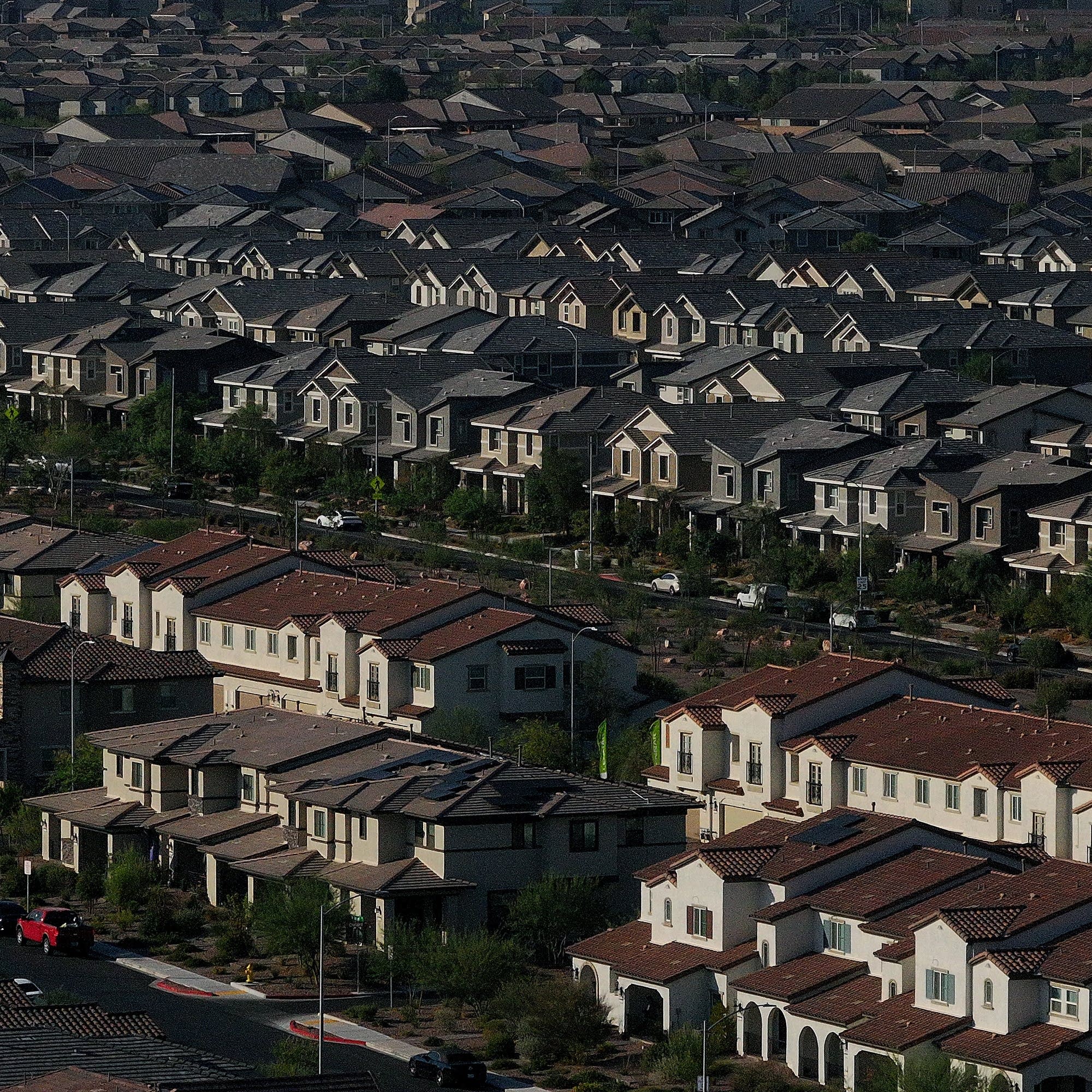
What's ahead for the housing market in 2026? For Marketplace, I'm Nova Safo in for David Brancaccio. As the year winds to a close, we've been looking ahead to 2026 and today we consider the fate of the housing market, which has been weighed down by rising home prices, high interest rates and climbing insurance premiums. Marketplace's Amy Scott has been looking at forecasts and joins me now with more. Hi, Amy.
- [01:12]
C
Hey, Nova.
- [01:13]
B
So let's begin by describing where the housing market is right now. How would you describe it as we close out the year?
- [01:19]
C
Yeah, well, it's overall been pretty sluggish. Of course there are big regional differences, but sales have been pretty flat. And that's just because affordability remains such an issue issue for people, you know, trying to get into the market. So mortgage rates have come down. You know, they were closer to 7% when this year started. Now they're in kind of the low 6% range for a 30 year fixed rate mortgage. But that hasn't been enough to offset the really high prices that are keeping a lot of would be buyers on the sidelines and then home sellers, you know, many of whom have these ultra low interest rates from the pandemic have just had a hard time parting with those rates and, and moving. So we've seen a lot of houses taken off the market or deals that fell through. And as, as folks have been telling me, you know, overall no one walked away happy from this housing market.
- [02:15]
B
Oh boy, that's a tough market. And what's the outlook for 2026?
- [02:20]
C
Well, most economists I've been talking to and realtors are expecting some improvement. A modest pickup in sales I've seen ranges from one to three, though the national association of Realtors is sort of the outlier, predicting a 14% increase. But generally economists expect Mortgage rates to stay in the low to mid 6% range, which will mean prices don't rise as fast as they have been. Many are actually expecting prices to rise more slowly than incomes, which would be the first time that happened for a prolonged period in many years. Redfin is predicting what they're calling a years long great housing reset that will begin in 2026 with gradually improving affordability and something more like a normal market, which we haven't seen in a long time.
- [03:12]
B
Well, that certainly would be a light at the end of the tunnel, but you know, we always have to take any forecast with a big dose of salt. Right. What are some caveats that we should be thinking about?
- [03:20]
C
Yeah, I mean, there's a lot of uncertainty about the job market. If it's going to get a lot weaker, that would certainly hurt home sales. What happens with inflation and tariffs is very much a question mark. Fed leadership, as one econom has told me, no one's ever right about economic forecasts. And if they say they were right, they're lying. So this is the best guess that folks I've talked to can make right now.
- [03:44]
B
Well, all right, Marketplace is Amy Scott. Thank you very much.
- [03:47]
C
Thank you.
- [03:48]
B
And by the way, there's fresh data this morning on home prices. In October, they rose 1.4% on an annual basis. That's according to the S and P totality Case Shiller index. A year ago at this time, home prices were rising at a 3.5% annual rate. New York City's Metro, the largest public transit system in the country, is retiring its swipeable card to get in and out of subway stations. In 1994, the card replaced a coin like token. Now the MTA is embracing contactless payments. Tap your smartphone or credit card. Existing Metro cards will still work for some time into 2026.
- [04:42]
D
Guys, thanks for helping me carry my Christmas tree.
- [04:44]
A
Zoe, this thing weighs a ton. Drew Ski, Live with your legs, man.
- [04:47]
D
Santa.
- [04:48]
A
Santa, did you get my letter? He's talking to you, Bridges. I'm not.
- [04:51]
D
Of course he did.
- [04:53]
A
Right, Santa, you know my elf Drew Ski here, he handles the nice list. An elf? I'm six' three. What everyone wants is iPhone 17 and at T Mobile, you can get it on them. That center stage front camera is amazing for group selfies, right, Mrs. Claus?
- [05:06]
D
I'm Mrs. Claus much younger sister. And AT T Mobile, there's no trade in needed when you switch, so you can keep your old phone or give.
- [05:13]
A
It as a gift.
- [05:14]
D
And the best part, you can make the switch to T Mobile. From your phone in just 15 minutes.
- [05:18]
A
Nice. My side of the tree is slipping. Kimber the holidays are better. AT T Mobile switch in just 15 minutes and get iPhone 17 on us with no trade in needed and now T Mobile is available in US cellular stores with 34 monthly bill credits for well qualified customers plus tax and $35 vice connection charge credits and balance due if you pay off earlier Accounts and Finance Agreement 256Gates $830 eligible forward in a new line $100 plus a month plan with auto pay plus taxes and fees required. Check out 15 minutes or less per line.
- [05:41]
B
Visit t mobile.com there's renewed focus on the vulnerability of the global auto supply chain after hackers targeted British carmaker Jaguar Land Rover. That happened in September. The car giant was hobbled by the cyber attack and production halted for weeks. The BBC's Theo Leggett takes a look at the repercussions.
- [06:01]
A
Jaguar Land Rover normally makes more than 1,000 cars a day at its factories around the world, but production was crippled for more than five weeks. And while the impact on JLR itself was severe, a swathe of other businesses, the carmakers suppliers were also hit. As David Leggett of Global Data Automotive explains, if you think of a typical vehicle, it could have up to 20,000 component parts with thousands of suppliers around the world. When manufacturing operations stop at the top, then the whole supply chain underneath that think of it as a pyramid. The whole supply chain underneath that seizes up because there is nowhere for the component parts and output to go and the factory is therefore growing to a halt. Among JLR's main suppliers is EvTech Group. It makes engine parts at a plant in the English Midlands. More than a month into the stoppage, I went there to have a look around. The normally bustling factory was eerily quiet and boxes of undelivered parts were stacked up from floor to ceiling in every available space. Evtech's chairman David Roberts told me what was going on. We stopped sales in early September, so we've had to take stringent cost measures to protect the business, make sure we survive that's involved, unfortunately, sending people home because we couldn't do any productive work for them. But clearly that can't last. Fortunately, it didn't last. In October, JLR resumed production and eventually so did its suppliers. According to the Cyber Monitoring Center, a non profit group which looks at the impact of hacking incidents, the attack on JLR caused financial losses of more than $2.5 billion. Professor Kieran Martin is chair of the center's Technical Committee. He believes the affair has exposed a key vulnerability in the way developed nations protect themselves against cyber threats. Under no sensible definition of absolutely critical infrastructure does JLR count. It's not the national grid, it's not one of the big banks, it's a carmaker. But it's the next level down where lots of economic activity, lots of prosperity, lots of people's jobs, lots of local well being depend on it. That next level down, I think, is a really serious systemic vulnerability in all our economies. JLR is now back up to full production, and it seems fears that many of its smaller suppliers might not survive have not been realized. Nevertheless, the affair has shown clearly how vulnerable our economies can be, with an attack on one key company causing havoc for thousands more. In London, I'm the BBC's Theo Leggett for Marketplace.
- [08:31]
B
And I'm Nova Safo with a Marketplace morning report from APM American Public Media.
- [08:43]
D
Hey everyone. You already listened to Marketplace podcasts, so you know that it's important to understand how economic forces shape our lives. And that feels especially important now as we're all trying to make sense of the latest headlines. I'm Rima Reis, host of Marketplace's this is Uncomfortable, a show that explores how money bumps up against our relationships, our choices, and the parts of life we don't always say aloud. And starting January 15th, we are back every single week. New stories, new questions, and the kind of conversations that make you feel less alone in this quickly changing economy. We're tackling questions like should I turn my hobby into a money making side hustle? How do I deal with layoff anxiety? Or what do we owe our parents financially? Don't miss an episode. Subscribe to this is Uncomfortable from Marketplace. Wherever you get your podcasts.