Loading summary
Transcript27 lines
- [00:00]
A
Hello listeners. Marketplace's Webby winning kids podcast Million Bazillion is back for an all new season. Hosts Bridget and Ryan are answering a whole new set of kid questions about everything from royalties and franchises to why the heck we have a two dollar bill. Even grown ups might learn a thing or Two Million Bazillion is presented in partnership with Greenlight, the debit card and money app for kids and teens. Give your family the tools to manage money wisely with Greenlight. Learn more@greenlight.com million and tune into Million Bazillion wherever you find your favorite podcasts.
- [00:38]
B
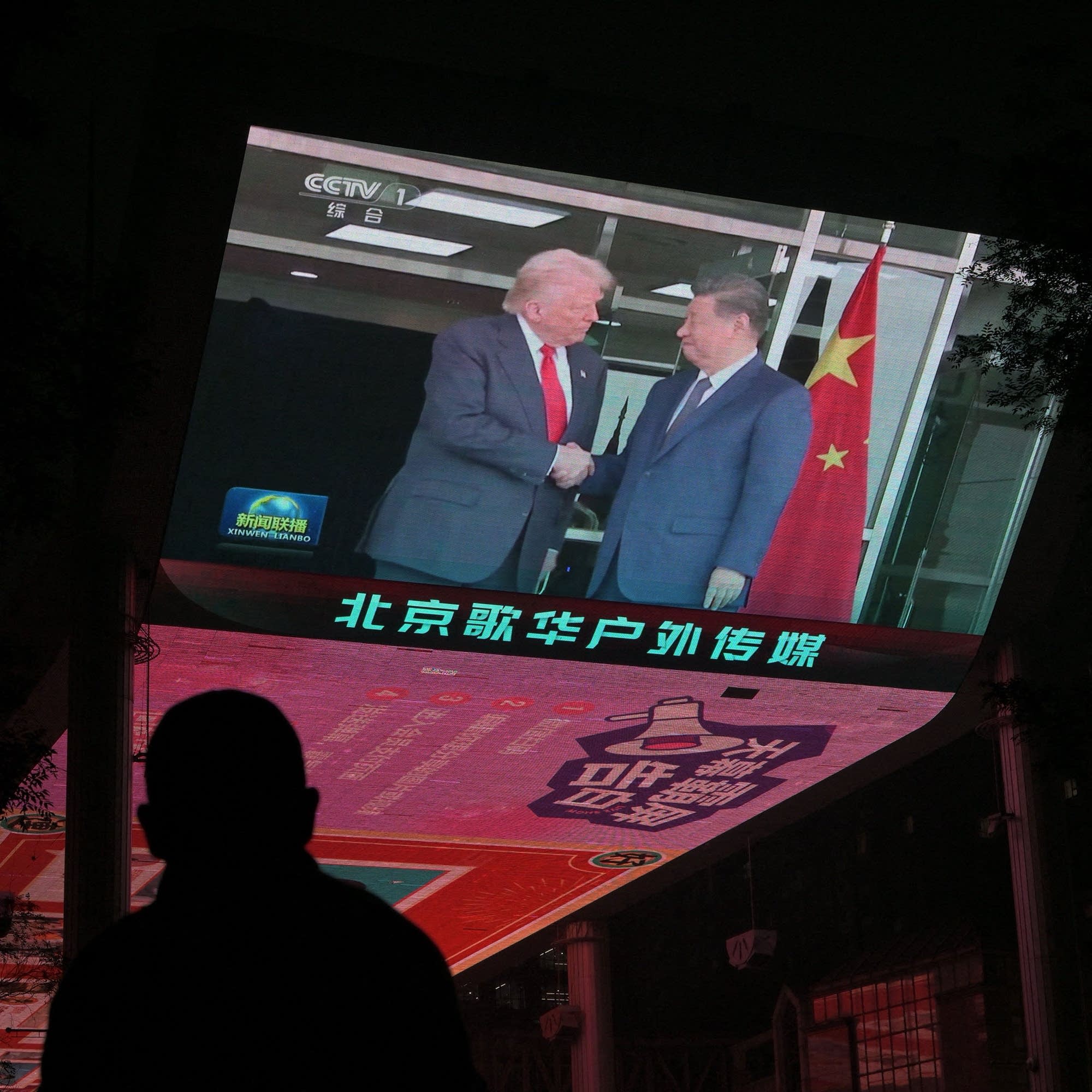
Introducing your new Dell PC with the Intel Core Ultra processor. It helps you handle a lot, even when your holiday to do list gets to be a lot like organizing your holiday shopping and searching for great holiday deals and customer questions and customers requesting custom things. Plus planning the perfect holiday dinner for vegans, vegetarians, pescatarians and Uncle Mike's carnivore diet. Luckily you can get a PC with all day battery life to help you get it all done. That's the power of a Dell PC with Intel inside backed by Dell's price match guarantee. Get yours today@dell.com holiday terms and conditions apply. See dell.com for details. The US and China today work to thaw some of the ice I'm David Brancaccio in Los Angeles. President Trump and Chinese President Xi today agreed to a one year trade truce and lowered the temperature in critical areas such as China's rare earths, illegal fentanyl shipments and US Controls on microchip exports. Marketplace's China correspondent Jennifer Pak reports from Shanghai.
- [01:34]
A
With this meeting, Trump and Xi have pulled U S China relations back from the brink. China says both sides will suspend plans to expand export controls, the US on its high tech and China on its rare earths, though that still leaves plenty of restrictions on both sides. Chinese exporters and American importers also got a tiny break. Trump will reduce tariffs on China's exports by 10%. Meanwhile, American farmers should see the Chinese buying their goods again, and Trump says China will do more to stem the flow of chemicals used to make the highly addictive drug fentanyl into the U.S. the meeting did not address core U.S. issues of fairness and market access. Still, Trump called the meeting amazing, while the Chinese say it had positive results in Shanghai. I'm Jennifer Paak for Marketplace.
- [02:23]
B
Treasury Secretary Scott Besant said today China has approved a TikTok transfer deal, adding that he expects it to move forward in the coming weeks and months, but gave no other details. China has after all these weeks of US assertions, yet to actually confirm that deal. To spin off TikTok's US business to US interests, the US passed a law late last year requiring a spin off amid privacy and propaganda concerns. Shares of Facebook Meta are in the dumps to start the day here after Bloomberg News reported the company wants to borrow $25 billion by selling bonds. The stock is down nearly 11% now. Susan Schmid is senior portfolio manager at Exchange Capital Resources.
- [03:07]
A
One of the things they cited was that they're going to be spending yet more on AI. They've increased the spend on AI throughout the year. I think investors are really concerned about this now. It becomes an increasing focal point for them and they're borrowing so that they can afford that spend.
- [03:23]
B
Now going the other way in early trading is Alphabet Google. Some people thought that AI would eat their business. Maybe less so, not less worried.
- [03:34]
A
This morning, Google showed strong revenues. That's important because remember that Google is your primary search engine. People were worried that with the advent of ChatGPT, Microsoft Copilot and other AI devices, users would be moving more towards that and away from that Google search engine. That's turning not to be the case. Google's adapted for it and their business is holding. Investors are rewarding that.
- [04:14]
B
The world is changing faster than ever. Now with the Economist Insider, a new premium video offering, we're giving you unprecedented access to the debates shaping our world. I have sat around that table at NATO. There is an incoming missile attack. Now, could you answer the question?
- [04:28]
A
I'm sorry, we've got very little time left.
- [04:30]
B
With a few surprises along the way.
- [04:31]
C
I can't promise we'll have a cocktail.
- [04:33]
B
Every time, but we'll try. So don't just be an Economist reader. Get on the inside track with the Economist Insider. Go to economist.com to join the conversation. When too much work bogs you down, Asana helps you handle it. That's because Asana is where humans and AI coordinate work together. AI makes it easy to hand off routine tasks, streamline workflows, and keep everyone focused on the work that matters. That's how work gets handled. That's Asana. Visit us@asana.com that's asana.com now to a story about the growing pains of the clean energy transition. In the Netherlands, thousands of residential and business customers face long delays getting new electricity connections as they build, expand or convert from natural gas. At the same time, people with solar panels are waiting to get connected to send their extra electricity back into the grid. Holland's Power infrastructure needs work as it moves away from fossil fuels. The BBC's John Laurenson filed this report for us from Rotterdam.
- [05:46]
C
When we all use electricity at the same time, our power grid gets overloaded, explains this TV public service announcement. This can cause malfunctions, so use as little electricity as possible. Between 4 and 9, flip the switch. Transport, heating, cooking, the host of rechargeable devices we now use. The Netherlands is electrifying extremely fast. It has the highest number of electric vehicle charging points per capita in Europe, for example. As for electricity production, the Netherlands has replaced gas from its large North Sea reserves with wind and solar leading the way in Europe for the number of solar panels per person. But the grid can't cope. Keesian Ramo is the CEO of the Dutch energy producer and supplier Eneco, 70% of whose electricity is now solar and wind.
- [06:39]
B
Grid congestion is like a traffic jam on the power grid. So it's caused by either too much power demand in a certain area or too much power supply. So too much power being put on the grid, more than the grid and the transformers can handle.
- [06:56]
C
The grid, he says, was designed when electricity was generated by a small number of big, mainly gas fired power plants.
- [07:04]
B
Nowadays we're switching to renewable power, and that means that there's a lot of power also being injected into the grid in the outskirts of the grid, where there's only relatively small power lines. Here we're in the virtual power plant of Ineco.
- [07:21]
C
At his company's head office in Rotterdam. Kiesan Ramo shows me a very large control panel. It's their virtual power plant that uses AI to help balance the grid. The Dutch have been skillful in managing challenges to the grid so far, largely avoiding blackouts. But for people and companies who want to scale up their use of electricity with a new or larger grid connection, that increasingly is just not possible. Eugene Byings is in charge of grid congestion with Tenet, the company that runs the national electricity grid.
- [07:54]
B
We have about 8,000 companies who want to feed in electricity and produce with either solar panels or wind farms. And we've got about 12,000 organizations, so factories and the bakery and the larger.
- [08:10]
C
Industries who want to take off and.
- [08:12]
B
Consume electricity off the grid. And for both categories, the grid is congested.
- [08:18]
C
For some of the members of the Dutch Chemical association, for example, whose president.
- [08:23]
A
Is Ninka Homan, grid congestion is putting the future of the Dutch chemical industry at risk. And in other countries it will be easier to invest.
- [08:32]
C
Grid company Tenet says it'll need $230 billion of investment in the grid to make it fit for purpose by 2040. In the Netherlands, this is the BBC's John Laurenson for Marketplace, and in Los.
- [08:46]
B
Angeles, I'm David Brancaccio. Marketplace Morning Report From APM American Public.
- [08:51]
A
Media, I'm Kimberly Adams, host of Make Me Smart, a podcast from Marketplace that.
- [08:57]
B
Makes today make sense.
- [08:59]
A
Join me throughout the week as I dig into the biggest stories in tech culture and the economy. Whether it's a vibe check on the job market or the latest on China US Relations, Make Me Smart helps you understand how the headlines actually impact your daily life. Listen to Make Me Smart on your favorite podcast, Applied.