Loading summary
Transcript26 lines
- [00:00]
A
This podcast is supported by Odoo. Some say Odoo business management software is like fertilizer for businesses because the simple, efficient software promotes growth. Others say Odoo is like a magic beanstalk because it scales with you and is magically affordable. And some describe Odoo's programs for manufacturing, accounting, and more as building blocks for creating a custom software suite. So Odoo is fertilizer magic beanstalk building blocks for business Odoo exactly what businesses need. Sign up@odoo.com that's o d o o.com.
- [00:32]
B
What if President Trump's central bank wish came true? From Marketplace, I'm Sabri Benishore in for David Brancaccio. First off, the Federal Reserve Governor Lisa Cook has filed a lawsuit arguing President Trump doesn't have the authority to fire her and that he violated federal law when he tried to. There will be more to come on that technology has made it so much easier to apply for a lot more jobs. Before it was digital job boards. Now AI helps people tweak their resumes and cover letters in seconds and then blast them out, practically automating job application. But AI has also helped employers automate sorting through all those applications. Our friends over at Marketplace Tech have been reporting on the trade offs involved when AI meets the job search. Marketplace's Megan McCarty Carino spoke with Oliver Golden Egan about his ongoing job search.
- [01:23]
C
I have not gotten traction on any applications that I have not had some sort of personal connection to.
- [01:28]
D
He graduated from Pomona College on scholarship last year after interning at Harper's Magazine. He's been looking for full time work in publishing. He usually tries to cold contact an employee of his target company so he can send his resume via email. He's even thought about delivering application materials on paper in person.
- [01:48]
C
I don't come from a background that's necessarily like replete with those kinds of connections. My mother's a housekeeper.
- [01:55]
D
AI application systems are often sold as fixes to the traditional biases in hiring. But Princeton computer science professor Arvind Narayanan says they introduce new unfairness.
- [02:07]
C
The experience that we put these job seekers through, right. Being interviewed by a robot, essentially, I think it's kind of a violation of basic dignity.
- [02:16]
D
He says there's little evidence AI can accurately predict who will excel at a job in most cases.
- [02:38]
E
How do you make an Airbnb, a VRBO picture, a vacation rental with a host who's showing you every room like you've never seen a house before. Now get rid of them. There you go. No host ever. Now it's a VRBO. Make it a VRBox.
- [02:54]
B
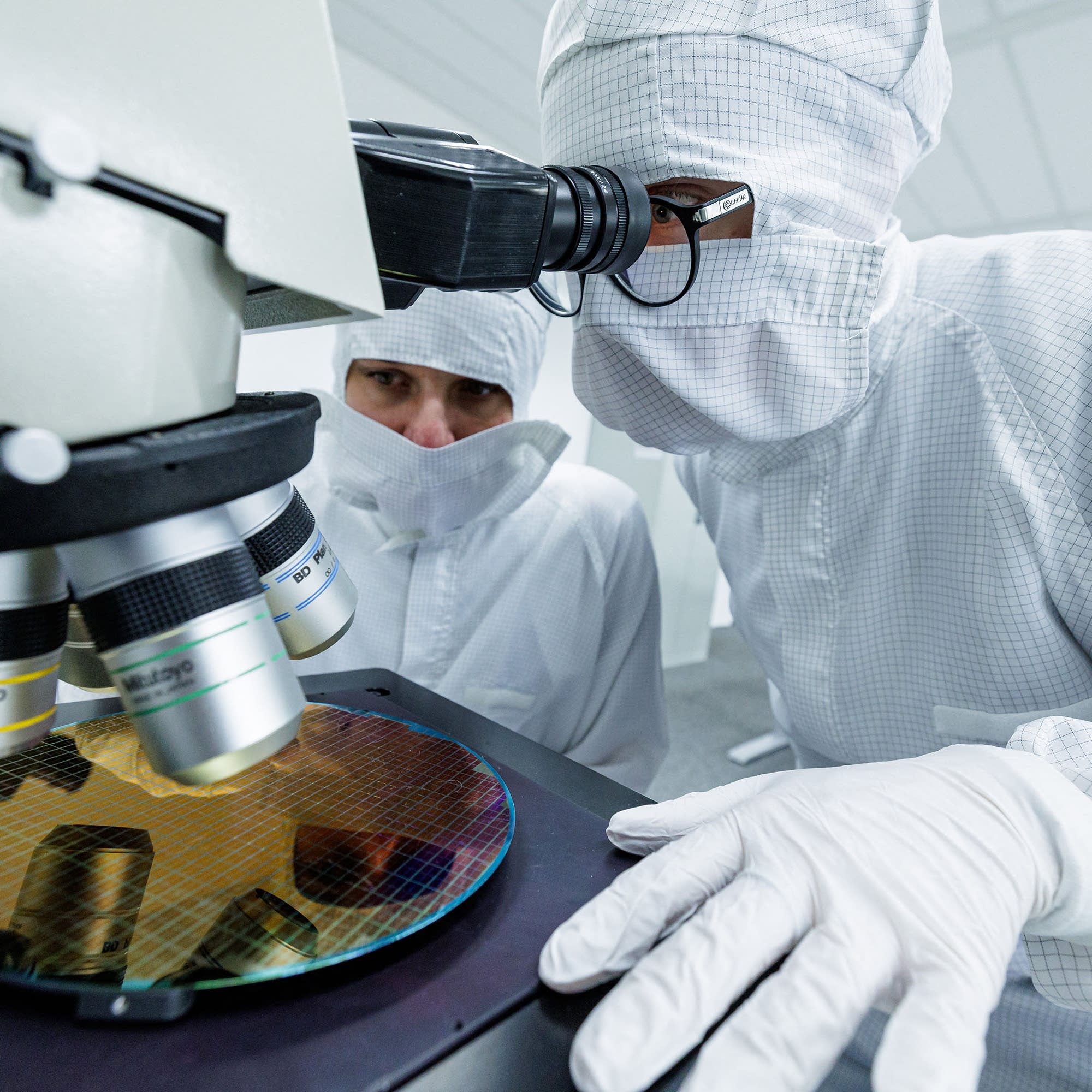
Both President Biden and President Trump have made boosting the US Semiconductor industry an economic priority, though in different ways. But what does it all mean if we don't have enough future engineers training to fill the semiconductor jobs that are created? That is the position we are in already, according to new data. Andrea Bells is vice dean of transformative initiatives at USC's Viterbi School of Engineering. She spoke with my Marketplace colleague David Brancaccio.
- [03:22]
F
So you got real world data on what we need for tech jobs in America, but it's interesting where you got it. How did you track this down?
- [03:31]
G
So we downloaded job postings from a popular platform and then looked at the job titles, but also the text of the jobs and the description of the company in order to see which job postings were relevant to our studies.
- [03:50]
F
And so, data in hand, how bad is it? How are the needs of industry outstripping people getting trained for those jobs?
- [03:59]
G
So, first of all, our focus is the semiconductor industry because this was a study supported by the Department of Defense Microelectronics Commons program, which is funded by the CHIPS Act. We looked at it for the spring of this year and and what we see in Southern California, which is our area of focus, is a big gap at the engineering level, meaning generally having a bachelor's degree in one of the engineering disciplines needed for chip production.
- [04:33]
F
I see now, I mean, you know, you're used to going into class and seeing fresh faced young people hungry to learn this stuff. What's holding the rest of them back? You've been thinking about this for a long time.
- [04:43]
G
So if you look at the numbers, enrollment in particular in electrical engineering disciplines has been declining over the course of 30 years. And what we see is that many of the students who previously would have gone into engineering disciplines have been migrating to computer science because they were reading the tea leaves and going where the job openings were. And obviously in the most recent data, you can imagine that computer science employment might be down a little bit, but it will be a small decline relative to the trends that we've seen over the last couple of decades. People don't major in electrical engineering the way they used to.
- [05:28]
F
What can policymakers do with that data? We're trying to fortify homegrown microchip manufacturing in America and in Southern California. There seems to be a mismatch between skills coming along and skills needed.
- [05:44]
G
Some of the questions revolve around how do you direct resources toward training? So, for instance, understanding the opportunities at the community college level, which will be highly regional depending on whether there is a factory in that area or not. I think continuing to understand national solutions will not be one size fits all, and certain areas of the country will have different needs than others. And so you need to tailor your solutions accordingly.
- [06:14]
F
I mean, it must be true that some other countries are better at this than we are in terms of bolstering the pipeline of STEM people.
- [06:22]
G
If you look at a list, at least from a few years ago, we saw that China produces four times more STEM graduates than than we do. We appear somewhere in the top 10, but not at the top, and we're not in the top five.
- [06:38]
F
Andrea Bells is vice dean of Transformation initiatives at the University of Southern California's Viterbi School of Engineering. Thank you very much.
- [06:46]
G
Thank you for your time.
- [06:48]
B
That was Marketplace's David Brancaccio there in New York. I'm Sabri Benishore with the Marketplace Morning.
- [06:54]
D
Report.
- [07:00]
B
From apm American Public Media.
- [07:03]
H
Hey, everybody. I'm Kyle Rysdal, the host of Marketplace. I'm going to join Amy Scott on September 9th. She's the host of How We Survive and also science writer Elizabeth Kolber for a conversation about the economic consequences of our climate crisis. We're going to break down how the acceleration of climate change is going to disrupt jobs and entire industries, even our daily lives. But it's not all doom and gloom. We're also going to dive into the solutions that are giving us hope right now. Thanks so much to Odoo for sponsoring this free webinar, and you can sign up today@marketplace.org climate.