Loading summary
Transcript29 lines
- [00:01]
Alice Lee
Lifelock.
- [00:01]
Marketplace Host
How can I help?
- [00:02]
Alice Lee
The IRS said I filed my return, but I haven't.
- [00:05]
Lifelock Advertiser
One in four tax paying Americans has paid the price of identity fraud.
- [00:08]
Alice Lee
What do I do?
- [00:09]
Nancy Marshall Genser
My refund though. I'm freaking out.
- [00:11]
Marketplace Host
Don't worry, I can fix this.
- [00:12]
Lifelock Advertiser
Lifelock fixes identity theft guaranteed and gets your money back with up to $3 million in coverage.
- [00:18]
Alice Lee
I'm so relieved. No problem. I'll be with you every step of the way.
- [00:21]
Lifelock Advertiser
One in four was a fraud paying American not anymore. Save up to 40% your first year. Visit lifelock.com Specialoffer terms apply.
- [00:32]
Nancy Marshall Genser
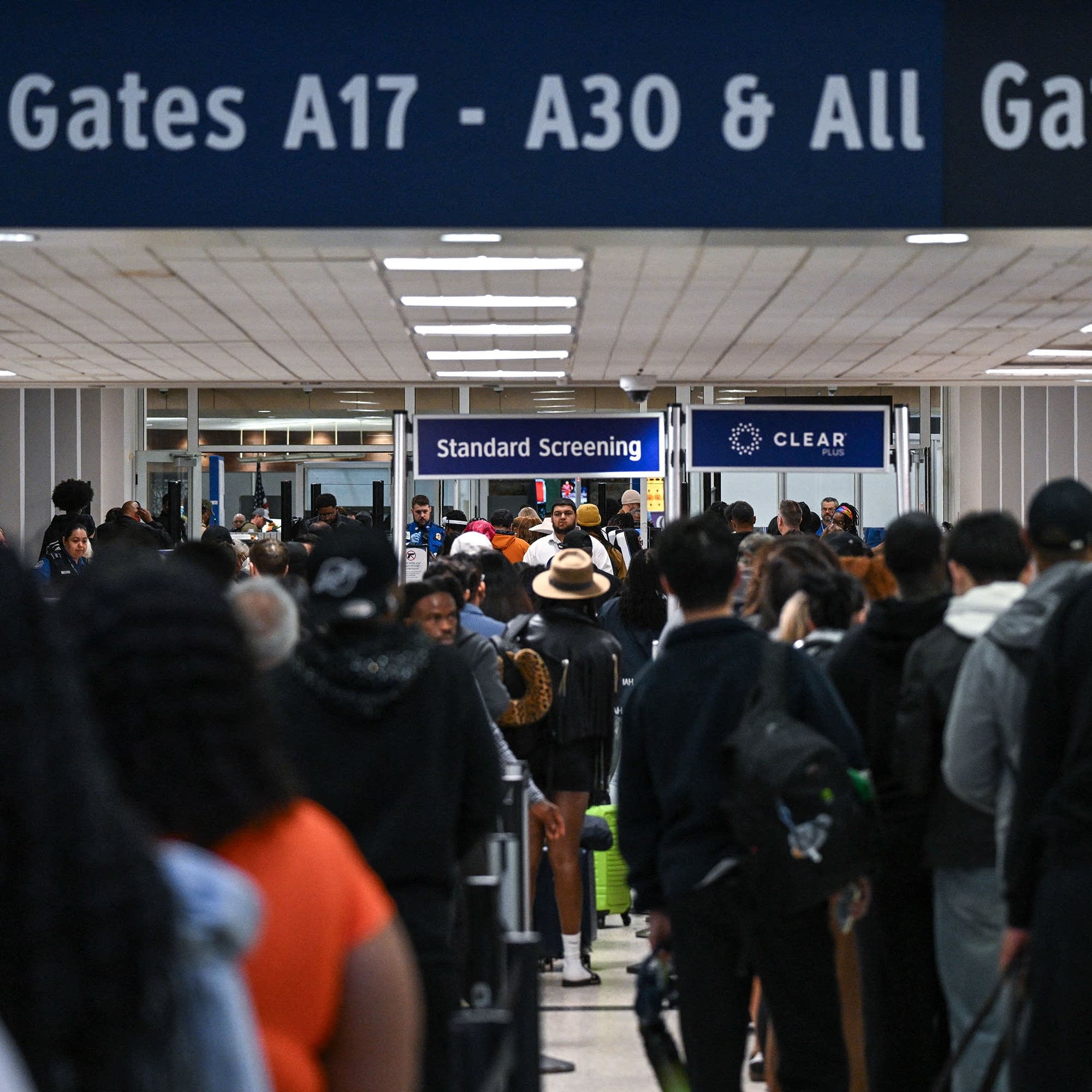
Wait times at airports could get longer next week From Marketplace, I'm Nancy Marshall Genser in for David Boncaccio. Airport security lines are growing as workers with the Transportation Security Administration go without pay during the partial government shutdown. Those lines could get worse if Congress can't reach an agreement to pay TSA officers by the end of next week. As Marketplace's Henry Epp reports, nearly 50,000
- [00:58]
Henry Epp
TSA workers missed a paycheck last week, and if Congress doesn't act, they could miss another one next Friday. That's led a few hundred TSA agents to quit, according to the Department of Homeland Security. Transportation Secretary Sean Duffy told CNBC this week that about 10% of TSA officers are calling out of work on average, Duffy said that's about five times the usual call out rate. And he said the situation at airports could get a lot worse next week if officers miss their next paycheck.
- [01:26]
Lifelock Advertiser
You're going to see small airports I believe shut down. You're going to see extensive lines and air travel is going to almost come to a grid halt stop.
- [01:35]
Henry Epp
Meanwhile, Congress is scheduled to go on recess at the end of next week. The union representing TSA workers urged lawmakers not to leave town until they agree on funding for the Department of Homeland Security. Parts of dhs, including the tsa, have lacked funding since mid February. That's after congressional Democrats demanded reforms to federal immigration enforcement following the fatal shootings of Renee Good and Alex Preddy by federal officers in Minneapolis earlier this year. Republicans and Democrats have so far not been able to reach an agreement on those reforms. Thousands of fema, Coast Guard and Border Patrol employees are also missing paychecks. I'm Henry Epp for Marketplace.
- [02:31]
USAA Advertiser
If you your parent or spouse served in the military, you could join our family. Our members saved an average of $70 a month on auto insurance when they switched. Tap the banner or visit usaa.com join today to check your eligibility restrictions apply.
- [02:47]
Nancy Marshall Genser
Imagine you're Applying for a job, a posting catches your eye. The pay range runs from 130,000 to nearly $500,000 a year. So where do you start negotiations? That range isn't hypothetical. It comes from an actual job listing. ON Indeed, about 15 states have passed laws requiring companies to include salary ranges in job postings, in part to help address wage gaps for women and people of color. But new research from Cornell University suggests the way those salary ranges are written, especially how wide or narrow they are, can influence how applicants approach negotiations. Alice Lee is an assistant professor of organizational behavior at Cornell and lead author of the study. Alice joins us now. Welcome.
- [03:32]
Alice Lee
Happy to be here.
- [03:33]
Nancy Marshall Genser
Let's stick with that real world example for a minute. Based on your research, how might someone, especially a woman, approach salary negotiations with a huge salary range like that?
- [03:46]
Alice Lee
So women on average tend to be more averse to financial uncertainty. And so if you see a wide range, you have very little idea of where your actual actually going to land. Past work suggests that women, like I said, tend to be more risk averse than men. And due to that, we found that women on average were opting more into job postings that had narrower pay ranges. More so than men were. Huh?
- [04:13]
Nancy Marshall Genser
Okay, so women prefer postings with narrow ranges. Is that a problem? I mean, are women hurt when they limit themselves that way?
- [04:23]
Alice Lee
The preference towards risk aversion in itself I don't think is a problem. I think that is a natural tendency, and I think there's good reason to respond in this way to ambiguous signals. The problem isn't the preference in itself, but sort of what happens after that. What we found in our research is that those who apply to narrow ranges are then more satisfied with an average offer. They're less likely to initiate negotiations, and when they do, they make offers that are much less assertive, meaning lower, and are thus less likely to end up with a higher salary than those that might have applied to a wider salary range.
- [05:03]
Nancy Marshall Genser
Oh, so interesting. So less likely to negotiate lower salary in the end. So could these pay range transparency laws actually be perpetuating the very pay gaps they were designed to close?
- [05:18]
Alice Lee
I think that's exactly right. And this cycle that we were finding does suggest that this could lead to a perpetuation. Because if women or those that are more generally aversive risk, are disproportionately applying to jobs with narrow pay ranges and afterwards then negotiating less assertively, you could imagine how this then leads to a certain demographic ending up with a lower salary at the end.
- [05:43]
Nancy Marshall Genser
What is the solution here then? I mean, do we need new laws?
- [05:47]
Alice Lee
I want to start off by acknowledging that employers, I think, do need some flexibility in how they set ranges. A single job title might span multiple experience levels. I think remote roles need a account for geographic cost of living differences, and industries have variable compensation like bonuses and equity. So the goal, I don't think should be to eliminate discretion. But I think it's the fact that discretion comes at a cost of clarity sometimes. New Jersey's law, I think, is a good model. It's capped the width of posted ranges at 60% of the minimum salary. Another, I think, important finding from our work is that when you provide contextual information alongside the range, it could help mitigate the ambiguity. So just explaining your range, not just posting it, auditing it, but also recognizing what your pay ranges will be signaling. I think these are some things that employers can keep in mind.
- [06:42]
Nancy Marshall Genser
Alice Lee is an assistant professor of organizational behavior at Cornell's School of Industrial and Labor Relations. Thank you.
- [06:49]
Alice Lee
Thank you so much.
- [06:51]
Nancy Marshall Genser
Every Friday morning you can get the best of Marketplace straight to your inbox. You'll get analysis on the latest economic news to help you stay informed. Read the latest issue and sign up marketplace.org subscribe In Washington, I'm Nancy Marshall Genser with the Marketplace Morning Report from apm, American Public Media.
- [07:15]
Marketplace Host
When we get big news overnight and the economy turns on a dime, Marketplace Morning Report is there to get you up to speed as you start your day. And listener support keeps this fast, smart global reporting available to everyone not stuck behind a paywall. We cannot do it without you. So if you rely on Marketplace Morning Report to make sense of the day ahead, invest in our independent and accessible journalism. Donate now@marketplace.org or click the link in the show Notes.