Loading summary
Transcript46 lines
- [00:01]
A
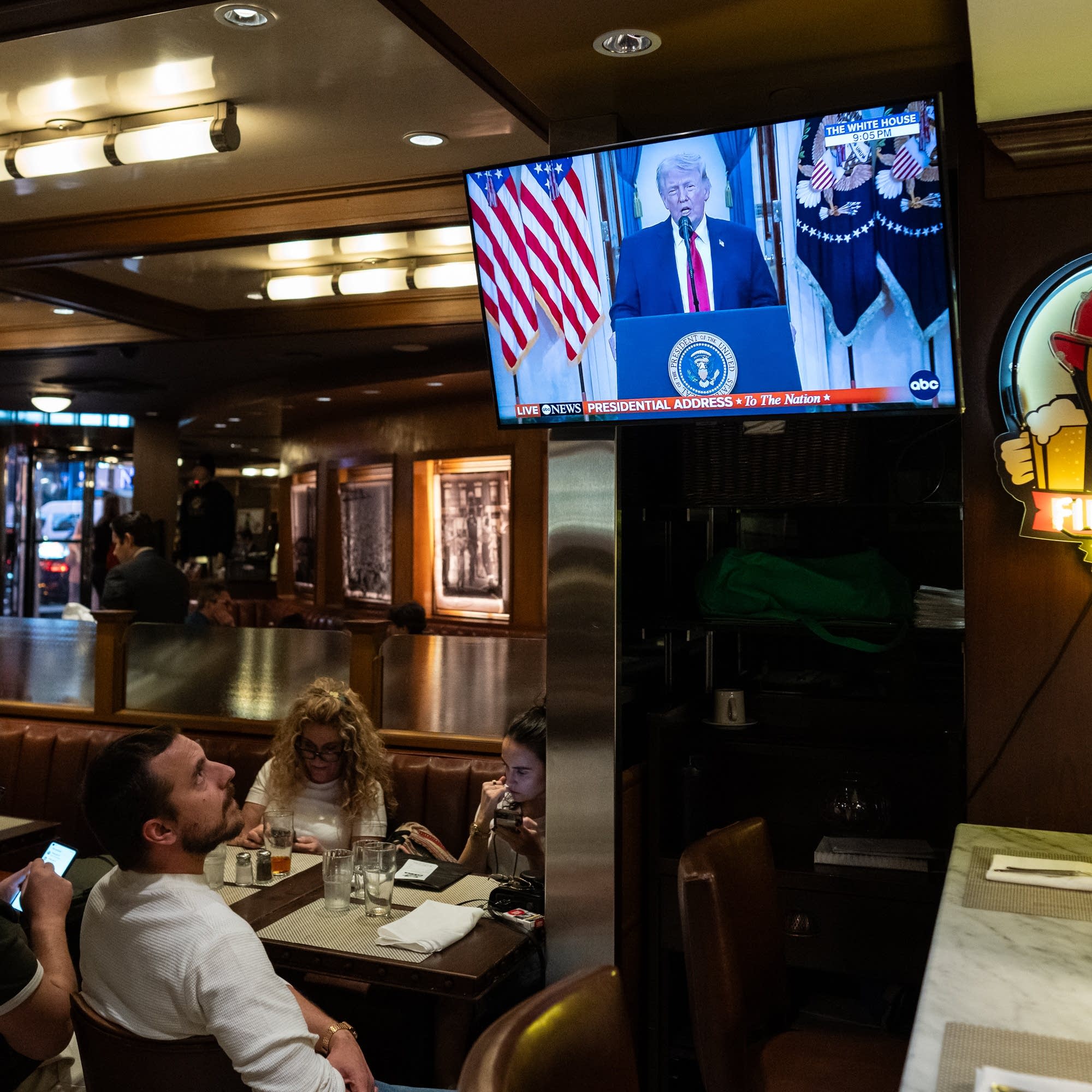
With VRBoCare, help is always ready before, during and after your stay. We've planned for the plot twists, so support is always available because a great trip starts with peace of mind. The President made the case for the Iran war. Markets were not impressed. From Marketplace, I'm Sabri Benishore in for David Brancaccio. After President Trump's address to the nation last night, the price of oil went up, up and stocks went down. This was a total reversal of what markets were doing going into the speech when stocks rallied and oil prices fell. Investors had been hoping for more information from the president about when the war with Iran might be over. Instead, we heard that military strikes are going to be intense over the next two to three weeks and that the effective closure of the Strait of Hormuz is not the United States problem. Marketplaces. Nova Sappho is here with more.
- [00:54]
B
Hi, Nova, Good morning.
- [00:56]
A
So the Strait of Hormuz is, you know, at the center of what is happening to global energy prices. What did President Trump say about that?
- [01:02]
B
Yeah, well, the President said, as he has before, that countries which directly get their oil from the Gulf region, we don't, should be securing the passage, not the United States. He also said this.
- [01:12]
C
When this conflict is over, the Strait will open up. Naturally. It'll just open up naturally. They're going to want to be able to sell oil because that's all they have to try and rebuild.
- [01:24]
B
Now he's talking about Iran there. And what the President didn't address is that oil prices are set in a global market as we're, as we know now. So we're affected here as well when there are supply shocks. Also, Iran has been allowing tankers it wants to allow through the Strait, a few of them, including its own. So without further intervention, the question is, does that become the new normal with that passageway? Mm.
- [01:47]
A
The price of oil went up right on up after the President's stress. Does that mean investors are now expecting the oil supply problem to persist for longer than they did going into the speech?
- [01:58]
B
That certainly seems to be the consensus takeaway. And I spoke this morning with Ryan Sweet of Oxford Economics.
- [02:04]
A
The military timeline doesn't equal the economic timeline in that this is going to take months to see a lot of the energy production begin to ramp up and eventually normalize.
- [02:18]
B
And before that can happen, of course, the Strait of Hormuz will need to be reopened. And we're seeing other countries now begin to grapple with how to do that after the fighting ends. That'll have to happen first. The UK is leading A virtual meeting of dozens of nations today to try to figure some of this stuff out. But there are no clear answers yet. Sabri, about what's going to happen next.
- [02:37]
A
All right, marketplace is NovaSafo. Thank you so much.
- [02:40]
B
You're welcome.
- [02:58]
D
Early birds. Always rise to the occasion for summer vacation planning because early gets you closer to the action. So don't be late. Book your next vacation early on VRBO and save over $120. Rise and shine. Average savings $141. Select homes only.
- [03:14]
A
Time now to check the Marketplace economic pulse. This is our regular check in on how the economy is doing from different perspectives today. The pawn indicator, as in pawn shops. For nearly 60 years, a place to hawk objects for cash has been a fixture in West Hollywood, California. In big letters, the storefront reads, elliot Salter gives instant loans. And as with any pawn shop, the place also sells the collateral objects when the loan isn't paid back. Marketplace's David Brancaccio stopped in to meet Mr. Salter. Him shelf.
- [03:43]
E
It's like a whole scene coming in here, but just give me a sense of what I'm looking at as you look around.
- [03:47]
C
Okay, up on the top shelf, there's some kind. It looks like a warship, wooden warship. There's a sailboat.
- [03:55]
E
There's vintage cameras, like from, well, the late 19th century. A couple of those. Maybe even audio equipment.
- [04:02]
C
Excuse me. Thank you. Okay. All right, Gladstone, take care. Good luck in selling them. Okay.
- [04:10]
E
A lot of guitars, so I mean, like all sorts of stuff. It's some stuffed wildlife.
- [04:18]
C
Yeah, yeah. Taxidermy. Let's put it this way. I have been doing this a long time. I mean, even before I opened my own store. And I always had an eye for unusual and quirky stuff. I guess it's a form of hoarding, but. But since it's interesting, it's more of a collection.
- [04:39]
E
I'll give you the collection because it's not ramshackle. There's order here.
- [04:43]
C
You may see order. I see chaos.
- [04:46]
E
And over to Dave behind the counter, what else is coming in these days?
- [04:50]
C
What else is coming in?
- [04:52]
B
I mean, people are really scrounging.
- [04:54]
E
Dave, that tells you something about the state of the economy. When people are scrounging for something to
- [04:57]
C
bring in, they need money today.
- [05:00]
B
And a lot of times, people are
- [05:02]
C
coming in for gas money.
- [05:03]
E
Ouch. I can give you economic statistic after economic statistic, some of them delayed because of government shutdowns and so forth. But setting that aside, Elliot, how's the economy here going into the spring of 2020? 6, judging from what you see here.
- [05:19]
C
You know, I always look at it this way. When my business is real good, it's not a good thing.
- [05:23]
E
So business is all right right now.
- [05:25]
C
It's okay. We are being much more frugal with what we're loaning. I mean, I have some guys that have six guitars on loan. Do they need six guitars? They think they do.
- [05:39]
E
You're tightening lending standards is how bank of America would say it. But being a little bit careful because you're wondering about, can people actually pay this back?
- [05:47]
C
Yeah, yeah, that's an important part of it. I always try to tell people what time span was the last four months. Oh, man, that went by quick. Well, what about the next four months? Oh, that's a long way away.
- [06:00]
E
You're describing something that economists are like, focused on and have studied, which is we see the next two weeks pretty clearly, but everything after that is kind of this blur. I've got a Rolleiflex. Look at that. I have a Rolacord. What is that, 2295. All right, that's cool. I've got some jewelry, lots of jewelry.
- [06:23]
C
Jewelry takes up very little space, but there's a lot of. I mean, this is probably, what would you say, an inventory. This is half cost wise or value wise?
- [06:34]
A
Way more than half, I'd say of the store.
- [06:36]
E
Yeah.
- [06:36]
C
Because it's made out of gold.
- [06:38]
E
Yeah. A notice here I think is an important one. Notice. Gold and silver prices are subject to change.
- [06:42]
C
Indeed.
- [06:45]
A
That was Marketplace's David Brancaccio there speaking with pawn shop owner Elliot Salter in West Hollywood, California, part of our Economic Pulse series in New York. I'm Sabri Benishore with the Marketplace morning
- [06:57]
E
Report
- [07:00]
A
from 8pm American Public Media.
- [07:03]
E
Hey, David Brancaccio here. I hope you're well and that your passport is up to date because I am hosting a trip to Italy this fall and you, you are invited stay at a world class Tuscan villa and step into the world of the Medici, the formidable family whose influence and power helped give rise to the Renaissance and the art we still celebrate today, not to mention the banking system. We're going to visit the world's oldest bank, swim in the thermal spa waters in Montecatini and take in the art of the Uffizi. All of this, and then we'll try to put it all into context with great conversation over even better meals and wine tasting. Please join me and know this. Buying into this trip will provide essential support for public media. Discover more about this fall's tuscany adventure@marketplace.org travel to reserve your spot today. That's marketplace.org travel.