Loading summary
Transcript26 lines
- [00:00]
Wealth Enhancement Host
This Marketplace podcast is brought to you by Wealth Enhancement. Who asks, how healthy is your financial plan? Does it need a second option? You'd get one before surgery. Isn't your financial health just as important? Get a wealth blueprint at no cost. We'll check the pulse on your plan, share what you might be missing and opportunities you could be taking advantage of, and determine whether your current advisor's a quack. Learn more at wealthenhancement.com build advanced manufacturing demands Precision aerospace demands trust In Puerto Rico, companies like Honeywell, Lufthansa Technik and Collins Aerospace deliver complex engineering and high value production within a US Jurisdiction. That means federal regulatory alignment, strong IP protections and fast access to the US Mainland, plus competitive tax incentives and a STEM trained workforce. From aerospace to advanced manufacturing, the infrastructure is proven and the talent is here. It's not what's next, it's where puerto rico visit investpr.org A plea from the
- [01:11]
Nancy Marshall Gensler
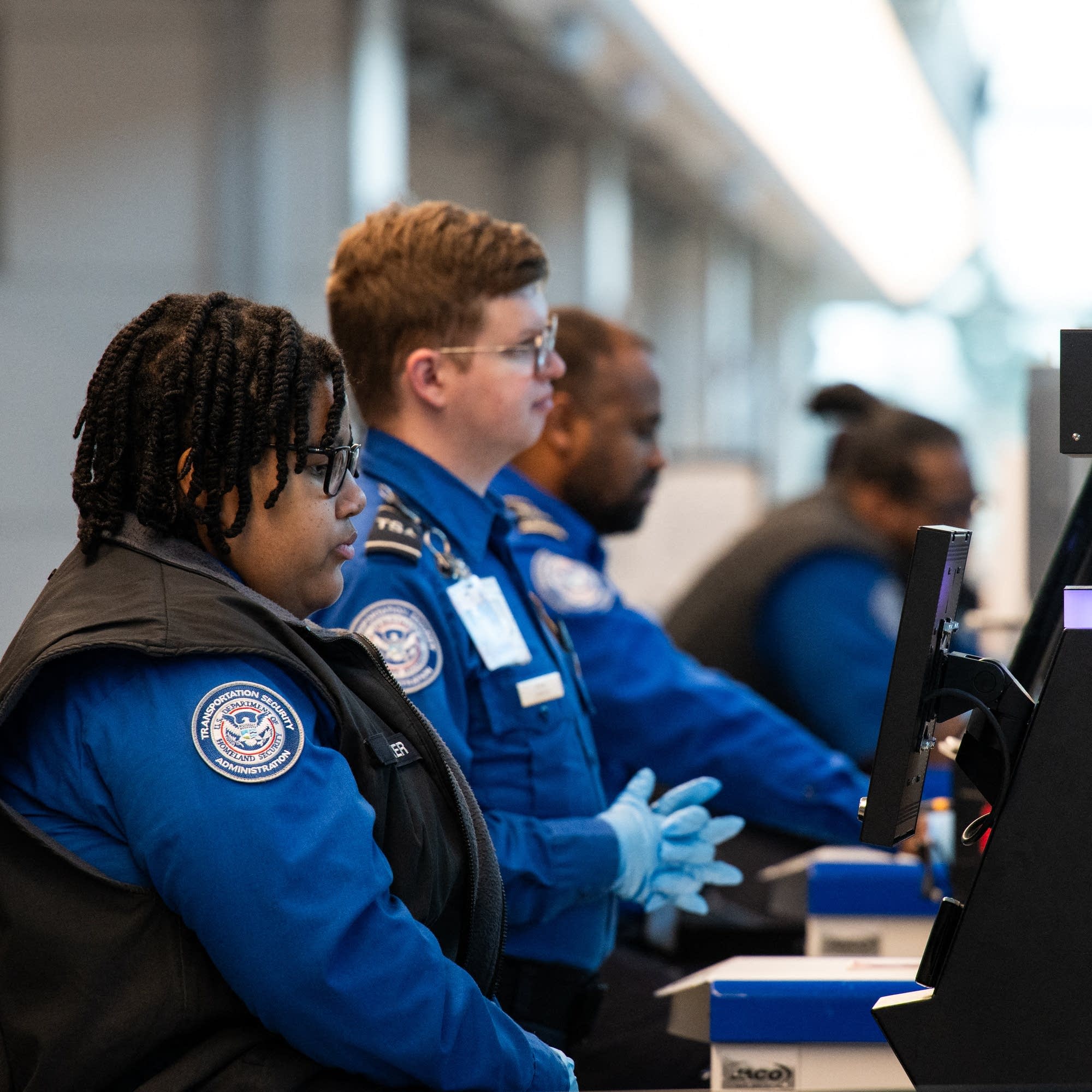
Airlines From Marketplace, I'm Nancy Marshall Gensler, in for David Brancaccio. The CEOs of major US airlines are urging Congress to fund the Department of Homeland Security and end the partial government shutdown, which has dragged on for a month now as Democrats demand reforms to immigration enforcement practices. In an open letter, the CEOs say wait times are growing at airports and air travel has once again become a political football. Marketplace's Nova Safo is here with more. Hello Nova.
- [01:41]
Nova Safo
Good morning, Nancy.
- [01:42]
Nancy Marshall Gensler
So why are airline CEOs sounding the alarm now?
- [01:47]
Nova Safo
Well, it has been a month, which means that TSA agents are now missing their first full month of paychecks. Air traffic controllers as well. Several days ago, the Department of Homeland security more than 300 TSA employees had already quit, so that number could now be even higher. There are reports of long security lines at airports around the country. Some airports have asked passengers to arrive three hours or more early, and the CEOs say that their airlines are trying to hold flights for passengers, rebook people as well. And all of this is happening, they point out, during what is usually the height of the spring break travel season. We're in the middle of it now, Nancy. So it's a particularly difficult time to have all of this disruption.
- [02:28]
Nancy Marshall Gensler
Oh, absolutely. So aside from wanting DHS funding restored, the airline CEOs are also calling for some permanent changes. What are those?
- [02:38]
Nova Safo
Yeah, there are three bills they're asking Congress to pass which would ensure that air traffic controllers and TSA employees get paid in the event of future government shutdowns. And the airlines are seeking this change because shutdowns are very expensive for them. They have to rebook people. They have to deal with canceled and delayed flights. And in the fall, when we had the longest government shutdown in US History, the big airlines lost hundreds of millions of dollars each, each in profits. And we know this because we saw the numbers play out in their earnings reports. And the CEOs are trying to end that cycle. Nancy.
- [03:11]
Nancy Marshall Gensler
Well, let's wish them well. Thank you very much, Nova.
- [03:14]
Nova Safo
You're welcome.
- [03:15]
Nancy Marshall Gensler
President Trump says he could delay a planned visit to China if Beijing does not help reopen the Strait of Hormuz and ease oil prices. Trump's comments come as Treasury Secretary Scott Besant meets China's vice premier in Paris. President for trade talks tied to the president's trip.
- [03:49]
Marketplace Announcer
This marketplace podcast is supported by VantageScore, the modern credit score used by nine of the 10 largest banks, over 3,700 companies, and now approved by Fannie Mae and Freddie Ma. Vantage Score, trended data, alternative data, reduced
- [04:06]
VRBoCare Representative
risk, day or night. VRBoCare is here 247 to help make every part of your stay seamless. If anything comes up or you simply need a little guidance, support is ready whenever you reach out. From the moment you book to the moment you head home. We're here to help things run smoothly because a great trip starts with the right support. And hey, a good playlist doesn't hurt either.
- [04:37]
Nancy Marshall Gensler
Existential threats to the US and world come in a lot of flavors. These biological, climate, nuclear, even catastrophic software threats. There are research groups around the world studying them and how to counter them. Today and for the next two Mondays, my colleague David Brancaccio is checking in with a handful of these places. Today, it's the University of Chicago's Existential Risks Laboratory. Chicago is, after all, the city where Enrico Fermi and his team achieved the first self sustaining controlled nuclear chain reaction. Daniel Holz is director of the lab and he spoke with David.
- [05:14]
David Brancaccio
Given your University of Chicago connection with Fermi's first sustaining atomic pile under the old stadium there, I wanted to focus on the existential threat of nuclear annihilation. Now we'll talk about that. But AI again, AI also encroaches into the existential threat conversation. If it were to trigger nuclear annihilation, how do you think about that?
- [05:39]
Daniel Holz
This is a pretty unique moment because of all these different threats. And so as you said, the nuclear threat is growing over the last few years, and then AI is also in and of itself a threat. And then these two intersect. AI is starting to insinuate itself into all sorts of military Command and control. And there's this sense that it's kind of inevitable that AI will essentially will have its finger on the button, as it were.
- [06:10]
David Brancaccio
I mean, you, Dr. Holtz, also chairman of the Science and Security Board at the Bulletin of Atomic Scientists, famed for your Doomsday Clock. That clock advanced in the last year.
- [06:23]
Marketplace Announcer
Yep.
- [06:24]
Daniel Holz
The clock is now at 85 seconds to midnight. And we highlighted, when we announced the time, a number of things that were of particular concern, and those included the nuclear risk and AI and of course, climate change, biological threats. But we particularly highlighted the way all of these kind of intersect and feed on each other and amplify each other, and the fact that governments just aren't engaging on these.
- [06:52]
David Brancaccio
I've done some work and have a lot of interest in interdisciplinary approaches to big questions. When you're thinking about, for instance, guardrails for AI, do you just want trained engineers at the table talking about it? Sounds like the way you envision, say, a curriculum on existential risk. It would be multidisciplinary.
- [07:12]
Daniel Holz
Yes, that's one of the critical parts about this. And all these different expertise are relevant. I mean, the problem is kind of this all hands on deck moment. So that comes into both our work, our research, but also the classes that we teach. And the truth is, for almost all of these issues, there's a technical aspect. But to make progress, a lot of the issues are political or legal or sociological. The solutions are in a different space, and you need to have some mastery of both of those to hope to actually have impact and make a difference.
- [07:48]
David Brancaccio
We're talking to the founding director of xlab, the Existential Risks Laboratory at the University of Chicago, and a professor of physics, astronomy and astrophysics, Daniel Holtz. Thank you very much.
- [07:58]
Daniel Holz
Oh, it's been my pleasure. Thanks for doing this.
- [08:02]
Nancy Marshall Gensler
And all of our existential threat interviews will accumulate. Every Monday@Marketplace.org an update on Brent crude. It's now down about 10, 9, 10% at $103 a barrel. In Washington, I'm Nancy Marshall Genzer with the Marketplace Morning Report from apm, American Public Media.
- [08:28]
Rima Reis
Maybe you've had this thought before. What if I turn this hobby into a side hustle?
- [08:33]
VRBoCare Representative
Attempting to turn painting into income may
- [08:36]
Rima Reis
have been the worst idea I've ever had. I'm Rima Reis. And this week on this is uncomfortable. The pressure to monetize what we love. Can we turn our passion into a paycheck without killing the joy? Listen to this is uncomfortable. Wherever you get your podcasts,