Loading summary
Transcript52 lines
- [00:00]
A
This podcast is supported by Odoo. Some say Odoo business management software is like fertilizer for businesses because the simple, efficient software promotes growth. Others say Odoo is like a magic Beanstalk because it scales with you and is magically affordable. And some describe Odoo's programs for manufacturing, accounting and more as building blocks for creating a custom software suite. So Odoo is fertilizer Magic Beanstalk building blocks for business Odoo exactly what businesses need. Sign up@odoo.com that's O D O O.com.
- [00:30]
B
Introducing your new Dell PC with the Intel Core Ultra processor. It helps you handle a lot, even when your holiday to do list gets to be a lot like organizing your holiday shopping and searching for great holiday deals and customer questions and customers requesting custom things. Plus planning the perfect holiday dinner for vegans, vegetarians, pescatarians and Uncle Mike's carnivore diet. Luckily, you can get a PC with all day battery life to help you get it all done. That's the power of a Dell PC with Intel inside, backed by Dell's price match guarantee. Get yours today@dell.com holiday terms and conditions apply. See dell.com for details.
- [01:02]
C
It wasn't your device, it was the Internet with widespread problems this morning. I'm David Brancaccio in Los Angeles. A problem with Amazon's remote computer service disrupted online operations early today at social media sites, newspapers, airlines, car service apps and more. While Amazon now says most of its cloud services are returning to normal, the original problem appears to have centered at its operations in Northern Virginia and was not a malicious hack. The the crypto exchange Coinbase had trouble. Same with Robinhood, the online stock trading site. The video game Fortnite. The British bank Lloyd lift the car service in some areas. The incident highlights how dependent so much of the digital world has become on a few cloud computing providers. The US dollar is up slightly this morning. It had fallen 1% in about a week and 10% since mid January. This cuts in different ways, Marketplace's Mitchell Hartman explains.
- [01:55]
D
Recently, the dollar's been weakened by several factors. First, worries about U.S. regional banks. Also President Trump's renewed tariff threats against China, says Maurice Obsfeld at the Peterson Institute for International Economics.
- [02:09]
E
Trade tensions escalate. People worry about more negative consequences for US Growth. That's negative for the dollar.
- [02:16]
D
And with growth flagging, the Federal Reserve has signaled it'll keep cutting U.S. interest rates, says Paul Christopher at the Wells Fargo Investment Institute.
- [02:25]
C
At the same time, you've seen banks like the European Central bank basically get to the end of their rate cutting cycle. So that interest rate differential has been.
- [02:33]
D
Dollar negative, another dynamic at play, says Cornell economist Ishwar Prasad. Central bankers and foreign investors stung by the Trump administration's trade policies would dearly.
- [02:44]
E
Like to ditch the dollar as an international payment currency, as a reserve currency.
- [02:50]
D
In the past, the dollar has served as a safe haven in times of global turmoil. But Maurice Obzfeld says it isn that way now.
- [02:58]
E
More and more, the kind of shocks that disturb the world economy, that trouble investors are coming out of the US.
- [03:04]
D
Which could drag the dollar down even more. I'm Mitchell Hartman for Marketplace.
- [03:10]
C
We have a partial federal government shutdown now in a 20th day here, plus trade and other geopolitical tensions. Yet my screens show the dow is up 264.6 10 of a percent in early trading. The S&P is up 0.8%, the Nasdaq up 1%. Now a report from Reserve's 12 regions was downbeat last week. Economist Julia Coronado is president of Macro Policy Perspectives.
- [03:36]
F
In fact, that's been kind of a pattern that the anecdotes from reports like the Beige Book are a lot more soft and don't show as much strength as corporate earnings and certainly the stock market, reflecting in part that small businesses and medium sized businesses are having a harder time navigating trade wars and immigration challenges than the big corporates.
- [04:02]
C
Yeah, we have to remind ourselves when I talk about The S&P 500 stock index, those are 500 very big companies and the medium to smaller ones may not have the resources to deal with the shifts in policy.
- [04:15]
F
That's right. They don't have the resources. And they do tend to do more of the hiring though. So that's how we reconcile some of the mixed signals from the stock market on the one hand and employment data and labor data that have looked a lot more worrisome of late.
- [04:31]
C
Just a couple seconds. A big thing is Friday, right? We finally get the inflation data you'll be tracking.
- [04:36]
F
We do get the inflation data. It's going to be very important. This is when we expect to see tariff pass through to consumers really picking up. So it's good that we'll be getting at least a little bit of data.
- [04:47]
C
All right. Economist Julia Coronado is also professor at the University of Texas, Austin. Thank you very much.
- [04:52]
F
My pleasure.
- [04:54]
C
The benchmark 10 year interest rate moved below 4% this morning by a sliver.
- [05:20]
A
This podcast is supported by Odoo. Some say Odoo business management software is like fertilizer for businesses because the simple, efficient software promotes growth. Others say Odoo is like a magic Beanstalk because it scales with you and is magically affordable. And some describe Odoo's programs for manufacturing, accounting and more as building blocks for creating a custom software suite. So Odoo is fertilizer Magic Beanstalk building blocks for business Odoo exactly what businesses need sign up@odoo.com that's O D O.
- [05:49]
G
O.com introducing your new Dell PC. Powered by the Intel Core Ultra processor, it helps you handle a lot, even when your holiday to do list gets to be a lot because it's built with an all day battery plus powerful AI features that help you do it all with ease, from editing images to drafting emails to summarizing large documents to multitasking. So you can organize your holiday shopping and make custom holiday decor and search for great holiday deals and respond to holiday requests and customer questions and customers requesting custom things. And plan the perfect holiday dinner for vegans, vegetarians, pescatarians and Uncle Mike's carnivore diet. Luckily, you can get a PC that helps you do it all faster so that you can get it all done. That's the power of a Dell PC with Intel inside, backed by Dell's price match guaranteed. Get yours today@dell.com deals, terms and conditions apply. See Dell.com for details.
- [06:53]
C
Now a story about helping farmers deal with all the fastballs, curve balls and sliders pitched by weather and climate. KUNC's Ray Solomon has a story now from Colorado about an agricultural apprenticeship offering new tools for climate adaptation.
- [07:08]
H
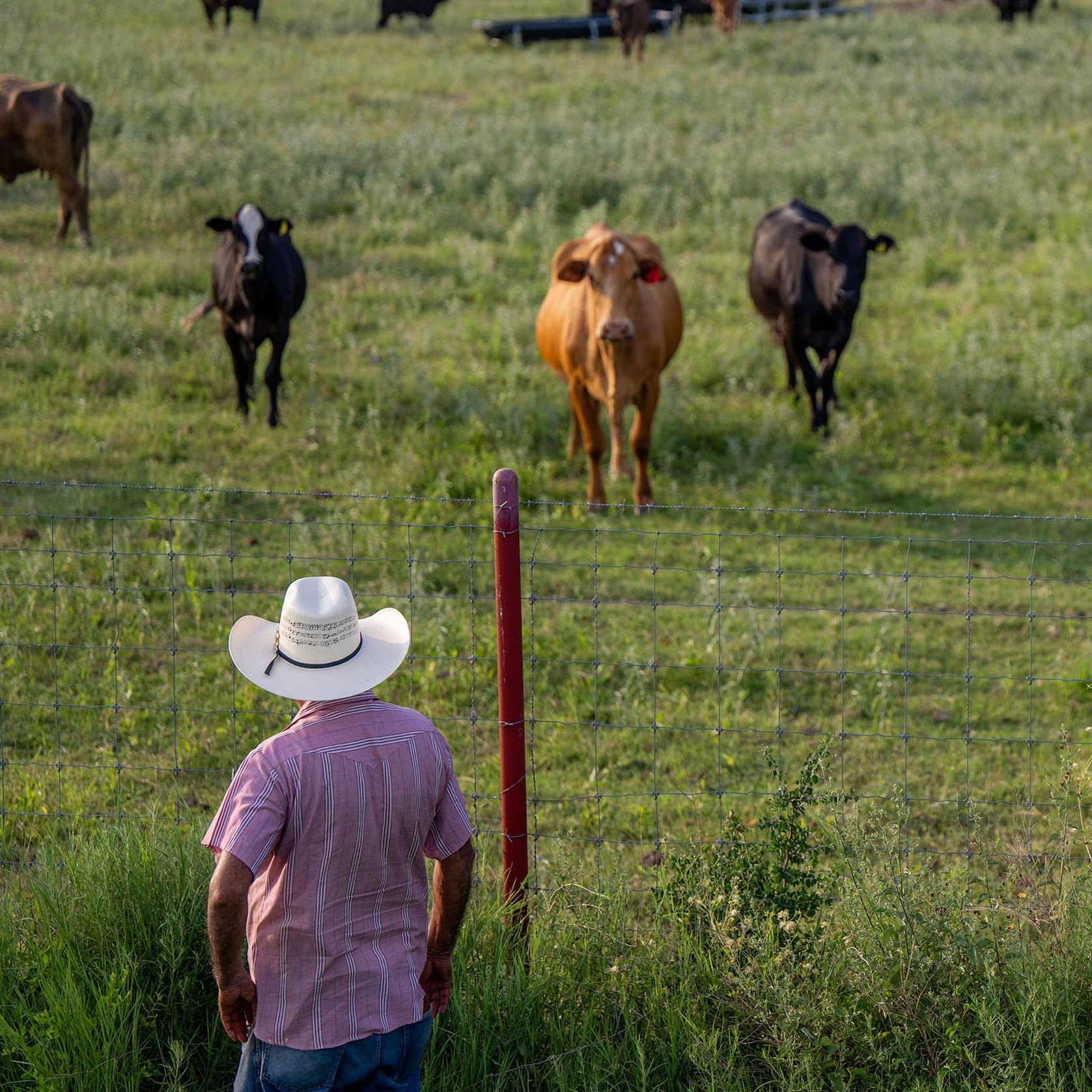
Before Jackson Watford started his apprenticeship last May here at Elk River Livestock in northwest Colorado, he didn't know much about regenerative ranching. Then he spent the summer moving fences and cattle nearly every day to prevent overgrazing and build healthy soil. Now he's convinced it's the only way to go.
- [07:27]
D
It's definitely more work, but I really enjoy it and I think it's worth it at the end of the day.
- [07:31]
H
Watford is a student at North Carolina State University. He spent the summer here working, earning credit towards the associate's degree in Agriculture Business Management. He expects to wrap up in the spring, all the while learning holistic ranching techniques.
- [07:47]
D
Just better for the environment. You're not tearing up the ground, briving the land.
- [07:51]
H
That's key for keeping the ranch afloat in a hotter, drier climate.
- [07:55]
A
Hearing old timers talk we used to get monsoons every day used to be so wet.
- [08:00]
H
Davey Barron owns Elk River Livestock and hired Watford as his summer apprentice.
- [08:05]
A
Now we're dry. You know we're dry more often, he says.
- [08:09]
H
Adapting to the changing climate is now an essential skill for ranchers.
- [08:13]
A
But if you're not managing differently for dry times, then you're not doing it correctly.
- [08:19]
H
Climate adaptation skills are increasingly part of career training for the next generation of farmers and ranchers. The Kivira Coalition is the environmental ag group behind this apprentice program. Program director Leah Ritchie says apprentices learn land stewardship in the field from veteran farmers and ranchers looking for help on the range.
- [08:40]
F
Some of them have talked with us about the challenge of finding labor who care about the same things and are excited about moving fence as often as they have to do to get the grazing outcomes that they want.
- [08:55]
H
According to Travis park with the National Council for Agricultural Education, environmental stewardship has always been big in farming and ranching. After all, farmers need to care for their land so they'll stay healthy and fertile. What's fresh is that climate literacy is now also part of the agriculture education curriculum.
- [09:15]
C
We want our students to understand the science of agriculture and to understand the science of agriculture, we need to understand the science of climate change and make production decisions based on the science in both those areas.
- [09:29]
H
There are more than a million students enrolled in those ag ed programs in high schools and colleges across the country, so the future adaptation workforce is hearing that message loud and clear. In Clark, Colorado, I'm Ray Solomon for Marketplace.
- [09:46]
C
You're listening to the Marketplace Morning Report. We are from APM American Public Media.
- [09:53]
I
Hello, I'm Debra Goldstein, host of the game show the Big Fib.
- [09:56]
J
And I'm the sound effects robot Lisa.
- [09:58]
I
Each week we bring you a hilarious podcast where human child contestants have to.
- [10:02]
D
Figure out who's an actual expert and who's a liar.
- [10:05]
J
Liar, pants on fire.
- [10:07]
I
Just listen to these great reviews on Apple Podcasts.
- [10:10]
J
User Addy Kitty says, I love this podcast. Lisa is my favorite. User Ichabod says, lisa is so funny. Oh my God, they're right. And user Icewolf says, more Lisa.
- [10:20]
C
More, more, more, more.
- [10:22]
I
Interesting selection. Who picked these reviews?
- [10:25]
C
Not me.
- [10:26]
J
Okay, I guess I am the liar. It was me. And oh, look at that. My pants are on fire. Gabriel, my pants are on fire.
- [10:32]
I
For more fun facts and a few fibs, follow the Big Fib on Apple podcasts or on gzmshows.com oh my poor.