Loading summary
Transcript28 lines
- [00:00]
Narrator/Reporter
When too much work bogs you down.
- [00:02]
Asana Advertiser
Asana helps you handle it.
- [00:04]
Narrator/Reporter
AI makes it easy to hand off.
- [00:06]
Asana Advertiser
Routine tasks and stay focused on important work. That's how work gets handled. Visit us@asana.com Introducing your new Dell PC with the Intel Core Ultra processor. It helps you handle a lot, even when your holiday to do list gets to be a lot like organizing your holiday shopping and searching for great holiday deals and customer questions and customers requesting custom things. Plus planning the perfect holiday dinner for vegans, vegetarians, pescatarians and Uncle Mike's carnivore diet. Luckily you can get a PC with all day battery life to help you get it all done. That's the power of a Dell PC with Intel inside, backed by Dell's price match guarantee. Get yours today@dell.com holiday terms and conditions apply. See dell.com for details.
- [00:46]
William Lee Adams
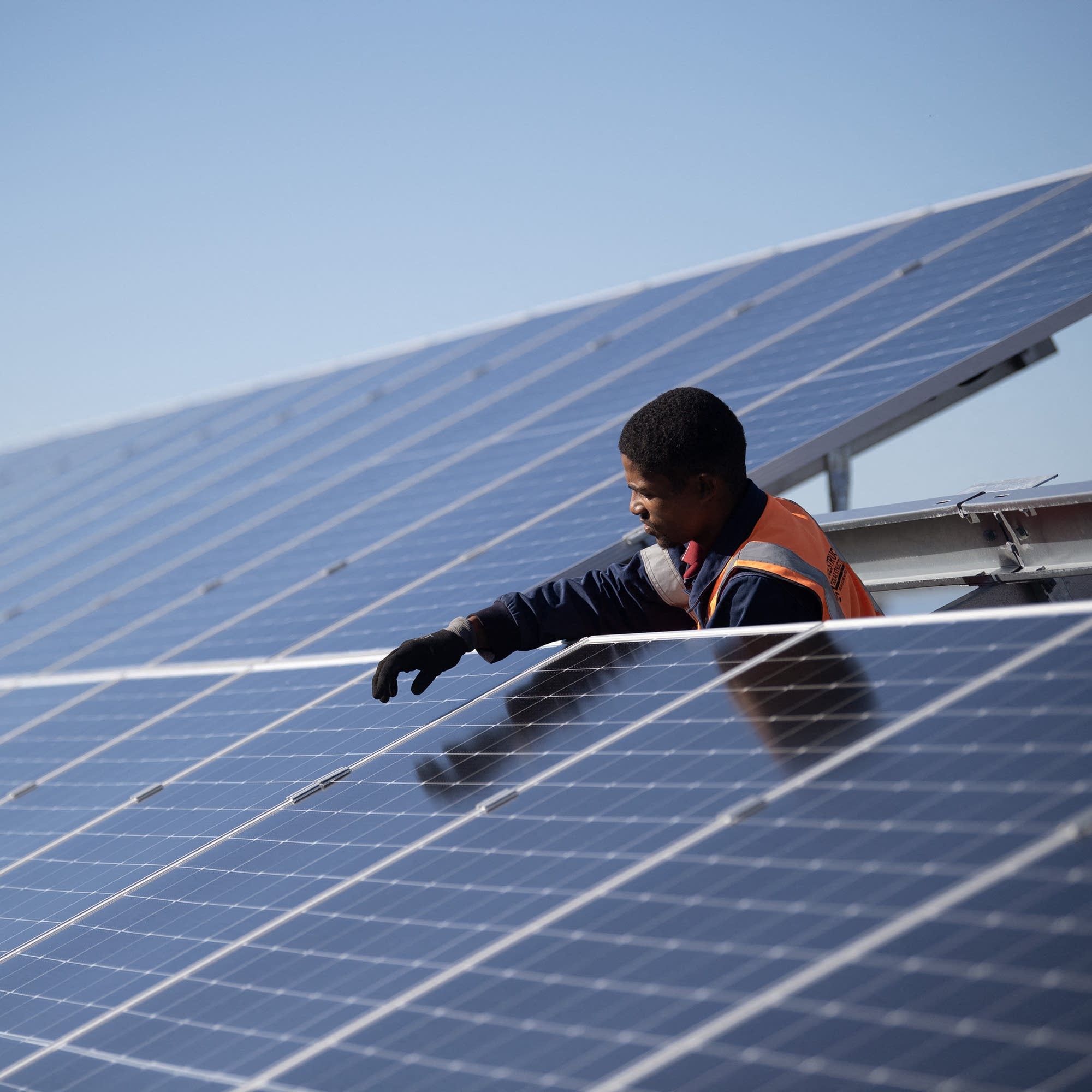
Renewable energy overtakes coal as the world's leading source of electricity Live from the uk, this is the Marketplace Morning report from the BBC World Service. I'm William Lee Adams. Good morning. Renewable energy has for the first time generated more electricity than coal. That's according to data from the global energy think tank Ember. It found the growth in solar and wind was so strong it met 100% of the new global electricity demand in the first half of this year. The BBC's climate editor Justin Rollette is here to unpack that. Justin, hi.
- [01:18]
Justin Rollette
Hi William. How are you doing?
- [01:19]
William Lee Adams
Really good. Thanks for being with us. Why is this so important?
- [01:23]
Justin Rollette
Because coal, the most polluting fossil fuel, has been the main source of energy for electricity generation literally since the dawn of the electric era, and still held that crown as recently as last year 2024. Which is why Ember, which is the global energy think tank that published today's report, describes this as a crucial turning point for the world energy system.
- [01:48]
William Lee Adams
And the pace of change is of course uneven. Who's leading the way?
- [01:52]
Justin Rollette
Sunny parts of the world, the tropics and lower income countries. Interestingly, China is overwhelmingly dominant in this industry. It added more wind and solar than the rest of the world combined, which helped reduce its fossil fuel generation for electricity by 2%. India also saw renewable power outpace electricity demand, but it's actually in smaller countries where the really dramatic fall that we've seen in the price of solar is really kicking in. What seems to be happening is that become now so cheap to buy solar panels and batteries to back them up during the night when the sun isn't shining that when you've got relatively high electricity prices or unreliable Electricity, both very common in developing countries. You just go down the market, you buy yourself a solar panel, put it on your roof, put it on your balcony and you've immediately got your own much more dependable and frankly much cheaper energy systems. Pakistan has added the equivalent of more than a third of total energy generating capacity in a single year. 2024. Nigeria racing ahead with huge investments in solar. And then smaller countries. Algeria increased ITS Solar imports 33 fold. 33 times increase in solar imports in 2024. Zambia Eightfold. Botswana sevenfold. So you see this just rippling across the developing world. Very different picture in developed countries.
- [03:15]
William Lee Adams
Of the developed countries, who's lagging behind?
- [03:18]
Justin Rollette
Well, the ones picked out in December report, they talk about the US and Europe and in the US there's a growth in electricity demand as we increasingly electrify so many things in our lives. New renewable power did not meet that increase in demand. It's actually a slightly different picture in Europe. The wind speeds were poor in Europe and drought, climate change meant there was less rain and therefore hydroelectric power, which still generates a lot of renewable energy, was much lower than normal and therefore that didn't meet the new increase in electricity demand in Europe. But these developed countries face very different challenges to developing countries. There you've got a well established electricity grid, really considerable electricity demand already, making the option of switching just to solar panels much more challenging.
- [04:05]
William Lee Adams
Justin, thanks for joining us on Marketplace.
- [04:07]
Justin Rollette
My pleasure, William.
- [04:09]
William Lee Adams
Here in the uk, police in London say they've dismantled an international gang suspected of smuggling up to 40,000 stolen cell phones from the UK to China over the past year. The phones are thought to fetch up to $5,000 each because they are unlocked and able to avoid censorship, unlike those sold legally. Here's the BBC's Seema.
- [04:29]
Seema Kotecha
The Metropolitan Police says it carried out the UK's largest operation against mobile phone theft, resulting in the arrest of 15 suspects and the discovery of more than 2,000 devices. Three people, including two Afghan men, have since been charged with conspiring to receive stolen goods. They're suspected of running an international smuggling gang. Figures show 80,000 mobiles were taken in London last year, almost triple the number stolen in 2020.
- [04:58]
William Lee Adams
Sima Kotecha let's do the numbers. Stocks in Taiwan, Singapore and Indonesia have hit record highs after a multi billion dollar chip supply deal between AMD and OpenAI. Taiwan's chip giant TSMC rose 3% on the news. The Chinese and South Korean markets closed for holidays. Elsewhere, Thailand's government has approved a $1.36 billion stimulus program which will reduce the cost of some food and consumer goods by up to 60%. Zimbabwe is on a quest to become Africa's blueberry capital after it recently signed a tariff free export protocol with China, one of the largest consumers of the fruit. The country's blueberry production is outpacing many other growers globally. It's expected to increase 50% this year to 12,000 tons. The BBC's Shingai Nyoka reports.
- [05:48]
Narrator/Reporter
In the cool of the early morning, workers file into a blueberry plantation to begin work. It's peak harvesting season and tons of berries must be reaped and packed before temperatures rise. Europe and the Middle east are major markets, but a trade agreement with China could make Zimbabwe a more significant global player. I've come to Laueta Farm. Scores of women are picking dark purple fruit from shoulder high bushes. They're separating the large quality berries for export. At another part of the farm, the land has been cleared and a new dam installed. Huge capital investment in anticipation of Chinese orders. Former international cricketer Alistair Campbell is determined to put Zimbabwe on the map, this time with blueberries.
- [06:35]
Alistair Campbell
Because of this China protocol and pending India protocol. This is where the growth is tangible growth and can happen very quickly providing the decks are cleared insofar as regulation is concerned and ease of doing business. So you attract foreign money and if you attract foreign money will be able to expand.
- [06:53]
Narrator/Reporter
So what would that mean for Zimbabwe's economy?
- [06:55]
Alistair Campbell
Well, huge. If we can expand to the level that we need to get to. There are funds out there that have money exactly for what we require, but we've been marginalised up to now.
- [07:04]
Narrator/Reporter
The farmers need over $100 million in order to double the acreage under berries to 1,500 hectares. But investors remain jittery about land tenure policies and perennial currency woes. It's time for tea and a roll call. I'm struck by the fact that almost all the reapers are women. 50 year old Rebecca Bonzo, a supervisor, explains to me that the farm has transformed a community plagued by high unemployment. Hundreds of women, many who are sole breadwinners, can now take care of their families, she said. Others see the access to new markets as a chance to diversify the players. In a Harare industrial area, packers are wrapping sugar snaps produced by numerous outgrowers. Exporter and contractor Clarence Mwale believes he can similarly integrate small scale farmers into the niche blueberries supply chain.
- [08:08]
Clarence Mwale
We have a contract to grow 2,000 hectares of blueberries. Using this small scale model, we target specific individuals who we know have capacity to grow blueberries. When the Chinese market opens up as it has now, it just gives us much more scope to look at where we were scrambling and fighting for the European market, which we haven't been able to fulfill. Now we've got a vast market that we need to feed. It gives everyone a chance to get into the blueberry production area.
- [08:37]
Narrator/Reporter
Zimbabwe will need to pass Chinese inspections before it can begin exports, but it will also need to build investor confidence in its quest to become Africa's blueberry capital.
- [08:49]
William Lee Adams
Shingai Nyoka There in the UK I'm William Lee Adams with the Marketplace morning report from the BBC World Service. Thank you for listening.
- [09:04]
Million Bazillion Hosts (Ryan and Co-host)
This week on Million Bazillion, Ryan and I are off to a sleepaway camp for podcasters where we meet up with some other podcast friends for a very special episode about animals and money. Together, we're going to tackle some very important questions, like what animals should be in charge of the economy.
- [09:20]
William Lee Adams
Well, like I said, there's plenty of crossover between the animal kingdom and your world of money.
- [09:27]
Million Bazillion Hosts (Ryan and Co-host)
Don't miss this special episode. Listen a million Bazillion on your favorite podcast app.