Loading summary
Transcript39 lines
- [00:00]
Dell Commercial Voiceover
Introducing your new Dell PC with the Intel Core Ultra processor. It helps you handle a lot, even when your holiday to do list gets to be a lot like organizing your holiday shopping and searching for great holiday deals and customer questions and customers requesting custom things. Plus planning the perfect holiday dinner for vegans, vegetarians, pescatarians and Uncle Mike's carnivore diet. Luckily, you can get a PC with all day battery life to help you get it all done. That's the power of a Dell PC with Intel inside, backed by Dell's price match guarantee. Get yours today@dell.com holiday terms and conditions apply. See dell.com for details.
- [00:30]
DSW Commercial Voiceover
Shoe shopping should be fun and full of surprises. DSW has never ending options for every style, mood and occasion, all at really great prices. From sneakers to boots and everything in between, DSW makes it easy to discover the styles you love and maybe even a few you didn't expect. Whether you're shopping in store or online, you'll always find fresh looks at prices that make sense. Find the shoes that get you at prices that get your budget at DSW stores or dsw.com.
- [01:02]
David Brancaccio
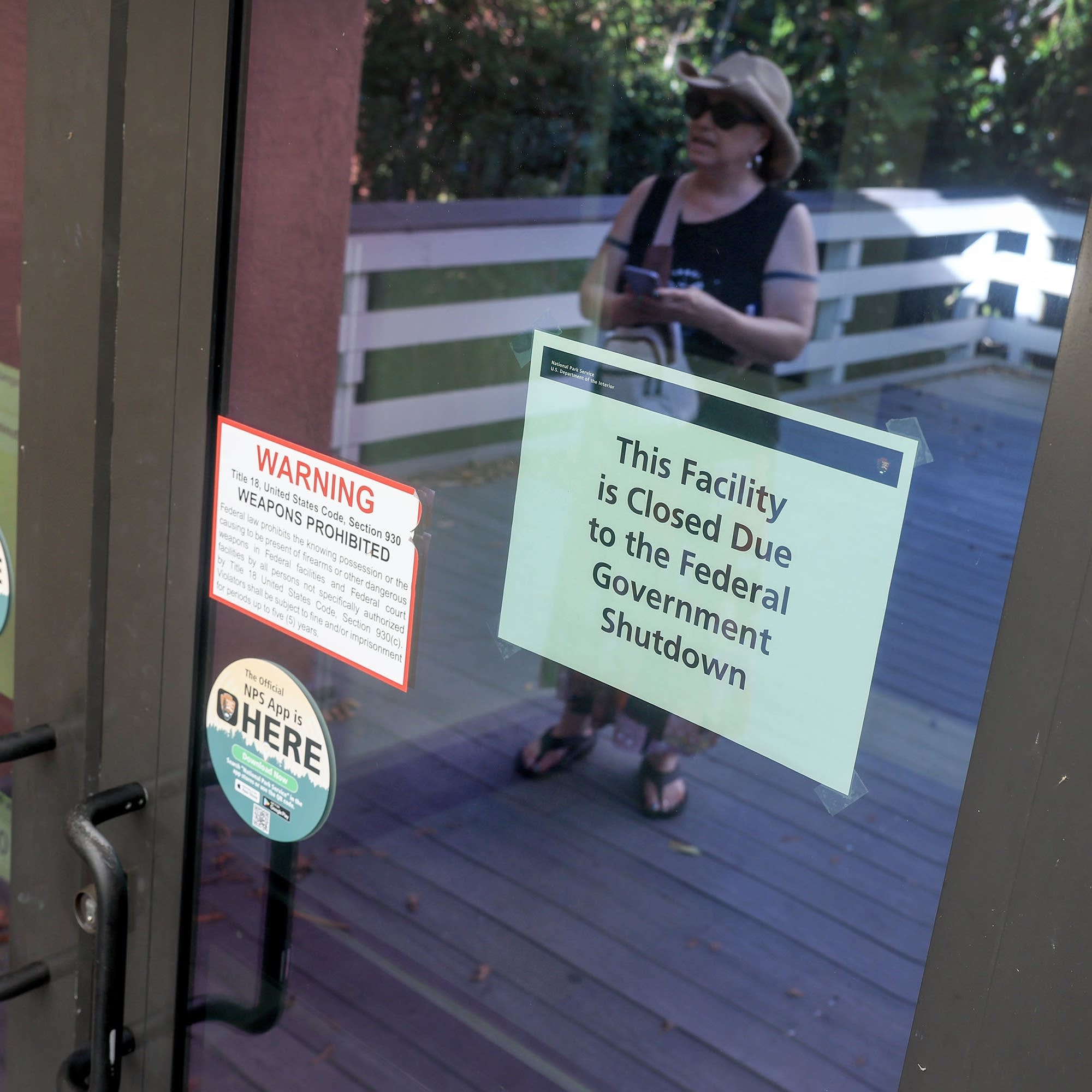
Economic insecurity not just for federal employees these days, but think of all the contract workers I'm David Brancaccio in Los Angeles. Good morning to you. It is day 14, entering a third week of the partial federal government shutdown for federal employees. The paychecks are grinding to a halt. A measure signed into law by President Trump in his first term entitles furloughed workers to back pay once the shutdown ends. That said, the current Trump administration has a theory that this law applies only to workers deemed essential who are actually working without pay. Now what is not contested millions of government contract workers who have no pay guarantee marketplaces Megan McCarty Carino reports contractors.
- [01:45]
Megan McCarty Carino
Outnumber federal employees by about 2 to 1, according to analysis from Elaine Kmark at the Brookings Institution.
- [01:53]
DSW Commercial Voiceover
In other words, there's been a boom.
- [01:55]
Marketplace Reporter/Analyst
In contracting in recent years.
- [01:58]
Megan McCarty Carino
Much of that is due to defense contracts for things like fighter jets. But there are also hundreds of thousands of lower wage service roles like janitors, cafeteria workers and security guards.
- [02:10]
Marketplace Reporter/Analyst
There's a lot of uncertainty and a lot of anxiety.
- [02:13]
Megan McCarty Carino
Julen Cosgrove is a VP at Melwood, a nonprofit that helps people with disabilities to get jobs in the D.C. metro area. The organization employs about 1,000 people at 70 different federal sites.
- [02:27]
Nancy Marshall Genser
A lot of people who work for.
- [02:28]
Marketplace Reporter/Analyst
Us, this is their first job or.
- [02:30]
Nancy Marshall Genser
Their first job in a long time, cosgrove says.
- [02:33]
Megan McCarty Carino
Some have already been furloughed Others are working without pay, though Melwood hopes to make them whole once the government reopens. I'm Megan McCarty Carino for Marketplace.
- [02:44]
David Brancaccio
Yesterday President Trump said it'll all work out on China trade policy and the stock market went up today. China sanctioned the US Parts of a South Korean cargo company and then Treasury Secretary Scott Besant, speaking to the Financial Times Times slammed China, saying its economy is a mess and that Beijing, quote, wants to pull everyone else down with it. US Stock index futures are down hard S And P futures -1% Nasdaq futures -plus 1.4% Some new tariffs began as you slept. It affects lumber, manufactured furniture, kitchen cabinets, among other things. Marketplace's Nancy Marshall Gensler has more.
- [03:23]
Nancy Marshall Genser
Starting today, there would be a new 10% tariff on lumber imports and 25% import taxes on wheat, wooden furniture, vanities and kitchen cabinets. On January 1, the furniture tariff rises to 30% and the vanity and cabinet tax increases to 50%. Around 85% of all US softwood lumber imports come from Canada, according to the national association of Homebuilders. Canada will be hit especially hard by the new tariff since it's already subject to other U.S. duties on its lumber. There are some carve outs for other countries. Duties on wood products from Britain will be capped at 10%, with a limit of 15% for the EU and Japan. I'm Nancy Marshall Genser for Marketplace.
- [04:24]
Dell Commercial Voiceover (Alternate)
Introducing your new Dell PC. Powered by the Intel Core Ultra processor, it helps you handle a lot even when your holiday to do list gets to be a lot because it's built with an all day battery plus powerful AI features that help you do it all with ease, from editing images to drafting emails to summarizing large documents to multitasking. So you can organize your holiday shopping and make custom holiday decor and search for great holiday deals and respond to holiday requests and customer questions and customers requesting custom things. And plan the perfect holiday dinner for vegans, vegetarians, pescatarians and Uncle Mike's carnivore diet. Luckily you can get a PC that helps you do it all faster so that you can get it all done. That's the power of a Dell PC with Intel inside backed by Dell's Price match guarantee. Get yours today@dell.com deals, terms and conditions apply. See Dell.com for details.
- [05:24]
David Brancaccio
Now to the Weddings section. You know the corporations all dressed up for marriage. The research company Deal Logic finds that January to September of this year we've seen the fewest mergers and acquisitions in more than a decade. But the the Corporate marriages that are happening are big, expensive affairs. Marketplace's Justin Ho has more on why we even track this.
- [05:45]
Justin Ho
Smaller companies buy or merge with one another to sell more kinds of products. Sometimes they do it to expand geographically or to lower costs. Big M and A deals are different.
- [05:55]
Drew Pascarella
Here. We're talking about companies that are already very well situated with respect to market presence.
- [06:00]
Justin Ho
Drew Pascarella teaches finance at Cornell University.
- [06:04]
Drew Pascarella
And here you're sort of solidifying a leadership position as opposed to a small company using M and A to enter a new market. For the first time.
- [06:11]
Justin Ho
We're talking about deals with values higher than $10 billion. Pascarella says they're typically less risky than smaller deals because big companies tend to be more stable when the economy goes south.
- [06:22]
Drew Pascarella
They're not a single product company or a single geography company that could be wiped out. And therefore, even in a volatile market that we continue to be in, they might feel a little bit more comfortable doing an M and A deal versus, say, a small.
- [06:36]
Justin Ho
Getting even bigger can help companies insulate themselves from economic turmoil. Emily Feldman, a professor of management at the Wharton School, says big M and A deals can give companies more control over scarce resources.
- [06:48]
Nancy Marshall Genser
Is it people? Is it their brains?
- [06:50]
Megan McCarty Carino
Right?
- [06:50]
Nancy Marshall Genser
Is it copper, like a natural resource? Is it one of the four remaining railroad companies in the United States?
- [06:56]
Justin Ho
And if a company can control more of its own supply chains, you're less.
- [07:00]
Nancy Marshall Genser
Subject to, you know, for example, what might be happening with suppliers or customers who might be impacted by some of the uncertainties that we've been talking about.
- [07:10]
Justin Ho
Big M and A deals still have to pass muster with regulators. AfrafSharipur, a law professor at UC Davis, says megadeals often involve regulatory scrutiny.
- [07:19]
Marketplace Reporter/Analyst
In several countries, these large megadeals are more subject to that, right, because those companies kind of hit multiple jurisdictions.
- [07:28]
Justin Ho
But Fsharapur says big companies can afford the teams of lawyers and other advisors that it takes to jump through regulatory hoops all over the world.
- [07:36]
Marketplace Reporter/Analyst
And that's why sort of that scale and complexity of the company might actually favor sort of the very large strategic buyers that want to do mega deals because they're also much more sophisticated in being able to manage regulatory complexity outside of one jurisdiction.
- [07:51]
Justin Ho
Fsharipoor says this year's big mergers and acquisitions will have consequences for the smaller companies that aren't doing deals.
- [07:58]
Marketplace Reporter/Analyst
You know, if you're a mid sized business in a particular sector and then your largest competitors are 10, 15 times larger than you, your ability to compete is going to be really tough.
- [08:10]
Justin Ho
And big corporate deals fsharipour says are likely to keep happening. I'm Justin Ho. For Marketplace.
- [08:16]
David Brancaccio
Multichannel tycoon Taylor Swift announced a streaming series coming to Disney. It documents her blockbuster eras tour six episodes, launching in December. Our producers are Tamara Fagan, Ashley Rodriguez, Ariana Rosas and Erica Soderstrom. Our senior producer is Alex Schroeder. Our supervising senior senior producer is Meredith Garretson. Morby In Los Angeles, I'm David Brancaccio. It's the Marketplace Morning report from APM American Public Media.
- [08:48]
Kimberly Adams
I'm Kimberly Adams, host of Make Me Smart, a podcast from Marketplace that makes today make sense. Join me throughout the week as I dig into the biggest stories in tech culture and the economy. Whether it's a vibe check on the job market or the latest on China US Relations, Make Me Smart helps you understand how the headlines actually impact your daily life. Listen to Make Me Smart on your favorite podcast.
- [09:14]
Marketplace Reporter/Analyst
Applause.