Loading summary
Transcript29 lines
- [00:00]
Asana Announcer
When too much work bogs you down, asana helps you handle it. That's because Asana is where humans and AI coordinate work together. AI makes it easy to hand off routine tasks, streamline workflows, and keep everyone focused on the work that matters most. That's how work gets handled. That's Asana. Visit us@asana.com that's asana.com.
- [00:31]
David Brancaccio
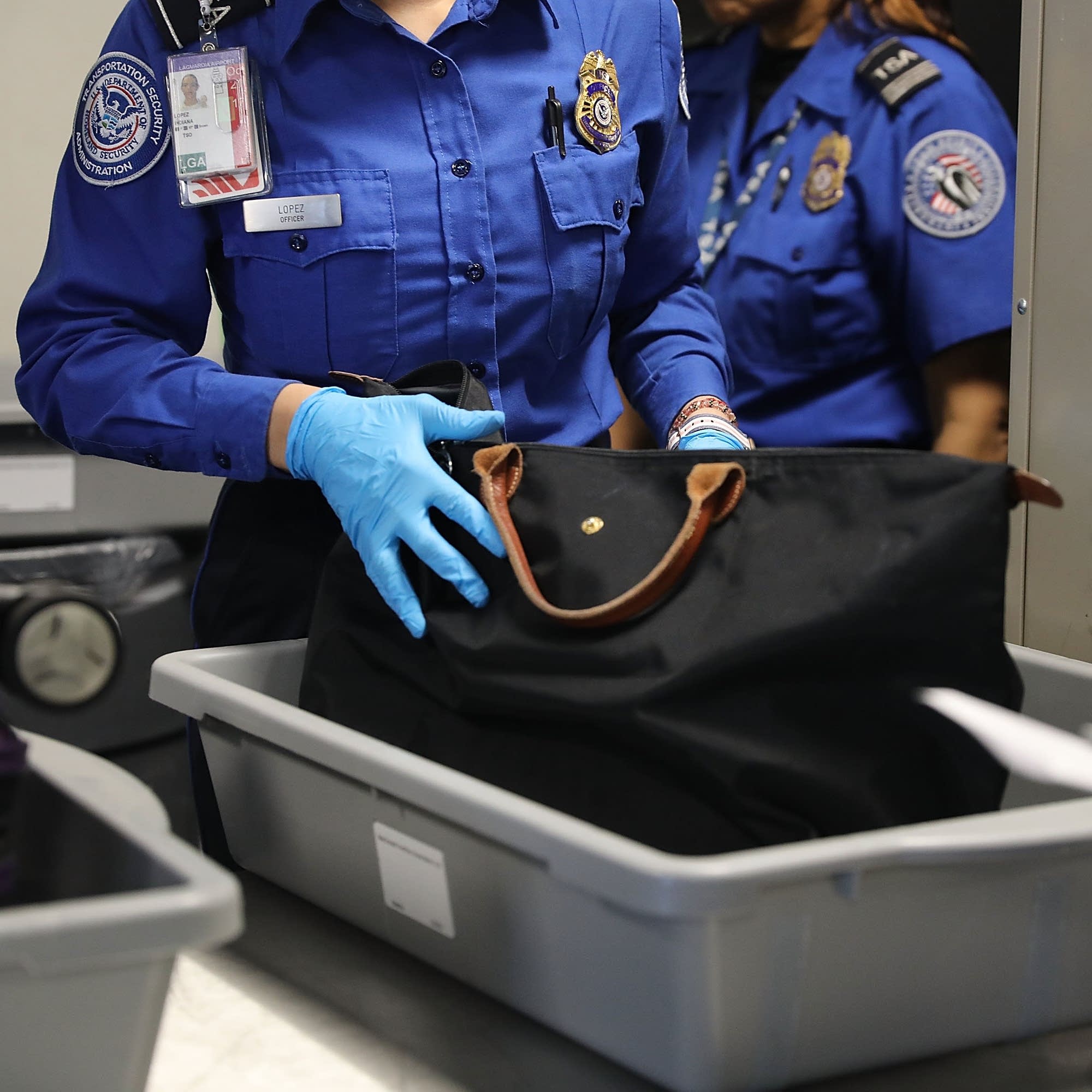
Could reopening the government turn on the matter of air travel? I'm David Brancaccio in New York. Starting tomorrow, federal workers will get paychecks for the days just before the government shutdown, but no pay for now for the work they're required to do during the shutdown. Looking at the short pay stubs won't go down well for folks who are supposed to be doing jobs. Shut down or shine. Among those TSA transport security agents and air traffic controllers play a role in how the country may be able to tolerate a shutdown when some, faced with no pay for now, decline to do extra work or simply taking the day off. The FAA has had to delay flights via some airports because of this effect. Marketplace's senior Washington correspondent Kimberly Adams reports now.
- [01:15]
Kimberly Adams
To be clear, points out Nick Daniels, president of the National Air Traffic Controllers.
- [01:20]
David Brancaccio
Association, air traffic controllers don't start a shutdown, and air traffic controllers don't end a shutdown.
- [01:25]
Kimberly Adams
That's Congress's job. But Daniels says air traffic controllers were already dealing with staffing shortages and equipment issues, and another shutdown with no pay has them angry. The union is telling everyone to keep coming to work, but some may decide not to, says Eric Hanson with the US Travel Association.
- [01:44]
Tim Walsh
If you look at previous shutdowns, it's really been travel delays and safety concerns that have shut down previous shutdowns.
- [01:54]
Kimberly Adams
Famously, in 2019, TSA agents stopped coming to work because they literally ran out of money to live, says Johnny Jones, a TSA officer working out of Dallas Fort Worth who's a local president with the American Federation of Government Employees.
- [02:10]
David Brancaccio
Only in America can you work for the federal government and go to work every day or even get sent home against your will and and they say, hey, we're just not going to pay you.
- [02:19]
Kimberly Adams
No big deal, jones says. They don't want to be political pawns in a shutdown, but folks are having to make calculations of just how long they can last without pay. In Washington, I'm Kimberly Adams for Marketplace.
- [02:51]
Asana Announcer
When too much work bogs you down, Asana helps you handle it. That's because asana is where humans and AI coordinate work together. AI makes it easy to hand off routine tasks, streamline workflows and keep everyone focused on the work that matters most. That's how work gets handled. That's Asana. Visit us@asana.com that's asana.com what does 268 horsepower sound like?
- [03:23]
David Brancaccio
You're hearing it right now. The all new Audi A5.
- [03:26]
Tim Walsh
Precision crafted to bring the thrill to every turn.
- [03:29]
David Brancaccio
This is powerful performance.
- [03:31]
Asana Announcer
The all new Audi A5.
- [03:36]
David Brancaccio
You know what for streamed shows, movies, maybe sports. But Netflix is adding more games playable beyond phones and now including big flat screens. And it can be a group thing. Marketplace's Samantha Fields reports.
- [03:48]
Samantha Fields
Want to play Boggle on your TV or Pictionary? Now you can on Netflix. The streaming company is making games available to play on the big screen for the first time, using your phone as the controller. The games Netflix is adding are intended to be played in groups with friends or family. Gaming is a lucrative industry. Other television, film and streaming companies have tried to break into it but haven't had much success so far. Netflix is hoping to change that. The company says its move into gaming is a long term strategy. Anyone who subscribes to the app for streaming will be able to play these games for free, at least for now. I'm Samantha Fields for Marketplace.
- [04:30]
David Brancaccio
Let us now check the Marketplace economic pulse views on the economy from a range of perspectives. Sometimes we give you the views from Main street, but today a survey of how big time CEOs are feeling about this moment of tariffs and the promise and perils of artificial intelligence. The audit, tax and advisory firm KPMG is out with the latest CEO Outlook Survey. Tim Walsh, KPMG's U.S. cEO, joins us now. Welcome.
- [04:56]
Tim Walsh
It is great to be here. David. Thanks for having me.
- [04:59]
David Brancaccio
You know, I do it anecdotally. I talk to the CEOs I can talk to. And I have been getting this year an impression that it's a little hard to predict where policy is, is going in America. Do you see that reflected this uncertainty?
- [05:13]
Tim Walsh
We do see that and that's certainly what I'm hearing as well. There is a, there's a, certainly a level of disruption and as you say, uncertainty that CEOs are dealing with. I mean the primary factor there that certainly is coming up most significantly is around tariffs and it's not the change of tariffs but the fact that tariffs are changing and then sometimes changing again. And so companies are clearly needing to very quickly model their cost structures and then, and then get after their options in terms of changing supply chains and, or doing Cost cutting or. And lastly, of course, understanding how much the consumer might be able to absorb as it relates to price increases.
- [05:57]
David Brancaccio
What percentage of the CEOs surveyed think they might have to pass along some of these costs to the people they sell to?
- [06:05]
Tim Walsh
You know, I would say that it's high on the list of things and options. And I would say the majority of companies, depending on the level of tariff that are facing, the more significant, obviously the tariff, the more, you know, the more likely it is that, that the consumer will need to absorb some of that.
- [06:21]
David Brancaccio
Last year, 70% of the CEOs you surveyed thought that this artificial intelligence technology would not lead to a big surge in layoffs, that it might increase productivity and so forth. Is that how they're feeling this year?
- [06:36]
Tim Walsh
It is, David. Certainly CEOs are experiencing the efficiencies both from investing in AI, specifically in investing in agents. But on the other hand, they're also seeing growth opportunities with that. And so I look at the labor force that we have, and I do know that there'll be some changes as it relates to that mix of labor force. But overall, I don't see the number of employees coming down at an organization like KPMG.
- [07:06]
David Brancaccio
Now, concern about cybersecurity issues among CEOs. We're talking coming off a month where Jaguar Land Rover of Britain, the factories were shut down because of some kind of cyber attack that must scare the daylights out of businesses more widely.
- [07:26]
Tim Walsh
That is an understatement. The cyber criminals are able to now employ AI as well, and so they can do more damage. And one really significant risk that CEOs are dealing with is the fact that AI and agents specifically are, are becoming the threat inside. Threat actors. The one positive I would leave you with, though it's not all negative, the good news is that, you know, you can fight AI risk with AI.
- [07:56]
David Brancaccio
Tim Walsh, US CEO of the audit tax advisory firm KPMG. Mr. Walsh, thank you very much.
- [08:02]
Tim Walsh
Thank you for having me. Great to be here.
- [08:04]
David Brancaccio
And in the first major public document since becoming the head of the Roman Catholic Church, Pope Leo has denounced what he calls the dictatorship of economic inequality. He called on Catholic to work to eradicate unjust economic structures by changing mindsets as well as getting help from science and technology. The document released today criticizes economic theories requiring us to wait for invisible market forces to resolve poverty. The Pope, born in Chicago, said the emphasis on helping the poor now is, quote, non negotiable. In New York, I'm David Brancaccio, Marketplace Morning report from apm. American Public Media. Hey, it's Marketplace Morning Report host David Brancaccio. I have an update on our fall fundraiser. Over 2,000 donors stepped up to power the future of Marketplace. Thank you to everyone who donated. Your support powers our mission to make everyone smarter about the economy. And we can't thank you enough. Thank you. This work doesn't stop. And it's never too late to become a Marketplace investor and head over to Marketplace. Org, donate and thank you.