Loading summary
Transcript29 lines
- [00:00]
InvestPR Narrator
Advanced manufacturing demands Precision aerospace demands trust. In Puerto Rico, companies like Honeywell, Lufthansa, Technik and Collins Aerospace deliver complex engineering and high value production within a US Jurisdiction. That means federal regulatory alignment, strong IP protections and fast access to the US mainland, plus competitive tax incentives and a STEM trained workforce. From aerospace to advanced manufacturing, the infrastructure is proven and and the talent is here. It's not what's next, it's where puerto Rico. Visit investpr.org day or night.
- [00:41]
VRBoCare Representative
VRBoCare is here 247 to help make every part of your stay seamless. If anything comes up or you simply need a little guidance, support is ready whenever you reach out. From the moment you book to the moment you head home. We're here to help things run smoothly because a great trip starts with the right support. And hey, a good playlist doesn't hurt either.
- [01:10]
Sabri Benishour
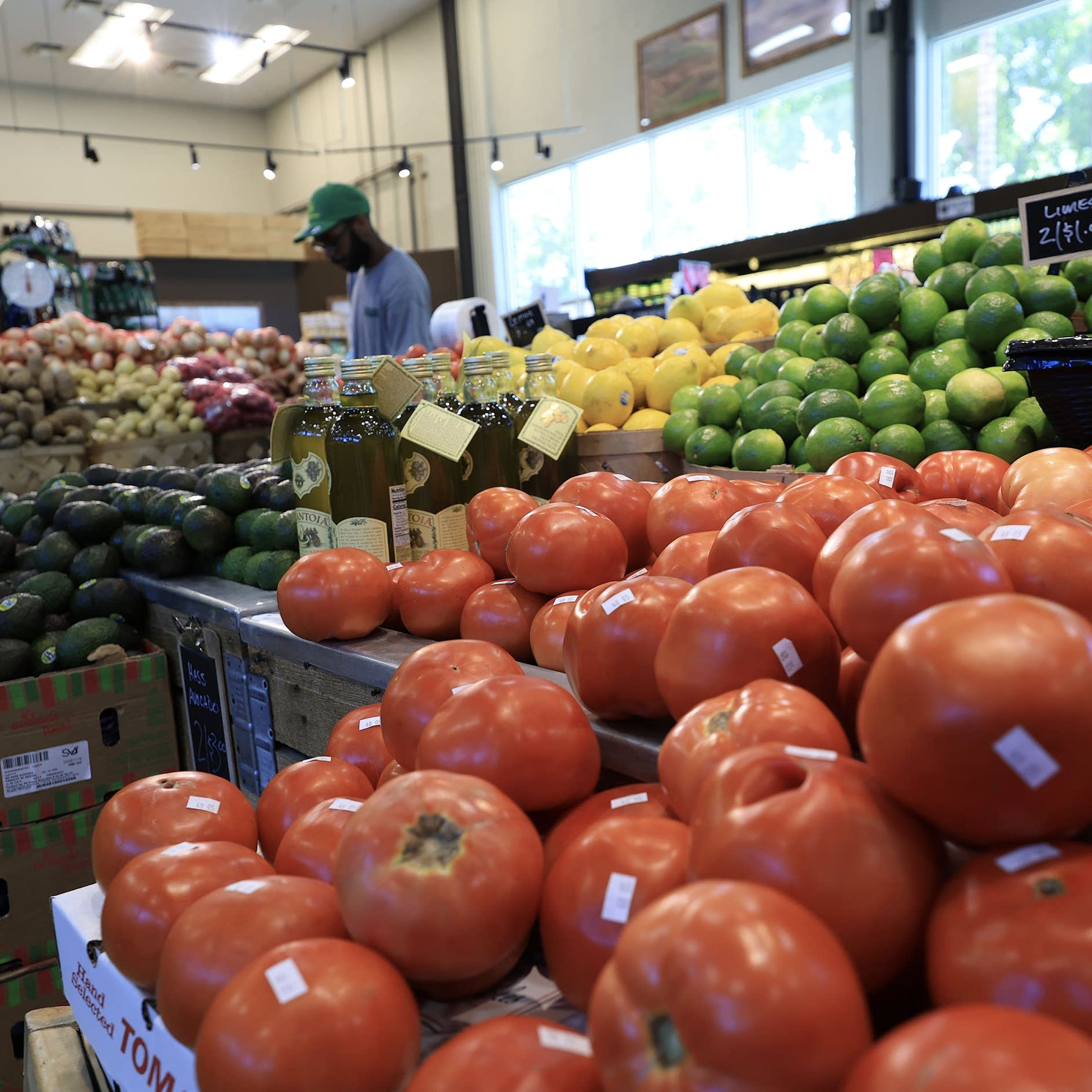
A New Kind of Blockade in the Strait of Hormuz Courtesy of the US From Marketplace, I'm Sabri Benishour. The price of oil and natural gas are back up after talks between the US And Iran collapsed and new threats from President Trump. He said the U.S. would blockade Iranian ports starting at 10am Eastern today and and intercept any ships passing through the strait that had paid tolls to Iran. The president had initially posted that the US Would be blockading the Strait of Hormuz itself, but US Central Command says ships will be allowed through as long as they aren't stopping by Iran. Brent crude is at $103 a barrel. Grocery prices in this month's Consumer Price Index are up lightly on average about 2% compared to this time last year. But averages have a way of hiding things. You don't see the extreme. If, however, you take a look at individual food groups, that is where things get interesting and you find the bigger numbers that you have probably already noticed yourself. On shelves. Fruits and vegetable prices are up 4% compared to last year. Non alcoholic beverages are up almost 5%, and meanwhile, meat and dairy are both down. Marketplace's Kaylee Wells has more on what's going on.
- [02:28]
Kaylee Wells
When it comes to fruits and vegetables, the main culprits are lettuces and tomatoes. Charlotte Ambrzek teaches economics at the University of Minnesota, Minnesota they had a lot
- [02:38]
Patrick Rooney
of heat and a lot of rain in not the order that they usually like to have those things in.
- [02:44]
Kaylee Wells
Too much fall rain splits tomatoes. Too much winter heat makes lettuces bitter, meaning lower yields of both and higher prices, ambrzyck says. As for the jump in beverage prices,
- [02:56]
Patrick Rooney
it's almost entirely driven by coffee and a lot of that is tariffs.
- [03:01]
Kaylee Wells
Meanwhile, meat prices have fallen for two reasons, says food economics and policy professor William Masters at Tufts University University.
- [03:08]
Patrick Rooney
Meat prices had been exceptionally high primarily because of the relatively low number of livestock in the US Herd.
- [03:17]
Kaylee Wells
Livestock farmers take a while to respond to demand because it takes a while to breed and raise a cow. Prices are falling, Master says, because supply is starting to catch up with demand. On top of that, prices had also
- [03:30]
Patrick Rooney
been high because of the surge of demand because of meat being this more fashionable thing now.
- [03:36]
Kaylee Wells
And as that fad begins to flatten, master says, that also brings down the price of meat. I'm Kaylee Wells for Marketplace.
- [03:57]
QuickBooks Payroll Advertiser
If you're a business leader, Intuit QuickBooks Payroll is an essential tool that completely integrates payroll, time, tracking, HR and your financials in a powerful all in one command center. No more juggling platforms or switching between vendors. All your data synced into one platform, offering clarity and confidence to make smarter decisions and focus on what matters. This summer, QuickBooks Payroll evolves to support the entire team life cycle. HR, time, benefits and payroll all working together in one connected system that fully integrates with your books. You'll be able to onboard employees in one seamless flow that feeds directly into payroll, configure automated HR workflows for things like promot promotions or offboarding, and track performance time off and benefits alongside payroll. Upgrade your workflow with QuickBooks Payroll Today and get ready for the brand new tools coming soon. More@quickbooks.com workforce that's quickbooks.com workforce I am
- [04:59]
Sabri Benishour
sure I don't need to tell you this, but we are just two days from tax day and we have spent the last few months breaking down how the big tax and spending law signed last summer by President Trump has changed tax season this year. Today we're talking about deductions for charitable giving. A report from the Indiana University Lilly Family School of Philanthropy found that tax law changes could increase how many people are donating to nonprofits, but at the same time reduce the overall amount of money charities get. Which sounds weird. So we are asking Patrick Rooney to help us make it make sense. He's co author of the report. Good morning.
- [05:38]
Patrick Rooney
Good morning.
- [05:38]
Sabri Benishour
So what are the main changes from the tax and spending law that are likely to affect charitable giving?
- [05:44]
Patrick Rooney
One of the main things is the universal charitable deduction. And what it does is, you know, most people, 90% no longer itemize on their taxes and so they may make charitable gifts, but they can't take a deduction. And this universal charitable deduction allows People to deduct up to $1,000 for singletons and up to $2,000 for married couples. And this is a way of really democratizing small d philanthropy. And we estimate that that will have around 6 to 8 million new donors coming into the philanthropic space.
- [06:26]
Sabri Benishour
So a lot more people can deduct charitable donations of up to $1,000. Where's the part where the total amount of giving comes down?
- [06:34]
Patrick Rooney
Yeah, so there's a couple factors that have negative or deleterious impacts, and one of them is that for itemizers, they can only deduct after they establish a floor of giving. So after they give 0.5% of their charitable gifts, they can only deduct the additional gifts. And we estimated that that would reduce charitable giving by $2.4 billion.
- [06:58]
Sabri Benishour
Oh, wow.
- [06:59]
Patrick Rooney
And something that's even bigger is that on the high end, people who are making a half million to a million dollars or more per year and facing the 37% marginal tax bracket, there's a cap of 35% on what they can deduct on all deductions, including charitable donations.
- [07:20]
Sabri Benishour
So just so I understand, the wealthiest income brackets, instead of being able to deduct 37% of their income in charitable deductions, they can deduct 35%. Are there a lot of really wealthy people that give that much of their income to charity?
- [07:36]
Patrick Rooney
Well, yeah, you know, in that group of people who earn a million dollars or more, they account for 48% of total household giving, dollar wise. So we estimated that this tax cap would reduce household giving by $6.1 billion. So, you know, it seems like it creates an outsized effect.
- [08:00]
Sabri Benishour
So all said, these kind of small changes would result in a $5.7 billion drop in charitable donations. The value of them overall, how big of a deal is that?
- [08:10]
Patrick Rooney
It's about 1% of total giving. And so that doesn't sound like that big of a deal. But this is something that will be an ongoing effect, not just in one year, but it'll be a permanent effect until the tax laws are changed again.
- [08:27]
Sabri Benishour
Patrick Rooney is professor emeritus at the Lilly Family School of Philanthropy. Thank you so much.
- [08:33]
Patrick Rooney
Thanks for having me.
- [08:35]
Sabri Benishour
In New York, I'm Sabri Benishore with the Marketplace morning Report from 8pm American Public Media.
- [08:46]
Maggie Smith
Hi, I'm Maggie Smith, poet and host of the Slowdown. Each weekday, I share a poem and a moment of reflection, helping you turn listening into a daily ritual. It's five minutes to slow down, pay attention, and begin the day with intention. Find it in your favorite podcast app and make the Slowdown your new daily poetry practice.