Loading summary
Transcript35 lines
- [00:00]
David Brancaccio
This Marketplace podcast is brought to you by Wealth Enhancement. Who asks, how healthy is your financial plan? Does it need a second option? You'd get one before surgery. Isn't your financial health just as important? Get a wealth blueprint at no cost. We'll check the pulse on your plan, share what you might be missing and opportunities you could be taking advantage of and determine whether your current advisor's a quack. Learn more at wealthenhancement.com build running a
- [00:31]
Odoo Advertiser
business is hard enough, so why make it harder With a dozen different apps that don't talk to each other? Introducing Odoo, the only business software you'll ever need. It's an all in one fully integrated platform that makes your work easier from CRM, accounting, inventory, e commerce, and more. And the best part, Odoo replaces multiple expensive platforms for a fraction of the cost. This is why over thousands of businesses have made the switch. So, so why not you try Odoo for free at odoo.com that's O-O-O.com
- [01:02]
Julia Coronado
what
- [01:02]
Nancy Marshall Genser
is Jay Powell thinking now? From Marketplace, I'm Nancy Marshall Genser in for David Boncaccio. The Federal Reserve's two day meeting on interest rates starts tomorrow. So let's take a look at some key economic data we got last week and what it could mean for the path of rates. For more we're joined by Julia Coronado. She's founder and president of Macro Policy Perspectives and a professor at the University of Texas, Austin. Good morning, Julia.
- [01:28]
Julia Coronado
Good morning.
- [01:29]
Nancy Marshall Genser
So last week we got the official government estimate of how fast the economy grew in the last three months of 2025, fourth quarter growth was cut in half. How significant will that be for the Fed?
- [01:43]
Julia Coronado
Well, right now that is looking in the rear view mirror. And so in a moment where we have a big shock in the form of an oil shock and an uncertain war, it will be more important for the Fed to look forward. And even then it's an uncertain outlook. So I think the Fed is going to be sounding a calm tone and saying that they're going to wait and see and gather more information.
- [02:08]
Nancy Marshall Genser
Okay, so no interest rate cut this
- [02:10]
Julia Coronado
week probably and none anytime soon. The Fed is still looking at conflicting tensions with still high inflation that's going to go higher with oil prices and that's one of their mandates. But also an economy that's okay, but certainly not booming. A labor market that looks a little wobbly but okay. You know, these are competing influences on interest rates. And so for now it's a wait and see.
- [02:37]
Nancy Marshall Genser
Julia Coronado, founder and president of Macro Policy Perspectives Buy Now Pay later products are now a common way for Americans to buy things, and recent data out from the JP Morgan Chase Institute found that these services are becoming increasingly important during and after the home Buying Marketplace's Kimberly Adams has more Owning a home
- [02:59]
Kimberly Adams
is the American dream, right? So people tend to try to get their credit in order before they do it, right?
- [03:06]
Various Experts (Chris Wheat, Rohit Chopra, Ed Dehan, Nick Rayners, Peter Zaitsev)
Before especially frequent users of BNPL Buy a Home, we see their credit card balances come down by like 12, 13%, something like that.
- [03:13]
Kimberly Adams
Chris Wheat is president of the JPMorgan Chase Institute.
- [03:17]
Various Experts (Chris Wheat, Rohit Chopra, Ed Dehan, Nick Rayners, Peter Zaitsev)
And then after they buy a home, you see things like their BNPL usage really, really go up quite a bit more.
- [03:24]
Kimberly Adams
That's because owning a home for the first time comes with lots of new expenses. Rohit Chopra is the former head of the Consumer Financial Protection Bureau.
- [03:32]
Julia Coronado
We do see that people do borrow quite a bit when it comes to furnishing their home, and many sellers of appliances and furniture are now using Buy Now Pay later as a key way to pay.
- [03:47]
Kimberly Adams
Ed Dehan, a professor at the Stanford Graduate School of Business, says this data reflects a larger trend.
- [03:53]
Various Experts (Chris Wheat, Rohit Chopra, Ed Dehan, Nick Rayners, Peter Zaitsev)
BNPL isn't just 18 year olds who've never had a credit card. It's really come into the mainstream. And even people who can afford a house are now using BNPL as part
- [04:03]
Kimberly Adams / Advertiser
of their digital wallets.
- [04:04]
Kimberly Adams
And that comes with its own set of risks. According to JPMorgan Chase Institute's research, first time home buyers who are frequent users of Buy Now Pay later services have an over 8% higher chance of missing a payment within a year of their purchases compared to people who rely on other methods to cover their shopping. In Washington, I'm Kimberly Adams for Marketplace.
- [04:41]
Kimberly Adams / Advertiser
Expanding to the US Market doesn't have to mean higher costs. Puerto Rico is a US Jurisdiction with federal regulatory alignment, strong IP protections and seamless access to the US Mainland. It's why companies like Amgen Honeywell and Lufthansa Technik operate high value manufacturing and aerospace services from the island. Add competitive tax incentives in a highly skilled, bilingual workforce and the advantage is clear. It's not what's next, it's where Puerto Rico Learn more@investpr.org Work moves fast.
- [05:12]
Grammarly Advertiser
Every email, report and proposal counts. That's where Grammarly comes in. It's your one place to think, write and finish. Grammarly's AI agents help you find natural phrasing, fine tune tone and confidently write wherever you work. It's the premier writing tool that 93% of users trust to get more work done in a world of generic AI don't sound like everyone else. With Grammarly, you never will. Download Grammarly for free@Grammarly.com Around Europe, governments
- [05:43]
Nancy Marshall Genser
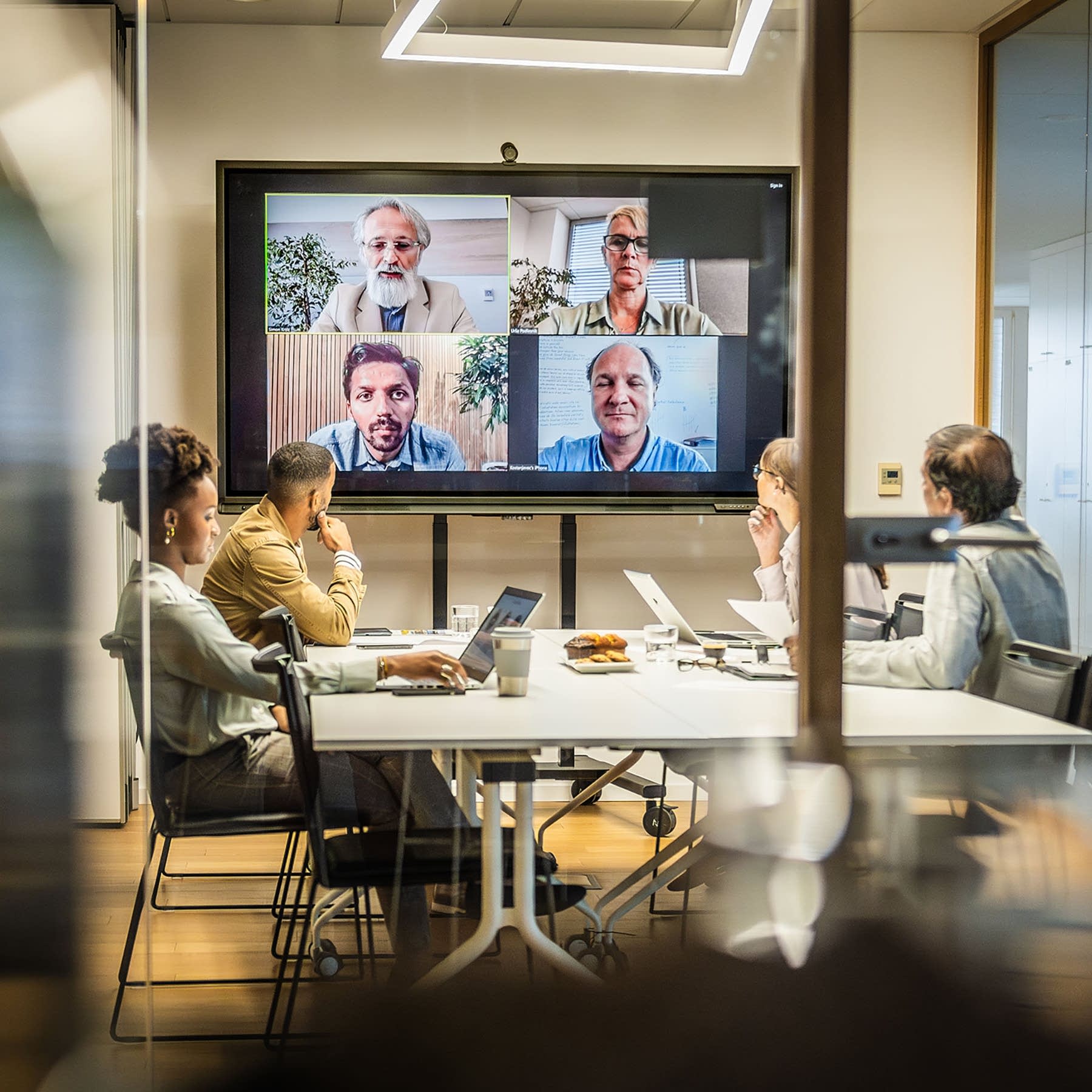
and institutions are looking to reduce their reliance on US Big tech. They're worried there could come a day when America cuts off digital access to foreign institutions. We saw a version of this last year when several International Criminal Court officials got sanctioned and couldn't access things like their email. The BBC's Elizabeth Hodson reports on the push for so called digital sovereignty.
- [06:06]
Elizabeth Hodson
At the start of February, senior French politician David Amiel announced on his X account that Zoom would be replaced by a French open source alternative called Vizio.
- [06:19]
David Brancaccio
In case you missed it, we're rolling out vizio with the 100% French video
- [06:23]
Various Experts (Chris Wheat, Rohit Chopra, Ed Dehan, Nick Rayners, Peter Zaitsev)
conferencing tool to all government employees.
- [06:27]
Elizabeth Hodson
Nick Rayners, senior geotechnology analyst at the Eurasia Group, says geopolitical tensions are fuelling decisions like these.
- [06:35]
Various Experts (Chris Wheat, Rohit Chopra, Ed Dehan, Nick Rayners, Peter Zaitsev)
There's been a kind of realization in Europe that Europe's reliance on US tech platforms is a geopolitical vulnerability. In a world where Donald Trump can threaten to invade Greenland or cut off satellite access to Ukraine. It's almost comparable to Europe's reliance on Russian gas before the Ukraine war kicked off.
- [06:55]
Elizabeth Hodson
And it's against this backdrop that governments are turning to open source database alternatives to things like Amazon Web Services or aws. Percona is one of these. You can either just use their software for free or use the company or other companies to help manage your database. And crucially, you still have access to the open source software. If Percona, a US company is forced to withdraw services if it's affected by sanctions, for example. Peter Zaitsev is Percona's co founder.
- [07:23]
Various Experts (Chris Wheat, Rohit Chopra, Ed Dehan, Nick Rayners, Peter Zaitsev)
The advantage of having the open source software is you have choice you don't have locked in where you are locked in the single provider.
- [07:36]
Elizabeth Hodson
But open source software still does often lag behind big tech. So are these massive governmental tech overhauls an overreaction, creating a lot of cost and inconvenience? Here's Nick Rayners again.
- [07:49]
Various Experts (Chris Wheat, Rohit Chopra, Ed Dehan, Nick Rayners, Peter Zaitsev)
That's the multi billion dollar question really. And certainly the US tech companies would tell you that this is a kind of absurd thing to be worried about. The kill switch scenario. Basically the scenario that Donald Trump could order all of Microsoft and Amazon servers to be switched off. The companies have put in place various measures to supposedly mitigate against this threat by putting their servers in Europe and managing them with European boards. The truth is it's impossible to say. We live in crazy times.
- [08:18]
Elizabeth Hodson
And Nick points out that the theory and practice of a major digital transition can be very different. I'm the BBC's Elizabeth Hodson for Marketplace,
- [08:29]
Nancy Marshall Genser
and in Washington, I'm Nancy Marshall Genser with the Marketplace Morning Report from apm, American Public Media.
- [08:39]
David Brancaccio
Hey, David Brancaccio here. I hope you're well and that your passport is up to date because I am hosting a trip to Italy this fall and and you, you are invited stay at a world class Tuscan villa and step into the world of the Medici, the formidable family whose influence and power helped give rise to the Renaissance and the art we still celebrate today, not to mention the banking system. We're going to visit the world's oldest bank, swim in the thermal spa waters in Montecatini and take in the art of the Uffizi. All of this, and then we'll try to put it all into context with great conversation over even better meals and wine tasting. Please join me and know this. Buying into this trip will provide essential support for public media. Discover more about this fall's tuscany adventure@marketplace.org travel to reserve your spot today, that's marketplace.org travel.