Loading summary
Transcript20 lines
- [00:01]
Marketplace Host
You can turn to Marketplace to hear from powerful leaders and everyday people about the economy and their role in it. Now we hope we can turn to you. Marketplace is facing real threats and challenges as we plan for the future. As a public media program, donations from you are an important part of our budget. Here's one action you can take right now that will have a long lasting impact. Start a monthly donation to support five bucks a month is a great place to start. Head to marketplace.org donate and thank you.
- [00:35]
Dell Commercial Voice
Introducing the new Dell PC. Powered by the Intel Core Ultra processor, it helps do your busy work for you so you can fast forward through editing images, designing presentations, generating code, debugging code, summarizing meeting notes, finding files, managing your schedule, responding to long emails, leaving all the time in the world for the things you actually want to do. Get A new Dell PC@dell.com AI PC how those ahead Stay ahead.
- [01:07]
William Lee Adams
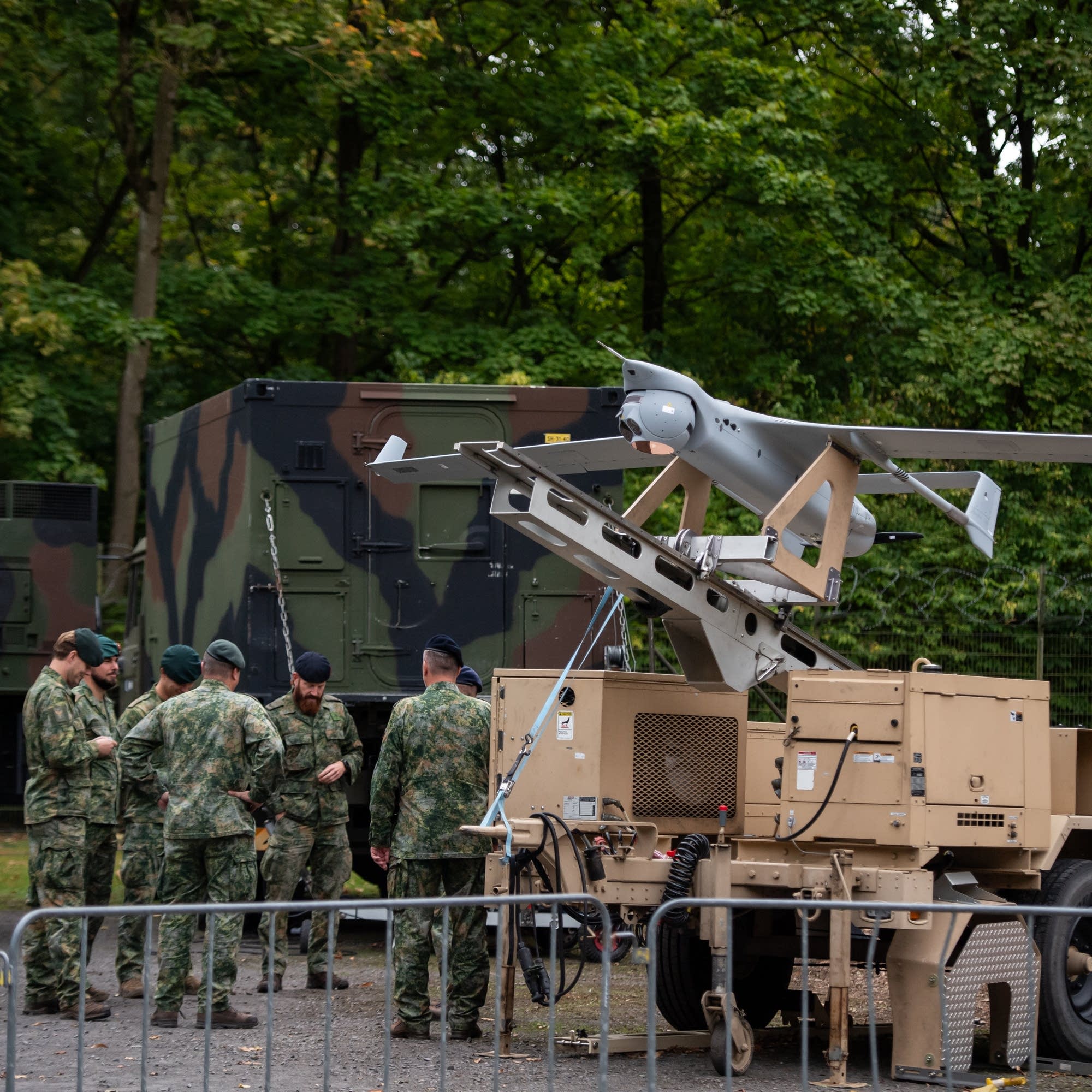
Europe plans to build a high tech drone wall, but how will it work and what's the price tag? Live from the UK this is the Marketplace Morning Report from the BBC World Service, I'm William Lee Adams. Good morning. Let's start with those plans backed by some European Union states to create a so called drone wall to keep out unmanned aircraft from Russia. A summit in the Danish capital Copenhagen follows a series of Russian incursions into EU airspace and comes just days after mystery drone flights forced the closure of airports in Denmark. This is Marco Mikkelsen, MP and Chairman of the Foreign Affairs Committee of the Estonian Parliament. The aim is to get the wall done by 2030. This is five years from now. We needed it yesterday and obviously there is a need just to invest, invest quickly into those technologies which are already appearing or are in use in Ukraine. Estonian MP Marco Mikkelsen there details on the drone wall are minimal and the tech is relatively new and expensive. David Jordan from the Freeman Air and Space Institute at King's College London says the estimates run from 4 to 8 billion billion.
- [02:18]
David Jordan
It's about a six week cycle now between a new innovation in drone warfare coming out and a countermeasure being found to it and then something new occurring. So it's very rapid and that does increase potential in terms of the cost and it depends upon how you wish to deal with them. Electronic warfare systems can be quite expensive. If you're shooting them down with guided missiles like something like a Patriot, that's an extremely expensive bit of kit. But you've got to have a system of course for detection, reporting, control of your intercepting forces and so on. And so forth. And that makes it extremely difficult to actually place any hard cost on it. But it's not a cheap enterprise.
- [02:55]
William Lee Adams
David Jordan To France now, where hundreds of thousands of workers from the eight biggest labor unions have walked out for the third time in as many weeks over looming budget cuts and pension reforms. The country's new prime minister, Sebastian Lecornu, was appointed after his predecessor quit over plans for a sharp reduction in the budget deficit. Let's do the numbers. Asian markets reached new highs with South Korea's Kospi index jumping by 3.2%. Taiwan's benchmark gained 2%. Chipmaker TSMC led the rally and European stocks set an all time intraday high. The Stoxx 600 rose 0.7%, led by technology, autos and mining. Now, we talk a lot on this program about the move to AI. And today marks 75 years since the invention of the Turing Test. It was created by British computer scientist Al Turing to tell the difference between a human and a machine. The BBC's Zoe Kleinman has more details.
- [03:52]
Zoe Kleinman
The Turing Test is used to measure not a machine's actual intelligence, but how convincingly human that machine can be. In written responses. The idea is to see whether human judges can be fooled into thinking they're interacting with real people. And it was used for many years. But in 2014, a chatbot called Eugene was reported to be the first machine to pass the Turing Test. The test is now considered outdated as technology has advanced. But distinguishing AI from a human has arguably become more important than ever.
- [04:24]
William Lee Adams
Zoe Kleinman there. Now to Chile, which has one of the fastest growing aging populations in South America. By 2050, it's estimated that a third of citizens will be more than 60 years old. And like many countries around the world with an aging population, some businesses are adapting. The BBC's Jane Chambers reports from the capital. Santiago.
- [04:47]
Jane Chambers
I've come to Cafe Figo and I'm here to talk to one of the people who works here, Alejandra Dietrich.
- [04:55]
Alejandra Dietrich / Carolina Belolio / Alejandra Perez
My name is Alejandra DIETRICH and I'm 68 years old. I used to work in the local council. I've never worked in anything like this before, but I thought I'd give it a go. And now I've been here for over a year and I really enjoy it.
- [05:09]
Jane Chambers
The legal retirement age here In Chile is 65 for men and 60 for women. But Alejandra says she still needs to work, even though it's tough to find employment.
- [05:22]
Alejandra Dietrich / Carolina Belolio / Alejandra Perez
It's hard for older people to find work. They always want to employ younger people. Who have just finished university.
- [05:27]
Jane Chambers
Sitting at one of the cafe's tables is Alejandra's boss, Carolina Belolio, who tells me about who she employs and why.
- [05:37]
Alejandra Dietrich / Carolina Belolio / Alejandra Perez
I've had the personal experience of leaving the job market when I was over 50 and it was hard to find employment.
- [05:43]
David Jordan
It was.
- [05:43]
Alejandra Dietrich / Carolina Belolio / Alejandra Perez
It's such a waste to lose all those skills. I only employ women over 50 years old. We come from all walks of life, teachers, nurses and secretaries.
- [05:55]
Jane Chambers
I'm travelling on the metro across town to meet someone who wants businesses to step up and do more to help older people in work. We are a group of around 40 people, mostly 50. That's Alejandra Perez, the president of a non profit organization called Talenton. Mainly we want to influence public policies to change the laws so that work can be more flexible. For this target of people, professional people, I've come to a busy hotel lobby to meet 65 year old Marcus Schreier, the founder of Kinacha Lab, a company which helps startups across Latin America. Ganesha Labs, one of the businesses working with talent on to share best practices about embracing an aging market and working with different generations.
- [06:45]
Marcus Schreier
I started the company when I was 55, now I'm 65 and when I built my own company that was one of my goals, to always have different generations playing with each other, working with each other. Because there is on the one hand the unstoppable spirit of the young ones and then of course, the more experience of the older ones.
- [07:04]
Jane Chambers
The people I spoke to tell me that with an aging population, Chile needs to adapt and embrace hiring older people because in a few years time they'll make up the majority of the workforce. They say that flexible working hours, changes in public policy and an appreciation of what they have to offer will help change Chile's mindset towards ageism. I'm the BBC's Jane Chambers for Marketplace.
- [07:28]
William Lee Adams
That's all for today in the uk I'm William Lee Adams with the Marketplace morning report from the BBC World Service.
- [07:43]
Million Bazillion Host
This week on Million Bazillion, we're doing some traveling and tackling all your travel related money questions. Find out how currency exchanges work, how money travels through the economy from where it's printed to our wallets. And we'll get to the bottom of why things seem so much more expensive at the airport. Don't miss this week's episode of Million Bazillion. Listen on your favorite podcast Appliance.