Loading summary
Transcript33 lines
- [00:00]
Marketplace Host
This Marketplace podcast is supported by Dell introducing the new Dell AI PC powered by Intel Core Ultra processor. It helps do your busy work for you so you can fast forward through editing images, designing presentations, generating code, debugging code, summarizing meeting notes, finding files, managing your schedule, responding to long emails, leaving all the time in the world for the things you actually want to do. Get a new Dell AI PC starting at $699.99 at Dell.com AI PC how those ahead Stay ahead. This Marketplace podcast is supported by Palo Alto Networks. Listen to threatvector, the Palo Alto Networks podcast, for in depth discussions with industry leaders and experts providing crucial insights for security decision makers. Whether you're looking to stay ahead of the curve with innovative solutions or understand the evolving cybersecurity landscape, ThreatVector equips you with the knowledge needed to safeguard your organization. Tune in and subscribe to threatvector wherever you get your podcasts.
- [01:02]
David Brancaccio
A New set of Tariffs Could Hit in three and a half weeks I'm David Brancaccio in Los Angeles. President Trump has extended the deadline for countries to lock in trade deals with the US or their exports will get hit with higher import taxes at the US Border. This week was supposed to mark the end of a 90 day pause, but now Trump says tariff hike day will be August 1st. US businesses and consumers pay those taxes. Katie Silver with our partners at the BBC has more on the current trade war talk.
- [01:34]
Katie Silver
Japan, whose trade envoy has visited Washington seven times to negotiate, has been told it will face 25% levies in a matter of weeks. The Prime Minister, Shigeru Ishiba says Japan can't reach an agreement with the US As Tokyo is unwilling to make easy concessions. In Thailand, the government said it was surprised to learn it would face tariffs of 36% and was preparing backup plans like diversifying export markets. South Korea and Malaysia both told they'll face tariffs of 25% and have said they'll continue to try to negotiate.
- [02:06]
David Brancaccio
Katie Silvers with our newsroom partners at the BBC. The Dow in early trading up 4 points, the S&P up about a 10th percent, the Nasdaq up 2. 10%. The 10 year interest rate tied to a lot of our borrowing is up at 4.42%. South Korea's Samsung Electronics issued a warning today that its profits are going to be way, way down because of the US Ban on selling advanced microprocessing chips to China. Oper profits for the spring into summer quarter could be down 56%. Among the spending cuts and the big tax bill signed into law by President Trump last week, $186 billion over the next decade to food stamps, the Supplemental Nutrition Program, SNAP Community food banks were already strained. Marketplace's Matt Levin has that the St.
- [02:51]
Dawn Whitman
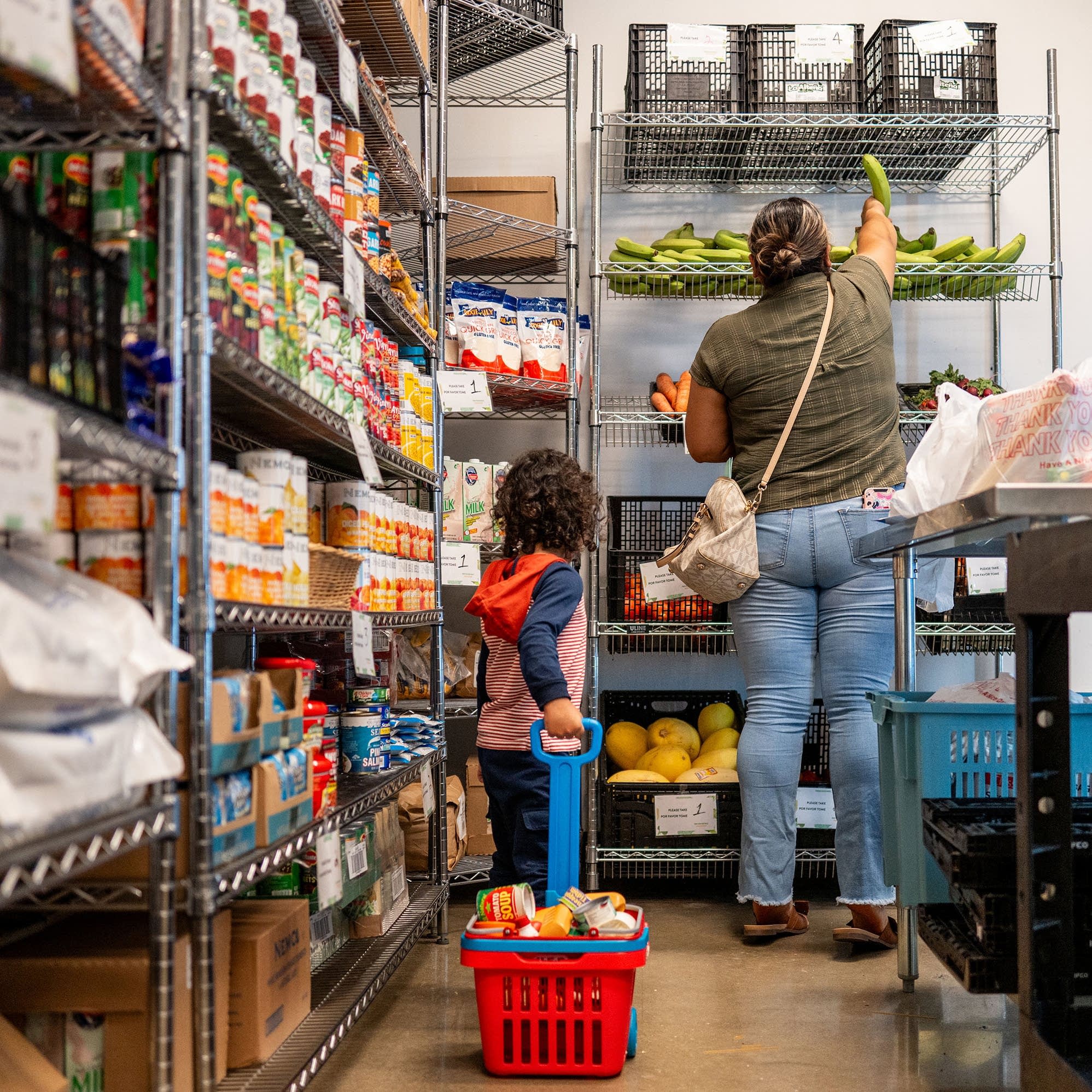
Leo food connection is one of the only food banks in Tacoma, Washington that allows the same patron to come and take food five days a week. But director Dawn Whitman says they're basically nearing capacity with the 300 or so families they serve each day. If significantly more people start showing up because their federal benefits are reduced, she may have to make some changes.
- [03:14]
Matt Levin
Our first thing would be to probably cut back on that. Oh, you can come every day. And also we would look at maybe the number of hours that were open.
- [03:27]
Dawn Whitman
In a day, whitman says. They've already seen an uptick in clients since last year as low income residents struggle with still elevated food costs. Vince hall at the national food bank network Feeding America says despite a relatively good economy, inflation has left lower income Americans with few options.
- [03:45]
Vince Hall
This is the first time in the history of food banking that we have seen record high demand at food distributions and very low unemployment, hall says.
- [03:54]
Dawn Whitman
There's just not a lot of resilience left in charitable food systems, and safety net cuts will only stress those systems more. I'm Matt Levin for Marketplace.
- [04:04]
David Brancaccio
This week marks six months since the wildfire destroyed more than 9,000 structures, mostly homes, in and around Altadena, California. Separately, more than 6,000 structures were lost along the coast in and around Pacific Palisades. Today we check in with a displaced family and tomorrow more on our coverage of how tariffs will affect rebuilding. As a company that makes metal frames for new homes tries to adapt to changing steel prices, marketplace.org will have that if you miss it on the air.
- [04:49]
Marketplace Host
This Marketplace podcast is supported by Dell. The Black Friday in July event from Dell Technologies is here. There's never been a better time to upgrade. Now's your chance for great offers on popular trusted technology. You'll also discover huge deals on exciting new AI ready laptops like the Dell 14 plus featuring Intel Core Ultra processors starting at $699.99. Don't forget to explore big savings on top electronics and accessories. Plus enjoy fast free shipping and other exclusive benefits like Dell Rewards Premium Support and Dell care Premium, which provides 24.7support with no hidden fees or deductibles. Upgrade for a limited time only@dell.com deals that's Dell.com deals.
- [05:40]
David Brancaccio
This Marketplace podcast is supported by Mercury. Mercury is the FinTech More than 200,000 businesses use to protect their money and power their financial workflows. Learn more@mercury.com Profits, losses and sales reports for the April to June quarter are just beginning to roll in. Delta airlines report second quarter results on Thursday. A piece of that a relatively new Delta package delivery service, which the airline started last year to cash in on E Commerce. But that comes with risks. Reporter Daniel Ackerman has that transporting cargo.
- [06:17]
Dan Bubb
Is nothing new for passenger airlines.
- [06:19]
Vince Hall
It honestly kind of takes me back to the origins of the airline industry. The airline industry actually began by transporting mail.
- [06:26]
Dan Bubb
Dan Bubb is a professor of aviation at the University of Nevada, Las Vegas.
- [06:30]
Vince Hall
One time actually passengers, believe it or not, had to sit on bags of mail. That was your seat.
- [06:35]
Dan Bubb
And even after airlines added real seats for people, many still earned extra cash by filling spare cargo space with packages, says airline consultant Robert Mann.
- [06:44]
Robert Mann
With thousands of flights a day by major network carriers, there's a lot of cargo capacity that goes unutilized.
- [06:52]
Dan Bubb
But man says Delta's new program is about more than filling empty space.
- [06:56]
Robert Mann
Well, the uniqueness of it is, first off, it's door to door, mann says.
- [07:01]
Dan Bubb
Delta is the only major carrier offering that service, and that could be attractive to shipping customers who don't want to bother getting their packages to the airport these days.
- [07:10]
Robert Mann
Going to the airport is a whole lot more difficult than it used to be. There's a whole lot more, you know, agita and cost and time involved.
- [07:18]
Dan Bubb
And while most of Delta's operations involve airports and airplanes, Delta and other carriers actually manage some door to door logistics already, says Vijay Pandyarajan, a business professor at the University of Michigan.
- [07:31]
Dawn Whitman
Delta already has great experience, for example, delivering delayed baggage.
- [07:37]
Dan Bubb
So the new service, which uses third party delivery firms for the last mile, builds on that capacity. But Pandyarajan says the strategy has some limitations. For one, there are a lot of.
- [07:48]
Vince Hall
Remote places where you don't have Delta.
- [07:51]
Dan Bubb
Flying in Erie, Pennsylvania or Lincoln, Nebraska, for example, both cities where Delta has ceased service, meaning that last mile delivery could be a last hundred mile delivery. Established players like FedEx, UPS and Amazon have that down to a science, says Dan Bubb of unlv.
- [08:09]
Vince Hall
They've got warehouses everywhere. They've got trucks driving all night, bubb says.
- [08:14]
Dan Bubb
The timing of shipments could also be uncertain because Delta might not know how much extra cargo space a flight is.
- [08:20]
Vince Hall
Going to have if they are transporting cargo. On the passenger flights, the bags get priority, and human organs, anything of a critical nature gets priority.
- [08:29]
Dan Bubb
Plus, says Bub, passenger flights can and do get delayed. I'm Daniel Ackerman for Marketplace and Weight.
- [08:37]
David Brancaccio
Watchers is adding new business lines at a time many people lose weight with new drugs as it emerges from bankruptcy protection beyond weight loss with exercise, healthy eating and drugs. The company said today it's working on plans to help women manage menopause. Weight Watchers filed for bankruptcy in early May. Our producers are Ariana Rosas and Erika Soderstrom. Our senior producer is Alex Schroeder. Our supervising senior producer is Meredith Garrettson. Morby In Los Angeles, I'm David Brancaccio. Marketplace Morning Report from apm, American Public Media.
- [09:12]
Marketplace Producer
Summer's here and it's time for your kids to have fun in the sun. But it's also a great time to nurture growing minds. Million Bazillion, a podcast from Marketplace, teaches your kids about something that impacts all of us money. From a fun explainer on tariffs, yes, it's possible to why some athletes make so much money. Million Bazillion tackles big questions with easy to understand answers. Listen to Million Bazillion all summer long, available wherever you get your podcasts.