Loading summary
Transcript30 lines
- [00:00]
Base44 Host
Picture the app you've been dreaming about. Now imagine it's real and ready to launch before Today's over. Meet base 44 the fastest way to bring your ideas to life without writing a single line of code. Just describe what you want to create and watch it take shape instantly. The design comes together, the features are built, and the backend is ready to go. No technical setup, no juggling tools, no waiting on anyone. A real product, fully working, ready to share, test or sell. From idea to live app Fast Start.
- [00:28]
Odoo Sponsor Announcer
Building today@base44.com this podcast is supported by Odoo. Some say Odoo business management software is like fertilizer for businesses because the simple, efficient software promotes growth. Others say Odoo is like a magic beanstalk because it scales with you and is magically affordable. And some describe Odoo's programs for manufacturing, accounting and more as building blocks for creating a custom software suite. So Odoo is fertilizer magic beanstalk building blocks for business Odoo exactly what businesses need. Sign up@odoo.com that's o d o o.com.
- [01:01]
Lyanna Byrne
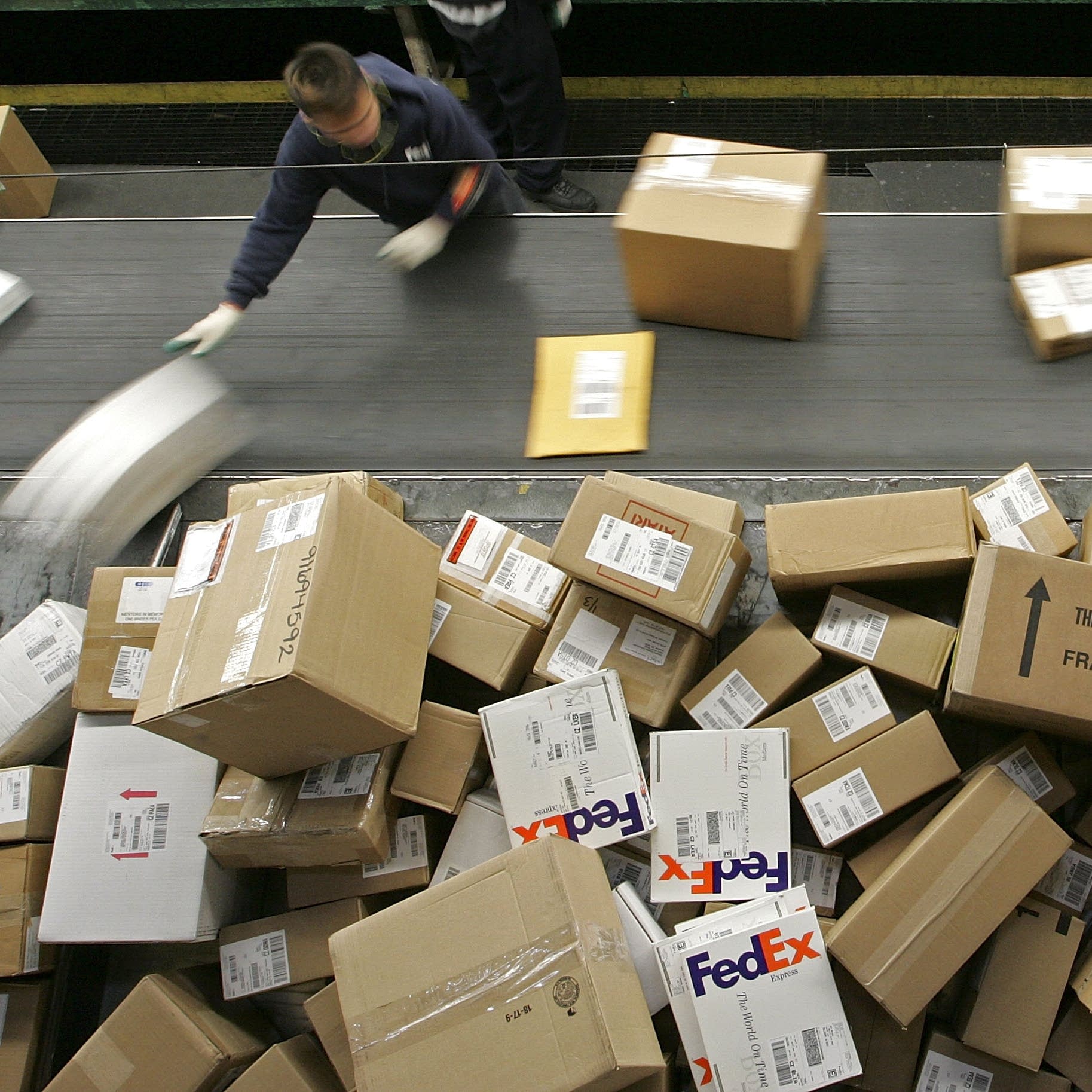
The US is closing a loophole that's kept a lot of online shopping cheap. Good morning, this is the Marketplace Morning Report and we're live from the BBC World Service. I'm Lyanna Byrne. Yes, if you're an American shopper, buying cheaper goods from abroad could be about to cost more. The US has wrapped up a long running global tax exemption on imports worth $800 or less. It's an end to what is known the exemption already ended for packages from China and Hong Kong. Now it's been stopped globally. The BBC's Sir Jana Tuari explains why.
- [01:35]
Sir Jana Tuari
The White House says that between 2015 and 2024 the volume of de minimis shipments entering the US increase to more than 1.36 billion and that the system has been abused and used to smuggle the deadly opioid fentanyl into the U.S. now there is a bit of flexibility for the next six senders having to pay either a fixed amount ranging from 80 to $200 or be subject to the tariff rate in the country of origin, which of course in India's case for example, could be as high as 50%.
- [02:12]
Lyanna Byrne
Now, like Serjana said, there will be a transition period where postal services can pay a flat duty. But Kate Muth, executive director of International Mailers Advisory Group, says that's not going to help.
- [02:24]
Kate Muth
The flat duty won't help because the way that's set up is it's $80 per package if you are one of the lower tariff countries. So for example the UK good that's maybe $20 coming to the US if you use that flat rate per package it would be $80 as the tariff. So six months that flat rate goes away completely and I don't expect anybody to use it anyways.
- [02:46]
Lyanna Byrne
Some overseas postal services have already stopped sending low value parcels to the us. In the uk one of the businesses feeling the squeeze is Yandy Skin, a BE exporter run by Julian Bataille. He says he's no idea how to charge customers.
- [03:01]
Julian Bataille
You know the most frustrating thing is the short answer is no, we don't, we don't know how, how much of that we want to obviously charge to the customer and is it going to affect their kind of buying attitudes and habits as well. So also was wanting to fundraise and it just makes it a very difficult time because we don't quite know how to spin the story to investors and there's a lot of uncertainty as well.
- [03:23]
Lyanna Byrne
Exporter Julian Bataille there. Now let's do the numbers. The Indian rupee slipped 310 of a percent against the dollar as part of a wider slide in Asian currencies as US tariffs and Indian goods continue to spook investors. And in Germany retail sales fell by 1 1/2% in July, far worse than expected. Raising fresh concerns about consumer spending in Europe's biggest economy. Meanwhile, the Japanese Defense Ministry wants to triple spending on drone manufacturing as part of a record $60 billion bud. It's over rising concerns on Chinese movements in the area. Japan has committed to doubling military spending to 2% of GDP. It was once a common sight news hawkers selling their newspapers on the street. But they've all but disappeared in the age of the Internet. But in Paris one still stands. Ali Akbar still pounding the streets just as he has been for the past 50 years. And now France's president is honoring him with the order of merit recognizing distinguished service. The BBC's Hugh Schofield has the story.
- [04:29]
Hugh Schofield
Here he is France's possibly Europe's last newspaper hawker. Ali Akbar, a sprightly Pakistani born man of 72. It was in 1973 that he began in the trade on Paris Left bank. And against all the odds he's still at it.
- [04:46]
Ali Akbar
When I started to sell the paper newspapers here in Paris we were between 35, 40 hawkers, hawkers. But now today I'm alone because no, no Banvai's papers, you know now because of digital what makes you keep going? Because I, I'm Independent. I'm free, I'm alone. So, no, no, no one is commanding me, you know, so I'm. I feel free. That's. You see, before, people were looking for me. They were looking after me to buy papers. And now today, I'm looking to sell. I try to sell papers. It's different. It's changed.
- [05:28]
Hugh Schofield
Now Ali sells 20 or 30 copies of Le Monde a day, and he keeps half the sales price. So money is not the motive. He does it because it's fun and people love him.
- [05:44]
Lyanna Byrne
Ali has been famous for us for more than 25 years and more. Selling his papers and making jokes. He knows everyone around the whole area.
- [05:55]
Hugh Schofield
It's just a shame he only sells 20 papers every day.
- [05:59]
Lyanna Byrne
His stories are amazing.
- [06:01]
Ali Akbar
All of them know. They know me, you know, because they were. I've been selling papers in Institute of Political Science. Po we call in French Sciences poor. So I met. So because they used to buy papers every day, Le Monde. So they became friends and give me some names. Some names. Mako, Adolph. I didn't want to. Mako also bought me papers. Yes. During that period of time.
- [06:27]
Hugh Schofield
Do you think he remembers that? That's why he's giving you the Order of Merit now?
- [06:30]
Ali Akbar
No, no, not at all. Not at all. Because he knows me. He knows my backstory. He decided to do something for me, I think. Breaking news.
- [06:39]
Hugh Schofield
Tell me, ali, how has St. Germain, the neighborhood changed in the 53 years that you've been selling newspapers here?
- [06:46]
Ali Akbar
Atmosphere in St. Germain is completely changed because before, the St. Germain was just like a village. Now became touristic. They were sold, but there is no more sold in St. Germain. Sold. Exactly.
- [07:03]
Hugh Schofield
You gotta laugh, right?
- [07:04]
Ali Akbar
Say you, say ye. Say you.
- [07:08]
Lyanna Byrne
That was the BBC's Hugh Schofield reporting in Paris and for the last time as your presenter of Marketplace Morning Report. From the BBC World Service, I'm Liana Byrne. It's been a real pleasure. Thanks for listening.
- [07:28]
Emily Hanford
The Trump administration is making deep cuts to education research.
- [07:32]
Lyanna Byrne
The cancellation notices started coming.
- [07:34]
Odoo Sponsor Announcer
When the contract is cut, the study just dies.
- [07:36]
Emily Hanford
It's all happening. Just as schools are trying to make use of research to improve reading instruction.
- [07:41]
Lyanna Byrne
There would not have been a science of reading without the federal funding.
- [07:47]
Kate Muth
It wouldn't have happened.
- [07:48]
Emily Hanford
I'm Emily Hanford. On our new episode of Sold A Story, what the Trump cuts mean for the science of reading. Go to your podcast app and follow Sold A Story.