Loading summary
Transcript27 lines
- [00:00]
Richard Karn
Hi, I'm Richard Karn and you may have seen me on TV talking about the world's number one expandable garden hose. Well, the brand new Pocket hose Copperhead with Pocket Pivot is here and it's a total game changer. Old fashioned hoses get kinks and creases at the spigot, but the Copperhead's pocket pivot swivels 360 degrees for full water flow and freedom to water with ease all around your home. When you're all done, this rust proof anti burst hose shrinks back down to pocket size for effortless handling and tidy storage. Plus your super light and ultra durable pocket hose Copperhead is backed with a 10 year warranty. What could be better than that? I'll tell you what an exciting exclusive offer just for you. For a limited time. You can get a free pocket pivot and their 10 pattern sprayer with the purchase of any size Copperhead hose. Just text water to 64,000. That's water to 64,000 for your two free gifts with purchase W A T E R to 64,000. By texting 64,000 you agree to receive recurring automated marketing messages from Pocket Hose. Message and data rates may apply. No purchase required. Terms apply.
- [00:59]
LHH Representative
Available@pockethost.com Terms this podcast is brought to you by LHH, the global talent solutions and advisory company. What does work really mean? For many, it's just transactional, functional. But LHH believes it can be more. Work isn't just about tasks and deadlines. It's about passion, people and possibilities. With the right guidance and vision, incredible things can happen at work. Finding the perfect hire, nurturing talent, making the ordinary extraordinary. LHH doesn't just find beautiful moments at work. LHH creates them. Recruitment, development, career transition. LHH a beautiful working world. Learn more@lhh.com beautiful Japan's exports just stalled.
- [01:47]
Liana Byrne
Hello, this is the Marketplace Morning Report and we're live from the BBC World Service. I'm Liana Byrne. So, Japan's overall exports dropped in May, the first decline in eight months, as Asia' feels the squeeze from President Trump's tariffs. Tokyo is pushing hard for a trade deal and automakers are taking the brunt of the hit. The BBC's Katie Silver has the story.
- [02:11]
Katie Silver
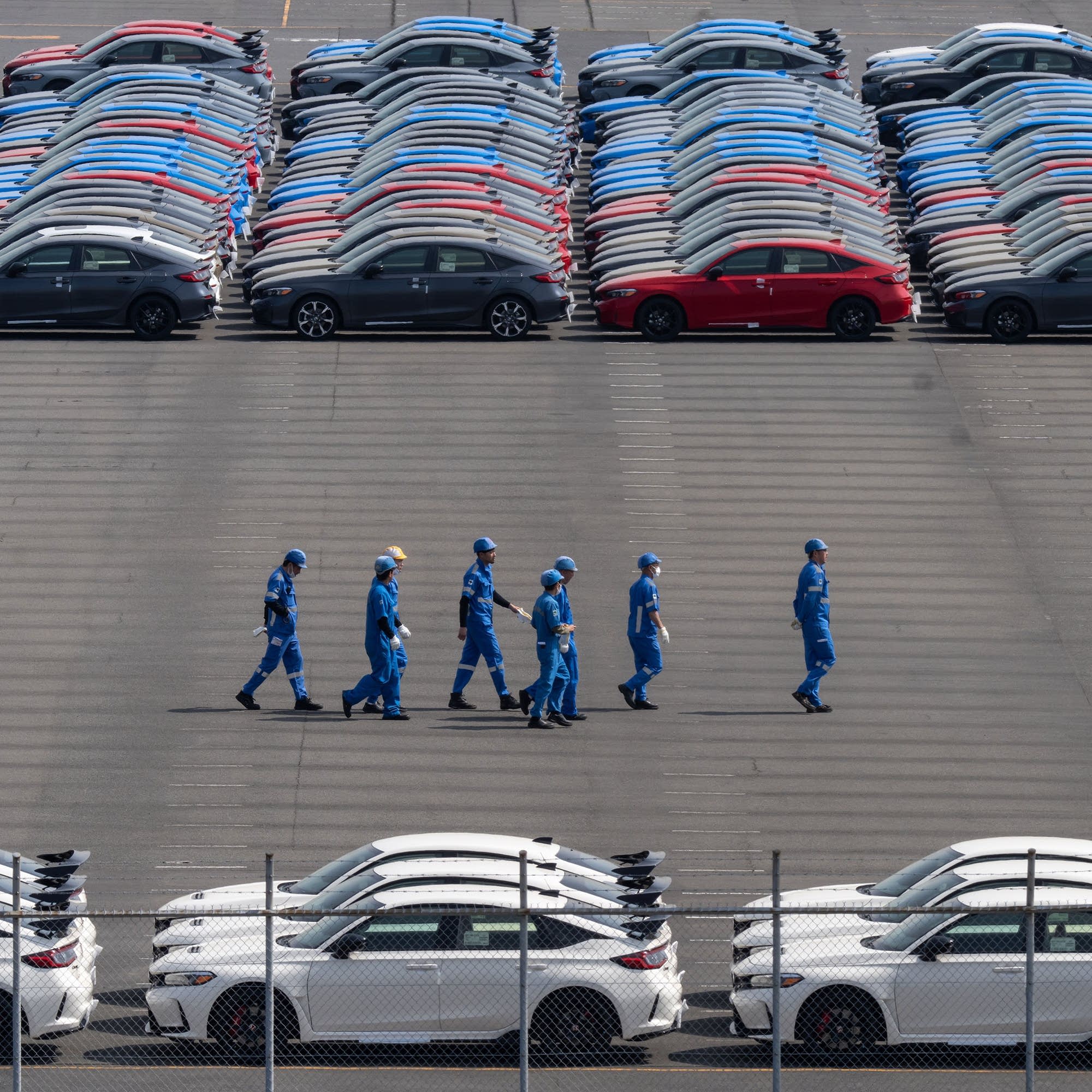
Selling Japanese cars abroad is a fundamental part of the country's economy. Last year, the US spent about $40 billion importing Japanese cars, including Toyota, Honda and Nissan vehicles. It was about a third of what Americans spent overall on Japanese goods. Now, though, these cars are subject to a 25% tariff, which other than Britain has hit the automotive industry across the it's contributed to Japanese exports to the US dropping by more than 11% in the month of May compared to the same period a year earlier. The tariffs are a huge blow to Japan's manufacturing sector and something Prime Minister Shigeru Shiba is desperately trying to tackle. There was hope some progress may have been made when he met President Trump at the G7 summit in Canada. But as Shiba said, some disagreements persisted and despite negotiating until the last minute, he walked away empty handed. Japan also faces a 24% so called reciprocal tariff rate that's due to start July 9th unless a last minute deal can be reached.
- [03:09]
Liana Byrne
Katie Silver there. Now let's do the numbers. Oil prices dipped slightly today after a 4% jump on Tuesday driven by fears of supply disruption from the Israel Iran conflict. Brent is trading just above $76 a barrel. Markets are watching both the risk to shipping through the Strait of Hormuz and today's Fed decision. Meanwhile, a Spanish government report says April's massive blackout across Spain and Portugal was caused by too much electrical voltage in the network that spiraled into a chain reaction, exposing weaknesses in the region's power grid. And flights to and from Bali were cancelled or delayed during peak tour season after a volcano erupted, sending ash more than six miles into the air, disrupting travel. Once dubbed Russia's Davos, the St. Petersburg International Economic Forum opens today, but geopolitics will likely steal the spotlight. Moscow's using the event to showcase economic resilience and claim it's not isolated over the war in Ukraine. The BBC's C. Rosenberg is there.
- [04:14]
Steve Rosenberg
The organizers of this year's forum maintain that representatives of 140 countries and territories will be taking part. And the Russian authorities will almost certainly try to use this event to demonstrate that attempts to isolate Russia on the world stage have failed. Now one thing I'm going to be looking for this week is to see whether there are more American companies here than in recent years. This is an economic forum, but geopolitics is never far away here. So we'll be looking for comments this week from President Putin on Ukraine, on events in the Middle east, on international security and on relations with Washington.
- [04:56]
Liana Byrne
Steve Rosenberg with that report. Let's return to President Trump's tariffs because negotiations are still ongoing over what tariff rate will be applied to European Union exports to the US Yesterday we looked at the impact on Spain's food industry. Today we're heading to the vineyards of France. The BBC's John Laurenson reports from Burgundy.
- [05:19]
Cecile Tremblay
We'Re going down in the cellar now to discover some wines of the.
- [05:25]
Francois Labbe
Ah, it's a great smell here. Monks planted vines in Burgundy a thousand years ago. Bourgogne, as it's called in French, produces some of the most prestigious and expensive wine in the world. Among the oak barrels and bottles with labels weathered by mould and age. Winemaker Cecile Tremblay rattles off names.
- [05:45]
Cecile Tremblay
I do some Nuit, St Georges, Vendre, Manet et Chausso, Grand Cru, Clove Jo, Grand Cru, Chapelle, Chamartin.
- [05:52]
Francois Labbe
Producers like her export a lot to the States, so the Trump tariffs could be damaging.
- [05:57]
Cecile Tremblay
For United States, for example, it's around 10% of the production, so it's a big production for me.
- [06:05]
Francois Labbe
Can I ask you if you're worried?
- [06:07]
Cecile Tremblay
Yes, sure. As everybody.
- [06:10]
Francois Labbe
And that was all Madame Tremblay would say about the Trump tariffs. French winemakers are walking on eggs at the moment, fearful of saying anything that might aggravate the situation. Perhaps the vintners representatives would be more forthcoming. I'll get in my car and drive over to one of her neighbours, Francois Labbe. He's the president of the Burgundy Wine Interprofessional Office, which represents this region's three and a half thousand winemakers.
- [06:37]
On the palate, a red cherry. You know, those big red juicy cherries that you crack when you bite.
- [06:45]
He pours me out some of the 2023 vintage from the vats down in his cellar. For Burgundy, he says, the American market is worth $400 million.
- [06:55]
Let's say that we export 130 million bottles. US take 25% of that. The US is the largest export market for the whole region. Definitely.
- [07:08]
And while French wines and spirits exports dropped 4% last year, overall sales of Burgundy wines to the US rose by 16%. They've never been so high. The Americans appreciate the whites, like Chablis and sparkling Cremen. They also go for the reds, which are lower in alcohol. The most American red wine. Francois says the most recent period of tariffs on wine saw a 50% drop in exports to the United States.
- [07:37]
We have in memory the tough situation we were in from October 2019 until April 2021, with a 25% tax due to an aeronautic conflict between France and the US. It really did affect our sales to the US.
- [07:59]
So what could be the impact of the 10% duties in place now?
- [08:03]
Some shippers and importers are going to Coupe La poirondeux, you know, 10% tax. So I take 5% on my margin, on my side and you take 5% on your margin just not to stop the flow of the export of your products.
- [08:21]
What would the impact be if after the end of this three month suspension, President Trump decides to impose this 20% tariff, as he threatened to do, we.
- [08:33]
Will go back to the 2019 situation where the market was almost, you know, stopped.
- [08:40]
For French wine exports in general, it could be even worse because last time champagne and wine stronger than 14 degrees of alcohol were excluded. This time, it's across the board. In Nuit St Georges, France, I'm the BBC's Jon Lorenson for Marketplace.
- [08:56]
Liana Byrne
And that's it from the Marketplace Morning Report from the BBC World Service, I'm Lianna Byrne. Have a great day and thanks so much for listening.
- [09:10]
Marie Magres
Personal finance isn't just about spreadsheets and investing. It's emotional. Talking to your partner about money, negotiating a raise, you even the smallest decisions, like splitting a bill, can bring up feelings of shame or anxiety. I'm Marie Magres, host of this Is Uncomfortable, a podcast from Marketplace about life and how money messes with it. In this season, we get into topics like workplace drama, tough financial trade offs, and the quiet tension that builds when love and finances collide. Listen to this Is Uncomfortable. Wherever you get your podcasts.