Loading summary
Transcript30 lines
- [00:01]
WhatsApp Representative
On WhatsApp, your personal messages stay private between you and whoever you send them to. So things like the passport numbers for your honeymoon stay between you and your fiance. And that video call for your gran's 80th stays in the family. Even your streaming password stays between you and your college roommates, who still ask for it every week in your group chat. Because on WhatsApp, your personal messages are yours. No one else can see or hear them now, not even us. WhatsApp message privately.
- [00:32]
Liana Byrne
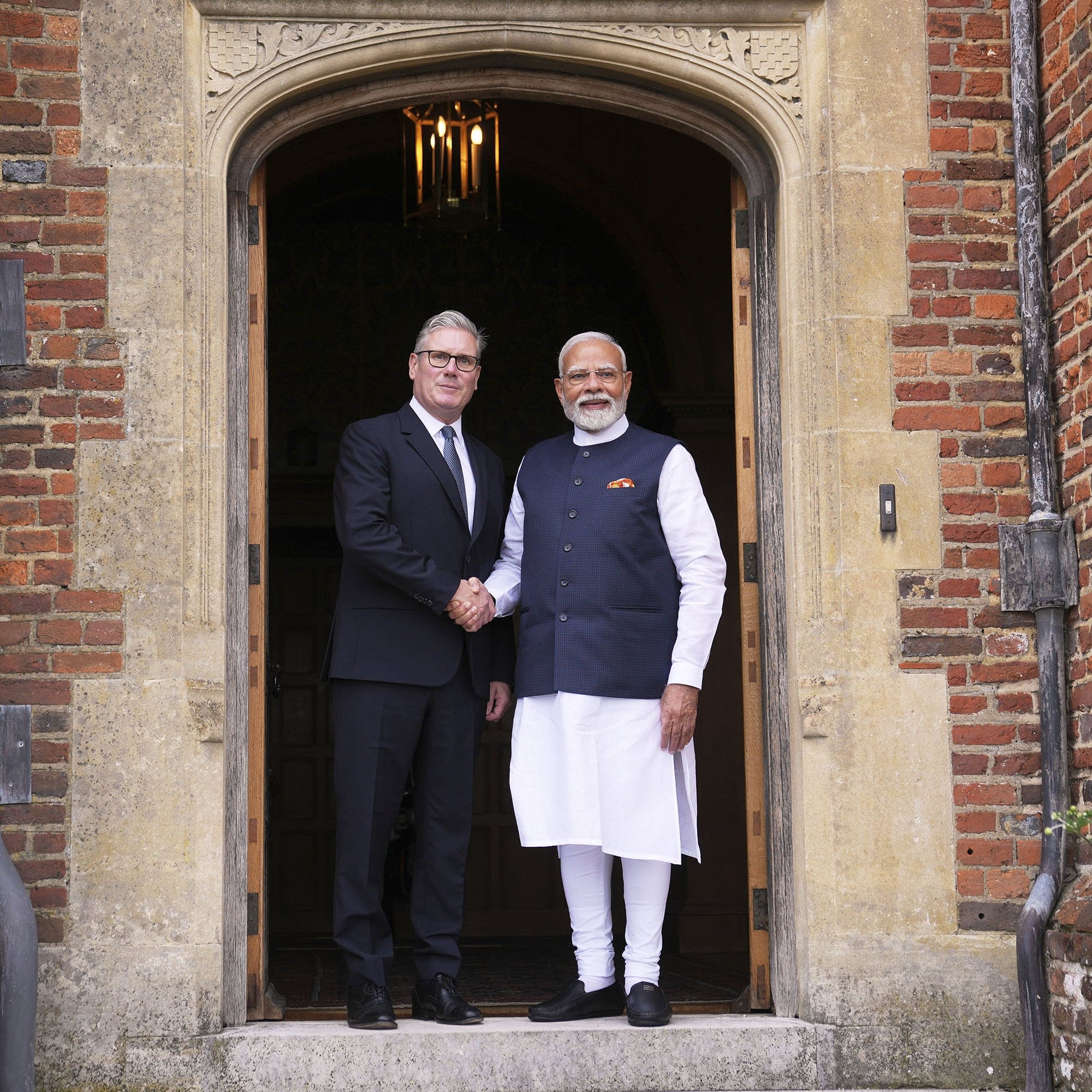
From whiskey to wages, the UK and India are agreeing a major trade deal. Live from the UK this is the Marketplace Morning report from the BBC World Service. I'm Liana Byrne. Good morning. So the Indian Prime Minister, Narendra Modi is in London today to seal a major trade deal with the UK Worth six and a half billion dollars. The agreement, billed as the biggest since Britain left the EU, will slash India's tariffs on UK goods 15% to around 3%. The BBC's Archa Shukla is looking at this one for us. Hello.
- [01:05]
Archana Shukla
Hi, Liana.
- [01:06]
Liana Byrne
Archana. It took them three years to get to this deal, so it must be a good one.
- [01:09]
Archana Shukla
Well, absolutely. It is a significant one for both the countries, especially for India that remains in negotiations with the United States, the eu. So getting a comprehensive trade deal with one of its largest trade partners is definitely significant. As part of the deal that was earlier announced, which will be formalized, about 90% of UK goods will get tariff reduced used when they exported to India. And especially, you know, categories like whiskey and gin, which will see the tariffs drop down from 150% to 75%. And the automobile sector is another sector from the United Kingdom that will gain quite a lot where the tariffs will fall from 100% to under 10%. There are other sectors like medical devices, cosmetics, all of this will become cheaper in India coming from the United Kingdom. And for the Indian sectors, especially the labor intensive sectors like the textiles, gems and jewelry, furniture, auto components, all of these will see cheaper tariffs when they export into the United Kingdom.
- [02:08]
Liana Byrne
Is everyone happy with this deal?
- [02:10]
Archana Shukla
There are certain question marks still remaining. One particularly is about worker visas. We know that in the recent years this has been a contentious issue between countries when they're talking on trade. And we've seen protectionism from countries like the UK and the US this draft deal at least did not mention anything about if both the countries would be opening up more channels for more worker visas and more student visas. The other thing which is still in contention is on the carbon tax. We know that the United Kingdom levies carbon tax on imports of products that are manufactured in carbon heavy production centers, especially products like steel and metals. That is something that India and the UK had been negotiating and there still hasn't been a headway on that.
- [02:57]
Liana Byrne
The baby seats. Archana Shukla, thank you so much for joining us in Marketplace.
- [03:01]
Archana Shukla
Thanks, Liana.
- [03:02]
Liana Byrne
Meanwhile, Australia is reopening its doors to American beef, lifting a ban that's been in place since 2003 after Mad Cow disease. The move comes after months of tension with Washington, where President Trump had threatened tariffs of up to 200% on Australian pharmaceuticals. The BBC's Phil Mercer reports from Sydney.
- [03:20]
Phil Mercer
The ban on beef was one of the Trump administration's main grievances with Australia. The restrictions were mentioned by the White House when it imposed tariffs on Australia in April. The government in Canberra says a rigorous scientific review, not political pressure, is behind its decision to allow U.S. beef imports to resume after more than 20 years. Officials insist they're satisfied the United States is effectively managing biological threats. However, opposition politicians believe Australia is caving into pressure from the US President Bill Mercer there.
- [03:56]
Liana Byrne
And all those trade deals are moving numbers. Investors are betting governments will strike deals with Washington ahead of its tariff deadline. Reports suggest the EU could strike a deal similar to Australia with the US And China's state news agency says it will step up cooperation with the bloc on methane emissions, carbon markets and green low carbon technologies. Tokyo closed up 1.3%, 6% in Europe's Stoxx 600 is up 5.10of a percent. Armenia it's a landlocked country of just 2.7 million people. And it's making big waves in tech. From coding labs and schools to startups linking up with Silicon Valley, it's tapping into its Soviet scientific roots to power a new digital future. The BBC's Rehan Dimitri reports from Yerevan.
- [04:45]
Rehan Dimitri
In schools across Armenia, afternoons are filled with the sounds of young minds discovering technology. In one such classroom in the capital, Yerevan, 16 year old Milena shows her latest creation, a smart parking app called autohive.
- [05:01]
Sarkis Karapitian
With this app, you can see how many free places there are in a parking lot and you can reserve your space from anywhere you want.
- [05:13]
Rehan Dimitri
The variety of projects the children are presenting is remarkable. This is one of Armaf engineering laboratories, where children aged 10 to 18 learn coding, robotics and 3D modeling in public schools. For many kids, the lessons help shape their ambitions.
- [05:30]
Sarkis Karapitian
I want to become a programmer, design my own products, and then we want to create our own company with my friends and make products.
- [05:38]
Rehan Dimitri
Sarkis Karapitian leads the Union of Advanced Technology Enterprises, which spearheads this initiative and.
- [05:46]
Sarkis Karapitian
The goal is to have 5,000 most.
- [05:49]
Liana Byrne
Talented kids decide to become an engineer every year.
- [05:53]
Rehan Dimitri
Armenia's focus on tech education is no accident. It has a long history of being one of the leading centers for computer science in Soviet times. Smartgate VC is a venture capital firm which helps startups that begin in Armenia to expand their operations to the United States via a special program. Samvel Khachikyan is the head of operations.
- [06:16]
Sarkis Karapitian
Idea of the program is to take a batch of founders from Armenia and go to Silicon Valley to top venture capital firms. They are getting connected to people.
- [06:28]
Rehan Dimitri
For startups in a small country like Armenia, thinking about bigger markets from day one is essential. Irina Hazarian, an architect by training, founded Dr. Yan, an app which connects patients with doctors.
- [06:42]
Sarkis Karapitian
So we started doctyan, I think three years ago. Now we're growing at least 25% revenue month by month, months. And that actually gives us the strength to start expanding into other markets.
- [06:53]
Rehan Dimitri
In a country which continues to face geopolitical challenges with its neighbors, developing its tech ecosystem isn't just about economic opportunity. It's about reimagining their nation's future. In armenia, I'm the BBC's Reyhan Dimitri for Marketplace.
- [07:09]
Liana Byrne
That's it from the Marketplace Morning Report. From the BBC World Service, I'm Lianna Byrne. Have a great day and thank you. Thanks so much for listening.
- [07:23]
This Old House Host
This Old House Radio Hour is your new home improvement podcast. In each episode we answer your questions. Whether you're fixing a leak, refinishing a floor, or restoring a century old house, our roster of experts have the answers to help you get the job done right.
- [07:37]
Liana Byrne
I never thought I'd be saying this to a bunch of people I'm just meeting, but I have a stinky house.
- [07:42]
Sarkis Karapitian
Tell us more.
- [07:43]
Rehan Dimitri
I want the details.
- [07:46]
This Old House Host
Find this Old House Radio Hour in your favorite podcast. Apparently.