Loading summary
Transcript39 lines
- [00:01]
A
The world of business is constantly evolving. And Comcast business keeps you in step with secure AI backed networking in more than 100 countries, powering 90% of the Fortune 500 and millions of small businesses. And behind it all, thousands of experts answering your call at 2:00am like it's 2:00pm One partner. That's it. Powering how business gets done for companies around the globe. When you add it all up, no one does business like Comcast business.
- [00:32]
B
A surprising new culprit for youth unemployment. From Marketplace, I'm Nancy Marshall Genser in Washington. A new analysis from the New York Fed points to a possible new reason for the rise in youth unemployment. Not AI, but remote work. The research finds that since the rise of remote work during the pandemic, companies have become less likely to hire recent college graduates into jobs that can be done off site. For more on what this means for this year's grads, we're joined by David Kelly, chief Global Strategist at JPMorgan Funds. Good morning.
- [01:05]
C
Good morning.
- [01:05]
B
So is remote work sidelining younger workers? Does that track with what you're seeing in the labor market?
- [01:12]
C
I think it adds to the problems that younger workers are facing. We've known ever since the pandemic that while more experienced workers can work from home with less supervision, it was really very important to have the youngest workers, the analysts and the research assistants in the office learning the culture, learning from each other. And so I think a lot of companies are just much more reluctant to hire people fresh out of college and have them work from remote locations. And I think that's just adding to the problems that younger workers are having.
- [01:42]
B
And why would that be? They just feel like they can't train people if they're remote.
- [01:47]
C
Well, that's right. I mean, there's a lot of stuff that you learn intuitively from the office, watching other people doing things, a lot of work habits in terms of when you clock in, when you clock out, do you get distracted? And also just the, the ability of companies to sort of know who they're dealing with and what they're dealing with. And the problem is that for younger workers, it's very often their first job. And so the employer naturally is, is just a little bit reluctant. And of course, I think this just adds to the problems that AI is already causing because a lot of those entry level tasks the younger workers would normally be assigned, they can be done pretty well by AI at this stage.
- [02:23]
B
Of course, youth unemployment has fluctuated pretty significantly since the pandemic. Then it recovered before quietly creeping back up as the broader labor market was relatively stable. Are you expecting more of the same this Friday when we get the jobs report for May?
- [02:39]
C
Well, I think any one jobs report is very volatile, so we'll obviously be looking at that carefully. But there are a lot of crosscurrents right now. We've got AI is taking some jobs, adding other jobs, and then we've got the overlay of just a lack of workers because of this huge swing in immigration. So I think it's quite difficult to interpret everything that's going on in the labor market right now, but certainly the strains that younger workers are facing right now is part of the picture.
- [03:05]
B
David Kelly is chief global strategist at JP Morgan Funds. Thank you.
- [03:11]
C
Anytime.
- [03:12]
B
President Trump is reducing tariffs on certain agricultural and manufacturing machinery in an effort to counter rising costs. He's also lowering tariffs on large equipment used by home builders, such as air conditioning systems. Marketplace's Nova Safo joins me now with a details. Good morning, Nova.
- [03:31]
D
Good morning, Nancy.
- [03:33]
B
So the tariffs involved here are on imported products that contain steel, aluminum and copper. Can you walk us through the changes?
- [03:41]
D
Yeah. So starting next Monday, tariffs come down temporarily from 25 to 15% for what are known as derivative products, in this case, specific imports of large machinery predominantly used in agriculture, construction and manufacturing. So tractors combines bulldozers, material handling equipment used in factories also, also H Vac systems. The White House says it's trying to help housing, manufacturing and agriculture. Those are the three industries it singled out.
- [04:09]
B
Okay. Now this is not the first time the president has changed tariffs for products containing steel and aluminum. How have these Import taxes evolved?
- [04:18]
D
Nova that's right. So in fact, the 25% rate on derivative items that's now getting lowered, that was put in place just a couple of months ago. Before that it was 50%. So the White House is trying to relieve price pressures on farmers and manufacturers because. Because, of course, we are in a midterm election year, Nancy yes, we are.
- [04:36]
B
And trade groups for farmers have been very vocal over rising costs. How else has the president tried to show that he's actually listening to them?
- [04:45]
D
Well, he went to China last month. Afterward, there appeared to be some kind of deal for China to purchase $17 billion worth of agricultural goods. No details yet on implementation. There may be some tariff concessions there as well. Also, the FTC is now probing the rise in fertilizer. Fertilizer prices, they're up as much as 50%. Of course, a lot of that due to the Strait of Hormuz, which remains closed.
- [05:06]
B
Nancy yeah, well, thank you very Much Nova.
- [05:09]
D
You're welcome.
- [05:32]
B
When you think of businesses open around the clock, what comes to mind? A casino, a diner, maybe even a pharmacy. Now add a hair salon to the list. One boy Kamau takes us to a 24 hour beauty shop that's reshaping the hair business in suburban Maryland.
- [05:48]
E
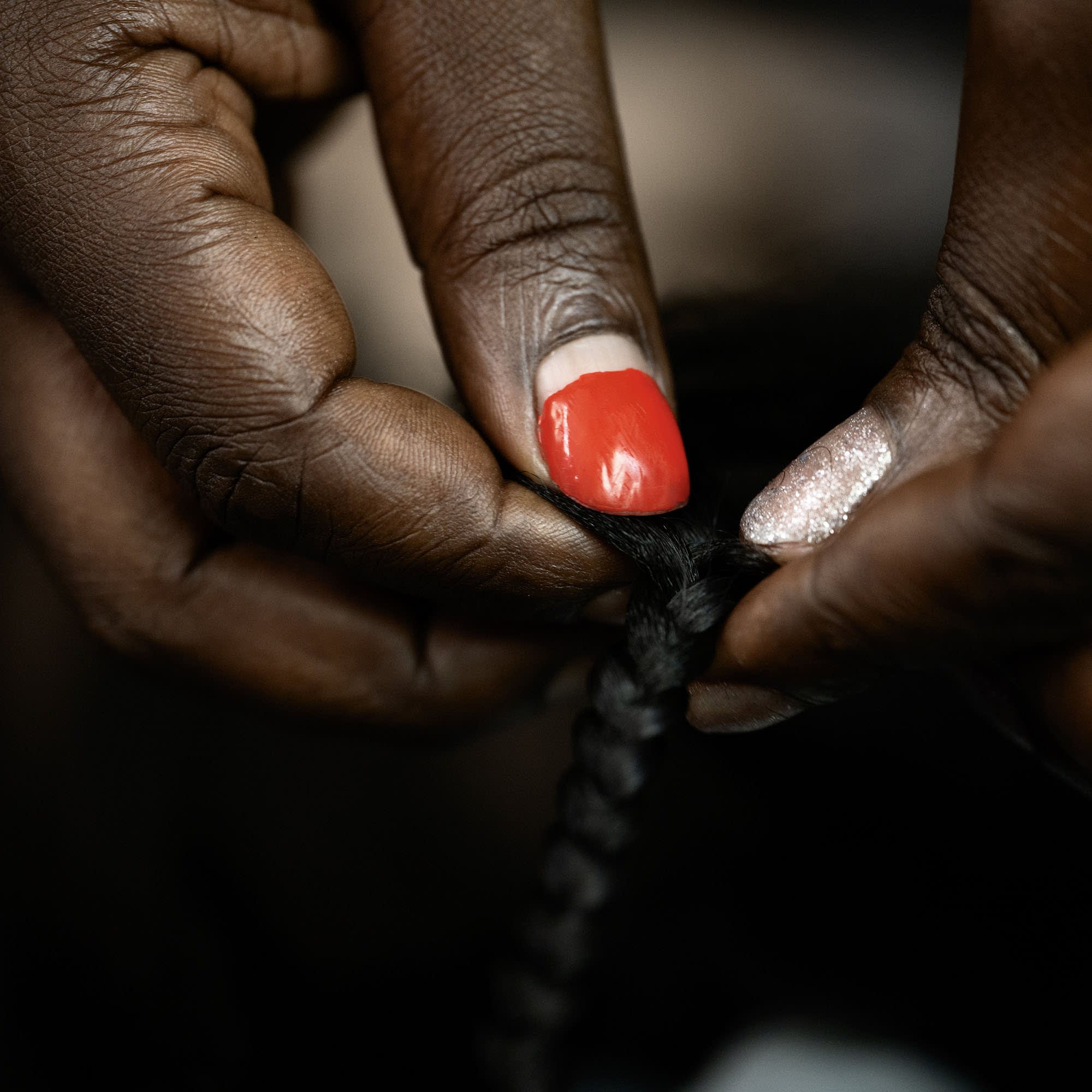
At Nadine's Hair Braiding in Bowie, about an hour south of Baltimore, customers can walk in at 2am or 2pm at and find a stylist among the salon's 120 chairs. Lucilvia Okombi is one of the 400 braiders who work here as independent contractors.
- [06:07]
F
When I'm tired, then I'm free to go home. Nobody is forcing you, so it's very flexible.
- [06:13]
E
That flexibility is the main draw for customers like Folade Smith. If I need to get in that chair immediately, I can get in a chair immediately. For many black women, a salon visit can mean hours of waiting. Here, two braiders work on one head, cutting service time in half.
- [06:32]
F
The client was telling me, please don't close before 8pm Please open at 2am
- [06:38]
E
That's Nadine Zhuico, the founder and CEO. She stumbled into the 24 Hour Model when her stylists started competing to meet customer demand. But there was an urgent financial goal, too. After Zuiko and her husband lost $200,000 in a Ponzi scheme, she was determined to make that money back fast.
- [07:00]
F
I just felt like if I'm sleeping and my business is still making at least $500 profit every day, that will cover the money I lost.
- [07:11]
E
With 245,000 followers on Instagram, social media drives customers in from other states. The salon even attracts clients like Maryland's junior US Senator Angela also Brooks. The average price of a braiding style is $220. On a busy day, Juico says the salon can bring in more than $130,000 in revenue. Customers pay the shop, and the salon splits the sales with the braiders. A typical braiding shop may only see a fraction of that in a whole month. One challenge to running such a massive operation. All that attention brings scrutiny.
- [07:51]
F
We have so much negative comments, not because they're true, but because they don't love the visibility that we have. But it's business.
- [08:00]
E
Another challenge is finding enough skilled labor. Juico wants governments to treat braiding as a formal trade taught in high school classes or skills specialized programs.
- [08:12]
F
Having a school will make people even value this job.
- [08:15]
E
For now, she's focused on franchising, hoping to build a national brand from the ground up. In Maryland. I'm One Boy Kamau for Marketplace.
- [08:26]
B
And if you're looking for the best of Marketplace, you can get our daily newsletter straight to your inbox every day. Sign up@Marketplace.org subscribe In Washington, I'm Nancy Marshall Genzer with the Marketplace Morning Report from APM American Public Media.
- [08:48]
G
I'm Amy Scott. And this week on our podcast How We Survive, I travel to an undisclosed location in the San Francisco Bay area to learn about a controversial solution to the climate crisis. It's called solar geoengineering, and it's basically a way to dim the sun in order to cool the planet. Proponents view this as a necessary inter. Others are not convinced.
- [09:15]
F
If we do this, this is a decision that will affect all life on the planet. I don't think it should be up to a couple guys in California.
- [09:25]
G
And while so far solar geoengineering is happening at a small scale, what happens if a rogue nation or a rogue billionaire makes the decision for us?
- [09:37]
F
I don't see that we have a world government that is capable of making decision on behalf of everybody who lives on the planet.
- [09:47]
G
Listen to this week's episode of How We Survive on your favorite podcast. Applause.